Category Archives: Science & Technologies

Solar-powered bus shelters opened in Tiruchi

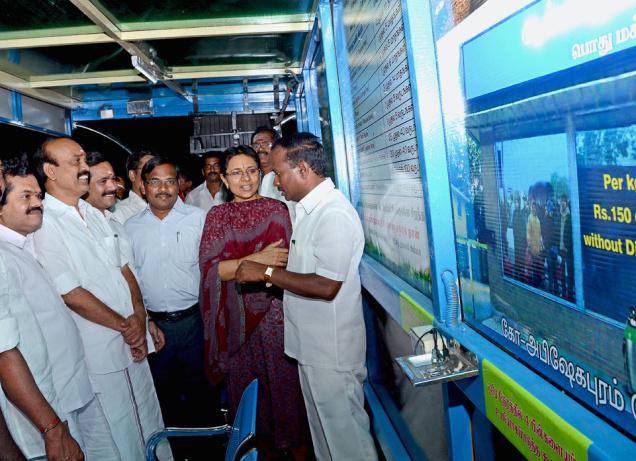
tapping alternate energy: (From left to right) MLAs M. Paranjothi and R. Manoharan, P. Kumar M.P., V.T. Dhandapani, Corporation Commissioner, and Collector Jayashree Muralidharan at the inaguration of solar-powered bus shellter at Karumanadapam on Saturday. / PHOTO:R.M. RAJARATHINAM. / The Hindu

MP sanctioned fund for about 21 modern bus shelters in the city

Two solar-powered bus shelters, established with funding from the Member of Parliament Local Area Development Scheme (MPLADS), were declared open by Collector Jayashree Muralidharan at Karumandapam on Saturday.

The Collector opened the shelters in the presence of P. Kumar, MP, who has sanctioned fund for about 21 modern bus shelters in the city under his MPLADS, M.Paranjothi and R.Manoharan, MLAs, and A. Jaya, Mayor.

The bus shelters are fitted with solar panels which will power the LED lights inside them, mobile phone charger, and FM radio.

RS. 4.50 LAKH EACH

The two shelters have been established at a cost of Rs.4.50 lakh each.

Each shelter has six chairs for commuters and the solar lighting system will have an automatic control mechanism.

source: http://www.TheHindu.com / Home> News> States> TamilNadu / by Special Correspondent / Tiruchi, December 09th, 2012

Red gram cultivation reintroduced in Ramnad

The Agriculture Department has reintroduced the cultivation of red gram, one of the major pulses, in this drought prone district after a gap of more than two decades.

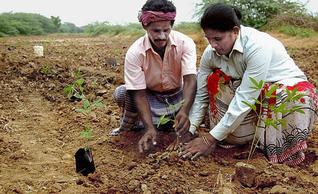
MIXED CROP: Farmers transplanting red gram seedlings at RS Mangalam block in Ramanathapuram./  Photo: L. Balachandar / The Hindu

Red gram was cultivated in the district as a mixed crop with paddy in rain fed areas about 25 years ago and farmers gave up the cultivation after finding it non-remunerative. Since then, the cultivation of the pulse came to a nil, with farmers settling down for paddy cultivation.

As production of Red gram was witnessing a fall in recent years, Collector K. Nanthakumar had suggested the reintroduction of the crop, after which, the department has selected progressive farmers to cultivate the pulse as a pilot project on about 20 hectares, scattered in all the blocks in the district, Joint Director of Agriculture Ka. Sakthimohan told ‘The Hindu.’

“We have taken up Red gram cultivation on an experimental basis on two hectares each in the blocks, using latest technology and practice of raising nurseries and transplanting under the National Agriculture Development Programme (NADP),” he said.

Discarding the direct sowing practice, the farmers have transplanted 35 to 40 days-old seedlings with a planting spacing of 5X3, significantly reducing the seed cost in the new method of cultivation. If 5 kg of seeds were required for direct sowing for a hectare, 2.2 kg of seeds were enough under the seedling transplantation method, he said.

The farmers have been advised to follow integrated nutrient, pest and water management for better yield, he said adding farmers are expected to get a yield of about 1.5 tonnes per hectare. Unlike the paddy crops, which required more water, three to four irrigation during the critical periods of growth-transplanting, flowering and pod-filling stages would be enough for Red gram, he said.

For achieving a good yield, the farmers have been asked to follow “earthing up” for supporting the plants and to avoid weeds. The farmers have also been asked to do nipping after 20 to 30 days after transplanting, which results in sprouting of secondary and tertiary branches, he said.

A farmer in R. S. Mangalam block, who started Red gram cultivation, assisted by the Agriculture Technology Management Agency (ATMA) said he has transplanted 500 seedlings in a hectare and expected a yield of 1 to 3 kg per plant and an overall yield of 1 to 1.5 tonnes per hectare.

Z Kamaldeen, Assistant Director of Agriculture, R.S.Mangalam block, described Red gram as an apt crop for rain-fed areas and best suited for this district. Unlike the ‘water loving’ paddy, Red gram consumed minimum water. The crop would also require only minimum fertilizer and the farmers could earn more revenue with less investment, he said.

More farmers would be encouraged to take up Red gram cultivation in this block as they could rotate the crop throughout the year and ensure sustainable income, he said. Self Help Groups would be involved in raising seedlings, he added. The foliage could be used to feed cattle, he added.

source: http://www.TheHindu.com / Home> National> TamilNadu / by Special Correspondent / Ramanathapuram, December 05th, 2012

2-day workshop on ‘writing scientific papers for publication’ held at SRM university prior to 64 th IPC

More than 100 post-graduate students and research scholars of various  branches of pharmacy from different parts of the country attended the two- day pre-conference workshop on ‘writing scientific papers for publication’ conducted at the SRM university on December 5 and 6, prior to the 64 th Indian Pharmaceutical Congress (IPC) in Chennai.

Hosted by the Indian Pharmaceutical Congress Association, this scientific workshop addressed the research scholars’ questions about scientific writing and trained them how to disseminate information about scientific work carried out by them for effective scientific publication.

“We teach good scientific communications about how to write a scientific paper fit for publication. The workshop will help the students to steer away from possible plagiarism while engaging in scientific writing. Training is provided for practising correct and standard referencing methods, following methods of literary survey and statistical tools that can be employed in their medical and pharmaceutical research,” said Dr Jerald Suresh, chairman of the pre-conference workshop.

He said unless the student knows what has been happening in the field of research, he will not have a clear vision about how to approach a problem in an innovative manner. So the focus of the workshop was to equip the students for research work and scientific writing. The ethical issues concerning plagiarism or copying of someone else’ work have been discussed in detail in the sessions. He said this is the third time a pre-conference workshop was held along with the IPC.

Speakers from US FDA, Auckland and from research institutes in myriad places in the country delivered lectures on how to prepare scientific papers on different branches of pharmacy such as pharmaceutics, pharmaceutical chemistry, pharmacology, pharmaceutical analysis, pharmacognosy and pharmacy practice.

Like the three ‘R’s for basic education, the pre-conference workshop was also supposed to explain the three ‘R’s for a scientific writing, which are the keys to getting started in research. They are Reading & Writing, Reckoning & Figuring and Wroughting (converting) and wrighting (manufacturing). The scientific workshop has close reference to the three ‘R’s of publishing of research papers, Dr Jerald Suresh told Pharmabiz.

The students represented 25 pharmacy colleges from various parts of the country and twenty delegates represented various industrial units. There was a panel discussion at the end of the second day.

G Selvaraju, director of drugs control department in Tamil Nadu, inaugurated the workshop on December 5.

source: http://www.Pharmabiz.com / Home> TopNews> Events / by Pharmabiz.com Bureau, Chennai / Friday, December 07th, 2012

‘My work speaks for itself’

Nirvikalpa Natarajan of Chennai has notched up so many formidable accomplishments that her peers in medicine find it hard to believe that she is only 30 years old.

Those accomplishments include performing hundreds of surgeries, and treating even more hundreds of patients in India, Ireland and Britain. Dr Nirvikalpa is a practitioner of oral and maxillofacial surgery, one of a only handful of women in her field.

That distinction, of course, attracts praise from her colleagues at Chennai’s Apollo Hospital. It sometimes also invites envy. The envy invariably comes from less accomplished people, and it takes the form of whispers that perhaps Dr Nirvikalpa is too young for her position, or that she’s a relentless seeker of success.

Such behind-the-back criticism doesn’t faze her. Dr Nirvikalpa has a simple credo: “My work speaks for itself.” It does indeed. In recognition of her work, she received a hugely prestigious award, the Dr M. S. N. Ginwalla Trophy for the Best Scientific Paper at the 37th National Conference of the Association of Oral and Maxillofacial Surgeons of India, last Saturday evening.

More than a thousand surgeons from across India and from abroad had gathered for the conference at the Hyderabad International Convention Centre, a facility where the auditoriums are so cavernous that a speaker on the stage can seem dwarfed.

But not Dr Nirvikalpa. Attired in a striking green sari, the tall surgeon with flowing black hair glided to the podium and gave a 10-minute oration that had the audience riveted. One could be forgiven for mistaking her for a fashion model.

She was so lucid that even an attendee unfamiliar with the field’s lingo could follow her. The way she projected her voice, and the manner in which she highlighted the salient points of her address on a screen presentation, spoke of her self-confidence. That self-confidence has been hard won. A graduate of Government Dental College in Mumbai, Dr Nirvikalpa went on to do post-graduate work at Saveetha University in Chennai. She has received two memberships at the Royal College of Glasgow, and a coveted fellowship from Royal College in Ireland. She has been selected for a fellowship in cranio-maxillofacial surgery in Hannover in 2013.

Oral and maxillofacial surgery is a unique specialty that deals with conditions, defects and esthetic aspects of the mouth, jaws and face. It is especially relevant in India, which has the world’s largest number of traffic accidents; such accidents often result in severe traumas to the head and face.

What sets oral and maxillofacial surgeons apart from other specialists is their in-depth understanding of the skeletal and dental framework of the face. Much as the foundations of a building are made from iron, the foundations of the face are its bones and teeth.

Knowing the subtleties of this allows them to deal effectively in areas of cosmetic jaw surgery, facial trauma, craniofacial surgery, oral pathology, temperomandibular joint surgery, oral implantology and oral cancer.

“Oral and maxillofacial surgery is ‘The Next Big Thing,’” Dr Nirvikalpa says. Why? Because it’s a super specialty in medicine, and because the technologies are advancing so rapidly that opportunities to serve bigger cohorts of people are increasing exponentially. Moreover, there’s a shortage of surgeons with requisite experience and skills in the field.

It is a multi-disciplinary field, one that requires surgeons like Dr Nirvikalpa to be deeply familiar with neuroscience, ophthalmology, dentistry and audiology, among other fields of medicine. It is a field that pays surgeons far more in the West than in India, and Dr Nirvikalpa could have just as easily joined the 400,000 physicians of Indian origin who practice medicine in the United States, Britain, Europe and Australia. But she chose to work in her homeland because of the rich diversity of patients, because of patients’ needs, and because, ultimately, “one has to give back to one’s own country.”

There’s also the fact that India, an economic giant, sorely needs more doctors. (Some 45,000 doctors graduate from the country’s medical school each year, and about 3,000 of these go abroad annually.) Even though India is a major supplier of physicians and nurses to industrialised countries, there are just about 600,000 registered allopathic physicians in India, according to the Union Ministry of Health. That translates into one doctor per every 2,000 of the population.

There’s one thing more that keeps Dr Nirvikalpa in India. That’s the benevolence of the man who founded Apollo Hospitals nearly 30 years ago, a cardiologist named Dr Prathap Chandra Reddy. Both Dr Reddy, and Apollo’s director of medical services, Dr N Satyabhama, serve as her
mentors.

Another mentor is Dr Vinod Narayanan, who is highly experienced in oral and maxillofacial surgery, and who is a consultant at Apollo Hospital. Dr Nirvikalpa also looks to Preetha Reddy, managing director of Apollo Hospitals, which has 55 institutions around India, and is one of the world’s largest healthcare systems.

So is she a relentless seeker of success? It’s not a question that Dr Nirvikalpa Natarajan will answer. After all, her work speaks for itself. And the fact that she’s still single at 30 also speaks for itself. One is tempted to add that she’s a very eligible 30-year-old surgeon. Anyone aspiring to change that situation should be prepared to put up with Dr Nirvikalpa’s 18-hour work days, seven days a week, and the fact that she shows no signs of slackening.

Pranay Gupte is an author and veteran journalist

source: http://www.KhaleejTimes.com / Home> International / by Pranay Gupte / December 04th, 2012
Research from Anna University Broadens Understanding of Fuel Research

Data detailed on Fuel Research have been presented. According to news originating from Tamil Nadu, India, by NewsRx correspondents, research stated, “In this study, the production of methyl ester from Oedogonium sp. oil was studied using an isolated thermo-, solvent-, and sono-tolerant Bacillus sp. lipase immobilized on celite. The application of ultrasound during the reaction reduced the reaction time significantly.”

Our news journalists obtained a quote from the research from Anna University, “The effect of sonication time, enzyme dosage, water content, methanol/oil molar ratio, and solvent addition on the performance of transesterification was studied. The reaction time required in the presence and absence of ultrasound was 2 and 40 h, respectively. Under optimum conditions, 75 and 82% fatty acid methyl ester (FAME) yields were obtained for normal and ultrasound-assisted transesterification, respectively.”

According to the news editors, the research concluded: “The reusability of the immobilized enzyme after five cycles did not show much loss in enzyme activity, and this indicates that the isolated enzyme was not affected as a result of the application of ultrasound.”

For more information on this research see: Production of Methyl Ester from Oedogonium sp Oil Using Immobilized Isolated Novel Bacillus sp Lipase. Energy & Fuels, 2012;26(10):6387-6392. Energy & Fuels can be contacted at: Amer Chemical Soc, 1155 16TH St, NW, Washington, DC 20036, USA. (American Chemical Society – www.acs.org; Energy & Fuels – www.pubs.acs.org/journal/enfuem)

The news correspondents report that additional information may be obtained from R. Sivaramakrishnan, Anna University, Dept. of Chem Engn, Madras 600025, Tamil Nadu, India (see also Fuel Research).

source: http://www.equities.com / Global Financial network / Home> Materials / By a News Reporter-Staff News Editor at Life Science Weekly / by Fuel Research NewsRx.com

Seminar recalls S Ramanujan

On Monday the Society for Promotion of Science & Technology in India organized a seminar on India’s Contribution to Mathematics and Legacy of Srinivasa Ramanujan at DAV College in Chandigarh’s Sector 10.

Professor M. S. Sriram of the University of Madras and Professor A. K. Agarwal of Panjab University spoke. Explaining the significance of mathematician Srinivasa Ramanujan who died in 1920 at the age of 32, they said that during his lifetime, he was as a creative genius who generated a plethora of formulae. His discoveries appeared simple and yet there was more to them than initially met the eye and because of these theorems, new directions of research were opened up, Over the past 60 years, as nearly all of Ramanujan’s theorems have been proven right and appreciation of his work and brilliance have grown.

His work now pervades many areas of modern mathematics and physics. As a tribute to Ramanujan, the Government of India declared December 22 – Ramanujan’s birthday to be ‘National Mathematics Day and  2012 has been designed National Mathematical Year.

Speakers expressed their concern that Indian is not producing enough mathematicians. They said there is a general perception in our society that the pursuit of mathematics does not lead to attractive career possibilities.

source: http://www.DayandNightNews.com  Home> The Capitol / Tuesday, November 27th, 2012

Modified Cape gauge locos flagged off for export to Mozambique

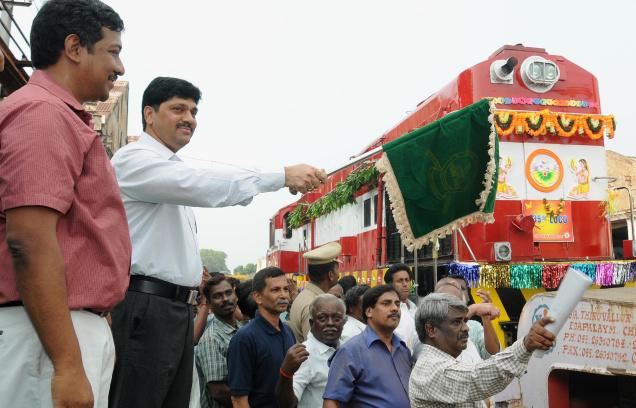
EMERGING POWER: Commissioner of Police Shailesh Kumar Yadav flagging off the locos at Golden Rock Railway Workshop in the city on Thursday. P.Mahesh, Chief Workshop Manager, Golden Rock Railway Workshop, is in the picture. /  Photo: M. Moorthy / The Hindu

Workshop has been exporting MG locos to several countries

Two in-service broad gauge locomotives converted into Cape gauge ones for Mozambique by the Golden Rock Railway Workshop were flagged off for export from here on Thursday.

The conversion, to suit the requirement of the Mozambique Railway network, was carried out by reducing the gauge distance from 1676 to 1067 mm. The horse power of one of the locomotive was upgraded from 2,400 to 3,100 HP and from 1,800 to 2,400 HP in the other.

The workshop had also carried out a series of modifications to increase the horse power by providing higher displacement turbo super charger, upgraded fuel injection equipment, larger capacity air intake cooler and micro processor controlled excitation system.

Several other special features have also been included. A plate type oil cooler to improve cooling efficiency of the engine lubricating system, self cleaning centrifugal lubricating oil filter system to increase life of engine oil, stainless steel interior panel in one of the locomotives and fibre reinforced plastic panel in the other, long-life polyurethane exterior painting and upgraded brake system have been provided. One of the locomotives also has an air-conditioned cabin.

The locomotives were flagged off by Shailesh Kumar Yadav, City Police Commissioner, in the presence of P.Mahesh, Chief Workshop Manager, and R.K.Rana, General Manager, RITES. The Golden Rock workshop has been exporting metre gauge in-service locos to various countries such as Malaysia, Myanmar, Mozambique, Mali, Senegal, Tanzania, Sudan, and Benin. The shop has exported 133 metre gauge locomotives to these countries through Rail India Technical and Economic Service and Indian Railway Construction Company. The exported locos also include 34 in-service metre gauge locomotives converted into Cape gauge for Mozambique and Sudan.

source: http://www.TheHindu.com / Home> News> Cities> Tiruchirapalli / by Special Correspondent / Tiruchi, November 23rd, 2012

630 entrepreneurs evince interest in setting up poultry units

Perambalur district allocated Rs.2.85 crore subsidy for poultry development

So far 630 entrepreneurs have evinced interest in setting up poultry units in Perambalur district in tune with Chief Minister’s thrust to accord fillip to the sector. (On August 3, the government came out with a slew of proposals for poultry development, including setting up of two poultry clusters in Villupuram and Sankarankoil zones covering seven districts, most of them non-poultry regions. It also announced financial assistance of Rs.20.31 crore for setting up farms with a capacity of 1,000-5,000 birds. The plan is to set up 230 poultry farms in each of these districts. Besides, Rs.2.4 crore had been granted for setting up poultry units in 16 districts).

Perambalur district is one among the seven districts and it has been allocated Rs.2.85 crore subsidy for poultry development.

Inaugurating the preliminary works for setting up a poultry unit at Keezhapuliyur on Saturday, Collector Darez Ahamed said that for a 5,000-bird unit the bank loan would be Rs.8.25 lakhs. Once the unit starts functioning, the entrepreneur would get Rs.2,06,250 (the State government’s subsidy of 25 per cent of the project cost).

Besides, once 75 per cent of the loan is settled by the entrepreneur, the remaining 25 per cent would be remitted to the bank by National Bank for Agriculture and Rural Development through its poultry capital fund.

Selected beneficiaries would be given training by Tamil Nadu Veterinary and Animal Sciences University training centres on setting up poultry units, distributing fodder, and identifying and preventing diseases.

Mr.Ahamed pointed out that 630 applications had been received for setting up poultry units in the district and steps had been initiated to establish units for 87 applicants who had space and bank loan. Apart from Keezhapuliyur, construction for eight more poultry units began on Saturday at Ezhumur, K.Pudur, and Murukkangundi villages, the Collector added.

source: http://www.TheHindu.com / Home> News> Cities> Tiruchirapalli / by G. Sathyamoorthi / Perambalur, November 25th, 2012

GIS in green polyhouses to aid Kodai farmers

Madurai:

A horticulture farm in Gundupatti in Kodaikanal block of Dindigul district has gone high-tech with the installation of the GIS (geographic information system), as part of a pilot project. The GIS provides global access to promote site-specific farming for the first time in Tamil Nadu.

According to S Raja Mohamed, deputy director horticulture (Central schemes) Kodaikanal, the programme has been launched with the objective of locating polygreen houses using GIS. It is being built with the help of subsidy assistances from the National Horticulture Mission  (NHM) for the year 2012-13, in the spatial imagery and to add the attribute data (obtained during the field work) to those polyhouse features.

The GIS-initiative project was taken up by the department of horticulture, Kodaikanal division in co-ordination with the agriculture engineering department, Dindigul division and Remote Sensing and GIS Lab, ECE department, Thiagarajar College of Engineering (TCE). The processes involved includes the raw imagery (the satellite imagery of the location containing the poly houses is obtained), geo-referencing (the spatial data is geo-referenced using the particular toolbar), digitisation and photo-annealing (the images of the polyhouses are also attached with the point features by defining a field of type ‘raster’).

Mohamed said that development and implementation of precision farming or site-specific farming has been made possible by combining the GPS and GIS. These technologies enable the coupling of real-time data collection with accurate position information, leading to the efficient manipulation and analysis of large amounts of geospatial data.

GPS-based applications in precision farming are being used for farm planning, field mapping, soil sampling, tractor guidance, crop scouting, variable rate applications and yield mapping in the developed countries. The carnations grown in polyhouses in Kodaikanal are of international quality coming next only to their famous Columbian counterparts. If accessible over the GPS, cut flower cultivators in the region can become global entrepreneurs without the interference of middlemen as their buyers can get details about them from anywhere in the world.

Precision farming is now changing the way farmers and agribusinesses view the land from which they reap their profits. Position information system provides position data with acceptable degree of accuracy, available on demand at any time and at any location and is able to interface with other equipment. Farmers using the GPS system have the advantage of utilizing their land to the maximum.

According to Mohamed and G Kandasamy, deputy director of horticulture (state schemes), four poly green houses of 8,754 sq metres, belonging to four beneficiaries of Gundupatti in Kodaikanal block, were built with the subsidy being provided under NHM during the year 2012-2013.

With the help of the agriculture engineering department, Dindigul, ground control points (GCP) with GPS measurement for the poly houses were taken and were processed with the help of R A Alaguraja, associate professor, ECE department, TCE for representing these poly houses using GIS.

Mohamed said that the GIS would provide a big advantage to farmers especially those into the floral industry, which is the cut flower industry.

source: http://www.timesofindia.indiatimes.com / Home> City> Madurai / by Padmini Sivarajah, TNN / November 22nd, 2012

Simulations to help medicos sail through emergencies

Programme to train doctors in labour rooms across State; aimed at giving mothers better care.

What does it take to handle emergencies in the labour room of a maternity hospital? Mostly experience, one would think. But it also requires being able to handle stress, and obstetricians have discovered that working with patients can be very stressful. And the best way to beat stress is to be prepared.

Picture: The Hindu

For the past five years, obstetricians the world over have changed the way they train. Doctors now learn in simulated environments, giving themselves challenging situations to deal with. This training programme has now arrived in the city, coinciding with national newborn week – November 15 to 22.

M. Padmapriya, a postgraduate student of obstetrics and gynaecology at the Government Kilpauk Medical College (KMC), who participated in the programme on Friday, ahead of the session for medical professors, says it is the best way to learn to handle an emergency.

“There are flow-charts, which no matter how many times you read, you tend to forget. The simulation programme has helped me remember the sequence I should follow in a real-life situation,” she said.

In an emergency, doctors end up issuing the same instruction to all the people in the room. “We send out all the nurses in search of blood and there is no one at hand in the operating room,” Dr. Padmapriya recalled.

The training, which created a variety of challenging situations and varied protocols, gave them the opportunity to practise, she said. “For instance, sometimes the baby’s head and shoulder make their way out but then the baby gets stuck. Experience in handling such situations through simulation will enable us to handle the emergency without causing severe morbidity in the newborn,” she said.

Narmada Kuppuswamy, one of the resource persons who conducted the programme said, “Such training programmes have been in vogue for the past decade but in the last five years, many medical colleges in the United States, Britain and Australia have adopted such training programmes.” The two-day programme, which began on Saturday, uses simple techniques like foam stitched to resemble a uterus and patient-actors, Dr. Narmada said.

Such programmes can ensure better care for the woman who comes for childbirth, said A. Kala, head of obstetrics at KMC. She cited studies that found that even in urban settings one in three women gets sub-optimal care and around 25 per cent of patients said they were unhappy with the quality of care provided to them. Better-trained obstetricians can handle emergencies and prevent maternal and newborn deaths, she said.

Confidential reports have also found that absence of team work, lack of skills and inexperience in handling emergencies, poor leadership and communication skills are causes for maternal mortality, Dr. Kala said.

Six persons from abroad and 10 from India are training teachers from 31 colleges in the State, with assistance from Health Education and Learning Projects Charitable Trust and American Tamil Medical Association.

Doctors say clean deliveries, skilled care during deliveries and timely access to emergency obstetric care can prevent newborn deaths. Incidentally, This week (November 15 to 22) is being observed as ‘national newborn week’. An awareness camp on care for newborns was recently held in the Chennai Corporation hospital in Saidapet.

source: http://www.TheHindu.com  / Home> Cities> Chennai  R. Sujatha / November 18th, 2012