Category Archives: Uncategorized
19
18
17
Documentary gives insight on blind chess players of India
Chennai :
Sixty-four squares. That’s all it takes to create a level playing field between the blind and the sighted, said Charudatta Jadhav, founder of the All India Chess Federation for the Blind (AICFB), on Saturday, at the premiere of the film, Algorithm, at PVR Skywalk in Chennai.
The film, directed by Ian Mcdonald, is a 100-minute black and white documentary that follows the lives of three young chess players between 2009 and 2011.
The film attempts to show that for the game of chess, you don’t need sight, just foresight; you don’t need eyes as long as you have vision. This was also underlined through a blind blitz game between five-time world champion and grandmaster Vishwanathan Anand and Jadhav. Anand and Jadhav tussled in a 10-minute game (of course Anand won), with the world champ facing away from the board and visualizing his moves. “For a moment there, I thought I had forgotten one of my moves, but luckily I hadn’t,” said Anand.
Krishna, who is featured in the film, took to chess at age nine because he wanted to play a game he could excel at. “I couldn’t and didn’t want to play outside with my friends because I couldn’t see the balls or bats they played with properly,” said Krishna, now a student at Loyola College. “Then my mother taught me to play chess and when I realized I could compete with people who could see, I decided to work hard to excel at it,” said Krishna, who has beaten many sighted champs over the years.
“Chess is about calculating and predicting moves,” said Jadhav, ” it is immaterial if you can see.” Unlike Krishna, who has been visually impaired since birth, Jadhav, now 47, went blind at 13. “It happened in a matter of days. I was a topper, sitting in school one day, when I began to see grey dots everywhere. My vision got fuzzy, and before I knew it I had lost my eyesight because of a retinal detachment,” he said.
“It was a depressing five years between 1980 and 1985, but chess changed my life… chess showed me that even the blind can be as independent as the sighted,” said Jadhav, who pursued software engineering because vision did not really matter in that field. Jadhav, now, head, innovation strategy, at TCS in Mumbai, decided to start the AICFB in 1998. “The blind do not want sympathy or pity. We want to be treated as equals,” said Jadhav,.
And that’s what McDonald has done in the way he portrays the champs – cheeky Darpan Inani from Baroda, the highest ranked totally blind player in India; gentle and eccentric Anant Kumar Nayak from Bhubaneswar; and the determined Krishna, who is fighting to conquer championships as well as his impairment. The documentary, though made in 2012, will release in theatres on August 21.
source: http://www.timesofindia.indiatimes.com / The Times of India / Home> City> Chennai / by Kamini Mathai, TNN / August 10th, 2015
Bulls in her backyard
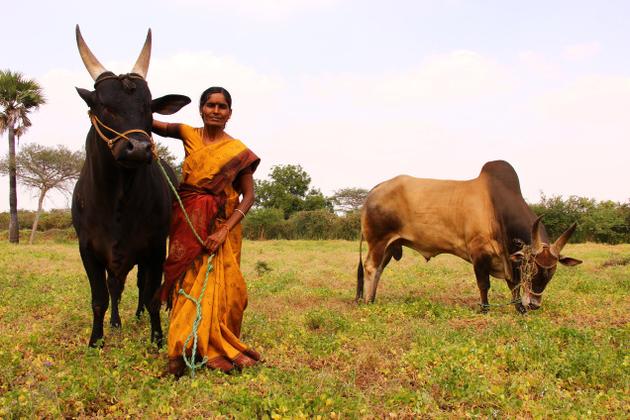
Meet Soundaram Ramasamy, the only woman bull keeper in Kangeyam, Tamil Nadu.
A small slightly built woman, wearing a mustard silk sari and roses in her hair, walks briskly up to an enormous black bull; nearly six-feet tall with a heavy-set neck, great hump and sharp horns, grazing under the shade of the acacia tree, and grabs the nose rope. Calling him ‘kannukutti’ (calf), she rubs his face and back gently, and leads him towards us with one hand.
This is Soundaram Ramasamy, a stud bull keeper, who is something of a legend in her village Kathasamipalayam and the Kangeyam region, Tiruppur district. ‘Kaalaikaramma’ (the bull-keeping woman) as she is known, is perhaps the only woman bull keeper. Besides, very few — man or woman — keep seven stud bulls. And certainly none have such fine Kangeyam specimens.
An indigenous cattle breed, the Kangeyams are native to Tamil Nadu’s Kongu region. I was there to document them with help from Karthikeya Sivasenapathy, of the Senapathy Kangayam Cattle Research Foundation. “Kangeyams,” he explained, “are ancient and handsome animals: both male and female have well-defined humps and curved horns. Both sexes can be put to plough; they can survive droughts, thrive on dry grasses and are very hardy.” But, the preference for high milk-yielders (Jersey and hybrids), prevalence of tractors in place of bullocks and, contentiously, the ban on jallikattu and reklashas savagely reduced their numbers. Karthikeya estimated a 90 per cent drop in 25 years. Today, there are less than 125,000 Kangeyams.
And that’s why 17 years ago, Soundaram and her husband Ramasamy began to breed Kangeyam cattle. They started with cows and, when one birthed an exceptionally good-looking bull calf, they decided to keep it. With Karuppan, that first bull, their stud farm was born. Slowly, the number of bulls grew. Now they have seven. Each bull was selected for its handsome features. Typically, the family rents a tempo, scours the countryside and cattle fairs, and pays between Rs.25,000-40,000 for a calf. The grown-up bulls fetch good prices. Soundaram was offered Rs.300,000 for Singaravelan, their biggest bull, in a cattle show. But she did not sell him.
Singaravelan is beautiful, but a bit of a brute. Ramasamy flatly refuses to approach him. “If I catch him, he’ll fuss. But Soundaram will easily get him.” And she does. She walks up to him, while he is flicking up mud with his horns, snorting, and pacifies him with words and pats. “I love the bulls like my sons,” she says, as Singaravelan stands next to her, massive but meek.
The couple’s careful grooming removes the menace from the animals. “When they get four teeth, (a way of telling the age of cattle) un-castrated bulls turn aggressive,” Ramasamy explains. “We train them to be docile. If not, nobody can handle them!” It is Soundaram who handles the bulls. Her day begins and ends with their upkeep. First, she takes the seven bulls out to graze on the Korangaadu (fields given over as pasture land, hosting 25 varieties of vegetation, a speciality of this region); later she fetches them their food and drink (water mixed with cattle feed, ground corn, cotton seeds, and broken urad dal) so that they are always in prime condition. Soundaram’s daily routine is so laborious and rigid that she can never travel anywhere. Her mother looks after the cooking and the kitchen. “I have no time!” she says. Her only other interest is roses. She points to the tall bushes outside her newly renovated house. “I love the flowers!”
When cows come to be serviced, Soundaram attends to that also personally. Almost everyday, she says, people come from a 150 km radius to mate their cows with her studs. The exercise can cost the cow’s owner up to Rs.4,000, including transport, food and stud-charges. (In contrast, artificial insemination costs only Rs.200-300). Each servicing nets Soundaram Rs.500. The cow’s owner gets to pick a bull of their choice. (Kangeyam bulls are usually white with black markings. But Soundaram keeps rare black-and-red specimens, as breeders and wealthy farmers prefer them).
While we are around, no cow turns up; a promise is made for the next day. Over tea, Soundaram shows me photos of the cattle mating. There’s a shot of her, her sari tucked into her waist, her hair pulled into a bun, her arms stretched to secure a rope around a visiting cow; in another, she’s right next to the bull, holding the rein, as it mounts a cow, a slip of a woman, besides the big, muscled bull. “My bulls need me beside them all the time.”
Her conservation efforts were recognised with the Breed Saviour Award in 2010. She was happy to receive it, and delighted when her relatives rang to congratulate her. “They were impressed that I went to Madras to get an award for raising bulls!”
Soundaram also has plans to expand the business, although the couple say they don’t keep the bulls for the money. “We do this because we’re passionate about keeping the Kangeyam breed alive.” Their income comes from the fields (Ramasamy grows drumsticks) and their two sons’ earnings. Soundaram’s second son, Veerasamy is now doing business in Chennai but is keen to start keeping cows to breed their own stud bulls.
In Soundaram’s farthest fields, we look at two more bulls. I beg her to name her favourite. She says she likes them all. I ask her to name the strongest. “All our bulls are strong. And they come running to me when I whistle.” She puts two fingers into her mouth and whistles; a piercing shattering noise. It startles me and the birds, but the bulls only look up enquiringly. She whistles again. They lower their heads and go back to grazing. She walks up to them, separate the horns locked in mock-fight, and strokes a bull. “He probably notices I’m wearing new clothes, and must be wondering where I went,” she says, pointing to her sari.
We don’t debate the point. Gently she rubs down the bull. I stand there, under a mid-day sun, watching a small woman and a big bull, content in each other’s company.
This article is part of the series ‘Vanishing Livelihoods of Rural Tamil Nadu’ and is supported under NFI National Media Award 2015.
source: http://www.thehindu.com / The Hindu / Home> Features> Magazine / by Aparna Karthikeyan / March 07th, 2015
Thousands visit wildlife photo expo
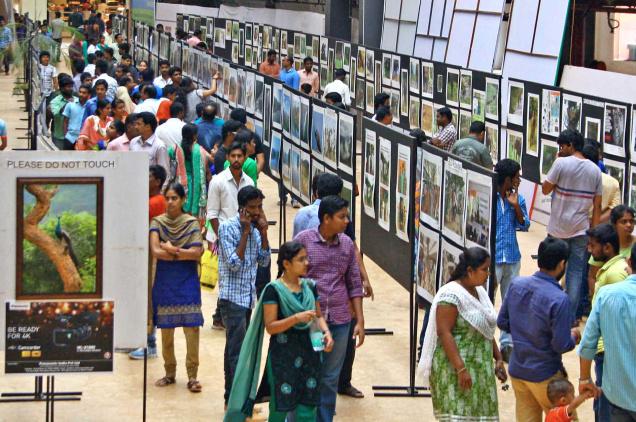
Importance of wildlife photography stressed
Thousands of visitors flocked Brookefields Mall in the weekend to see the wildlife photographs displayed by 165 photographers across the country in the ‘Click Your Pic 2014’ wildlife photography contest and expo. It was organised by the Environment Conservation Group.
The photographers displayed India’s rich biodiversity. Eminent wildlife photographer T.N.A. Perumal, who distributed prizes to the winners of the competition, on Sunday, spoke on the importance of wildlife photography and change in technology that had made wildlife photography much easier.
I. Anwardeen, Conservator of Forests, Sathyamangalam, asked the public to work towards conserving wildlife and India’s rich natural heritage.
R. Mohammed Saleem, president of ECG, elaborated on the importance of the pictures displayed in the expo and efforts taken by photographers in taking them.
Winners were given prizes in three different categories. In the mammals category, Sudharshan Murthy came first, followed by Bharathi and Dhanuparan. In the birds category, Ganesan Ram won the first prize. Anvitha Jaganath and Sivakumar came second and third. In the insects category, Sibi Ussan bagged the first and the second prizes. R. Prakash Kumar of Nallampalayam bagged the third prize.
Prizes for the drawing competition held on Friday were also given away to school students on Sunday.
The exhibition is open to visitors at Brookefields till November 19. Schools can bring their students in batches to visit the exhibition and learn our rich natural heritage.
source: http://www.thehindu.com / The Hindu / Home> News> Cities> Coimbatore / by Staff Reporter / Coimbatore – November 18th, 2014
Wildlife institute nears completion
Reproductive biology, animal care sciences, conservation ecology and a wildlife forensic lab will form part of the institute
An advanced institute for wildlife conservation, research, training and education is nearing completion in Vandalur, near the zoo.
Forest department sources said an announcement in this regard was made last year. The government had sanctioned Rs. 27.13 crore for establishing the institute.
Taking up research to aid the survival and recovery of species and their habitats, exclusive breeding programmes by creating captive breeding centres, training youth on conservation, finding solutions for man-animal conflict, advanced training for zoo management and captive breeding are some of the main objectives of the institute.
Reproductive biology, animal care sciences, conservation ecology with a field station in Kanyakumari, conservation education, centre for conservation and evolutionary genetics, migratory birds, species survival and a wildlife forensic lab will form part of the institute.
The first consultative meeting to develop a road map for the institute was held on October 13, on the zoo premises.
More than 20 forest service officers participated.
In the future, the institute will offer courses on wildlife conservation.
A sum of Rs. 7.13 crore will be spent on the building, and Rs. 20 crore on developing infrastructure, different centres and laboratories with state-of-the-art equipment.
source: http://www.thehindu.com / The Hindu / Home> News> Cities> Chennai / by P. Oppili / Chennai – November 12th, 2014
Death centenary of a Dravidian leader
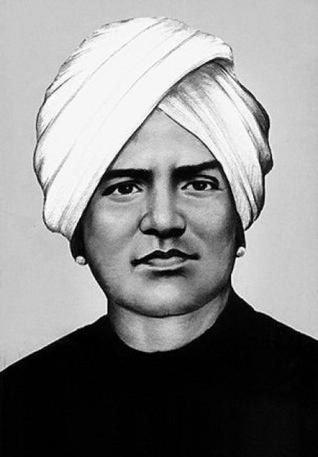
He had his roots in The Nilgiris: Nilgiri Documentation Centre
The Kotagiri based Nilgiri Documentation Centre (NDC) has pointed out that 2014 marks the death centenary of a pioneering Dravidian leader who had his roots in the Nilgiris.
Stating that not many are aware of this, NDC Director Dharmalingam Venugopal has in a statement issued here on Wednesday pointed out that Pandit Iyothee Thass (1845-1914), who was born in Coimbatore, was brought up in the English household of George Harrington in Ooty. His father worked for the Harringtons. Thass was originally named Kathavarayan.
Tamil scholarThass became a well known Siddha practitioner and Tamil scholar with expertise in the traditional knowledge on astrology and palm-leaf manuscript reading. In 1870, Thass founded Adhvaidhananda Sabha in Ooty. In 1891, he established an organisation called the Dravida Mahajana Sabha, and organised the first conference at Ooty. In that conference, 10 resolutions were passed including the one on enacting a criminal law to punish those who humiliated untouchables, creating separate schools and providing scholarships for matriculation education for untouchable children; providing employment for educated untouchables, and representation for untouchables in District Boards and Municipal Boards.
In 1898, Thass visited Sri Lanka and converted himself to Buddhism under the influence of Colonel Olcott of Theosophical Society and founded ‘The Sakya Buddhist Society’ at Royapettah, Madras. In 1907, Thass launched his journal ‘Oru Paisa Tamilan’ as an organ of this organisation.
After a year the name was changed to ‘Tamilan’. It was edited, published and owned by Thass. The average circulation of the weekly was 500. The ‘Tamilan’ is considered the most renowned journal in Dalit print history because of its rich content and ideology.
In 1881, when the colonial Government planned to carry out the second census, Thass gave a memorandum to the Government requesting that the people of depressed classes in Tamil speaking land should be considered as Adi-Tamilar and not as Hindus.
Thass died in 1914. The institute for Siddha Research in Chennai is named after him.
source: http://www.thehindu.com / The Hindu / Home> News> Cities> Coimbatore / by Special Correspondent / Udhagamandalam – November 13th, 2014
Students attempt Limca record
Four students will travel 5,907 km in 78 hours and 4 minutes, in a four-wheeler, driving non-stop
Four students from ITM Business School, Siruseri, are attempting to enter the Limca Book of Records by travelling 5,907 km in 78 hours and four minutes, in a four-wheeler.
The team will travel across the four metropolitan cities in the country.
V. Sathvik, Mohana Murali Krishna, Krishnaswamy and Adarsh Bhooshan, who make up ‘Team SAAMI’, set out on Wednesday morning from the ITM campus.
The record is dedicated to ‘all the men who respect women’, a release said.
“Women play an important role in our lives and we would like to honour them by doing something we absolutely love — driving,” said Mohan.
The journey began in Koyambedu and will end there in four days.
The car will be driven continuously and the engine will be switched off only when the team is filling fuel.
If the team is successful, they will reach Chennai by Saturday morning, the release said.’
source: http://www.thehindu.com / The Hindu / Home> News> Cities> Chennai / by Staff Reporter / Chennai – October 16th, 2014