Two Singapore office buildings seem to be magnets for Indian-owned businesses
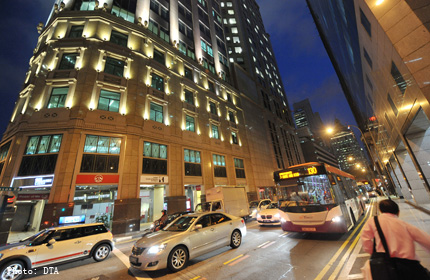
CECIL Street, nestled in the very heart of Singapore’s central business district, is a buzzing hive of activity. Where once it was lined by rickety, one-storey shophouses, today it has become part of the nation’s financial hub.
Beginning at Maxwell Road and running parallel to Robinson Road, this street is home to office buildings like Capital Tower, Aviva Building, Cecil House, Keck Seng Tower, The Octagon, GB Building and the 46-year old Tong Eng Building.
It is here, in Tong Eng Building, that several Indian-owned businesses thrive. Nearly 35 per cent of the roughly 190 offices in this building are occupied by them, many having settled in decades ago while others are more recent arrivals.
Not too far away, at 1 North Bridge Road, is a similar story: High Street Centre, a stone’s throw from the Clarke Quay MRT station, is also home to a multitude of Indian businesses. Nearly 60 per cent of the approximately 200 offices in this building are occupied by Indian businesses dealing with trades ranging from engineering consulting to electronics retail.
But why, despite growth, branching out and even moving offices, have these businesses continued to operate from these two locations? Tong Eng Building
For some, Tong Eng Building is filled with positive vibes which has been good for business. Says Batavia Eximp and Contracting’s managing director Atish Mody: “Tong Eng is definitely a popular building for Indian businesses. It is considered to have the best vaastu – along with the Afro-Asia Building – within the traditional CBD area. Of course, this does not mean other buildings have lesser vaastu (an ancient Vedic science of layout planning of buildings that is said to influence peace and prosperity of the inhabitants), but these two buildings have a well-known track record of housing Indian firms.”
Event management firm De Ideaz’s chief executive officer Purnima Kamath, who has been a tenant in the building for the past 11/2 years, agrees: “There is a certain good feng shui in this building; a lot of positive vibes… and a feel good factor.”
Vintel Exports’ managing director Puneet Jain claims his family-owned business dealing in agricultural commodities has been in Tong Eng Building for nine years. He has moved offices in that time, but remained within the building.
He tells tabla!: “This building seems to be lucky – touch wood – for Indian companies. And business has been good so far. When business is good in a place, we Indian businessmen don’t like to take unnecessary risks by moving.”
Not only does he have many friends in the building, some of his family members also have their offices there.
“My cousin, who moved to Singapore after me, was also drawn to this building. I also have many relatives in different parts of this building. My auditor is here too – so this building is a one-stop shop for me, whether it’s meeting people for coffee or work. Even if I were to shift to a bigger office, I would like to stay in this building. In fact, my unit number is 11, so I would look for the same unit number, even if it’s on a different floor,” he adds.
Singaporean businessman Balasupramaniam, who runs Net Access Singapore, has been a tenant since April this year and chose the building because of its location and rent. “Not only is it within the heart of the CBD,” he says, “but it has a carpark and the rent is reasonable, which is the main thing.”
He was already familiar with the building prior to setting up his office thanks to some of his friends already having their offices here. For MrBalasupramaniam’s IT business, having so many varied businesses under one roof is a huge bonus. “We do send out our brochures to other businesses in the building. We even have a few clients here,” he adds.
The location of the building was the draw for P.L. Global Impex’s managing director Naresh Dinodiya to move into Tong Eng in 1992. “It’s very convenient because several banks are located in the vicinity, a lot of people from the same trade are around the area (mainly in the building), transportation is easily available and there are enough food venues,” he tells tabla!.
Attributing convenience and comfort factor as the reasons several Indian businesses stay put in this building, he adds: “The building is very central, it’s easily accessible and it has a lot of people from the common trade which makes communicating much easier.”
While convenience is undoubtedly the key word, most of these businessmen agree that the atmosphere within the building is what they enjoy. Since almost 35 per cent of the building is occupied by Indian businesses, there is almost a community-like air in the building.
As Mr Mody puts it: “It is nice to see familiar faces – and many of them good friends too – in the lift. We have many common things to discuss and one just has to call and walk across to another office to get your work done. Even coffee and tea breaks are true stress-relievers when it’s shared with friends – we just go next door to Starbucks or to Mama Chai down the road.”
Mr Dinodiya seconds this opinion: “The atmosphere in the building is warm and welcoming, especially in the entrance lobby where people greet their fellow businessmen and have a little chat about the market or something. It’s quite often referred to as a ‘meeting point’.” High Street Centre
Located not too far away from Tong Eng Building in North Bridge Road is High Street Centre. Completed in 1969, it is home to several Indian businesses – almost 60 per cent of the offices are occupied by them. And like Tong Eng Building, most businesses have been there for many years.
Dynamix International’s director Vinod Dadlani has been a “High Street boy” for a long time and is well versed in the history of the building. Although his own business is just three years old, he has worked for other establishments in the same trade, within High Street Centre and High Street Plaza, since 1994.
He tells tabla! that High Street Centre has always been a trade hub: “It used to be popular with Russian traders who came here to buy electronics – similar to how Mustafa Centre is for many today. There were spice and textile merchants, electronics retailers and many others. Then the textile merchants moved out to Arab Street.”
Mr R. Narayanamohan, whose accounting firm Natarajan and Swaminathan has been operating from the building since 1977, says that he can remember some businesses that were very well known.
“The famous ones I can recall are Khimchand and Sons (textile business) and SA Majeed and Co (supplier of uniforms to most of the schools in Singapore). All these businesses were originally in shophouses and, when those were demolished to make way for High Street Centre, they moved into the new building as well as High Street Plaza. After we moved into this building in 1977, we mainly catered to the Indian business community in the building and started assisting the newly established Indian businesses there,” he says.
Today, the turnover of businesses moving out of the building is low and it continues to be a hub for traders.
Says Mr Dadlani: “Many individuals own blocks of offices – for example, 24 offices will be owned by a single individual, who will rent them out. It is hard to find a vacant office.”
According to MrNarayanamohan, most of the Indian businesses in the building have purchased their office space. “It is very convenient to have our offices here. The building has been totally renovated and the facade was changed to a glass-panelled frontage, making the building very modern,” he says.
Today, High Street Centre is well known for its electronics retail shops, owned mostly by Indians. Ganga Jamuna Electronics’ general manager
M. Sreenivasan, who has been a tenant here since 1992 when the firm relocated from Sembawang, says: “There are a lot of electronics shops based here, mostly Indian, although there are a few Chinese-owned electronics shops too. And although we have a branch in Serangoon as well, we haven’t moved out of this building because High Street Centre has a good name for electronics, so business is still good.”
Despite being in different geographical locations, both Tong Eng Building and High Street Centre have many things in common: Easy access, good business dealings and a friendly atmosphere. Even the electronics retailers at High Street Centre, despite being competitors, enjoy a good relationship.
“There are lots of electronics retailers here yet the atmosphere is friendly and people are co-operative,” says Mr Sreenivasan.
The influx of Indians into these buildings has even had its integration effect as Chinese neighbours happily co-exist with their Indian counterparts. In fact, over the years, they have become good friends. Mr Dinodiya, whose company is one of the few Indian businesses on his floor at Tong Eng Building, says: “We have wonderful Chinese neighbours and over time we have become really good friends. It’s a very homely atmosphere in the building here. Everyone knows everyone.”
This is all the more visible during festival time. The Indians celebrate pujas and the Chinese celebrate Chinese New Year, giving the buildings a community-like feel… and hopefully ushering in more business.
source: http://www.news.asiaone.com / Singapore Press Holdings / AsiaOne> News> Singapore / by Malavika Nataraj / table! / December 30th, 2011