A group of mentally challenged individuals are breathing life into Madurai Sungudi
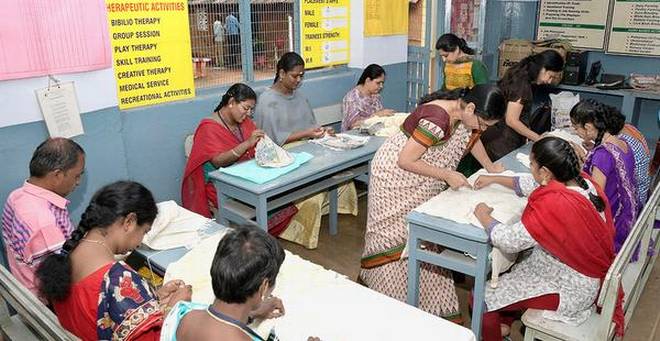
Inside the vocational training centre of M S Chellamuthu Trust & Research Foundation, eight women and a man sit at tables working intently on white pieces of cloth. They tie small knots on the fabric with concentration and are a picture of patience. Mentally-challenged, they are part of an innovative project designed to facilitate their rehabilitation.
“When we started teaching them to tie the sungudi knots in September last year, their hands quivered and they could barely hold the cloth to tie the threads,” says Hema Arun Amarnath, a key resource person from local NGO Tharagai. However, recently, three of them were acknowledged as artisans as they received their first payment and also saw their end product, sungudi dupattas, go for sale.
A year ago, Nancy, Vimala and Soundarya wouldn’t have imagined that they would be able to do this. It was the decision of the Trust’s Executive Director R Rajkumari to create a win-win opportunity, where the patients could heal themselves while reviving a dying art.
“People with mental illness are mostly taught candle, agarbatti or papadmaking as vocational skills. But, to involve them in a highly-skilled work to keep the traditional craft of Madurai alive, makes them warriors of art,” she says.
“Nine people were identified for the project based on their clinical status, interest and functional capacity,” points out K S P Janardhan Babu, Director (Projects). “The achievement is big, not only for them, but also their trainers, mentors and caretakers,” he adds.
“For these artisans, art is now central to their being, feeling and thinking,” says Sridevi Suresh, who was instrumental in associating her friends and like-minded individuals in this journey to save a dying art.
“They surprise us,” says volunteer Sumathi Rajan, “by giving us a product that qualifies for sale through Crafts Council of India (CCI). “Sungudi has lent itself well as a therapy for their minds,” adds Babu.
The vocational training centre at Shenoy Nagar is a place without stigma where Anitha, Rajeshwari, Somasundaram, Gayathri, Ramya and Nandhini come from the different rehab centres of the Trust and share camaraderie for three hours every day. “I complete 11 rows every day and each row has 25 knots,” says Rajeshwari, who came for treatment of schizophrenia four years ago. “I am under medication now,” she says, “Tying the knots calm me.”
Says Somasundaram, “I belong to a family of tailors and tying sungudi knots makes me happy,” he says. Nancy says with pride that she completes 72 knots in 30 minutes and has mastered the technique. That is why after a strict quality check, her piece was cleared for sales.
Once the handcrafted piece is approved for the market, the women are paid 10 paise per knot. Every blouse piece contains 800 to 1,000 knots and a sari has a minimum of 5,000 knots.
In the initial weeks of learning, Tharagai provided them small handkerchiefs to practice on. Later, they moved to one metre blouse pieces. Those who improved their knot tying skill are working on saris now. Their work is not time-bound and there is no pressure on them.
“This is a socially-engaging experience for us. We get a deeper understanding of mental health and they are able to reshape their lives,” says Sridevi.
The Tharagai volunteers visit the centre every fortnight to take stock of the progress made by the group.
In the initial days, they came every day with a trainer from Gandhigram and once the members got the basics right, they practised under the supervision of the centre head Bhavana.
Each piece they work on is tagged with their details such as starting date and the number of knots tied and a record is maintained to assess their progress.
The next time you go to Kamala — The Craft Shop of Crafts Council of India in Egmore, check out the authentic sungudi fabrics and saris. This small group has fought many battles to reach there.
source: http://www.thehindu.com / The Hindu / Home> Life & Style / by Soma Basu / October 22nd, 2018