Seed bank created

SeedbankCF05feb2016

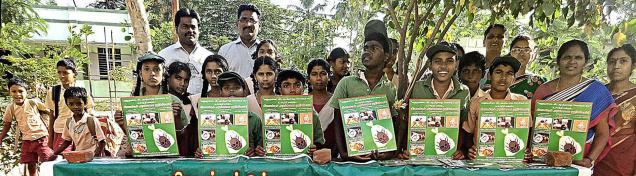
As part of observing World Wetlands Day, students of Panchayat Union Middle School in Kannanderi in Magudanchavadi Union have collected 10,000 neem seeds to create a seed bank in the school.

At a function organised by the Eco-Club of the school, headmaster K. Chandrasekar explained the importance of wetlands and the need to create an awareness among the people about its values and benefits.

Eco-Club coordinator R. Jeyakumar explained the signing of the convention on wetlands on February 2, 1971 in the Iranian city of Ramsar.

The day was celebrated for the first time in 1997.

He said that the theme for the current year is ‘Wetlands for our Future: Sustainable Livelihoods.’ The European Space Agency has published satellite images of wetlands around the world.

As part of the celebrations, students collected neem seeds from various places and formed a seed bank.

They said that the seeds would be sowed in wetlands and more seeds would be added to the bank every year. Teachers too participated in the celebrations.

source: http://www.thehindu.com / The Hindu / Home> National> Tamil Nadu / by Staff Reporter / Salem – February 05th, 2016

ICF Rolls Out First Batch of Military Coaches

Chennai :

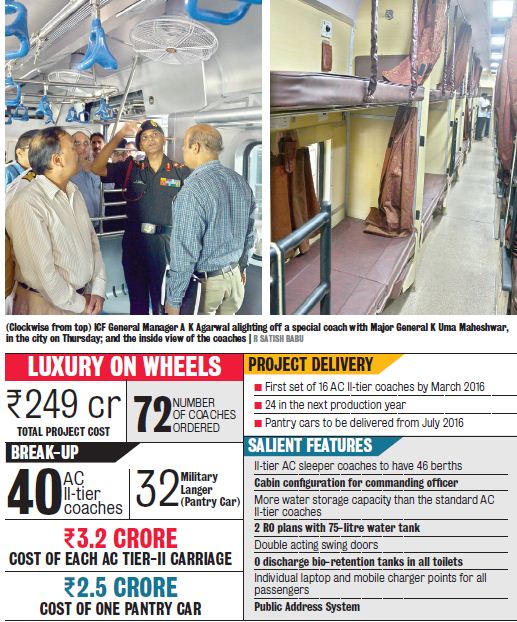
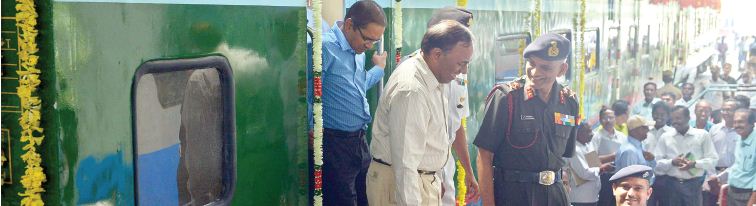
Integral Coach Factory (ICF) on Thursday rolled out the first two of the Military AC II tier coaches for the defence personnel as part of an order tendered by the Ministry of Defence. ICF General Manager Ashok Kumar Agarwal and  Major General Umamaheshwar, VSM, Additional Directorate, General Strategic movement Integrated HQ, Ministry of Defence( Army) flagged off the coaches in an event held at ICF.

ICF had bagged the order in March last year to supply 40 specially designed Tier II air conditioned coaches and 32 Military Langer (pantry) cars.

MilitaryCoachCF05feb2016

Speaking at the launch, ICF GM, Ashok Kumar Agarwal said, “These coaches have more or less the same features of a standard AC two tier coach and are designed to accommodate the comfort level of troops who are always on the move.”

One of the main features of the coaches include enhanced water storage capacity so as to help the troops in long time sustenance without supplies. Besides this, all the lighting is of LED leading to less power being consumed and an additional diesel generators in the pantry units to give power to one additional coach beside it.

MilitaryCoach02CF05feb2016

Apart from these, minor enhancements such as RO plant with dispenser, bio retention plants for the toilets, charging point on each berth, LED based lighting, Public Address system, Mini office cabin, chest for storing documents,additional inter vehicular coupler for connecting power car are adde  to the standard configuration of AC TIER II coaches, ICF officials said.

source: http://www.thehindu.com / The Hindu / Home> Cities> Chennai / by Express News Service / February 05th, 2016

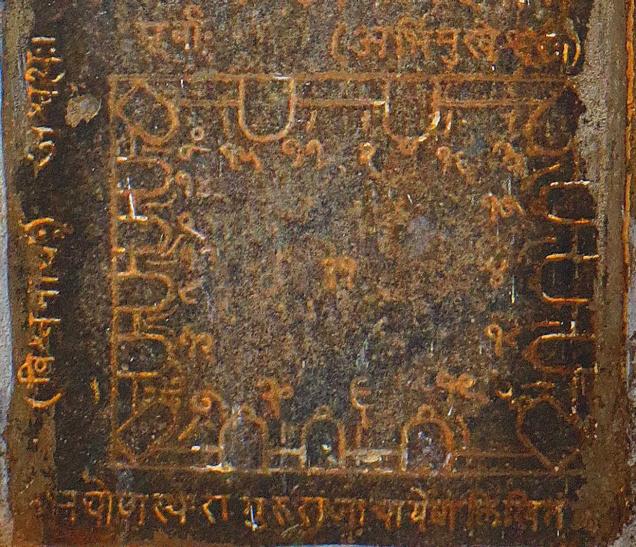
Inscription that sheds light on Mahamaham tank, ‘theerthas’ discovered

An inscription found at the Mahamaham tank. -Photo : special Arrangement

The inscription has it that it was composed by Guru Rajacharya of Kumbakonam, who was the brother of Guru Ragavendra of Brindhavan.

As Kumbakonam is gearing up for the Mahamaham, discovery of a rare inscription throws light on the Mahamaham tank plan and the arrangement of 20 ‘theerthas’.

“I found inscription in Sanskrit on the outside wall of the sanctum sanctorum of the Brahma Theerteswara temple on the bank of the tank. Probably this is the first inscription giving plans of a temple tank,” historian Kudavayil Balasubramanian told The Hindu.

He said the Brahma Theertheswara temple is one of the sixteen temples built by Raghunatha Nayakkar under the guidance of Maha Pradani Govinda Dikshithar in the 17thcentury. He had also renovated the steps on all sides of the temple leading to ‘theerthas’ .

“The ‘theerthas’ listed in numerical order in the inscription will help the devotees find their exact location,” he says. According to the inscription, ghats leading to the tank have been identified as various ‘theerthas’ and they are similar to the ghats in the Ganga river at Kasi.

“In the past, the tank would be full during Mahamaham. But in the early 1900s, wells symbolising various ‘theerthas’ were dug and the water level in the tank was kept very low to prevent drowning of devotees,” said Mr Balasubramanian.

Raghunatha Nayakkar also built the sixteen Dhana Mantapas in front of the shrines.

The inscription has it that it was composed by Guru Rajacharya of Kumbakonam, who was the brother of Guru Ragavendra of Brindhavan.

source: http://www.thehindu.com / The Hindu / Home> News> Cities> Chennai / by B. Kolappan / Chennai – February 03rd, 2016

TN IPS officer first woman to head paramilitary force

Chennai  :

Archana Ramasundaram, a 1980-batch IPS officer of Tamil Nadu cadre, has been appointed director general of Sashastra Seema Bal (SSB), a paramilitary organisation guarding the country’s eastern frontiers with Nepal and Bhutan. She is the first woman IPS officer to head SSB since its inception in 1963 and will continue in that post till her retirement on September 30, happy to head next year. “I am happy to head SSB and want to use my years of experience to improve the force,”Ramasundaram told TOI over phone.

In 2014, she was caught in a tug-of-war between the Centre and Tamil Nadu government when the UPA government was in power. She was selected as additional director of CBI in Delhi after clearance from the state government. But the state did not relieve her from TN police after she was selected for the CBI post. Ramasundaram, who has replaced B D Sharma, another official from her batch, who retired from service on January 31, was director of National Crime Records Bureau in New Delhi since June last year. The Union government had upgraded the post of director NCRB to that of director general of police to accommodate her in that post.

In 2014, based on instruction from Centre to join duty at CBI headquarters, she sent a letter to the chief secretary of Tamil Nadu and shifted to Delhi in 2014. This resulted in her suspension by the state government on charges that she deserted office. The Centre, last year, quashed her suspension. Though the state moved the Delhi high court on appeal, the petition was dismissed.

Ramasundaram, known among her colleagues as an upright official, is the senior most IPS officer in Tamil Nadu cadre at present. The pre sent DGP of Tamil Nadu Ashok Kumar, is two years junior to her. She hails from Ballia in Uttar Pradesh and is married to S Ramasunda ram, a 1979 batch IAS officer from Tamil Nadu, who took voluntary retirement from service in 2011.

There are five paramilitary forces SSB, Central Reserve Police Force (CRPF) Border Security Force (BSF) Central Industrial Security Force and Indo Tibetan Border Police and none has ever had a woman chief.

Besides Ramasundaram, IPS officers, K Durga Prasad and K K Sharma, have been appointed directors general of CRPF and BSF, respectively.

source: http://www.timesofindia.indiatimes.com / The Times of India / News Home> City> Chennai / TNN / February 02nd, 2016

MADRAS MISCELLANY – Another house on Eldam’s Road

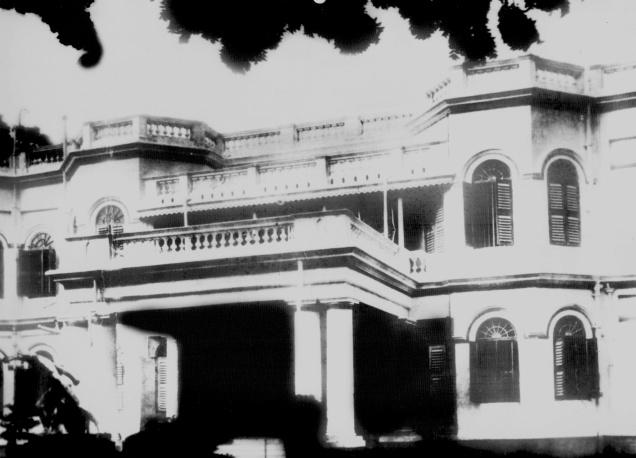
EldamsRoadCF01feb2016

A calendar anyone interested in the city’s past might like to possess is ‘Madras Then…’ brought out by the C.P. Ramaswami Aiyar Foundation with a dozen old pictures of Madras taken in, I would say, the early 20th Century. There are certainly a couple of pictures in it I’d like to use in this column when the occasion rises, because in one case the view presented is of buildings well-known but no longer visible in this fashion, and, two, the scene and its venue no longer exist. Meanwhile, however, with all the recent references to houses on Eldam’s Road, a third picture caught my attention and I present today The Grove, the Foundation’s present home and once the home of Sir C.P., though its main entrance was then on what was Mowbray’s Road.

Once woodland, the land at the junction of Eldam’s Road and Mowbray’s Road (T.T.K. Road) had belonged to John Bruce Norton, the eminent lawyer. It then passed into the joint hands of Bhashyam Aiyangar, Madhava Rao and Chentsal Rao. They, in turn, sold the three acres and a small house in it for Rs. 30,000 to Venkatasubba Aiyar in 1882. Venkatasubba Aiyar had only one child, Seethalakshmi Ammal, and she was CP’s mother. In 1885-86, Venkatasubba Aiyar developed the small house into a mansion, The Grove, and gifted it to his only daughter. She in turn left it to her only son, CP.

Two outstanding features of the house were its magnificent, eight-pillared portico and its 16-pillared central hall, a kalyanakoodam (wedding hall). In this marriage of Occidental and Oriental styles, the former’s pillars were of masonry, the latter’s included 12 of Burma teak and four of African ebony. Steel girders were imported from England for the roof of the kalyanakoodam and the ceiling for the Venetian marble-floored library came from Belgium. Over the years, the mansion was expanded considerably, but leaving its main features untouched.

A description of the property adds, “The grounds were lovingly tended… Two-century old rain trees and the rare African baobab trees were carefully looked after. Well manicured lawns were laid. Exotic plants defied the searing Madras summers to perform botanical miracles. Fountains and marble statues sprouted at the most unexpected spots. A lovely naked marble maiden sprang up bang in front of the portico. At the main entrance to the property a grand pair of wrought iron gates was erected. Needless to say, the long driveway (from the gates to the portico) was simply spectacular…”

It was in these grounds that CP exercised his passion for riding while his numerous dogs yapped at the heels of whichever horse he was on. These gardens had a fascinating story to tell. When Annie Besant was interned in Ooty over her allegedly seditious writing in New India, CP took it upon himself to edit the paper and bring it out. If he had edited the paper from his house, he ran the risk of the house being confiscated under the prevailing laws of sedition. So he placed chair and desk under the shade of a divi divi tree in the garden and put up a notice saying the spot was the editorial office of New India. It was an arrangement that continued till Annie Besant returned to Madras.

But for all the magnificence of The Grove and its gardens, its lavish parties and the hosting of the eminent, its pride was its library. In the 1930s, it was described by a knowledgeable visitor as “one of the finest private libraries in India”. It had 50,000 books, numerous paintings and antiques. Situated on the first floor of The Grove, in a room that could have done with more windows, it was a meticulously arranged facility that always overwhelmed visitors.

*****

When the postman knocked …

With a whole heap of mail, the rest of this week’s column is devoted to what the mail, snail as well as space, has brought in.

*Pointing out an error in my recollection of G. Subramania Aiyar (Miscellany, January 18) S. Raghavan writes: “The story states that Mr. Aiyar was among those who started The Aryan School (which was the precursor to Hindu High School). Hindu High School (or its precursor), to the best of my memory, was founded in 1852 and the school celebrated the centenary in 1952 with the construction of a Centenary Block. Mr. Aiyar was born around 1855, I wonder as to how he could have been among those who started Hindu High School. Of course, if he had started The Aryan School sometime in the 1880s and this was later merged with Hindu High School (which obviously was an older school) the story may be acceptable but in that event Mr. Muthiah ought to have clearly stated thus (instead of stating “now Hindu High School” in parenthesis). The story gives the impression that Hindu High School was started by Mr. Aiyar (as Aryan High School) which is definitely not true.” This was a case of error compounding error. My original source was an article in The Hindu of April 26, 1998 which stated: “He was appointed headmaster of the Anglo-Vernacular School, Triplicane. Later, he started the Aryan (now Hindu) High School.” What I did not read carefully enough was a correction to this from V. Subramanyan, grandson of G. Subramania Aiyar. He wrote to the author of the original article as follows:

“No doubt G.S. Aiyar was appointed the Headmaster of the Anglo-Vernacular School (now the Hindu High School), Triplicane. Disagreeing with some of the committee’s policies, he came away and in 1888 founded Aryan High School (now Kellett High School), Triplicane. He admitted to the school all boys regardless of caste.” In further clarification, may I add, a Tamil and a Telugu Padasala in Triplicane were founded in 1852 and merged in 1860 as the Triplicane Andhra Dravida Padasala. This was later renamed Anglo-Vernacular High School of which G.S. Aiyar became Headmaster in 1879. This School was renamed as Hindu High School in 1897.

*It’s all still a bit confusing, those houses on Eldam’s Road that I wrote about on January 4 and 25. V. Ramnarayan tries to explain it to me in these words: “Soundarya was the large house next to Sri Sundar(where P.S. Ramachandran (PSR) lived) in a compound measuring 28 grounds or an acre or so.Soundarya was in a separate compound to the left of Sri Sundar. There were two houses, Sundar andParvati, in one compound, and Soundarya was a different property. It was much bigger, too.Soundarya had belonged to Justice P.R. Sundara Iyer, Ramachandran’s father. M.D. Seshadri Iyengar had bought it for about Rs. 60,000. P.S. Ramachandran’s eldest brother P.S. Swaminathan owned Soundarya Nursery, and I am sure it was no coincidence that it shared a name with the Eldam’s Road house. Sri Parvati still stands in its original form, maintained by Lakshmi Venkataraman, daughter of P.S. Venkataraman (PSR’s elder brother), a building contractor. At Sri Parvati is an art gallery run by Lakshmi. Sri Sundar was developed into flats many years ago.

“When I was growing up, both Sundar and Parvati were with our extended family (and still are), whileSoundarya was already owned by M.D. Seshadri Iyengar. It had belonged to an Englishman, and I have all along believed that P.R. Sundara Iyer bought it from him and that his sons sold it to MDS. However, I was once told, that P.R. Sundara Iyer sold it to an Englishman who sold it to MDS.

“When P.R. Sundara Iyer’s sons ventured into business and went bankrupt, only the minor son P.S. Ramachandran’s properties had been protected under the law, according to family lore. That is howSundar and Parvati were saved. PSR is said to have helped his brothers, including the eldest, P.S. Swaminathan, who then started Soundarya Nursery, which became a success.”

*Joshua Kalapati, the chronicler of Madras Christian College, writes in connection with my reference to Prof. Edward Ross and S.R. Ranganathan, the Father of Library Science (Miscellany, January 4), “Ross was an outstanding teacher of both head and heart. He was Seventh Wrangler in the Mathematical Tripos of Cambridge University in 1904. Having studied Statistical Theory under the famous Professor Karl Pearson in the University of London, Ross sought to introduce all these pioneering ideas in the Mathematics Department of Madras Christian College, where he taught between 1907 and 1933. Ross not only enabled Ranganathan to do his B.A. in 1909, but Masters as well, although he was the only one student in the Mathematics Department. It was a blessing because Ross taught his brilliant pupil, as it is said, ‘in the corridors, in his flat and all around’. Because Ranganathan lived in the First Student Home of the College, more interaction was possible. There was also a connection with the great mathematician Srinivasa Ramanujan, who also admired the genius of Ross. Robert Kanigel, Ramanujan’s biographer, narrates that when he was very ill, Ramanujan placed two large notebooks stuffed with Mathematics into the hands of a close associate, saying, “If I die, please hand over to Professor Singaravelu Mudaliar from Pachiappa’s or to Edward Ross of Madras Christian College’.”

*From Australia comes another communication from A. Raman. Sending me the title page of Materia Medica – Madras published by the Government of Madras, he points out that the correct name, as indicated on this page, is Mohideen Sheriff and not Moodeen Sheriff as variously stated (Miscellany, January 4). Dr. Mohideen Sheriff’s classic comprises six volumes.

*A.V. Mukuntharajan, responding to my request for more information on P.M. Adikesavalu Naicker (Miscellany, January 18) wonders whether he is the same person who was known as Sardar Adikesavalu Naicker who lived opposite the railway gate in Washermenpet. The title ‘Sardar’, he thinks, was bestowed by Mahatma Gandhi. Which only makes me want to know more about this leader.

source: http://www.thehindu.com / The Hindu / Home> Features> MetroPlus> Society> Madras Miscellany / by S. Muthiah / January 30th, 2016
ISTE award for engineering college professor

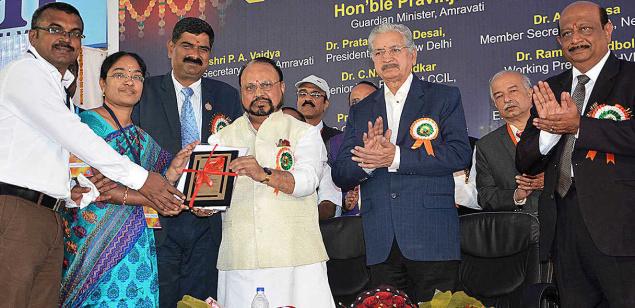
N. Santhiyakumari, Professor and head, Electronics and Communication Engineering, Knowledge Institute of Technology, Salem, receiving the Indian Society for Technical Education award at the 45th ISTE annual convention in Amravathi, Maharashtra.

The India Society for Technical Education (ISTE) has announced 20 awards in various disciplines in connection with the 45th ISTE annual convention, 2015.

The ISTE recognises research work from all over the country.

N. Santhiyakumari, Professor and Head, Electronics and Communication Engineering, Knowledge Institute of Technology, Salem was selected for the Maharashtra State National Award – 2015 in recognition of her outstanding research work in the area of biomedical image processing. She received the award from Anandrao Adsul, MP, at a function organised by the ISTE, New Delhi, at the HVPM’s College of Engineering and Technology, Amravati, Maharashtra.

Dr. Santhiyakumari won the award for her research work on implementation of medical decision making system for cardiovascular and cerebrovascular disease analysis, a press release from the college said

ISTE recognises research works from all over the country

source: http://www.thehindu.com / The Hindu / Home> National> Tamil Nadu / by Special Correspondent / Salem – January 31st, 2016

‘I dedicate the award to my family, doctors and staff’

D.K. Srinivasan. Photo: M. Karunakaran

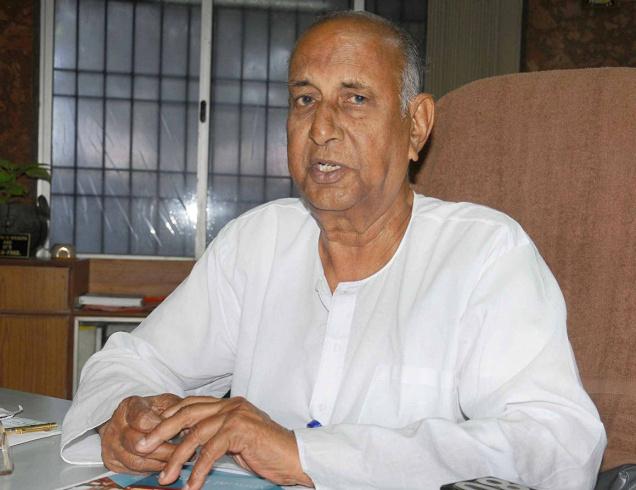
Recently, there was jubilation at a multi-specialty hospital in West Tambaram over a rare honour bestowed upon its founder. He had been chosen for the coveted Padma Shri Award and the joy of those who worked with him knew no bounds.

The man, as we all know, is D.K. Srinivasan, who started the Hindu Mission Hospital in West Tambaram along with his friend Dr. C.S. Gangadhar Sharma, a leprologist, on December 5, 1982. What was just started as an outpatient ward in a small shed, over three decades ago, is now a majestic landmark on GST Road with 220 beds. The hospital serves 500 outpatients and 100 inpatients every day.

D.K. Srinivasan, founder-secretary of the hospital, gave up his businesses to serve the poor by offering them medical care at subsidised rates. Apart from providing healthcare, he is instrumental in offering quality education to the underprivileged and first-generation students through Valluvar Gurukulam Higher Secondary School, Grand Southern Trunk Road, West Tambaram. “Initially, it was quite difficult; balancing the funds from donors and meeting out the demands of the public were major challenges,” says Srinivasan.

Today, the multi-specialty hospital has grown by leaps and bounds and has a raft of facilities including 9 operation theatres and offers various specialties, including cardiology, spine surgery, neurology, orthopaedics and also an intensive care unit for children.

It charges Rs.200 per sitting for dialysis, conducts 200 free Intraocular Cataract Lenses (IOL) eye surgeries, distributes free artificial limbs and callipers, free speech and hearing therapy for special students. The hospital also conducts free medical camps regularly in various areas in the region, including Mudichur, Kancheepuram and Tambaram. During the recent deluge, the hospital provided free medical treatment to over 6,000 flood-affected victims and free dialysis for 40 patients. On how he feels about the award, he says, “I dedicate the award to my family, doctors and staff of the Hospital.”

source: http://www.thehindu.com / The Hindu / Home> Features> DownTown / by T.S. Atul Swaminathan / Chennai – January 30th, 2016

Last ruler of Kandy has his resting place in Vellore

SriVikramaRajasingaCF30jan2016

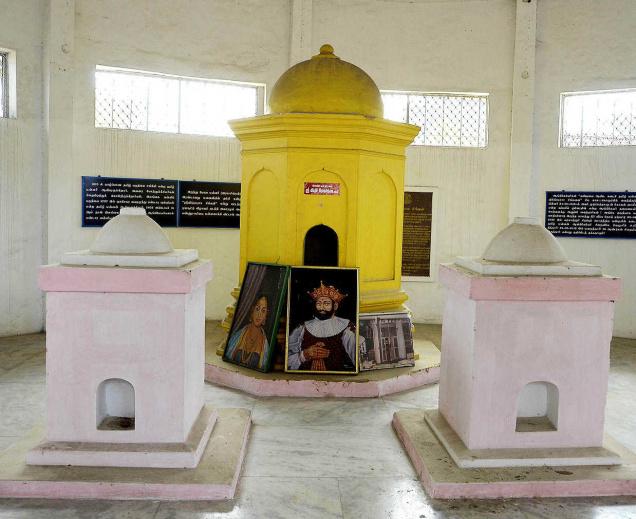
Muthu Mandapam, a memorial for Sri Vikrama Rajasingha

A rusty signboard marks the lane leading to Muthu Mandapam near the banks of the Palar river, off the busy Katpadi Road. It is the resting place of the last ruler of the Sri Lankan kingdom of Kandy, Sri Vikrama Rajasingha, since 1832.

Saturday (January 30) will mark the death anniversary of this “Tamil-speaking” ruler of Kandy. Though Muthu Mandapam, the memorial built around his tombstone, as a locality is popularly known among Velloreans, the place is not frequented by many.

As a layer of dust on the floor is swept away by Muniyamma, an elderly woman, the tomb of this king stands tall inside this pearl-shaped structure that was raised in 1990. It also houses tombs of seven of his family members.

Known as Prince Kannasamy, Sri Vikrama Rajasingha, a king of the Nayaka dynasty, was sworn in during 1798. He ruled Kandy till 1815, after which he was exiled by the British. He, along with a few of his family members, were taken as royal prisoners and imprisoned in Vellore Fort in 1816.

Plaques in Muthu Mandapam hail him Sri Lanka’s last Tamil King, and note that he was housed in a room inside the fort for 16 years. This room later went on to be used as the Registrar’s office of the Vellore district.

He died on January 30, 1832. Among his family members, who were laid to rest here, are his queen Savithri Devi and other spouses.

The Tamil Nadu government had constructed pearl-shaped structure over the tombs, which were earlier in the open amid huts in the area, at a cost of Rs. 7 lakh. Former Chief Minister M. Karunanidhi inaugurated Muthu Mandapam on July 1, 1990. The pearl-shaped structure was known to be designed by him.

“The chess board and boomerang used by the king are on display at the museum. While the chess board is made of wood, the chess coins and boomerang are made of ivory,” said K. Saravanan, curator, Government Museum, Vellore.

The Muthu Mandapam is under the maintenance of the Public Relations Office. Staff said that every year, the descendants of the king living in Madurai and Chennai visited the memorial on his death anniversary.

source: http://www.thehindu.com / The Hindu / Home> National> Tamil Nadu / by Serena Josephince M / Vellore – January 30th, 2016

After an award by Portugal govt, inventor of low cost napkin machine wins Padma Shri

Coimbatore :

For Arunachalam Muruganantham, the year 2016 couldn’t have started off any better. It was only a few days back that he got to know that he had been honoured by the Portugal government as Indian Business Leader of the Year.

Even before congratulatory messages for the recognition were still pouring in, Muruganantham’s mobile phone has gone again into a non – stop ringing mode. The 52 year old native of Coimbatore, acclaimed for invention of low cost sanitary napkins, has been chosen by the union government for Padma Shri award 2016.”I am not usually excited by awards. But Padma Shri is an exception,” says Murugantham who had just landed in Coimbatore on Monday evening after a tour of various cities addressing a variety of audiences ranging from students to businessmen.

“The award will be an inspiration for youth, especially engineering students. Rather than helping me, the award might inspire another Muruganantham to emerge,” he said.

He hopes that youth would start realizing that social activism doesn’t always mean getting on to the streets and serving the poor. Youth, especially engineering graduates, should realise that social change and improving someone’s life could also be done through an invention, using engineering,” Muruganantham tells.

There are lakhs of youth without jobs. They should identify a social cause and be a solution provider by coming up with more machines like the low cost sanitary napkin making machine,” he said.

The Coimbatore based social entrepreneur, who was listed by TIME magazine as one among world’s 100 most influential persons in 2014 was born in a poor family of handloom weavers in Coimbatore.He lost his father at a young age and had to drop out of school at the age of 14 years.

Soon after marriage, he realized troubles of women during menstruation after marriage, he started experimenting with sanitary pads to help his wife. When women members of his family grew tired of being test subjects, he started experimenting with sanitary pads on himself. SSubsequently, he came up with a machine to make those low cost sanitary pads and sold his first napkin making machine in 2004 in Madhubani in Bihar. tnnIn the decade since then, he has sold 2500 machines across India and abroad as NGOs and corporates saw the value in promoting the machine for better personal hygiene among women.

I am not inclined to display the Award in my house or call myself Padma Shri,” says Muruganantham signing off with the note that he has a long way to go to ensure that every single woman in the country uses a sanitary napkin.

source: http://www.timesofindia.indiatimes.com / The Times of India / News Home> City> Chennai / TNN / January 27th, 2016

IIT-M Lads Design Foldable Rail Ramp

Chennai :

Ever wondered why railway coaches should have just the vertical footboard that is risky for passengers? This could soon change if the idea of a group of IIT Madras students, who have designed a semi-automatic one to be fitted to the coaches, becomes a reality.

Designed at one of India’s premium technology institute’s tech festival Shaastra, the idea has already attracted the attention of top Railway officials.  Impressed by this project idea along with two other ones that won the ‘Indian Railways Design Challenge’, Railway officials have decided to try out these modifications in upcoming coaches.  The contestants were asked to design a suitable mechanism or device that could be fitted to the bogie or moved about on the platform without major alterations to the coaches.

Taking up this task, team ‘Innovators’ comprising mechanical and civil engineering students from IIT, had created a foldable semi-automatic footboard. Explaining its working principle, Borde, a team member said, “On arrival at the station, the guard should press a centrally-connected switch so that the steps, with multiple pin joints and controlled by single pneumatic cylinder and micro-controllers, roll out. When the switch is pressed again, these would fold back.” Borde’s team had designed a standard four-bar mechanism, which will be attached to the bogie with the fixed pivots attached close to the door. This mechanism consists of a ladder, a stepped ramp and a pneumatic telescopic bar.

RailwaysCF27jan2016

A student event-organiser, Surya said, “One of the team members, whose father lost a limb while getting into a train, came up with this innovative automatic footboard design for Southern Railway coaches. This could end the woes of the elderly and differently abled persons.”

Speaking to Express, Narendra Borde, one of the team members said, “Every year, hundreds of passengers get either maimed or even killed while entering or exiting trains through the steep footboard. This is because of the large gap between the platform and the coach.”

While Borde’s team’s project was selected as one of the top three projects by Southern Railway officials who were the judges, another team from IIT-M secured the first place.

Raj Dandekar, a student from the team said, “After taking the maximum and minimum gap into consideration (229-305 mm) across India, with no major modifications in the coach design, our mechanism can help 22-24 people comfortably entrain and detrain within 180 to 250 seconds.”

The students claimed that the total cost of this device would be around Rs 8,300.

R Kuppan, Chief Mechanical Engineer, Southern Railways, who attended the event said, “We are generally skeptical when it comes to student projects, but today their projects were outstanding. The winners will be given a chance to work on their ideas with Railway engineers to develop them and we will try it on our railway coaches.”

source: http://www.newindianexpress.com / The New Indian Express / Home> Cities> Chennai / by Ram M Sundaram / January 25th, 2016