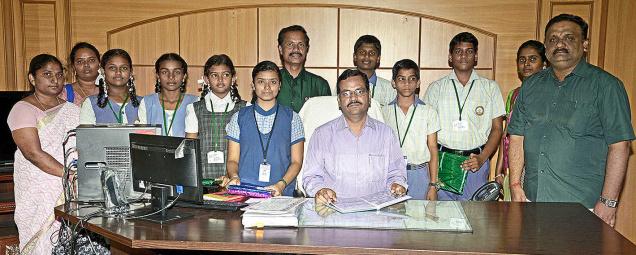
The members of the Jawahar Bal Bhavan, Namakkal, who excelled at the national cultural competitions, with Namakkal Collector V. Dakshinamoorthy.
A seven-member team of the Jawahar Bal Bhavan, Namakkal, won the first place in the Bommalattam dance event at the national level Children’s Cultural Festival held at New Delhi recently.
Events
The members participated in two events – Panchayat Raj awareness street play and Bommalattam folk dance. The team won the second place in the street play event.
The competitions were held on the themes that centred rural development.
District Collector V. Dakshinamoorthy felicitated the members.
M. Thillai Sivakumar, Project Officer, Namakkal District Jawahar Bal Bhavan, was present.
source: http://www.thehindu.com / The Hindu / Home> National> Tamil Nadu / by Special Correspondent / Namakkal – December 07th, 2015
A 53-year-old businessman with end-stage liver failure has received a fresh chance at normal life, thanks to the efforts of a team of doctors from a private hospital in the city and the timely reception of organs from a liver and brain dead man.
Motilal Jain from Jodhpur in Rajasthan was admitted at Cethar Hospital in the city a couple of weeks ago. He was suffering from an acute case of Hepatitis B. He also had abdominal swelling due to fluid collection, blood in the motion and jaundice and renal failure.
A team of doctors, including transplant surgeon Dr G Rajarathinam, transplant anesthetist Dr Rasweth Krishnamoorthy and interventional radiologist Dr Bavuharan, assessed the patient and decided that he had to undergo a liver transplant if he was to live, even though the process would be very risky.
The organ of a liver and brain dead man was chosen, and the surgery commenced. It took 16 long hours, since the condition of the patient was volatile, but the doctors emerged successful in the end.
Motilal is now recovering. Doctors and the patient met the media on Sunday to brief them on his condition and explain the technological advancement that had made the surgery possible.
“Humans come in contact with Hepatitis B virus through non-sterilized injections and other reasons. So, it is highly risky to operate on such patients. Despite the difficulties, our doctors pulled it off,” said executive director of Cethar hospital Karthick Sivakumar on Sunday.
A liver transplant usually costs around Rs15 lakh, but in Motilal’s case the expense ran up to Rs23 lakh because he required the expensive ‘immuno suppress’ injection twice, Karthick added.
source: http://www.timesofindia.indiatimes.com / The Times of India / News Home> City> Trichy / TNN / November 24th, 2015
Realworks Studios, a start up based out of Coimbatore is making heads turn with its open source 3D animation work for ‘Urumeen’ that releases today
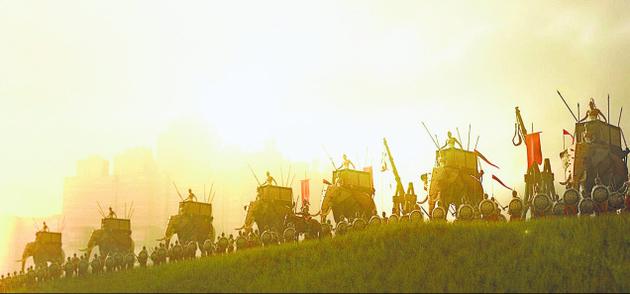
Going virtualScenes from Urumeen that were captured virtually by Sivaprasad Velayudhan ( right) and his team
Here are some of the tweets about the new Tamil film Urumeen “URUMEEN 5 mins sequence features,
India’s first film using 3D portion using open source software and motion capture” “The 1st few mins of #Urumeen r goin to b unlike anythin u’v seen b4! Motion Capture 3D by TN technicians! Watch out!”
Sivaprasad Velayudhan
So, animation artist Sivaprasad Velayudhan and his team at Realworks Studios in Coimbatore have reasons to be thrilled.
“We have done the motion capture sequence in an entirely frugal method with free tools that are available online,” says Sivaprasad.
War
The introductory war sequence in the film that takes place in the pre-independent era has been captured virtually.
“Filmmakers get such work done in studios abroad. We have used the motion sensor hardware that is used in gaming and other open source tools to create the 3D portion. The film’s director Sakthivel Perumalsamy is happy with the outcome,” he says.
Urumeen features actors Bobby Simha and Kalaiarasan and has two parallel stories, one set inside a forest and another in an urban background.
It releases today.
Sivaprasad who left his IT career to start this venture says Coimbatore should become the film hub it once used to be.
“In the South, movies started from Coimbatore. Why can’t we bring those glorious days back? The city is buzzing with so many short film directors and film makers . I want to tell film makers, instead of going abroad for animation work, come to Coimbatore,” he says.
His 13-member team operates out of a studio that is based on Linux, which is free.
“I don’t invest on software and workflow. We use free tools like blender and gimp. This way we cut cost and offer work at a fraction of industry standards,” he says.
Next project
His team is currently working on director Ramprakash’s film Pokkiri Raja that features actors Jeeva and Hansika.
Recently, Sivaprasad was in the news when he made a trailer of Ranadheeran , modelled on Rajinikanth’s Kochadaiiyaan , to prove the possibilities of open source software.
“We got 1.4 lakh views in one month. Soundarya Rajnikanth, who directed Kochadaiiyaan , tweeted about our work. It was an in-house experiment. We spent 10 weeks to make the four-minute trailer. It’s an experiment to let the filmmakers know the immense possibilities of virtual production with open source software.”
He says it’s time filmmakers start thinking out of the studios.
“You don’t have to shoot everything in a studio. With films like Baahubali , things are already happening. While visual effects are used to show explosions, car stunts, and action sequences… 3D visualisation is a virtual production. English movie TinTin was entirely virtual,” says Sivaprasad.
Advantage
Talking about the advantages of a digital platform, he says:
“There is an option of undo. And in 3D you see things from all angles. Though I started drawing from an age of four, I made a transition to the digital platform for efficiency. My family has been very supportive. Also my team, who have explored and experimented with me.”
Sivaprasad says the virtual production helps filmmakers explore genres like science fiction.
“I can replicate 1000 pillars, a war sequence, a 3,000 ft waterfall or 10,000 warriors fighting a battle…but the same can’t be said about human emotions. We are working on it. Whatever we do, there is no way you can replicate a Rajinikanth, virtually.”
Visit: www. realworks.in
https://www.youtube.
com/channel/
UCDVbaz6fqec7c-
DH8_nbFog
It’s an experiment to let the filmmakers know the immense possibilities of virtual production with open source software
source: http://www.thehindu.com / The Hindu / Home> National> Tamil Nadu / K. Jeshi / December 04th, 2015
Internet giants Google and Facebook have stepped in with technical aid for relief work in Chennai. Facebook has activated its “safety check” feature through which people can broadcast to their Facebook friends that they are safe with a single click. Google, on the other hand, has compiled all the crowdsourced material available online on the crisis response page. Meanwhile, small efforts by scattered individuals to bring food, candles, even power banks to the stranded, continued in the marooned city.
The Google Crisis Response page for “South India Flooding” has compiled publicly available links with help on food and shelter resources, and emergency phone numbers. Scattered online information in the form of tweets, google documents floated by rescue volunteers, and news reports are all compiled on a single location.
Facebook switched on its Chennai Flooding safety check featureat around 07.30 am on Thursday. At the time of going to press, data on the number of people who had used it was not yet available.
Besides the one-click safety check, there were several SOS calls on Facebook as well. One Kokila Palaniappan sought help contacting her family in Chennai. Saying that about 10 members of her family were stuck and unreachable, she provided an address and wrote in a public post: “They don’t have any food and most of them are sugar or heart patient. Have been trying for rescue boat for the past 12 hours and in vain. Also they don’t have much charge in their cell phones. So it is getting difficult to reach them. Any help extended would be greatly appreciated.” The post received over 3,000 shares.
By Thursday evening, a less than hopeful response came on the thread: “hi koki, went and searched ur house for 4 hrs today.. We went in boats with food and cried their names, no one responded. There’s 15 ft water in that street and it is impossible to recognise ur house from those photos,” wrote one Ashwin Badri.
Surprisingly, #chennairains not only lost its top spot from the national Twitter trends list on Thursday evening, but vanished from the list all together.
Even the city-specific trends for Chennai the tag, or one even related to the deluge, like #ChennaiFlood was nowhere on the list. However, volunteers, rescuers, and those in need of help continued to tweet their locations and the materials they required or could provide.
Angels of Change, a first-of-its-kind coffee table book showcasing the achievements of women in the field of education in Coimbatore, an initiative of The Times of India, was launched by the University Grants Commission vice-chairman H Devaraj at a function here on Wednesday.
The book profiles 15 women educationists from the city who have dedicated their lives to selflessly serve the academic world. All the personalities featured in the book have had strong social and personal reasons to start a school or a college in the city.
Devaraj unveiled the first copy of the book and felicitated the women featured in it. A citation and a copy of the book were given to each of the outstanding contributors to education.
Congratulating all the women achievers, he said, “I am happy to launch this book that showcases the legacy of school and higher education in the city. I will take back messages from the book to frame policies on women empowerment.”
He praised the women for taking forward the legacy of serving the society for which Coimbatore is known.
President of Indian Chamber of Commerce, D Nandhakumar, also congratulated the women for their untiring service to the society and Coimbatore.
He recalled the contribution of women in improving education in the city, and cited the role of the Indian Chamber of Commerce for the betterment of the society through education.
Corporation commissioner Dr K Vijayakarthikeyan also congratulated the women achievers and The Times of India.
source: http://www.timesofindia.indiatimes.com / The Times of India / News Home> City> Coimbatore / TNN / November 26th, 2015
N Hemamalini, with her father Neelakandan, who is a farmer in Odugathur, talking to District Sports Officer Nagaraj on Monday | S Dinesh | EPS
Vellore :
The not-yet-16-year-old N Hemamalini of Odugathur Government Girls Higher Secondary School, the daughter of a farmer from Madiyapattu village in Vellore district in the recently concluded 31st national level junior athletic meet held in Ranchi in Jharkhand, threw the javelin for a distance of 39.69 metres in the under-16-year category. It bettered the previous national level record by 0.60 metres.
She also won gold medals and achieved the distinction of being the record holder in the Junior State (Open) held in Kumbakonam in July 2015 when she threw the javelin to a record distance of 40.98 meter. Earlier, she set the record in the 26th South India Athletic Championship by throwing the javelin for a distance of 38.05 metres. She has won gold medals in state level school meets, state level junior open meets and the regional level CM Trophy.
“I have been practicing hard for two to three hours a day for the last three years. Even during school holidays, I use to train,” said Hemamalini, who is studying in class XI.
Hemamalini has been improving her ability to better her performance in every meet and she even outdid seniors in the recently held CM Trophy, in which she won silver medal and a cash prize of `75,000.
Since January 2014, she won eight gold medals and three silver medals, said her school Physical Education Teacher and mentor V Krishnamoorthy.
“She has the potential to win medals for the country at the international level athletic meets,” said the teacher, who has been training her for the last three years.
The teacher, in fact, arranged an air ticket for the young athlete from Bangalore to Ranchi to attend the national level meet during the third week of November in Ranchi after the trains were cancelled due to rain.
She is the pride for her father Neelakandan.
source: http://www.newindianexpress.com / The New Indian Express / Home> States> Tamil Nadu / by J. Shanmuga Sundaram / ENS / December 01st, 2015
Abhinaya Rangarajan’s Facebook page, ‘The Artist Project’, is a tribute to the Indian craftsman
She is 23, but Abhinaya Rangarajan has her life sorted. While she is an architect during the day, by dusk, she is a busy entrepreneur. The Artist Project, a Facebook page started by her in July, is getting “overwhelming responses”.
The page that is followed by around 5,500 people, features an artist/artisan from across India every two weeks, and promotes his or her products.
“If you are buying a handmade product, you might as well care to know the hands that made it. After all, the product is a cumulative result of all the skills that the person possesses,” she says, taking just a second’s glimpse at her cell phone that beeps occasionally. “Ever since I started the page, messages have been pouring in — orders, enquiries and requests to be featured. I did not see it becoming such a hit. I get around five to six orders a day, am still coping with the success,” she says.
Abhinaya notes all the orders, and at the end of the week, passes them on to the artisans, who either courier it to the address of the customers themselves or send it to her.
“While I used to handle everything myself, with increasing orders, I now have an intern working for me; a final-year college student,” she says. A no-profit venture, Abhinaya runs it for the sheer pleasure of helping encourage the craftsmen/artisans (she refers to them as artists), and to provide a platform for those who either do not have access to market benefits.
Each post on the Facebook page has a brief description about the artist’s background, besides high resolution photos of their products. Till date, seven artists have been unveiled on the page — Auroville-based shoemaker Rajasekaran who runs ‘Aasai footwear’; an alumni of Vidya Sagar, Swaminathan who weaves mats and sells them in his boutique; Nimisha Zachariah who specialises in textile jewellery; Amrita Giriraj, a visual arts graduate from Stella Maris, who makes accessories from shells; award-winning leather puppet makers D. Venkatramana and K. Ramdas from Andhra Pradesh; and Karishma who makes home decor using bangles.
“The artists featured by us are happy. For example, the puppet makers were almost out of business. They were hosting workshops for a living, which hardly helped them meet their needs. Now, they get orders for their products, and make money,” says Abhinaya. “And Karishma, who had started making bangle decor as a means to pass time while she was pregnant, has now taken it on as a full-time project,” she adds.
It all began when Abhinaya, who graduated in Architecture from SRM University two months ago, was interning in Bangalore. “Since there was not much work, I would pack my bags and head to the outskirts every weekend. It was one one of those trips that I came across the wooden-toy makers of Channapatna. There were a line of stalls, all selling the same products,” she says.
And from her conversations with the artisans, she realised that they did not know how popular their toys were all across the world, and were definitely not getting the due for the amount of effort and time they put in.
Besides her steely resolve to give the artists a bigger audience, Abhinaya, who is planning to pursue a Masters in Product Design, says her interest was piqued also by the urge to know more about the creative products. “Also, I was a DIY kid myself. Be it birthday parties or get-togethers, I wanted to make my own earrings and hats. So this was expected,” she says with a child-like laugh.
For details, look up The Artist Project page on Facebook.
source: http://www.thehindu.com / The Hindu / Home> Features> MetroPlus / by Naveena Vijayan / Chennai – November 30th, 2015
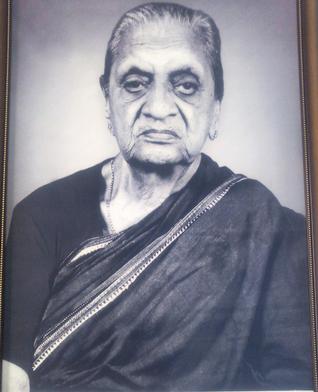
T.V.M.Thillai Ammal ( 1914 – 2009 ) was the second daughter of T.A.Ramalingam Chettiar ( 1882 – 1952 ) the father of the Co operative movement and the first Member of Parliament from Coimbatore. Thillai Ammal was married to Dr. T.V.Muthuswamy at a tender age of 14 years. Muthuswamy passed away due to an attack of TB just three years after their marriage. She went to Chennai, joined a tutorial college and did a two-year programme. Thillai Ammal interacted with Mahatma Gandhi and attended a number of his prayer meetings. Later, she spent a lot of time in the Sabarmati Ashram where she was inspired to devote her time to the well being of the socially and financially downtrodden people. She gave her bangles away for the freedom movement.
The Kasturi Bai Trust was the first social organization that gave Thillai Ammal the required inputs that were to guide her. She returned to Coimbatore and Periya Naickenpalayam were her cousin T.S.Avinashilingam Chettiar had established the Sri Ramakrishna Mission Vidyalaya. It was here that began serving the society of this region. Her nephew, the octogenarian educationist remembers, “My aunt used to visit the nearby villages and teach people the value of hygiene and education. I used to accompany her on these missions. The prayer meetings mobilised women folk and they were taught crafts and awareness about health. She adopted villages and conducted street plays and villu paatus as part of a continuous awareness initiative. A number of them were offered assistance and therefore were able to establish themselves by purchasing cattle or setting up petty shops. She helped them acquire land for housing by acting as their representative. “
Later, she started Seva Nilayam with some kids in 1949 and subsequently her father T.A.Ramalingam Chettiar and the Coimbatore public helped her establish a permanent premises for Seva Nilayam at Syrian Church Road. Dr.Muthulakshmi Reddiar inaugurated the new facilities in 1950. Thillai Ammal started an Umber Charkha training course and a type writing course for widows in order to empower them. Seva Nilayam became the home for a number of abandoned kids and these kids grew up under her watchful eyes. She was the ‘Amma’ for these kids and the Saradhamani Primary School and the Seva Nilayam High School were created by her with the purpose of empowering the girls in her care. The kids who grew up at the Seva Nilayam were enriched with education, social and moral values and a sound traditional foundation that stood them well all their life. Thillai Ammal visited prisoners in jail and she tried to make a difference in the lives of the inmates and their families. A Junior approved school was started for the kids in need of rehabilitation in the year 1951 and a working women’s hostel came into being in 1982.
Thillai Ammal, educated thousands of girls and conducted hundreds of marriages. The Avinashilingam University honoured her with a Doctorate in 2004. Recalls Dr.T.V.Angappan, “Several citizens were made part of this initiative. Sir.R.K.Shanmukham Chetty, Dr.C.Subramaniam, R.Venkataswamy Naidu , M.S .Palaniappa Mudaliar were part of the committee. Social worker and legislator Savithri Shanmugam was with my aunt. She met eminent leaders such as Indira Gandhi, and K.Kamaraj who visited Seva Nilayam and appreciated her work.”
Jayshree Ravi, the grand niece and the Secretary of Seva Nilayam recalls, “I used to visit her everyday for more than 12 years. She made me unlearn a number of things before inculcating the concept of service in me. She was frank, simple, committed, calm, patient and understood the language of the downtrodden, handled difficult situations with aplomb and was fearless at all times. It is thanks to her hard work and her life long mission that Seva Nilayam has withstood the test of time . The sacrifice of Thillai Ammal is our foundation for she gave away all her wealth for this cause and she just had three khadi sarees in her cupboard along with one shawl presented by Indira Gandhi . Her ornament was benevolence”
The amazing T.V.M. Thillai Ammal was one of the early social workers among the women of Coimbatore who added lustre to the lives of the downtrodden.
source: http://www.thehindu.com / The Hindu / Home> Features> MetroPlus / by Rajesh Govindarajulu / November 27th, 2015
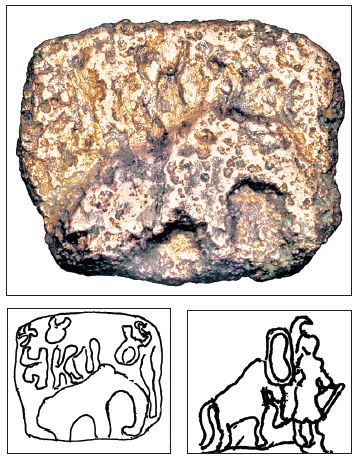
The Swastika extensively found in the Indus Valley Civilization and considered as auspicious in Hinduism, Buddhism and Jainism, is found in a coin of famous Tamil king Adhiyaman, one of the seven chieftains known for charity.
The coin, which was found by R Krishnamurthy, a well known numismatist and Dinamalar Editor, also shows warriors with Greek style of headgear and writings in Brahmi and Tamil-Brahmi. The coin could show the Tamils’ link with the early Indus Valley and later Greek civilizations.
(Clockwise from top) The coin found by numismatist R Krishnamurthy; and the impression of the front and the back of the coin
According to some historians, Adhiyaman is said to be from the Mazhava tribe, which ruled a territory in the Indus Valley between Jhelum, Chenab and Ravi rivers. The finding could show a link between the Indus Valley civilization and Tamils of Sangam age. Besides, the Swastika symbol, otherwise called gammadion cross, which was also used by the Nazis, could have originated in the Indus Valley, which is one of the ancient civilizations along with the Egyptian and Sumerian civilizations.
Explaining the coin, Krishnamurthy said: “The front side shows an elephant near a flag mast, while Swastika symbol is found on the top left. The name Adhiyaman is seen on the top of the elephant. On the back side, a river and two fishes are found. A horse and a soldier wielding a shield and sword-like weapon are seen. The soldier is wearing a headgear with Greek style hair decorations.” King Adhiyaman, referred in several poems of classical Tamil poetry of the Sangam age was the ruler of Thagadur, now known as Dharmapuri. His name is found in ancient Tamil poem collections of Purananooru, Agananooru, Kurunthogai and Natrinai.
source: http://www.newindianexpress.com / The New Indian Express / Home> Cities> Chennai / by Express News Service / November 30th, 2015
A rich repository of the fascinating accounts of five generations of women, ‘A Grandmother’s Legacy’ by English author Jenny Mallin, is not only a recipe book but also a memoir of the life of Anglo-Indians during the British era.
While the origin of the book dates to 18th century Yorkshire in England, the Anglo-Indian aspect of the family history took root in erstwhile Madras where Benjamin Hardy, a foot soldier in the British army , landed in 1778. Now, more than two centuries later, Jenny Mallin, the great-great-great-great-grand-daughter of Benjamin and Frances, and the proud custodian of an 1844 recipe book, has shared her family secrets to the world.
Jenny worked as a producer on BBC News for seven years and then as a corporate travel buyer. “Losing my father in 2010 was the catalyst (to become an author). I realised I could lose my mother soon; time was ticking. Sometimes a doubt would creep in -‘Am I betraying these ladies?’ But I did not want the legacy to end with me,” says the 57-year-old who launched her book at the British Council Library on Friday. “I would read a recipe to my mother every day from the book, cook a dish, ask her opinion and make sure it tasted authentic. In three years, I re searched more than 500 recipes,” she says.
The desire to preserve the culinary heirloom for posterity began with 15-year-old Wilhelmina Sausman, a Vellore resident who married Joseph son of Benjamin and Frances in 1844. Since then, the book, which Jenny has now stored in a safety deposit box in a bank, had been passed on. “My mother Cynthia, who was born in Kolkata, had great imagination. In a small London kitchen, she would produce wonderful dishes, while listening to the radio.”
It wasn’t easy for Jenny to decipher some words and ingredients written down by her grandmothers. “I am a born researcher and I felt like Sherlock Holmes trying to put together a jigsaw puzzle,” says Jenny .
Each chapter in Jenny’s book celebrates the life of the five women who have inspired her in innumerable ways. Interspersed with their recipes are the interesting customs of that era. For instance, in Rawalpindi, her grandmother Irene was a governess to 16year-old Benazir Bhutto, who would grow up to be the prime minister of Pakistan.
source: http://www.timesofindia.indiatimes.com / The Times of India / News Home> City> Chennai / by Diana Ningthoujam, TNN / November 28th, 2015