Chennai, 12/04/2015. For City: Shanti movie poster.Photo:Handout_E_Mail / The Hindu
Fifty years ago, Sivaji Ganesan’s film, Santhi, marked the end of a popular combination in Tamil cinema.
It was the last film in which Sivaji and M.R. Radha shared space on the silver screen.
This snippet was shared by T. Murali of Nadikar Thilakam Films Appreciation Association which organised a function on Sunday to the mark the 50 year of Santhi.
The film that was to be released on April 10 in 1965 was delayed by 12 days as the makers wanted a ‘U’ certificate instead of an ‘A’.
“Earlier, the Central Board of Film Certification thought of giving it an ‘A’. The makers thought such a certificate for those times would deter people from bringing their families to the film. So, it took them a little while to get a ‘U’ certificate,” he said.
Jayanthi Kannappan, daughter-in-law of A.L. Srinivasan who produced Santhi, brought the camera using which the film was shot 50 years ago.
“My father-in-law had the privilege of paying salaries to four Chief Ministers, including M. Karunanidhi, Jayalalithaa, M.G. Ramachandran and N.T. Rama Rao, for various films. Not just that, he also introduced five directors, including A. Bhim Singh and K.S. Gopalakrishnan,” she said.
The programme was followed by the screening of the film. The film’s cast included Sivaji, C.R. Vijayakumari, Devika and S.S. Rajendran, and was directed by Bhim Singh.
source: http://www.thehindu.com / The Hindu / Home> News> Cities> Chennai / by Staff Reporter / Chennai – April 13th, 2015
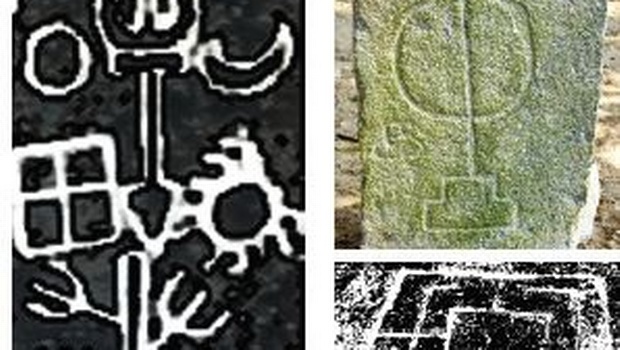
The symbols discovered at the Shiva temple in Alundur | Express
Tiruchy :
Rare symbols have been discovered at the Lord Shiva temple at Alundur in Srirangam taluk in the district recently denoting the Brahmadarshana symbol, Manduka Diagram and Sulastone with plinth.
According to research team scholars headed by T L Subash Chandra Bose, the symbols were found at Shiva temple in Alundur as well as in some of the surrounding areas.
The scholars claimed they also found a trident with a base with the Tamil letter ‘Ka’ inscribed on the right side of one of the pillars in the temple. The symbols could date back to the 16th century BC, they said. Elaborating the significance of the Tamil letter ‘Ka,’ Subash Chandra Bose said that the alphabet refers the first true letter and also the first numerical number ‘one’. The root of letter ‘Ka’ is a cross between vertical and horizontal lines referred to as the ‘causation’.
“Ka represents Lord Param or Brahman (not Brahma). Lord Param is also symbolically indicated as an oblong with a cross at the center. It is a four square matrix (Pecaka diagram) which you can see in the Sulastone at Keezhakuruchi village stating about the Siva Temple — Jambukeswarar Akhilandeswari — in Thiruvanaikoil near Srirangam where the tree, the spider and an elephent attained moksha,” he said.
The Mayamata — the temple architectural manual — says the centermost four square in the 64 square matrix is the heart zone, where the Ka — Lord Param or Brahmam dwells. An interesting reference found in Chaandogya Upanishad (verses 4.10.4-5). Ka and Kha is Brahman. Below is the explanation or interpretation of it, he said.
source: http://www.newindianexpress.com / The New Indian Express / Home> States> Tamil Nadu / by Express News Service / April 04th, 2015
The food habits of the modern society are decided by companies that manufacture and process food. However, it is crucial to bring back some of our traditional food varieties back, including the nutrition-rich millet.
Nowadays, millets are included in bakery products like bread and bun to ensure healthier consumption of food. Millet varieties like Kuthiraivali, Varagu and Samai are used to prepare noodles. Consumption to millets is believed to help reduce chances of cancer and diabetes, and also controls obesity since it contains good amounts of fiber, protein and minerals.
S Kanchana, head of the food science and nutrition department at Tamil Nadu Agriculture University (TNAU), said, “We conducted a training programme two months back for entrepreneurs to teach them about the millets that can be used in bakery products. Millets like Varagu, Thenai and Kuthiraivali has good amount of fibre and protein. Moroever, people who consume millets are 20% to 30% less likely to develop insulin resistance and diabetes-related diseases.”
Health mixes containing millets are sold at the Uzhavan Unavagam, or farmers canteen. Small millets like Thenai, Samai, Kuthiraivali and Varagu are low in glycemic index, which helps maintain blood sugar levels.
V K Balaji, 43, a farmer who runs a snack stall at Uzhavan Unavagam said, “We prepare noodles and snack items using small millets. Children and old alike enjoy consuming snacks made of these millets. It helps to maintain blood sugar levels and hence it is advisable to consume millets”.
source: http://www.timesofindia.indiatimes.com / The Times of India / Home> City> Madurai / by Karishma Ravindran, TNN / April 01st, 2015
Towering personality:The institutions founded in Pachaiyappa Mudaliar’s name came into being more than 40 years after his death —Photo: The Hindu Archives
The name Pachaiyappa Mudaliar conjures up an image of an educationist blessing a student, and reminds one of a slew of educational institutions bearing the name. Actually, neither the educational institutions nor the Trust founded in his name were in the picture during his lifetime, or even some 40 years after his death.
Pachaiyappa Mudaliar, who made a fortune as a dubashi (interpreter) during the reign of the East India Company in the country, died in 1794. The foundation stone for the first residential school for caste-Hindu students was laid only in 1846. The money, bonds and jewels, all worth over Rs. six lakh, were used for charitable activities and various temple rituals, before the arrival of George Norton, the attorney general of Madras Presidency.
The biography of Pachaiyappa Mudaliar, who lived only 40 years, has been re-issued after a gap of 104-years. It reveals the life and times of the man and the legal battles, attempts to appropriate his properties and the efforts taken by Mr. Norton to create Pachaiyappa’s Trust and a slew of educational institutions, including a key college Chennai. The biography was penned by Komaleeswaran Pettai (now Pudupettai) Seenivasa Pillai, the first trustee of the Trust who worked together with Mr. Norton in establishing the educational institutions.
Now,Va.Mu.Se. Andavar, associate Tamil professor at Pachaiyappa’s College, has re-published the book, written in a quaint style that was probably in vogue about a 100 years ago.
“This is probably the first authentic material on the life of Pachaiyappa Mudaliar,” says Mr. Andavar.
Pachaiyappa Mudaliar, born in Periapalayam in 1754, lost his father even before his birth. His mother, Poochi Ammal, reached Madras with her children in search of a livelihood and was supported by a renowned dubashi , Powni Narayana Pillai, who took Pachaiyappa Mudaliar under his wing.
Pachaiyappa Mudaliar had a meteoric rise as a dubashi and his richness can be explained by the fact that he lent Rs. one lakh to the king of Thanjavur. But the book tells us Pachaiyappa Mudaliar, who married twice, could not lead a peaceful life, as his wives fought over the inheritance of his fortunes. He died in Thiruvaiyaru in 1794.
“Mr. Norton interpreted the will of Pachaiyappa Mudaliar in such a way that the money utilised for temple charities and feeding of the poor was used to launch educational institutions,” says Mr. Andavar, pointing out that Rs. one lakh was set apart for resumption of temple charities, but it could not be continued because of subsequent legal battles.
The biography of Pachaiyappa Mudaliar, re-issued after 104 years, throws light on the creation of the Trust and educational institutions that bear the dubashi’s name
source: http://www.thehindu.com / The Hindu / Home> News> National> Tamil Nadu / by B. Kolappan / April 06th, 2015
Amidst the many camera flashes, clicking noises and constant whispers from on-lookers, city-based language teacher, P Aravind, was trying his best to recall the 270 binary numbers being flashed before him from a computer. He finally managed to recall all the 270 digits shown to him in the fifth attempt in a bid to enter the Guinness Book of World Records at the Kasthuri Sreenivasan Trust on Friday morning.
Aravind, 36, who teaches Italian, Spanish and French and has a passion for languages, had been dabbling in memory techniques for more than 15 years to help make learning of languages easier. “Every time I learnt a new language there was always a long list of words, verbs, vowels, nouns, phrases and sentences to learn,” said Aravind. “I initially found it tough and monotonous. I noticed that my students began losing interest when the going got tough,” he said.
That was when Aravind began researching memory techniques which he used to test his memory power from time to time.
I began training a year ago with just 40 numbers, and slowly kept increasing it by 20 every two months,” he said. “The earlier record was set in 2011 by a Mr Jayasimha with 264 digits. I decided to use the memory palace technique developed by Greek Poet Simonedes in 2500 BC which involves imagining a palace where you place numbers in various corners, place the rest in any way, leave the palace and continue your journey. When you return and start looking at the palace you start finding the numbers as you walk through it,” he said. He practiced at least three hours a day.
He managed to memorize 270 numbers in a minute and repeat it within eight minutes, practicing in front of many locations. “I did it in a crowded bus stop, Brookefields Mall and at the location on Thursday evening to get used to distractions,” he said.
While he looked nervous during the first attempt on Thursday evening, he looked more confident during the second attempt and was close to reaching the target before failing at the 240th digit. After a five minute break, he began all over again and succeeded in his fifth attempt.
Aravind dedicated the achievement to all his students. “I want this to be an example to all students who think they can’t memorize anything. They just need to zero in on the right technique,” he said.
source: http://www.timesofindia.indiatimes.com / The Times of India / Home> City> Coimbatore / TNN / April 04th, 2015
It was an attempt to revive the tradition and folk culture at the Rukmani Arundale auditorium of the Tamil Nadu Isai Nataka Manram, recently. The excitement on the faces of the audience bore testimony to the fact that folklores like Tholpavai or Bommalattam were deeply rooted in them.
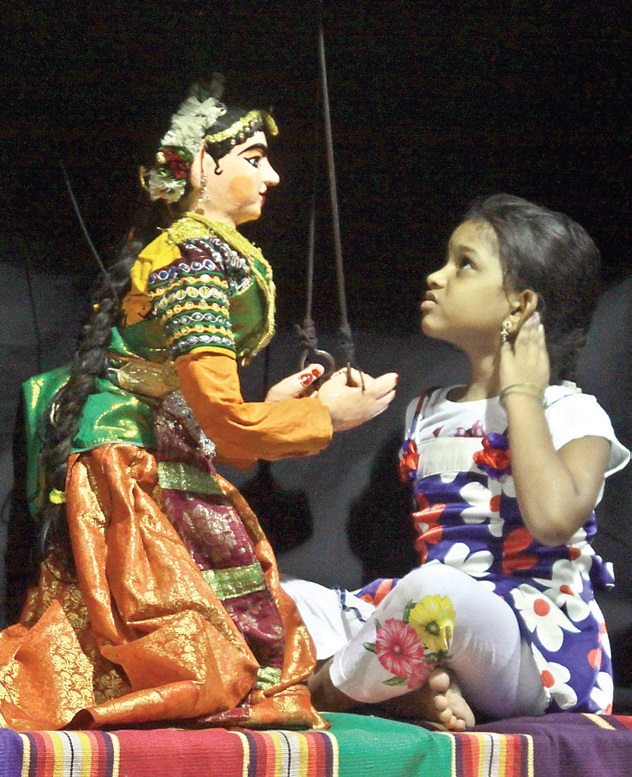
A Bommalattam performance at Rukmani Arundale Auditorium | MARTIN LOUIS
The puppetry show was amusing as the group performed with much precision and perfection. The two-day event featured Tholpavai by Paramasiva Rao, with the story ‘Shoorpanagai Vadham’ being staged on the first day and Murugan Bommalattam Sabha by 90-year-old Shankara Narayanan with Seetha Kalyanam.
One could not predict the age of the artiste, who managed to hold the audiences captive. There was also an interactive session between the artiste and the audience.
Chitra Vishwesaran, member secretary of the manram, said,”Tholpavvai and Bommalattam are dying artforms. We are very particular that these artforms should be nurtured and must be passed on to the next generation, as they are unique. We have been presenting various festivals like these, such as Panchamoorthi Vizha and Purana Nataka Vizha, which were funded.”
Fascinated by the performances, the audience left the auditorium, hoping for more such events in the city.
source: http://www.newindianexpress.com / The New Indian Express / Home> Cities> Chennai / by Express Features / April 06th, 2015
How the city-based spice brand well-known across the world has now reintroduced its products in the country.
In 1920, while India was still ruled by George V and Madras was still a Presidency, Punjab Mittulaul Lalah started a spice business from a small shed in Triplicane. His sisters used to help blend and pack the various masalas, including a curry powder that would make a mark for itself in kitchens all over the world.
Today, the company, known as Lalah’s, operates out of a swanky glass and wood panelled office on TTK Road. Their state-of-the-art factory is in Tiruppur district, with a capacity of 15,000 metric tonnes per annum. The machines might do the roasting, grinding and packaging, but the blending is still done by hand. And that, says Laavanya Manradiar, vice-president of marketing, head of new product development and great-great granddaughter of Mittulaul, is what gives their spice blends a human touch. The fourth generation to be part of the management, she is passionate not only about the history of the company, but also about its future.
“My maternal grandfather, Dowlathram Seth, took over the thriving business after his father. He was a dynamic personality and travelled the world over, taking the brand to 25 countries at a time when ships were the fastest mode of transport. However, he passed away early, when only my mother Jayshree was married, and so my father stepped in and took over the business,” she says. Jayshree and her husband Rajkumar Manradiar, who was from an agricultural family in Erode, worked together to consolidate the overseas business and expanded operations to the 37 countries they supply to now.
After running a software company with her husband Ishwar for a few years, Laavanya joined her parents in the family-owned business in 2012 (she has an elder sister who has settled in Coimbatore and teaches the visually-challenged). She says, “With meticulous planning, my parents put a lot of systems in place. My father believes in quality, service and commitment; he calls them the three pillars on which we function. My mother has a keen business sense, and she personally does the sourcing of our raw materials, which is the most important part of bringing out a quality product.” And 38-year-old Laavanya seems to have inherited that business acumen, as she did her MBA in finance at the University of Hull in the United Kingdom. “Since U.K. is a great market for us, I could actually understand Lalah’s as a brand while I was there. In that sense, I was initiated into the working of the company quite early,” she says.
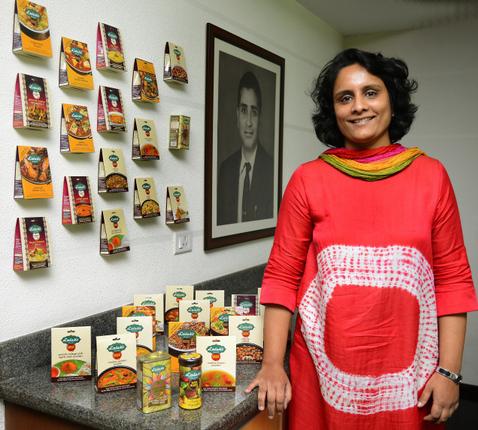
Blending it right Laavanya Manradiar Photo: R. Ravindran
“My focus is on innovation,” Laavanya reiterates, seated in her office with an assortment of Lalah’s products lined up on the shelf behind her. “The most important thing was knowing our competition. We stopped retailing in India in the early 90s, but when we looked into the current market, we felt that the time was right to step in again. In India, only 30 per cent of the spice suppliers are from an organised sector. So on November 30, 2012, we decided that we would bring home not only the products we are best known for, but also a whole new range.”
And so they went back to the drawing board, to rediscover their own product, the original Madras curry powder, which she felt was a “champion” the way people spoke about it. “Even a champion needs to reinvent himself or herself. The market is already filled with region-specific brands catering to distinct palates. We wanted to make our curry powder so versatile that it could be used in any cuisine, from north Indian to south Indian to continental,” says Laavanya.
She was quite astonished that so many people could recall the brand, and more so, when they began singing “Lalah masala, ahaa, Lalah masala”. “We have been asked to bring back the jingle! It showed a lot of goodwill, and to capitalise on it, we took three years of ideating and production before we launched our new line,” she says. With 50 different spice blends and innovative packaging — each 100 gm packet has four sachets of 25 gm each — the revamped range began to retail in stores about a month ago. “Each of the sachets makes enough to serve four people. As it is individually packaged, it retains freshness. In spite of the fact that we don’t use MSG, preservatives or added colours, our products have a shelf life equal to that of other brands in the market.” But she refuses to call the products organic as she cannot vouch for the way the raw materials are grown.
Each packet comes with a recipe, most of which have been written by Laavanya. “We spent a lot of time on recipe development; our chef and I took a month to perfect a sambar recipe. But I also learnt a lot. For instance, we spent weeks trying to get a thick Alleppey fish curry the way restaurants serve it. After some research, I found that, in its authentic form, it was a watery gravy made by fishermen when they were out on their boats,” she says, adding that the recipes have garnered a lot of positive feedback, especially from people who are just learning to cook.
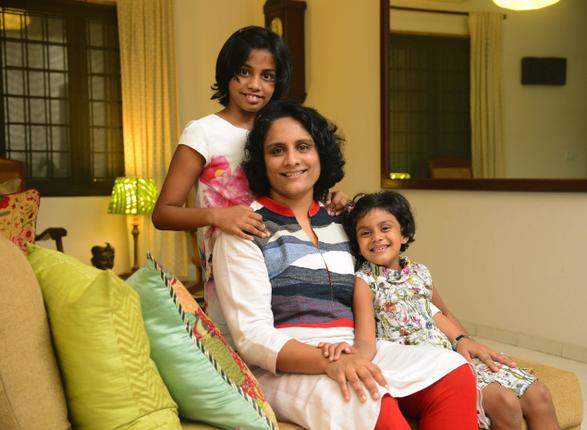
Blending it right Laavanya Manradiar with her daughters Photo: R. Ravindran
At home, Laavanya slips into an easy routine with her two daughters, Shriya (9) and Shakti (5). They read together, and spend more time talking than they do watching TV in the family room which is dominated by a photo wall. She does whip up meals at times, but says that her husband is the better cook of the two of them.
A former National-level tennis player, Laavanya encourages her kids to play sport; the elder one is an ace swimmer already, taking part in State-level meets and setting new records. The little one is quick to inform us that she knows how to bake a vanilla sponge cake, make volcano lava with vinegar and hot water and will one day be a doctor while her sister will be a scientist. Based on Roald Dahl’s Charlie and the Chocolate Factory, she also likes to think that the family factory produces chocolate and not spice mixes. But she also confides, “I like the masalas that amma makes. Punjabi paneer makhni is my favourite.”
The family is excited about their upcoming vacation to the U.S., but Laavanya has her mind more on business and less on Disneyland. “There is so much scope for our brand there, and I will be focussing on expanding our operations. But I am looking forward to going to Wimbledon later this year,” she smiles.
source: http://www.thehindu.com / The Hindu / Home> Features> MetroPlus / by Susanna Myrtle-Lazarus / April 02nd, 2015
Seventeen students from VIT University calling themselves ‘Team Vimaanas’ has been awarded the first position in the Asia-Pacific Region, in the Micro Class of airplanes category at SAE Aero Design international competition held at Lakeland, Florida, USA, competing with 25 other teams from prestigious universities across the world.
Teams from IIT Kanpur, NIT Jamshedpur, Manipal Institute of Technology, McGill University, University of Western Ontario, Polytechnic Institute of NYU and other European and American universities competed in the international competition. VIT chancellor G. Viswanathan while complimenting the VIT team for their achievement, said VIT University encourages students to take part in technical events as they provide a platform for them to broaden their horizons while gaining rich and practical experience.
SAE Aero Design competition is conducted by the SAE (Society of Automotive Engineers)International.
“The contest was to design a micro-class category light aircraft that could hold a cylinder of a six-inch diameter and we began to work on this since September last year,” said Rushat Gupta Chadha, the VIT team captain who is in his fourth year Mechanical Engineering.
Weighing just 330gms the micro plane is capable of lifting a weight almost three times its weight with both wingspans measuring 36 inches and also measuring 36 inches from the tip of its nose to its tail. Although the team from VIT University was adjudged the sixth best team overall, they stood first in the Asia-Pacific Region. With several categories on which the micro planes were judged, the team was awarded the second prize for Highest Payload Lifted, fourth prize for the Highest Payload Fraction, and the sixth prize for Design.
“We got three returns on our investment of hard work. First, we learnt to apply technical knowledge and test them practically. Second, this competition acted as a booster to our morale and confidence. Finally, it is an achievement that probably no other Indian student team has achieved so far,” Chadha said. The team now plans to compete in the Advanced Class category in the same competition.
source: http://www.newindianexpress.com / The New Indian Express / Home> States> Tamil Nadu / by Express News Service / April 02nd, 2015
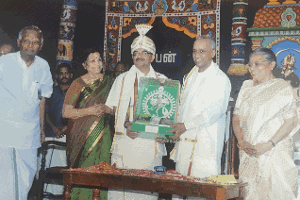
Tarun Vijay receiving famous Kamban Acedemy award from Justice Rama V Subramniyam.
New Delhi :
Tarun Vijay has become the first north India to get famous Kamban Academy award.
The BJP MP from Uttarakhand received the award from Justice Rama V Subramniyam at Karaikudi — the samadhi place of Kavi Chakravarty Kamban, the immortal author of Tamil Ramayana.
This is the first time that the highly prestigious ‘Aruntamizh Aarvalar Award’ is given to any non-tamil person by Kamban Academy.
source: http://www.timesofindia.indiatimes.com / The Times of India / Home> City> Chennai / TNN / April 02nd, 2015
The flower of Crucifix Orchid resembling a ‘Holy Cross’ grown in Nagercoil.
Sixty-three-year-old Stanley Joy Singh of Nagercoil grows ‘Holy Cross’ flowers with passion.
. He developed an interest in growing orchids from his school teacher Robinson Sigamani when he was in standard VIII while on an eco-tour to Pechiparai dam. Since then, the orchids in his backyard have grown in numbers. Today, over 600 varieties bloom in his backyard under shade.
Talking about the ‘Holy Cross’ flower, Mr. Singh says that they display a significant three-lobed lip and resemble a cross. The species originated from tropical and sub tropical USA and the Caribbean Islands. The popular and captivating species is commonly known as Crucifix Orchid.
The Holy Cross flowers bloom for two months in a year in February and March in four colours – orange, red, pink and blue. However, over 100 hybrid varieties of Holy Cross bloom all through the year in different colours.
“The passion flower, Crucifix Orchid, symbolises the passion of Christ for humankind, which consummated in his crucifixion and death on the Cross,” says Mr. Singh.
According to environment educator, S.S. Davidson, the plant is easily cultured at homes in pots as it is a tropical plant.
source: http://www.thehindu.com / The Hindu / Home> News> National> Telangana / by R Arivanantham / Nagercoil – April 04th, 2015