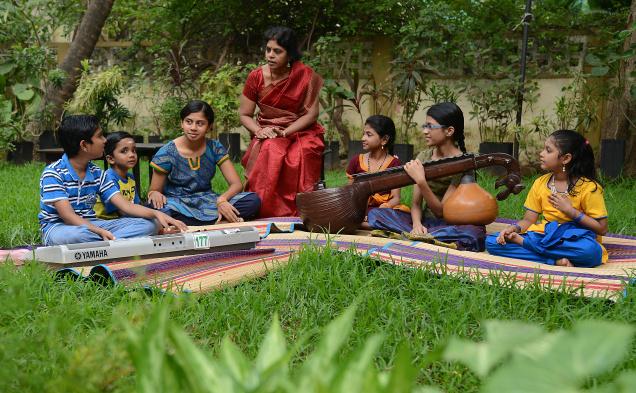
Giving kids a chance: Jayashree Kannan also conducts classes in bhajans and slokas and tell moral stories from mythologies. Photo: K.V. Srinivasan / The Hindu
Coimbatore-based Children’s World Academy to function from Adyar. It will provide stage opportunities to students for free
Wanting to revive her mother’s initiative, Jayashree Kannan, a resident of Kasturba Nagar in Adyar will be inaugurating Children’s World Academy on November 16. The organisation was founded by her late mother Saradha Natarajan at Coimbatore in 1979 to commemorate the International Year of Children declared by the United Nations Educational, Scientific and Cultural Organisation. “My mother was an accomplished Carnatic vocalist and she always felt that budding talents should be given opportunities to perform on stage and Indian forms of art should be preserved,” says Jayashree Kannan.
“In Coimbatore, my mother used to organise nearly five to six concerts in a year and conduct music, dance and drawing competitions on Children’s Day.” She had released a book titled Sangeetha Baala Paadam in Tamil, for children, which dealt with lessons in Carnatic music. “After her demise in 2010, the forum became inactive. Now, I want to take forward my mother’s organisation in Chennai and cherish her passion for art and her interest in teaching,” says Jayashree Kannan.
Like her mother, Jayashree Kannan will be organising classical music and dance concerts. Competitions, lecture-cum-workshops on Indian forms of art will be conducted as well.
“Participants need not pay fee in any form but they will be screened and given an opportunity,” she adds. The Kasturba Nagar Residents Association has promised to offer its support to the initiative by providing its community hall. The inauguration is on November 16 at the community hall in Kasturba Nagar Residents Association, No: 5, Third Cross Road, Adyar. To know about the procedure of participation and other details mail to jsriknan@gmail.com vckannan@yahoo.com or cwaoffinearts@gmail.com. Jayashree Kannan can be contacted at 98418 16134.
source: http://www.thehindu.com / The Hindu / Home> Features> DownTown / L. Kanthimathi / November 08th, 2014
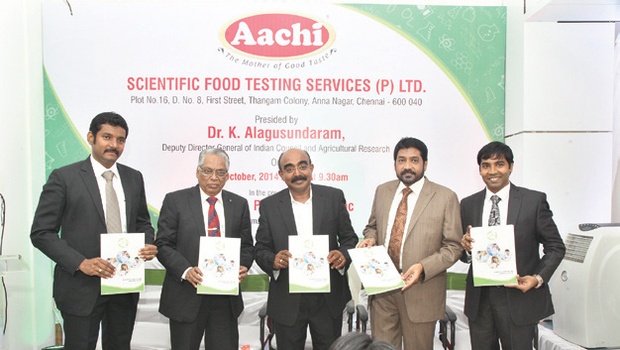
Aachi group launched a state-of-the-art comercial food testing labaratory, Scientific Food Testing Services (STFS), recently.
The laboratory, which is located in Anna Nagar is a boon to all manufacturers and operators in Tamil Nadu and nearby towns, said a press release.
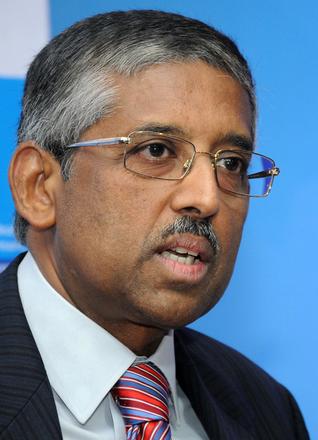
STFS was inaugurated by Dr K Alagusundaram, Deputy Director General, Indian Council for Agricultureal Research (ICAR).
He also released the first copy of information handbook and brochure of Scientific Food Testing Services. The vote of thanks was delivered by Abishek Abraham, executive director, Aachi group.
source: http://www.newindianexpress.com / The New Indian Express / Home> Cities> Chennai / by Express News Service / November 08th, 2014
Thalinji, a small village near Tirupur where electricity is being generated using biomass, is a model for mitigating climate change using renewable resources.
“Four years ago, Tamil Nadu Agricultural University (TNAU) set up a 100 cubic metre biomass plant to generate electricity for 120 houses and 28 streetlights in association with an NGO named non-conventional energy and rural development society,” said S Kamaraj, head of bioenergy department.
The village generates 12 units of power every hour using the biomass plant which is maintained by SAG Federation and women self-help groups. There are seven solar-powered street lights as well.
Eleven scientists from across the country have come together to bring about a change in Indian villages and to give them facilities without disturbing the ecosystem or affecting the climate.
They will participate in the 21 days winter school organised by Agricultural Engineering College and Research Institute in the city and learn methods of using renewable energy to mitigate climate change.
“In Gujarat, there is abundant availability of biomass, so I am looking to learn the various methods of using it as an energy source and implement the most viable one in our state by education the students and researchers there,” said Modi Vijayesh Mahendrabhai, assistant professor, Sardarkrushinagar Dantiwada Agricultural University, Gujarat.
A participant from Raipur is looking forward to learn the latest technologies and replicate them in tribal villages in Vellore district.
“We are working on a project on using wasteland and waste water to create an algae and extract bio-fuel from it. This winter school will definitely give us more insight to our project,” said S Joshua Davidson, assistant professer, KVK, Vrinjipuram, Vellore.
With India generously being endowed with renewable resources, there exists a potential of the order of 80,000 MW, according to Ministry of New and Renewable Energy.
“At present the total renewable energy based power generation in India is 28,000 MW out of the total 2,30,000 MW which works out to be 12.7% only,” said K Alagusundaram, Deputy Director General, Indian Council of Agricultural Research.
With concerns for environmental protection and climate change increasing, the importance of renewables for power generation is attracting greater attention, he added.
TNAU vice chancellor K Ramasamy said that that biomass availability in the state should be identified and a data bank should be created.
“Energy plantations and bio mass processing industries should be promoted to promote energy efficient technologies for biomass based power generation,” he added.
source: http://www.timesofindia.indiatimes.com / The Times of India / Home> City> Coimbatore / by Komal Gautham, TNN / November 07th, 2014
V. Sundaram, former Indian Administrative Service (IAS) officer who became prominent after his controversial stand on the coal import issue in the early 1990s, died at his residence in Chennai in the early hours of Friday after a brief illness.
He was 72. He is survived by three daughters.
A native of Tiruchi, Mr. Sundaram was a post-graduate in economics from the Delhi University. He briefly worked in the University before joining the IAS in 1965 at the age of 23 years.
He served as Collector of the undivided Tirunelveli in the mid-1970s and subsequently, became the first Chairman of the Tuticorin Port Trust.
source: http: thehindu.com / The Hindu / Home> News> Cities> Chennai / by Special Correspondent / Chennai – November 07th, 2014
Several African countries have been taking advantage of India’s expertise in the leather sector and the latest to join the bandwagon is Botswana. Scientists from Chennai-based Central Leather Research Institute (CLRI), who have already been offering expertise to the governments of Sudan, Egypt and Ethiopia, will now help establish a leather park in the land-locked country in southern Africa.
A survey will be conducted and a feasibility report submitted. CLRI bagged the project based on a proposal sent to the government of Botswana three months ago.
“It is a $30,000 project. The park the Botswana government will be setting up would be a full-fledged industrial complex. It will be similar to the one we have in Kolkata but in terms of size, it will be smaller than the one we have here,” said Dr B Chandrasekaran, chief scientist, Centre for Human and Organisational Resources Development, CLRI.
He said a team of experts from the CLRI would conduct a large-scale survey in the African country and a feasibility report would be submitted to its government in three months time. “It is basically taking stock of the situation. The survey will include the animal and human population, meat-eating habits, raw material use, import and export of hides (animal skin), machinery, manpower and status of industries. The report will also suggest suitable location and all that is needed to set up an integrated park,” said Chandrasekaran.
CLRI has already been providing advice to other African countries, including Ethiopia, where they have been working on an 24.4 crore project to develop a leather Institute. They have also offered expertise in developing academic curriculum and investments in the field in Egypt and Sudan.
“Manpower in India and China is no more cheaper and manufacturers are looking to Africa as the next hub. That is the case in any sector. In Botswana, too, we can, in the future, play a role in establishing institutions for manpower development for the park,” Chandrasekaran said and added that offering expertise would also help in expanding India’s commercial relations.
source: http://www.timesofindia.indiatimes.com / The Times of India / Home> City> Chennai / by U. Tenonmayam, TNN / November 04th, 2014
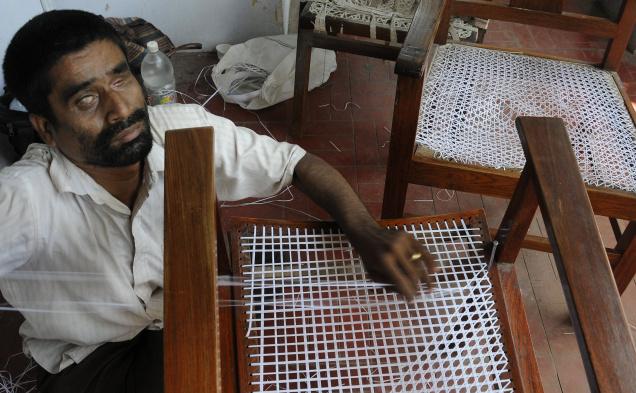
K. Nandakumar says the only requests for repairing wire seats come from offices. Photo: M. Srinath / The HIndu
Chairs with wire seats, which were once seen in every household, are used only in a few offices now
Until a decade ago, weavers who deftly stretched and twisted cane fibre with nimble fingers to make a chair seat in a few hours, were a common sight. But, not anymore.
The art of making such seats is slowly dying out as people prefer to purchase new chairs instead of getting them repaired. This has forced many weavers to look to other professions. An example is 36-year-old visually challenged K. Nandakumar, who now sells books and plastic utensils on trains to support his family.
The services of weavers like him are in demand only in a few government offices where cane chairs are still in use. “Earlier, I used to be called to households too. Today, I get to work only at places such as the Egmore Court and Chennai Metropolitan Water Supply and Sewerage Board offices,” he says.
Such furniture was very popular in the 1970s. “People now prefer metal and wood as they are easy to maintain. But, cane and wire seats are comfortable and do not generate heat,” he says.
Nandakumar did a one-year course in chair weaving in Uttar Pradesh in 1997. “It takes nearly five hours to weave a chair and I get Rs. 250 to Rs. 300 for a seat. It is difficult to work on more than two seats per day,” he explains.
R. Sekar, head clerk at Egmore Court, who has called Nandakumar to repair chairs for the complex, says weavers are rarely seen these days. “It is especially hard to find someone who does it with finesse,” he adds.
source: http://www.thehindu.com / The Hindu / Home> News> Cities> Chennai / by Vivek Narayan / Chennai – November 05th, 2014
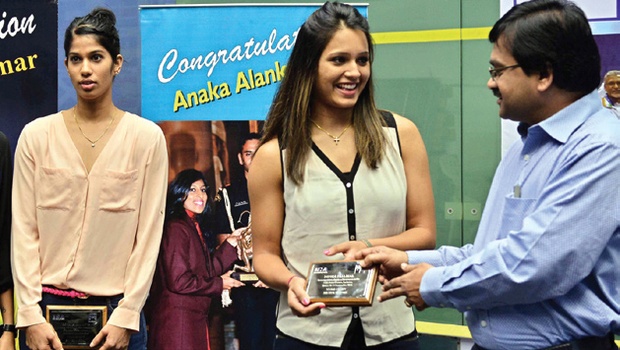
Squash stars Dipika Pallikal (centre) and Joshna Chinappa (left) being felicitated by the federation in Chennai on Friday | P JAWAHAR
Chennai :
Injuries are not always career stalling, though it’s an aberration than rule. While many eventually concede to the overwhelming reality that their career would never be revived, some just pick themselves and return recalibrated.
There wouldn’t be a better example in Indian sport than Sachin Tendulkar, who in his career that spanned a remarkable quarter century defied intermittent spells of career-threatening injuries. Joshna Chinappa is no Tendulkar, whichever sporting yardstick you measure them with, but like the master she has turned a career-threatening injury into a springboard to rediscovering herself.
It was in mid 2012 that she sprained her ankle midway through a match. She was stretchered off, and the doctors confirmed her worst nightmare that she wouldn’t be able to play the game she had given her heart, body and soul. An anterior cruciate ligament seemed to have laid her path out of the game.
The World No 21 returned to India heartbroken. “A lot of doctors, even in the US, told me that I won’t be able to play squash again. I couldn’t even think of it. All my dreams, aspiration and hopes seemed over. I didn’t know quite what to do and I used to cry a lot every day. It was the toughest phase of my life,” she said.
But misery, sometimes, has the strange power to embolden you, and Joshna decided to fire-fight the cruel destiny. “I was 26 and I knew it was now or never. If I don’t recover now, I may never play squash again. I didn’t want to regret later in life. So I decided to give one last shot. The knee was operated and the rehabilitation began,” she recounted.
Suddenly, life, despite the screeching pain on her ankle, turned more pleasant. And a chance meeting with former national champion Ritwik Bhattacharya turned her life around. “I was doing my rehab in Mumbai when I bumped into Ritwik and his wife. I told them about my situation. They infused the belief that I could come back stronger. To convince me, they had to counsel, cajole and event taunt me.”
Gradually, life limped back to normalcy. “It took me almost 10 months to get back on to the court. But I didn’t hurry my return. It was like starting the career all over again and gradually my movements became more fluent. The confidence was back. But in the first six months, I kept losing. But I was just happy to be back on the court,” she reflected.
In hindsight, the injury proved career-defining. “Now I feel it’s the best thing to have happened to me. Maybe, it gave me a much-needed break. It made me value my life and career all the more,” she said.
Maybe, it’s this newfound positivity that has revitalised her game. Subsequently, she went on to script history with Dipika Pallikal in the Commonwealth Games, besides the team silver in Asian Games and achieving her career-high ranking of 19 in April.
Joshna’s story can motivate injury-plagued athletes, but it comes with a statutory warning: only for those strong in mind.
source: http://www.newindianexpress.com / The New Indian Express / Home> Sport / by Sandeep G. / November 01st, 2014
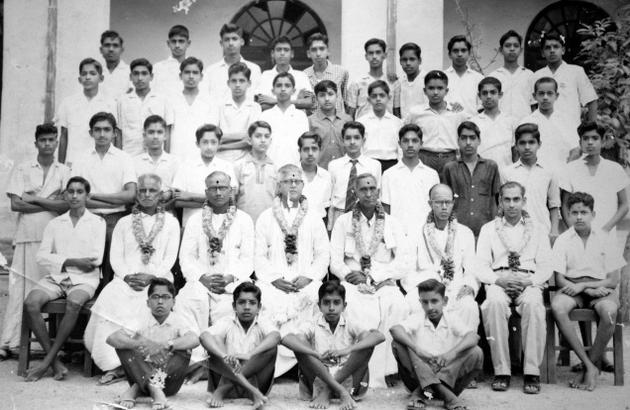
One for the album: A group photo of one section of the 1965 SSLC batch. / by Special Arrangement
Students of the 1965 batch of P.S. High School are scouring the city for their old buddies.
The 1965 SSLC batch of P.S. High School, Mylapore, has understood the spirit of reunions, which is about honouring old ties. A small group of these old students are leaving no stone unturned in finding out the whereabouts of the rest of their friends from the batch.
This group, which is on the job, has the contact details of only 40. Not a happy number, considering the batch had eight sections with 250 students. As the reunion is scheduled for January, 2015, they don’t have much time left to trace the rest of them.
“Target setting is the order of the day and each of us has to locate four to five classmates,” says M.S. Sundararajan, former chairman and managing director of Indian Bank, who is the president of the old students committee.
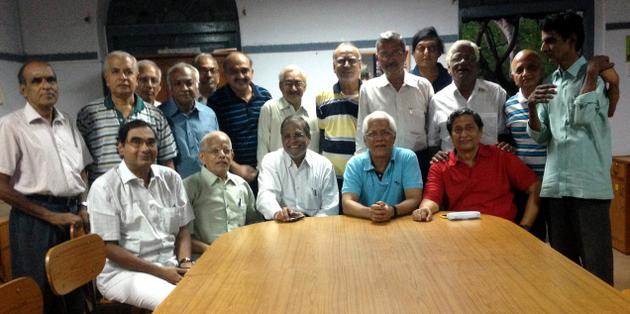
Some of the batch mates at a recent get-together. / by Special Arrangement / The Hindu
The goal is to locate 100 to 150 classmates before the reunion, planned to be coducted on the school founder’s day. Currently, the majority of the 40 identified batchmates are from ‘B’ section and the committee is looking for at least two people from the other sections who can help with the contacts of the others.
Sundararajan, a resident of Ambujammal Street at Alwarpet, says he is excited at the idea of the entire batch meeting after 50 years. He vividly remembers Sivaraman Street, where a few of his classmates used to come from. He plans to revisit the area in search of his friends.
K. Muralidharan, who created the pages on social networking sites to connect with the old friends, has little hope of locating people through Facebook or Twitter. “It looks like not many of my batchmates are tech-savvy. I have therefore decided to go to various streets,” he says.
Recently, he went to Luz Street and tried to get details of a few from a stationery store. “Some even shy away from attending the reunion for various reasons,” he said.
Not many of the teachers who taught the batch are alive, so the reunion will be a success only if a good number of old students turn up.
A souvenir has been planned for the occasion. To get in touch with the group, call Muralidharan at 98840 27239 or email jhamuna@gmail.com
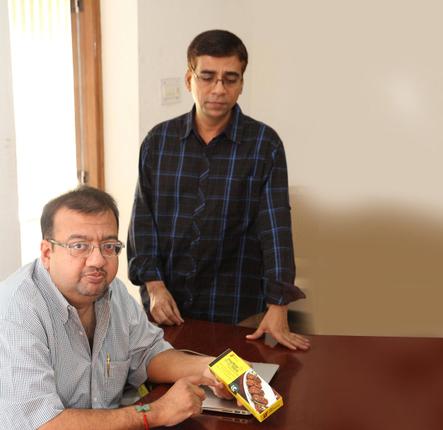
RU Srinivas (left) and Rajan, founders of Idli Factory, in Chennai. – N. RAMAKRISHNAN
Chennai-based Idli Factory sells up to 200 boxes a day
For a large part of his professional life, he was working for overseas clients. But when RU Srinivas decided to turn an entrepreneur, he wanted to do something for the domestic market. His argument: not too many people were taking the domestic consumers seriously enough.
And, being a self-confessed foodie, what better than get into the food business, catering to consumers at home. The dish that he decided to serve them: the ageless and timeless idli, re-shaped, packaged and served to eat on the go.
As to why the focus on the domestic market, a peek into Srinivas’ career provides the insight. He studied for CA during the day and attended evening college for a B.Com degree, then studied M.Com by correspondence, went to the US for an MBA and worked in a bank in Boston for three years as a loan analyst. He returned to India in 1993 and worked for companies that would allow him to, as he says, “have one foot in India and one foot in the US.”
He was largely in the IT/BPO space with his last job being CEO of Caliber Point, the BPO arm of IT company Hexaware. His job meant that he had to travel a lot and found that being a vegetarian, food was a major limitation. “It was beginning to get a little tiresome and I wasn’t enjoying myself as well. I decided to quit and do something else,” says Srinivas, in his first-floor office in the same house he grew up in, in what was once a quiet residential part of Chennai. The ground floor serves as his “factory”.
Triggering point
But the trigger, he says, for getting into the food business and deciding to make idlis was a trip to a restaurant in Chennai, when he had to fork out ₹77 for a plate of idli. He thought that was exorbitant and without any reason. He realised that a large part of the cost was the real estate and salaries for the numerous waiters hanging around, all of which were getting billed into his idli.
So, even as his mind was made that he would get into the food space, he was sure that he would not set up a restaurant, but would have a central kitchen and thus substantially minimise the real estate cost. This obviously meant that the food could be enjoyed even if it was not hot. His mind went back in time, to the train journeys that his mother and grandmother would go on, when they would pack food that would last the entire journey. And, one of the items was the idli, which would be made fresh, soaked inmilagai podi (chilli powder) mixed in gingelly oil. The longer it soaked, the tastier it would be. Bingo, he had the dish that he would make in his central kitchen and sell. And, thus was born his venture Idli Factory, which he started with friend Rajan.
Various combinations
The two partners tried various combinations of rice and urad dhal, till they were convinced that they had got it absolutely right. Both were keen that they make something that was world class. But, then Srinivas felt that the “idli market needed some shaking up.”
They thought the easiest thing would be to change the shape of the idli. Only later did they realise that this was easier said than done. Moulds to make idlis were available only in the circular shape. For good reason, they realised. “Getting the right sort of mould was a nightmare. It is only then we realised the wisdom of the current shape, because you are able to scoop it. After a lot of effort, we worked on a mould that allowed us to get consistently shaped products,” says Srinivas.
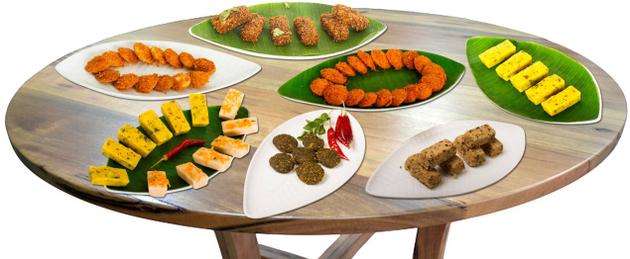
Srinivas and Rajan persisted and then came up with a rectangular shaped idli, coated with milagai podi(chilli powder) mixed in gingelly oil. What did they call it? Madras Bars. Then there were the small, circular mini idlis coated in curry leaf powder and garlic, branded Madras Roundtana. Srinivas credits the Chennai-based Firebrand Labs, which he says is “our marketing arm for the branding and packaging.
“They have been pretty much joined with us at the hip right from the beginning.” It was in April that Idli Factory took off. The products are available only in Chennai through select retailers. They sell up to 200 boxes a day and can make around 1,000 boxes a day if there is demand. Srinivas would like to get into other similar traditional foodstuffs that are popular in different regions.
Challenges
But he is aware of the challenges. Distribution and shelf-life are a challenge. The idlis do not have any preservatives and though they can last for a couple of days, retailers prefer to return unsold boxes the next day. “Is there some way where I can work on the packaging to improve shelf-life without adding anything, without altering the composition of the products,” wonders Srinivas.
How does he reach out to more retailers in the city, especially when he offers an attractive 20 per cent margin? Is there somebody else in a similar business? Can he pool logistics resources with them, he asks, listing out the challenges.
Spreading beyond Chennai would mean that he should either set up central kitchens in different cities or adopt the franchise model. “Is franchise the right route? I don’t know,” confesses Srinivas. “We seem to have made a mark by being paranoid about quality. Can I expect the same sort of thing? Do I know how to drive quality in a remote location in manufacturing? All our lives, we have driven quality in remote locations. But this is a new game for us,” he says, adding that both Rajan and he are in the process of learning and growing their business.
source: http://www.thehindubusinessline.com / Business Line / Home> Features / by N. Ramakrishnan / November 03rd, 2014
V. Mohan, chairman and chief diabetologist of Dr. Mohan’s Specialities Centre, has published 870 research papers in high-impact journals and textbooks — Photo: Bijoy Ghosh / The Hindu
The Fellowship of The World Academy of Sciences was recently conferred upon city-based diabetologist V. Mohan.
This is one of the most prestigious science awards and is conferred annually on top scientists in various disciplines, globally, according to a press release.
Dr. Mohan, chairman and chief diabetologist of Dr. Mohan’s Specialities Centre, has published 870 research papers in high-impact journals and textbooks and his work has received 23,813 citations till date.
He is one of the few practising medical doctors in the world to be conferred this prestigious fellowship, a press release said.
The award was presented to him at the 25th general meeting of The World Academy of Sciences held in Muscat on October 27.
source: http://www.thehindu.com / The Hindu / Home> News> Cities> Chennai / Chennai – November 02nd, 2014