Donkey’s milk still available for needy

Trichy :

It seems there is still a demand for donkey’s milk. A group from Cuddalore district could be seen on Trichy’s streets on Friday selling it fresh and direct from the animals.

The milk vendors accompanied their animals while looking for consumers who believe in its efficacy. They walked with the donkeys under the scorching sun.

It is said donkey’s milk has medicinal value and can boost the immunity level of babies. Several people feed babies a small quantity of donkey’s milk, though doctors don’t dispute it.

Speaking with the donkey owners, who are from Thozhudhur in Cuddalore district, revealed a few interesting nuggets about their business. They buy jennies or female donkeys from Eral in Tuticorin district and Sithayankottai in Dindigul district where donkeys are reared for this purpose. One donkey alone costs Rs 15,000, a member said.

The group chooses one district a day to sell the milk. The members start their day early in the morning and chose semi-urban areas. They get up to 100 ml to 150 ml milk from a donkey every day. Selling a small quantity for Rs 30, they can earn up to Rs 300 to Rs 500.

On Friday afternoon, they moved to Samayapuram after the day’s business. They expect a good sale in Samayapuram too.

Usually, the milk sellers do not stay in one area for more than a day and they cover almost all parts of Tamil Nadu. Occasionally, they visit their village.

source: http://www.timesofindia.indiatimes.com / The Times of India / Home> City> Trichy / TNN / May 03rd, 2014
TAMBARAM : Free, unlimited buttermilk for the thirsty

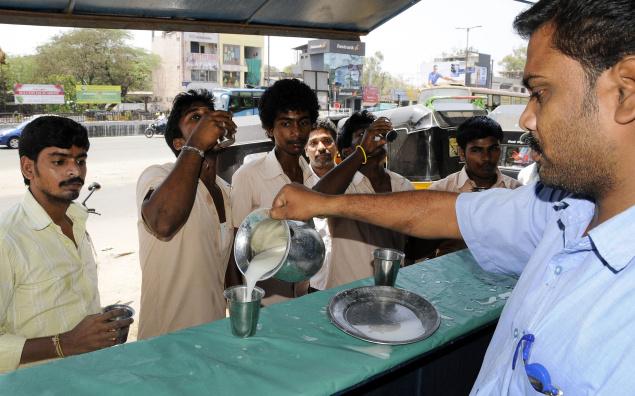
Noble gesture: The shed set up by Gayathri Trust near Chromepet bus station. /  Photo: G. Krishnaswamy / The Hindu
Noble gesture: The shed set up by Gayathri Trust near Chromepet bus station. / Photo: G. Krishnaswamy / The Hindu

Many an organisation in the city provides free water and buttermilk to the thirsty during summer. Here is an organisation which does this service a bit differently: they provide an unlimited supply of free butter milk. At 11 a.m. every day, people throng the stall put up Sree Gayathri Trust, Chromepet, to give way the buttermilk.

“It’s our way of helping people get through summer. Buttermilk, apart from quenching thirst, is also good for health,” says G. Raghavan, founder, Sree Gayathri Trust.

The stall was set up on Monday (April 21) in memory of professor S. Narasimhan of Madras Institute of Technology, Chromepet.

“The stall will be around till the end of May. Every day, around 300 litres of buttermilk will be served free, and I ensure that quality and hygienic buttermilk is served,” says Raghavan. The buttermilk is laced with curry leaves, coriander, salt and asafoetida. The Metropolitan Transport Corporation bus drivers halt their vehicles to have buttermilk in bottles. Daily around 600 people visit the stall, which is open from 11 a.m. to 2 p.m.

“Sweating, tiredness, muscle cramps, nausea and headaches would reduce significantly if buttermilk is consumed. Very soon, I am going to distribute free curd rice packets for people to beat the summer,” he says.

B. Raja, an autorickshaw driver, and a resident of Pallavaram says, “This buttermilk served here is tasty. Whenever I drive through this area, I make it a point to stop at the stall.”

People from Pallavaram, Tambaram and Tambaram Sanatorium are also regular to the stall. Those who want to contribute towards this work, can contact G. Raghavan at 044 22654777 or at 9444022033.

source: http://www.thehindu.com / The Hindu / Home> Features> Downtown / by T. S. Atul Swaminathan / Chennai – May 01st, 2014

Broomstick fest held in Theni district to bring harmony in family

Madurai :

A village near Andipatti in Theni district recently celebrated a bizarre festival where the brother-in-laws or cousins in a family thrashed each other with brooms to overcome their differences and bring harmony.

This ritual is held as part of the festival of the 100-year-old Muthalamman temple in Maravapatti near Andipatti. Every year, the brother-in-laws, usually the married men in the family and their brothers take part in this ritual.

According to Muthuraj, an elderly man in the village, the ritual is being practiced for more than a century now to solve disputes. “Disputes are common in almost every family. When a girl married and sent to her in-laws hose, there are instances where the brothers of the girl and her husband refrain from talking to each other over small disputes. This broom ceremony helps to solve such issues,” he said.

On the day of the festival, the brother-in-laws beat each other with the brooms and finally end up hugging each other. It was interesting to watch the men dressed in their worst attire being hit by others. They were rolled on the wet ground and the crowd gathered was laughing to their fullest. Large crowds from the neighbouring villages too gathered witness the event.

Periyathai, a villager, said, “If the bridegrooms are villages, which doesn’t follow such ceremonies, we inform them well in advance before the marriage as it is believed that participating in the festival also enhances family ties. There have also been instances where the mothers of the bridegrooms have called off the wedding arrangements because they believe their sons are above the rest,” she said.

On Tuesday, the men gathered in the village armed with brooms, many had even bought new ones as they did not want to offend their opponents, and started hitting each other with it.

The women in this village do not get very upset when some dispute arises because they know it would be solved in the next festival.

source: http://www.timesofindia.indiatimes.com / The Times of India / Home> City> Madurai / by Padmini Sivarajah, TNN / May 02nd, 2014

Su-Kam installs solar power system in houses in Tamil Nadu

Power back-up solutions provider Su-Kam Power Systems has installed solar power systems across 10,000 houses in seven districts under the Tamil Nadu  Chief Minister’s Solar Powered Green House Scheme in the State.

The company would be undertaking an additional 2,500 solar installations under this project by end of this month, Su-Kam Power Systems said in a statement.

“We are pleased to work for TEDA (Tamil Nadu Energy Development Agency) and provide them a customised solution to harness solar energy to meet basic power requirements in rural homes”, Su-Kam Vice-President Solar projects, Ashish Sethi said.

As per the Tamil Nadu Chief Minister’s Solar Power Green House scheme, three lakh houses would be constructed with solar power lightings over a five year period from 2011 to 2016.

“In addition to the above installations, TEDA has assigned us the project for installing solar power systems in 27,700 additional houses in the next phase of this project”, Sethi added.

Su-Kam has six manufacturing facilities and over 30,000 dealerships in the country, the statement added.

source: http://www.business-standard.com / Business Standard / Home> PTI Stories> National> News / Press Trust of India / Chennai – May 02nd, 2014

Swelect commissions solar park

Coimbatore :

Swelect Energy Systems (SWEES) is betting big on solar energy. The company has commissioned its 15MW solar energy park set up with an investment of 106 crore near Vellakoil in Karur district .

After setting up over 1,500 rooftop projects across the country, the company has established the modular energy park. Swelect, which makes solar PV (photovoltaic) modules and converters, owned 12MW of the plant and 3MW capacity of the installation is owned by two other companies— Yajur Energy Solutions and Amex Alloys, a leading steel foundry.

Stating that the project was one of the few truly modular energy parks, with the composition of 5 X 33 bays to feed three energy generating systems, R Chellappan, managing director, Swelect said that on an average 75,000 units of power being is generated, with 5,000 lesser units being produced during a very cloudy day.

The park has been set up on 75 acres and the company would expand it on the 75 acres adjacent owned by it depending on requirements, he said.

source: http://www.timesofindia.indiatimes.com / The Times of India / Home> Business> India Business / TNN / May 02nd, 2014

History, architecture and more: stories behind HC

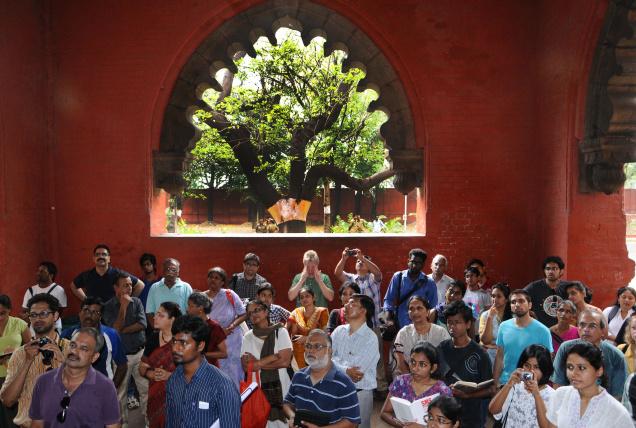
Heritage walks on the Madras High Court campus will be held on the second Sunday of every month — Photo: R. Ragu / The Hindu

On a carpet of withered leaves, under the shadow of a century-old building, a group of architecture and history lovers listened with rapt attention the stories the walls of Madras High Court had to tell, on Sunday.

“Just next to the lighthouse (constructed in 1838) where we stand, there used to be two temples. Water from the temple tanks were brought by priests and witnesses deposed had to touch the water and take oath,” said M.L. Rajah, advocate and member of the Madras High Court Heritage Committee, to participants of the High Court heritage walk. Later, the temples were shifted out of the complex, he said.

As the group strolled from one building to another, interesting anecdotes and stories behind the architecture unfolded.

“The buildings of the High Court, including the law college and the lighthouse, are exuberant examples of Indo-Saracenic architecture that display an amalgamation of Islamic, Moorish, European and Hindu styles, among others,” said Sujatha Shankar, architect and convenor of INTACH (Chennai chapter).

They also show how public buildings have been used to convey political messages; and what better way to communicate them than through architecture, she said.

After a glimpse of the architectural marvel of these buildings, Mr. Rajah led the crowd to the next stop: the statute of Sir V. Bhashyam Iyengar, the first Indian acting advocate-general.

“He had a morbid desire to die while arguing a case; and incidentally, during a court proceeding, when he felt uneasy, he walked up to the statute of Sir T. Muthuswami Iyer, and passed away,” he said.

The group then walked through the Madras High Court museum, the Madras Bar Association and ended the tour at the magnificent court halls.

Ann Neuman, a 45-year-old writer from New York who arrived in Chennai a week ago, seemed visibly excited after the walk.

“My friends specifically asked me to not miss this walk. It is wonderful to hear the history of the court systems here and what it has done to the city,” she said.

The heritage walk initiated by the Madras High Court Heritage Committee will be held on the second Sunday of every month. For details, contact: 9841013617.

source: http://www.thehindu.com / The Hindu / Home> News> Cities> Chennai / by Sunitha Sekar / Chennai – May 12th, 2014

Android App on Women safety Brings Award for VIT Student

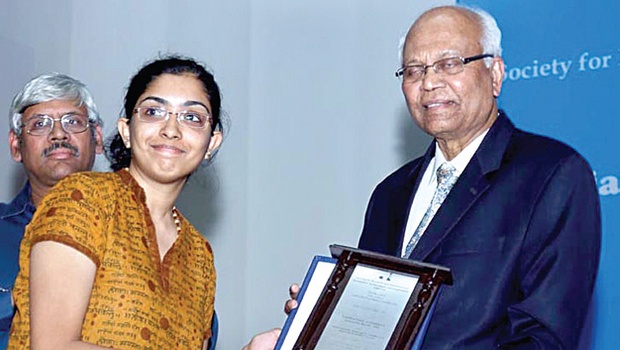
Mithila Harish receiving the Gandhian Young Technological Innovation Award from Dr R A Mashelkar, Chairman, SRISTI, at a recent function in IIM-Ahmedabad | express

A final year student of Vellore Institute of Technology (VIT) Mithila Harish has developed a mobile app for women’s safety and has bagged the Gandhian Young Technological Innovation (GYTI) Award for it.

Studying B Tech in Electronics and Instrumentation, Mithila said she was concerned over the growing danger to women and children as  they were being subjected to kidnapping, acid attack, rape and extortion and wanted to help them using the tools of technology. The distressing situation can be both mental and physical.

Along with a professor who was her guide, the student developed a voice-activated app on the Android platform that would help women in distress by providing the location information through an SMS to trusted emergency numbers stored in the mobile phone. “This would certainly help improve the chances of detection and prevention of crime,” she told Express.

The app recognises voice command of the user. Supposing a woman screams a keyword such as ‘danger,’ the app would automatically alert the emergency number. The app is a combination of early warning and tracking services aimed at providing a degree of succour. Broadly, its functionality spans situation-sensing, situation-recording locally and situation- broadcasting.

The biggest strength of the tool is that the solution aims at providing  both the obvious and simple features such as GPS-tracking and the more subtle and complex ones such as phrases recognition, probabilistic tracking and device-hopping solutions.

“I faced conceptual and methodological challenges in implementing the advanced technology in the app. Keeping battery and memory capacities of the phone are some of the  practical issues,” she noted.

source: http://www.newindianexpress.com / The New Indian Express / Home> States> Tamil Nadu / by V. NarayanaMurthi – Vellore / April 30th, 2014

Railway workshop sets a new benchmark

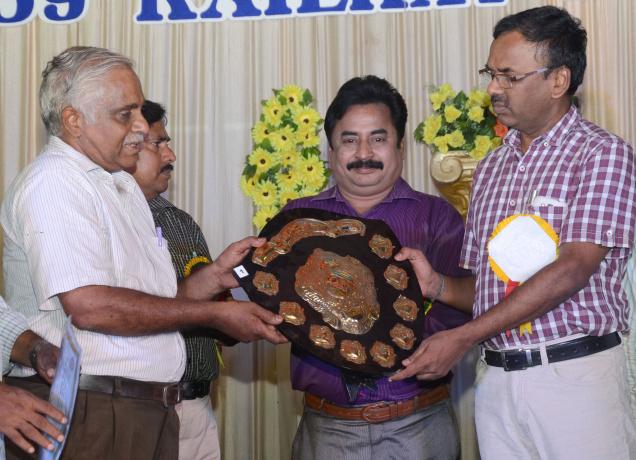
V. Selvam, right, Chief Workshop Manager, Golden Rock Railway Workshop, giving away the Best Communication and Technical Development Award to G.S. Gopalakrishnan, Senior Section Engineer, in Tiruchi on Tuesday. / Photo: R. M. Rajarathinam / The Hindu

988 coaches overhauled in 2013-14; orders bagged for 1,000 low container wagons

The Golden Rock Railway Workshop here had created a record in periodic overhauling (POH) of passenger coaches in the 2013-14 fiscal, its Chief Workshop Manager V. Selvam said on Tuesday.

The workshop had carried out period overhauling of 988 coaches in 2013-14, including 144 air-conditioned coaches as against 924 coaches in the 2012-13 financial year, Mr. Selvam said speaking at the 59 Railway Week celebrations organised by the workshop here.

Highlighting the achievements of various wings of the workshop, Mr. Selvam appreciated the officers and employees for their joint effort in surpassing the targets.

The workshop had bagged a fresh order for the manufacture of 1,000 bogie low container wagons from the Container Corporation of India (CONCOR) at a cost of Rs. 315 crore. The CONCOR had deposited Rs. 74 crore to the Railways in this regard, Mr. Selvam said.

Due to power conservation measures, the electrical wing of the workshop had saved 24,341 units of electricity.

There were no electricity-related accidents in 2013-14 in the workshop because of effective power management measures, he said.

Mr. Selvam said the workshop had bagged the General Manager’s Green Shield Award for the fifth time and another award for ‘Best Maintained Extra Division Office (Major)”.

Certificates were presented on the occasion to a number of 961 workshop employees in appreciation of their outstanding performances.

source: http://www.thehindu.com / The Hindu / Home> News> Cities> Tiruchirapalli / by R. Rajaram / Tiruchi – April 30th, 2014

When the red flag first flew over Chennai

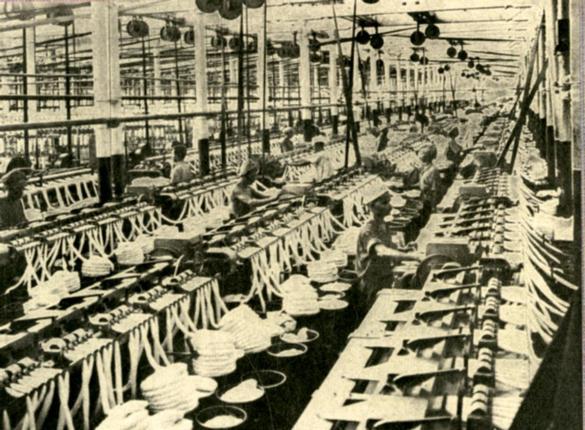
The Making of the Madras Working Class./  Photo by D. Veeraraghavan / The Hindu
The Making of the Madras Working Class./ Photo by D. Veeraraghavan / The Hindu

High Court and Napiers Park saw the country’s first May Day celebrations

On the evening of May 1, 1923, as factories across the country were winding down for the day, labourers of Madras city revelled in the first recorded May Day celebrations of the country at Triplicane Beach. Legend has it that it was in the celebrations near Madras High Court and Napiers Park that red flags were first unfurled.

The events which led up to this day reveal a dramatic story which saw the city becoming an arena where volatile class wars were waged.

India’s first organised labour union was born near the Perambur Barracks in the vicinity of the Buckingham and Carnatic Mills of Madras. Selvapathi Chettiar and G. Ramanjalu Naidu, shopkeepers whose shops were patronised by millworkers, on hearing about the appalling working conditions in factories, resolved to form a union.

Providing the historical context, A. Sounderajan, CPI (M) MLA of the Perambur constituency, says, “Workers were treated like slaves in the mills. With the end of the First World War in 1918, the management revoked concessions it had granted for uninterrupted production. Discontent was high but news of the Bolshevik Revolution in Soviet Russia instilled hope.”

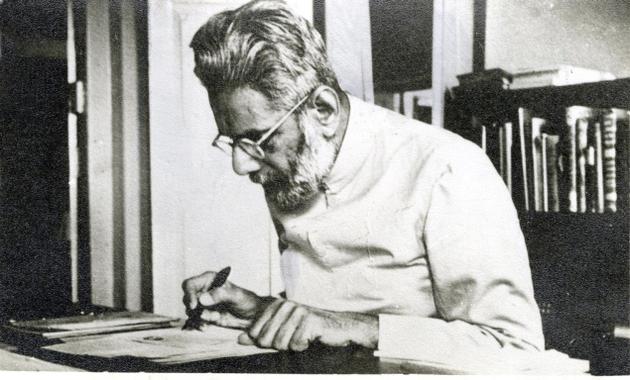
The specific incident which propelled action was the plight of a B&C millworker who was left no choice but to soil his work station on being forbidden a break to relieve himself. Outraged at the humiliation meted out to a fellow worker, as many as 10,000 employees of Carnatic mills, Perambur Works and other factories assembled at the Janga Ramayammal Garden at Stathams’ Road in March 1918. TV Kalyanasundara Mudaliyar (Thiru Vi. Ka.) editor of Desa Bakthan, and B.P. Wadia the Parsi theosophist, over the next month, delivered a series of lectures on the need for collective action by labourers. Finally, on April 27 1918, the Madras Labour Union (MLU) was launched with B.P. Wadia as its first president.

B. P Wadia, the first president of the union. / The Hindu

Five years after the first labour union in the country was inaugurated, Singaravelar Chettiar, a labour activist commemorated May Day. Urging Indian labourers to join in the celebrations, he said that the occasion would serve as a source of strength as on this day, workers across the globe would unite in a show of power.

One can only imagine Napiers Park and Triplicane resounding with stirring union sloganeering — Reduce working time! Better Wages! More Leave!

source: http://www.thehindu.com / The Hindu / Home> News> Cities> Chennai / by Nitya Menon / Chennai – May 01st, 2014

T NAGAR : Play with clay

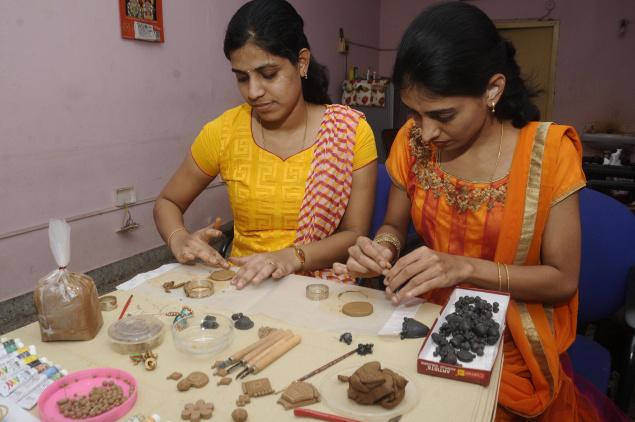
Supraja Saikumar (right) and Saranya Damodaran. / Photo: M. Srinath / The Hindu

From creating terracotta jewellery for personal use, Supraja and her sister are now teaching the art to others. Vipasha Sinha meets the duo

Terracotta jewellery has found a special place in every woman’s life. It is eco-friendly, colourful and goes with almost everything. Cashing in on the trend are Terracotta sisters who organise regular workshops in T. Nagar.

Supraja P. Sasikumar and Saranya Damodaran learnt the art of terracotta jewellery-making so that they could make their own jewels. Eventually, they decided to teach others the art.

“I’ve always been passionate about jewellery and keep up with the latest fashion. I heard about terracotta jewellery and wanted to learn how to make it. I joined a class three years ago,” says Supraja.

She regularly made jewellery for herself and people always took notice of her accessories.

“Making a piece of jewellery for oneself is different from teaching others. I prepared for three months and my sister helped me out. I am a research scholar and a professor at Adhiparasakthi Engineering College. It is the teaching instinct that led me to do research before starting my classes. Since a year ago, we have been conducting regular classes during the weekends and teaching anyone above the age of eight. We have taught around 350 students,” she says.

At Supraja’s workshop, one can learn to make varieties of studs and jhummkas, anklets and she also teaches how to make Ganesh idols out of terracotta. “The session is inclusive of designing and painting,” she says.

The workshop is held every weekend at 101/35 Bazullah Road, T. Nagar, next to Vivek and Co. For details call 7708752662.

source: http://www.thehindu.com / The Hindu / Home> Features> Downtown / by Vipasha Sinha / Chennai – May 01st, 2014