Channels change, music continues…

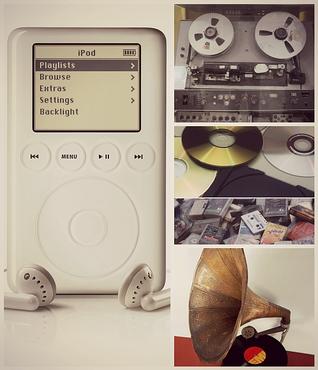
Music technology has indeed come a long way. / Photos: Desikan Krishnan,  V.V. Krishnan, AP and  Vipinchandran. / The Hindu
Music technology has indeed come a long way. / Photos: Desikan Krishnan, V.V. Krishnan, AP and Vipinchandran. / The Hindu

From the humble gramophone to iTunes and MP4, music technology has come a long way.

My earliest recollection of listening to recorded music is that of a strange looking contraption with a brassy and shiny loud-speaker mounted on it, churning out a crackling version of a Carnatic melody (kriti) by one Kanchipuram Dhanakoti who would sign off the three-and-a-half minute song, raucously announcing her name. Well, that was the custom then!

This was soon replaced by a better looking and more compact box with its speaker built in and a neat looking turn-table that worked on an optimum speed (78 RPM) only if it were wound enough by a special lever which resembled the manual-starter of a truck. A circular disc made of vinyl would be placed on the turn-table and it would be activated by a spindle at the top with a stylus (subject to change once in a while) that coursed over its grainy surface and generated the music much to our delight and wonder!

The image of a dog peering into the loudspeaker with curiosity later became a popular brand mnemonic – “His Master’s Voice” – for The Gramophone Co. of India.

Those were the days when the high-pitched voices of S.G. Kittappa, Ariyakkudi Ramanuja Iyengar, M.K. Thyagaraja Bhagavathar and Dandapani Desikar ruled the roost on 78 RPM vinyl. T. N. Rajarathnam’s three-and-a half minute capsule of Thodi was breathtaking, to say the least. When Long Playing records (LP’s) and Extended Play (45 RPM) followed the 78 RPM, there was a veritable explosion of various genres of music that entered our homes. Remember Saraswathi Stores on Mount Road where everybody who wanted to buy records homed in on with regularity?

While there was the haunting voice of Ustad Abdul Karim Khan surprisingly singing ‘Rama Ni Samana’ in Kharahapriya (unbelievable, but the recording is still available) and Veena Dhanammal’s dulcet fingers floated over a seemingly fretless veena to thrill the connoisseurs of Hindustani and Carnatic music respectively, the younger generation (which included yours truly then) began to get LPs of Bing Crosby and Frank Sinatra from the world of Pop, and Duke Ellington and Louis Armstrong straight, so to speak, from the smoke-filled bars of New Orleans.

A remarkable change in the world of storing and delivering music took place when the spool recorder made its first appearance in Japan and later took India by storm. The AKAI-M 10 (if I vaguely recall the model) became a household name and a status symbol for those who wanted to swing in with the times and display it in their living rooms. Catering to a higher segment, the tape recorder, armed with four tracks, boasted the capacity to bring home several hours of Carnatic music concerts, long-drawn symphonies of Beethoven, jazz standards ranging from Thelonious Monk and Miles Davis to Charlie Parker and Dizzy Gillespie, not to forget the complete repertoire of the golden oldies, Mohammed Rafi, Mukesh and Talat Mehmood, and ghazals of Begum Akthar.

But Man’s thirst for innovation soon put paid to the rule of the cumbersome Tape Recorder. The entry of Compact Cassettes into the world of Recorded Music was a remarkable phenomenon making it possible for music to go wherever he wanted it to and allowing him to manipulate its flow in whichever sequence he desired. One thrilled to the idea of having a small package of invaluable music tucked away in one’s pocket. (At a later point of time, history would repeat itself when the pen-drive captured much more music within its tiny frame!).

The advent of a slew of Japanese models flaunting two-in-ones (tuner plus recorder) made it possible to record music easily on cassettes and play them at leisure. The versatility of cassettes made them extremely popular and the music industry witnessed an unprecedented boom with enormous popular appeal. One vividly recalls how NRIs would swoop down on Sankara Hall on Mowbrays Road and other exhibition halls to pick up cassettes in baskets!

Teenagers had the pleasure of listening to Elvis Presley and the Beatles at home while those of ‘sterner’ stuff could switch over to Jimmy Hendrix, Janis Joplin and Jim Morrison in the privacy of their “pads”! My prized collection of cassettes of Jean Luc Ponty and Stephane Grappelli demonstrated how international fusion could be churned out on violins by those virtuosos even in the early 1990s!

As a jolly bachelor in Calcutta, I spent lazy Sunday afternoons at home with my friends, quaffing generous draughts of beer and listening to popular tracks from Abba (“Hasta Manhana”), Osibisa and Boney M (“Ma Baker” and “Daddy Cool”) on my heavy-duty Aiwa!

Came the moment when EPs and LPs, packaged tantalisingly in colourful jackets and fighting a losing battle for shelf space, finally took a bow and graciously allowed cassettes to step into the limelight. During this metamorphosis, a soft interim entry by Laser Discs did make some ripples but the fiery momentum set up by the flow of cassettes drove them away without much ado. So too did Cartridges with a short life-span.

The recording industry appears to be a cruel and relentless one with no regard for their star players; thanks to a slew of new products being researched and finally churned out by the ever pioneering software industry, CDs and MP4 players have wiped out cassettes from the field of play just as cassettes did to LPs earlier.

Music lovers, saddled with thousands of cassettes collected and recorded with passion over many years and hours of night-long recording sessions, are today left with a treasure-trove but with no takers! The next generation is ‘cool’ with its pen-drive, iPod and Smart Phones. Apple and Bose are there to cater for those who can afford them. A neat and tidy hard disc back-up unit takes care of all their music, apart from their study notes and other papers!

Cassettes and cassette players are no longer being manufactured and it is a Herculean task to get the old ones repaired at Electronics Repairers who are preoccupied with more sophisticated equipment. Cosmic, Norge and Nakamichi Cassette Decks, once a part of the prized accoutrements, are now perhaps a mere memory!

The initial enthusiasm that drove many to several outlets in Chennai to transfer their musical treasure from cassettes to CDs has evaporated of late since the portents are indicative of CDs themselves being eased out by music files, MP4 players and through downloads from various sources, not to mention retail points such as Giri Trading Co., Mylapore, building up of one’s own library on Real Player and, of course, tapping into the inexhaustible sources of YouTube, I-tune Stores, non-stop Radio Stations and music-centric websites on the Internet.

One is reminded of a clairvoyant advertising tycoon who prophesied a decade ago at an Asian Advertising Congress that one day, not too far away, each home will be equipped with just One Black Box that will use a convergent digital technology to incorporate all the elements of Voice, Video, Text and Graphics delivering all forms of Information, Communication and Audio-Visual Entertainment. Beware, Apple and Microsoft are already at it!

It looks like we are almost there!

(vkalidas@gmail.com)

source: http://www.thehindu.com / The Hindu / Home> Features> Friday Review / by V. Kalidas / Chennai – April 25th, 2014

MAILBOX : Music’s changing modes

Here are some of the responses to the article ‘Channels change, Music Continues…’ (FR, April 25) written by V. Kalidas.

Your article transported this 80-year-old man to his school days. At home, we had a phonograph box which my aunties called ‘poonaikkara petti.’ We had a rare collection of old records of Carnatic music. With the arrival of the radio in our home, the phonograph fell into disuse. Even today, I regret destroying those shellac record discs, dipping them into hot water and fashioning art plates out of them.

Later, as a high school student, I used to assist my uncle who had an agency selling His Master’s Voice and Columbia phonograph records obtained from Calcutta and Madras. These were made of a compound of black shellac and were prone to breakage and damage and ended up with scratchy needle noise with repeated use.

Vinyl records were not commercially produced in India until my uncle went out of that business in the 1960s. I distinctly remember receiving a thin vinyl recording from the ‘Voice of America’ containing a couple of minutes of an American President’s speech.

Now, an iPad with ear phones, loaded with vintage Carnatic fare, is my walking companion, courtesy my grandsons. Times have changed…

V.Thiruvengadanathan

Madurai

The article on the technological changes in the delivery of music during the past decades is interesting. This was possible because, at every stage, the consumer was willing to invest in new hardware – gramophone, spool player, cassette player, CD player and MP3 player…

By contrast, the newspaper industry persists in the century-old practice of putting ink on paper and delivering it at the doorsteps of the consumer, this last-mile connectivity too becoming progressively more expensive.

Today’s technology allows wireless transmission of the newspaper that can be received by the consumer on his tablet. The day is not far off when printed newspapers (and magazines) will become financially non-viable since other cheaper options are opening up for advertisers too. The newspaper industry has to think ahead and brace itself for this change.

K.S. Ramakrishnan

By email

I enjoyed reading your article; it brought back memories of the 1940s. HMV with their dog and the Megaphone took me back to old Nair tea shops and the sudden slowing down of the RPM (the boy would say, ‘Sariya key kudukkillai’). Then there was the Saraswathi Stores in the neighborhood of the now demolished Globe Theatre and the Wellington. Of course, Md. Ebrahim (replaced by VGP) brings back warm memories regarding Western Music.

There was one other store in George Town opposite the Madras High Court. Forget its name! Among the tape recorders, Grundig & Telefunken was also popular.

‘Old man’ Cheema

Chennai

source: http://www.thehindu.com / The Hindu / Home> Features> Friday Review> Music / Mailbox / Chennai – May 01st, 2014

STONESPEAK : On Units of measurement

Special Arrangement The measures found on one of the walls of the Thanjavur Big temple. / Photo: Sri Gokul Seshadri / by Special Arrangement / The Hindu

How many are familiar with weights and measures such as Kuzhi, Maa, Veli and Muntiri that were used in olden days?

(A monthly column that unravels fascinating facts about heritage, art and architecture, this one throws light on measurements used in medieval period)

Writing in the 19th Century, a British official complained, “the number of viss in a maund differs in a bewildering way, both according to local custom and to the substance which is being weighed… a ‘measure,’ is a most varying quantity – any old compressed beef tin of any size passes as a measure, if you will accept it. The only way is to get accustomed to your providers’ peculiarities and pay accordingly.” The same traveller would be surprised if he was in the medieval Tamil Nadu! Weights and measures from inscriptions are complex. They vary with region, dynasty and many kings created their own!

Different calculations

Weights and measures are frequently found in inscriptions that deal with gifts of land and produce to temples. The Chola and Pandya territories seemed to have had different measures but with many local variations. Some calculations can be made.

Land was measured in Kuzhi – which was one rod in length and one rod in width. Three Kuzhi made aMaa. 20 Maa made a Veli (sometimes called Sey as well). A Maa approximates to 33 cents. Because a rod length varied it’s difficult to say that a Veli in one part of the state was the same elsewhere. 1/80 of a Veli made a Kani and 1/320 of a Veli made a muntiri. Smaller land fractions went to as low as 2.81 sq.ft. Such small fractions were useful since land was taxed not just by spread but fertility as well. By colonial times, a Veli was equal to 6.6116 acres.

Grain was measured as eight Naazhi that made a pucca padi or a pattanam padi in the Pandya country. Surprisingly in Thanjavur, eight Naazhi made only half that quantity and was called a china padi. Amarakkal was used to measure grain. A Nerai Naazhi approximated to a little less than a kilo, possibly 850-900gms.

Gold and gems had a separate calculation. One gold kasu (coin) was four kunrimani (a seed). TwoKunrimani made a manjadi and 20 manjadi made a kalanju. 2.5 kalanju made a sovereign of pre-independence proportions, around eight grams today.

Land measures are most commonly encountered. Several temples such as those in Kanchipuram (Varadaraja temple), Srirangam and others have alavu kols – lines etched into the stone wall that are a measure for land. These come in varying lengths, 12, 16, sometimes even 18 ft. The ends are differentiated with a zig zag or some decorative feature, and the alavu kol, usually has a name to it. Raja Raja called his, Adavallan after the Chola tutelary deity Nataraja of Chidambaram. These measures continued even in the 19th centuries, temples in the Pudukottai district have such measures from the reigns of the Sethupathis. The Kols were based on a human span – (chaan) or a foot (adi). A rod was named after the number of spans and feet it comprised. 16 span rods were most common but mostly in the northern districts. Foot rods become more popular in the 12th century. The 18 foot rod was more popular in the Pandya country. We have evidence of land surveys being conducted during the reigns of Raja Raja I and Kulotunga and Jatavarman Sundara Pandya I in the 11-13th centuries. The person responsible for it, being honoured with the title “Ulagalanda” or one who surveyed the world.

In the 18th century, the documents in the Thanjavur Sarasvati Mahal library give us insights into the measures of that period. One Manjadi was 260 mg, One kalanju was 5.2 gms, One tank was One gm, One tola was 2.9 gms, One palam was 35 gms, Oneseer was 280 gms and One marakkal was three Kg. 12tolas made One palam (35 gm), eight palams made One seer (280 gm), five seers made One veesai (One kg and 400 gm), eight veesai made One manangu (11 kg and 200 gm), 40 manangu made One baram(448 kg).

In another system prevalent in the Maratha times One padi made 750 gm and four padis made Onemarakkal (three kg). This was used mostly for agriculture produce. Land was measured by a rod fourteen feet in length. 20 maa made one veli (6.5 Acres). 100 kuzhi made a maa. The Marathas also had taank (rhyming with ‘Monk’). One tola (three gm), in 1820, made three taank, whereas in 1780, One tola was equal to One taank. Gold and silver had a separate system. One kunrimani made 13.3 mg, two kunrimani made One manjadi (26.6 mg), 20 manjadi made One kalanju (5.320 mg), 60 kunrimanimade One poun (7.98 gm).

During the colonial times, measures included One padi, ½ padi and ¼ padi. Two aazhakku made ¼padi. ½ and aazhaku was a Veechampadi. Another unit was a Maakani. In Kumbakonam a ½ padi was a chinna padi. In many places down south liquids were sold as a Chombu– about 1/4th padi. Old timers still remember these units and can swiftly calculate and convert without modern devices – perhaps in some ways modern technology has made us mentally less agile!

(The writer can be contacted at pradeepandanusha@gmail.com)

source: http://www.thehindu.com / The Hindu / Home> Features> Friday Review> History & Culture / Stone Speak / by Pradeep Chakravarthy / Chennai – April 24th, 2014

Farmer’s Notebook : Using fish waste to make a low-budget crop nutrient

Mindless usage of chemical fertilizers and spraying pesticides to increase yields have made farming a commercial exercise profiting only some private companies rather than a small farmer.

“The challenge today is to generate a better yield and income from small farms using locally available materials since more than 80 per cent of farmers in India are small farmers,” says Dr. Kamalasanan Pillai, Head of the R&D, Vivekananda Kendra –Natural Resources Development (Vk- Nardep), an NGO in Kanyakumari, Tamil Nadu.

While cattle-dung based formulations are well known, still not all marginal farmers are cattle owners – particularly cow – which is essential for indigenous formulations. Some of these formulations are also costly for a marginal farmer.

New technology

Vk-nardep developed a new technology using fish wastes to make a nutrient that offers all the vital ingredients needed for crop growth in an organic way through locally available resources.

“Though fish is available throughout the year, during the post monsoon season huge quantity of fish waste as well as non-edible fish related waste are generated both in village markets and also in household kitchens.

The disposal of this waste material poses a big problem. As the fish-waste contains rich proteins, it cannot be kept beyond 24 hours. This waste material becomes the basic substrate for the bio-formulation developed by us. This also solves the problem of pollution and waste-disposal,” says Dr. Pillai.

Giving details on how the fish substrate can be done he says:

About 20 kg of fish waste is collected and stored in a plastic can of 40 litres capacity.

To this 10 litre of water is added followed by 20-30 ml papaya latex. The papaya latex (pappain) is collected after making a small cut on the surface of a mature green papaya fruit. The material is mixed well with pappain and kept for 5-8 hrs. The vessel is kept closed with stirring every hour.

Fermentation

After five to eight hours, jaggary solution (four kg jaggary dissolved in five litres of water) is added to the fish substrate and stirred well. This mixture is allowed to ferment well for 15-20 days. The scales and fish bones get degraded well within this period.

After the stipulated day the extract is prepared by adding two to five times water to the fermented material.

The extract can be filtered and applied to plants, preferably as a foliar spray. The undigested part if any, can be used as manure for the soil.

Shelf life

For increasing shelf life further, the extract can be filtered using a muslin cloth followed by pressure filtration to get rid of small solid particles.

The material filtered with the pressure filter can be kept for a period of three months and used when necessary. To use this as spray dilute 250 to 500 ml of the extract in 10 litres of water.

Farmers are advised to spray this after 4 pm in the evening for best results.

“The formulation can be used for all vegetable and flower crops. The technology is particularly useful for those who do not have cattle.

It also benefits the waste disposal problem of local fish markets and restaurants – particularly the fish waste. Extensive trials have been conducted by our institute using this fish extract on crops like lady’s finger, amaranthus, palak, brinjal and tomato and have fetched good results,” he explains.

Amino extract from chemical source/commercial brands available in the market costs Rs. 300 per litre while the locally made fish-amino costs only Rs. 40-50. It is ecologically safer than chemicals and has also pest repellent effect. “We are working to see how beneficial this extract is for paddy and banana crops as well,” he adds.

Workshops

VK-nardep work is on seeking sustainable solutions to address the environmental and agriculture related issues and innovates sustainable alternatives. It regulalry organises awareness camps, seminars, workshops and brings out publications on sustainable farming practices. To know more contact Dr.P.Kamalasanan Pillai, Project Coordinator,Vivekananda Kendra – NARDEP,,Kanyakumari – 629 702,,Tamilnadu, ), e.mail : vknardep@gmail.com, web : vknardep.org, mobile : 09387212005, phone: 04652 246296.

source: http://www.thehindu.com / The Hindu / Home> S & T> Science / Farmers Notebook / by M.J. Prabu / February 28th, 2013

FARMER’S NOTEBOOK: Multipurpose solar pest manager for brinjal and jasmine growers

THE EFFECT: Frequency of pesticide spray was reduced from once in seven days to once in 15 days and finally once in 30 days./ by Special Arrangement / The Hindu

Continuous power supply is essential for any type of agricultural activity. Particularly in villages where the concept of invertors or generators is yet to attain a major breakthrough, electricity disruption means temporary suspension of any activity till power supply resumes.

Though the Government has been harping on need to harness solar power and grants subsidies for installing solar units for farm related activities, the concept is yet to gain momentum.

Major issue

But for some individuals like Mr. David Raja Beula, Assistant Director of Horticulture, Kadayam in Tirunelveli district, Tamil Nadu, electricity disruption does not seem to be a major issue since he has developed several solar powered farming equipment.

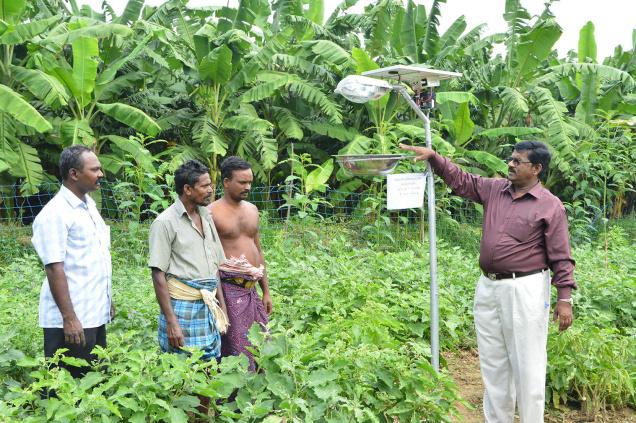
Among his recent innovations is the multipurpose solar pest manager and garden light. The device according to him was developed to help brinjal and jasmine cultivators in the region control fruit borer and white fly pest in their crops.

The height of the solar light is about eight feet. It has a solar panel, a battery, two five watt bulbs and an insect collection stainless steel tray on which a sticky paste of castor oil and shampoo mix is smeared.

“Brinjal and jasmine farmers in Kadayam region in the district were struggling to control the fruit borer and white fly pests for a long time. They sprayed pesticides once in seven days to control the problem. During this time I had developed the multipurpose solar pest manager and introduced it to the participants at a meeting. About 35 farmers who attended the meeting were given one device to experiment the efficiency of the device,” says Mr. Beula.

The collection of killed fruit borer moths started at the rate of three moths and gradually increased to 500 moths a day and white flies from 100 numbers to 700 a day.

Reduced spray

“We also found that the frequency of pesticide spray was reduced from once in seven days to once in 15 days and finally once in 30 days, thereby bringing down the expense from Rs.10, 000 to Rs.5,000 for an acre of brinjal and from Rs. 24,000 to Rs. 12,000 for jasmine,” he explains.

Priced at Rs.15,000 a piece, it can be used to control pests in other crops also, according him. Since the device has also a light facility attached, it can be used to light the fields and garden in which it is used.

Farmers repeatedly spray several chemicals, or in case of organic methods use the required bio applications on the jasmine and brinjal crops. But complete eradication seems impossible as the larvae hide in the shoots and fruits and escape the sprays.

“Naturally farmers tend to over-spray thinking that more spraying effectively controls the pest.

Big expense

Repeated spraying causes a big expense for a small farmer. In addition to the financial cost incurred for buying the inputs, excessive application of chemicals creates a negative impact on the environment, in the harvested flowers and vegetables and poses a serious risk to consumers as well,” he says.

Mr. Sivaperumal a small farmer from Therkumadathur village showed thousands of white flies in jasmine crops attracted and killed in the device.

Another farmer from Tharuvai village Mr. Anthony Raj was deeply impressed by the effectiveness of the device in controlling the fruit borer in his brinjal crop and says, “I have got the confidence to expand the cultivation area from half an acre to two acres in the coming season,” he says.

Dhan foundation an NGO in Madurai that works for farmers’ welfare has recorded that the solar multipurpose device helps reduce the boll worm’s infestation in cotton crops by controlling the moths and there was reasonable reduction in pesticide usage among the 35 farmers using it.

Based on order

“At present I do not have a readymade unit available for those who are interested to try it. It is manufactured based on order. So farmers who need it are requested to contact me in advance and place orders,” says Mr. Beula.

For more details and personal visit interested farmers can contact Mr. P. David Raja Beula Assistant Director of Horticulture Kadayam, Tirunelveli District Tamil Nadu,email: microeconomicsdavid@yahoo.co.in, mobile: 09486285704.

source: http://www.thehindu.com / The Hindu / Home> S&T> Science / Farmers Notebook / by M.J. Prabu / January 01st, 2014

EID Parry acquires Chile-based Alimtec SA from Bayer Group

The company bought Alimtec, a key raw material supplier for its US arm, for 1.9 million Euro

Murugappa Group firm EID Parrt (India) Ltd has acquired Alimtec SA, a Chile based company of Bayer Group , for 1.9 million Euro, in order to ensure surety of raw material supply for its US subsidiary, US Nutraceuticals.

“We have bought 100 per cent stake in Alimtec for 1.9 million Euro, from Bayer Group. The company has been one of the important supplier of raw materials for us,” said V Suri, chief financial officer, EID Parry (India) Ltd.

The acquisition is by way of purchase of the stake from Bayer Finance and Portfolio Management SA and Nunhems Chile SA, subsidiaries of Bayer AG. With the acquisition, the company would ensure reliable sourcing of Astaxanthin (HA), a raw material from algae, used in food supplements by US Nutraceuticals.

Alimtec was one of the major suppliers of the raw material to the company and when they were looking for a buyer for the company and EID Parry stepped in to ensure enough raw material supply, he added.

At present there are very few companies which produce the raw materials, and almost 10 metric tonne of the total 40 metric tonne requirement of HA by US Nutraceuticals is met by the Chile-based firm. The facility also has potential to scale up production, which would in turn help the company to scale up sales in the US firm, as the market demand is high, he said.

The acquisition will culminate in value creation for nutraceutical business and the entire production of Alimtec will be used by the US firm for its Astaxanthin products catering to USA and Europe Markets, announced the company. The acquisition would also immediately bring in around 10-15 per cent cost reduction in production of food supplements in which HA is an ingredient, said the company.

source: http://www.business-standard.com / Business Standard / Home> Companies> News / BS Reporter / Chennai – April 25th, 2014

Madurai Rescue Robot Walks Away With Cash Honour at VIT

“If I get support from educational institutions and the government, I will  be glad to develop a kit for every district in the State to rescue children who fall into  deep borewells,” said 43-year-old M Manikandan, a technical faculty at the TVS Community College in Madurai, who along with his team, had rescued a child that had fallen into a borewell in Sankarankoil recently.

On Tuesday, the VIT university invited Manikandan and his team to honour them for having developed the mechanical kit ‘rescue robot’ and rendering their service in this regard free of cost. They also received a cash award of `25,000 each as part of the VIT University Day celebrations.

Demonstrating the kit, Manikandan said he had  been working for the past 12 years on the problem of rescuing children who had fallen into deep borewells. “Every time I hear of children falling into borewells and they could not be rescued, I felt bad and I wanted to do something to help them,” he said. This had prompted him to develop a nine-foot mechanical ‘arm’ that could be spread apart and closed using a two-directional threaded shaft, fitted with a cycle freewheel and a chain that could be inserted into the well. In 2006, he made modifications with an air piston arrangement, that could be stretched, replacing the first version. The piston unit had received the Lemelson Recognition and Mentoring Program (L-RAMP) Award of Excellence from the IIT-Madras. The talk show ‘Visuvin Arattai Arangam’ beamed on a TV channel had also given a cash award of `30,000 for this innovation. Manikandan and his team members M Thirunavukarasu (a colleague in the college), M Vallarasu (a technical support), P Rajkumar a volunteer) have so far been involved in the rescue operations of six children but could save only one child in Sankarankoil.

The team is presently working on adding a vacuum cleaner to suck the soil-fill from the interior of the well to prevent the  child from choking in the well. The VIT has volunteered to help the team in this regard, he added. Manikandan wants to donate the rescue robot to the Fire Department and train the firemen too.

source: http://www.newindianexpress.com / The New Indian Express / Home> States> Tamil Nadu / by V. NarayanaMurthi – Vellore / April 23rd, 2014

Madras was where idea of Congress was born

Chennai :

Whether or not she’s got Chennai in her sights, it’s highly improbable that Sonia Gandhi will drop by Mylapore even if she does stop by the city. Would she be interested in scoping out the birthplace of the Indian National Congress? Probably not, but for those who would, a building called Vishwakamal Apartments on RK Mutt Road pinpoints the site where constructive plans to establish a pan-Indian nationalist party were first laid out, in 1884. “Seventeen eminent men from the South had earlier that year met in the Mylapore house of Diwan Bahadur Raghunath Rao (where Vishwakamal now stands) and resolved that a ‘national movement for political ends’ be formed, spreading the message through provincial committees… What emerged from this was the Indian National Congress, formally founded at its inaugural session held from December 28-30, 1885, in Bombay.” This extract is from an essay by Dr S Subramanian in the anthology edited by S Muthiah titled “Madras Chennai: The Land, The People & Their Governance”.

The essay hails Madras as the birthplace of the Indian National Congress. “The political party system was born in Madras,” Dr S Subramanian, head of Madras Presidency, writes. He goes on to say that the idea to establish a country-wide nationalist party was anticipated “at the Theosophical Society’s annual convention held in Adyar in 1884, where retired English civil servant Allan Octavian Hume suggested that an all-India organisation be formed to present the cause of the Indian people”. It’s a piece of history absent from popular political lore.

Ramu Manivannan, professor of political science at University of Madras, acknowledges the tendency of historians to overlook certain contributions of the south to India’s political history. “Many groundbreaking issues and concepts originated in Madras Presidency,” he states.

“These include the fact that India’s ‘first war of independence’ took place in 1806 in Vellore, much before the 1857 mutiny in Meerut.” Gandhi’s adoption of the loincloth as a sartorial political statement is said to have taken place in Madurai, he adds.

“It is the responsibility of political elites of the south to highlight these facts of southern political history,” he maintains.

Dr Bernard D’Sami, associate professor of history at Loyola College, points out that INC was not the first organised manifestation of the country’s nationalist efforts, but the culmination of several regional nationalisms unified under Gandhi. Indeed, Dr Subramanian writes that the Madras Mahajana Sabha (1884) was the forerunner of the INC. He calls it the first political organisation of the ’emerging elite’ of Madras city; the provincial precursor of the INC whose associates included P Rungaiah Naidu, T Madhava Rao, Diwan Bahadur Raghunatha Rao, T Rangachari, Justice Sankaran Nair, and Dr Subramania Iyer.

If this list reads like the roll-call of an upper crust club, it is because politics in late 19th-early 20th century Madras was peopled largely by highly educated, landed Brahmins, many of whom established the provincial branch of the Congress. This group was called the Mylapore Group; comprising lawyers and journalists, they kept the Congress in the Moderate camp with regards to its political demands and manifesto. Their clout in the Congress led to the rise of a retaliatory faction – the Egmore Group – which took a more extremist stand on constitutional reforms. Kasturi Ranga Iyengar and Chakravarti Rajagopalachari counted themselves among the Egmore lot, also called the Nationalists. Both groups wrangled for control of the provincial Congress, but by the time the constitutional Reform Bill was passed in 1919, post-world war-I, it was Egmore that got the better of Mylapore with the Gandhian non-cooperation line of engagement.

source: http://www.timesofindia.indiatimes.com / The Times of India / Home> Lok Sabha Election 2014> News / by Joeanna Rebello Fernandes, TNN / April 20th, 2014

Kakkan: Great son of Madurai and humble soul

Madurai :

The leafy Kakkan Street in Shenoy Nagar here is an exception as most city streets are devoid of greenery. The neem tree-lined street is notable for big bungalows beside it. The street, which is named after dalit and Congress leader P Kakkan (1905-1981), runs parallel to Vaidynatha Iyer Street which is named after the social reformer who led the dalits into Meenakshi temple.

Kakkan, who was Iyer’s disciple, belonged to Thumbaipatti near Melur. He was minister for home affairs, agriculture and public works in K Kamaraj’s government. He was instrumental in constructing dams like Vaigai and establishing agricultural colleges across the state. Kakkan retired from politics after losing the assembly election in 1967. He is remembered for his austerity and integrity. He didn’t accumulate wealth and died a poor man.

Kakkan’s younger brother P Vadivelu (79) recalled an incident from his life. “When Kamaraj was collecting funds for the 1962 Sino-India War, Kakkan took me to the podium and asked me to donate my gold chain,” he said. Jawaharlal Nehru had awarded Vadivelu that gold chain for winning a medal in an athletic meet. “Kakkan never used his political clout for his personal gain nor for the benefit of family members. It is difficult to find such a person these days,” Vadivelu commented. When the then chief minister M G Ramachandran found him in a general ward of the Government Rajaji Hospital, Kakkan refused to be moved to a special ward, though MGR requested for it.

Recalling the relationship between Iyer and Kakkan, Vadivelu said that it is fitting that two parallel roads are named after them. Kakkan was like an adopted son of Iyer. “When Iyer died in 1955, Kakkan tonsured his head as a sign of mourning,” he recalled. Kakkan also served as the warden of dalit student hostel Sevalaya at Shenoy Nagar. It was started due to the efforts of Iyer.

N Pandurangan, a 77-year-old veteran Congress party worker, said that the street was named after Kakkan while he was alive. “Kakkan was a noted leader and worked in Sevalaya. In those days, places used to be named after persons even when they were alive unlike today’s custom of naming posthumously,” Pandurangan, said.

The office of the Press Information Bureau is a landmark on Kakkan Street.

source: http://www.timesofindia.indiatimes.com / The Times of India / Home> City> Madurai / by  J. Arockiaraj, TNN / April 20th, 2014

MAN & MACHINE – Battle to save the Hindustan Contessa being waged online

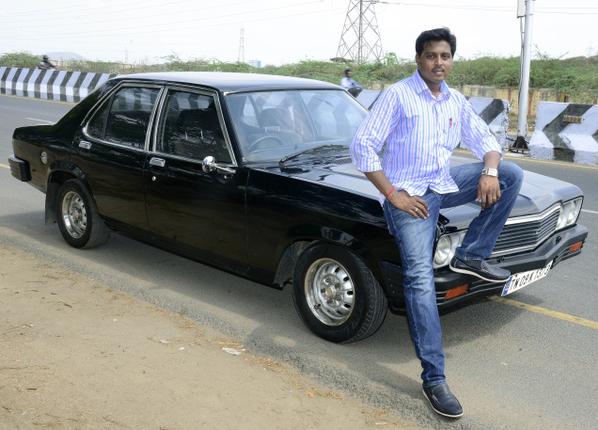
R. Gunasekar with his 1997 Contessa. /  Photo: R. Ravindran / The Hindu
R. Gunasekar with his 1997 Contessa. / Photo: R. Ravindran / The Hindu

Online communities bond over the Contessa. They periodically organise rallies and exchange restoration notes

When he is at the wheel, R. Gunasekar senses admiring glances coming his way. Delusions of grandeur? No, he drives around in a Contessa, a car that is getting scarcer and is beginning to strike most people as a curiosity.

As this machine was rolling off the Hindustan Motors’ assembly line as recently as 2002, this is rather surprising, and saddening. As any automobile enthusiast following the Contessa would tell you, many of these cars have gone to the scrapyard.

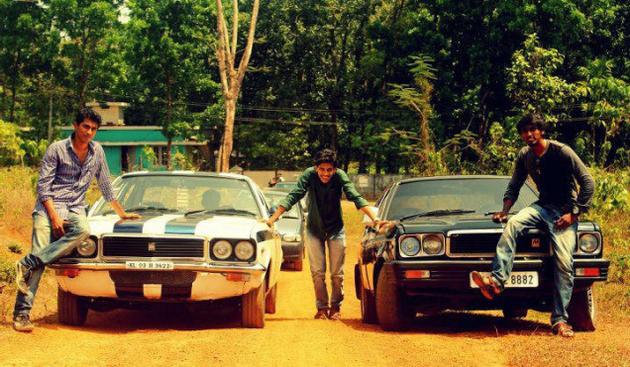
Members of a Contessa club from Kerala who are active on Facebook./ by Special Arrangement / The Hindu

On the positive side, there are online communities that bond over the Contessa. They periodically organise rallies and exchange restoration notes. As these groups connect on popular social networking sites such as Facebook and on reputed automobile forums such as Team-BHP.com, they are capable of drawing other Contessa owners into their fold.

“These online groups are a hope for the Contessa: they may keep the remaining cars from going to the scrapyard,” says Gunasekar, who is not very active in any of these forums, but is in touch with those who are.

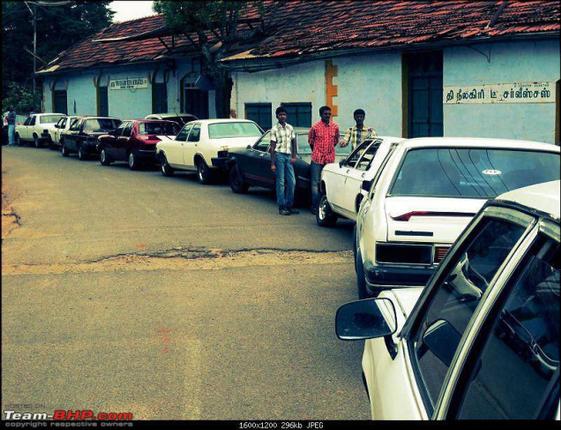
Among the prominent ones is CCI-Conty Club India (on Facebook), which organised a meet-up for Contessa owners from Karnataka, Kerala and Tamil Nadu at Nilgiris in 2013. The event saw a turnout of around 20 cars; the Club is reported to be planning another meet-up shortly, this time in Bangalore.

Meet-up of CCI-Conty Club India members in Nilgiris last year. / by Special Arrangement / The Hindu

“Most of the people in the various Contessa clubs are in their early-20s to mid-40s age group. These are people who have experienced the car as children or as young adults: having seen it driven or driven it themselves. Their passion for the Contessa is incredible,” says Gunasekar, 34.

A good number of them have a grip on the character of the car and seem fully capable of spearheading restoration projects – a healthy sign, considering a last-ditch effort is required to save this Indian car.

Gunasekar, who is assistant manager at Popular Motor Corporation and a car freak from the cradle, is similarly hands-on about his 1997 Contessa that has a 2.0-litre, inline-four diesel engine and twin-lamp headlights.

“My father runs a garage and I have seen Contessa cars being serviced there,” he says. “Ambassador and Contessa have a good number of interchangeable parts, especially engine parts. To service the engine in my car, I can use the parts of a corresponding Ambassador diesel engine. It is the same with the gear-box. Front brake pads, brake booster and a few suspension bushes are among other interchangeable parts. For those that are not, I go to the second hand market at Pudupet.”

If he still does not find what he is looking for, he knows where to turn to.

Says Gunasekar, “I just have to go to any of the online forums. They are certain to be helpful.”

(Prince Frederick is a staff writer for MetroPlus and MetroPlus Melange)

source: http://www.thehindu.com / The Hindu / Home> Features> MetroPlus> Motoring / by Prince Frederick / Chennai – April 30th, 2014