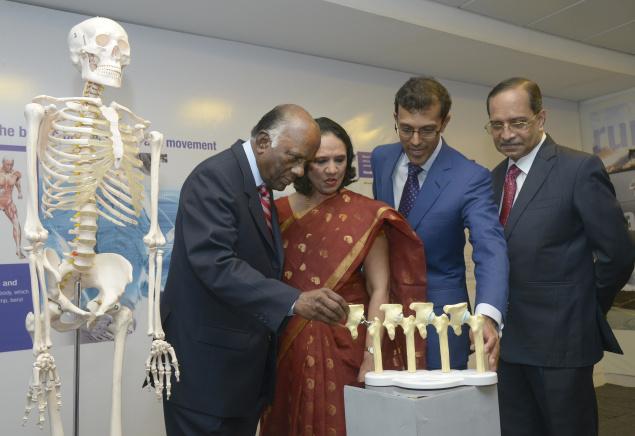
Dr. P.V.A. Mohandas, Managing Director, MIOT Hospitals, Mallika Mohandas, Chairman, MIOT Hospitals, Dr. Prithvi Mohandas, Joint Managing Director and Dr. Barry D. Rosario of MIOT Hospitals on Thursday. / Photo: V. Ganesan. / The Hindu
In two separate events on Thursday, achievements of orthopaedics in the city were highlighted. While MIOT Hospital celebrated the performance of 30,000 joint replacement surgeries, Apollo Hospital called for a conference to talk about a specific total knee replacement procedure.
MIOT Hospital marked the performance of 20,000 hip replacements and 10,000 knee replacements and also opened a museum within its premises. The Museum of Arthroplasty (Joint Replacement) seeks to educate the public and patients on choosing long-lasting artificial joints. The museum has models of prosthesis used over the years. One of the earliest prosthesis — John Charnley prosthesis of 1963 — resulted in the first successful total hip arthroplasty , said P.V.A.Mohandas, founder and managing director of the hospital.
Barry J.M. D’Rosario, director, Centre for Knee Replacement Surgery and Computer Navigation, said, “Osteoarthritis is one of the main indicators for knee replacement, followed by rheumatoid arthritis and other causes such as post traumatic arthritis,” he added.
Many people under 40 are coming in for joint replacements, Prithvi Mohandas, joint managing director, said. “We need to ensure the artificial joint lasts a lifetime and the patient does not get admitted again,” he explained.
Apollo Hospitals
Meanwhile, a team of doctors at Apollo Hospitals have performed a total knee replacement with the help of ATTUNE Knee System and I Assist Navigation System on a 72-year-old patient.
The ATTUNE Knee System helps in re-creating the precision of human knee, allowing doctors to personalise the fit for each patient, while the I Assist Knee System is a computer-assisted stereotactic surgical instrument system that aids doctors in positioning of orthopaedic implant components.
source: http://www.thehindu.com / The Hindu / Home> News> Cities> Chennai / by Staff Reporter / Chennai – April 18th, 2014
NEW ATTRACTION: The project is supported by Christian Aid with technical support from Change Alliance. / Special Arrangement / The Hindu
Thottiankulam village on the Sevaiyur-Tuticorin highway in Virudhunagar district is bone dry all through the year. Farmers, mostly small and marginal, have either left the place seeking work in towns or have moved to other vocations.
In the midst of the vast expanse of empty fields dotted with palm trees here and there, a small patch of greenery catches attention. A group of people are busy tending to the green patch of vegetables, all grown organically.
Short term
The green patch which has been attracting a number of visitors driving on the highway has been made possible by an organisation called Saal (Sustainable Agro Alliance Limited) in Madurai, which has been encouraging struggling small farmers to take up short-term vegetable cultivation.
This programme, supported by an organisation called Christian Aid with technical support from Change Alliance, is fast proving to be a significant intervention in terms of gathering adequate and robust evidences to confirm that small-holder agriculture is feasible.
“The key mantra behind successful production lies in creating better environment. The first step in this process is to focus on the soil and not on plants. A healthy soil gives good yield. And in our system we take care to conduct soil analysis, enrichment using cow dung, cow urine, and humus obtained from dried leaves, agriculture wastages etc to make the barren land productive,” says Mr. B. Jeyabala Murugan, Chief Executive Officer, Saal.
The next step revolves around building an immune system for the plants. The seeds and seedlings are treated with good fungicides and bacteria to form a layer around the roots. This protective layer bestows immunity against soil borne diseases.
Border crops, inter crops, trap crops and multi cropping are also taken up. Farmers are taught to prepare herbal pest repellent using locally available materials.
All about arithmatic
“Our organic process is all about maths. We can predict yield as long as we follow the guidelines for vegetable variety, field size and plant population. It guides us to achieve desired production,” says Mr. S.Henry Joe, Operations Officer.
The final step is helping in marketing the produce. Effective marketing is the ultimate step for success in any agriculture work. With all the hard work done in the farm, if the produce is not fetching the due price then everything is a waste. Saal has facilitated some innovative, transparent and reliable market access to the growers.
High demand
“Local production, local consumption is our motto and our value chain process encompasses farmers, consumers and traders. Our pricing policy is based on a mix of conventional and niche market segments to increase consumption and thereby achieve higher demand, which help operate supply chain efficiently,” says Mr. John Suresh Kumar, Senior Programme Officer.
Already in three adjoining districts the organisation has established a supply chain for organic vegetables. The balancing of supply and demand is done through an online programme to track, trace and synchronise production and marketing and communication strategy
“We provide the farmers with live education in the farm, offer them bio inputs in initial stages of process, provide expert guidance in their field and attend to emergency situations. Those who have adopted this process have noticed that their plants are not only immune to diseases, they are better tolerant to changing weather conditions. The plants are better drought tolerant (could survive for more than seven days without water.),” explains Mr. John.
Shelf life
The life of the vegetable crops has extended significantly — say, from four to eight weeks — and they are able to get yield continuously. This extended vegetable yield has helped earn more income through better pricing in the market.
The small patch of organic greenery has also been seeing a number of insect activities and visits by birds, butterflies, and bees, creating a sort of biodiversity in the region.
The farm, on day-to-day basis, is managed by a supervisor, farm manager and six trained farmers. Presently more than 120 organic vegetable growers from Madurai, Virudhunagar and Dindigul districts are part of a similar programme and 100 more are expected to join soon.
For more information and personal visits interested readers can contact Mr. John Suresh Kumar, Senior Programme Officer on email:jnujohn73@gmail.com, mobile: 8287755019.
source: http://www.thehindu.com / The Hindu / Home> S & T> Science / by M. J. Prabu / April 16th, 2014
(Left) Rock art found in Theni district depicts men celebrating, perhaps after a hunting expedition, and some deer. (Right) Art showing bulls, fowl and deer./ Photo: P. Balamurugan / The Hindu
The paintings were done by prehistoric man with white kaolin
Rock art showing bulls with humps and without humps, deer, line drawings of a human being and jungle fowl and men celebrating perhaps after a successful hunt or a cattle raid have been found in two rock shelters in Tamil Nadu. Prehistoric man did them with white kaolin.
While one group of paintings can be dated to the Iron Age (circa 1500 BCE to circa 500 BCE), the second one may belong to the early historic age (circa fifth century BCE to circa third century CE).
P. Balamurugan, research scholar, Department of History, Pondicherry University, discovered them in March. He found them on the right bank of the river Vaigai, near Arugaveli village, seven km east of Mayiladumparai, in the Kadamalaikundu region of Andipatti taluk, Theni district.
The two rock shelters are in different locations on a small hill, forming part of the Western Ghats.
K. Rajan, Professor of History, Pondicherry University, said the two rock shelters are called “Chitrakalpudavu” in Tamil. ‘Chitram’ means painting, ‘kal’ is rock and ‘pudavu’ means shelter, he explained.
On the ceiling and inner wall of one shelter are painted bulls with and without humps, a bull lying on the ground, deer and jungle fowl. They have been depicted in a circular manner around a human figure.
While the bulls have been fully painted with white pigment, the human being and the jungle fowl are line drawings.
Dr. Rajan estimated that this group of paintings belong to the Iron Age.
The paintings in the other shelter show men with upraised hands, as if they are celebrating after a victorious hunt or a cattle raid. Among the paintings here are a deer and an animal with a long tail.
This group of rock paintings could belong to the early historic period, he said.
An Iron Age habitation mound, littered with black and red ware, is situated at the foothill of this site, suggesting that these paintings could have been executed by a proto-historic community, Dr. Rajan says.
Rock paintings were found during a recent field work in a rock shelter, Kutiraikattiputavu, that is, a shelter where horses are tied.
There are more than 120 rock art sites in Tamil Nadu. depicting hunting scenes, various animals, birds and geometric designs.
source: http://www.thehindu.com / The Hindu / Home> S&T> Science / by T. S. Subramanian / Chennai – April 11th, 2014
K. Premkumar, National long jump champion, and J. Hemashree, National sprinter in relay, were chosen as the best sportsman and sportswoman respectively for the annual awards for excellence by the St. Joseph’s Sports Academy.
K. Premkumar, national long jump champion, and J. Hemashree, national sprinter in relay, were declared the best sportsman and sportswoman respectively.
K. Premkumar, National long jump champion, and J. Hemashree, National sprinter in relay, were declared the best sportsman and sportswoman respectively for the annual awards for excellence by the St. Joseph’s Sports Academy at the St. Joseph’s College premises on Sunday.
Premkumar created a national record of 8.09 metres, while Hemashree was part of the Indian relay quartet that scooped a bronze medal in the last Asian Junior meet.
Established in 1999 with an initial strength of 25 boys and 25 girls, the Sports Academy, funded by the St. Joseph’s College of Engineering, has trained over 250 athletes and the enjoys the distinction of having shaped 28 international stars like Gayathree, Hemashree and Deepika.
A total of Rs.1.60 lakhs was given away as cash prizes for the 32 achievers this year. Deepika received the highest prize of Rs.17000, followed by Dharn and Prem Kumar at Rs.14750 and Rs.11000 respectively.
The Academy also honoured fifty coaches with a cash award of Rs.10,000 each. The leading coaches included R.Chandran, L.Srinivasan, Sampath, Delliraj (Basketball), Maruthaiyam, Prakash, Samy (Volleyball), Ravichandran, Velayuthan (chess), Sivakumar (Coimbatore), Annadurai (Myladurai) and Suresh (Thanjavur) in athletics.
The award winners were felicitated by Dr. Babu Manoharan, Managing Director, St .Joseph’s College of Engineering.
Dr. C. Sylendra Babu, ADGP-Coastal Guard presided over the function along with Mr. M.Vijayakumar, Secretary, TNPSC, P.K.Behera, Additional Commissioner of Central Excise, Olympian V.Baskaran, and C.K.Valson, Secretary, AFI.
source: http://www.thehindu.com / The Hindu / Home> Sports> Athletics / by Staff Reporter / Chennai – April 09th, 2014
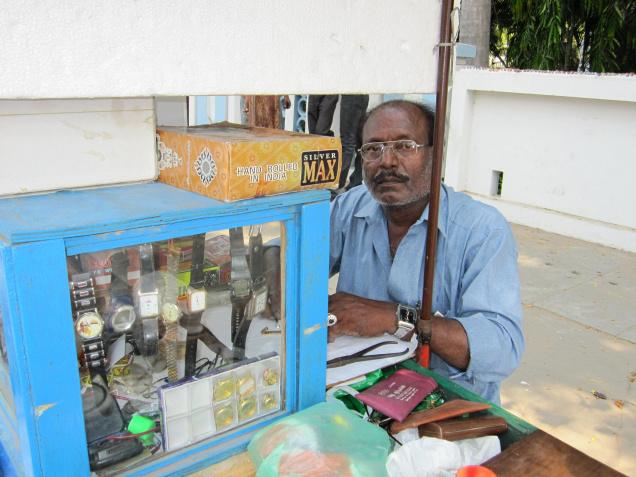
S. Amjad Ibrahim says sometimes business is dull and sometimes there is no business at all. / by Special Arrangement / The Hindu
On some days, I earn around Rs.150-200. Sometimes, there’s no business at all. Then I just sit here and watch the world go by until it is time to go home
It’s just been a few months since I set up my mobile stall here; before this I was selling agarbatti (incense sticks) and attar (fragrant essential oil used in perfumes). I also offer lucky birthstones and sunglasses for two-wheeler users.
Customers can both buy watches and get them repaired by me.
Usually it’s nothing more than a battery change. But watches stop working when they get wet. The water cuts off the battery wire within and also rusts the metallic buttons.
Most of the parts are electronic these days, so they can be replaced piecemeal without damaging the entire watch.
It takes me around 20-30 minutes to repair a watch. And there are days when a watch refuses to work despite all the time I spend on it – I put it away and return to it after a break.
I usually charge Rs. 10 or 20 for watch-repair. Of late I have taken to selling spectacle frames as well.
Shops charge in the hundreds of rupees for a single frame – I buy cheap frames and used ones as well, and sell them for around Rs.20-30 to people who cannot afford the pricey ones.
I push my cart from home, around 2 kilometres away and reach here (Bharatidasan Salai) by 10 a.m.
The traffic policemen often complain about vendors like us being in the way – but as you can see, I’m just minding my own business without troubling anyone.
There’s no breakfast, just a cup of tea at home. For lunch, I usually have a serving of ‘kool’ (porridge) from the stall nearby. It keeps me full until sunset, when I pack up my cart and push it back home in time for dinner. It’s good exercise for me.
On some days, I earn around Rs.150-200. Sometimes, there’s no business at all. Then I just sit here and watch the world go by until it is time to go home. I have six grown-up children, three sons and three daughters.
Most of the watch spares are easily available in Singarathope – you have to ask for ‘China movement’. I’ve spent roughly Rs. 6000 on my stock; I do hope I’ll be able to earn a profit soon.
I’ve dabbled with many other jobs and businesses before – I used to own a grocery store once, but had to close it down because I couldn’t manage it alone.
It’s important to keep earning something, no matter how old you are.
source: http://www.thehindu.com / The Hindu / Home> Features> MetroPlus> Society / by Nahla Nainar / Tiruchrapalli – April 11th, 2014
While many of them may miss the eclectic culture of Calcutta, there is no doubt among members of the cotton hub’s Bengali community that Coimbatore has now become their favourite city. This is the one community that has been able to maintain its own identity while blending in perfectly with the local community.
On a conservative estimate, more than 22,000 Bengalis hailing from upper and middle class families have settled down in the city. The city also plays host to numerous youths from districts outside Kolkata migrating to work in various industrial units and private firms in the area.
“Most of us have been living here since the 80s. We have made this our home and are totally comfortable here. The salubrious climate and the peaceful law and order situation makes it a better place to raise a family than Kolkata,” said Subrata Majumdher, Secretary, The Bengali Association, Coimbatore.
Majority of the city’s Bengalis are engaged in various business activities. However, the younger generation is opting for IT jobs in MNCs. According to Subrata Barik, another prominent member of the community, a major chunk of Bengalis are associated with gold manufacturing units. In fact Edayar Street in the old city area is lined up with numerous gold manufacturing units owned by members of the West Bengal community. However, the rest of the community is scattered across the city, especially in Saibaba Colony and Kavundampalayam.
“Majority of our community is associated with gold manufacturing business and our workers and gold craftsmen form an integral part of the sector in Coimbatore,” Barik added
Keeping their traditions alive, the community annually arranges elaborate Durga Puja celebrations in the city. The authenticity of the celebration is maintained as artisans from Bengal are hired and brought to Coimbatore and preparations are done from scratch including making the Durga idol.
“Durga Puja celebrations are always done with pomp and style with artisans and musicians specially brought from Calcutta to make the idols and perform for the crowd,” said Ayan Chatterjee, one of the founding members of the Bengali association here in the city.
However, the absence of an authentic Bengali outlet in the city is the one small grievance of the community.
Despite the numerous chat and snack stalls, the city still lacks an outlet that caters to Bengali tastes. However, members are hopeful that this will change very soon.
source: http://www.timesofindia.indiatimes.com / The Times of India / Home> City> Coimbatore / by Binoy Valsan, TNN / April 07th, 2014
There were a number of contenders for bowler of the month for March, but none could top Ravichandran Ashwin.
Imran Tahir finished as the top wicket taker of the World Twenty20, taking a wicket once every 10 balls.
Samuel Badree kicked dust in Sunil Narine’s eyes, Amit Mishra was a leg-spinning bundle of joy and Rangana Herath had one really rather good spell.
Even Dale Steyn could stake a claim after a very good run in the World T20.
In the end, though, it was Ashwin who came up trumps. He took 11 wickets in the World T20 at an average of 11.27.
Although his performance in the final of the World T20 against SriLanka was somewhat underwhelming, he was superb overall. It’s not only his ability to take wickets that made him the top choice, but also his ability to stifle the scoring rate, forcing pressure to build and batsmen to lose their minds.
Not once in the entire tournament did he concede more than 30 runs and his 4-for-11 against Australia was fantastic to watch. There was also the carrom ball to dismiss Hashim Amla in the semi-final, a fantastic delivery that would fox any batsman in the world.
Ashwin is the kind of bowler who likes to experiment and who likes to keep on changing and learning. In the lead up to the World T20 during the Asia Cup, Ashwin had a new approach once again. After two average tours against South Africa and New Zealand, Ashwin had to try something, so he tried to model his action after Sunil Narine.
The results weren’t immediate, and he finished the tournament with nine wickets in four games at an average of 18.55. The change in action caused much criticism from some quarters. Maninder Singh was one of the most notable critics. He was quoted by The Times of India as saying the change in action could destroy Ashwin’s career.
” What is he trying to do? He was a wicket-taking bowler for us, but this is going to kill him. I don’t know how the coaches are allowing him to do this. Don’t forget Narine is a freak and his action has always been like that. If a spinner tries to copy Narine at the age of 25, he will not last in international cricket for too long. “
Ashwin, clearly not one for taking note of the naysayers, obviously wasn’t bothered. On the eve of the game against Australia, Ashwinrevealed why he was flirting with the newly adopted action. He was quoted by the Indian Express as saying:
” I want to do something different. I want to keep trying something—unless you try you don’t go and venture and find out what can work or not. I’d never bowled in full-sleeves before. So I wanted to see how it would feel. And I just wanted to see if you can get more revs on the ball if you can do a little bit with your elbow, as much as that is. That’s what it was all about. You can get a lot of advantage with these things—so why should I lag behind if someone else is getting a competitive edge? “
Brief change, innovation, foolish—call it what you want—Ashwin is clearly the type of player who always wants to push himself no matter what. His performance in the World T20 was down to some old-school spin bowling and his carrom ball. That ball, which made him so effective in the first place, proved to be his most potent weapon.
It’s not the first time Ashwin has tried something new; he has admitted in the past, as per ESPNCricinfo, that he uses tennis ball cricket to help him learn new tricks and improve his game.
Spinners are the most effective bowlers in T20 cricket. They are transformed in the format because batsmen are forced to attack instead of just being able to see out the overs. The bowlers likeAshwin who combine the ability to take wickets with the ability to stifle the runs deserve the most credit, though, and if that requires a little bit of innovation here and there, who are we to judge?
Data and stats via ESPNCricinfo.
source: http://www.bleacherreport.com / Bleacher Report / Home> Cricket> India / by Antoinette Muller, Featured Columnist / April 08th, 2014
The Sports Development Authority of Tamil Nadu (SDAT) is organising a coaching camp on April 13 at the Veerapuram Shooting Range, for beginners in 10-metre air rifle shooting.
The camp will be held at the Tamil Nadu Special Police III battalion unit between 10 am and 1 pm (single session).
Air rifles, pellets and target boards will be provided by the SDAT.
The registration fee is `500 per head and the minimum age for enrolment is 12 years and the first 60 names will be shortlisted on first-come first-serve basis.
The range is located at Veerapuram, about six kilometres from Avadi.
Those wishing to join the coaching camp may contact R Senthilraj, shooting coach (9444495252) and N Charles Manohar, Regional Senior Manager for Sports and Youth Welfare, Chennai Region (9940341476).
source: http://www.newindianexpress.com / The New Indian Express / Home> Cities> Chennai / by Express News Service – Chennai / April 10th, 2014
Orient Green Power Company is consolidating its biomass power generation business with a sharper focus on group captive power generation.
The wind and biomass-based renewable power company has informed the BSE that it will sell a 10-MW biomass power unit in Pollachi in Tamil Nadu to its subsidiary to enable the unit tap the group captive market to sell power to private sector consumers.
Under the group captive scheme, customers will own at least 26 per cent of the equity stake and consume more than half the power generated.
Company officials said Orient Green has 10 biomass power generation units totalling over 86 MW of power generating capacity. The Pollachi unit is the third power plant to opt for group captive as opposed to selling power to the state utility. One of the expected advantages is timely payment from private sector consumers.
An additional 20 MW is coming up in Kolhapur through a joint venture.
Biomass, or wood-based and agro-waste, fuel costs about ₹1.5-3 a kg and up to 2.5 kg of fuel is needed to generate a unit of electricity. In Tamil Nadu tariff levels range around ₹6.50-7 a unit, according to an investor presentation by the company.
Orient Green has over 500 MW of renewable energy capacity, with more than 420 MW of wind power projects.
source: http://www.thehindubusinessline.com / Business Line / Home> Companies / The Hindu Bureau / Chennai – April 08th, 2014
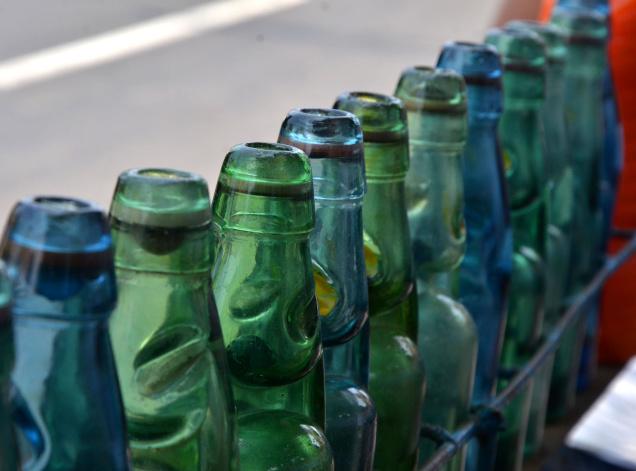
Today, soft-drinks have replaced the humble goli soda and manufacturers are helplessly watching their customers switch loyalties. / Photo: V. Raju / The Hindu
The only goli soda bottle manufacturing unit in the country has stopped production. Does it mean goodbye to a childhood memory for many in the city?
“Paathu, paathu — careful!” says an agitated Balakrishnan. The few minutes I hold the thick, translucent bottle for a photograph are torturous for him and his team at Vasu Soda Company, Mylapore. They watch over the bottle like hawks; my every movement is being scrutinised. I respectfully return it to its dwelling — a wooden crate into which it slips with a clink to rub shoulders with its waiting mates.
This is the treatment a bottle of goli soda elicits today. The shapely bottle is comfortable to hold. Fingers easily grip the curves below the bottle’s neck; it is heavy; you know it has travelled long and far as you take a sip of sweet panner soda from the thick, smooth mouth. The green-coloured goli, the single, most important component of the soda that holds the gas in, talks to you as it tinkles against the bottle every time you bring it to your mouth.
What is it saying? Good-bye perhaps?
The last few goli soda manufacturers in the city feel so. Says D. Balakrishnan: “It has been several months since we got new soda bottle supplies. To make-up for the numbers, we are filling soda in regular cork bottles.” The 75-year-old has been in the business ever since a bottle of soda cost half anna. “We did roaring business then,” he recalls. On festivals such as Deepavali and Pongal when people ate their stomach’s fill, they would amble to the street-corner shop late in the afternoon for a drink of goli soda.
Today, soft-drinks have replaced the humble goli soda and manufacturers are helplessly watching their customers switch loyalties. It has been six months since a consignment of fresh bottles arrived from Sasni, a town in Uttar Pradesh. “I don’t know what I’ll do once I run out of bottles,” says Balakrishnan. “On average, some 12 bottles break in a day,” he adds.
“I have just about 363 goli bottles left,” says V.R. Kanniappan of Scott & Company, Triplicane. “Will I be able to sustain for another five years? If stock doesn’t arrive, I doubt it,” he shakes his head. Goli soda manufacturers in the city who once supplied to hundreds of shops in their locality cater to less than half the number today.
Ask any of them and they would blame the soft-drink giants who ate into their market from the 1990s. “They advertised their products very well, where as we didn’t. They gave away plenty of offers and refrigerators to shopkeepers free of charge,” he adds. The refrigerators were a huge hit. “And our bottles were thick; they took up more space and electricity to be cooled.”
Kanniappan recalls how manufacturers such as him made their own cooler boxes out of thermocol for goli soda. “But shopkeepers had to pay for the ice. This meant extra expenses.” Today, Kanniappan’s company works only on alternate days for lack of work and manual labour.
But he is hopeful. “If the bottle production starts again, our business has a chance of picking up,” he feels. S. Mayilvel of Vela & Company, Royapettah, has branched into apple, masala, ginger, nannari, orange, and lime flavoured sodas to improve its customer base. “Goli soda does have its own fan following. But if we don’t get fresh bottles, the drink could become extinct,” he says.
Mayilvel has some 1,000 goli bottles that he fiercely protects. These bottles are long-lasting investments; the cork in a regular bottle costs anything between 35paise to 75paise each, which has to be replaced every time a bottle is popped open.
P. Saravanan of Swati Agencies, a city-based dealer who supplies goli soda bottles to companies across the city says the current dearth of bottles will soon come to an end. “I visited the unit in Sasni last month. There is a leakage in the furnace which will soon get fixed,” he says. Saravanan assures that production will start in the coming months. But Kanniappan will stop biting his nails only when the supplies actually arrive. With each passing day, he counts down the last few bottles he is left with.
source: http://www.thehindu.com / The Hindu / Home> Features> MetroPlus / by Akila Kannadasan / Chennai – April 11th, 2014