Multi-tasker Srimathi Sridharan Loves Doing New Things

As a voice over artist, cartoon dubbing artist, anchor, freelancer writer and a graphic designer, Srimathi Sridharan’s mantra is to plan ahead. After completing her bachelor’s in electronic media, she is now pursuing her master’s in communication at MOP Vaishnav College for Women, Chennai. She is also pursuing a diploma course in animation at IMAGE. “I am purely a career-oriented person who likes to grab and make use of every opportunity I get. I basically like to try out new things every now and then. I put my heart and soul in whatever work I do,” says the 21-year-old.
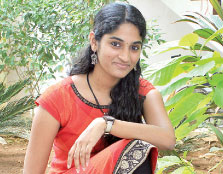
SrimathiCF19dec2013

Ask her how she manages to multi-task and she explains, “Planning is the key. Each day, I put down a to-do list and make sure I complete the tasks before coming home. Once I’m home, I ensure that I spend quality time with my parents. Balancing work and life is very important to me. If you strategise and prioritise, you will have time to attend classes, finish your work and even go out with your family for dinner.”

Srimathi has been working since 2009 and feels that her journey has been good so far. “I really love to work and keep myself engaged. Trying out different things fascinates me. Monetary needs are secondary. Work should be satisfying,” says Srimathi, who earns approximately `15,000 per month.

This all-rounder’s future plan is to become a full-time journalist. “Dedication, skills and knowledge update is very vital for career growth. But this is not the end and I can’t say that I have enough experience in whatever I do. I have a long way to go,” she signs off.

— kaviya@newindianexpress.com

source: http://www.newindianexpress.com / The New Indian Express / Home> Education> Edex / by Kaviya Sanjeevi – Chennai / December 16th, 2013
With the Right Focus

RajeshCF30dec2013

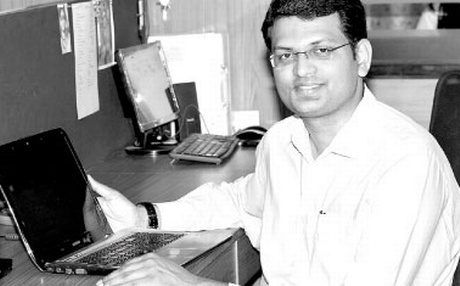
The co-founder of Focus Academy for Career Enhancement (FACE), B Rajesh, has over 3,000 friends on Facebook. This is not surprising, given that his company has trained more than 5.5 lakh students over the past five years. Rajesh grew up in Coimbatore, where he completed electrical engineering from PSG College of Technology in 2004. His campus job at TCS took him to Mumbai, which he left after a year to join IIM-Kozhikode.

This was where he met Venkataraghulan, a classmate who also hailed from Coimbatore, with whom he teamed up to win a number of business school competitions. Rajesh was fairly active on campus, as a member of the placement committee and a part of many sports teams.

Both Venkataraghulan and Rajesh had the entrepreneurial itch at college, but had to put it on the back burner after landing jobs at Deloitte and Citibank respectively. “We would meet from time to time to discuss a number of business ideas, trying to figure out the next big thing. We did not want to remain in the rat race for long,” remembers Rajesh.

The final push came when they attended the ‘Laboratory in Entrepreneurial Motivation’ workshop at IIM-Kozhikode, conducted by Prof Sunil Handa from IIM-Ahmedabad, and decided to quit their jobs the very next morning. “It was truly a life-altering experience,” recalls Rajesh.

They philosophised that instead of waiting for the big idea, they should convert any idea into something big. As luck would have it, they met a teacher from school, who was running a new engineering college. They started with providing communication and aptitude training to her students. CAT coaching is the low hanging fruit for any IIM graduate, so it was a logical progression for them. However, the market was crowded, with national players like TIME, Career Launcher and IMS in the reckoning. They pivoted the business when a college approached them to train its students for campus recruitment. It was a golden opportunity as there were no organised players in the market yet, and they haven’t looked back. They now have five offices in the south, and deliver all their programmes using in-house faculty.

Rajesh says, “Education is an interesting but difficult space to crack, given the number of regulations and the cadre of people currently in the sector. One needs a lot of perseverance along with nimbleness to keep adapting to the market needs and remain contemporary.”

Rajesh is a travel buff and a foodie, an interest that has taken him to many places in Europe and South East Asia. He also loves movies, Surya being one of his favourite actors. His mantra for success includes aggression, ambition and extremely good people skills. Visit www.focusacademy.in.

— rohit@learnbizsimulations.com

source: http://www.newindianexpress.com / The New Indian Express / Home> Education> Edex / by Rohit Koshy -Bangalore / December 16th, 2013

Blind dancers mesmerize Madurai

Madurai :

They might need others’ help to walk, read and write. But they do not need anyone’s help to dance. More than 200 blind students from various schools from the country took part in a dance competition organized in the temple city on Saturday.

Witnessing the scintillating performance by the students, the astonished spectators doubted if the performers are indeed blind. Viewers, who had come to the programme expecting an ordinary performance, were shocked by the stunning performance.

Right from folk, classical and western, the students did not leave any genres untouched. It was a feast for the eyes for the hundreds of people assembled at the Lakshmi Sundaram Hall in Tallakulam. “Lack of vision has never been a problem for the students as they have excellent memory power. It just took 20 days for them to get accustomed to any genre,” claimed Radha Ramakrishnan, a volunteer who accompanied a group of girls from the Rehabilitation Centre for Blind Women in Trichy.

The students displayed real magic on the stage. Some learnt to balance ‘karagam’, an ornate vessel placed on the head, in just 20 days. “We started with just balancing the ‘karagam’. Later we added the ‘karagattam’ steps. It was not very difficult. We have already won medals in three national dance events for blind. Hope, we would succeed in this event too,” said V Deivanai, a native of Pudukkottai district, who along with team members, took part in three events.

As many as 17 schools and institutions from various parts of the country participated. It was organised by Amway Opportunity Foundation, a corporate social responsibility wing of Amway, along with Indian Association for the Blind, Madurai. This was fourth edition of the event. The previous ones were held in Delhi, Ahmedabad and Kolkata.

source: http://www.articles.timesofindia.indiatimes.com / The Times of India / Home> City> Madurai / by V. Decanathan, TNN / December 01st, 2013

Coir board looking at coconut development in Pudukottai

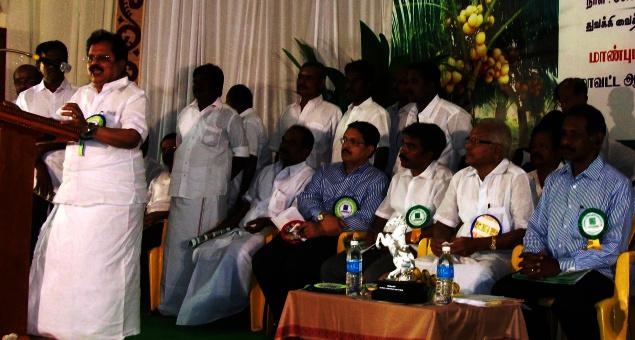
Minister of State for Commerce and Industry, E M Sundarsana Natchiappan, addressing at a seminar on coconut development in Pudukottai. /  by Special Arrangement / The Hindu
Minister of State for Commerce and Industry, E M Sundarsana Natchiappan, addressing at a seminar on coconut development in Pudukottai. / by Special Arrangement / The Hindu

Union Minister tells farmers to emulate their counterparts in Pollachi

The Coir Board of India is satisfied over the potential of coconut production in Pudukottai district and all efforts will be taken to provide subsidy and other benefits being implemented through the Board, said E.M. Sudarsana Natchiappan, Union Minister of State for Commerce and Industries.

Delivering the keynote address at the day-long state-level seminar-cum-exhibition on “coconut development” organised jointly by the Coir Board of India, the Pudukottai District Coconut Farmers’ Federation, and the Aranthangi Coconut Farmers Association here on Saturday, Mr. Sudarsana Natchiappan said that the board, after a survey, had identified the potential of the district in coconut production. He appealed to the coconut farmers to fully utilise the subsidy-based programmes being implemented by the board. Every farmer would get an annual subsidy of Rs. 17,500 a hectare for two years and fertilizers would be supplied to farmers.

With a view to tapping the potential of coconut largely available in this belt, the Union Ministry of Commerce and Industries would set up a coconut and coir handicrafts design centre in Karaikudi. The modalities were worked out in this regard, he said.

Hemachandran, Deputy Director of Coir Board of India, Kochi, explained the steps taken by the board after realising the potential of Pudukottai district in coconut production. He appealed to farmers to emulate the example of Pollachi where the producers got prospective returns and ensured quality in produce.

G.S. Dhanapathy, District Chairman of Farmers Forum of India, said the objective of the seminar was to evolve ways and means for value addition in coconut products and for promoting export.

Speakers from various government departments explained the agricultural inputs, subsidy, and compensation being provided by the Union and State governments to coconut growers.

An exhibition was organised as part of the seminar. Mechanisation in coconut cultivation was explained to the visiting coconut growers. It sought to sensitise the visitors on marketing coconut and value-added produce.

A large number of coconut farmers from across the State participated in the seminar.

source: http://www.thehindu.com / The Hindu / Home> News> Cities> Tiruchirapalli / by Special Correspondent / Aranthangi – December 01st, 2013

Two-Day Expo Offers Insight Into Disability Management

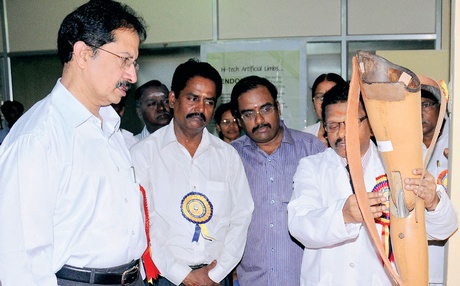
Dr V Kanagasabai inspects a prosthetic limb at the two-day exhibition ahead of the International Day of Persons with Disabilities | A Raja Chidambaram

Close to three percent of the Indian population are differently-abled, said Dr V Kanagasabai, Dean, Madras Medical College and Rajiv Gandhi Government  General Hospital on Monday.

He was speaking at the inauguration of a two-day exhibition at the Government Institute of Rehabilitation Medicine at KK Nagar ahead of International Day of  Persons with Disabilities, which falls on Tuesday.

Kanagasabai said that among the differently-abled, more than one percent are visually challenged, 0.6 percent have locomotor disability and another 0.6 percent are hearing impairing, while the rest are either mute or suffer cerebral palsy.

“Apart from that, Tamil Nadu has the highest number of road accidents where people lose their limbs or vision or become paralysed. For them, we offer immediate  treatment at the RGGGH and are later sent for rehabilitation,” the dean said after inaugurating the exhibition.

He also elaborated on the services offered at the Government Institute of Rehabilitation Medicine. He said that they manufacture prostheses and orthotics for those  who lose their limbs and the paraplegic. “Awareness about disabled-friendly environments is slowly picking up,” the dean said when he spoke about the United Nations theme for this year – Break Barriers, Open Doors: For An Inclusive Society and Development For All.

Stressing that the aim of the two-day exhibition was to create public awareness on the hospital’s work on disability management, Dr C Ramesh, Director and Head of the institution, said there were about 20 stalls, including one that has a display of artificial limbs for amputees and calipers. “We have stalls that attempt to give an idea  on the rehabilitation we do here, including physical medicine, physiotherapy, occupational therapy and more.”

The exhibition also had live demonstrations on small scale projects focusing on self-employment and micro loans from various centres. NGOs that had been working towards the upliftment of the differently-abled also participated in the expo, apart from displaying artwork, artificial jewellery and other products made by  them.

The Government Institute of Rehabilitation Medicine, which was part of the Government General Hospital, moved to the present campus in KK Nagar in 1979. The 60 -bed hospital treats about 150 out-patients a day and supplies over 1000 artificial limbs a year for nominal amount of `38 and calipers and splints at `30.

source: http://www.newindianexpress.com / The New Indian Express / Home> Cities> Chennai / by Express News Service – Chennai / December 03rd, 2013

Bat count falls as old temples undergo renovation

Tirunelveli :

On the dark roofs of old, derelict temples hang these nocturnal mammals, oblivious to the buzz during day. As sun sets, they leave their abode and chart their path using their echolocation instincts. The seemingly insignificant bird, however, plays a pivotal role in agrarian ecology as it can check the growth of pests. However, the habitat of temple bats is in danger as many old temples are being renovated across the southern region.

The number of bats residing in temples has fallen drastically from 4,166 to hardly 2,000 within one year, says a recent study carried out by M Mathivanan, a member of Ashoka Trust for Research in Ecology (ATREE), and two foreign volunteers. The previous study was carried out a year back. Most of the 61 temples visited by the team in Tirunelveli and Tuticorin, were a century to a millennia old.

“Lot of renovation is carried out in temple towers. This is destroying the habitat of temple bats. They leave as the once-dark spaces are illuminated after renovation and the rough surface where they perch is polished. It is difficult to hang from smooth ceilings and bright light scares them,” Mathivanan explained.

Experts said disappearance of bats will definitely impact agriculture. “Every bat consumes approximately 600 insects per hour and most bat species feed on insects. They play a crucial role in controlling pests in the field and environment in general,” said R Marimuthu of Zoo Outreach Organisation. “The fruit-eating bats on the other hand are crucial for pollination. The seeds are germinated better in their guts, hence they help in reviving forest species,” he pointed out.

Till a few decades back farmers used bat droppings as nutrients for chilly cultivation, the study noted. Rakshamuthu, a farmer of Ayansingampatti, said they used to collect the droppings from forests as well as temples. “Bat droppings should be mixed with cow dung as using the former alone would prove to be an overdose for plants due to its nutrient profusion. One sack of droppings will be enough for one acre and it was used predominantly in chilly cultivation. The practice disappeared with the usage of modern chemical fertilisers,” the old farmer recalled.

ATREE has decided to test bat droppings in agriculture. “We are testing it on paddy because most chilly farms in this region have been turned into paddy fields,” Mathivanan said.

Though temples need timely renovation, conservationists advocated that bat habitats could still be saved by avoiding lights on renovated towers. Further, bat houses could be established near agricultural fields so that they stay near the fields, helping pollination and pest control. “Considering the contribution of bats to ecology, we have decided to promote awareness on the need to conserve temple bats and their habitat in the region. We hope using bat droppings in paddy cultivation will yield good results,” Mathivanan added.

Factfile:

* The bat species found in temples: Schneider’s leaf-nosed bat (Hipposideros speoris), Greater False Vampire Bat (Megaderma iyra), Leschenault’s rousette (Rousettus leschenaultii), Black-bearded tomb bat (Taphozous melanopogon) and Egyptian free-tailed bat (Tadarida aegyptiaca)

* Leschenault’s rousette is a fruit-eating one, while the rest are insectivores

* Insectivorous bats help to check growth of pests, while fruit-eating bats help in pollination and germination

* The number of temple bats declined by half in the last two years – from 4,116 to 2,000

* Study covered 61 temples in Tirunelveli and Tuticorin districts

source: http://www.articles.timesofindia.indiatimes.com / The Times of India / Home> City> Madurai> Renovation / by J. Arockiaraj, TNN / December 03rd, 2013

Aiming for AIDS-Free Generation

Asha Nivas and Queen Mary’s College organised an AIDS Awareness programme at the Queen Mary’s College on Monday. The program was themed ‘For an AIDS free generation’.

A Viluppattu presentation was given by the Asha Nivas Culture Group on HIV/AIDS, the way it spreads, the risks involved in it and the precautions one had to take to prevent contracting the disease.

The programme also had Kurian Thomas, director of Asha Nivas, G Bhaskaran, NSS co-ordinator, University of Madras, S Sridhar from the Men and Women Clinic, Anna Nagar, and Lilly Josephine, chief community development Officer, Asha Nivas, speaking to the students attending the program.

Eswari Ramesh, NSS programme officer, Queen Mary’s College, also added that the program was one of the hundred events that QMC was planning to conduct to celebrate the college’s centenary, which falls in  the academic year 2014-15.

source: http://www.newindianexpress.com / The New Indian Express / Home> Cities> Chennai / by Express News Service – Chennai / December 03rd, 2013

Lamborghini tractors to launch in India on Dec 12

Lamborghini tractors have the potential to change the way India's view farm vehicles.
Lamborghini tractors have the potential to change the way India’s view farm vehicles.

Soon there will be a name everyone knows in fields across India. On December 12, Lamborghini will launch its luxurious tractors here as part of the Kisan agri exhibition being held at Pune.

Though the Italian brand Lamborghini is usually associated with sports cars, its tractors have a longer history since they were launched in mid 1950s, even before the cars. The tractor brands has been owned by the SDF Group since 1973.

In India the tractors are manufactured at SDF’s plant in Ranipet, primarily for export. The plant is a global production hub for many of SDF’s internationally renowned tractor models including Deutz-Fahr.

Lamborghini tractors have the potential to change the way India’s view farm vehicles. Initially, the plan is to target rich farmers, golf courses, vine yards, cricket stadia and luxury resorts.

source: http://www.indianexpress.com / The Indian Express / Home> FE Online / New Delhi – Monday, December 02nd, 2013

Bespoke Canvases

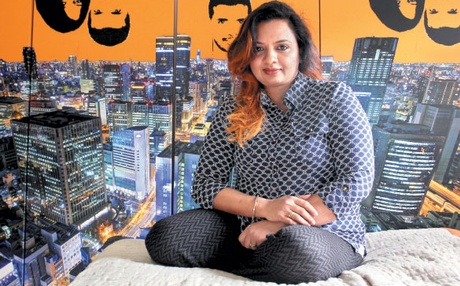
Artist Amrithaa with a creative canvas in the background | P Ravikumar

Custom art for your home. That’s what advertising exec-turned-artist Amrithaa does for a living. And stepping into the splash of green of her living room at T Nagar, it’s easy to understand why. You see that in this designer’s home, every room is a canvas. From her nature-fresh sofa cushions that make you feel a bit like you’re in a Lyril ad to digital art, custom-made to fit into different spaces — there’s even one above the commode in the bathroom! More importantly, every art indulgence is as personal as they come. There’s a large canvas of suspended motorbikes in one bedroom (a passion of her son’s) and a collage of neon yellow touched photos of a memorable New York trip with Amrithaa and her husband in another. “I think I’ve actually been customising art all my life,” she admits. And after a degree in Fine Arts and 22 years in the ad business, creativity is a given.

Ironically, Amrithaa’s venture of creating canvases for aesthetic homes began last year while remodelling her own apartment, when an argumentative architect told her that ‘some of her design ideas just weren’t possible’. Her husband smiles as he recalls, “So she asked him, if I do it and show you, will you shut up then?”

Needless to say, every guest, friend or relative who visits the space now can’t stop piling on the praise. Back then, it was impossible fittings. These days though, it’s about impossible-to-find art. “I have one client who recently asked me for erotica,” she tells us. “And another one who has given me a project for a 20-foot piece metal mural that starts on the ground floor and goes as high as the first floor of the building!” Of course, some art enthusiasts just want to keep it simple. Compact canvases in sizes that are made-to-fit, are often painted on request to match or contrast the room’s interiors. “This is something you will never find,” says Amrithaa candidly. “First of all, if you go shopping for art – it’s up to you to find a way to weave the frame into your home space. It’s not like you can commission an artist for one piece that matches the colour scheme of your dining room!” she adds.

With a creative team that handles everything from photography to fibre glass work and graffiti, this home designer promises a dose of colour to suit just about any palette. “And we use archival quality canvases that are guaranteed to last 150 years,” she points out, upping her proposition a notch. One has to wonder out loud though — with a passion for art, why not just start a gallery? Amrithaa takes a moment before she responds. “That would mean getting into the retail business,” she states simply. “I just want to focus on what I love most, my art.”

Amrithaa’s made-to-order art pieces are priced at `5,000 upward, depending on size. For details, log on to her website www.haute-arts.com

source: http://www.newindianexpress.com / The New Indian Express / Home> Cities>Chennai / by Sonali Shenoy / ENS – Chennai / December 02nd, 2013

Treasure trove dug out at village pond

TreasureCF15dec2013
Thanjavur:
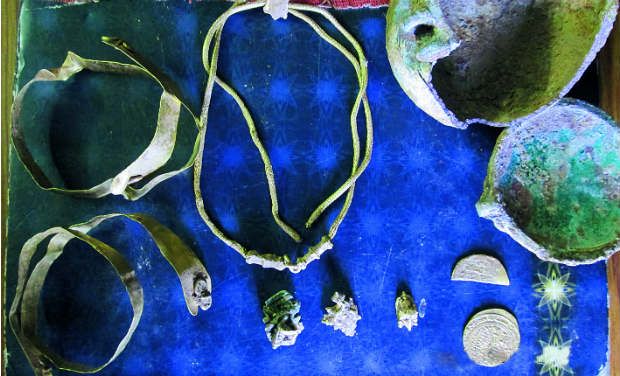
 An ancient copper urn and a treasure trove were unearthed by workers engaged in desilting a village pond near Amma­pettai. A group of 10 workers, led by panchayat president Manickam, was busy desilting the pond located on a field owned by Kirubanandam at Thirubuvanam Tho­ppu street near Amma­pettai on Saturday.
One of the workers, Krishnasamy stumbled upon the ancient copper burial urn. When he dug further, he unearthed a treasure trove which included one set of ear-studs, two sets of girdle-like ornament (oddiyanam) worn by women, a gold chain and two gold coins, all weighing 7.3 sovereigns (59 grams).
Krishnasamy took the treasure trove to his house much to the chagrin of the other workers. On being informed, revenue and police officials from Papanasam rushed to his house and seized the treasure trove.
They took it to the Papanasam taluk office. Later, the copper urn and gold ornaments were handed over to officials of the state archaeology department for further examination. The age of the copper urn and the gold ornaments is yet to be ascertained, sources said. Revenue officials have also ordered locals not to undertake any more work at the spot.
source: http://www.deccanchronicle.com / Deccan Chronicle / Home> News> Current Affairs / DC / December 02nd, 2013