LIGHTS, CAMERA, CONVERSATION… A road movie about roots

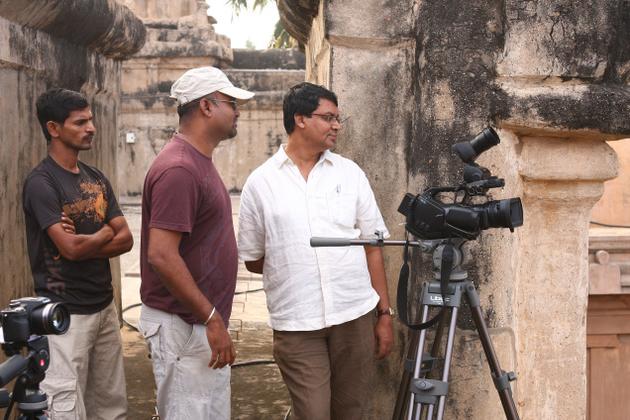
A journey within: The shooting of the documentary / by Special Arrangement / The Hindu

A documentarian sets out in search of his identity and comes up with the untold story of Tamil Muslims

“O Mankind! We created you from a single (pair) of a male and a female, and made you into nations and tribes, that ye may know each other…” Yaadhum, a documentary by the filmmaker Kombai S Anwar, opens with this quote from the Quran, and the image that follows is practically a counterpoint — the procession of Lord Ranganatha along the streets of Kombai, in the Theni district of Tamil Nadu, accompanied by traditional temple sounds from the nagaswaram and a large drum.

Then, as the procession passes the local mosque, we see the reason for this juxtaposition of word and picture: the investigation into the arrival of Islam in a place of Hindus and Tamils. In a voiceover, Anwar says, “While ‘who am I’ is never a question that bothered me during my growing-up years, it became quite important to me and to countless other Muslims, especially in these increasingly troubled times.” The documentary is labelled ‘A Tamil Muslim’s Journey In Search Of His Roots And Identity.’

Anwar told me that the idea for the film took shape from a paper he presented — Tamil Muslims: The Untold Story — at a national seminar. The paper was well received, and he was invited to give more talks on the subject. “After every presentation,” he said, “there would invariably be a few from the audience asking if a CD of the same material was available, so that they can pass it on to friends. With many such requests, and tired of the stereotyping of Muslims as well as the increasing polarisation, I thought I should make this the subject of a documentary film, so that it can reach a bigger audience.”

When he started about four years ago, he found it difficult to get funding, as Yaadhum was seen as a “religious project.” So he went ahead on his own, with money from his sister, a few friends, and his professional assignments in photography and filmmaking, which included a series of short films on the Big Temple at Thanjavur commissioned by the ASI.

Yaadhum, which loosely means “all” or “everything,” showcases the close relationship between Muslims and those from other communities. In one stretch in Madurai, we meet the Muslim family that has, for generations, been building the fence around the sacrificial pit in Puttu Koil, the site of one of the Thiruvilaiyadals of Lord Shiva. “These relationships have evolved into kinship in southern Tamil Nadu,” says Anwar, who found it difficult to get permission to shoot inside mosques and temples. To film the prayers at the Kombai mosque, for instance, he had to ask the jamaath leaders (office bearers of the mosque), who, in turn, asked the congregation during the Friday-afternoon Jumma prayer. Only after they agreed could Anwar go ahead. The officials at the temple, on the other hand, wanted some time to think about it; eventually they said he could go ahead. Later on, when they got to know him, they admitted that they were initially wary about a Muslim showing interest in the temple, so they checked with a friend from the CB-CID. Anwar told me, “It was my luck that the CB-CID asked them not to worry.”
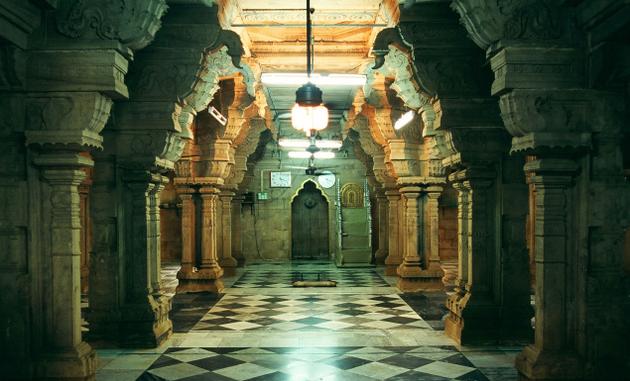
The Kilakarai Jumma Mosque / by Special Arrangement / The Hindu

It is precisely these rifts that the film intends to bridge, by showing how, once, these rifts didn’t exist at all. At the site of a dig near Kodungallur, a major port of the Chera kingdom, Prof. PJ Cherian, Director, Kerala Council for Historical Research, speaks of its “multi-cultural character 2000 years back”, and how “people belonging to different cultural groups, different belief systems, different practices, different traditions had an opportunity to come together and have interfaces. They all may have come here as traders. But you know trade doesn’t carry just goods. It brings in ideas, technology and new thinking… Multiple groups from the Mediterranean, from the Saudi Arabian region, from West Asia, from the Mesopotamian region, from the Indian Ocean rims, all were active here.”

This cultural overlap is found in Tamil Nadu too — say, in the Vaishnavite pilgrimage town of Alwar Thirunagari, where the mosque is built in the Dravidian architecture style. Dr. Raja Mohamad, Asst. Director of Museums (Retired), Govt. Museum, Chennai, says that there are no regulations with respect to Islamic architecture. “All that’s needed is a quiet place for prayer. And while building this space, the builders adopted the local architectural style.” Yaadhum is some sort of road movie, and Anwar’s stops along the way illuminate various aspects of Islam in the South and even Goa. He goes to Chola country, establishing the presence of Muslims through an inscription that refers to “Ahmed the Turk.” He goes to Kayalpattinam, which belonged to the Pandyas, and finds an almost 1000-year-old mosque to which additions have been made at different times. He narrates the history of the Tamil Muslims of Pulicat, most of whom are boat builders. He goes to Calicut, home of the Mapilla Muslims. Prof. MGS Narayanan, Director General, Centre for Heritage Studies, Dept. of Cultural Affairs, Govt. of Kerala, talks about a law which is supposed to have been passed by the Zamorin that at least one member of the fishermen families in Calicut must get converted to Islam so that there will be enough people to support naval warfare against the Portuguese who wanted to conquer Malabar in the 16th Century. (Hindus were generally reluctant to go to sea.)

We see venues, like Kottar in Nagercoil, where Tamil-Muslim literature flowered. The Arabic, Persian and Urdu influences introduced many new genres to Tamil literature — Kissa, Nama, Padaipor, and Munajaath. Among the most pleasant surprises of the film — and one that underscores the narrative crux of cultural osmosis — comes in these portions. We see a palm-leaf manuscript of Mihraj Maalai, poems written by Aali Pulavar in the 16th Century in memory of the ascent of the Prophet, and then we hear Isai Aruvi Seera Aboobacker sing these verses like a virutham (a free-style rendition, not set to a beat) in the Carnatic raga Kapi.

At the end of the film, Anwar says, “I am only halfway through my journey.” He still has many more miles to go and oceans to cross, this time in search of the Tamil Muslim Diaspora — but he has no more doubts about his roots. “I am a Tamil, a Muslim, and so many other things. In short, I am all of this —Yaadhum.”

source: http://www.thehindu.com / The Hindu / Home> Features> MetroPlus / by Baradwaj Ranjan / Chennai – November 29th, 2013

Belgian mission in Chennai will look to expand trade

Chennai :

The Belgian government on Thursday opened a consulate in the city to expand its relations with India. “Over 160 companies from the country have investments in India. With most of them having a presence in the south, we saw the need to consolidate our presence here,” the Belgian ambassador to India, Pierre Vaesen, said.

Belgium earlier had a trade office in Chennai, which is being converted into a consulate. The consulate was opened as part of the Belgian economic mission to India. Today, bilateral trade between the two counties is worth about $15 billion, with two-thirds coming from the diamond sector. “The mission of this visit is to diversify this to other areas like renewable energy, logistics, pharma and railways,” Vaesen said.

“The main purpose of the consulate is to build bridges between people and societies and expand ties between the countries. There can be collaborations between the countries in innovation, technology, sustainable energy and medicine,” said Jan Van Dessel, director general of bilateral affairs, federal public service, foreign affairs of Belgium. The consulate expects to give about 10,000 visas from the new consulate in Chennai, most of them business visas, he said.

As part of the visit to Chennai, companies from Belgium signed MoUs with five Chennai-based organisations, in the presence of Her Royal Highness Princess Astrid of Belgium. The country has signed 32 agreements with many Indian organisations. Hari Logistics, an importer of logs and timber, signed an MoU with Dedoncker P&G, an exporter of Belgian poplar logs, while Chennai-based auto component maker IM Gears signed one with Herfurth Logistics to cover transport clearance and distribution activities in Belgium.

source: http://www.articles.timesofindia.indiatimes.com / The Times of India / Home> City> Chennai> Belgium / TNN / November 29th, 2013

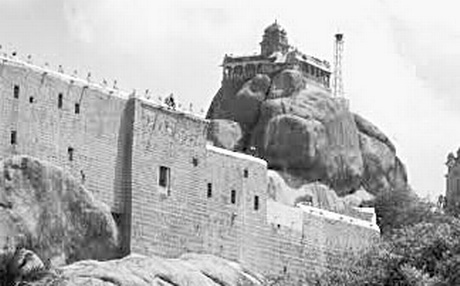
The rambling Rock fort of Trichy

RockFort08dec2013

After an overnight journey on the night train from Bangalore, we landed in Tiruchirapalli, the confluence of the Cauvery sangama where the last rites for one’s dead is held in all reverence. Traversing the crumbling banks of the Cauvery, we performed the shraddha in all its solemnity, sitting and twiddling on the hot sands. As the day cooled, we made our way in an autorickshaw across the city to the rambling Rock fort with its unique temple complex situated atop a steep hill.

Even the auto driver seemed to know all the details of this monument and went on eulogizing the historicity of the fort as well as the rock formations which is estimated to be about 3800 million years old.

The uniqueness of this place is not the fort which is in total ruins but the rock cut Ganesh temple. Since we had left the Cauvery banks very late, it was almost 4.30 pm when we reached the fort area. But once we started climbing the hill, we realised how steep a climb it was. In the blazing, sweltering heat, the flight of more than 330 steps was indeed very tiring and we had to reach the summit before the temple door closed for the evening.

Resting now and then, we managed to see many exquisite carvings and sculptures on way to the Ucchi Pillayar temple that is dedicated to Lord Ganesh. Located on top of the hill, it attracts many tourists and devotees.However, the local people say that it has become the suicide point for many. The temple authorities are very strict about the timings and nobody is allowed after the evening hours. The security is so tight that they send any person down who is seen loitering in any nook and cranny of the hill top.

In fact, most people come to see the temples as there is hardly anything to see in the fortified structures which has witnessed many a battle in different eras.

The Rock Fort at Tiruchirapalli or the famous trading city of Trichy has seen the footprints of many dynasties from the Vijaynagar to the Madurai Nayaks. There are two more temples in the fort complex, the Mannika Vinayakar temple at the foothills and a rock cut temple dedicated to a Nayakan era saint, Taayamannavar.

All these temples built during different eras tell the story of the glorious heritage through the inscriptions and carvings on various walls.

source: http://www.newindianexpress.com / The New Indian Express / Home> Cities> Bangalore / by Meera Bharadwaj – Bangalore / November 28th, 2013

‘Tamil for science’ seminar in January

Coimbatore :

A seminar on ‘Tamil for Science’ will be held at Dr G R Damodaran College for Science in January. Jointly organized by the college and the linguistics department of Bharathiar University, the seminar will bring together professors and researchers who will deliberate on how to develop Tamil such that it can be effectively used to teach and communicate science subjects, both to students and the masses.

The seminar which will be held on January 8th and 9th will discuss measures to popularise science through the vernacular language. It is being organized as part of the centenary celebrations of Dr G R Damodaran. Teaching science and technology through the vernacular has been considered an effective way to take science and technology to the masses. Researchers say that though there have been several attempts to popularise science through Tamil, nothing has come to fruition. For one, there is a lack of standard vocabulary for scientific terms. For instance, computer is called ‘Kanini’, ‘Kanipaani’ or ‘Kanipuri’ depending on the region. This issue can be resolved by preparing a standard document comprising Tamil words for each specific scientific concept or object. These words should be simple which the general population can comprehend.

“We need to come up with equivalent Tamil words for electronic gadgets and scientific terms,” said C Sivashanmugam head of the department of linguistics, Bharathiar University. Such effort will help make the teaching of science in the vernacular easier, he added.

Popularising Tamil words is the key to its success. D Padmanabhan, correspondent of Bharathidasan University and editor of ‘Kalaikathir’ magazine, founded by Dr G R Damodaran to spread science through Tamil said that one of the major challenges they face is to take developments to the general population. Those interested in participating in the seminar should contact Sivashanmugam at 0422-2428401.

source: http://www.articles.timesofindia.indiatimes.com / The Times of India / Home> City> Coimbatore> Tamil / TNN / November 28th, 2013

Rooftop Gardening to Come up in State

To ensure a continuous supply of fresh vegetables to urban markets, the State Horticulture Department will set up 40 collection centres and 100 retail outlets in Coimbatore and Chennai.

Speaking to Express on the sidelines of Farm to Fork: Challenges and Opportunities in Indian Agribusiness & Food Processing Industry, organised by the Federation of Indian Chambers of Commerce and Industry here, Satyabrata Sahoo, State commissioner, Directorate of Horticulture and Plantation Crops, Agriculture Department said that the State government had sought expression of interest from aggregators or private entrepreneurs for setting up 16 collections centres.

The aim is to create a forward linkage from rural to urban areas.

He said that Chennai and Coimbatore would have 50 retail outlets each under the scheme.

The move will ensure an assured income to farmers in rural areas adjoining the cities. Clusters of farmers will be formed to supply produce to a society run by the farmers at the district level.

Private entrepreneurs or aggregators will be engaged to collect, sort, grade and pack the produce at their location and supply it to retail outlets in the city. This scheme will be implemented as a public private partnership, he said.

Sahoo said that rooftop gardening would soon be implemented in the State in 12,000 places.

“We have called for tenders,” he added.

Nine thousand of these will be taken up in the city while 3,000 rooftops in Coimbatore will be converted into gardens.

Earlier, addressing the gathering, Michael Carter, Australian Trade commissioner said that Australia’s Queensland University of Technology (QUT) and the Biotechnology Industry Research Assistance Council (BIRAC), Department of Biotechnology, had entered into a `148 million partnership to help stamp out iron-deficiency anaemia, a major cause of maternal death during childbirth.

The project will see new strains of iron-rich bananas.

source: http://www.newindianexpress.com / The New Indian Express / Home> Education> Student / by Express News Service – Chennai / November 28th, 2013

Musicians to pay homage to saint of music

Chennai :

At the 9am mass today at the Church of Teresa of Avila in Nungambakkam, about 40 musicians of various faiths will come together to pay homage to the Christian patron saint of music, St Cecilia. While the feast of St Cecila is actually celebrated on November 22 world over, a 38-year-old tradition at St Teresa’s Church honours her with a special mass attended by a 40-piece orchestra and a 20-member choir on the nearest Sunday.

“A commemorative mass was being celebrated since the 1920s at the Presentation Church on Mount Road, but the tradition moved to St Teresa’s 38 years ago,” says Fr P J Laurence Raj, the parish priest. Incidentally, while music festivals and recitals in honour of St Cecilia take place every year on her feast day, the earliest recorded festival took place in Normandy in 1570.

The annual tradition plays out without fuss. An ensemble of independent musicians, many of whom play for the film industry, and the likes of A R Rahman, Illayaraja, Harris Jayaraj and Pritam gather on the assigned morning of the mass to strike up a rousing orchestral performance during the liturgy. “They perform every year for free, because they want to do something for God,” says Jerry Fernandes, coordinator of the programme. Fernandes, a violinist who has played for Illayaraja since his first movie, is leader of the Madras Chamber Orchestra.

“Because it’s a liturgical performance, the programme comprises only of hymns, but we play a marching tune at the end of the service, of which one or two encores are often requested,” says Fernandes. One of the veteran performers at the mass is Kerala Kumar, a 57-year-old freelance violinist who has played for Malayalam music director M Jayachandran (films like ‘Pranayam’ and ‘Celluloid’) and Tamil composer D Imman (of such films as ‘Kumki’ and ‘Mynaa’).

“I have been performing at this mass for the last 15 years, for the love of music, and the love of God,” he claims. For cellist P S Srinivas, who plays for Illayaraja and A R Rahman, music is above religion and this is why he has been part of this special ensemble for the last 25 years.

source: http://www.articles.timesofindia.indiatimes.com / The Times of India / Home> City> Chennai / TNN / November 24th, 2013

Nature and YOU

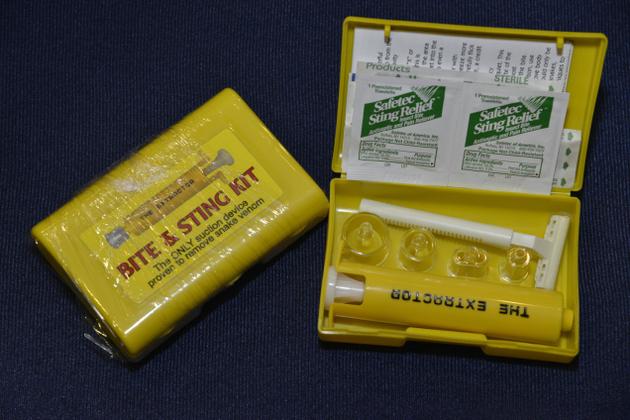
A first aid kit for snake bite at Adventure Shoppe in Coimbatore / Photo: K. Ananthan / The Hindu

Nature enthusiast A. Sivakumar speaks to K. Jeshi on how hitting the outdoors brings alive the conservationist in every traveller

He spends weekends in the company of birds, butterflies and Nature. He goes trekking in Wayanad, Mudumalai and the Niligiris and believes enjoying Nature is the first step in conservation. “You take ownership and want to give something back,” says A. Sivakumar.

He enrolled as a member of Salim Ali Naturalist Forum (SANF) for bird watching. During an outing, he realised that trekkers often sourced camping and trekking equipment from other States. That’s when he got the idea of starting Adventure Shoppe. It stocks equipment for camping and trekking, riding, racing and wildlife management, and has compact travel kits and accessories. “We want to encourage people to travel more. The idea is to kindle the conservationist in every traveller,” says Sivakumar.

Initially, orders were hard to come by. Sivakumar persisted, personally meeting forest officials, wildlife and Nature enthusiasts, birders and conservationists. “The word spread. My first order was for 10 sleeping bags for the Forest Department,” he recalls.

Slowly, he was approached for providing equipment (carabiner, hooks, climbing rope and body harness) for windmill installations and cleaning of high-rises. Sivakumar explored wildlife management equipment and introduced a range of camera traps. “The Forest Department uses it to record wildlife. Recently, it also helped them arrest a poacher,” he points out.

A camera trap at Adventure Shoppe in Coimbatore / Photo: K. Ananthan / The Hindu

What’s new?

All the products are imported from the U.S. and South East Asian countries. “Selecting the right product, supplier and brand makes up 70 per cent of our work. We go in for CE-certified products as we are dealing with lives. Hundreds of products hit the market every day and we keep a watch on what’s new.” There is stiff online competition, but credibility keeps us going, he says. This wildlife enthusiast has also supplied 5,000 snake bite first-aid kits to 240 battalions of the CRPF. “In 2010, we got just five kits because we weren’t sure about the product. The former Director-General K. Vijayakumar saw the product on our website. They found the product useful. In fact, the kit saved the life of one of my friends Rajkumar, who worked as honorary wildlife warden of Nagarhole.”

Sivakumar’s clientele is spread across the country and includes conservationists, racers, riders, climbers, trekkers and corporate houses, besides Government departments. Recently, he supplied multi-function watches for Indian Air Force pilots. They track heart beat, altitude, latitude, longitude and work as a barometer.

At the shop

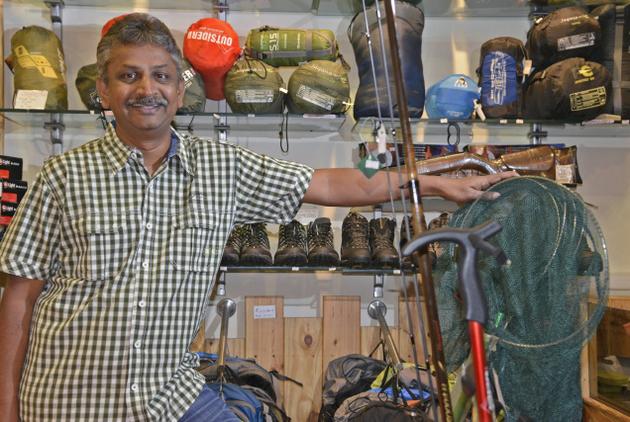
He walks me down his shop in Fun Republic. There are temperature-specific sleeping bags (that can keep you comfortable even at minus five degrees!), infra red and no-flash camera traps, scuba-diving accessories, archery equipment, fishing accessories, racing suit for riders, backpacks…. There is also a mini refrigerator, Swiss knife, riding luggage for bikers, universal dynamo charger for cell phones, gloves, boots and helmets. The latest addition is wildlife T-shirts.

A.Sivakumar of Adventure Shoppe /  Photo: K. Ananthan / The Hindu
A.Sivakumar of Adventure Shoppe / Photo: K. Ananthan / The Hindu

He says there is great potential for his products in Coimbatore. “People from here often travel to the Himalayas and Rishikesh. They buy water-proof shoes, hiking poles and winter clothing. They also buy compact travel accessories such as foldable chairs, cots and a multi-fuel cooking stove that works on petrol, diesel or kerosene.”

In the pipeline are plans to launch a no-flash camera traps for home security and a life straw with an inbuilt filter. It ensures that the water trekkers drink from any open body is instantly filtered.

Sivakumar says weekend travel has taken off in a big way. So has dirt biking. “Customers ask for helmets that cost Rs. 40,000 or more. They are aware and prioritise on safety.”

He also helps travellers makes the transition to conservation. “I tell them that photographing Nature alone won’t do. They should stay connected with Nature, observe and conserve. It helps them stay stress free.” Sivakumar follows what he preaches. He takes off on his Royal Enfield 500 cc bike during the weekends. “I am a biker and a conservationist,” he smiles.

Trekking essentials

Good footwear, sleeping bag, compass or GPS, first-aid kit, camping tents, backpacks, water bottles, rain coats, protective gear, multi-fuel stove. “One has to go prepared inside a forest. You need to wear protective shoes to avoid ankle injury. Carry sleeping bags to protect yourself from lizards, snakes, and insects. A pepper spray works as self-defence, and also distracts elephants and bears.”

Camps for children

Sivakumar and a couple of friends have started Iternis that arranges two-day, two-night treks and nature camps for children and adults. Call: 9843222000.

To know more, visit: www.adventureshoppe.com

source: http://www.thehindu.com / The Hindu / Home> Features> MetroPlus / by K. Jeshi / Coimbatore – November 21st, 2013

Ancient rock murals found in TN’s Pudukottai district

Ancient and rare rock murals reflecting the pre-historic character of the district have been discovered in the Tirumayyam Fort premises, an official said today.

The existence of rock paintings which depict dances that existed in 5000 BC was known earlier, historian and District Chief Educational Officer N Arulmurugan said.

The paintings, made with red colour painting material, were found during a study of the Fort by a team of historians, including himsef, he told reporters here.

“The rock paintings at the Fort reflect the pre-historic character of the district… They are older than the murals of Sithannavasal, painted between 7th and 9th AD,” he said.

The painting on one side of the cap shaped rock near the entrance of the fort had faded. But on the otherside one can see row of paintings including one depicting man and a woman lying down in reclining posture.

Another painting is a dance programme wherein a couple are playing some musical instruments and another couple dancing holding their hands. This type of dance was mentioned in ancient Tamil literature ‘Tolkapiam’ as “Undattu” (a dance), he said adding a spectator, probably the queen or the chief of the area, had been separately drawn in a big size.

On the northern side of rock also many images had been painted. One of them showed several men following a woman in a queue.

Paintings had also been found on the roof of the cave between the Shiva and Vishnu temples in the fort. Some paintings show about the use of animals as a mode of transport and use of weapons made from rock for hunting animals.

Arulmurugan urged the archaeological department to protect the paintings.

The district was one of home of pre-historic man. A very large number of burial sites have been found. In and around Pudukkottai, there are many vestiges of the oldest habitations of man and some of the lithic records known in the south.

source: http://www.business-standard.com / Business Standard / Home> PTI Stories> National> News / by Press Trust of India / Pudukottai (TN) / November 22nd, 2013

Malli stall comes up at airport

Picture for representational purpose only.
Madurai:
With SpiceJet’s Mad­urai-Dubai flight taking off tonight, putting the customs airport in the Temple City on an expansion mode, a stall exclusively for Madurai malli (jasmine), which the city is famous for, was opened to promote the flower known for its fragrance in the international market.
N. Jegatheesan, malli exporter and president of Tamil Nadu Chamber of Com­m­erce and Industry, has taken a small 4×4 square feet space at the international terminal on rent to make the queen of flowers available for arriving and departing passengers.
The neatly strung fresh jasmines, tied with banana fibre, is sold in two boxes1.5 m long strand for Rs 100, and 3 m long string for Rs 300. Given that stringing the buds is an art perfected by the flower sellers of Madurai, and is looked at with awe by tourists, a skilled jasmine ‘weaver’ has been engaged to keep tying the flowers to demonstrate the craft to tourists.
Union minister of state for commerce and industry E.M. Suda­rsana Natch­iappan, wh­o inaugurated the stall on Friday, welcomed the move to have a sta­nd for Madurai malli at the airport as the flow­er, like the Meenakshi tem­ple, is synonymous with the city’s heritage. He urged the trade and industrialists to take steps to promote the flower in the international market.
On day one, the patr­onage for malli boxes was good. “We kept 50 boxes for sale as it was the opening day. But to our surprise, all were sold out even bef­ore the arrival of passe­ngers of the inaugural Dubai flight,” Jegat­heesan said. If the swanky airport s­ports a jasmine stall no­w to help passengers gra­b a strand or two, the­ book Madurai Ma­llig­ai authored by educ­ati­onist, Dr Uma Kan­nan, has already been made available to help international tour­ists have an insight of th­e city’s ubiquitous flo­­wer and its versatility.
source: http://www.deccanchronicle.com/ Deccan Chronicle / Home> News> Current Affairs / DC / November 23rd, 2013

Baby toilets distributed to avoid open defecation

Trichy :

If habits die hard, then good habits must be inculcated in kids from impressionable ages. This was the thinking behind the distribution of baby toilets  made of plastic to 65 people in the first phase of the scheme, said  Trichy Corporation may A Jaya.

Distributing the baby toilets to the parents at the corporation office, Jaya said this was part of the government’s commitment to make the state open defecation-free by 2015. In the rural areas, the government was implementing a host of measures to underline hygiene education for effective behaviour change under the total sanitation campaign (TSC), but it was the first time baby toilets were distributed in the city.

“In the corporation and municipal limits, as many as 30% of the people still defecate in the open and at the least the children from the stage of infants must be taught against defecating in the open. Hence, the scheme is introduced by the state government,” said V P Thandapani, corporation commissioner.

Known as ‘mini-toilets’ the portable plastic pieces would be provided in higher number to cover all those who needed them, said Dhandapani. “This is to inculcate the habit of using the toilets at home, so that they do not think of defecating in the open,” he explained. Research proves that the children could be brought to such a good habit within a matter of a week, he further said.

source: http://www.timesofindia.indiatimes.com / The Times of India / Home> City>Trichy / TNN / November 19th, 2013