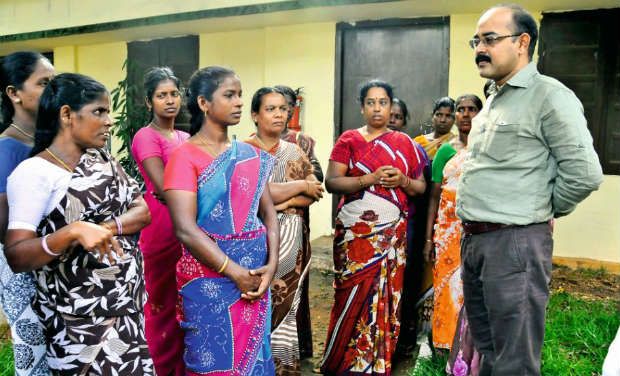
On the occasion of World Diabetes day, the city municipal corporation opened its herbal canteen service at the main office complex of the corporation. Specifically meant to serve healthy and nutritious meals the herbal canteen at the corporation is expected to be a great relief for hundreds of visitors and employees working at the corporation main office.
“The menu was fixed after ensuring the nutritional content of the food. Members of selected self help groups will operate the centre and our officials will monitor it,” said G Latha, commissioner, Coimbatore municipal corporation.
The herbal canteen will serve soup varieties from 11.am to 12.30 am at Rs10 per serving. Lunch time is from 12.30 to 2.30 pm during which limited meals and various variety rice would be served for Rs40 and Rs20 respectively. Evening snacks would be available from 4pm to 6pm at a rate of Rs10 per plate. Items include Navadhanya Adai, Vazhapoo Vadai and other savouries. The canteen will also serve various varieties of herbal and organic teas.
“We have supplied utensils and other facilities to the women entrusted with the canteen and they will pay us Rs750 daily. We will also fix a salary for them,” Latha added.
The corporation has spent around Rs 2.76 lakh on the herbal canteen and was reportedly planning to give it on a monthly rent of Rs5000 but now it is exploring possibility of lowering the rent. The canteen would be managed by 14 members of Sri Ganga Yamuna Womens SHG from Kurichi.
“The corporation has given us the facilities to operate the canteen. We will purchase the ingredients and other items required from the open market,” said P Pushpavalli, an SHG member.
source: http://www.articles.timesofindia.indiatimes.com / The Times of India / Home> City> Coimbatore / by TNN / November 15th, 2013
Mount Cantonment CEO Prabhakaran speaking with cross-section of women identified by Loyola’s School of Human Excellence to be hired as conservancy staff at cantonment. — DC
Chennai:
The Military Cantonment Board in St.Thomas Mount has launched a unique initiative to provide employment to widows and destitute women in Chennai’s slums, identified by the School of Human Excellence of the prestigious Loyola College.
These women have been employed as conservancy staff to keep the vast cantonment area in the city clean, according to cantonment CEO Prabhakaran. He told DC that women working as housemaids for paltry salaries of 2,000-3,000 rupees a month are now being paid Rs 350 per day by the cantonment board.
“They are immensely happy. With their family incomes going up, their children are not dropping out of schools,” said the cantonment official, adding, “This is the first of its kind initiative undertaken by any cantonment, or for that matter any city corporation, in the country.”
He said the women were assigned only the job of sweeping the streets and there were no menial jobs like drainage cleaning given to them. “We treat them with dignity. We also make available free medical and education facilities for the families as we have two hospitals and two schools in the cantonment,” Prabhakaran said.
He said the programme was launched with just seven women workers drawn from different city slums on September 10 and their number went up to 22 now. Interestingly, the ‘spark’ for the initiative was lit at the birthday lunch that the CEO got for his wife Agila.
The couple chose to share lunch with the nearly 100 poor girls housed at the Fr Chirag Foundation, a vocational training centre run by Fr Henry Jerome, Dean, School of Human Excellence, Loyola College.
“That experience moved me and I decided I must do something for the poorer sections of our society. Loyola College helped me through its ‘outreach’ programme led by Prof Bernard Sami. His team was already familiar with most slums in the city and they helped us to identify deserving women,” said Prabhakaran.
Shanti, 38, is among the 22 now happily employed at the cantonment. This widow from Mangalapuram slum in Chetput lost her husband to alcoholism-most women in the group have similar stories to tell-four months back.
“I slogged as a housemaid and needed to frequently borrow at high interest from moneylenders. I was worried for my little son and daughter attending school. Now we feel reassured,” she said.
source: http://www.deccanchronicle.com / Deccan Chronicle / Home> News> Current Affairs / DC / by D. Senthil Natarajan / November 14th, 2013
Oil palm cultivation has been introduced in Pudukottai district, thanks to the efforts made by the National Agriculture Development Programme (NADP).
The NADP has fixed a target of 100 hectares to be brought under oil palm cultivation. Gandarvakottai being one of the potential blocks for oil palm, the cultivation was taken up at Veeradipatti village in the block on Wednesday.
At a function at Veeradipatti, K.M. Shajahan, Joint Director of Agriculture, said special subsidy would be sanctioned to encourage the practice.
He explained the assured returns from oil palm from the third year of its cultivation.
Lack of awareness about the profitability of the crop was a major hurdle.
Campaign
The department would launch an intensive campaign to motivate farmers. Oil palm cultivation required less labour, he said. The NADP has permitted cultivation in Pudukottai, Sivaganga, and Virudunuagar districts.
Sadanandham, Deputy Director of Agriculture (government of India schemes), said oil palm would be an alternate and viable crop.
source: http://www.thehindu.com / The Hindu / Home> News> Cities / by Special Correspondent / Pudukottai – November 14th, 2013
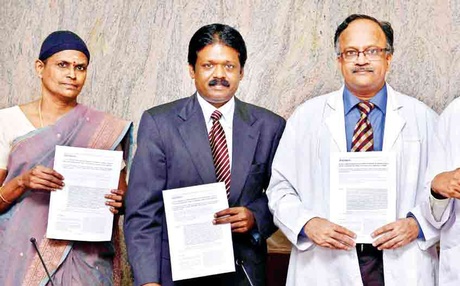
Doctors from MMC, ICH,Egmore and Nichi-In Centre present a report on the use of polymer scaffold for stem cell study | Jawahar
In an attempt to treat nerve issues related to gastrointestinal disorders, Madras Medical College and the Institute of Child Health (ICH), Egmore along with Nichi-In Centre for Regenerative Medicine, have for the first time in the country, conducted a study on stem cells that have a potential to treat the disease.
The doctors have also for the first time found a synthetic scaffold that can help in the optimal regeneration of the neurons after the cells are transplanted in the affected portion of the intestine.
The four-year study is restricted to finding a treatment for Hirschsprung’s Disease, a disorder of the abdomen, in which part or whole of the large intestine lacks the nerves which are needed for movement of the stool through the intestine. The disease, which one in 5,000 children have at birth, affects the activity of the large intestine. Due to the lack of nerves, the intestine doesn’t relax, thus creating an obstruction while passing stool.
Professor Dr V Senthilnathan said ICH receives about eight to 10 cases a month and about 120 cases a year. Unlike the current treatment option where pull through surgery is performed by pulling out the normal portion of the colon, which has the nerves, to the anus, cell-based therapies can be a potential solution to the disorder, as the surgery involves single to multiple stages. “By the age of three, the child would have undergone two or three surgeries,” the doctor said.
Doctors here collaborated with Japanese researchers to isolate and culture enteric neural precursor cells from biopsy samples that are taken from the gut of patients who were undergoing surgeries for the disease. These cells, along with a novel thermo-reversible gelation polymer scaffold, are grown, divided and multiplied in a laboratory, before they can be transplanted in the affected portion of the colon, in Hirschsprung’s Disease, along with the scaffold.
Once transplanted, the scaffold can help in optimal regeneration of neurons that have the capability to restore the function of the colon. “We take the cells from the area where the nerve is normal. These are grown and multiplied, and then transplanted to the affected area,” explained Dr J Krishnamohan, Professor of Paediatric surgery, Government Kasturba Gandhi Hospital.
Though several similar studies have been conducted in many countries and tested on animals, doctors here have for the first time found a scaffold that is purely synthetic as there are chances of the human body rejecting the conventional scaffold material.
“We have used Japanese laboratory to grow the cells. We will approach the ethics committee and based on their recommendation, we will proceed further. But if we need to get this therapy for public use, we need a laboratory on our own, which could cost `40 to 50 lakh,” Dr Senthilnathan said.
Dr J Krishnamohan said that phase one of the study was completed and that it could take another 10 years for it to be put to public use.
source: http://www.newindianexpress.com / The New Indian Express / Home> Cities> Chennai / by Express News Service – Chennai / November 13th, 2013
Stepping into the library of the Pandiyan Nedunchezhiyan Corporation Higher Secondary School in Madurai, one does not get the feeling of visiting a library situated inside a corporation school. Equipped with air conditioners, modern furniture, cushioned executive chairs, the library provides a perfect atmosphere for the children to kindle their reading habits. With only 466 books in 2009, the library now grown up leaps and bounds with more than 8,000 books in its collection. Thanks to the efforts of the librarian, K Kanagadurga, who joined in 2009 on a consolidated pay, the number of books not only increased, but it also imbibed reading habits among many students.
Philanthropists, who recently visited the library were taken aback by the maintenance were assured their contribution to the library to increase the books. A group of them had donated 1,032 books to the library. At a function organized in the library to felicitate the donors on Monday evening, V V Rajan Chellappa, mayor, Madurai Corporation took part. Speaking on the occasion, he said that people should take cue from the donors and give back to the society.
With two periods allocated for library for the 300-odd students in the school, the librarian is proud to say that 90% of the children are now fond of using the library books. Apart from the students belonging to the school, students from other schools in the surrounding areas are also benefited.
“When the book fair was held recently in Madurai, I thought of using the opportunity to equip the library with new books. I contacted some of the philanthropists. They were impressed when they visited the library and offered to contribute the books,” Kanagadurga said.
The library has books covering most of the subjects required for the students. Interesting simple scientific facts’ related books, history, biographies, autobiographies of eminent people are also available, she said.
“The most important thing is to attract the students to the library with simple books that are enjoyable to read. The books should be attractive so that children at least take and flip through them and discover the contents,” she said.
source: http://www.articles.timesofindia.indiatimes.com / The Times of India / Home> City> Madurai / TNN / November 13th, 2013
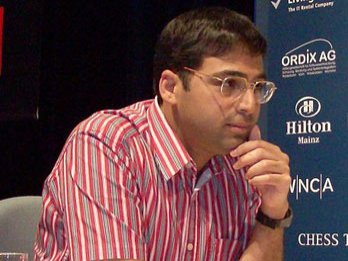
Viswanathan Anand an Indian chess Grandmaster and is the current World Chess Champion was born on December 11, 1969 in Mayiladuthurai, a town in Tamil Nadu.
Anand at the age of 37, he became the world number one for the first time.
Recently Viswanathan Anand drew the third game with Magnus Carlsen a 22 year old Norwegian chess grandmaster.
Here are some 5 facts to know about him:
Viswanathan Anand has won the World Chess Championship five times (2000, 2007, 2008, 2010, 2012), and has been the undisputed World Champion since 2007.
Viswanathan Anand rates the late American chess prodigy, grandmaster, and the eleventh World Chess Champion Bobby Fischer as the best of all time.
Anand was the FIDE World Rapid Chess Champion in 2003, and is widely considered the strongest rapid player of his generation.
Anand became India’s first grandmaster in 1988. He was also the first recipient of the Rajiv Gandhi Khel Ratna Award in 1991–92, India’s highest sporting honour.
In 2007, he was awarded India’s second highest civilian award, the Padma Vibhushan, and is the first sportsperson to receive the award in Indian history. Anand has won the Chess Oscar six times (1997, 1998, 2003, 2004, 2007, 2008).
Image courtesy:Wikipedia
source:http://www.indiancolleges.com / IndianColleges.com / Home> Articles / by Editorial Team / November 13th, 2013
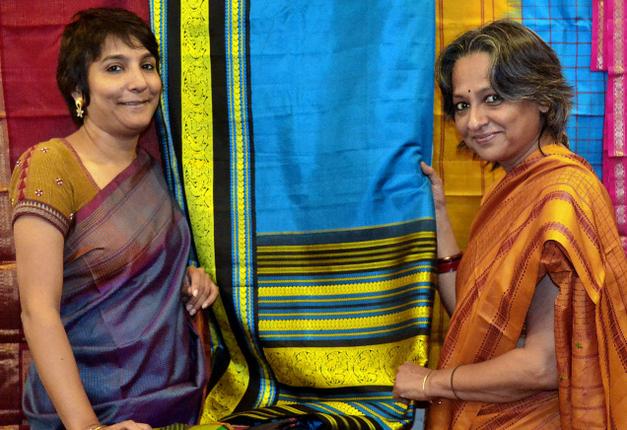
Simrat Chadha and Nilini Sriram with korvai saris. / Photo: S.Madhuvanthi / The Hindu
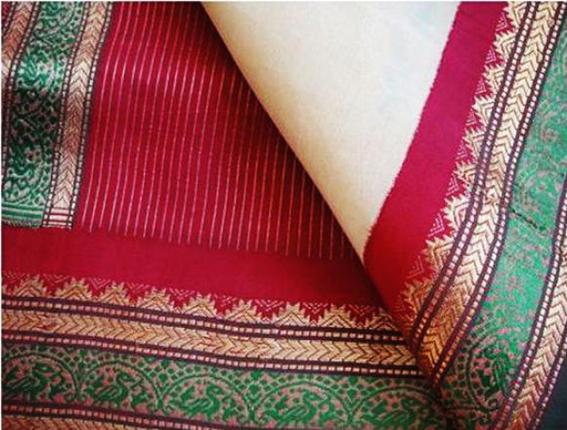
Simrat Chadha brings alive the classic Kanchipuram sari, complete with near forgotten designs and colour combinations.
‘We are forward, Weave backward. Say the pitras as they sit by the loom’ – Rg Veda 130
To the rhythm of this unspoken bit of ancient poetry, countless weavers across India and across time have woven saris, upper cloths and veshtis of great beauty and elegance. In time, each region of the country came to excel in a particular set of motifs and designs in colours of Nature that blended to create unique saris with names which were bits of poetry in themselves.
The motifs of the Kanchipuram pattu sari, the pride of South India, had lyrical names such as tuthiripoo, bavanchu, kuyilkann, muthuchir, paalum pazhamum, oosivanam, vaizhapoo and simhasana. As Simrat Chadha, a South Indian pattu revivalist, puts it, “Ironically, the Kanchipuram sari itself is a misnomer. It came to be so called only because of the aggregation of saris and weavers in the city of Kanchipuram. Kanchipuram was actually a great veshti weaving centre! The “pattu” sari, or the Kanchipuram sari as it is commonly known, also owes its design soul less to Kanchipuram and more to the aggressive, spontaneous grace of Andhra’s design language and Karnataka’s staid yet graceful weaving patterns with Tamil Nadu’s structured textile philosophy. Every art form in Tamil Nadu follows strict structural formats. Even checks or lines whatever intricacy they wished to express followed structure. The exquisite Benarasi too came under Kanchipuram pattu sari’s structured patterning when the northern ‘hans’ became the ‘hamsam.’
Benaras patterns
Between 1820 and 1920, the pattu sari weaver began to absorb Benaras patterns such as ‘kinkab’ and ‘khilat’ in a Kanchipuram sari. In fact, so great was the popularity of the Benarasi saris that this writer’s mother’s nine-yard wedding sari – a nearly 100 year old heritage piece today – was a shot silk Benarasi silk spattered with woven bouquets of English flowers bunched in baskets.
A weaver at work / by Special Arrangement / The Hindu
What distinguishes a true blue Kanchipuram pattu whose history, according to Hobbes and Watson, goes back to a timeless yesterday while other textile historians give it no more than 500 years?
It has a defined design structure, is heavy in weight, with a warp and weft twist called ‘murukku petta,’ tested zari and a matte finish. It can be identified by ‘seeru’ stripes and ‘kattam’ checks, three shuttle korvai which is a plain interlocked joint or a ‘muggu’ temple spine, and patterned border, mundanai end piece and so on. The borders are wide and pallus defined by elephants and parrots, among other designs.
While the korvai has all but vanished, so have many of the other features of the classic Kanchipuram sari leaving behind a rather soulless coming together of colours, uninspired borders and trendy motifs.
For that rich look: A re-created Kanchivaram sari./ by Special Arrangement / The Hindu
Simrat’s passionate journey of revisiting and recreating the classic Kanchipuram was to stop “a bit of our culture and heritage from vanishing in front of our eyes. It was to entice the young person into appreciating and wearing the sari. It’s also my journey of responsibility. We are building pride of association at two ends – the customer and the weaver.”
“It all began with our collection of kodu and kattam cotton saris with korvai which was hugely popular. This convinced us to start our own pattu revival journey. I read all possible books on Kanchipuram saris and began collecting originals. All the old original Kanchipurams belong to mamis — friend’s mothers, aunts, grandmother and even great grandmothers! We then took a few of these originals and visited weavers and weaving centres in Kanchipuram, Salem and Madurai, to convince the weavers to replicate them.
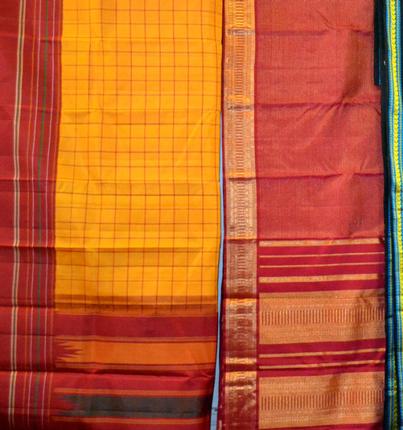
Sarees of various patterns recreated with Korvai. / Photo: S. Madhuvanthi / The Hindu
The response varied. Why should they weave a korvai which was time and labour intensive or create such an intricate border? Sometimes, there would be excitement when an older weaver would identify an oosivanam or a mubaggam which he himself had woven in his younger days! There was a lot of travelling back and forth by the revivalist team, much persuasion and great creative excitement as looms were set up and the recreation process got under way.
The collection of 60 original Kanchipurams and 20 re-created ones mesmerises with ancient mellow beauty, mellifluous mingling of colours, and near-forgotten motifs. An old oosivanam in pink with stripes and a magical border sits besides its revised avatar. The same look and feel with perhaps a subtle difference? An old Vaira-oosi with red body stripes and yellow border is now re-created with yellow body and red border.
If original Korinads entice with their harmony of colours and texture so do the recreated ones in deep blue with red stripes and yellow border or in flaming orange. Part of the re-created saris is the ‘kallam puttani’, ‘kalaialangara pudavai’ and ‘moobhagam’ in a stunning intersection of purple and grey, black and grey and so on. Original black body and broad red border Kanchipurams stun with their design harmony.
Equally harmonious are black and shocking pink, off white with huge checks and ‘maanga’ borders, turquoise with yellow border, some with tiny checks, and much more…
Call 044-24997526 if you want to re-create old heritage saris.
source: http://www.thehindu.com / The Hindu / Home> Features> Firday Review> Art / by Pushpa Chari / November 14th, 2013
Vasan said the Ministry has shortlisted 15 lighthouses, including Mamallapuram, Marakkanam, Kanyakumari and Rameswaram, in the country to be made tourist attractions. | EPS
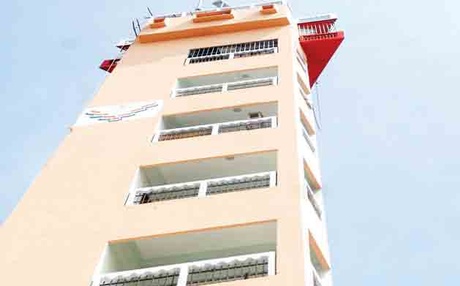
After over two decades, the Chennai lighthouse, overlooking the Marina beach, the second longest in the world, was today opened to visitors.
Shipping Minister G K Vasan opened the 46-metre tall heritage structure to visitors, which has been the first spot of sight for mariners approaching the commercial capital of south India from Bay of Bengal.
It was closed for visitors, following security threats during the early 90s, as the triangular structure painted in red and white, functioning since 1977 is located very close to Tamil Nadu DGP Office, Forensic Laboratory, All India Radio and holy shrine of Santhome Basilica.
Vasan said the Ministry has shortlisted 15 lighthouses, including Mamallapuram, Marakkanam, Kanyakumari and Rameswaram, in the country to be made tourist attractions. “Mamallapuram lighthouse will be opened in January next, while Marakkanam lighthouse will be opened on November 30,” he said.
Security arrangements have been made with cameras and smoke detectors installed at various spots and trained personnel being deployed in the campus on the Kamarajar Road.
Stainless steel fences have been erected on the 10th floor, till where the visitors are to be allowed.
The minister also laid the foundation for National Navtex Network intending to provide enhanced safety and security for maritime traffic. “It is a project of over Rs 20.25 crore and is expected to be completed by December 2014,” Vasan said.
NAVTEX is an international automated medium frequency direct printing service for delivery of navigational and meteorological warnings and forecast, search and rescue information and pirate warnings to ships.
The Indian Navtex Network would have seven transmitting stations including Veraval, Vengurla Point, Muttom Point, Porto Novo, Vakalpudi and Balasore — to broadcast maritime safety information to mariners up to 250 nautical miles.
An emergency NAVTEX Control Centre is also being established at Visakhapatnam in Andhra Pradesh to ensure uninterrupted service to mariners.
The network would broadcast navigational warnings, meteorological warnings and forecasts for 10 minutes at regular intervals round the clock.
The Ministry would also have monitoring stations at Okha, Ratnagiri, Azhikode, Puducherrym Dolphin’s Nose, Sagar Island and Port Blair.
source: http://www.newindianexpress.com / The New Indian Express / Home> Cities> Chennai / by PTI – Chennai / November 14th, 2013
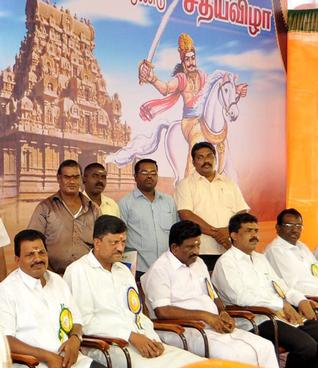
K.Thangamuthu, Chairman of Sadhaya Vizha Committee,(Sitting center) and Babaji Rajah Bhonsle, Senior Prince,(Second from left) at the 1028th Sadhaya Vizha (Coronation day) of King Raja Raja Cholan, in Thanjavur on Sunday. / Photo:B. Velankanni Raj / The Hindu
The life of King Raja Raja Cholan and the history of Thanjavur district should be documented for the benefit of future generations, said District Collector N.Subbaiyan here on Sunday.
Inaugurating the 1028 Sadhaya Vizha(Coronation Day) of King Raja Raja Cholan, who built the Big Temple in Thanjavur, Mr.Subbaiyan said kings of yesteryears had recorded their history in the form of epigraphs and there was a need to document them now.
The Big Temple spoke volumes about the architectural skill, spirituality, and humanism of King Raja Raja Cholan. The temple remained the centre of administration and evidences in the form of epigraphs are available on the reforms initiated by the king in land administration and conduct of elections.
K.Thangamuthu, chairman, Sadhaya Vizha Committee, Babaji Rajah Bhonsle, Senior Prince and Hereditary Trustee of Palace Devasthanam, G.Dharmarajan, Superintendent of Police, Thanjavur district, participated.
A seminar on Raja Raja Cholan followed the inauguration. V.Latha, assistant professor of Sculpture, P.Jayakumar, Professor of Epigraphy, K.P.Nallasivam, assistant professor of Philosophy, M.Bhavani, assistant professor of Epigraphy, all from Tamil University, and K.Menaka, Assistant Professor, Department of History, AVC College, Mayiladuthurai, spoke on the various aspects of the king’s administration.
source: http://www.thehindu.com / The Hindu / Home> News> Cities> Tiruchirapalli / by Special Correspondent / Thanjavur, November 11th, 2013
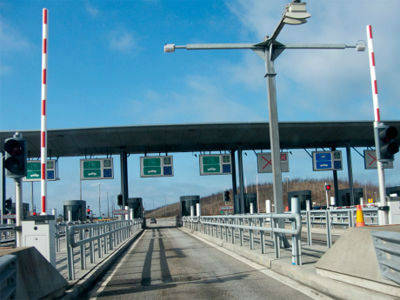
SBI Macquarie Infrastructure Trust has acquired 74% stake in a Trichy road project developed by IJM of Malaysia and Shapoorji Pallonji for Rs 275 crore. This is SBI Macquarie’s third buy in the road space in the last one year.
India’s road sector is abuzz with talks of mergers and acquisition, with smaller and more aggressive bidders piling up orders that have run into viability issues, creating an opportunity for financial and strategic investors to shop around for distressed projects.
(India’s road sector is abuzz…)
“Trichy Tollway project has so far made losses but the project is up and running and there are no execution risks involved. Given the toll collections, the valuation looks attractive,” a source close tot the development told ET.
Trichy Tollway Private is a 50:50 joint venture between IJM and Shapoorji Pallonji. The project entails quadrupling the two-lane 92.75 km stretch on National Highway 45, and subsequently operating and maintaining it for 20 years under a concession with National Highways Authority of India . The project started commercial operation in September 2009 and has three years of operating history.
SBI Macquarie bought almost equal stake from the two JV partners, reducing their collective stake to 26%. Post the acquisition, SBI Macquarie has roped in Feedback Brisa Highways OMT, a JV between Feedback Infrastructure and Brisa, Auto Estradas de Portugal SA, to operate and maintain the project.
SBI Macquarie Infra is managed by a JV established in 2008 between State Bank of India, Macquarie Capital Group and International Finance Corporation. It had earlier bought 35% stake in Ashoka Buildcon’s roads arm for Rs 800 crore. It also acquired 74% stake in GMR’s Jadcherla Expressways for Rs 203 crore.
Cash-strapped infrastructure developers are in the market looking for equity investment in 40 projects. Many of these projects are up for sale because of lower-than-expected toll collection, rising cost of credit and bottlenecks in land acquisition.
A few highly leveraged developers are also scouting for investors to raise funds to finance other projects. In the past, companies like Hindustan Construction Company and Ashoka Buildcon have inducted equity investors for their subsidiaries.
source: http://www.articles.economictimes.indiatimes.com / The Economic Times / Home> News> Economy> Infrastructure / by Rachita Prasad, ET Bureau / November 11th, 2013