A greening project takes root in rural Coimbatore

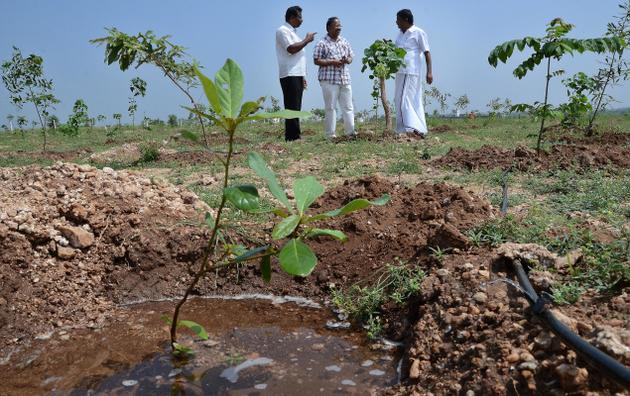
RAAC Secretary R. Raveendran (centre) and N. Nithyanandam (left), President of Thiyana Social Welfare Trust, discuss the Pasumai Panchayat project with a resident of Mylampatti Panchayatin Coimbatore district on Sunday./ Photo: S. Siva Saravanan / The Hindu

2,700 saplings planted across ten acres of barren land in Mayilampatti

Around 15 kilometres from the city is Mayilampatti, a dry village with huge tracts of barren land, which is now laying the foundation for a movement to increase the green cover in all the 235 village panchayats of Coimbatore district.

Mayilampatti has become the first village to be chosen for executing the ‘Pasumai Panchayat’ project, a mass sapling-planting initiative launched by Former President A.P.J. Abdul Kalam in May.

This project has brought together many stakeholders right from NGOs such as Siruthuli, Residents Awareness Association of Coimbatore (RAAC), Thiyana Social Welfare Trust, to corporate firms such as Coimbatore Textile Club, besides Government agencies such as panchayats and District Rural Development Agency.

As many as 2,700 saplings have been planted across ten acres of barren poromboke land at Mayilampatti.

The main objectives of the project are to increase the green cover, provide roosting place for birds, and create a research field to help students pursue studies in agriculture, horticulture, photography and bird-watching, says RAAC secretary R. Raveendran.

Further, two ponds will also be dug at Mayilampatti, which has a significant peacock population.

Technological tools such as global positioning system(GPS) have been adopted for systematic planting.

The area, soil nature and ground water level were scientifically tested to find out the kind of plant species most likely to thrive on the land. Further, drip irrigation has been adopted, he says.

The growth data will be recorded with suitable picture support from an aerial view and posted on the web.

N. Nithyanandan, president of Thiyana Social Welfare Trust, says a lot of time was spent on convincing all the local stakeholders as the residents have to take ownership for the project to succeed.

While the Mayilampatti Panchayat accorded the necessary approval expeditiously, volunteers from Siruthuli, RAAC and Thiyana Social Welfare Trust, besides students from National Model School’s Nature Club, National Institute of Fashion Technology, Tirupur, and Kathir Engineering College, planted the saplings.

The Coimbatore Textile Club came forward to fund the drip irrigation while the Forest Department gave the saplings. The DRDA has suggested that MNREGS workers also be utilised for the project, he says.

With the project proving successful, he says many other Panchayats have approached them to initiate similar projects in their villages.

Already six acres have been identified in Neelambur Panchayat besides another 14 acres at Vagarayampalayam.
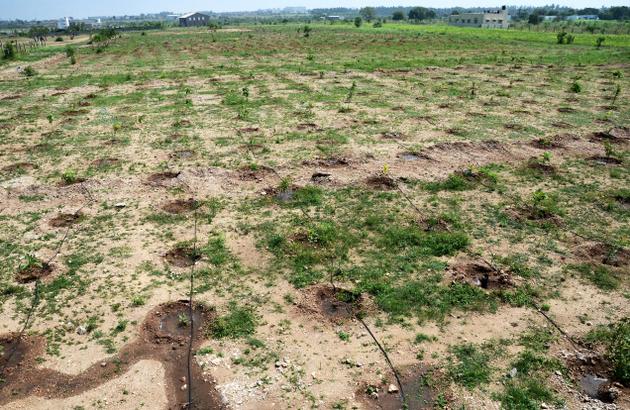
A view of the Pasumai Panchayat underway at the Mylampatti Panchayat in Coimbatore district on Sunday./  Photo: S. Siva Saravanan / The Hindu
A view of the Pasumai Panchayat underway at the Mylampatti Panchayat in Coimbatore district on Sunday./ Photo: S. Siva Saravanan / The Hindu

Mayilampatti Panchayat president Radhamani Selvaraj says around 30 people including several children work in the project every day from 6 a.m., an indication of the positive reception for the project from the residents.

A.V. Govindaraj, president, Arasur Panchayat, says that through this project they can leave behind a better place for the next generation.

source: http://www.thehindu.com / The Hindu / Home> News> Cities> Coimbatore / by R. Sairam / Coimbatore – November 11th, 2013

A book that throws some light on Shola flora, fauna

Coimbatore :

Academics often complain that there are hardly any authoritative texts on our native wealth especially with regard to our plant species. In a bid to overcome this limitation a few researchers have jointly come up with a book which documents the flowering plants in the Sholas and grasslands. The book ‘Flowering Plants of Sholas and Grasslands of the Nilgiris’ was released recently by three researchers from the city based Institute of Forest Genetics and Tree Breeding (IFGTB) along with another botany researcher from Kerala.

“We have documented characteristics of 641 plants with their photos. This could be used for reference by foresters, researchers and students,” said N Krishna Kumar, Director IFGTB who led the project. S P Subramani and R Aanandalakshmi 2 other researchers from the institute and P S Udayan, a botany lecturer from Sree Krishna College, Guruvayur, Kerala have contributed to this text. He said that the Shola forest, spread across Nilgiris, Kodaikanal and parts of Kerala, is around 2,000 metres from sea level. Shola forests are unique to the region with soft soil which retains water and a cool climate, housing its own set of plant species. The researchers note that due to climate change and human factors, plants which were not seen here are suddenly thriving in the region while some that are specific to the area are spreading to outside areas.

They went through documents and collections of all plants recorded by various researchers and put them together. The book contains plant features including its characteristics and its various uses. The name of each plant is given in Malayalam, Tamil, Kannada and English. “Even foresters are unable to recognise several plants and those who know them, recognise them only in the native language,” said P S Udayan.

Around 256 species have medicinal uses including modern medicine, Ayurveda , folk, homeopathy , siddha, Tibetan and Unani. The book includes several interesting facts like that of the Rhododendron Arboreum, a red flower which is an ever green shrub seen in many hilly areas. A sub-species of this existed in the Sholas which served as a kind of protection against fires. Once these plants began disappearing from the region, forest fires became more frequent, said Krishna Kumar.

Krishna Kumar, an officer with the Indian Forest Service (IFS) had started collecting data from 1992. He said that the Shola forests are facing problems especially human interventions. However, more research needs to be done before coming into any conclusions.

source: http://www.articles.timesofindia.indiatimes.com / The Times of India / Home> City> Coimbatore> Kerala / TNN / November 11th, 2013

Showbiz time for Saurashtrians in Madurai

Madurai :

In the din of flamboyant film posters, a flex board installed along the busy Kamarajar Salai in Madurai fails to catch the attention of speeding motorists. But for a few, who stop over to have a glance, the board, brings an instant smile. Written in bold are the words “Hedde Jomai” (idiot son-in-law), the title of a made-in-Madurai Saurashtrian movie.

Far away from the glamour and grandeur of Kollywood – the multi-crore Tamil filmdom – a niche film industry is in its nascent stage at Madurai. Saurashtrians in the temple city who had migrated to Madurai from Gujarat three centuries back have begun making films in their mother tongue to keep their language alive and entertain the 3 lakh strong Saurashtrian people here.

So far, half-a-dozen films – family dramas, comedy, devotional and even a romance flick – have been made on a shoestring budget. The filmmakers point out that Saurashtrian language films are not even made in their native Gujarat. “We want to keep alive our identity. Though our people watch Tamil films, we always have a longing to watch a film in our mother tongue,” says V K Neelarao, director of ‘Hedde Jomai’.

The filmmakers utilise available equipment like cameras and flashguns used by professional videographers. Shooting is widely done in Madurai, while some chose to travel to places like Yercaud for outdoor shootings. The budgets are limited to less than Rs 10 lakh.

“For Hedde Jomai, besides story, screenplay, dialogues and direction, I have also penned the lyrics. The film revolves around women empowerment,” says Neelarao, a former journalist with a vernacular magazine. The film was entirely financed by his businessman son V K N Kasiviswanathan. Reluctant to reveal the budget, Neelarao, however, says that he is not after profits.

S R Ramlal, who has made two films ‘Simmasanam’ and ‘Hamsadhvani’, says that his films are mostly funded by the crowds. “None of our technicians or actors demand payment. In fact, they would also pool in money for the production,” he claims. Most of the crew and artistes are Saurashtrians, but for few exceptions,” Ramlal says. In Hedde Jomai, but for the female lead from Kerala, all are Saurashtrians from Madurai.

The films are exhibited in community halls during the association meetings and family get-togethers for an entry fee. CDs of the films sell like hotcakes in Madurai. The films are also screened in local cable channels.

K B Sivakumar, a cameraman who also dons the hat of an editor says that the content of Saurashtrian films are completely different from mainstream Tamil films. “We are not influenced by Tamil films. There will not be any resemblance,” he says.

A yarn trader, J P Appan Raj says that he went popular overnight among the Saurashrta community after he played the lead role in a film. “Everyone on the street kept gazing at me,” says Raj, who got inspired by thespian Sivaji Ganesan.

source: http://www.articles.timesofindia.indiatimes.com / The Times of India / Home> City> Madurai / by V. Mayilvaganan, TNN / November 11th, 2013

3 engg colleges in western Tamil Nadu win awards for best streams offered

Salem :

Three engineering colleges in western Tamil Nadu  (Coimbatore, Erode and Salem districts) have been conferred awards for being the best in country in the streams of Computer Science and Information Technology, Electronics and Communication Engineering and Electrical Engineering.

The award was conferred on them by All India Council for Technical Education (AICTE) and Confederation of Indian Industry (CII) in association with ministry of human resource development.

“Southern colleges dominated the awards yet again in the engineering category,” said C R Swaminathan, co-chair chairman of CII National Higher Education Committee. Kapil Sibal, Union minister for communications and information technology participated in the function held in New Delhi recently. During his speech, Kapil Sibal called for reforms in the education system to make it child-centric and he said that several initiatives need to be taken to take the system forward.

Ahead of the two day CII Global University-Industry Congress and 5th Higher Education Summit, CII and AICTE conducted a survey throughout the nation. “The objective of the survey was to showcase best practices of industry partnerships across AICTE approved technical institutes in the covered streams. A total of 1,050 AICTE approved institutes from established engineering, management, pharmacy and architecture institutes, and from emerging engineering and management institutes, participated in the voluntary survey,” Swaminathan said.

He also said that top business houses including Tata Chemicals , Forbes Marshall, Elico, Sun Pharma and Pennar Industries joined hands to give awards to the winning institutes in recognition of their strong linkages with industry. “The exercise involved a survey of industry-linkages with colleges where objective scores generated by the AICTE web portal based on data gathered from the online survey, were evaluated by a high-level jury. On-ground visits to shortlisted colleges were made by a team comprising AICTE and CII representatives to ensure that the data submitted was valid. Their feedback was then analyzed to arrive at the final winners,” he said.

The winner in the best industry-linked institute in electronics and communication category was PSG College of Technology in Coimbatore. The award for best industry-linked institute in mechanical engineering went to College of Engineering Pune; for electrical engineering to Kongu Engineering College in Erode; for civil engineering to Walchand Institute of Technology, Sangli; for computer & IT engineering to Sona College of Technology, Salem and for chemical engineering to Institute of Chemical Technology. XLRI Jamshedpur was declared the best industry-linked institute in management. Bombay College of Pharmacy was adjudged winner in the pharmacy stream. “Of them, Sona College of Technology in Salem, PSG College of Technology in Coimbatore and Kongu Engineering College in Perundurai in Erode district are situated in western Tamil Nadu,” Swaminathan said.

source: http://www.articles.timesofindia.indiatimes.com / The Times of India / Home> Education> Information Technology / TNN / November 11th, 2013

The great ‘vocabulary battle’ comes to an end

The winning team from Bala Vidya Mandir that battled with five other finalists to bag the Oxford Dictionary Quiz trophy | Express

Teams from over 75 schools in the city battled it out at the Oxford Dictionary Quiz conducted by the Oxford University Press recently. Words like euphoria, serendipity and quixotic were being thrown around the hall during the prelims. Following this six finalists got into the heated battle for the title.

With over 300 students, teachers and parents cheering on, the six teams that were named after famous contributors to the Oxford English Dictionary, went through a gruelling six-round finale. Finally, the team from Bala Vidya Mandir in Adyar emerged the winners of the competition, albeit with a very tight lead over the runners up. The team comprised Sadhana Smriti of Adyar and Karthi Srinivasan of Besant Nagar. They were presented with a trophy that resembled a dictionary, made out of silver.

The winners were presented with certificates and prizes by the quizmaster Adittya Nath Mubayi and IIT Madras Professor Shreesh Chandra Chaudary.

Sadhana Smriti, whose team emerged as the winner, when asked about their preparation, said, “Our effort was really extempore and we had no preparation before the finals.” Karthi Srinivasan said, “Our school has a strong focus on extracurricular activities and we have clubs for debates and quiz.”

The competition, which was going pretty even between the top three teams till the penultimate round, shifted in favour of Sadhana and Karthi’s team, in spite of them not attempting a single question in the round. The other teams, which attempted the questions in the last buzzer round lost out on the negative marking. When quizzed whether there was any strategy involved regarding their decision to not attempt any questions in the final round, Sadhana said, “No strategy, we just figured that we were in a decent position and we didn’t want to spoil it by answering questions we weren’t sure of and get negative marking.”

The teams participating in the finals were all given prizes and the teams that emerged in the top three were from Bala Vidya Mandir, Adyar, Maharishi Vidya Mandir, Chetpet and DAV Boys School, Mogappair. The trophy was presented to the winning team in a ceremony held after the quiz.

source: http://www.newindianexpress.com / The New Indian Express / Home> Cities> Chennai / by Express News Service – Chennai / November 11th, 2013

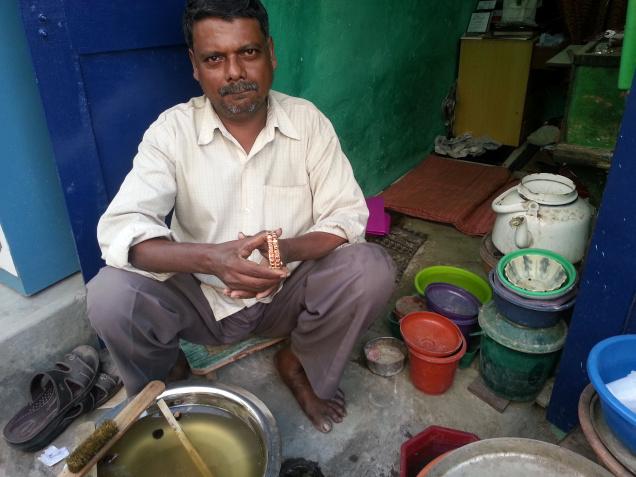
I am… Basheer; Gold, silver polisher

Basheer / The Hindu
Basheer / The Hindu

It’s only four in the evening, but Basheer has already decided to go home — he has no work that day. “The festive season just got over, hasn’t it? People will come to polish bangles and chains only after a few days,” he says, softly. Seated in front of a steel basin, with four boondhi kottais (soap berries) and four small brushes floating in the water, Basheer talks of the gold polishing business that he has been a part of for the last 30 years.

A Class 8 dropout, Basheer was initially a two-wheeler mechanic, before he trained for five years and became a skilled silver and gold polisher. After working out of several locations in Mylapore, Basheer now runs the ‘K. Noor Mohamed Gilt Shop’. “Earlier, I had my own shop. This one,” he says, pointing to the small, rectangular shop, with its blue shutters and green walls, “belongs to my cousin. He asked me to run it.” I strain to hear his voice, which gets drowned in the street noises of Mathala Narayanan Street; it’s only an old, narrow thoroughfare, but vehicle sounds and arguing neighbours make us raise our voices.

Our loud voices attract attention. One gentleman enquires why I’m asking Basheer “all these questions”; another offers to answer on his behalf and says, “He lives in Kunrathur.” Basheer explains that he moved to the ECR approximately 30 years ago. “Land was cheaper there, but now, it sells for crores!” Every morning, for the last three decades, Basheer has been taking two buses to reach Mylapore. “It’s faster to get here now, even though there’s heavy traffic after Tiruvanmiyur. In those days, there were hardly any buses, you see!” he smiles. The return journey is equally long, and he typically gets home for a late dinner around 10 p.m.

The day is spent in polishing silver and gold. Job orders range from small items — bangles and chains — to the temple kavacham or crown polishing. “Approximately 15 years ago, I polished silver items for the Kapaleeswara temple. Many of my customers are from Chennai, but some come from faraway places too.” Basheer, very modestly, says he’s an expert at polishing temple (dance) jewellery. “Dance jewellery is made in Nagercoil, and it’s difficult to clean and polish, as it has a lot of stones,” he says, showing me a pair of red-stone bangles that he has freshly gilded for a customer. It’s hard to tell it’s only ‘covering’.

To gold polish jewellery, Basheer first cleans it well. “I use soap berries bought from the naatu marundhu kadai; they foam naturally,” he says, pointing to the soapy water in the basin. Next, Basheer readies the ‘gold bath’, by dissolving a tiny amount of gold in acid, and boiling the resulting fine dust in water. This is then used to coat the article, by electrolysis. “After plating, the chain or bangle is dried on a bed of sawdust. It will then shine like gold.” (Silver plating is somewhat similar, except, it is buffed in the end).

Gold polishing costs around Rs. 250, a price that does not make it really profitable. “Gold prices have increased, but customers are not willing to pay more,” Basheer says. But he also rationalises their reluctance — gilt jewellery itself sometimes only costs Rs. 250, and the gold finish lasts for just a few months. And yet, Basheer seems happy with his lot; he talks of his three children — all graduates — and his visits to Nagore, with his family, once every two years. And when an old woman comes to his shop seeking alms, he springs up from his low stool, and fetches her a few coins…

(A weekly column on men and women who make Chennai what it is)

source: http://www.thehindu.com / The Hindu / Home> Features> MetroPlus > Society / November 11th, 2013

IIT-M working on battery to store solar power

IITcf19nov2013
Chennai:
 Tasting success in the solar technology, the Ind­ian Institute of Techn­ology (IIT), Madras, will soon come out with a cost-effective battery technology, which could be used to store large quantity of electricity.
Speaking to DC on Satu­rday, IIT-M director Prof. Bhaskar Ramamurthi said that several faculty at the institute had started their research on optimisation of electricity and appropriate battery technology.
“We are working on lower life cycle cost. We are looking at bulkier, non portable, batteries, which would be used for fixed use. Centre for decentralised photovoltaic systems in our institute is working on how to handle problem of load shedding and harness solar power locally,” he said.
Prof. Ramamurthi says that India en­joys solar power for over 300 days in a year from 9 am to 4 pm with variations. Pointing out that the present solar tech had mismatch of production and storage (battery) of electricity, he said that a person had to spend Rs 14 to store one unit of power in the battery.
source: http://www.deccanchronicle.com / Deccan Chronicle / Home> News> Politics / DC / by N. Arun Kumar / November 17th, 2013

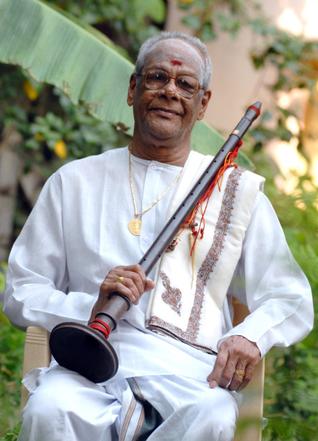
Nagaswaram exponent dies

S.R.D. Vaidyanathan / The Hindu

Vaidyanathan was recipient of many awards including Kalaimamani

S.R.D. Vaidyanathan, a famed exponent of Semponnarkoil school of nagaswaram, died here on Monday. He was 85 and is survived by wife, six daughters and a son.

Vadiyanathan was the grandson of Semponnarkoil Ramasamy Pillai, the first nagaswaram player to cut a disc as early as in the 1920s and the son of Semponnarkoil R. Dakhsinamurthy Pillai, the younger of the Semponnarkoil brothers.

If Semponnarkoil, a small town near Mayiladuthurai and sung by Saivite minstrels, could secure a prominent place in the Carnatic music world, credit should go to the brothers, who excelled in rendering rakthi melam encompassing beautiful and intricate laya.

Vaidyanathan teamed up with his brother S.R.D. Muthukumarasamy and they became the second generation of the Semponnarkoil style. He was trained by Mayavaram Ramaswami Pillai and he learnt vocal music from Thiruvazhundur A.K. Ganesan Pillai, and Madurai Mani Iyer, who was staying in Mayiladuthurai then.

“He helped me shed my inhibition and approach concerts with a free mind. As a nagaswaram player, he performed outdoor and the open space had a tremendous impact on his music. Perhaps, I imbibed the trait from him,” said vocalist Sanjay Subrahmanyan, one of the students of Vaidyanathan.

Mr. Subrahmanyan, whose association with Vaidyanathan began a decade ago, said his teacher was an intelligent musician with a catholic taste. He followed a difficult kala pramanam and excelled in rendering keerthanas and tough pallavis.

“He could play every word of the viribhoni varnam in four different kalams (speed). Flute Mali had rendered it in three different kalams,” said Mr. Sanjay Subrahmanyan and recalled how he was mesmerised by his playing of entukku beddala in sankarabharanam at Tiruvaiyaru Thyagaraja festival.

Thavil player Tanjavur T.R. Govindarajan, who accompanied Vaidyanathan for many years, said only an experienced thavil player could understand his music and manage a concert.

Carnatic tradition

“While his knowledge of layam could be matched only by very few thavil players, his playing of nagaswaram strictly adhered to the Carnatic tradition,” he said.

Musicologist B.M. Sundaram said Vaidyanathan also mastered avadana pallavi: singing a pallavi and keeping at the same time different tala structures.

S.R.G. Rajanna, his cousin and another surviving senior Semponnarkoil brother, said no one could beat Vaidyanathan when it came to playing pallavis.

Music Academy’s TTK award

Vaidyanathan was recipient of many awards, including Tamil Nadu government’s Kalaimamani and the Music Academy’s TTK award.

source: http://www.thehindu.com / The Hindu / Home> News> National> Tamil Nadu / by B. Kolappan / Chennai – November 19th, 2013

Marakkanam lighthouse ready to guide fishermen

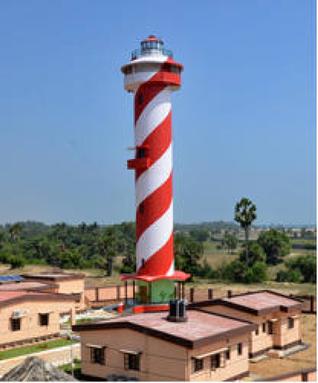
The new lighthouse in Kadapakkam has been emitting light since last week ./  Photo: T. Singaravelou / The Hindu
The new lighthouse in Kadapakkam has been emitting light since last week ./ Photo: T. Singaravelou / The Hindu

It will be inaugurated by Shipping Minister on November 30

The new lighthouse at Marakkanam has started emitting light, providing safe passage for small boats in the nearby fishing hamlets.

Till recently, fishermen were being guided by the lighthouse located either at Puducherry or Mamallapuram.

The Marakkanam lighthouse in Villupuram district is located about 60 km from Puducherry and 40 km from Mamallapuram. It is also 17 km from Marakkanam towards Cheyyur.

It took nearly 12 months for the authorities to construct 110-120 feet high structure at a cost of Rs.2.20 crore. The new facility will be inaugurated by Shipping Minister G.K. Vasan on November 30. According to the sources, it is the 24th lighthouse on the east coast spanning from Pulicat to Kovilthottam.

It will be powered by a solar panel. Its light will be visible for 17 nautical miles during night and 16 nautical miles during the day. Last week, a technical team visited the spot to increase the light’s length.

As per the maritime agenda, the Centre plans to set up at least one lighthouse for every 30 nautical miles along the maritime route in the country. Currently, there are 184 lighthouses in the country, of which 33 are on the east coast. The 25th lighthouse is being set up at Vembar in Tuticorin district. Land has already been acquired and the authorities are awaiting formal clearance from the Union the Environment Ministry to commence civil works.

Lighthouse Tourism

Even as the Centre has decided to allow tourists to climb the Marina lighthouse from Thursday, there are requests from the public to have an aerial view of the city and the port from the third lighthouse building in the Madras High Court. Sources said that Chennai maritime trade saw lighthouses being operated from four sites.

The first one was erected at Fort’s Museum, the second one along the Esplanade Line in the Madras High Court and the third one at the centre portion of the High Court’s main building. The second and third lighthouses can be allowed for public viewing only after renovation. Meanwhile, the Public Works Department said it would cost about Rs.75 lakh to renovate the third lighthouse.

The court has sought details about the renovation. After getting a reply from the department, the matter would be placed before the court’s Heritage Committee for its decision.

source: http://www.thehindu.com / The Hindu / Home> News> National> Tamil Nadu / by N. Anand & K.T. Sangameswaran / Chennai – November 11th, 2013

Devotion down the ages

 Vikku Vinayakram, Vidya Shah and the Manganiyars explored the various angles of bhakti in Nirgun Naad, writes Subha J. Rao

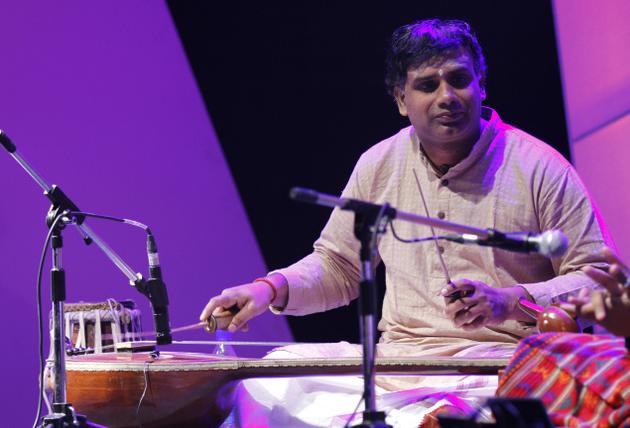
Even today, in the Avudaiyar temple in Pudukottai, the rhythm of the gethu vadhyam, an ancient percussion instrument, cascades over devotees. When N. Rajaraman played the 150-year-old instrument, shaped like a veena, the audience was transported back in time. Images of camphor-scented temples and eager devotees queuing up in front of the garbhagriha came alive.

N. Rajaraman plays Gethu Vadyam at Nirgun Naad / The Hindu

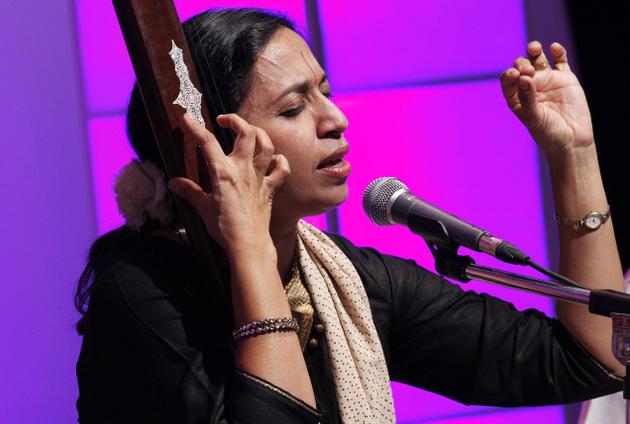
Rajaraman was part of Nirgun Naad, curated by Sufi singer Vidya Shah. The show brought together top performers from different streams of music. There was Vidya and her team, representing Sufi, Chugge Khan Manganiyar and his brother Salim who brought with them rustic ragas and devotion from the desert and, finally, Vikku Vinayakram.

Vidya Shah at Nirgun Naad / The Hindu

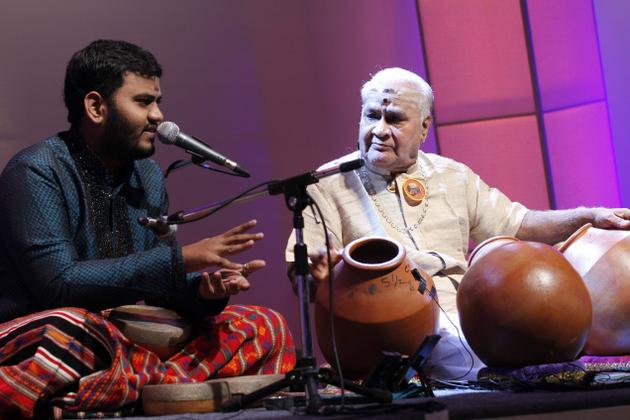
The ghatam vidwan is steeped in classicism yet happily embraces fusion. At 69, he continues to be a rockstar on stage, playing simultaneously on four ghatams, throwing one up in the air for some lovely music, pounding on it one minute and gently patting it the next…all without losing a beat. Accompanying him was his grandson S. Swaminathan, who played the kanjira and also performed solkattu with shlokams in praise of Mahaperiyavaa (Chandrashekarendra Saraswati).

Vikku Vinayakram and S. Swaminathan at Nirgun Naad./  Photos: K. Ananthan / TheHindu
Vikku Vinayakram and S. Swaminathan at Nirgun Naad./ Photos: K. Ananthan / TheHindu

Vidya began the concert with Amir Khusro’s ‘Mohe Apne Hi Rang Me’ followed by Meera Bai’s ‘Ritu Aayi’, an effervescent song celebrating the rain. The songs chosen for the evening celebrated various aspects of bhakti. Among them was ‘Bas Tu Hi’, by woman Sufi saint Rabia Al Basri from Iraq. The song had an addictive rhythm. Adding to the magic was Vikku mama, who made a grand entrance on stage during this number. Pandit Kumar Gandharva’s ‘Guruji Main Toh Ek Niranjan’ was up next. After Vidya sang, Swaminathan performed a solkattu. The thani avarthanam of sorts featuring all the percussionists — Swaminathan, Rajaraman and Shanti Bhushan Jha — was a treat to the ears; Ghulam Ali on the saarangi and Amar Sangam on acoustic guitar created lingering music.

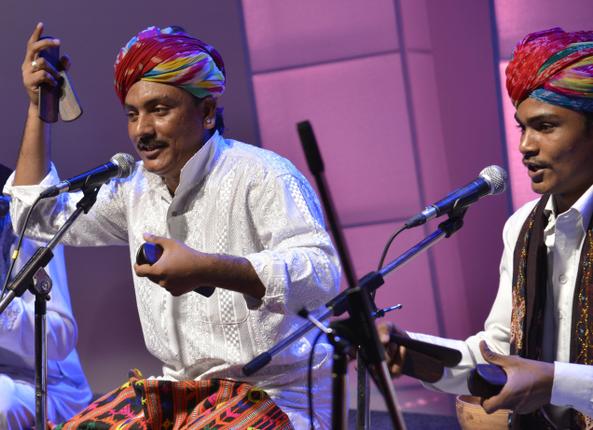
The Manganiyars, who had come all the way from Jaisalmer, stepped in for some vocal and percussion flourishes, their infectious enthusiasm rubbing off on the audience.

Chugge Khan Manganiyar and Salim Khan Manganiyar at Nirgun Naad / The Hindu

Vidya next rendered Naseer Akbarabadi’s ‘Tanha Na Use Apne’ and concluded with the rocking ‘Mast Kalandar’, leaving the audience asking for more of her rich voice that effortlessly caressed the peaks. We were also left wishing that the Manganiyars had sung more of their brand of soul-stirring music.

Nirgun Naad means music that celebrates a formless divine. In a sense, the concert did just that, leaving us with lovely snatches of devotion — for Nature, for the almighty. An evening that prompted you to seek that kernel of devotion within, to surrender.

PERFORMERS

Vikku Vinayakaram: Ghatam

Vidya Shah: Lead vocals

Chugge Khan Manganiyar: Vocals and Morchhang

Salim Khan Manganiyar: Back-up vocals and Khadtaal

S. Swaminathan: Kanjira

N. Rajaraman: Gethu Vadhyam

Shanti Bhushan Jha: Tabla

Ghulam Ali: Saarangi

Amar Sangam: Acoustic Guitar & Mandolin

source: http://www.thehindu.com / The Hindu / Home> Friday Review> Music / by Subha J Rao / Coimbatore – November 11th, 2013