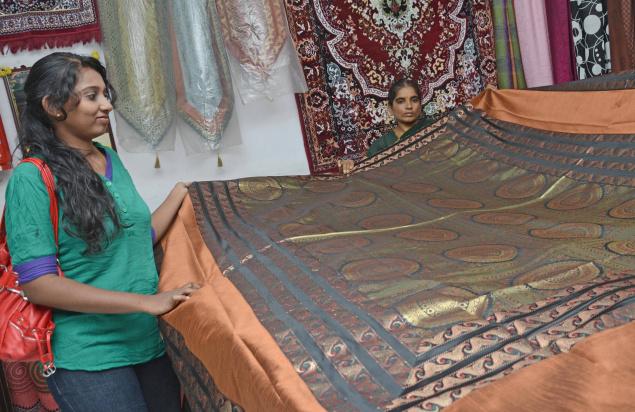
Exhibition of handloom fabrics at Poompuhar showroom in Tiruchi on Tuesday. / Photo: R.M. Raharathinam / The Hindu
10 per cent discount offered; Poompuhar expects sales of Rs. 7 lakh
Handloom products from different parts of the country such as Jaipur, Haryana, Varanasi, Tamil Nadu, Andhra Pradesh, and West Bengal could be viewed and purchased at a special exhibition being conducted at Poompuhar showroom in the city.
The handloom exhibition was opened to public on Monday and will be held from 10 a.m. to 8 p.m. till August 17, except Sundays at Singarathope in the city. The collections are priced between Rs. 60 and Rs. 15,000, and one could avail of a discount of 10 per cent on handloom items. The highlights of the exhibition are silk items priced between Rs.12,000 and Rs. 14,500.
The 13-day exhibition will feature unique collections such as Madurai Sungadi saris, Valanar saris, Banaras silk saris, cotton handloom saris, chudidhars, gaghra cholis, tops, skirts, and nighties.
Accessories such as Pashmina shawls, silk scarves, silk shawls, and silk bags are available.
Patchwork bed-sheets, sofa back covers, dewan sets, cushion covers, door and window curtains, woollen carpets, quilts, silk table cloths, silk wall hanging sceneries, and different silk products can be purchased. The stock value of the items on display is approximately Rs. 30 lakh, according to V. Ganesan, manager, Poompuhar.
Poompuhar expects sales of Rs. 7 lakh from this exhibition and hopes the revenue will help artisans who have put in a lot of hard work and dedication towards creating the items.
“Poompuhar has begun the selection process to provide training to 100 women on Thanjavur picture painting. The interviews are likely to be conducted shortly,” said Mr. Ganesan.
source: http://www.thehindu.com / The Hindu / Home> News> Cities> Tiruchirapalli / by Staff Reporter / Tiruchi – August 07th, 2013
He has been dominating Bollywood music scene for decades now and is the only Indian composer to win two Academy awards, but A R Rahman does not yearn for a break from work as he feels it is just the beginning of his career.
Known as the “Mozart of Madras” among his fans, Rahman started his journey composing scores for documentaries and TV shows before getting his first movie break with 1992 release “Roja”.
Since then he has given soul-rendering music in films like “Rangeela”, “Taal”, “Dil Se”, “Jodhaa Akbar”, “Swades”, “Rang De Basanti”, “Rockstar” and “Jab Tak Hai Jaan” and “Raanjhanaa”.
“I don’t have the time to relax. I still have so many things to do. My music school and so many other projects keep me busy. This is like God’s way of saying go on. I am here to make music and will continue doing so. Things have just started for me,” Rahman told PTI in an interview.
The music composer is all set to make his debut on the season 3 of ‘Coke Studio’ this year. He will be composing two Tamil songs, another song titled ‘Zariya’, with lyrics by Prasoon Joshi and a track based on Rabindranath Tagore’s ‘Mind Without Fear’.
“I took up the show just for the joy of performing with artistes coming together from different cultures – ranging from Tibet to the Middle East.
“My compositions for Coke Studio celebrate cultures, under the overarching theme of happiness. I teamed up with Prasoon and Valee sir (Tamil Lyricist) to create the lyrics for a couple of my songs on happiness and am pleased with the outcome,” said Rahman.
source: http://www.indiatvnews.com / India TV / Home> Entertainment> Bollywood / August 07th, 2013
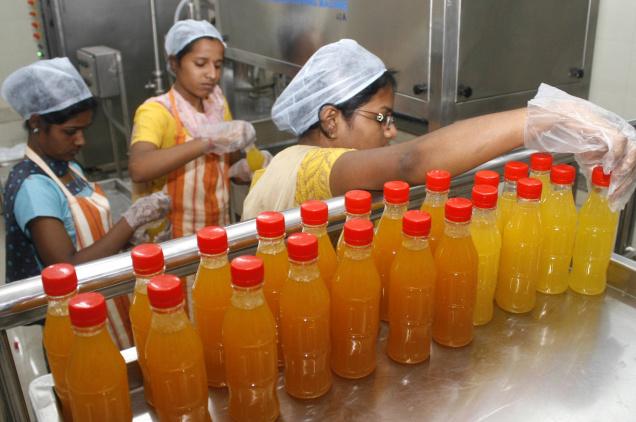
Students of the Department of Nutrition and Dietetics of PSG College of Arts and Science at the Food Processing Plant filling sauce bottles and capping them./ Photo: S. Siva Saravanan / The Hindu
The Food Processing Centre of PSG College of Arts and Science, set up in 2011, allows entrepreneurs to manufacture their value-added products, and offers a variety of courses to train people the techniques of value-addition.
Operated under the aegis of the Department of Nutrition and Dietetics of the college, the centre has been set up by the college management, with partial funding from Union Ministry of Food Processing Industries. It is licensed by the Food Safety and Standards Authority of India.
The focus, according to, S. Radhai Sri, Associate Professor of the department and coordinator of the food processing plant, was to take forward the concept of reducing wastage and post-harvest handling of fruits and vegetables.
“It is also to help conduct research and outreach activities for entrepreneurs, members of self help groups, students, and also farmers, to enhance food safety in all spheres of the food system gamut,” she says.
“Equipment such as steam jacketed kettle, pasteuriser, homogeniser, fluidised bed drier, and pulper, can be used by food business operators for research and development work as well as product development. Consultancy services are also provided on product development and market testing,” she adds.
The unit has product lines for ready-to-serve beverages, jam, jelly, and sauce. It is also equipped for canning of fruits and vegetables, packed and flavoured milk production, instant mixes and masala powders, research and development, and quality checking laboratories.
The centre is equally interested in promoting its training programmes – ranging from one day to one year — for the benefit of those who are trying to establish themselves as entrepreneurs.
There are weeklong programmes on preparing products from fruits, vegetables, etc.
The one-year programme is a Diploma course on Post Harvest Technology approved by the Bharathiar University.
Admissions for the training programmes are open.
Contact
Those interested can contact the Food Processing Centre on 0422-4303300 (extension 3357 / 3314).
source: http://www.thehindu.com / The Hindu / Home> News> Cities> Coimbatore / by Staff Reporter / Coimbatore – August 08th, 2013
Armenian Church / by Special Arrangement / The Hindu
In the 360th year of Armenian presence in the city Anusha Parthasarathy visits monuments and streets associated with this trading community
If you walk along Armenian Street today, it is vastly different from the time when the merchantmen of Madras occupied it. Street stalls are buzzing with business, bikes are parked right along the road and where they are not, cars squeeze in. A sea of people trundle down the narrow road, and yet no one turns to even take a look at an old arched entranceway, sharing its wall with a crowded fast-food joint. The Armenians, who established a thriving settlement in Madras in the 1600s, will celebrate the 360th year of their presence in the city in September this year.
The earliest existence of Armenians in India dates back to the late 8th Century. A man called Thomas Cana, arrived along the Malabar Coast in 780 AD. According to Portraits of Hope: Armenians in the Contemporary World by Huberta Von Voss, not much is known about his origin or mission but he was lauded as someone who worked for the rebirth of Christianity. The Armenian presence in Madras however, became rather eminent in the 1660s. Madras: The Land, The People and Their Governanceby S. Muthiah points out that the earliest Armenian tombstone dates back to 1663 and is of Coja David Margar. This was found near Little Mount. Hurberta Von Voss’ book though, also says that the Armenians of Madras were the first to discover the sepulchre of St. Thomas upon the Mount and took the Portuguese there in the 16th Century. In fact, it is popular knowledge that the church atop the Mount served as a lighthouse to guide Portuguese and Armenian ships around that time.
Even if there is no record of when exactly Armenians settled here, it was clear that they monopolised trade between India and West Asia on the one hand and Manila, a Spanish bastion then, on the other (according to S. Muthiah’s Madras: The Land, The People and Their Governance). They traded mainly in silk, spices and gems. In fact, the last Armenian to live here was Michael Stephen, who left the city a few years ago. And now, only a church, a street named after the community and a few lesser-known relics carry their stories.
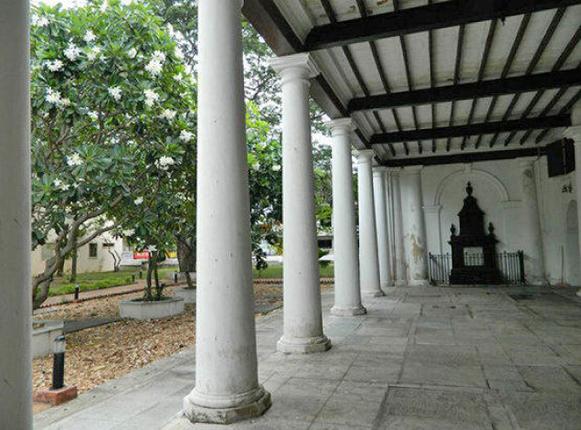
The most visible Armenian monument in Chennai is the much-written about Armenian church, which was first built in 1712 and later rebuilt after the French siege in 1772. The first church was built of timber in the present High Court area with permission from the East India Company. The Armenians were given 50 pounds to manage the expenses of the church. This encouraged more traders to settle in and around the area. Vestiges of Old Madras by H.D. Love points out that the earliest Armenian church, situated in Old Black Town, as shown in Thomas Pitt’s map, was probably built shortly after the Company entered into a covenant with the Armenian residents in India. The new church, however, was consecrated in Aga Shawmier’s chapel grounds in George Town. The street on which the church is situated continues to be called the Armenian Street, where the settlers once lived.
Perhaps the most famous Armenian in Madras was Coja Petrus Uscan, who is remembered for constructing or donating to the many remaining Armenian relics in the city. S. Muthiah’s book says that he was the heir of a family that had trade relations with the East for generations. But he settled in Madras only in 1723, on his return from Manila. A philanthropist, he contributed to several religious institutions in Madras.
Significant inscription
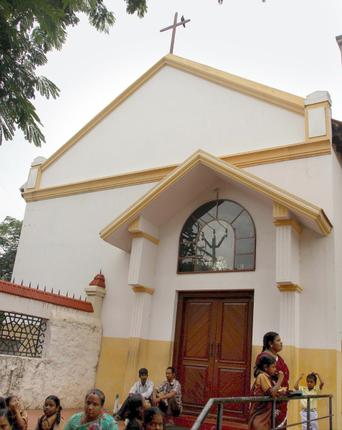
Santhome High Road isn’t a place where one can wind back time. Cars rush past at breakneck speed and there is no time to stop and stare, even if the object of concern is a three-century-old Armenian inscription that faces the road. Just at the edge of San Thome Matriculation Higher Secondary School is St. Rita’s church (now chapel), towards which Uscan donated liberally. It was built by Armenians and an inscription on its east wall, in Armenian characters, says In Memory of the Armenian Nation, 1729. H.D. Love’s book points out that the event commemorated was the opening of the grave of St. Thomas, which took place in April 1729, to which Uscan was a witness.
St. Rita’s chapel / by Special Arrangement / The Hindu
Another inscription in Portuguese in the same church shows that it was partially rebuilt in 1740. The church, now a part of the school, is not on the mainstream heritage map.
(To be continued…)
source: http://www.thehindu.com / The Hindu / Home> Features>MetroPlus / by Anusha Parthasarthy / Chennai – July 30th, 2013
The three-day festival conducted by Carnatica at MFAC will feature leading artistes who will focus on the art of ragam-tanam-pallavi singing
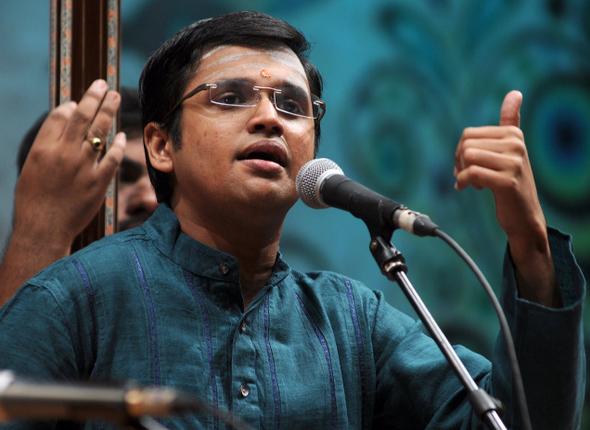
Pallavi Darbar, a unique festival dedicated to the art of ragam-tanam-pallavisinging, is all set to take place between August 7and 9 at the Mylapore Fine Arts Club. The event, in its third year, organised by Carnatica in association with Sri Parthasarathy Swami Sabha, is conducted with an intention to familiarise Carnatic music fans with the art of pallavi singing. It also aims to highlight the challenges posed to the artiste apart from simply encouraging pallavi singing. “Pallavi singing is the ultimate challenge to a musician’s creativity and with a bit of concerted effort we can guide the audience to enjoy this aspect of our music,” says K.N. Shashikiran who conceptualised this festival. ‘On the spot pallavi singing’ will be the highlight this year.
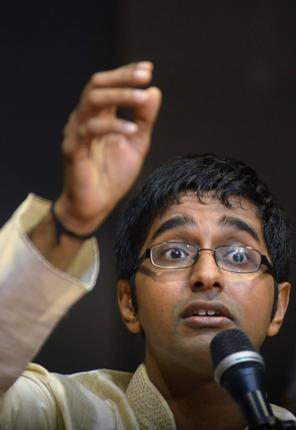
This being the centenary year of Dr. Sripada Pinakapani, the festival is dedicated to the musician who passed away in early 2013. The event will features artistes such as Trichy J. Venkataraman, Chitravina N. Narasimhan, Suguna Purushothaman, Malladi Brothers, Abhishek Raguram, Suguna Varadachari, Saketharaman, T.N.S. Krishna and Akkarai Sisters to name a few.
Abhishek Raghuram.. Photo: V Sreenivassa Murthy / The Hindu
The last day of the event will host an on-the-spot-pallavi contest ‘Pallavi Puzzle’, with singer Bharat Sundar moderating the event. Teams consisting of up to three people will be allowed to participate in this event. Entries can be sent in either through email to carnaticamusic@gmail.com or via registrations at the venue. Another open-house session on the valedictory day with J. Venkatraman,Chitravina Narasimhan and Suguna Purushothaman will be moderated by K.N. Shashikiran
The event is open to all.
Programme:
Dates: August 7 to August 9
Venue: Mylapore Fine Arts Club
The festival is dedicated to Dr. Sripada Pinakapani’s birth centenary year
Aug 7
5.00 p.m.: Open house on Art of Pallavi singing – with Vidwan Trichy J.Venkataraman,
Chitravina N.Narasimhan and Vidushi Suguna Purushothaman
6.00 p.m.: Pallavi concert by Malladi Brothers, S. Varadarajan, K.V. Prasad, Vaikom Gopalakrishnan
7.30 p.m.: Abhishek Raghuram, Akkarai Subhalakshmi, Anantha R. Krishnan
Aug 8
5 .00 p.m.: Pallavi and its intricacies by J. Venkatraman
He founded the Karky Research Foundation in 2013, whose main focus is language computing.
Quietly and astutely Madhan Karky came out of his father’s (award-winning Tamil poet Vairamuthu) shadow to deliver hit after hit songs in Kollywood. His debut song as lyricist was Irumbile Oru Irudhayam (Endhiran, 2010) when he was working as professor at Anna University, Chennai. He went on to pen lyrics for more than 15 films. Some of his songs are Elay Keechaan (Kadal), Google Google (Thuppaki), Ask Laska (Nanban) and Veesum Velichathile (Naan Ee).
However, this 33-year-old’s first love is teaching. He decided to take on his father’s mantle for financial reasons, Karky claims. He graduated in BE (computer science) from College of Engineering (CEG), Guindy, Chennai, in 2001 and went on to pursue a master’s course in information technology at University of Queensland, Australia — he graduated in 2004. He later read for PhD in sensor networks from the same university. “My experiences in Australia were an eye-opener. I had to work at an Indian restaurant to fund my expenses. There I met people from different cultures and countries. At college we were a mixed batch of students from China, Italy, Spain and India,” he says.
He founded the Karky Research Foundation in 2013. The foundation’s main focus is language computing. “The lessons learned in college are a part of education. The experiences and lessons you learn outside college are what I would call as real education. No one teaches you those things,” he says as we sit down to discuss his college life.
What did college teach you?
It was after joining college that I took an interest in academics. At CEG, everything about the subject interested me. At Queensland, they made studying interesting. Australian education taught me how to study without getting bored.
What was your proudest moment in college?
I tutored Chinese students and got the Best Tutor Award three times in a row at Queensland. I also felt very proud when I was awarded the PhD, as I was a bad student in school and no one expected me to earn a doctorate. My mother was highly supportive and I dedicated the degree to her.
Have you had any embarrassing moments in college?
Yes, there was a subject called engineering drawing. I didn’t like the subject and it was very boring. I could not clear the subject and had to write it twice. Finally I managed to pass, but that was an embarrassing experience.
How did you score points with the opposite gender?
My relationship with them was good. I treated girls and boys at the same level. I came from a boys school, but did not want to treat girls differently. We had a friendly rapport.
Was bunking a part of your college life?
I never bunked college. Anna University had a lot of freedom and we were lucky it was inside the city. We had free time in between classes. During this time we went out for movies and came back in time for the next session. So we had fun, and never had to bunk.
Did you have any rifts with professors? Why?
There were no rifts. I shared a good rapport with professors. We had a friendly relationship. We used to visit them at home for project discussions, met their families and it was all very informal. I never had any bad experiences.
Where did you hang out in college with friends?
Sathyam Cinemas was the usual hangout when I was in Chennai. In Australia, the university was situated near a lake, just outside the city. A bridge connected the city and the college. We always went for a walk on the bridge during our free time.
What extracurricular activities were you involved in?
I was active in the Computer Society of Anna University. We used to go to schools and teach them computer science. We used to teach government school teachers computer science in Tamil. I was a Navy Cadet in NCC. I also headed the Indian Students Association at University of Queensland.
source: http://www.newindianexpress.com / The New Indian Express / Home> Education> Edex / by Kaviya Sanjeevi – Chennai / August 05th, 2013
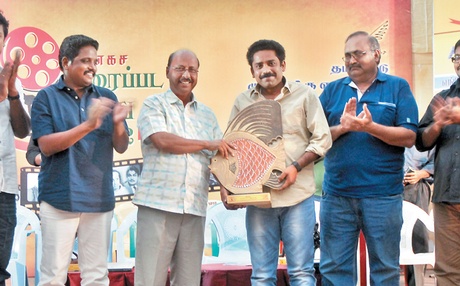
Director Seenu Ramaswamy receives Best Film award for Neerparavai | R Satish Babu
While Indian Cinema is close to celebrating its 100th year, the Tamil Nadu Murpokku Ezhuthaalar Kalaignargal Sangam (Tha Mu Ea Ka Sa) presented awards to the best Tamil films of 2012 at an award function held recently.
This year films such as Vazhakku Enn 18/9, Neerparavai and Saattai directed by Balaji Shakthivel, Seenu Ramasamy and M Anbazhagan respectively were chosen as best films of 2012 while Madhubaanakkadai, a debut effort from Kamalakannan was chosen as the best ‘New effort in Tamil cinema’.
Apart from mainstream movies, short-films and documentaries were also chosen for various awards. The short-film Mouna Mozhi directed by Jayachandra Hashmi was chosen for the Pa Ramachandran Memorial Award while documentary film Naali directed by Ra Murugavel and Lakshmanan were also chosen for the same award. The duo are already popular for translating the book The Confessions of an Economic Hitman into Tamil as Oru Porulaadhaara Adiyaalin Oppudhal Vaakkumoolam and penning the first poetry collection in a tribal language titled Odiyan.
Speaking to City Express, the organiser of the event said, “Whenever a good creation arises in Tamil arena, be it literary or artistic or cinema, we from the Tha Mu Ea Ka Sa never fail to appreciate them. Hence, we distribute awards to such good work every year.”
Eminent personalities such as poet Nandhalala and Sahitya Akademi award winner writer Su Venkatesan were present during the occasion.
source: http://www.newindianexpress.com / The New Indian Express / Home> Entertainment> Tamil / by Express News Service – Chennai / July 31st, 2013
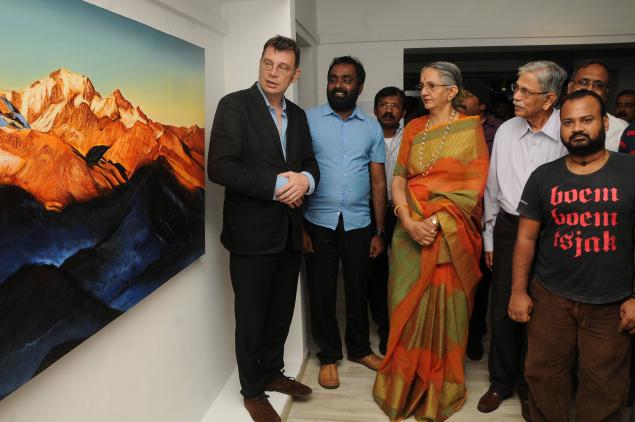
PHOTO REALISM: Franck Priot with artist A.P. Shreethar (second from left) / by Special Arrangement / The Hindu
Franck Priot, COO of Film France, woos Tamil filmmakers to the exotic country with offers
The chief operating officer of Film France, the official film division of the French Government, Franck Priot, who was in the city recently, invited filmmakers to shoot films in France. “We are looking forward to having more filmmakers from Tamil Nadu to shoot on the streets of Paris and other locations,” he said. Franck said the filmmakers will not be charged to shoot their films, and that the French Government has decided to offer a number of other services too free of charge — such as finding the right local production managers to help the film crew, helping with preliminary location scouting etc.
Why is Film France focussing specifically on this market? “Tamil films do good business there. Films such as Billa 2 and 7 Aam Arivu did good business, and there is enormous potential. We are also focussing on China, a booming film market,” he says.
The connecting link
He contends that shooting in France may be advantageous — “a lot of the Tamils have assimilated into French society, and Tamil films act as the only connection between the second-generation Tamils and their culture and language,” he observes. “Also, if stars such as Ajith, Vijay and Suriya have their film premieres in France, it will be huge as they have a great fan following there,” he says.
What does he think of Indian directors he has interacted with while they were shooting in France? “I am quite impressed with the way your directors adapt quickly to the rules and regulations of our country and obtain such high quality visuals in such a short period of time.”
(Franck Priot was in the city to inaugurate Mont Blanc In Painting — An Ode To France, an exhibition of creations by A.P. Shreethar. It is on at Art Houz, No. 41, Kasturi Ranga Road, Alwarpet till July 19. For details, call 2499-2173)
source: http://www.thehindu.com / The Hindu / Home> News> Cities> Chennai> Cinema / by Udhav Nag / Chennai – July 17th, 2013
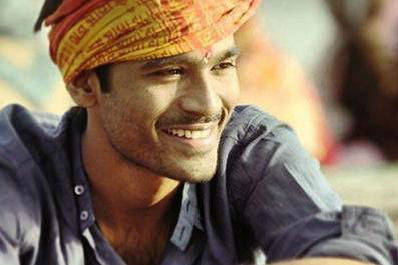
Singer-actor Dhanush, who is on a roll with the positive response to ” Raanjhanaa”, has a new endorsement in his kitty. He is now the face of a chewing gum brand.
Dhanush, whose popularity went several notches high thanks to his song “Why this kolaveri di?”, will feature in the new TV commercial of the product.
(Dhanush More Pics )
“It feels great to be associated with Center Fresh. Looking forward to work on some exciting campaigns for the brand,” Dhanush said in a statement.
Dhanush’s youth connect is a vital reason why he has been chosen to endorse Center Fresh, which itself is popular among the youth.
A new TVC for the brand is currently under development and it will be released later this year.
source: http://www.articles.timesofindia.indiatimes.com / The Times of India / Home> Entertainment> Bollywood / by IANS / July 31st, 2013
The life of a window cleaner hangs on a rope, but the invention of a group of Anna University students may just make it safer.
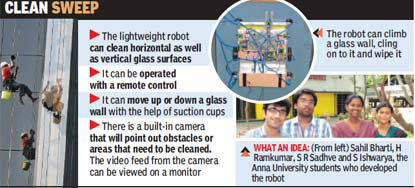
H Ramkumar, along with his three team members from the production technology department of the university’s MIT campus, has created a semi-manned robot that can climb glass walls, cling onto them and give them a wipe.
“We wanted to bring out something that would be lively and stand out from monotonous models,” said Ramkumar on the robot that was designed as part of the students’ BE final year project. “We also need a safe and efficient cleaning system because, conventionally, a human worker has to hang several feet above the ground with an unreliable safety system. Sometimes it proves fatal.”
Though it is in its skeletal form now, the 2.1kg robot is ready with its functions. The remote has four buttons to control the robot’s movement, done with the help of suction cups that take turns to climb glass walls. The light and rectangular vehicle has two wheels in the middle and four suction cups at the corners. While two cups help in climbing, the other two help the machine hold onto the wall.
On one corner of the device is a rolling wiper with a compartment above that to keep a water bottle. Near that is a tube through which water is sprayed continuously and the wiper cleans the wall, moving up or down simultaneously. A sponge wiper at the other corner and two flat ones in the middle do the finishing job. The dirty water is collected by a rolling wiper.
The students don’t claim it is the first of its kind. “We were inspired by some models in other countries,” said Ramkumar. “They use high-end technology for skyscrapers but we’ve used simple methods so far. But, our innovation would be an image processing camera,” said Ramkumar. The sensor in the built-in camera would show obstacles in the path or in any particular area to be cleared so that the machine can be moved accordingly. “The video can be continuously observed on a screen,” he said.
“Finalising the design was the toughest part,” said Ramkumar’s teammate S R Sadhve. “We had to stay back till late in the evening during the designing stage. Building the device was easier because we got most of the equipment from our college laboratory.” There are many such robots in other countries, but these are not available in the Indian market. “We would like to take this project forward and improvise it,” said Sadhve.
The duo, along with Sahil Bharti and S Ishwarya Lakshmi, got the ‘excellent paper’ award at the International Conference on Computer Science and Mechanical Engineering (ICCSME) and their paper was also published in the journal of South Asian Research Centre ( SARC).
source: http://www.articles.timesofindia.indiatimes.com / The Times of India / Home> City> Chennai> Mechanical Engineering / by Saradha Mohan Kumar, TNN / August 02nd, 2013