VEEN Waters discovers unique Nilgiri source to enter India

Finnish premium brand, VEEN Waters, known for its smooth spring water with an exceptionally low mineral composition and it’s award winning packaging, has announced it’s agreement with Blue Mountain Springs Pvt. Ltd. to gain exclusivity into another exceptionally low mineral composition spring water source in India, through which the brand will enter the Indian market.

The second spring water source is located in the Nilgiri mountains of Tamil Nadu in one of the oldest hill stations of India, Kotagiri.  At 1980mts, nestled amongst  dense Shola forests and splendid green lush of tea estates, the highlands of Kotagiri have been referred to as the “Switzerland of India” by the British collector of Coimbatore, John Sullivan when he first discovered the region in 1819.

“We have been looking into India for a while now, but what attracted us to this source was the almost identical characteristics of the water to our source in Lapland” says Mikko Nikkila, director of VEEN Waters Finland Oy.

The Indian source will bottle Veen products to cater to the Indian market and also for export within the subcontinent, whereas the Lapland source will continue to bottle for existing markets of Europe, UAE, Qatar, Singapore, China, Russia and the USA.

VEEN waters currently produces premium spring water products, Veen velvet and Veen effervescent in high quality glass packaging, which is sold in the culinary environment, exclusively to fine hotels, restaurants, bars and nightclubs.  This will be replicated for the Indian market.

“We are very pleased to collaborate with an exciting brand such as VEEN and thrilled that our unique water from the Nilgiris will be showcased for its distinctive properties”, added Arvind Rathnam, director of Blue Mountain Springs Pvt. Ltd.

More info:
www.veenwaters.com

source: http://www.PackagingEurope.com / September 28th, 2012

Narain Karthikeyan out-qualifies Pedro again

New Delhi:

India’s  Narain Karthikeyan managed to out-qualify his much experienced teammate Pedro De La Rosa for the second race in a row at the Singapore Grand Prix. HRT after intense work in the garage and analysis of data gathered on Friday, improved the performance of its cars substantially along with the sensations of its drivers De la Rosa and Karthikeyan.

Karthikeyan proved to be consistent and safe once again throughout the day, which culminated in a good qualifying session where he finished in 23rd, whilst his teammate De la Rosa, who went out with a new gearbox on Saturday which led to a penalty for not completing the obligatory five Grands Prix, finished in 24th.

“I’m happy because in qualifying I completed an almost perfect lap. I’m pushing very hard and I think that right now I’m driving very well. I’m very comfortable within the team, they help me a lot and make me feel at home, and when the atmosphere is that good it’s easy to perform well,” Karthikeyan said after the qualifying session on Saturday.

“I’ve done two good consecutive qualifying sessions and I hope to keep that momentum. Tomorrow’s race will be tough physically and mentally but we will fight to achieve the best possible result,” the Chennai driver added.

The Spanish team’s technical director Toni Cuquerella was also satisfied with Karthikeyan’s performance in the qualifying session. “Narain completed a good qualifying session, in the same line as his last Grands Prix where he has been more secure and consistent. It’s a shame that Pedro was unable to complete a clean lap this time. Tomorrow will be a tough race because, in terms of time, it is the longest in the season. But it will also be tough because of the high temperatures that the engine and the brakes reach, but also because of the thermal degradation of the rear tyres. It all leads to a two or three-stop strategy,” he said.

The tough conditions which the drivers will face in Sunday’s 61-lap race will be decisive in the outcome of the race. But also the high probability of the safety car coming out and the degradation of the tyres will play a vital role in the strategy, which is anticipated to be between two and three stops.

“Overall my sensations are positive because the car has improved but we didn’t complete a good qualifying session. We were using a new set of tyres and they were blocking a lot so we were unable to complete a clean lap,” De La Rosa said.

“Although I already knew that tomorrow I would be starting last because of the penalty, I tried to complete a quick lap, but it wasn’t to be. I take with me the fact that the car has improved quite a bit and that is important ahead of tomorrow because it will be a tough race. It will be tough for everyone but we have to race intelligently to not overwork the brakes and manage the tyres well. As always, we will give it everything to do the best we can,” the former McLaren driver added.

source: http://www.timesofindia.indiatimes.com / Home> Sports> Racing / by Devadyuti Das, TNN / September 22nd, 2012

Sport was more than a pastime for GK

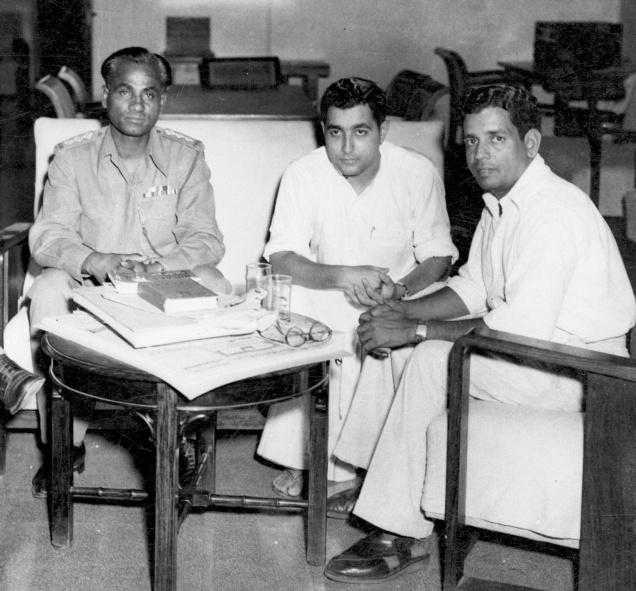
 PASSION FOR EXCELLENCE: G. Kasturi (centre), the dynamic Editor of The Hindu who was an all-round sportsman, seen with the legendary Dhyan Chand and S.K. Gurunathan (right), the Sports Editor of newspaper, when the hockey wizard visited the newspaper’s office in 1955. / The Hindu Photo Archives

It is difficult to relate in words the interest and enthusiasm that G. Kasturi showed for sports as Editor of The Hindu.

To say it bordered on passion, which remained undiminished till life ebbed out of him on Friday, is no exaggeration.

We, in the Sports Department, were always in awe of his range of interests and knowledge. He also had an abiding concern for accuracy and advocated simple prose as the means to convey an idea or the mood of a sporting moment to the readers.

He was a multifaceted genius. An all-round sportsman — who shone in tennis, cricket and in cue sports in his youth — GK, as we respectfully referred to him, was versatile to the point of being flawless in judgment.

If the sports pages of The Hindu today has a measure of variety and vivacity, it is largely because of the foundations he laid in1947.

His love for sport prompted the birth of the Sport & Pastime in 1947. For the sports fraternity of the country, thirsting for recognition in the post-independent era, S & P was a God-sent vehicle. It also grew into a ‘Bible for sport’.

He literally planned and polished every page, both in the choice of articles and pictures, to embellish the life and times of sportsmen and women. He was instrumental in starting the annual S & P Trophy limited-over tournament, and even captained the S & P team in the inaugural year.

VISIONARY

Always ahead in thinking and planning, GK kept himself informed of the happenings in every discipline. Even as recently as two months ago, he discussed in detail with this writer the raging controversy in Indian hockey. He recalled with a touch of nostalgia of how The Hindu came forward to donate the Rangaswamy Cup, for the National hockey championship, in 1951.

GK’s in-depth knowledge of cricket was phenomenal. He dissected, with impeccable logic, the technique of every batsman and bowler. In a recent discussion he debated why Indian spin dominates on local pitches. His two cricketing heroes were Wally Hammond and Lala Amarnath.

During a meeting connected with the layout for The Sportstar in the late 1970s, GK pulled out a picture showing Hammond in full flow while playing an off-drive and asked, “Will any of your batsmen play this shot with such elegance and class?” For a moment, he fixed his eyes on the picture, immersed in the beauty of it. Such was his boyish enthusiasm.

GK’s recurring theme during interactions with reporters and sub editors was on inculcating the spirit of innovation. He believed in the adage that change is the essential part of existence.

“Put on your thinking cap and imagine what the readers would think of the sports page tomorrow morning,” he said times without number. He advised the desk to unfailingly come up with something new to capture the attention of the reader.

Abreast with the latest development in the world of sports, GK followed interesting matches on radio and TV. He watched with the members of the sports staff the famous last ball six by Javed Miandad against India at Sharjah in 1986.

FOR THE YOUTH

GK consistently advocated that the sports pages were meant for the youth, more so for the growing-up children, to see their achievements recorded and photographed. In a recent discussion, he lamented over the fact that newspapers of today were devoting less and less space for activities in colleges and schools.

For a brief period in 1963-64, GK headed the State tennis association. He strongly pleaded for spreading the sport to district centres and make the game less expensive for the underprivileged children.

GK, Sir, you are incomparable. Simply because the mould in which the Almighty created you does not exist. He has destroyed it.

With tears in our eyes, emotions welling up in our hearts, and prayers on our lips, we bow in reverence to your departed soul. Your memory, we will ever cherish.

source: http://www.TheHindu.com / Home> Sports> Other Sports / by S. Thyagarajan / Chennai, September 21st, 2012


Rochelle feels like a Princess in a Meera and Muzaffar Ali outfit

     Rochelle Maria Rao

Weddings today are the most extravagant occasion in India and this time Aamby Valley India Bridal Week presented a mix of traditional and contemporary bridal designs.

Pantaloons Femina Miss India International 2012, Rochelle Maria Rao looked stunning as she walked the ramp for designers Meera and Muzaffar Ali in a traditional bridal ensemble.

When contacted, Rochelle said, “Day 3 of the Bridal Week was pretty relaxing for me as I only walked for one show, Meera and Muzaffar Ali which was a lot of fun. I felt quite the blushing bride in my red and green suit. The accessories, music and anklets on my bare feet took me back to my Telegu roots. The Mughal style clothes made me truly feel like a Hydrebadi princess on her wedding night.”

Country’s top designers presented their signature collections at the Aamby Valley India Bridal Fashion Week and is considered as one of the top bridal fashion weeks.

source: http://www.feminamissindia.indiatimes.com / Home> Miss India> News / September 22nd, 2012

A peep into British era documents

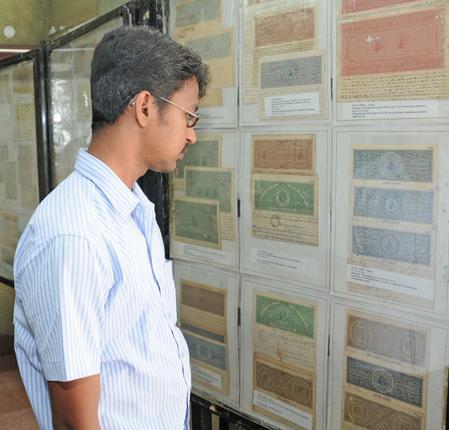
Philately expo boasts of first ever revenue stamp, printed in 1860, among other artefacts

A student taking a look at some of the stamp papers on display at the exhibition at Head Post Office in Tiruchi on Saturday. /  Photo: M. Moorthy / The Hindu

The monthly initiative of Tiruchi Philatelists Association to probe various themes through stamps has taken an interesting departure from the norm this time around. Though stamps are part of the exhibits, the spotlight is on documents of pre-independence India, predominantly dating back to the Victorian era.

The latest expo has two sections – the initial frames cataloguing printing errors challenge one’s attention to detail while the subsequent ones holding coffee coloured documents offer a peep into colonial India. Both exhibits are prize winning entries of an advanced philatelic capacity and are sure of hooking legal experts, those involved in commerce or trade and anyone with a penchant for records of a bygone era, according to association members.

Can you spot the bloopers?

Titled ‘Errors and omissions’, secretary of the association, J. Raghupathy’s cache reveals both blatant and diminutive errors caused by a printer’s negligence on stamps and postal stationery like postcards and inland letters.

Most of the errors can be spotted only on a sheet of stamps and are spotted by collectors who purchase stamps in bulk. “Error spotting is part of philately and is proof of how meticulously they study stamps,” says P.Soundararajan, president of the association. While many of the slip-ups can be spotted with the naked eye, it requires a magnifying glass to zero in on the error in some instances.

Though some bloopers nullify the value of the stamp, they escape the eye and end up at post offices including denominations cut off, perforated line running across the face of the stamp, mirror images, printing on cellotape, change of hues in multicoloured stamps, smudging or spread of ink and even an ‘India’ with a missing ‘I’.

Most of the errors were caused by negligence or dust in cylinders when stamps were printed through the photogravure process until the 1990’s. Though errors have reduced with digital printing, bloopers emerge every now and then, says Raghupathy.

The fiscals exhibits with documents and revenue stamps are vignettes of British India. “Fiscals are a relatively recent branch in philately; stamp papers and revenue stamps are also sold through post office,” says Soundararajan, the owner of the exhibits.

Among the exhibits are the first revenue stamp in India released on June 14, 1860 printed in pinkish paper with a lilac crown watermark and share certificates from the nineteenth century, hundi papers, foreign bills, promissory notes and shipping documents. A document issued by City Corporation of erstwhile Rangoon interestingly has a stamp featuring Rameshwaram temple.

Sale deeds with stamps from two annas to two hundred rupees offer an insight into registration fees and property prices during pre independence India.

Telegrams with stamps from an era where cost of the telegrams was indicated by special stamps, are also displayed. The Expo is on till October 15 at the Philatelic Bureau, Head Post Office, between 10 a.m. and 6 p.m. on all working days of the post office.

source: http://www.TheHindu.com / Home> News> Cities> Tiruchirapalli / by Olympia Shilpa Gerald / Tiruchi, September 20th, 2012

Chennai to run for a noble cause

Chennai Runners, a group that promotes running in Chennai for the past six years announced The Wipro Chennai Marathon (TWCM) 2012 to be held at IIT Madras on December 2, 2012. The inaugural marathon, which would cover 42 km, is expected to have around 5,000 runners participating in the event. Wipro Technologies will be the title sponsor along with Apollo hospitals and United Way of Chennai.

This year, the marathon, TWCM 2012, promises to provide runners with technology support such as RFID-based (Radio-frequency identification) timing technology.

Speaking on the occasion V P Senthil Kumar, race director, Chennai Marathon said, “It has been our vision to host one of the world’s best marathons in Chennai. With Wipro as our title and technology partner, we can see a fruition of our vision. We are convinced that their support and expertise in the technology arena will help us heighten the race-day experience for the participants.”

Lakshmi Naryanan, chairman of United Way Chennai, said, “United Way is proud to be associated with The Wipro Chennai Marathon 2012. The Chennai marathon is for creating livelihood for physically challenged men and women. We will do the running for them, so that they can better run their lives.”

Chennai Runners, founded in 2006, is an informal group of people who share a passion for running, is over 1,000 people strong now. The group has conducted several half marathons including 10 km and 5 km events in the past few years and has now associated with Wipro to bring a world class marathon event to Chennai.

United Way of Chennai works for the increased quality of life of the underprivileged in the areas of health, education and livelihood.

Show Space, an event management organisation based out of Chennai has been roped in and is actively involved in managing and promoting the Wipro Chennai Marathon

source: http://www.ibnlive.in.com / Home> South> Southern News > Chennai / The New Indian Express, Express News Service / September 20th, 2012

Carnatic to the Core

While one is an accomplished Carnatic vocalist the other is an acclaimed performer on the Saraswathi Veena. As a part of an initiative by SPICMACAY, Carnatic vocalist R Vedavalli and Saraswathi Veena performer Jayanthi Kumaresh will be performing in the city. The duo will be performing individually on September 21 at IISER, Pashan and on September 22 at IUCAA, Pune University. On one hand Kumaresh, who has been performing for the last 25 years, has been honoured with the title Kalaimamani by the Government of Tamil Nadu. On the other, Vedavalli is the director of the advanced school of Classical  Carnatic music at The Music Academy, Madras and is working on popularising the Mallari music form down south.

Speaking about the same she says, “Mallari, an ancient temple music form wherein different passages are played for each holy ritual, is now played only in one temple at Chidambaram. The last of the Vidwans, Radhakrishnan Pillai, is in his eighties, and the music form would have ended with him. Efforts to revive and continue this as well as other music forms have yielded success and now there are many more disciples of Mallari.” Vedavalli, a devout traditionalist, adheres strictly to the sampradaya of classical Carnatic music. She started when she was gifted her first harmonium at age five by Sangita Kalanidhi Madurai Srirangam Iyengar, and also began vocal lessons under him. Her later training was under Sangita Kalanidhi Mudicondan Venkatarama Iyer and in 2000, she received the Sangita Kalanidhi herself, considered the highest honour in Carnatic music.

Kumaresh has toured both India and other countries, and has been a part of numerous music festivals, seminars, lecture demonstrations and workshops while on tour. She recently performed at a music festival in Woodstock, New York and was the first ever Veena player to represent Carnatic music at the festival. She also conducted a workshop at the Trinity College of Music and the Bharatiya Vidya Bhavan in London this year. In fact she started playing the Veena at the young age of three, and was one of the youngest artistes in India to receive the A-TOP award from the All India Radio (AIR), the highest grading offered by the only grading body in India-AIR. She was awarded a Doctorate by the University of Mysore for her work on the subject ‘Analytical Study of Different Banis and Playing Techniques of the Saraswathi Veena’.

About her professional commitments Vedavalli says, “ I was a professor of Vocal Music at Government College of Music, Adyar, Tamil Nadu, after serving at the Madras Music Academy for several years,” She is now the Director of the advanced school of Classical Carnatic music at The Music Academy, Madras.

source: http://www.expressindia.com / Home> expressindia> Story / by Ankur Borwankar / September 20th, 2012

Seeing through the world of sounds

Coimbatore:

S Sabari Venkat is just like any other smart 10 year-old-kid with a sweet smile and a sharp mind ready with an answer to almost every question thrown at him. But sit with him for two minutes and the truth will hit us like a sharp slap across our face. This fifth standard student who is also one of the class toppers is flashing the smile at us from his inner world which is constantly black, devoid of colours and any optical sense of recognition. Sabari was born blind in both eyes and though his retina’s react to light flashed at his left retina, it does not reach him since he is suffering from more than 90%  blindness in his left eye and total blindness in his right eye. Sabari had accompanied other differently-abled children to an event held at a private hotel here in the city.

“It was very good experience all of them said good things to me,” says Sabari at his residence near Perianacikenpalayam.

Later in the day as we entered his modest rented house comprising of two rooms and a kitchen adjacent to a private marriage hall in the locality, Sabari was tinkering with the volume switch of the television set. He constantly sits in front of the television and ‘listens’ to the programs aired on various channels, especially those which telecast cartoons. With great concentration and excitement he sits in front of it and draw faces and shapes to the conversations and sounds from the TV speakers in his mind

“He sits in front of the television and follows the conversations very keenly. He stays completely glued to it often,” says K Sreenivas, Sabari’s father.

Sabari is presently a student of Ramakrishna Mission Vidyalaya Swami Shivananda Higher Secondary School near Perianaickenpalayam along with normal children. He still manages to be one of the top scorers in the class often in the second or third position. The school authorities also support him in his academics and a teacher from the institution helps as his scribe during examination. Sabari is also a good orator and has won several competitions for chanting shlokas from Bhagavad Gita. He also regularly dresses up as Swami Vivekananda and is greatly inspired by his teachings narrated to him by his father K Sreenivas and his teachers.

“Swami Vivekananda lived for just 39 years but managed to achieve great things within that short span. Not everyone is able to do so in life,” says Sabari.

K Sreenivas, an agrarian and his wife S Neelaveni waited long for the birth of their first child and was initially shattered when they were told that Sabari will not be able to see them or anything else around him after his birth.

The couple was earlier residing near Kozhinjampara near Pollachi along the Kerala-Tamil Nadu border but they decided to sell of their agriculture land and relocate to Coimbatore city to ensure that Sabari is not left behind either in his education or medical treatment under any circumstances. The couple had tried to bring light to at least one of his eyes and tried to get his left eye treated. Though doctors diagnosed him with cataracts and an ensuing complication called Synechia which could not be completely cured so far.

“We used to live in a semi-rural area and in those places if there is a handicapped kid in the family people tend to talk about it constantly. Some do it out of sympathy, some because of superstition but we made a decision that our son need not grow up listening to it and so we came to Coimbatore,” Sreenivas adds.

source: http://www.TheHindu.com / Home> City> Coimbatore / TNN / September 16th, 2012

Axe falls on Tamil Thaatha’s house

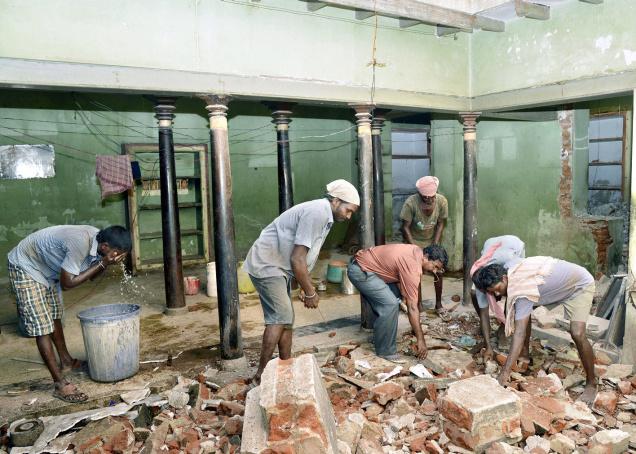
ERASING HISTORY: Demolition work in progress at U.V. Swaminatha Iyer’s house at Triplicane in Chennai on Saturday. / Photo R. Ravindran / The Hindu

It was here that Rabindranath Tagore called on Swaminatha Iyer in 1926

Thyagaraja Vilas, the house of the grand old man of Tamil literature (Tamil Thaatha), U.V. Swaminatha Iyer, and one of the city’s landmarks, will soon disappear.

The descendants of Iyer have reportedly sold the property at Thiruvatteeswaranpet and the buyer is demolishing the house. The inner walls have been brought down. Nameboards bearing the titles ‘Thyagaraja Vilas’ and ‘U.Ve. Swaminatha Iyer Illam’ have been removed.

The man overseeing the demolition said that he worked for the buyer.

“It is really sad because it is from this house he edited and published many ancient literary works such as Silapathikaram, Patthupaatu and Ettuthogai after collecting palmleaf manuscripts from every nook and corner of the country. Even a university cannot match his efforts,” says writer Indira Parthasarathy.

When Rabindranath Tagore visited Chennai in 1926, he called on Iyer at this house and even penned a poem in praise of Iyer’s contribution.

Iyer came to this house as a tenant in 1904 following his appointment as a Tamil teacher of the Presidency College in 1903. The monthly rent was Rs. 20. Subsequently, he bought the house and named it after Thyagaraja Chettiayar, who was instrumental in getting him the post of Tamil teacher of the Kumbakonam Arts College in the wake of his retirement in 1880.

Parthasarathy, an alumnus of the Kumbakonam College, says the demolition will not only remove the memories of Iyer but also those of Thyagaraja Chettiyar, an eminent scholar, after whom the house was named.

“Chettiyar’s contribution to Tamil is explained by the fact that the principal of the Kumbakonam College, an English man, had his image engraved on one of the pillars of the college,” says Prof. Parthasarathy.

Iyer had explained why he named the house after Chettiyar. “It is a gesture to express my gratitude; even atonement, as I had failed to acknowledge Chettiyar’s name in my edition of the ‘Seevaka Chinthamani,’ one of the five great epics in Tamil,” he stated in his biography of Thyagaraja Chettiyar.

Ki. Va. Jagannathan, one of the students of Iyer, had recalled in his book ‘Yenathu Aasiriyarpiran’ that the owner of the house happily sold the house to Iyer though he had taken advance from another person.

Swaminatha Iyer worked in Presidency College till 1919. Later, he was the principal of the Meenakshi Tamil College from 1924 to 1927. He left the house only in 1942 along with many Chennai residents, fearing aerial bombardment during the Second World War.

As the former ‘asthana vidwan’ of the Thiruvavaduthurai Mutt, he was allowed to stay in a house of the Mutt at Thirukazhukundram. He died there on April 28, 1942 following a brief illness.

“The government should intervene and secure the house of Swaminatha Iyer as it did in the case of the house where Subramania Bharati resided. Iyer, Bharathi and Pudumaipithan form the Trinity of the Tamil language and cultural awakening. We cannot afford to ignore the fact,” says Prof. Parthasarathy.

source: http://www.TheHindu.com / Home> News> States> TamilNadu / by B. Kolappan / Chennai, September 16th, 2012

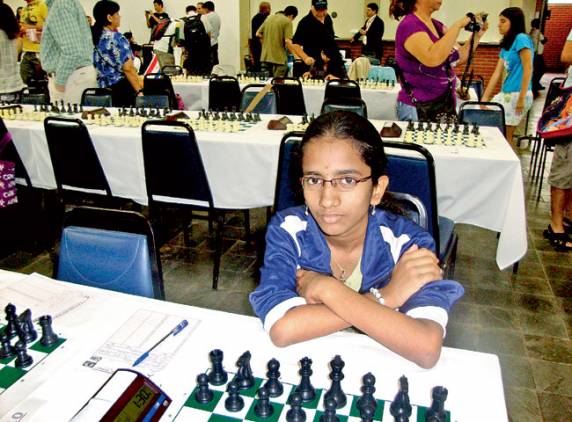
Board queen keen to conquer the world

M. Mahalakshmi.

It is an unlikely setting in which to find a chess champion. An asbestos-sheeted single-room house in a slum at Erukkancheri with the family struggling to make ends meet.

However, the tough conditions have made M. Mahalakshmi, who is the world under-12 girls’ chess bronze medallist, more determined to win the forthcoming world under-14 girls’ chess championship.

“I want to become the world champion. It is my goal in life. My immediate goal is to win gold at the world youth championship that begins in Solvenia on November 7,” the teenage girl from Chennai told Deccan Chronicle.

The Class 9 student of Velammal Matriculation School has so far won two bronze medals (under-8 and under-12) at world level tournaments.

At the Asian level, she has bagged gold in the under-10 category in 2008, silver in the under-14 meet in 2010 and a bronze in the same under-14 event in 2011.

The fourth daughter of an electrician, Mahalakshmi picked up chess from her third sister M. Jagadambal.

Put under the tutelage of prominent coach M.J. Ismail, she quickly rose to prominence at the national level when she bagged the under-7 title in 2005.

However, her family troubles have ensured that she has to fight greater odds to keep ruling the chess board. Mahalakshmi now trains under R.B. Ramesh and misses out on the individual attention.

“Earlier we used to arrange for individual training for her. At that time, I was running a PVC pipe company and was living in a decent flat.

Now we are struggling to make ends meet and so have stopped professional coaching for her,” said her dejected father P. Mukunthakumar, adding that she missed participating in a open tournament at Orissa recently because of lack of funds.

The little champ is, however, not worried about coaching or losing valuable tournament practice. “I train for at least eight hours a day at home.

My school is very considerate and sponsors me when I travel abroad,” said Mahalakshmi. To motivate this young chess champion call 98400-33294.

source:  http:/www.DeccanChronicle.com / Home> Channels> Cities> Chennai / by S. Sujatha / DC, Chennai / September 17th, 2012