Rs 30 crore gold car on display in fort city

Vellore:

India’s first Golden car made by the Tata Group and valued at `30 crore is on display here for the next four days at the Dhandapani Mudaliyar Kalyana Mantapam. VIT vice president G V Selvam inaugurated the exhibition of the car here on Tuesday.

“The gold car is a brand initiative aimed to create awareness among the general public that gold ornaments from the tiniest size of 0.2 gm to 80 kg could be designed by the Tata group”, noted S Balachandar, branch manager of Gold Plus here.

R Suresh, head, Business Analytics, Titan Industries at Bangalore said, the Goldplus Nano Car, a Tata product was declared as the first ever gold jewellery car that embodies the 5,000 years old jewellery making profession in India. He added, “The car’s body, made of 80 kg of 22-carat solid gold and 15 kg silver, features artistic designs made with precious stones (navaratna). As many as 14 techniques of jewellery making have gone behind the effort. From the intricate ‘filigree’ to the delicate and colourful ‘meenakari’, from the stunning ‘kundan’ to the traditional ‘naqashi’, the car has it all”.

The blueprint of the car was created in January 2011. The Titan jewellery industry plant at Hosur took up the work the following month and finished it by September. The components of the car’s outer body have been developed using gold, using the Fiber-Reinforced technology and a lot of precision engineering has gone into it, achieved by a team of 30 artisans and engineers, Suresh informed.

After its launch in Mumbai in September 2011, the Goldplus Nano Car is travelling to all the Goldplus showrooms at 32 locations in the country that includes 16 chain shops in the State before its stop at Vellore. The car would go to Kancheepuram for a brief display before winding up the tour

source: http://www.ibnlive.in.com / South> TamilNadu / Express News Service, The New Indian Express / posted January 025th, 2011

Chennai better than Bangalore for setting up top B-school: Dr. K Rangarajan, Director, VIT Business School

MBAUniverse.com interviewed the Director of the B-School, Dr. Kalyani Rangarajan to know what makes VIT Business School unique, the future plans and the importance of Chennai in the map of MBA education in India.

VIT Business School, VIT University is one of the top B-schools in Chennai. Established in September 1994 as the Department of Management Sciences under the University of Madras, VIT Business School (VITBS) has expanded along multiple fronts.

MBAUniverse.com interviewed the Director of the B-School, Dr. Kalyani Rangarajan to know what makes VIT Business School unique, the future plans and the importance of Chennai in the map of MBA education in India.

Dr. Kalyani Rangarajan, Director, VIT Business School Chennai is a postgraduate in Mathematics and has done her PGDM from IIM Ahmedabad. She is also a doctorate in Health Economics from Bangalore University.

Starting her career in banking Dr. Kalyani moved on to consulting and training after her MBA.  Her passion for teaching gradually drew her into academics and she has taught in B Schools in Karnataka and Andhra Pradesh.  Her last stint was with PES Institute of Technology as Director of their MBA Program.

Excerpts from the exclusive interview:

Q: How has been your journey so far as the Director of VIT Business School? What are your key learnings?

A: The journey so far has been very exciting.  Compared to Karnataka, where I had operated previously, the scope for establishing a high-end B-School at Chennai is better, as the market place is not crowded to the same extent as in Bangalore.

As we are a fledgling B-School, first of all, we have to quickly attain a high awareness level about our existence among B School faculty and MBA aspirants. I have learnt that networking quickly with the the local academic and industrial community, is of utmost importance. High end placements will lead to better quality admissions, which will go a long way to building a strong B School. We provide plenty of value addition to the students’ learning through industry-oriented add-on courses.

Q: As the Director of the VIT Business School, what are the initiatives you have taken?

A: We are toning up the academic inputs to the programme.  We have taken significant efforts to get in touch with VIT alumni , besides organizing a Corporate Conclave to bring senior industry executives to visit our campus.
Currently our focus is on finding suitable placements for our first batch of MBA students, who will be employment- ready by May 2012. We are also making efforts to have quality admissions through CAT, XAT, GMAT and MAT channels.  This time we have increased our online marketing efforts. Admissions will be done on an all-India basis.

The focus on research has commenced right from the beginning and we have admitted our first batch of full-time and part-time Ph. D scholars in a wide range of areas such as Derivatives, Microfinance, work-life balance. Our faculty members have applied for funding to various research organizations such as ICSSR, UGC etc.

Efforts are on to form a strong academic advisory body.

Q: How does a university B-School have an edge over stand alone B-schools?

A: Since VIT Business School comes under the well known VIT University, the B-School is able to offer a full fledged MBA program. The advantages of a standalone B-School are incorporated by having independent premises, flexibility in framing of the curriculum and separate budget for the B-School.

Q: How is VIT Business School different from other B-schools in India in terms of curriculum, pedagogy and other factors?

A: We have endeavored to make our programs and projects innovative. Some of the qualities that we have imbibed in our program include Fully Flexible Credit System (FFCS), Overseas Experiential Learning Program (OELP) to name a few. Experiential learning constitutes 40 per cent of the continuous assessment in many courses and Interactive, learning centered pedagogy. Elective courses are handled by a congregation of visiting faculty from top companies and leading business schools such as XLRI, IIMs etc.

The achievements of the programs and the projects include successful implementation of FFCS and adoption of ‘RUBRICS’ as a tool for assessment, class discussions based on cases developed by the faculty, ‘Higher Order Thinking’ skills tested in examinations and need based industry internship and two overseas experiential learning trips have been organized during the current year, one to Dubai and another to Malaysia or Singapore.

Q: The admission process of VIT Business School is going on at the moment. What qualities do you look for in your prospective students?

A: We will look for reasonably high cut off scores, good communication skills and will be picking up students with initiative and drive.

Q: What are your future plans for your institute?

A: We expect VIT Business School to emerge among the top B Schools in South India.

Q: What are your views on the state of management education in India?

A: Management education is in a state of flux with over 4000 B Schools, the MBA aspirants are confused as to which one to apply for and what to look for in a B-School. There will be a shake-out when foreign B Schools enter the fray!

Q: Chennai is not on the map of Indian management education like Delhi, Pune or Bangalore is. What lies in future? What are the USPs of Chennai region from the perspective of a potential MBA student.

A: It is an advantage for us.  We will endeavor to position ourselves as a premier institute of management education in Chennai. The B-School fever is yet to catch on strongly in Chennai, as reflected in the number of MAT and CAT applications every year.  Since Chennai has always been a strong centre of academics and high academic and research credentials are a must for any top-end B School, there is room for an academically strong B School in Chennai. We plan to occupy this niche.

source: http://www.MBAUniverse.com / January 02nd, 2012

Building Businesses

Two Singapore office buildings seem to be magnets for Indian-owned businesses
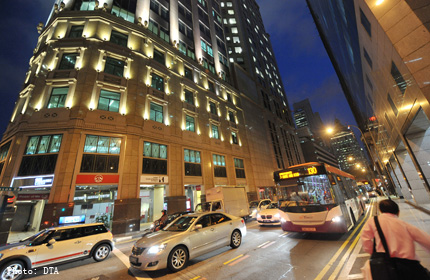
CECIL Street, nestled in the very heart of Singapore’s central business district, is a buzzing hive of activity. Where once it was lined by rickety, one-storey shophouses, today it has become part of the nation’s financial hub.

Beginning at Maxwell Road and running parallel to Robinson Road, this street is home to office buildings like Capital Tower, Aviva Building, Cecil House, Keck Seng Tower, The Octagon, GB Building and the 46-year old Tong Eng Building.

It is here, in Tong Eng Building, that several Indian-owned businesses thrive. Nearly 35 per cent of the roughly 190 offices in this building are occupied by them, many having settled in decades ago while others are more recent arrivals.

Not too far away, at 1 North Bridge Road, is a similar story: High Street Centre, a stone’s throw from the Clarke Quay MRT station, is also home to a multitude of Indian businesses. Nearly 60 per cent of the approximately 200 offices in this building are occupied by Indian businesses dealing with trades ranging from engineering consulting to electronics retail.

But why, despite growth, branching out and even moving offices, have these businesses continued to operate from these two locations? Tong Eng Building

For some, Tong Eng Building is filled with positive vibes which has been good for business. Says Batavia Eximp and Contracting’s managing director Atish Mody: “Tong Eng is definitely a popular building for Indian businesses. It is considered to have the best vaastu – along with the Afro-Asia Building – within the traditional CBD area. Of course, this does not mean other buildings have lesser vaastu (an ancient Vedic science of layout planning of buildings that is said to influence peace and prosperity of the inhabitants), but these two buildings have a well-known track record of housing Indian firms.”

Event management firm De Ideaz’s chief executive officer Purnima Kamath, who has been a tenant in the building for the past 11/2 years, agrees: “There is a certain good feng shui in this building; a lot of positive vibes… and a feel good factor.”

Vintel Exports’ managing director Puneet Jain claims his family-owned business dealing in agricultural commodities has been in Tong Eng Building for nine years. He has moved offices in that time, but remained within the building.

He tells tabla!: “This building seems to be lucky – touch wood – for Indian companies. And business has been good so far. When business is good in a place, we Indian businessmen don’t like to take unnecessary risks by moving.”

Not only does he have many friends in the building, some of his family members also have their offices there.

“My cousin, who moved to Singapore after me, was also drawn to this building. I also have many relatives in different parts of this building. My auditor is here too – so this building is a one-stop shop for me, whether it’s meeting people for coffee or work. Even if I were to shift to a bigger office, I would like to stay in this building. In fact, my unit number is 11, so I would look for the same unit number, even if it’s on a different floor,” he adds.

Singaporean businessman Balasupramaniam, who runs Net Access Singapore, has been a tenant since April this year and chose the building because of its location and rent. “Not only is it within the heart of the CBD,” he says, “but it has a carpark and the rent is reasonable, which is the main thing.”

He was already familiar with the building prior to setting up his office thanks to some of his friends already having their offices here. For MrBalasupramaniam’s IT business, having so many varied businesses under one roof is a huge bonus. “We do send out our brochures to other businesses in the building. We even have a few clients here,” he adds.

The location of the building was the draw for P.L. Global Impex’s managing director Naresh Dinodiya to move into Tong Eng in 1992. “It’s very convenient because several banks are located in the vicinity, a lot of people from the same trade are around the area (mainly in the building), transportation is easily available and there are enough food venues,” he tells tabla!.

Attributing convenience and comfort factor as the reasons several Indian businesses stay put in this building, he adds: “The building is very central, it’s easily accessible and it has a lot of people from the common trade which makes communicating much easier.”

While convenience is undoubtedly the key word, most of these businessmen agree that the atmosphere within the building is what they enjoy. Since almost 35 per cent of the building is occupied by Indian businesses, there is almost a community-like air in the building.

As Mr Mody puts it: “It is nice to see familiar faces – and many of them good friends too – in the lift. We have many common things to discuss and one just has to call and walk across to another office to get your work done. Even coffee and tea breaks are true stress-relievers when it’s shared with friends – we just go next door to Starbucks or to Mama Chai down the road.”

Mr Dinodiya seconds this opinion: “The atmosphere in the building is warm and welcoming, especially in the entrance lobby where people greet their fellow businessmen and have a little chat about the market or something. It’s quite often referred to as a ‘meeting point’.” High Street Centre

Located not too far away from Tong Eng Building in North Bridge Road is High Street Centre. Completed in 1969, it is home to several Indian businesses – almost 60 per cent of the offices are occupied by them. And like Tong Eng Building, most businesses have been there for many years.

Dynamix International’s director Vinod Dadlani has been a “High Street boy” for a long time and is well versed in the history of the building. Although his own business is just three years old, he has worked for other establishments in the same trade, within High Street Centre and High Street Plaza, since 1994.

He tells tabla! that High Street Centre has always been a trade hub: “It used to be popular with Russian traders who came here to buy electronics – similar to how Mustafa Centre is for many today. There were spice and textile merchants, electronics retailers and many others. Then the textile merchants moved out to Arab Street.”

Mr R. Narayanamohan, whose accounting firm Natarajan and Swaminathan has been operating from the building since 1977, says that he can remember some businesses that were very well known.

“The famous ones I can recall are Khimchand and Sons (textile business) and SA Majeed and Co (supplier of uniforms to most of the schools in Singapore). All these businesses were originally in shophouses and, when those were demolished to make way for High Street Centre, they moved into the new building as well as High Street Plaza. After we moved into this building in 1977, we mainly catered to the Indian business community in the building and started assisting the newly established Indian businesses there,” he says.

Today, the turnover of businesses moving out of the building is low and it continues to be a hub for traders.

Says Mr Dadlani: “Many individuals own blocks of offices – for example, 24 offices will be owned by a single individual, who will rent them out. It is hard to find a vacant office.”

According to MrNarayanamohan, most of the Indian businesses in the building have purchased their office space. “It is very convenient to have our offices here. The building has been totally renovated and the facade was changed to a glass-panelled frontage, making the building very modern,” he says.

Today, High Street Centre is well known for its electronics retail shops, owned mostly by Indians. Ganga Jamuna Electronics’ general manager

M. Sreenivasan, who has been a tenant here since 1992 when the firm relocated from Sembawang, says: “There are a lot of electronics shops based here, mostly Indian, although there are a few Chinese-owned electronics shops too. And although we have a branch in Serangoon as well, we haven’t moved out of this building because High Street Centre has a good name for electronics, so business is still good.”

Despite being in different geographical locations, both Tong Eng Building and High Street Centre have many things in common: Easy access, good business dealings and a friendly atmosphere. Even the electronics retailers at High Street Centre, despite being competitors, enjoy a good relationship.

“There are lots of electronics retailers here yet the atmosphere is friendly and people are co-operative,” says Mr Sreenivasan.

The influx of Indians into these buildings has even had its integration effect as Chinese neighbours happily co-exist with their Indian counterparts. In fact, over the years, they have become good friends. Mr Dinodiya, whose company is one of the few Indian businesses on his floor at Tong Eng Building, says: “We have wonderful Chinese neighbours and over time we have become really good friends. It’s a very homely atmosphere in the building here. Everyone knows everyone.”

This is all the more visible during festival time. The Indians celebrate pujas and the Chinese celebrate Chinese New Year, giving the buildings a community-like feel… and hopefully ushering in more business.

source: http://www.news.asiaone.com / Singapore Press Holdings / AsiaOne> News> Singapore / by Malavika Nataraj / table! / December 30th, 2011

Indian-origin scientist & Nobel Prize winner Venkatraman Ramakrishnan to be honoured with knighthood

LONDON:  Indian-origin scientist Venkatraman Ramakrishnan, a winner of the 2009 Nobel Prize for chemistry, will be honoured with knighthood in 2012.

Venkatraman works as a biologist at the Medical Research Council’s Molecular Biology Laboratories in Cambridge, BBC reported.

Born in 1952 in Chidambaram in India’s Tamil Nadu state, Venkatraman was awarded the Nobel Prize in 2009 along with two other scientists “for studies of the structure and function of the ribosome”, according to the Nobel Prize website.

The ribosome — the cell’s protein factory — translates genetic code into proteins, which are the building blocks of all living organisms.

Experts said the India-born scientist’s work solved an important part of the problem posed by Francis Crick and James Watson when they discovered the now-iconic double helix DNA structure as to “how does the code become a living thing”.

source: http://www.articles.economictimes.indiatimes.com / Home> Collections / News> News by Industry / IANS/ December 31st, 2011

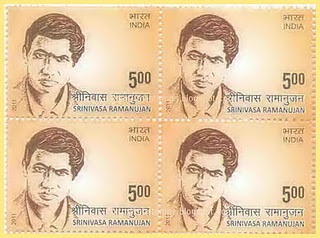
India Post Released Srinivasa Ramanujam Stamp on 26.12.2011

India Post released New stamp for Srinivasa Ramanujam in his 125th birth anniversary. Stamp Released by our honorable Prime Minister Dr. Manmohan Singh in Chennai also declared December 22, the birthday of Ramanujan, as ‘National Mathematics Day.’
Srinivasa Iyengar Ramanujan ( 22 December 1887 – 26 April 1920 ) was an Indian mathematician, Born in Erode, Tamil Nadu, India, to a poor Brahmin family, Ramanujan first encountered formal mathematics at age10. He demonstrated a natural ability, and was given books on advanced trigonometry written by S. L. Loney. He mastered them by age 12, and even discovered theorems of his own, including independently re-discovering Euler’s identity. He demonstrated unusual mathematical skills at school, winning accolades and awards. By 17, Ramanujan conducted his own mathematical research on Bernoulli numbers and the Euler–Mascheroni constant. He received a scholarship to study at Government College in Kumbakonam, but lost it when he failed his non-mathematical coursework.
He joined another college to pursue independent mathematical research, working as a clerk in the Accountant-General’s office at the Madras Port Trust Office to support himself. In 1912–1913, he sent samples of his theorems to three academics at the University of Cambridge. Only Hardy recognised the brilliance of his work, subsequently inviting Ramanujan to visit and work with him at Cambridge. He became a Fellow of the Royal Society and a Fellow of Trinity College, Cambridge, dying of illness, malnutrition and possibly liver infection in 1920 at the age of 32.
During his short lifetime, Ramanujan independently compiled nearly 3900 results (mostly identities and equations).Although a small number of these results were actually false and some were already known, most of his claims have now been proven correct. He stated results that were both original and highly unconventional, such as the Ramanujan prime and the Ramanujan theta function, and these have inspired a vast amount of further research. However, the mathematical mainstream has been rather slow in absorbing some of his major discoveries.
The Ramanujan Journal, an international publication, was launched to publish work in all areas of mathematics influenced by his work.
source: http://www.sapost.blogspot.com / December 26th, 2011

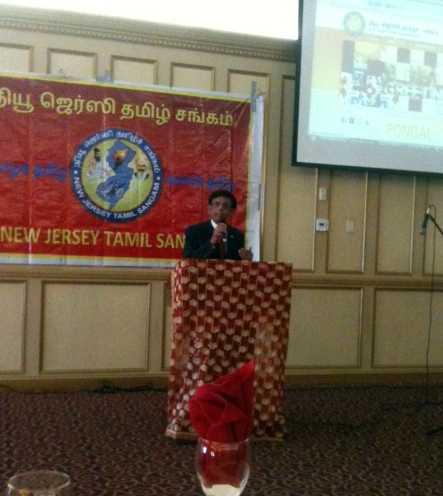
Rep Srinivasan was conferred the Leadership Award for his extraordinary services to the community by the New Jersey Tamil Sangam on Dec 18th, 2011

Speaking on this occasion Rep Srinivasan complimented the community leaders for their efforts to ensure that the next generation and generations to come of Indian Americans are aware of their rich culture and heritage.

He also requested the community leaders to enlarge their scope of services and that at every opportunity make the extra effort to give back to the community here in the United States that has been so generous and kind to each and everyone of us.

“The launching of the website”, said Rep Srinivasan “will definitely enable us to be connected and communicate our mutual interests in culture effectively and efficiently.

source: http://www.RepSrinivasan.com / by CFryx / December 20th, 2011

India’s 22 Million Plus YouTube Sensation – The Kult Of Kolaveri

Website: http://www.youtube.com/watch?v=YR12Z8f1Dh8
Sony Music India has created a viral phenomenon, the likes of which has never been seen before in India, for the cross cultural Tamil-English musical hit Why this Kolaveri Di. Reaching over 20million hits and counting on Youtube, 3.6 million Facebook shares and #Kolaveri hash tag trending on Twitter amongst media, fans, journalists, celebrities and industry barons in just over two short weeks, Why This Kolaveri Di has become an overnight hit that has now crossed over into the international markets.

The video received 83,000 youtube views within 24hours when it was first released to now become the most viewed video on Youtube. Composed by the 21 year old Anirudh, the track is sung by Tamil superstar and now singer Dhanush. Usually used as a popular slang term amongst Tamil youth, the term Kolaveri, meaning ‘murderous rage’, is now being picked up by marketers and brands alike and people in other parts of the work as a form of expression. The track is also the first regional language (Tamil) song ever to see a high rotation on Mainstream Music Channels – play listed on 43 Radio Stations Pan-India and gaining an audience as far afield as Australia and Czechoslovakia.

The simplicity and originality of the viral has also deeply engaged its audience and is the first viral video to be replicated with fans re-creating their own versions of the viral video. Since the video hit youtube just over two weeks ago the number of responses has been steadily growing; even renowned Bollywood playback singer Sonu Nigam’s four year old son has made his own viral which has already notched up over 1 million hits.

“We believed in our creativity and when we sat with the Sony Music team they saw the true potential in it. Our creativity and their vision has led to the song exploding globally. We are proud to be associated with a team and an international brand like them as we see the true value they bring to music”, says Anirudh the 21 year old Music Director.

The video was shot by the Sony Music team and has a raw feel to it, similar to any making-of or unplugged recording. The natural un-staged set-up of the video allows the viewer to connect with the track, creating a deeper level of engagement that sets it apart from other Indian viral videos.

Why This Kolevari Di is a track that is changing the landscape of how music is shared in India. Shridhar Subramaniam, President India and Middle East Sony Music Entertainment and the mind behind creating the viral rage adds “There is a change in the music landscape that we all are witnessing today. Regional Music has huge acceptability- growing at the rate of 20% per annum and regional advertisements are becoming national and today the success of our song ‘Why this Kolaveri Di’ is an endorsement to this phenomena. We have been a part of the change since 2008 when we entered the Tamil Music market and today enjoy a 60% market share. Our outlook and strategy has been to expand in this market and our recent foray in the Punjabi Music Market is another such step.”

“Now, it has been our conscious effort to long tail ‘Why this Kolaveri Di’ concept by creating official dance mixes of the song, exploiting publishing and distributing the same. We want to keep it fresh, buzzing and alive till each person world over has seen/heard it.”

Planned as part of the soundtrack for forthcoming film “3” and gaining more hits each hour, Why This Kolevari Di has signalled a new era in Indian music and that is bridging the gaps between regional and international musical differences.

Why this Kolevari Di is available to download on ITunes.

source: http://www.mi2n.com/ Music Industry News Network / December 18th, 2011

Let’s build on Mauryan inspiration, says Kalam

“Chandragupta built an empire based on a strong central government and a large, powerful army. Ours is akin to it.”

That modern India has been inspired by the Mauryan concepts of statecraft and governance is one of the significant insights provided in “The Dancing Girl: A History of Early India,” by Balaji Sadasivan (1955-2010), a neurosurgeon and Singapore’s former Senior Minister of State for Foreign Affairs.


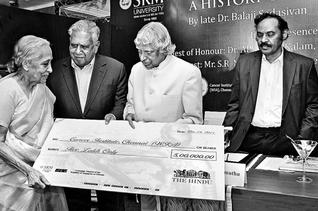
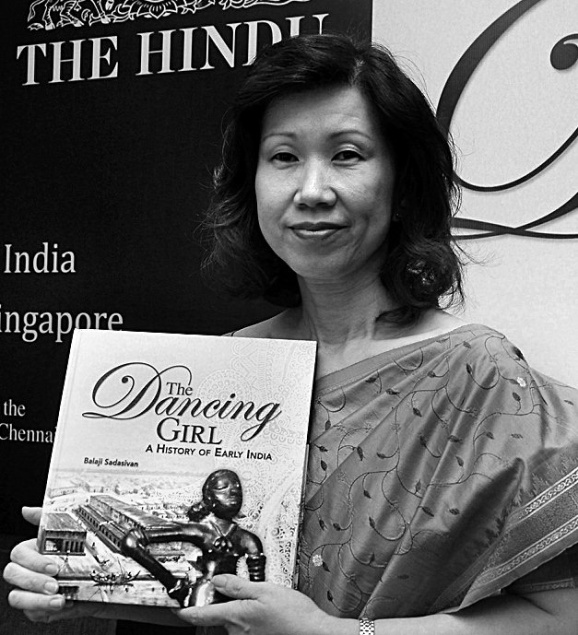
“The Dancing Girl: A History of Early India,” a book by Balaji Sadasivan, former Singapore Minister, was released at a function organised by The Hindu and SRM University in Chennai on Wednesday. On the occasion, the former President, A.P.J. Abdul Kalam, presents a cheque for Rs. 5 lakh to V. Shanta, Chairperson, Adyar Cancer Institute. The former Singapore President, S.R. Nathan (second from left), and SRM University Chancellor T.R. Pachamuthu are in the picture. In the second photograph Ma Swan Hoo, wife of Balaji Sadasivan, displays a copy of the book. At far right, is a section of the audience at the function.  Photos S.R. Raghunathan 

Capturing this facet of the author’s findings, the former President, A.P.J. Abdul Kalam, who launched the book at a function organised by The Hindu and SRM University here on Wednesday, said Chandragupta Maurya had built an empire based on a strong central government and a large, powerful army. “This model is virtually akin to the model being followed after our Independence.”

Another contribution of the Mauryas during the reign of Asoka, the former President noted, was the provision of moral and ethical dimension. “He defined that the primary purpose of the government was to provide peace, prosperity and welfare to all the citizens. The author rightly brings out that modern India looks to the Mauryan Empire for inspiration and has taken Mauryan Lion as the state emblem.”

Attributing the attainment of Independence to the phase of the freedom struggle which was led by Mahatma Gandhi, Mr. Kalam said people had to cherish and nurture Independence with the ethics and value system of the era of Chandragupta Maurya.

Quoting the author, Mr. Kalam said the Bhakti movement in India developed from Tamil-speaking south to Sanskrit-speaking north. The spiritual development of Hinduism was based on devotional songs, expressing ecstatic love for God. The compositions were mainly in Tamil, though the numbers of popular hymns were in Sanskrit. The Bhakti movement, encompassing Saivites and Vaishnavites, made Hinduism accessible to Indians of all States in both Sanskrit and regional languages, the former President pointed out.

S.R. Nathan, former President of Singapore, who presented copies of the book to donors, said it was labour of love written by an author who was captivated by the history of his ancestral homeland.

Pointing out that the rise of South Asia, like East Asia, was a civilisational one — though attention has been focussed on the economic potential — and the history of civilisations provided profound insights into their contemporary standing and the possible road ahead, Mr. Nathan said that from this perspective, the book offers much not only for the Diaspora but also for those who are in India itself.

Ma


Ma Swan Hoo, wife of Balaji Sadasivan, who accompanied him on numerous visits to historic sites across India, provided the rationale for naming the book ‘The Dancing Girl’, which refers to a bronze statuette excavated from Mohenjodaro and a showpiece in the National Museum in Delhi. This 10.8-cm statue, a symbol of an advanced civilisation that existed about 4,500 years ago, was important to the history of India, she said.

Balaji Sadasivan, whose roots were in Arcot of Tamil Nadu, was a great lover of the history and civilisation of many countries. He chose to write on the history of India, a country he was so much in love with. He had originally planned to cover the history from ancient times to the present period over five volumes. This book is a combination of the first two volumes of 30 chapters and covers the ancient period up to the start of the decline of the Mughal reign in the 17 {+t} {+h} century.

Addressing the gathering, N. Ram, Editor-in-Chief of The Hindu , praised Balaji Sadasivan’s approach to history, and said the author regarded himself as an amateur but he was a gifted amateur. He instinctively realised that history was not an “unending catalogue of dull facts.”

By reading “The Dancing Girl,” one could learn a good deal about the mind and interests of the neurosurgeon and professional politician-turned historian. “He selects; draws out facts of significance, ignoring the dross and the trivial, and invests them with meaning. He provides interpretation. All interpretation is disputable but the historian must venture out to recreate, even trans-create, the historical picture. This is what this gifted amateur does in an engaging, accessible, enjoyable manner,” Mr. Ram added.

He appealed to Mr. Kalam to provide a push and use his moral influence for the Nalanda University revival project as there were reports of slow release of funds by the Union government to the project although the Bihar government had been very supportive.

Dr. V. Shanta, Chairperson, Adyar Cancer Institute, received a cheque for Rs. 5 lakh for the Institute from Mr. Kalam and Mr. Nathan. K. Kesavapany, Singapore’s Ambassador to Jordan and Director, Institute of Southeast Asian Studies, and T. R. Pachamuthu, SRM University Chancellor, spoke.

source: http://www.TheHindu.com / National / by Special Correspondent / Chennai, December 15th, 2011


Habitat Forum Berlin, Anna University architecture contest for MRTS Light House station

Whether or not the Southern Railway and the Tamil Nadu Government (through the CMDA) care to make the best use of the MRTS system, there is great interest in it elsewhere.

The Habitat Forum Berlin, School of Architecture and Planning, Anna University and City Connect, an NGO in Chennai have jointly announced a contest for architecture students to submit ideas for the Light House Station on the MRTS.

This neglected station suffers from poor maintenance, although it is close to several educational instutions, the Marina Beach, and shopping malls such as Chennai City Centre. What is more, it is ideal transit point as it is cheek-by-jowl with Dr. RK Salai. MTC in fact operated some services via this station to achieve inter-modal connectivity when the system was extended to Velachery, but quickly discontinued them.

It would be interesting to see how architects view the problem, and what their ideas are.

source: http://www.straphanger.wordpress.com / December 13th, 2011


Giving a leg-up to folk performances

Vellore:

Cultural programmes will take place district-wise henceforth, according to executive member of the Tamil Nadu Iyal, Isai and Naadaga Mandram, actress Chachu. Chachu earlier distributed awards to 35 artistes and musicians, sponsored by the Department of Culture and Arts, at Anna Kalaiarangam, on Sunday.

Speaking on the sidelines of the programme, she pointed out that , “A mega dance fest had taken place in Chennai from October 28 to November 9. Similarly, cultural programmes would be held in all districts.

Folk artistes would be given preference in these programmes,” she informed About the programme, Chachu said the fest would start in Tiruchy and move on to Srirangam, Vellore, Tiruvannamalai and other districts.

Chachu distributed prizes to winners of the cultural programmes conducted by Jawahar Siruvar Mandram, identity cards to 1,300 folk artistes, and welfare measures to other artistes.

Vellore district Collector S Nagarajan, Health Ministers Dr V S Vijay, Mohammed John, Vellore Corporation Mayor Karthiyayini, deputy mayor Dharmalingam, deputy director of arts and culture department were also present on the occasion.

source: http://www.ibnlive.in.com / Express News Service, The New / Indian Express/ Home> South> TamilNadu / posted: December 19th, 2011