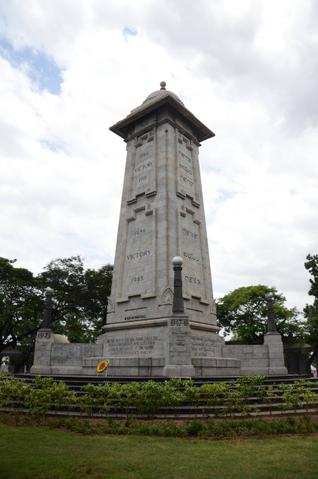
The Marina Beach is largely a late 19th/early 20th century phenomenon, caused by the expansion of the port. Till the 1870s, when harbour works began, the sea practically lapped the walls of Fort St George, barring a narrow promenade of sorts. This pathway extended southwards from the Fort and expanded into a circular space, a short distance before where the Cooum fell into the sea.
The roundabout became the spot where high society met, to converse, gossip, quarrel and much else. This was where romances were conducted, the lonely English officers and company servants courting young ladies who had been shipped out of England with strict instructions to find a suitable husband, or perish. There were occasional scandals too, such as when Warren Hastings romanced the married Baroness Imhoff or when Police Commissioner Edward Elliot wooed and later eloped with the wife of Colonel Napier. The place was soon christened Cupid’s Bow.
As the popularity of the spot grew, amenities were added. Ornamental lights and a bandstand came up. These regularly corroded with exposure to the salt-laden breeze and the Corporation of Madras records regularly report expense incurred in replacements and repairs. The Governor’s band performed each evening. The route from the Fort to Cupid’s Bow, now the southern end of Rajaji Salai, became Band Beach Road and that from the Island, now Flagstaff Road, was Band Practice Road. There was a strict dress code in force at Cupid’s Bow – men had to be in top hat and full formal morning dress, the dhoti no doubt not even a remote possibility. Women of course, were dressed at the height of then prevalent fashion.
Not everyone looked upon Cupid’s Bow with favour. In B.M. Croker’s 1892 novel, A Family Likeness, Nita Perry “a natural beauty of Madras” would walk all evening on Cupid’s Bow with her dog, “running the gauntlet of every carriage”, leaving her shy suitor to murderous thoughts. Lord Napier and Ettrick, the Governor of Madras in the 1860s, did not think much of it either. At the end of a particularly hot day, he was writing to his friend Madame Novikoff who was in far away Russia:
“The sun has just set. The world begins to breathe. I fancy that the musicians are just tuning their instruments at the bandstand. Round the bandstand there is a curved walk which is called Cupid’s Bow, but, alas! The god never draws it.” Interestingly, the roundabout was connected across the Cooum to the south by a bridge named after him. Its successor is still called Napier’s Bridge.
source: http://www.thehindu.com / The Hindu / Home> Features> Friday Review> Hidden Histories / by SriRam V / Chennai – August 08th, 2014