Category Archives: Arts, Culture & Entertainment

New display at Madras Crocodile Bank

The Madras Crocodile Bank has 5 new inmates – anacondas. This the first time anacondas have been displayed here. The snakes were brought from Protivin Crocodile Zoo in the Czech Republic in 2011. In exchange, four gharials were sent from here.
The officials have decided to display these animals to dispel wrong notions and beliefs about them. One of the visitors said, “Unlike what we have seen in movies, the anacondas at the croc bank are cute. It was amusing to watch them move about the enclosure, their heads bobbing in the water.”
Madras Crocodile Bank Director, Mr. Colin James Stevenson said, “As anacondas are aquatic in nature, in summer, they stay under water. The ideal temperature for anacondas is between 27 degrees Celsius and 30 degrees Celsius.” Keeping this in mind experts at the bank monitor temperature inside the enclosure to ensure the right amount of heat.
source: http://www.LiveChennai.com / Home> News / January 20th, 2013

Plans to maximise business, tourism potential of Tiruchi

Tiruchi Intra-City Development Endeavours inaugurated by MP

Tiruchi Intra-City Development Endeavours (TIDES), an organisation envisaged as a forum and think-tank for development of the city, has planned a meeting with heads of local businesses as an initial step towards its goals of maximising the city’s potential for investment, business and tourism.

Repository on urban development

Envisaged as a forum for members to compare notes on responsibilities and experiences in planning and development of the city, TIDES was inaugurated at a meeting presided over by P. Kumar, Member of Parliament.

The organisation which hopes to function as a repository of information on urban development is compiling various documentaries with statistics projecting business and tourism potential of the city, said A.R.Yogandran, member, executive committee, TIDES. These documentaries would be screened during the meeting.

The data would be disseminated through seminars, conferences, and publications by TIDES. The forum would also act as facilitator between organisations, institutions keen on city development.

TIDES has put forward 13 chief appeals to the Mr. Kumar at the meeting. Among the appeals presented by TIDES is the inclusion under the Jawaharlal Nehru National Urban Renewal Mission, that funds various urban development projects, said Kanagarajan, Secretary, TIDES. Improving recreation facilities in the city and projecting the city as a tourism destination are focus areas of the forum.

The lion’s share of representation by TIDES has been towards developing connectivity to the city.

Holding air traffic as crucial to promoting the city as tourist destination, TIDES has appealed for speeding up expansion of runway, resuming curtailed services by Air India Express, and introduction of more domestic services, particularly to Mumbai and Delhi.

Other demands include environment friendly traffic signals and proper bus terminuses at K.K.Nagar, Srirangam and Thuvakudi. Other appeals are oft-reiterated demands by various city forums, like establishment of an integrated bus stand and shifting Gandhi Market. On the educational front appeals are for making Tiruchi as centre for JEE, CAT entrance exam and counselling for Anna University, said Prem Kumar, President of TIDES.

G. Ravichandran, president, Tiruchi Travel Federation, M Ponnilango, vice president, Maluk Mohamed, principal, MAM College of Engineering and Parthasarathy, director, Baby Engineering, were present.


  • TIDES is compiling documentaries with statistics projecting business and tourism potential of city
  • Improving recreational facilities in the city, a major focus of the forum
  • _______________________________________________________________________________________
source: http://www.TheHindu.com / Home> National> Tamil Nadu / by Staff Reporter / Tiruchi, January 17th, 2013

Unearthing stories from stone

   The cave with early Tamil-Brahmi inscription in Samanarmalai. / The Hindu

Following the discovery of the Tamil-Brahmi cave inscription at Samanarmalai near Madurai (The Hindu, March 24, 2012), the photographic survey team of the Central Institute for Classical Tamil (CICT), Chennai, visited the site in May. It secured high-resolution photographs and HD videos, which were computer analysed. In the first part of this article, M.V. Bhaskar, co-ordinator, CICT Project, reports on the survey of the site. In the second, Iravatham Mahadevan proposes a revised reading and interpretation of the inscription based on the CICT survey.

The Jaina monuments

The recent discovery of a Tamil-Brahmi inscription in a cave (Fig.1) at Samanarmalai near Madurai is of exceptional importance due to its location and early date. It is the 95th Tamil-Brahmi stone inscription digitised as part of the CICT Photographic Survey (2007-12), the aim of which is to build, for posterity, a comprehensive archive, on HD video and high resolution still imagery, of these priceless records of civilisational heritage, and to disseminate their content and context in all the forms that traditional and modern media allow.

The survey covers, apart from the inscriptions, records of each of the sites as they were before Tamil-Brahmi, as cradles of human habitation from the pre-historic times, and the historical continuity that extended, in most cases, up to the medieval period.

To shift focus back to Samanarmalai (“Hill of the Jainas”), it was closely associated with the famous Jaina monastery known as Tirukkattampalli at Kurandi, a village about six km south of the hill. The monastery flourished during the medieval period from about the 8th to the 12th century C.E., but is no longer extant. It was either destroyed or allowed to fall into ruins. Evidence points to the former. Stone blocks from the ruins, inscribed with the name of Tirukkattampalli Jaina monastery, are now found built into a Siva temple at Sivamadam, a nearby village.
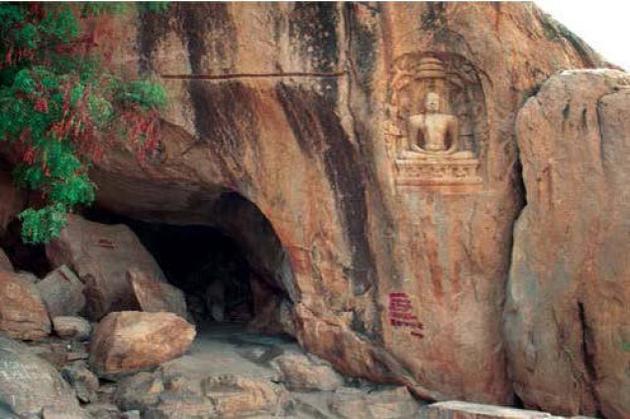
Settipodavu: Another Jaina site on Samanarmalai with sculptures of Tirthankaras and Vatteluttu inscriptions (9th century C.E.). /The Hindu

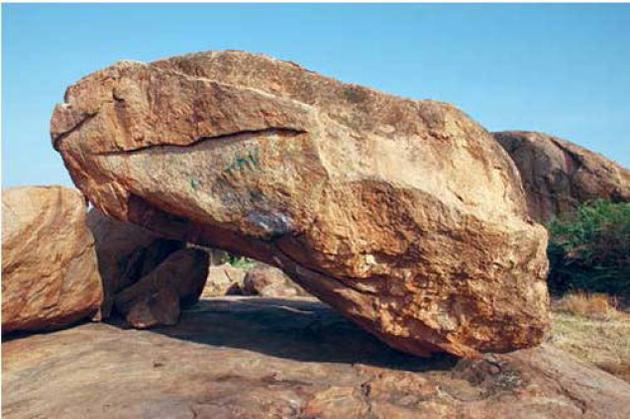
Geographically, Samanarmalai is an extensive complex of low rocky hills stretching more than three km. Two well-known Jaina monuments are on this hill, Settipodavu (Fig.2) at the base, and Pechipallam (Fig.3), one level above, both with sculptures of Jaina Tirthankaras and Vatteluttu inscriptions of about the 9th century C.E. A further level above Pechipallam and a level below the newly discovered Tamil-Brahmi cave are remains of a Jaina structure up to the basement level. A hillock with Jaina vestiges adjoining Samanarmalai tragically collapsed in the late1990s, due to heavy quarrying nearby.
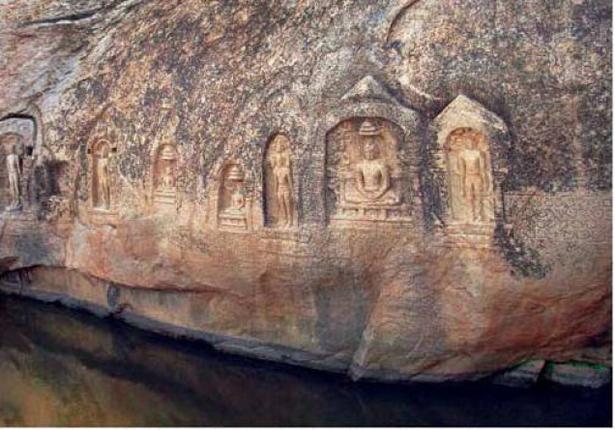
Pechipallam, a natural pool on Samanarmalai hill with sculptures of Jaina Tirthankaras and Vatteluttu inscriptions (9th century C.E.) on the boulder overlooking the pool. / The Hindu

The Samanarmalai complex, in the wider sense, includes the adjacent hills at Muttupatti and Kongarpuliyankulam, which have caves with a large number of stone beds, besides Tamil-Brahmi inscriptions dating from the 2nd century B.C.E. The recent discovery (Fig.4) has pushed back the historicity of Samanarmalai to well over 2,000 years, coeval with the earliest Tamil-Brahmi inscriptions. It appears that the caves with very numerous stone beds in the Samanarmalai region served as places of retreat for the Jaina monks of the Tirukkattampalli monastery during the rainy season (vassa).
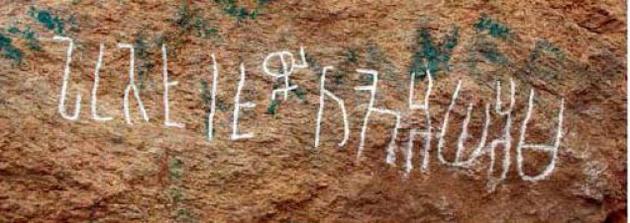
    Tamil-Brahmi cave inscription at Samanarmalai. / The Hindu

To reiterate the importance of Samanarmalai, several inscriptions form Jaina temples across Tamil Nadu and South Kerala refer to the Tirukkattampalli monastery and its illustrious line of Jaina teachers including Ajjanandi. The inscriptional evidence indicates that Tirukkattampalli-Samanarmalai was the central seat of authority for Jainism in the Tamil country, even as Sravanabelagola still is for the Jainas of Karnataka. Inscriptions (12th century C.E.) on the basement of the ruined Jaina temple above Pechipallam refer to visits of senior Jaina monks from Sravanabelagola, some of whom chose to end their lives through sallekhana (fast unto death) on the Samanarmalai hill. Here is clear evidence that the fame of Samanarmalai had spread beyond the borders of the ancient Tamil country.

The Tamil-Brahmi inscription

The newly discovered Tamil-Brahmi inscription at Samanarmalai may be assigned to about the 2nd century B.C.E. on palaeographic evidence. The tall and narrow characters and the archaic orthography, indicate that the inscription belongs to the earliest period like those at Mangulam, also near Madurai.

The brief one-line inscription reads:

peruterur uzhi taatai ay-am

(pool (of) Taatai at Peruterur)

The inscription commemorates the association of a person known as Taatai with the pool on the hill, which was probably deepened or renovated by him. Some interesting aspects of the four words comprising the inscription are noticed below.

Peruterur appears to be the earlier name of the village now known as Kilkuyilkudi at the foot of the hill. The earlier name suggests that it was a large village with streets wide enough for chariots to pass through. The word ter occurs here in the old sense of “(horse-drawn) chariot” and not with the later meaning of “(temple) chariot” as there were no structural temples at that time.

Uzhi is an archaic grammatical term for the locative (seventh) case-ending “in, at” (Nannul 302), as inpunattuzhi “in the field (of dry crops)” (Akananuru 388:13).

Taatai literally means “father” and occurs in this sense in the Sangam poems (Paripaatal). This is one of the kinship terms borrowed by Indo-Aryan from Dravidian. The word taata is used in Prakrit also as a respectful or affectionate form of address towards an elder person. The word taatai seems to occur in the latter sense here.

Ayam (spelt ay-am) means a “pool or mountain spring”. The deep natural pool at Pechipallam (Fig.2) found near the cave seems to be the one mentioned in the inscription. It is significant that this pool is presently known as Pechipallam, as pallam “hollow or pit” is a synonym for ayam (Tamil Lexicon), andPechi (from Peychi) is perhaps a reference to the yakshis found among the Jaina sculptures.

Apart from the general problems in deciphering 2,000-year-old, weathered and vandalised inscriptions engraved on rough, unhewn and undulating rock, this particular inscription poses additional challenges. The 4th and 6th letters look identical but must be read differently to suit the context. The 3rd, 8th and 9th letters look different but must be read alike, as t. The use of the long vowel u (6th letter) for the short vowel, and writing ayam as ay-am, splitting the suffix, are characteristic orthographic peculiarities found in the earliest Tamil-Brahmi inscriptions in this region (Early Tamil Epigraphy 2003).

A combined assault by the technical team, epigraphists and linguists has succeeded in deciphering the inscription, which confirms that the largest Jaina establishment of Tamil Nadu is also the oldest.

For further reading: R. Champakalakshmi 1975. Kurandi Tirukkattampalli: An ancient Jaina monastery of Tamil Nadu. Studies in Indian Epigraphy vol. 2: pp. 84-90. This is the definitive paper on the subject. We have drawn liberally from this source.

In situ tracing: K.T. Gandhirajan

Photographers: A. Sarangarajan and K. Thanigaimani

source: http://www.TheHindu.com / Home> Arts> Magazine / by M.V. Bhaskar & Iravatham Mahadevan / January 05th, 2013
World of its own

Culture Curry

Mint Street, which was once home to East India Company’s finances, is now a melting pot of communities in Chennai. Colin Todhunter explores its bustling bylanes that have become a city in their own right.

Slap, bang, wallop. It’s a full-force smack in the face. It’s the wall of heat that hits on exiting Chennai’s Central Railway Station. Turn left, then left again, and it’s not long before the road narrows and things gets even hotter. A stone’s throw from the station and it’s off the train and into the sweltering world of Mint Street.

This isn’t the sanitised world of AC shopping-mall India that’s much talked about by the media. It’s the earthy Sowcarpet area of north Chennai. This isn’t the place of latest fashion trends, burger dens or cool cola hangouts. It’s a world of wholesale markets, cycle rickshaws and tightly packed buildings. This is a place of congested streets, narrow lanes and wandering cattle. It’s a place many Chennaiites have heard about, but have never visited. The main pavementless thoroughfare, Mint Street, is a relentless offering of temples, hardware stores, eateries and clothes shops.

Shoppers’ delight

It’s a hard rock affair on Mint Street, where concrete turns to rubble and burst drains turn rubble to mud. It’s a heavy-metal, kitchenware delight, where a hundred shops and stores offer gleaming pots, pans, stoves, bowls and shiny, steel utensils. A thousand meals yet to be prepared throughout the kitchens of Chennai with equipment bought on this street. A million bellies yet to be filled with idlis, dosas and sambhar, the holy trinity of Tamil culinary delight. Guarded by temple priests and touched by believers who pass by, an eternal flame rages in front of Shiva’s metal trident outside a Hindu temple. It’s dusk and Marwari moneylenders’ daughters hit the throttle and blaze into the night and possibly into your heart. Flames of passion down on Mint Street. Beauty exists not only inside a Hindu temple, but also on the seat of a Hero Honda.

Just another Indian street, where cows compete with vegetable stalls, where people jostle with vehicles, where men haul heavy loads for quenching the insatiable needs of the masses? Nothing could be further from the truth. Mint Street may well be a hot and bothered affair and might fray the nerves, but it’s Chennai’s special street. It’s the world in one place.

Okay, that may be a little bit of an exaggeration. It’s more apt to state that it’s where different parts of India have come together to produce a uniquely Tamilian cocktail with intriguing Gujarati and Rajasthani aftertastes.

Marwari domain 

Ram Ram Rajasthan, good day Gujarat. The area around Mint Street is Rajasthan by the sea, Gujarat on the Coromandel Coast. It’s where Marwaris (an ethnic group from those two states), mostly moneylenders and businessmen, migrated to during the 20th century. It’s where the yellow veil of the desert state still covers faces, still hangs head to toe on slender figures that glide at dusk. Down on Mint Street, hear the call of Gujarat, feel the heat of Rajasthan. Indeed, Sowcarpet derives its name from sahukar, which means moneylender in Hindi.

It’s not just old women who you’ll see walking about in colourful, traditional north Rajasthani and Gujarati clothing and jewellery here. Slender women with faces fully veiled and wearing lehenga choli walk past in groups with babies perched on hips, as light-skinned 20-somethings in more conventional sarees zip past side-saddle on the back of mopeds or scooters. Out of Tamil Nadu and into the heart of what could be the most tradition-bound neighbourhoods of Jodphur or Bhuj within just a few minutes’ walk of Chennai’s main rail station. Even many of the store signs and name boards are in Hindi or Gujarati scripts.

This is where pedal power meets bullock cart. It’s a place where the modern submits to tradition. A girl in jeans accompanies her married sister in a saree. Traditional gold jewellery shimmers in brightly lit shop windows, and drips on the skin of women who sit in groups on shop floors, where men wheel out cloth from endless rolls for customers’ inspection. Rolls of material destined to be draped around bodies then hung over a million Sowcarpet balconies above the streets while drying in the sun.

Men stand sipping at stalls. The world viewed from over the rim of a plastic cup of scalding coffee. A poor cycle rickshaw man transports a young woman of north Indian ancestry with a mobile phone pressed against her veil-secluded head. Dogs take a break between naps in search of a spare bit of rice. Cows munch on vegetation strewn across the street. People stop at stalls of apples, mangoes, aubergines and oranges, all meticulously laid out for public perusal. It’s abundance overload on Mint Street.

Perfumes, paper plates, plastic tubing or intricate henna hand painting done in the street, pay your money and take your choice. ‘Shree Ganesh Steel’, ‘Bharat Steel House’ and ‘Gents Beauty Parlour’. The mundane practicalities of everyday living next to alluring adornments designed to attract. An innings already played out, an old man sits and waits on the step of a six-storey apartment block. A hundred different architectural styles, each narrow building separately designed yet attached to one another and lining the streets.

A dozen different designs in a single lane, many with intricately carved alcoves and cosy bays, stacked above the chaos of the streets below. Functional concrete boxes stripped of any beauty or appeal by architects, whose motto must have been ‘uglification is us’, stand next to shiny marbled buildings in which each metal railed balcony, window ledge and carefully designed recess were thought out down to the finest detail. The claustrophobic lanes hemmed in by a never ending wall of three to seven storey buildings winding their way into the distance. Ugliness and beauty, paradox and jumble.

Food for thought

Mint Street itself derived its name from having housed the East India Company’s mint. These days, many people visit the area to sample the tasty bites on offer, which hail from all over India. Snack on chaat or crispy jalebis. Try out different flavours of kulfis and sample pyaaz kachori. How about paani puris or a murukku sandwich? Take some Chotu Motu bhel, Raj Shri paani puri, Sinabhai idlis, Novelty pav bhaaji, aloo sabzi, bhindi, raita, shahi panner or Kolkata paan.

For many who visit this area of Chennai, the place is just too crowded and congested. But they visit this area for dry fruits, spices and grains. They come for textiles and sarees. They come for gleaming metallic kitchenware, plastic products, fashion jewellery, machine tools, electronic items, stationery and various general products at low cost. The area is not really a place to hang out. It’s a fast and furious world of hardwork, cow mess, mud, indigestion and sensory overload. It’s definitely not for the weak hearted.

Perhaps that’s why many from more affluent parts of the city never come. They prefer to visit the AC worlds of Express Mall, City Centre Mall or Spencer Plaza. For many people, not just in India, but throughout the world, perhaps some things are better out of sight, out of mind. In Sowcarpet, things are hot, maybe a little too hot, maybe a little too real.

source: http://www.DeccanHerald.com / Home> Supplements> Sunday Herald articulations / by Colin Todhunter / January 20th, 2013

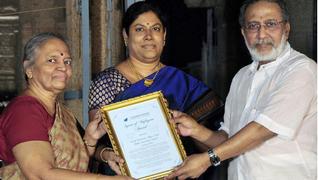
‘Spirit of Mylapore’ award to Lady Sivaswami Girls School

TT Srinivasaraghavan, MD, Sundaram Finance Ltd., presenting the award to Leela Narendran, Secretary, Lady Sivaswamy Ayyar Girls’ Higher Secondary School.

Lady Sivaswamy Ayyar Girls’ Higher Secondary School was chosen for the 5{+t}{+h}Sundaram Finance ‘Spirit of Mylapore’ award.

The award was presented on January 13 by T.T. Srinivasaraghavan, MD, Sundaram Finance Ltd., to P. Ruby Puthotta, Headmistress and Leela Narendran, Secretary, Lady Sivaswamy Ayyar Girls’ Higher Secondary School on the final day of the 11{+t}{+h}Sundaram Finance Mylapore Festival.

T.T. Srinivasaraghavan said, “For the past 143 years, Lady Sivaswamy Ayyar Girls Higher Secondary School has remained committed to the objective of educating girl children.” The school was founded by the Maharaja of Vijayanagaram in 1869 and later taken over by Sir PS Sivaswami Ayyar.

Sundaram Finance instituted the ‘Spirit of Mylapore’ award in January 2009. Every year, it recognises the long-time resident or institution of Mylapore that has contributed significantly to the culture and heritage of Mylapore.

It is to be noted that the previous recipients were Book Seller RK Azhwar, legendary musician Shri. Rajam, Dabba Chetti Kadai and Rasi Silks.

source: http://www.TheHindu.com /Home> Features> Down Town / January 20th, 2013

Benny Dayal, the new sensation in the music world

He is just 28-years-old but has been successful in mak-ing a mark in the film industry through his catchy voice. Having stepped into the industry only a few years back, Benny Dayal has been successful in establishing himself as one of the best playback singers among the younger generation who have stepped into the entertainment industry. Born and brought up in Abu Dhabi, Benny completed his graduation in Chennai and worked as a HR professional before getting his first break ‘Pappu Can’t Dance…’ for the movie ‘Jaane Tu Ya Jaane Na’ composed by A.R. Rahman. Since then Benny has never looked back. He is one of the versatile singers in the present era who can sing in 5 languages. Within a short span of time, Benny has been able to impress a number of music composers including A.R. Rahman, Haris Jayaraj, James Vasanthan, Salim Sulaiman, Vishal Shekar, Pritham, Shankar-Ehsaan-Loy and others. He was also honoured with R.D. Burman Award for New Music Talent at the 54th Filmfare awards and also New musical sensation award at the 2009 Stardust Awards.

Star of Mysore caught up with Benny when he was in Mysore recently for a concert organised by Royal Stag at the Windflower Resort and Spa.

By S.N. Venkatnag Sobers

Star of Mysore (SOM): How did you start your career in the music industry?

Benny Dayal: It was a shock for me when I got a call from A.R. Rahman studio to record a song for one of his compositions. The ‘Pappu can’t dance…’ became a huge hit, all thanks to my guru A.R. Rahman for giving me a break. Before entering the industry I used to sing along with my band S5 which still continues to do so. But I would give all credit to Rahman Sir for introducing me into the industry.

SOM: You have been able to work with a number of music composers in a short time. How would see your growth?

Benny: I would say I have been very lucky to have worked with a number of music directors. I have just started my career and there is lot more to achieve.

SOM: You have lent your voice for songs in 5 different languages? Which is the language that you are very comfortable with?

Benny: Again it is just luck which has given me an opportunity to work with music directors from South and North India. For me, languages have never been an issue. I am ready to sing in any language.

SOM: Having worked with so many music directors, whom do you consider to be most comfortable to work with?

Benny: There is nothing like that. Like I said earlier, A.R. Rahman is my guru but for me Salim-Sulaiman have been great. I consider them as my brothers. It is because of them I moved to Mumbai and met many music composers.

SOM: How has 2012 treated you?

Benny: Last year has been amazing. All the songs which I have sung have become hits. ‘Daaru Desi’ from ‘Cocktail’, ‘Ek Main Aur Ekk Tu’ from ‘Ek Main Aur Ekk Tu’ have been great hits. This apart, I also got an opportunity to record a song for Shankar-Ehsaan-Loy for ‘Vishwaroopam’ which turned out be a great experience. I will be starting 2013 with the song ‘Lat Lag Gayi’ from the movie ‘Race 2’.

SOM: You have also sung a few Kannada songs. Would you like to sing more for sandalwood?

Benny: Yes, I have a sung a few songs for movies such as ‘Gaana Bajaana’ and ‘Love Guru’. But I have not been approached by any of the music composers from Sandalwood. Given an opportunity, I would definitely work for Sandalwood.

SOM: What is your opinion about the reality shows. They say the singers in reality shows have to wait for a long time and struggle hard to get a break in the industry?

Benny: No doubt reality shows are bringing in fresh talents in the industry. But they need to wait for the right break and just keep practicing music till the time comes.

source: http://www.StarofMysore.com /Home> Feature Articles / January 17th, 2013

Jaya unveils Pennycuick memorial, announces one for Karikala Chola

LOWER CAMP (THENI): Chief minister J Jayalalithaa on Tuesday inaugurated a memorial for British engineer  Col John Pennycuick , who was instrumental in building the 118-year-old Mullaperiyar dam that has remained the lifeline of five districts in southern Tamil Nadu, at the Lower Camp in Theni district.

Nestled in the foothills of lush green western ghats, the memorial announced exactly a year ago when the protest over Mullaperiyar rights was at its peak between Tamil Nadu and Kerala. The inauguration of the Rs 1.25 crore memorial, coincides with the birth anniversary of Pennycuick, who is regarded as a demigod by the farmers in Theni.

Inaugurating the memorial, Jayalalithaa announced that a similar memorial would be built for Karikal Chola, one among the popular Chola kings, who built Grand Anicut (Kallanai) across river Cooleroon.

“Kallanai is much older than the Mullaperiyar dam. It was an engineering marvel built more than 2,000 years and continuing to benefit crores of people even today. It is the oldest among the dams still in use. A memorial would be built to honour and express gratitude to Karikal Chola,” Jayalalithaa said.

Narrating the legal struggles by Tamil Nadu government in exercising its rights over Mullaperiyar dam, she said that the case was being heard in the Supreme Court. “The empowered committee constituted by the Supreme Court had submitted its report on April 2012 stating that Mullaperiyar dam was strong and safe and recommended that the water level can be raised to 142 feet as per an earlier order. The committee also categorically recommended that after the maintenance works, the level can be raised to 152 feet. I believe that the Supreme Court would award a favourable judgement for Tamil Nadu based on the report,” she said.

She also took the opportunity to hit out at the Central government and charged that it had to failed to act on a Tamil Nadu assembly resolution regarding Mullaperiyar dam. “Tamil Nadu assembly passed a resolution in December 2011 seeking deployment of the Central Reserve Police Force to protect the dam. Besides, in accordance with the Supreme Court order that enabled raising of the water level in the dam to 142 feet the resolution sought that the Kerala government should amend its Act that restricted the water level. We had also requested that the Kerala government should not hinder the long-term maintenance work in the dam. But the Centre has not taken any action based on the resolution,” she said.

Jayalalithaa also hit out at DMK  chief M Karunanidhi denying charges that the AIADMK government had failed to protect the Thiruvalluvar statue in Kanyakumari. Noting that it was during her tenure that Rs 1.28 crore was allocated for the statue, she said that every four or five years chemical coating was given to the 133-feet tall statue.

source: http://www.timesofindia.indiatimes.com / Home> City> Madurai / TNN / January 16th, 2013

Coimbatore streets crowded with Pongal shoppers

Coimbatore :

With Pongal, the harvest festival just two days away, the commercial parts of the city are crowded with last minute shoppers, even though the prices of essentials including sugarcane, turmeric and rice continue to increase rapidly. It is not uncommon for people from neighbouring towns and villages to travel to Coimbatore to buy new clothes and accessories. Pongal bazaars are very active, especially in the vicinity of the Flower Market and Town Hall. Fresh loads of sugarcane and turmeric arrive periodically, to cater to the rising demand, ahead of Pongal.

Prices are skyrocketing this season but we have to celebrate the festival the traditional way with grandeur. The power cuts have eased a bit and we hope this will continue till the end of the festival,” said P R Pramod, a businessman from Peelamedu, who was doing his Pongal shopping near the Flower Market.

Marketing manager of a leading textile firm in Oppanakara Street said that people were coming in large numbers to do their Pongal shopping. “Business is better when compared to Diwali and Christmas last year,” he said. The textile shops have introduced new varieties and designs. “Many people from villages come to the city to buy modern clothes. This has in no way impacted the demand for traditional saris,” he added. Grocery stores have also been witnessing a sudden rush of festival revelers. People are mainly looking to buy sweets, said a shop owner.

M Jayanthi, a housewife residing at Kuniamuthur says that everyone at home wears new clothes for Pongal. Sunitha Shree R, part of the faculty at a city college  said that her family celebrate’s by cooking special dishes and holding prayers. “We generally buy rice, make special sweets and visit the temple,” she says.

The Coimbatore railway station saw crowds of people waiting to buy tickets. N Ramu and Asha Jyothi, second year M Pham students at Sri Ramakrishna College of Medicine said they were eager to go home to celebrate Pongal with their families in Vijayawada. TNSTC has started operating 400 additional buses to manage the rush mainly in the Chennai and Madurai routes. There is a huge demand for tickets to Trichy, Madurai, Thanjavur, Thirunelveli, Thoothukudi, Theni, Pudukottai and Karaikudi.

M Sekar, treasurer of Erode Kani Market Textile Traders Association said, “Sales of wholesale clothes has picked up only in the last week. People from Madurai, Nagercoil, Tirunelveli and Tuticorin buy whole sale from here. Over the last one week, we have sold handloom textile and readymade clothes worth Rs 15 crore”.

source: http://www.articles.timesofindia.indiatimes.com / Home> City> Coimbatore / by  Arun P. Mathew, TNN / January 12th, 2013

Tamil heartland gets set to promote English language

MKU to focus on English-speaking ability for employability

Madurai is gearing up to give a major push to the English language.

Bowing to current trends in employment, the Madurai Kamaraj University and its affiliated colleges are putting their money on ‘English Language Labs’ to promote communication skills among undergraduate students, most of whom are from the rural areas.

Language lab

With the focus on spoken English, the university is in the process of setting up an English language lab for which Rs.30 lakh has been allotted by the State Government recently. Kalyani Mathivanan, Vice-Chancellor, told The Hindu on Saturday that the lab would be equipped with special CDs to enable students to listen to good English and help them improve their communication and pronunciation.

“We are keen to get the English lab ready before the start of the next academic year. Students should make use of the facility on a regular basis so that they will be able to pick up the basics,” she said.

Focus on English Department

The Vice-Chancellor felt that if students are able to speak in English, they will improve their self-confidence. She said that the English Department would be enhanced and given more visibility on the campus.

“Right now, some sections connected to this department are located in an isolated place.

Very soon, all of them would be housed in the same building,” she added. Dr. Kalyani Mathivanan urged the affiliated colleges to create more opportunities so that students can listen to English CDs to become familiar with the language.

Affiliated colleges

Affiliated colleges too have realised the importance of students conversing in English.

The Department of English at Yadava College, which draws more students with a rural background, has established a language lab with 50 computer systems.

C. Raju, Associate Professor, said that audio-visual facilities would enable undergraduate students acquaint themselves with grammar and correct pronunciation.

“We are focusing on fluency, conversation, body language and interview skills. In fact, our UG students have to compulsorily pass a Communicative English paper in their semester examinations,” Dr. Raju said.

Principal of Madura College, R. Murali, requested the Vice-Chancellor to keep the varsity’s English language lab open for students of affiliated colleges as well.

“Speaking in English has become inevitable and nobody can survive without it these days. We request the university to allot time slots for students of affiliated colleges.

Also, the University Grants Commission can provide more funding support to colleges to set up language labs,” he added.

Dr. Murali welcomed the MKU move to promote English learning activity and said that interactive CDs made learning effective.

source: http://www.TheHindu.com / Home> News> Cities> Madurai / by Shastry V. Mallady / January 13th, 2013

Book fair brings royalty issue to the fore

As the 36 Book Fair got under way in Chennai on Friday, a debate on royalty for writers has come to the fore, even as publishers are complaining about the government’s failure to purchase books for public libraries since 2009.

The book fair has been witnessing a steady increase in the number of participants — from 687 last year to 747 this year — and around 10 lakh titles are out on sale. This growth, however, has not benefitted writers, says critics.

“While writers are not aware of their rights, there is a lack of commitment on the part of publishers both in terms of moral and legal. Around 75 per cent of the publishers do not pay royalty to the writers and many pay grudgingly,” alleged A.R. Venkatachalapathy, Professor, Madras Institute of Development Studies.

But he hoped the industry would move to that stage next, as writers who have established a name for themselves are getting proper payment.

“A decade ago it was impossible get a book published unless the author was well-known to the readers. But the trend has changed and it has become easy for anyone to get a publisher,” he explained.

Even writer S. Ramakrishnan, one of the most sought-after authors in Tamil and who had no issues with his publishers, said his case could be an exception and that a majority of writers could not get royalty properly from their publishers.

“In Tamil Nadu, you cannot lead a life depending on your writings for livelihood. Even those who buy the book from publishers and sell it get a discount of 30 to 35 per cent. But writers’ royalty continues to remain at 10 per cent and in some cases it has moved up to 12 per cent. Publishing still remains a cottage industry and many treat it as a profession without any capital investment,” he said.

Mr. Ramakrishnan, during a visit to the US, was asked whether he was a multi-millionaire as he had written around 50 books.

“That is the kind of assumption related to writers elsewhere. One of my short stories was published by Penguin and I am getting royalty for it every three months,” he said, adding that many publishers did not make any promotional efforts to sell books.

Even though writer Rajendrachozhan agreed royalty was an issue, he made a case for analysing the issue taking into consideration so many factors plaguing the publishing industry.

“Book writing and publishing is no longer considered an intellectual pursuit. Publishing books is seen as a commercial venture and serious literary efforts would not be encouraged by all publishers. Moreover, there is no transparency in the ways followed by the Library Authorities in selecting books for purchase, and failure on the part of the government to purchase books also affected the industry severely,” he said.

PUBLISHERS’ ARGUMENT

“No publisher denies royalty to a book that sells. But how can a publisher pay for the books printed and remain unsold? A. Madhavan is a brilliant writer in Tamil. But in the last ten years I am not able to sell his books I first printed,” said Vasantakumar of Tamizhini publications.

He said that publishing industry could not be viewed in isolation when popular and mass media promotes inferior quality.

His views were echoed by Manushyaputhiran of Uyirmai Pathipagam.

“We pay royalty promptly to writers. But at the same time I volunteered to publish the books of young writers to encourage them. There is one book. I published 450 copies and I am yet to sell 350,” he said.

source: http://www.TheHindu.com / Home> News> Cities> Chennai> Arts / by B. Kolappan / January 12th, 2013