Category Archives: Leaders

Memories of Coimbatore: Women in action

Shashi Ghulati on the Coimbatore of the 60s, and the slew of welfare activities she and other ladies undertook in the city
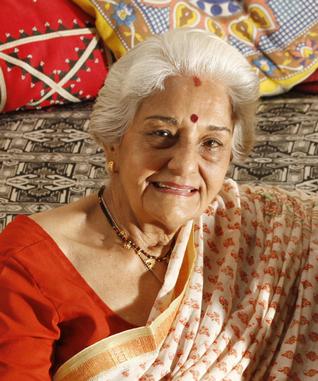
                         Shashi Ghulati during a photoshoot Photo: K. Ananthan 

I migrated from Calcutta to Coimbatore in 1964 after my husband Sagar decided to quit Hooghly Pilot Service to start his own business. Since I grew up in Madras in the 40s and 50s, moving to Coimbatore was a sort of homecoming for me. The city was an overgrown village back then. The hills in the periphery of the city gave one a feeling of being in a hill station. And yes, the salubrious climate! It was one of the major reasons why we chose to settle down in Coimbatore even after experiencing the exciting lifestyle of Calcutta.

I distinctly remember the level crossings on Avanashi Road and Cross Cut Road. The flyovers did not exist then. These crossings tested our patience especially when we had to get our kids to school on time!

When we moved to our first home at Siddhanaidu Layout, I would drive past the Kamarajapuram sweeper colony. The area housed municipal workers and cobblers. The roads were lined with numerous huts and they were very badly maintained. I wanted to do something about it. I became a member of YWCA and proposed an idea of starting a community centre at Kamarajapuram. The then President of YWCA, Dr. Rangala and Secretary Hepzibah were receptive to it.

Literacy drive

With the municipality’s support, we restored a dilapidated reading room in the locality and started a crèche, nursery and a tailoring unit. Adult literacy classes were started for women in Kamarajapuram and they are functioning even today.

The very first Ladies Circle in India was founded in Coimbatore in 1968. The wives of members of Round Table No. 9 in the city formed it. I was the Founder President. The Ladies Circle helped organise recreational activities for children in Kamarajapuram, set up kitchen gardens and volleyball training sessions.

I remember the time I visited Stanes School to enrol my son there. The school had an expanse of open land. There were not many trees. Strong gusts of wind raised waves of dust in the school. Reverend H.O. Fowler of Stanes was a very genial man. His wife, Alda Fowler and V. Amritham didn’t let me miss Calcutta at all.

In 1966, the members of the Society for the Aid of Handicapped Children started the Coimbatore Orthopaedic and Rehabilitation Centre at Krishnasamy Mudaliar Road. Alda, Amritham, Dotty Boppayya and I were the first office bearers of this centre, which is now ‘Amrit Centre for Special Needs’ on Mettupalayam Road.

In January 1984, the Indian National Trust for Art and Cultural Heritage (INTACH) was founded in New Delhi. In November 1985, Dr. Deborah Thiagarajan, then State Convenor of INTACH, Tamil Nadu, invited me to found a chapter at Coimbatore. In August 1986, this chapter was formed. Till 1995, our initiatives included documenting and listing several public structures in the city. We fought for the restoration of the Victoria Town Hall, which was being used as a godown.

Awareness campaigns

In 1987, 88, 90 and 92, National Environment Awareness Campaigns were held for a period of four months each. These addressed issues involving pollution of rivers Bhavani and Cauvery, the Noyyal tank, and the ground waters of Tirupur due to industrial and sewage effluents.

INTACH Coimbatore pioneered legal action to save the Bhavani River with a PIL in the Supreme Court.

In the early 70s, Coimbatore had the privilege of playing host to Mother Teresa twice. During her first visit, I had the opportunity to meet her. She expressed her desire to do something for the homeless in the city. She wasn’t ready for any sort of civic reception then.
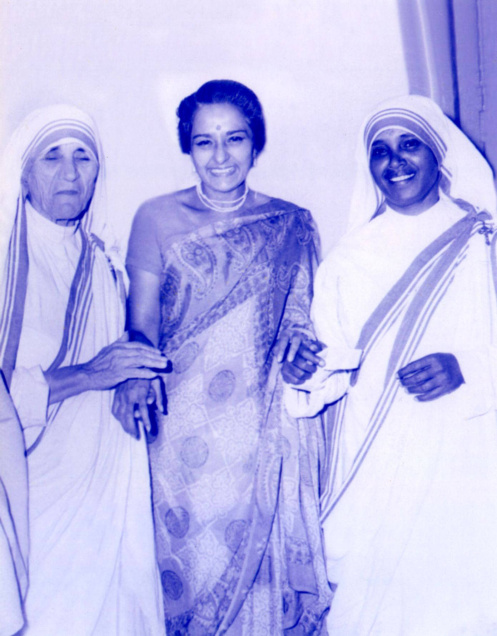
In Divine Company Shashi Ghulati (centre) with Mother Teresa Photo: Special Arrangement

Nuns from the Missionaries of Charities came down to Coimbatore to set up Nirmal Hriday and Sishu Bhavan near Carmel Garden School. As members of Ladies Circle No. 1, we invited the nuns to volunteer at a home for juvenile delinquents near Lakshmi Mills.

During Mother’s second visit, a huge gathering was organised for her at the grounds in Carmel Garden. But the most exciting thing for me was that I got to be her chauffeur!

(As told to NITHYA SIVASHANKAR)


BIO

SHASHI GHULATI Born in 1934 in Chennai, she made Coimbatore her home in 1964. She was the first President of the Ladies Circle India. As part of her work with Women’s Voluntary Services in Calcutta, she worked with refugees from East Bengal. Her interests include music, writing, reading and drama. Shashi is the secretary of the Coimbatore Book Club Theatre Group and she regularly directs plays in the city.

I REMEMBER

Sessions with a group of us sitting down and reading out of favourite books and plays. We would have these meetings at home. These sowed the seeds of the Coimbatore Book Club.

source: http://www.TheHindu.com / Life & Style> MetroPlus / by Nithya SivaShankar / Coimbatore, April 03rd, 2012

Kovai Gets First Woman Dy Mayor

Coimbatore:

Coimbatore got its first woman Deputy Mayor, S Leelavathi Unni, in a ‘hurry’ on Monday thanks to a classic case of slip between the cup and lip for the AIADMK’s originally intended nominee K B Balraj. The post of Deputy Mayor had fallen vacant following the resignation N Chinnadurai on December 30 last year.

Just hours before the Coimbatore Corporation Council was to meet to elect the new Deputy Mayor on Monday, it became apparent that Balraj would be the ruling party nominee for the post. Immediately, senior AIADMK functionary M Manimaran sought to preempt Balraj. He pointed out that since the latter had got a contract to operate a Corporation abattoir in Uppilipalayam, electing him would lead to conflict on interest in civic administration.

Balraj had recently written to the Corporation seeking to annul his contract with an eye on bagging the post. His request to surrender his contract was on the agendas for Monday’s council meeting.

With Manimaran and a few other councillors objecting to Balraj’s candidature confusion prevailed

Amid the drama, Corporation Commissioner consulted Mayor S M Velusamy and adjourned the council meeting by an hour. Subsequently, after backroom confabulations with Chennai, first time councillor Leelavathi Unni was asked to file her nominations.

A brief while later the Commissioner declared that she was unanimously elected Deputy Mayor.

source: http://www/ibnlive.in.com /  Express News Service / Tamilnadu / February 28th,2012

Rs.1 crore Jindal prize for Dr.Kalam, Santosh Hegde

Caption: Dr. Kalam, Justice Hegde

New Delhi, Feb.16:

Former President A.P.J. Abdul Kalam and former Lokayukta of Karnataka Justice N. Santosh Hegde have been selected by the Sitaram Jindal Foundation for S.R. Jindal Prize for their outstanding contributions in their respective fields.

The prize amount carries a cash of Rs. 1 crore. Sitaram Jindal Foundation will felicitate 25 other achievers also at the award ceremony to be held on Feb. 23.

S.R. Jindal Prizes will also be awarded for crusade against corruption, rural development and gallantry.

Patron of the Foundation Sitaram Jindal said, Dr. Abdul Kalam has been selected for the award for his contributions in science and technology while Justice Santosh Hegde will be honoured for his extraordinary service in social development.

source: http://www.StarofMysore.com / General News / February 16th, 2012

Kalam asks experts in medicine to develop new technology

Former President inaugurates laser surgery machine at Maxivision Eye Care

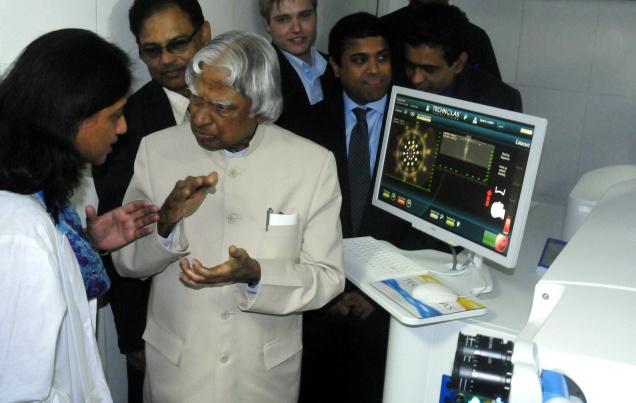
A. P. J. Abdul Kalam , the former President of India inagurating the VICTUS Femtosecond Laser Cataract Surgery Machine installed at the Maxivision in Hyderabad on Tuesday.Photo: K. Ramesh Babu / The Hindu

Former President of India, Dr. A. P. J. Abdul Kalam said here on Tuesday that the country’s best talent in the field of medicine should strive to develop innovative technology so that the needy could afford the fruits of modern medicine. On Tuesday, Dr. Kalam inaugurated VICTUS Femtosecond Laser Cataract Surgery machine at Maxivision Eye Care, Somajiguda.

“I call upon the Maxivision eye surgeons to form a team of experts who can explore the multidimensional uses of Femtosecond laser in treating various eye ailments. We need to utilise the technology and help people who can’t afford modern medical care,” Dr. Kalam said.

The former President said that the multiple applications of the Femtosecond laser would help doctors treat a host of eye ailments.

Immediately after the inauguration, the renowned nuclear scientist also interacted with the eye surgeons of Maxivision and enquired about the newly acquired laser surgery machine.

The officials of Maxivision said that the new machine had been under test from November 2010.

Already, the eye surgeons had completed close to 450 eye surgeries by using the new laser machine. The surgeons pointed out that not a single case had reported complications after the surgery.

The VICTUS platform, essentially, helped doctors conduct cataract, refractive and therapeutic procedures of the eye on a single platform. The laser machine would help surgeons perform computer controlled precise, accurate and reproducible incisions compared to current manual procedures. The success rate for such surgery was 100 per cent, doctors added.

“This is the first such laser machine in the World and I would like to congratulate Maxivision for this accomplishment,” founder and chairman of GVK, G. V. K. Reddy said.

Chairman of L.V. Prasad Eye Institute, Dr. G. N. Rao, Founder of Maxivision Eye Hospitals, Dr. Kasu Prasad Reddy, Film Producer D. Ramanaidu and several other doctors were present.

source: http://www.TheHindu.com / News> Cities> Hyderabad / by Staff Reporter/ February 01st, 2012

N. Ram steps down as editor of The Hindu

N. Ram announced recently that he will be stepping down as editor-in-chief of The Hindu and its associate publications.


The veteran editor, who has been the daily’s editor-in-chief since 2003, will be vacating office on 19 January. “…In keeping with the relevant resolutions adopted by the board of directors and the shareholders on editorial succession…” Ram is reported to have said it in a mail to his employees.

Beginning his career as an associate editor in The Hindu in 1977, Ram went on to head other publications of the group such asFrontlineThe Hindu Business Line and Sportstar and was awarded the Padma Bhushan by the India government. He won accolades for his Bofors Scandal exposé during the reign of Prime Minister Rajiv Gandhi.

source: http://www.Sunday-Guardian.com / Media Minutes / Wednesday, January 18th, 2012

The long and short of it

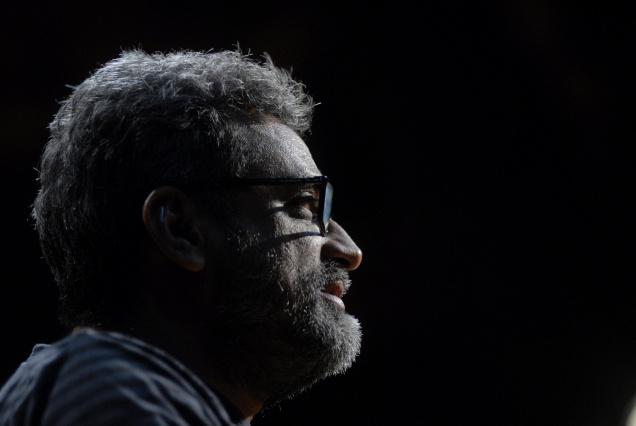
 Fitting script to star Balki feels that’s a concept we can’t really change Photo: Murali Kumar k.

Ad man and feature filmmaker R. Balki tells Bhumika K. that in Indian cinema the actor is definitely bigger than the character

His ads make sure you don’t switch channels between programmes. You’ve also enjoyed his films if you’re as much of an Amitabh Bachchan fan as he is. The same guy who came up with the “Daag achche hain” concept for a washing powder, also turned the Indian love story on its head with the May-December romance “Cheeni Kum”. R. Balakrishnan, better known in the ad and film world as R. Balki, is now in the process of giving Sridevi’s acting career a breath of fresh air.

He’s producing the much-awaited “English Vinglish”, Sridevi’s large screen comeback, written and directed by his wife, Gauri Shinde.“My wife wrote the story with certain experiences in mind…it’s an ode to her mother. It’s a woman-oriented subject and needs a certain sensitivity in how it’s made. I loved the script so much, I just wanted the film to be between us,” is how Balki explains his entry into the Hindi film industry as producer.

Balki, who’s the chairman and chief creative officer of ad-agency Lowe Worldwide, was in Bangalore recently to speak to college students at ‘Expressions 2012′, the annual seminar on journalism and mass communication organised by Commits. Ad guys never fail to charm with their talk, and if the students at the seminar lapping up his every word were anything to go by, Balki was Chief Charmer. Playing clips of his advertisements, Balki spoke of the power of advertising, of saying so much without saying it all. And how the same ad can be stretched into an entire movie.

It’s all out in the open — that Balki is a big fan, both of music composer Ilayaraja and Amitabh Bachchan — a combination that made his maiden film “Cheeni Kum” in 2007 and then again his “Paa” in 2009, great successes with the audience.

It is also now part of Bollywood legend that Balki writes the script keeping in mind particular actors, and always gets them to star in those roles. “In Indian cinema, an actor has assumed a role larger than that of the character he plays. So you start thinking on those terms. Auro (the character of a 13-year-old that AB played in ‘Paa’) is still Amitabh Bachchan at 13 — he’s witty, intelligent, sarcastic — everything that Amitabh is. You and I can’t change it,” is Balki’s reason for fitting a script to star. He continues: “My desire is to work with Amitabh Bachchan so I will write for him. Shah Rukh Khan also has an image associated with him and it’s a strong one, Aamir Khan is still Aamir Khan, even if he is playing a college student. The characters can’t be actor-neutral and we love it. It’s a bonus we as a country have.”

All this Balki says over phone, as the high-flier who zips into the seminar zips out to meet his mother who lives in Bangalore. “I’m a Bangalorean. We’re Tamilians who’ve lived here all our life. I’ve spent 34 years of my life in Bangalore. It’s only in the last 13 years that I’ve been in Mumbai. I guess my association with Bangalore figures in me as a person, and influences me. Bangalore has always been cosmopolitan in outlook and I’m comfortable with my Hindi, Tamil and Kannada. It may rob you of the kind of cultural richness that you would have if you were born in a city like Chennai, but it is replaced with another richness — a far more easy going, fuss-free attitude, which reflects in the way I think.”

A product of Frank Anthony Public School and Christ College, Balki has fond memories of the restaurants and landmarks in the city, and “of lanes I’ve walked in depression” when he was quite undecided about his career. “Theatres like Lido, Galaxy, Lavanya and Lakshmi, and Kannada, Tamil and Telugu films are all part of my memories,” he laughs. “I love Kannadiga food; I love akki rottiand bisi bele bhath and ask my mother to make Kannadiga saaru when I visit.”

While he straddles both worlds — of ad and feature filmmaking — with ease, Balki says “I love advertising. It’s like solving a problem; it’s addictive. Unless you have a fantastic story to tell, making a feature film is too laborious a process.” That, coming from a man who claims he’s never worked on a single crossword in his life! Speaking earlier at the seminar, Balki spoke of how advertising is one of the most insecure professions. “You don’t know where your next idea is coming from. It can kill you or make you. It’s just a game and you keep playing.”

source: http://www.TheHindu.com/ Arts> Cinema / by Bhumika K / January 10th, 2012

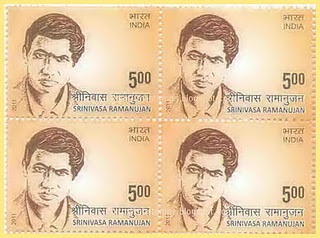
India Post Released Srinivasa Ramanujam Stamp on 26.12.2011

India Post released New stamp for Srinivasa Ramanujam in his 125th birth anniversary. Stamp Released by our honorable Prime Minister Dr. Manmohan Singh in Chennai also declared December 22, the birthday of Ramanujan, as ‘National Mathematics Day.’
Srinivasa Iyengar Ramanujan ( 22 December 1887 – 26 April 1920 ) was an Indian mathematician, Born in Erode, Tamil Nadu, India, to a poor Brahmin family, Ramanujan first encountered formal mathematics at age10. He demonstrated a natural ability, and was given books on advanced trigonometry written by S. L. Loney. He mastered them by age 12, and even discovered theorems of his own, including independently re-discovering Euler’s identity. He demonstrated unusual mathematical skills at school, winning accolades and awards. By 17, Ramanujan conducted his own mathematical research on Bernoulli numbers and the Euler–Mascheroni constant. He received a scholarship to study at Government College in Kumbakonam, but lost it when he failed his non-mathematical coursework.
He joined another college to pursue independent mathematical research, working as a clerk in the Accountant-General’s office at the Madras Port Trust Office to support himself. In 1912–1913, he sent samples of his theorems to three academics at the University of Cambridge. Only Hardy recognised the brilliance of his work, subsequently inviting Ramanujan to visit and work with him at Cambridge. He became a Fellow of the Royal Society and a Fellow of Trinity College, Cambridge, dying of illness, malnutrition and possibly liver infection in 1920 at the age of 32.
During his short lifetime, Ramanujan independently compiled nearly 3900 results (mostly identities and equations).Although a small number of these results were actually false and some were already known, most of his claims have now been proven correct. He stated results that were both original and highly unconventional, such as the Ramanujan prime and the Ramanujan theta function, and these have inspired a vast amount of further research. However, the mathematical mainstream has been rather slow in absorbing some of his major discoveries.
The Ramanujan Journal, an international publication, was launched to publish work in all areas of mathematics influenced by his work.
source: http://www.sapost.blogspot.com / December 26th, 2011