Category Archives: Science & Technologies

Videocon to start operations in Manamadurai unit in 3-4 months

The company has invested around Rs 700-800 crore for the plant

The electronic consumer durables manufacturing facility of Videocon Group in Manamadurai, at Sivaganga is likely to start operations in next three to four months, said Rajkumar Dhoot, managing director of Videocon Industries. The project has been proposed to complete with an investment of around Rs 1,600 crore.

Speaking to reporters in the sidelines of Vision Tamil Nadu,a seminar organised by Assocham, he said, “The plant would be ready for operations in next three to four months. We have so far invested around Rs 700-800 crore for the plant.”

The new facility would be manufacturing various consumer electronic products including washing machine, refrigerator and colour television.

There was some delay in completion of the project, due to the economic slow down and related issues. However, the works are on full pace now, he said.

The company would also look at exporting the products from the facility to overseas. It has identified demand in exporting electronic consumer durables to countries like Indonesia and Malaysia.

According to reports in 2009, the State Industries Promotion Corporation of Tamil Nadu, the government agency which allots land for industrial projects, has allotted around 70 acres to Videocon to set up the plant in Manamadurai. The company currently has a manufacturing facility in Hosur.

The company is the largest manufacturer of colour television in India and though the market for cathode ray televisions are shrinking, it still has shortage in supply in states like Tamil Nadu and Karnataka, said Dhoot. The Manamadurai plant would initially create employment opportunity for around 500-700 people.

source: http://www.business-standard.com / Home>  Companies & Industry / by Gireesh Babu / Chennai, July 04th, 2012
PSU to commence vaccine production

More than four years after it was shut down for failing to comply with the Good Manufacturing Practice (GMP) standards, the government’s vaccine manufacturing unit-Pasteur Institute of India (PII), Coonoor, is all set to roll out its first batch of vaccine doses for Dipetheria Pertussis Tetanus (DPT) from Tuesday.
The Public Sector Unit (PSU) will supply about 15 lakh of DPT doses for the country’s Universal Immunisation Progr-amme (UIP). The institute proposes to release about 30 million doses of DPT for the year 2012-2013. “This will be the first time after four years that the PSU will start rolling our vaccines again,” said a senior official in the health ministry.
The vaccines have been validated and underwent a quality control testing CDL Kasauli in March 2012.
The manufacturing process had started in 2010 after Union health minister Ghulam Nabi Azad ordered the Drug Controller General of India (DCGI) to partially revoke the suspension of licence of the PSU in order to enable domestic use of the vaccines.
PII and two other PSUs— Central Research Institute (CRI), Kasauli and Bacillus Calmette-Guerin (BCG) Vaccine Laboratory, Guindy were closed down in 2008 by the then Health Minister Anbumani Ramadoss on the grounds that they were not GMP compliant.

source: http://www.DeccanChronicle.com / Home> Channels> NATION> North / by Correspondent / New Delhi / June 26th, 2012

‘Awareness about diabetes needed’

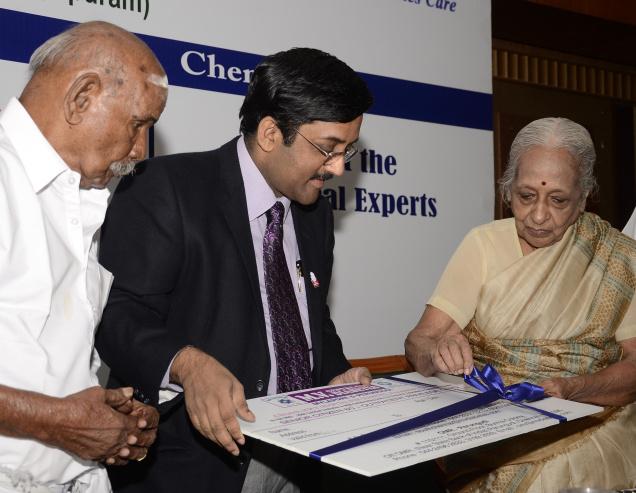
 A privilege: Dr. Shanta and Vijay Viswanathan, MD, M.V. Centre for Diabetes, handing over the Senior Citizen Outpatient Privilege Card to 99-year-old Ramasamy (left).  Photo: K.V. Srinivasan / The Hindu

Chennai:

“Lack of exercise, consumption of fast-food, obesity and sedentary lifestyle can lead to diabetes,” said V. Shantha, Chairperson, Cancer Institute.

Speaking at the launch of M.V. Centre for Diabetes, Senior Citizen Outpatient Privilege Card at M.V. Hospital for Diabetes, Royapuram, on June 16, she said that the number of people with diabetes in India was high when compared to other countries.

“The medical fraternity has moved from cure to control. Prevention should be given more importance in non-communicable diseases such as cancer, diabetes and cardio-vascular diseases.

“There is lack of medical care and medical insurance in non-communicable diseases. Care, cure and control should be the focus in non-communicable disease than treatment and management,” she said.

“Diabetes is more of a lifestyle disorder that can be attributed to modifiable risk factors such as lack of physical exercise, obesity and eating junk food.

Awareness and education on diabetes must be done on a large-scale, which should be a continuing programme,” Shanta pointed.

Adequate diabetic control and participation of family and physician is important in diabetic care and preventing health complications, she noted.

M.V. Hospital for Diabetes Managing Director, Dr. Vijay Vishwanathan, said that 4.6 million people died around the world in 2011 due to diabetes, of which 50 per cent of people were below the age of 60.

“India spends 31 billion on diabetic care. Around 60 million people in India are estimated to have diabetes. In India, diabetes patients have to spend money from their own pocket whereas in the United States of America, patients can avail themselves of health insurance policies,” he said.

The hospital launched the Privilege Card for senior citizens aged 80 and above in M.V. Centre for Diabetes, Mylapore and Perungudi, where it would provide a concession of 50 per cent.

The cynosure of all eyes was 99-year-old P.V. Ramasamy of Sivaganga district, who has been suffering from diabetes for the past 25 years. He said that diet control, daily exercise and regular intake of medicines have helped him to live a longer life. More than 20 people, who are 80 years and above and surviving with diabetes, were honoured on the occasion.

source: http://www.TheHindu.com / Home> Health / by T. S. Swaminathan / Chennai, June 24th, 2012

IIT professors to present innovation and incubation at IIT Madras

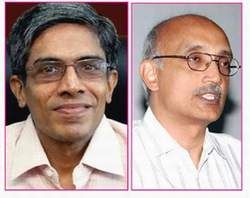
The IIT Madras delegation consisting of two-member team led by Director, Dr. Bhaskar Ramamurthi and Dr. Ram Nagarajan, Professor, Department of Chemical Engineering and the Faculty Advisor, Office of Alumni Affairs will be visiting Houston on June 18 and 19, 2012.

  Dr. Bhaskar Ramamurthi and Dr. Ram Nagarajan

The Team will be meeting with IIT Madras Alumni of North America (IITMAANA) and IIT Alumni of Greater Houston (IITAGH) members on June 18 evening to communicate “IITM Vision and Plans” to the alumni and solicit their input and support. This meeting will begin at 6:30 PM on Monday, June 18, at Mayuri Restaurant, 5857 Westheimer.

On June 19, at the luncheon meeting in collaboration with the Indo-American Chamber of Commerce of Greater Houston, Dr. Bhaskar Ramamurthi plans to address the business and entrepreneur community about the recent successes of IIT Madras innovation and incubation initiatives.

This gathering will take place at Narin’s Bombay Brasserie, 3115 West Loop South, Suite 110; (77027) on Tuesday June 19, from 11:00 AM to 1:00 PM.

Later in the afternoon, at the “Academic and Research Collaboration” session, the Team plans to communicate IITM academic collaboration initiatives with the Deans and Faculties of Rice University, University of Houston, University of Texas, and Texas A& M University and solicit their active participation.

The IITMAANA, established in 1980, is a US based non-profit alumni organization that serves the needs of IIT Madras and her alumni in North America region. The Houston Chapter is actively pursuing Prof. S. Sampath Endowment Chair Fund Raising, the first of its kind “to honor the Professors who have made profound impact on the students during their days at IITM and beyond in a sustainable way”.

The IITAGH, established in 2004, is a non-profit organization that was created to meet three goals: to promote professional growth of its members; to provide a social network for IIT alumni and their family members to swiftly assimilate into the Houston community, and to give back to the local community.

The team’s visit is locally coordinated by Mallik Putcha, and Dr. Subba Viswanathan, Founding President and Director respectively of IITMAANA, and supported by Witty Bindra, President of IITAGH

source: http://www.india-herald.com / India Herald

Gov. Perry Appoints Kannappan to Key Texas Board

        Sam Kannappan

AUSTIN, Texas, United States

Governor Rick Perry recently appointed Sockalingam “Sam” Kannappan of Houston to the  Texas Board of Professional Engineers Texas Board of Processional Engineers  for a term to expire Sept. 26, 2017.

The board licenses qualified engineers, enforces the Texas Engineering Practice Act and regulates the practice of professional engineering in Texas.

Kannappan is a professional engineer and senior design engineer for SNC-Lavalin Hydrocarbons and Chemicals. He is a member of the American Society of Mechanical Engineers, the Gas Pipeline Safety Research Committee, a board member of the Society of Piping Engineers and Designers, and an advisory board member of the Asia Society of Texas.

Born in Nattarasankottai in the Sivaganga district of Tamil Nadu, Kannappan is a past member of the Texas On-Site Wastewater Treatment Research Council. He received his bachelor’s degree from Annamalai University in India and a master’s degree in mechanical engineering from the University of Texas.

Kannappan is a prominent local Indian American community leader and one of the co-founders of the Sri Meenakshi Temple in Houston.

source: http://www.indiawest.com / Home> News> US Indian / by Staff  Reporter / June 15th, 2012

IIT Madras to tie up with Automation Industry Association to enhance research projects

Chennai:

The Indian Institute of Technology – Madras has planned to tie up with the Automation Industry Association to set up a centre of excellence in the field in Chennai. The collaboration will enable the institute to get industry inputs in developing curriculum, and come up with industry-relevant and need-based research projects.

A memorandum of understanding will be signed between IIT-M and the association on June 7 in this regard. Each participating company will bring a ‘mentor’ and a subject matter or domain expert. There will be joint development of curriculum, research projects, individual technology demonstrations, and training workshops under the MOU. The idea is to infuse contemporary technology and content into the educational system.

Industrial automation is the use of control systems such as computers to control industrial machinery and processes, replacing human operators. In the scope of industrialization, it is a step beyond mechanization. Whereas mechanization provides human operators with machinery to assist them with the physical requirements of work, automation greatly reduces the need for human sensory and mental requirements as well.

Leading players in the field of automation, such as B&R Automation, Larsen & Toubro Control and Automation, Invensys Process Management and Siemens Limited, have announced immediate participation in the project with their state-of-the-art technologies. PV Sivaram, MD, B&R Industrial Automation and an alumnus of IITM, said, “The challenge here is to share and excite a global industrial vision amongst the new breed of B.Tech and M.Tech graduates.”

K Nandakumar, vice-president of the association, AIA, said the tie-up is an opportunity to showcase success ideas and to interact with emerging technical talent and users.

source: http://www.timesofindia.indiatimes.com / Home> Education / by M Ramya / June 06th, 2012

A stimulating treatment for ailments

Coimbatore:

The ancient practice of treating patients for various ailments by activating the vital points in the body called Varmam Kalai is gaining ground in the state. This time around it is not only Siddha practitioners who seem keen on learning the therapy, but allopathic doctors too are open to practicing it along with their standard treatment procedures.

In the recently concluded first international conference on medical varmalogy organised by Arts Research Institute (ARI) in Coimbatore, more than 200 medical practitioners, most of them allopathy doctors, participated in it. “Doctors have not suddenly developed interest in Varmam Kalai. It has taken several years of research to make them believe that varmalogy can successfully coexist with allopathic treatment,” said Suresh Manoharan, secretary, ARI.

The word ‘varmam’ denotes energy flow in the body, also known as life energy. The points where this energy resides in the body are identified as varmam points. The basic objective of the varmam system of medicine is to stimulate these points using palms, fingers, etc., to cure diseases, he explained.

He said doctors who researched and practiced the art were able to successfully treat 27 diseases including arthritis, chronic renal failure, bleeding disorders, facial palsy, diabetes and asthma. Where allopathy treatment has failed, like in the treatment of autism, varmalogy theraphy has helped, he added.

Siddha practitioners have also shown keen interest as medical varmalogy is included in their scope of study. So far, 2000 of them have learned the art. Meanwhile, 250 ayurveda doctors have been trained in the art. Suresh said that nearly 3000 patients receive varmam treatment each month at the institute.

He said the power of varmalogy is such that a single varmam point can be utilized to treat as many as 42 diseases. Explaining how varmalogy works he said the disease or the problem occurs when an organ or a point loses its energy or has excess. By stimulating these energies those areas or organs can again be activated or revitalized.

The advantage of varmam kalai is it works well in conjunction with other systems of medicine, like allopathy, homeopathy, siddha and ayurveda and is a holistic system for disease prevention. Besides it promotes effective life-style management, he said.

Shiny Richard, a resident of Nilgiris, whose 15-year-old child Sneha Merlin was suffering from thyroid and autoimmune disorder, has seen a remarkable change in the past one year after she underwent Varmalogy therapy. “Initially, my daughter had fever and it failed to subside despite several doses of medication. The overdose of medicines and steroids made her very uncomfortable. However, once she started varma therapy she does not require any medication and her dosage of steroids too has been reduced,” Shiny said.

“They have been stimulating points on my neck, thyroid gland, knee, ribcage, head, elbows and foot. I am feeling much better now,” said Sneha.

source: http://www.timesofindia.indiatimes.com / Home> City> Coimbatore / TNN / by C P Sajit / June 02nd, 2012

Ex-Army doctor, going strong at 95

Chennai:

A board outside an apartment building in Adyar announces free counselling for cancer patients. Inside the comfortably furnished room, Brigadier Dr C R Suryanarayan sits, ready to receive anyone who might need help.

Dr Suryanarayan was one of the pioneers of radiation treatment in India, having started the first Radiation Medicine Centre in the Military Hospital at Delhi in 1957, as Chief Medical Officer. For his contribution to the field of chemotherapy in cancer treatment, he was recently given a lifetime achievement award by the Tamil Nadu Dr MGR Medical University. He has spent the last few years travelling around the world, delivering lectures on a wide range of topics. Closer home, he provides free counselling for those suffering from cancer. His interest in the field of cancer treatment probably stems from the fact that he is the nephew of Muthulakshmi Reddy, founder of the Cancer institute.

At 95 the doctor is a sprightly person who keeps up to date with the latest technology. Turning on his laptop, he says, “When I started out, we had no conveniences like computers. Everything was handwritten and recorded meticulously.” He now has scanned copies of his correspondence with stalwarts in many fields including Annie Besant, Otto Werberger and Sir Bernard Russell, all of which he holds close to his heart. “I was a junior researcher, but they still found time and were kind enough to read my work and write to me,” he says with a smile.

An alumnus of Presidency College (1935-1937) and Madras Medical College (1937-1942), he did his postgraduate training in radiation medicine, nuclear medicine and cancer chemotherapy in the United Kingdom. He was honorary consultant in nuclear medicine, cancer chemotherapy at the Southern Railway Hospital in Perambur, Chennai. Dr Suryanarayan talks about his experience in the wars he served in – World War II, Middle East, Indo-Pak, Indo-China and Bangladesh wars. “In 1943, at short notice I was asked to report to Colaba at Mumbai. We boarded the Ascanis, which was sailing to an undisclosed location. It turned out to be Basra. On the way we were chased by German submarines but managed to make it,” he says.

Recounting his experience of treating people for viral ulcers and conducting de-lousing camps for immigrants, the doctor says, “We went to Cancun, Mosul, Syria, Jordan, Tel-Aviv and Tehran; each place had its own charm and beauty in spite of the war. The oases waters were too precious to dirty so we used to wash our faces with beer.”

In 1946 he was back to India, and posted at Ayodhya to deal with a cholera epidemic. Alone and in charge of treating hundreds of people of different faiths, the doctor says the first thing he wanted there was harmony. “I set up pictures of all the gods in a small hall where the sick were gathered and I asked them to pray. That was the day I found that such unity could exist between people of varied beliefs,” he says.

Dr Suryanarayan has also undergone paratrooper training. “I did not like it very much,” he confides, adding that he never did jump out of a plane after his training was over. He still leads an active life and says, “Even now I am ready to speak to any group of students. They need to be well informed about the world.”

source: http://www.ibnlive.in.com /  Home> South> Southern News> Chennai / by Susanna Myrtle Lazarus / The New Indian Express / May 29th, 2012

Lighting up the lives of those in need

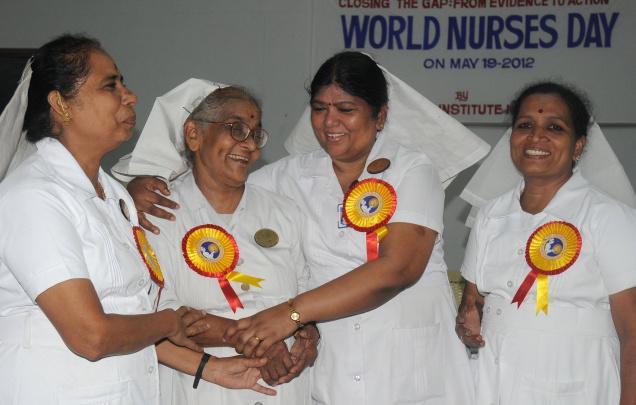
Dedicated to serving On International Nurse’s Day, several nurses were presented with lifetime achievement awards — Photo: R. Ragu / The Hindu

C.N. Janaki, in her nurse’s uniform and starched white cap that keeps wispy white hair neatly in place, has a quick smile that forms deep dimples in her cheeks. The matron is 70 years old and has 49 years of experience as a nurse at the Cancer Institute in Adyar.

NO REGRETS

Ms. Janaki lost her parents when she was 11, and her brother sent her to Avvai Home, a residential facility for orphans in Adyar. In 1964, after training as a nurse, she joined the Cancer Institute and has never looked back.

She barely recognises cancer as a dreaded disease. Unlike in the older days, thing are different now, she says. Ms. Janaki has remained single, devoted to her work. And what has she learnt from her experience? “That I have come this far is an achievement. I have done well in life. As for work, in the early years it was difficult. Now so many new techniques have come to make our job easy,” she said.

ACCOLADES RECEIVED


Ms. Janaki was one of the nurses in the State, chosen by the Tamil Nadu Dr. MGR Medical University, for this year’s lifetime achievement award, presented on International Nurse’s Day, which fell on May 12.

V. Renuka Devi, 54, also a recipient of the award graduated as a nurse from the Madras Medical College and has around 34 years of experience. Her daughter is in college and her husband is a lawyer practising in the Madras High Court. She enjoys her work at the hospital. “I have seen a lot of children come for treatment. What hurts me most is when I hear that someone has died despite treatment,” she says. It is difficult for her to hear of a child’s death. “When patients are treated and then they die, I am very upset,” she said.

Jeeva’s persona would put any patient at ease. An able leader, she organises International Nurse’s Day programmes at the institute.

‘MAKE A COMMITMENT’

According to Dr. V. Shanta, chairman, Cancer Institute, it was Ms. Jeeva who introduced the concept at the institute two years ago. On Saturday, she paid tributes to the nurses and urged them to rededicate themselves and to “make a commitment to do the job well”.

Jeeva travelled and worked abroad before she chose to come to the Cancer Institute. Her rich experience has helped her develop professionally, she said.

Perhaps the best motivation comes from forgotten achievements. T.G. Sagar, director of the Institute, recalled that it was a nurse in the early twentieth century, Mary Joseph, who first identified a malignant nodule, which later came to be known the Sister Mary Joseph nodule after her.

source: http://www.TheHindu.com / Home> News> Cities> Chennai / by R. Sujatha / Chennai, May 20th, 2012

IICPT urges industry to look at high pressure processing for food safety

Indian Institute of Crop Processing Technology (IICPT), Thanjavur, is now calling for the need to look at high pressure processing for food safety.

Food safety is the responsibility of the growers, manufacturers and processors and food handlers. The supply to consumers is in different forms such as fresh, preserved and processed products of plant, animal and marine origin.

During the past two decades, numerous researches on food preservation using emerging technologies have been developed. Since these processing techniques have little or no new thermal effects on food, they are commonly referred to as non-thermal preservation technologies. Among these emerging technologies, the most promising ones for food application are high-pressure processing and use of pulsed electric fields. Although the fact that high pressure kills microorganisms and preserved food in the early 19th century, its commercial benefit became available to the food processing industry in a decade ago, stated officials at IICPT.

The concept of high pressure treatment of foods involves subjecting food materials to pressures as high as 9,000 times the atmospheric pressure. It is uniformly applied throughout a food material independent of its mass and time, they added.

Typically, the pressurisation time for foods is independent of the quality of food placed in the pressure vessel, The presence of air in the food increases the pressurisation time, since air is more compressible than water.

According to IICPT, in contrast to the thermal treatment, high pressure processing does not break the ‘covalent bonds’ in food, and thus helps to preserve the flavour. The effect of high pressure on enzymes is largely due to the nature of the proteins.

In fact, the first commercial production of high pressure processed jam was carried out in Japan in 1992, which was well received by consumers. Since then a diverse range of foods, including fruit juices, vegetables, milk, yoghurt, cheese, fish, pork, beef, ice cream, Japanese unrefined rice wine and rice cakes containing herbs are processed using this technology, stated IICPT.

The non-availability of suitable equipment burdened early application of high pressure. There has also been considerable progress made in equipment design which has ensured global recognition of the potential for such technology in food processing. Moreover, high pressure technology can supplement conventional thermal processing for reducing microbial load or substitute the use of chemical preservatives. The advantage of high pressure technology includes that it enables, food processing at ambient temperature or even lower temperature. Causes of microbial death leads to improvements in overall quality of foods and it can be used to create ingredients with novel functional properties.

The food technologists globally recommend high pressure processing to prevent hazardous micro-organisms like E Coli, Salmonella and Vibrio. Presently the food industry is interested in eliminating the harmful organisms.

IICT officials’ said that High pressure processing was not likely to replace traditional methods. However, they observed that high capital expenditure could limit the application initially but this could be offset by lowering the cost expenses of lower operating costs if efficient energy systems were used.

source: http://www.fnbnews.com / Home> Top News / by Nandita Vijay, Bengaluru / Saturday, May 19th, 2012