Category Archives: Science & Technologies

Dam maker could bat and bowl too

The first we heard of his name was when as students we played inter-collegiate cricket in Chennai. The competition that pitted colleges from all over the state was always played for the Pennycuick trophy. As a PUC student of Loyola College I was a member of the team that won the trophy in 1968. Our trip to Coimbatore to play the final was the highlight of college life then. The name itself did not drop a penny until we learnt the reason why the trophy was named after him was because the Colonel in the Royal Engineers himself had instituted the cup long before leaving for home after a long stay in India. It was later, as members of the historical Madras Cricket Club, were we to learn of the association of a very competent cricketer in the making of a great dam across the Periyar River at considerable personal risk and expense.

As one of the early secretaries of MCC, the Colonel had been instrumental in moving the club from its original location on The Island between Mount Road and Beach Road to its present home in Chepauk on land that originally belonged to the Nawab of Carnatic. This was in 1865 and the ground has remained virtually the same save for a concrete stadium built in the late ’60s that was later to be replaced in part by modern stands.

The Colonel was also heading the Public Works department in Madras in 1890 when a cyclone damaged the ancient clubhouse and he was generous in sanctioning the funds for repair work. A princely Rs 10,000 was the grant then and the club spent it lovingly on a new clubhouse that was in red brick to be in consonance with much of the Indo-Saracenic architecture that distinguishes the city.

Historians record that the Colonel was a decent batsman, often opening the innings and also bowled (underarm?) well enough to have actually picked up nine wickets in the first Madras-Bangalore Test match in 1862. He also represented Madras against Ceylon in 1886. The MCC placed on record his services to the club in 1896 when he retired from the game — “For over thirty years this gentleman has been associated with and has encouraged Cricket in the Madras Presidency, while his services to the Club, both as an official and in the field (he was a fine underarm bowler), will long be remembered.” He reciprocated with that first cricket trophy to be competed for by Indians in the Madras Presidency. No wonder a commentator described it as “his last, lasting and most important contribution to Madras Cricket.”

His work as an irrigation engineer may have gone on to far outstrip his cricketing talent. His masterstroke at engineering a dam to bring its wet-flowing water through a tunnel back to parched lands in Tamil Nadu (Madras Presidency then) is something he will be remembered for long even though his name now gets posthumously into controversies as two states wrangle over the state and status of the dam he built against all odds.

source: http://www.DeccanChronicle.com / Home> Channels> Cities> Chennai / DC, Chennai / January 09th, 2012
Meet on computer communication

Coimbatore, Jan. 4: 

Sri Sakthi Institute of Engineering and Technology is organising the second International Conference on Computer Communication and Informatics (ICCCI 2012) between January 10 and 12.

About 150 scientists, research scholars, professors and teachers from universities across the world would be presenting their research work in the areas of computer engineering, IT, electrical and electronics engineering and communication engineering, states a release from the institute.

Dr A. Sivadhanu Pillai, Scientist – DRDO, CEO and Managing Director, BrahMos Aerospace is slated to deliver the inaugural address, while the former Vice-Chancellor, Anna University and Chairman, National Design and Research Forum, Bangalore, Dr R. M. Vasagam, is to deliver the key note address.

The Vice-Chancellor of Amrita Vishwa Vidyapeetham University, Dr P. Venkat Rangan, is to deliver the inaugural address.

source: http://www.TheHinduBusinessLine.com / Industry & Economy> Info-Tech / Our Bureau / January 04th, 2012

Indian-origin scientist & Nobel Prize winner Venkatraman Ramakrishnan to be honoured with knighthood

LONDON:  Indian-origin scientist Venkatraman Ramakrishnan, a winner of the 2009 Nobel Prize for chemistry, will be honoured with knighthood in 2012.

Venkatraman works as a biologist at the Medical Research Council’s Molecular Biology Laboratories in Cambridge, BBC reported.

Born in 1952 in Chidambaram in India’s Tamil Nadu state, Venkatraman was awarded the Nobel Prize in 2009 along with two other scientists “for studies of the structure and function of the ribosome”, according to the Nobel Prize website.

The ribosome — the cell’s protein factory — translates genetic code into proteins, which are the building blocks of all living organisms.

Experts said the India-born scientist’s work solved an important part of the problem posed by Francis Crick and James Watson when they discovered the now-iconic double helix DNA structure as to “how does the code become a living thing”.

source: http://www.articles.economictimes.indiatimes.com / Home> Collections / News> News by Industry / IANS/ December 31st, 2011

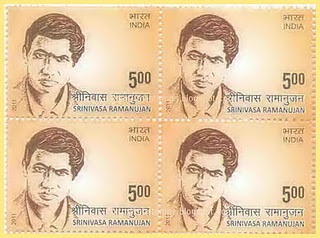
India Post Released Srinivasa Ramanujam Stamp on 26.12.2011

India Post released New stamp for Srinivasa Ramanujam in his 125th birth anniversary. Stamp Released by our honorable Prime Minister Dr. Manmohan Singh in Chennai also declared December 22, the birthday of Ramanujan, as ‘National Mathematics Day.’
Srinivasa Iyengar Ramanujan ( 22 December 1887 – 26 April 1920 ) was an Indian mathematician, Born in Erode, Tamil Nadu, India, to a poor Brahmin family, Ramanujan first encountered formal mathematics at age10. He demonstrated a natural ability, and was given books on advanced trigonometry written by S. L. Loney. He mastered them by age 12, and even discovered theorems of his own, including independently re-discovering Euler’s identity. He demonstrated unusual mathematical skills at school, winning accolades and awards. By 17, Ramanujan conducted his own mathematical research on Bernoulli numbers and the Euler–Mascheroni constant. He received a scholarship to study at Government College in Kumbakonam, but lost it when he failed his non-mathematical coursework.
He joined another college to pursue independent mathematical research, working as a clerk in the Accountant-General’s office at the Madras Port Trust Office to support himself. In 1912–1913, he sent samples of his theorems to three academics at the University of Cambridge. Only Hardy recognised the brilliance of his work, subsequently inviting Ramanujan to visit and work with him at Cambridge. He became a Fellow of the Royal Society and a Fellow of Trinity College, Cambridge, dying of illness, malnutrition and possibly liver infection in 1920 at the age of 32.
During his short lifetime, Ramanujan independently compiled nearly 3900 results (mostly identities and equations).Although a small number of these results were actually false and some were already known, most of his claims have now been proven correct. He stated results that were both original and highly unconventional, such as the Ramanujan prime and the Ramanujan theta function, and these have inspired a vast amount of further research. However, the mathematical mainstream has been rather slow in absorbing some of his major discoveries.
The Ramanujan Journal, an international publication, was launched to publish work in all areas of mathematics influenced by his work.
source: http://www.sapost.blogspot.com / December 26th, 2011

Habitat Forum Berlin, Anna University architecture contest for MRTS Light House station

Whether or not the Southern Railway and the Tamil Nadu Government (through the CMDA) care to make the best use of the MRTS system, there is great interest in it elsewhere.

The Habitat Forum Berlin, School of Architecture and Planning, Anna University and City Connect, an NGO in Chennai have jointly announced a contest for architecture students to submit ideas for the Light House Station on the MRTS.

This neglected station suffers from poor maintenance, although it is close to several educational instutions, the Marina Beach, and shopping malls such as Chennai City Centre. What is more, it is ideal transit point as it is cheek-by-jowl with Dr. RK Salai. MTC in fact operated some services via this station to achieve inter-modal connectivity when the system was extended to Velachery, but quickly discontinued them.

It would be interesting to see how architects view the problem, and what their ideas are.

source: http://www.straphanger.wordpress.com / December 13th, 2011