Category Archives: Science & Technologies

India gets DNA diagnostic centre

With male infertility reportedly reaching an alarming high of 50 per cent in Coimbatore, a centre in the city is offering a first-of-its-kind procedure that can ascertain damage to DNA strands in about 5,000 sperm cells at the rate of 200 per second.

Set up in collaboration with SCSA (Sperm Chromatin Structure Assay) Diagnostics, US, Women’s Centre will accept semen samples from across the country to diagnose DNA fragmentation, considered the most important aspect of male infertility.

Explaining the partnership, Dr Donald Evenson, inventor of the technique, said Women’s Centre was the only centre outside US and Europe with rights to offer the diagnostic device, considered a solution for couples unable to conceive.

Dr Mirudhubashini Govindarajan, clinical director of the centre, said damage to DNA that lowered sperm count or hindered sperm movement could be due to lifestyle-related factors.

She said stress at workplace and handling chemicals, pesticides in agricultural belts were some of the causes.

People in the jewellery industry who handle heavy metals such as cadmium and traffic police exposed to too much heat were increasingly experiencing the problem of infertility, Dr Govindarajan said.

She said semen analysis technology in India was inadequate and women underwent a series of tests but often never conceived despite normal results.

She said Women’s Centre would tie up with IVF labs to share the method of sending semen samples for DNA fragmentation diagnoses

source: http://www.DeccanChronicle.com / Home> Channels> Cities> Regions> Coimbatore / by Vidyashree Charmaraj / DC, Coimbatore / Saturday, March 17th, 2012
Ponni Sugars to commission 19 MW plant soon

Chennai, MARCH 10:

Ponni Sugars (Erode) Ltd is set to commission its 19-MW co-generation plant by the month end.

This will be a significant development for the company in terms of revenue generation and potential growth to the top line.

Mr N. Ramanathan, Managing Director, Ponni Sugars, told Business Line that the project is being completed on schedule and well within the estimated project cost of Rs 102 crore.

The costs have been contained despite increase in the base rate, he said.

Initially, the cogeneration plant will operate at 15 MW which will help generate a surplus of about 11 MW that will be supplied to the State grid.

At full capacity, the surplus supplied to the grid will increase to about 14 MW. This will mean an additional revenue of about Rs 45 crore a year for the company at the current tariff level of Rs 4.47 a unit.

Ponni Sugars has tied up for a bank loan of Rs 65 crore and a loan under the Sugar Development Fund for about Rs 25 crore. The balance is through internal accruals.

The current sugar season has been a good year for Ponni Sugars, with sugarcane arrivals set to grow significantly over that of last year and sugar recoveries also increasing.

During 2010-11, the company crushed about 6.3 lakh tonnes (lt) of sugar and in the current year this is expected to increase by about one lt. This, along with the 50-basis-point increase in sugar recovery observed so far in the current season, augurs well for the company, he said.

rbalaji@thehindu.co.in

source: http://www.TheHinduBusinessLine.com / Companies / by R Balaji / March 10th, 2012

BrahMos Aerospace ropes in NIT-Tiruchi for R&D news

Indo-Russian joint venture BrahMos Aerospace has tied up research with plans to take up collaborative research work with the National Institute of Technology (NIT) at Thiruchirapally in Tamil Nadu as part of its programme of participative research with educational institutions for development of hypersonic version of Brahmos missiles.

BrahMos is initiating research collaboration with a number of academic and industrial institutions across the country for development of robotics, sensitive materials etc required for hypersonic missiles, its CEO and MD Dr Sivathanu Pillai said.

He was addressing a gathering at the eighth edition of ‘Pragyan-2012’, the annual techno-management festival at the National Institute of Technology-Trichy.

The Pragyan fest has, meanwhile, received the ISO 9001 (2008 edition) certification for conducting seven memorable editions, giving it the stature of an international festival, last year. Pragyan is now among the top five student technical festivals in the country.

BrahMos is in the process of venturing into development, design and production of hypersonic missiles, which can travel at seven to eight times the speed of sound (7-8 Mach), Shivatanu Pillai said.

He said BrahMos is on the look out for new materials that could withstand high speed and heavy vibration in the development of hypersonic missiles.

NIT-T, which has courses in disciplines like robotics, material management, metallurgy, was among the institutions being roped in for the collaboration, Pillai, who made a presentation at Pragyan, the annual Techno-Management festival of the institute, said.

NIT- Trichy director Dr Srinivasan Sundararajan said discussions with BrahMos had already been initiated and the collaboration agreement would be finalized soon.

source: http://www.domain-b.com / Defence> Arms & Munitions / February 25th, 2012

Restore India’s math glory: AP governor

Thangavur:

Andhra Pradesh governor, ESL Narasimhan, on Friday called for restoring India’s mathematical glory by deriving inspiration from legendary mathematician Srinivasa Ramanujan.

Addressing a gathering at the national conference on Vedas – the treasure house of mathematics, at the SASTRA University in Thanjavur, Narasimhan said, “It is high time we sketch an action plan for renaissance. The intelligentsia should remember that we are the heirs of the infinite mathematical wealth left behind by our ancestors.”

Admiring Ramanujan, he said despite living only for 33 years, he rose to the level of Fellow of Royal Society (FRS), Cambridge, in 1918. Had he lived for some more years, he would have won the highest order of awards such as the Nobel for the country.

Narasimhan reiterated that the Vedas were the treasure-house of knowledge and this was an established fact. While jyotisha (astrology) was needed to find out Vedic rituals, jyotisha also required knowledge of Ganita (mathematics) that occupied the top most position among the Indian sciences. Jyotisha was a science based on movements of planetary bodies. A study of it was possible when the scale of time and direction were applied. The application of time, direction and distance involved mathematical calculations.

Thus either astrology or astronomy could not survive without mathematics while the science of Vedanta was the back-bone of all Vedangas.”Like the crest of a peacock and the shining gem on the hood of the cobra, Ganita is the supreme of the Vedangasastras,” he said.

Referring to ancient Indian scientists such as Lagadha, Aryabhatta and Brahmagupta, he said they measured time and distance. The measurement of time started with Nimesa and ended with Brahma Kalpa. But Nimesa was wrongly translated as minute. “The Indian Nimesa is just the time taken to close or open the eyelid. It’s not the duration of 60 seconds.”

At the conclusion of his speech, he suggested a few points to restore the glory of mathematics, saying Vedic mathematics should be introduced in Vedapathasalas from 5th standard onwards, universities should think of introducing Vedic mathematics at the postgraduate level and that special incentives may be offered to scholars pursuing research in Vedic maths.

Narasimhan appealed to the audience to come forward to save the country from the deficit of mathematical knowledge and the scarcity of mathematicians. Besides, he urged everyone to learn Sanskrit, which was the gateway to understanding ancient Indian wisdom.

source: http://www.articles.timesofindia.indiatimes.com / City> Madurai / Home> Collections> Vedas / TNN/ February 18th, 2012

Dyers submit fresh proposals for achieving zero liquid discharge

They plan to try out nano-filtration, multi-effect evaporation techniques

A year after the Madras High Court directed the closure of over 720 dyeing units in Tirupur, the dyers have submitted fresh proposals with the promise of improved technology for achieving zero liquid discharge to be functional again.

“The closed dyeing units have submitted proposals for achieving zero discharge with new and proven techniques. Once all the proposals are in, the papers will be verified with assistance from professors of Indian Institute of Technology-Madras and Anna University-Chennai, over the next few months,” said an official at the Tamil Nadu Pollution Control Board (TNPCB).

If the proposals are found convincing, the dyeing units would be asked to submit a detailed project report and then allowed to operate in a phased manner, initially at 30 per cent of capacity and then at 50 per cent, to monitor if the zero liquid discharge as ordered by the High Court was adhered to, the official said. According to industry sources, the dyers had already invested Rs.800 crore on treating waste water and were paying huge sums as interest but could not achieve zero discharge. The new proposals are based on the governments’ grant of Rs.200 crore for the dyers, official sources said.

TNPCB officials in the know said the common effluent treatment plants (CETPS), to which over 500 dyeing units were linked, were able to treat 85 per cent of waste water but were struggling for want of technology to achieve zero liquid discharge.

“Now, the plan is to try out nano-filtration and multi-effect evaporation to achieve zero liquid discharge in three CETPs,” said a senior TNPCB official.

According to a Central Pollution Control Board (CPCB) report on waste water treatment, nano-filtration could be positioned between reverse osmosis (RO) and ultra-filtration. Nano-filtration can be operated on lower pressure than reverse osmosis and as such treatment cost is lower than for RO. For zero discharge, Tirupur dyeing industry has to look at a multi-effect evaporator instead of the mechanical vapour recompression used earlier, the official said.

In fact, the CPCB had specifically suggested nano-filtration and multi-effect evaporator as technologies to achieve zero discharge in Tirupur dyeing industry way back in 2005. However, the dyers refused to embrace the technology but came up with a marine discharge proposal. “We have rejected the marine discharge proposal asking the dyers to look at technological options to be functional again,” said a senior official.

Before the High Court order, the Noyyal river and ground water survey in Tirupur showed that the TDS (Totally Dissolved Solid) had grossly contaminated the water with levels ranging above 5,000 mg/l (milligram per litre) as against the standard 2,100 mg/l which was a gross violation of norms.

The TNPCB, after a study visit to dyeing units in Gujarat, has suggested nano-filtration membranes.

source: http://www.TheHindu.com / News> States> TamilNadu / by Special Correspondent / Chennai, February 13th, 2012

Technology demonstration centre planned

The Tamil Nadu Pollution Control Board (TNPCB) will work with research institutions such as Indian Institute of Technology, Madras, and Anna University to set up a technology demonstration centre at Rs.5 crore in the city, said B.V. Ramanaa, Minister for Environment.

Inaugurating a workshop on ‘Onshore petroleum spills’ at IIT-M on Tuesday, he said the advance in technology and rapid industrialisation in the State has resulted in increased effluent discharge and air pollution causing environmental challenges to the industries and monitoring agencies.

Elaborating further, C.V. Sankar, principal secretary, Environment and Forests, told reporters that new industries were being formed unlike earlier days when it was mostly water and air pollution for which there were laws for prevention.

The objective of the demonstration centre was to take the help of academic institutions and research institutions like IIT-M, Central Leather Research Institute (CLR) and Anna University who were involved in collaborative research with national and international institutions. The industries certainly know, say for instance, like how to achieve zero liquid discharge in dyeing units. The research institutions could contribute with their knowledge of latest technological processes, be it chemical or biological, and explain to industries ways of preventing pollution, Mr. Sankar said.

Recently, CLRI developed a technology to reduce salt usage in tanneries.

The process is mostly done manually and research could help the industry reduce salt at the same time preserve rawhide, he said adding that a suitable location was being identified in the city for the centre. IIT-M director Bhaskar Ramamurthi said it could not purely be a demonstration centre but should have research components.

source: http://www.TheHindu.com / News>  States> TamilNadu / by Special Correspondent / Chennai, February 08th, 2012

“Creating talent pool to develop specialised apps a big challenge”

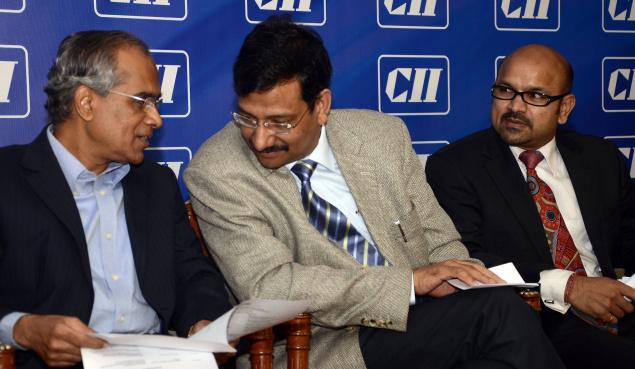
New wave: (From left) Cognizant Technology Solutions vice-chairman N. Lakshmi Narayanan, Polaris Financial Technology founder, chairman and CEO Arun Jain and Mobile Conference chairman Anand P. Surana in Chennai on Thursday. Photo: K.V. Srinivasan / The Hinu

In future, the gold rush will be in developing applications for non-PC based devices, as smart phone devices have overtaken personal computers and laptops, said N. Lakshmi Narayanan, vice-chairman, Cognizant Technology Solutions, on Thursday.

Delivering the special address at ‘Mobile conference 2012′, organised by the Confederation of Indian Industry (CII), he said that as the future would be driven predominantly by younger people under 35 years of age, the biggest challenge for business organisation was to create the talent pool that could develop specialised and focussed applications (apps) keeping in mind the consumer preferences.

Mentioning that the new world required a new thinking as consumers opted for smart phones and not personal computers and laptops, he said the future of working, worker, workplace and communication would be driven predominantly by non-PC devices. However, enough people were not available to create the apps.

Urging youngsters to develop new apps in different languages, he said that the largest selling business apps were in markets such as Brazil, China and Japan. India offered fantastic opportunity for developing apps in different languages.

Arun Jain, founder, chairman and CEO, Polaris Financial Technology, stressed the need for companies to get into design thinking to emulate the phenomenal success of Apple through its iPods and iPads.

“Design thinking is different from designing products or management. It is about designing the entire eco-system. From that perspective, Aravind Eye Care can be thought of an apt example of design thinking that created an entire eco-system of eye care using innovative public, private and local community partnerships.”

In his welcome speech, S. Sridharan, Convenor, IT, ITeS & Electronics Panel, CII-Chennai Zone, said as compared to its predecessors, the new wave of technologies such as cloud computing, mobile applications and social media were cost effective that could enable small players to access best systems and business practices to fight against large companies.

Anand P. Surana, chairman, Mobile Conference 2012, said that in just two years mobile-ready sites had grown from 1.50 lakh to 30 lakh. About 10.9 billion applications were downloaded in 2010 and the number was estimated to reach over 76 billion in 2014. Consumers spent $6.2 billion on apps last year and studies predict that it would grow to $35 billion by 2014.

source: http://www.TheHindu.com / News> Cities> Chennai / by Special Correspondent / Chennai, February 03rd, 2012

Kalam asks experts in medicine to develop new technology

Former President inaugurates laser surgery machine at Maxivision Eye Care

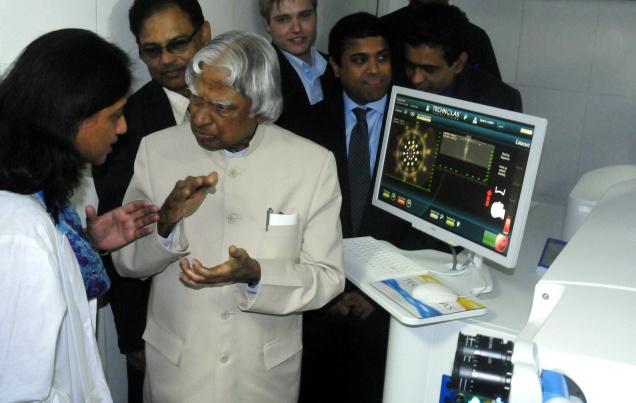
A. P. J. Abdul Kalam , the former President of India inagurating the VICTUS Femtosecond Laser Cataract Surgery Machine installed at the Maxivision in Hyderabad on Tuesday.Photo: K. Ramesh Babu / The Hindu

Former President of India, Dr. A. P. J. Abdul Kalam said here on Tuesday that the country’s best talent in the field of medicine should strive to develop innovative technology so that the needy could afford the fruits of modern medicine. On Tuesday, Dr. Kalam inaugurated VICTUS Femtosecond Laser Cataract Surgery machine at Maxivision Eye Care, Somajiguda.

“I call upon the Maxivision eye surgeons to form a team of experts who can explore the multidimensional uses of Femtosecond laser in treating various eye ailments. We need to utilise the technology and help people who can’t afford modern medical care,” Dr. Kalam said.

The former President said that the multiple applications of the Femtosecond laser would help doctors treat a host of eye ailments.

Immediately after the inauguration, the renowned nuclear scientist also interacted with the eye surgeons of Maxivision and enquired about the newly acquired laser surgery machine.

The officials of Maxivision said that the new machine had been under test from November 2010.

Already, the eye surgeons had completed close to 450 eye surgeries by using the new laser machine. The surgeons pointed out that not a single case had reported complications after the surgery.

The VICTUS platform, essentially, helped doctors conduct cataract, refractive and therapeutic procedures of the eye on a single platform. The laser machine would help surgeons perform computer controlled precise, accurate and reproducible incisions compared to current manual procedures. The success rate for such surgery was 100 per cent, doctors added.

“This is the first such laser machine in the World and I would like to congratulate Maxivision for this accomplishment,” founder and chairman of GVK, G. V. K. Reddy said.

Chairman of L.V. Prasad Eye Institute, Dr. G. N. Rao, Founder of Maxivision Eye Hospitals, Dr. Kasu Prasad Reddy, Film Producer D. Ramanaidu and several other doctors were present.

source: http://www.TheHindu.com / News> Cities> Hyderabad / by Staff Reporter/ February 01st, 2012

TNEB asks Anna University to study unmetered power connections

Chennai:

The Tamil Nadu Electricity Board (TNEB) has asked Anna University to conduct a pilot study of unmetered connections in farms and slums in an effort to reduce transmission and distribution losses.

TNEB officials said there are approximately 13 lakh hut connections and 19.8 lakh agricultural connections, which get free power supply. The study will help TNEB understand the consumption pattern of agriculture and hut consumers and keep tabs on distribution losses.

The university has started the study and is expected to complete it within a year. Four members of the electrical engineering department are involved in the study.

The agriculture sector consumes 14,000 million units of the 70,000 million units distributed by the board. “This is just a rough calculation. We supply free power to hut dwellers and farmers, but we cannot meter the use due to political compulsions,” said a senior TNEB official.

As metering of connections is essential to understand supply and consumption, TNEB commissioned the study. “It will be a scientific study. TNEB has provided us all the details. Now we are analyzing them to find out of consumption pattern. If necessary we will make field visits,” said a faculty at the university’s electrical department.

The study was undertaken as TNEB got reports about agricultural connections being misused. “Some farmers allow water dealers to use their connections to run pumps and draw water from wells. This is common in the western region of Tamil Nadu, including Coimbatore. Every year we detect 300 cases. During 2009-10, 329 such cases were detected and in the year before, 317,” said an official.

“Politicians do not want to meter the agriculture connections fearing the vote bank. But it is essential to curb power theft in the sector and such a study is the only way we can understand the consumption pattern,” said the official.

A recent study by Citizen Consumer and Civic Action Group said the biggest problem facing the debt-ridden TNEB is the lack of metering of over 20 lakh farm power connections. It said TNEB routinely puts transmission losses at 18%, but that figure is not scientific, and the total annual losses are 30% to 32%, which includes farm power.

source: http://www.articles.timesofindia.indiatimes.com/ City> Chennai /TNN/ by  Vivek Narayan / January 23rd, 2012

Anna University-BCT Kalam centre to enhance professional skills

By A Staff Reporter – MUSCAT:

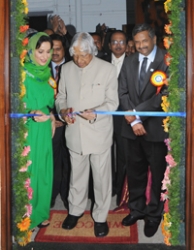
The Anna University and Bahwan CyberTek Kalam Centre of Excellence set up by Bahwan CyberTek in collaboration with the Ramanujan Computing Centre (RCC), Anna University, was inaugurated by the former President of India, Dr A P J Abdul Kalam in the university’s Chennai campus yesterday.
Also present at the inauguration were Hind Bahwan, Chairperson, Bahwan CyberTek Group, Durgaprasad, Director and CEO Bahwan CyberTek Group, Mannar Jawahar, Vice-chancellor of Anna University and Rhymend Uthariaraj, Director of RCC.
Bahwan CyberTek has set up the 40-seat state-of-the-art Centre of Excellence (CoE) with Bahwan CyberTek’s Cuecent BPMS Software Suite. Through the COE, Bahwan CyberTek will provide an opportunity to enhance the professional skills of the students and faculty of Anna University in BPM, SOA and emerging technologies. Bahwan CyberTek will also provide project sponsorships, research options and paper publications support to the students and faculty of the University.
Kalam at the launch set the vision for the joint AU-BCT Kalam Centre of Excellence initiative to research the convergence of Bio, Nano, IT and Ecology to build sustainable innovation and leadership in institutions to emerge out of India that will have a global impact.
Hind Suhail Bahwan, Chairperson, Bahwan CyberTek Group said “With innovation being the corporate philosophy, and with our strong commitment to contribute to the society we operate in, we have set up this CoE to serve the students and faculty of this esteemed university and also be a platform for ongoing innovations in IT.”
S Durgaprasad, Director and CEO, Bahwan CyberTek Group said “My association with my alma mater is a special one and I firmly believe that this coming together of the Industry and the Academia marks a true collaboration and commitment to bring about far-reaching technological innovations.”
Prof P Mannar Jawahar, Vice Chancellor – Anna University, said “The CoE that has been established at RCC is a world-class, shared-use educational and R&D facility serving the student and industry community.
“Bahwan CyberTek will conduct certification courses and aid in providing projects and consulting work for the faculty and students of Anna University. This collaboration holds tremendous potential for innovation and offers far-reaching benefits for students. The technologies formed by the partnership of RCC-AU and Bahwan CyberTek not only will enable and enhance further technology development and research, it will positively impact the knowledge of students of Anna University”.
Ramanujan Computing Centre (RCC) located in Anna University (AU), Chennai, is functioning as a technology provider to students, researchers and teaching community to fulfil their computational, technological and Internet requirements. The centre is truly state-of-art with the sophisticated Wi-Fi connectivity, Video Streaming Server to render Video Conference/Video-on-demand facility.
Bahwan CyberTek, established in 1999, is a global IT provider of innovative software products and services.

source: http://www.main.omanobserver. om / Oman Daily Observer / Sunday, January 15th, 2012