Category Archives: Uncategorized

Every home should have a library: Kalam

Bangalore :

Former President APJ  Abdul Kalam on Sunday asked parents to have a small library at home to encourage their children to read books.

“Every home should have a small library with a minimum of 10 books to inculcate the reading habit in children,” Kalam said at a function to mark the sesquicentennial (150 years) of Bishop Cotton Boys’ School here.

Citing the importance of education, he said parents should take sincere steps to increase the collection of books every now and then. “And they should make their wards refer to the books at least an hour a day,” he added.

Paying a tribute to his science teacher Siva Subramaniam Iyer, Kalam said he was inspired by him to become a rocket scientist. “When we were in Class 5, he took us to Rameswaram beach to show students the birds’ flying pattern. He also had a model aircraft to show us the similarity. This eventually inspired me to become a rocket scientist,” he added

Hailing the significance of the Bishop Cotton Schools, the former president said: “One hundred and fifty years is a long time for a school. In astronomy, it’s equal to the number of time taken by the Earth to orbit around the Sun. But most importantly in its every orbit, a star is born.”

Earlier in the day, Bishop Cottons Girls’ School, founded in 1865, celebrated a Holy Communion service on St Peter’s Day at its Bishop George Edward Lynch Cotton auditorium. Archbishop of Dublin Dr Michael Geoffrey Jackson, Bishop Cotton Boys’ School principal John K Zachariah and Bishop Cotton Girls’ School principal Princess Franklyn presided over the service. The day was named after the school’s patron saint and inspiring role model.

source: http://www.timesofindia.indiatimes.com / The Times of India / Home> /City> Bangalore> Namma Metro / TNN / June 30th, 2014
Govt’s fruit farm in Salem gets 3-star rating for big yield

Salem :
The government’s fruit farm in Karumandurai in Salem district has received three stars in the agriculture ministry’s five-star rating system. Spread over 1,050 acres, the farm produces varieties of mango and other fruits.The National Horticulture Board, part of the agriculture ministry, gave the Karumandurai Tamil Nadu Government Fruit Farm the rating for its nursery maintenance and plant and fruit production.”This rating would be applicable for two years. We are growing more than two lakh saplings of alphonso, neelam, malgova and imam pasanth mangoes every year. We also raise one lakh guava plants, 20,000 sapota and 10,000 pomegranate plants. Apart from these, we grow other fruits such as banana and jackfruit. Every year, we grow more than 6 lakh fruit plants and made a profit of 17 lakh in the last financial year,” said A Mohan, horticulture officer at the farm.He said a farm should have consistently produced good quality fruit plants for at least three years before it is eligible for the rating. The volume of production should increase every year.

The horticulture department has 66 fruit farms across the state, of which Karumandurai farm is the biggest. The farm, started in 1981, is one of the largest in south Asia.

He said TNGFF has insect-proof screen houses, soil sterilisation yards and indexing against viral and virus-like diseases. Nursery plants are reared under the care of pathologists, entomologists and horticulturists.

The horticulture officer said this year they have planned to sell more than 6 lakh fruit plants to growers and nursery owners and that targets for coming years were also being fixed. The nursery plants of sound health ensure better life expectancy and performance in the orchards, he added.

(AM Shudhagar will send fruit farm photos)

source: http://www.timesofindia.indiatimes.com / The Times of India / Home> City> Chennai / by B. Senthil Kumaran , TNN / June 25th, 2014 

Tiruchi students create a buzz at the spell bee contest

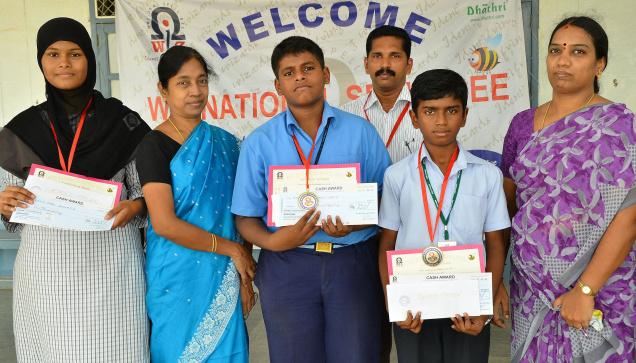
Winners of Wiz National Spell Bee competition with Geetha Periyanayagam (Second from Left),Principal, and Rohini (Right), Coordinator at SBIOA Matriculation Higher Secondary School in Tiruchi on Saturday./ Photo:B.Velankanni Raj

Students from various schools showcased their language skills at the Wiz National Spell Bee competition for Tiruchi zone, here on Saturday.

The contest, which tested both the oral and written skills of students from classes 1 to 12 under different categories, was held at SBIOA Matriculation Higher Secondary School. The competition was conceived by a panel of eminent academicians and experienced teachers across the country.

The winners from SBIOA Matriculation Higher Secondary School, Alpha Wisdom Vidyashram, and Samadh Senior Secondary School were felicitated by Geetha Periyanayagam, principal, SBIOA Matriculation Higher Secondary School in the presence of Josh Sebastian, zonal coordinator, Wiz National Spell Bee, and Yasmin Nazeer, regional coordinator.

According to a press release form the organisers, Wiz National Spell Bee, through its competitions at various levels encourages the schoolchildren to improve their vocabulary. .

source: http://www.thehindu.com / The Hindu / Home> News> Cities> Tiruchirapalli / by Staff Reporter / Tiruchi – June 22nd, 2014

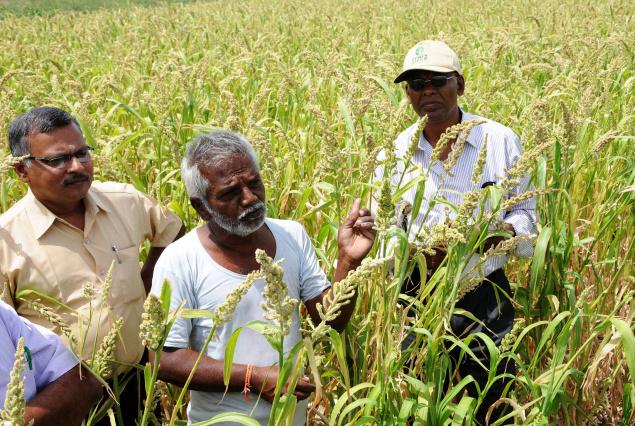
Kuthiraivaali cultivation promises to make farming profitable

A farmer explaining the salient features of cultivating kuthiraivaali (Barnyard millet) during summer, in Watrap region of Virudhunagar district./ Photo: G. Moorthy / The Hindu

Virudhunagar district to produce 12.5 tonnes of seeds

Summer cultivation of ‘Kuthiraivaali’ (Barnyard Millet), introduced for the first time by the Department of Agriculture, has been a hit among farmers of Virudhunagar district.

While, initially, officials found it tough to convince farmers to come forward to cultivate the minor millet as a major alternative crop to cotton and paddy, the success tasted by a few farmers has helped more farmers evince interest in this crop.

Virudhunagar has been chosen to produce 12.5 tonnes of ‘Kuthiraivaali’ seeds as part of the State government’s ambitious project to increase the area under millet cultivation to ensure food, fodder and livelihood security.

“We have given 125 kg of CO (KV) 2 seeds provided by Tamil Nadu Agricultural University to 25 farmers. Cultivation of minor millets has been taken up on 50 acres,” Joint Director of Agriculture K. Subbiah said. The seeds are expected to be ready by August for sowing in September across the State.

Assured yield

Deputy Director P. Vanniyarajan said diversification to millet cultivation, especially during summer, would give assured yield with higher returns.

P. Poongavanam, a farmer in W. Pudupatti, said he had increased the extent of summer cultivation to eight acres because of ‘Kuthiraivaali’ that consumed less than 50 per cent of the water required for paddy or cotton.

S. Vijayakumar (54) of Maharajapuram is used to rain-fed irrigation of ‘Kuthiraivaali.’ He expected more than double the yield now, thanks to the improved variety of seeds and modern irrigation technique.

Another farmer, R. Gnanagurusamy (63), said that cultivation of the minor millet had the advantages of less water and fertilizer, no pesticide and free from crop damage by birds and animals.

Input cost less

“The input cost is less because of decreased need for weeding and farm preparation,” he said.

Stating that the plants grew taller (up to 6.25 feet) under irrigated condition, the Assistant Director (Seed Certification), S. Ramamoorthy, said farmers had the benefit of getting more quantity of fodder.

Besides getting higher yield and higher price, farmers who have taken up ‘Kuthiraivaali’ for seed production are given higher price. “While the market price is Rs. 25 to 30 a kg, we have promised to give them Rs. 50 a kg,” Muthaiah, an Agricultural Officer, said.

The officials are also planning to set up a unit to process the minor millet at a cost of Rs. 2.20 lakh after forming a cluster of ‘Kuthiraivaali’ farmers. “The farmers will get a better price for value addition,” Mr. Vanniyarajan said.

source: http://www.thehindu.com / The Hindu / Home> News> Cities> Madurai / by S. Sundar / Virudhunagar – June 21st, 2014

YES team to US

A 100-member delegation visits America to study business opportunities and improve bilateral trade

If the delegation of Young Entrepreneur School (YES), a youth development programme of the Tamil Nadu Chamber Foundation, signs a trade contract during their visit to the popular brand’s Visitors’ Centre in San Francisco, Madurai can expect a Levi’s jeans manufacturing unit.

“It is part of our plan,” says V. Neethi Mohan, Chairman, YES. “The Visitors’ Centre is a permanent installation in commemoration of the 150th anniversary of Levi Strauss and Co. showcasing the company’s history and business. We will be visiting the Levi’s facility on June 23.”

The 17-day trip is titled as ‘Bizcover America’. Members drawn from various YES centres such as Chennai, Dindigul, Ramanathapuram, Karur and Sivakasi leave on June 8. The delegation will also visit US India Business Council, a premier business organisation representing America’s top companies investing in India. They have planned to visit New York, Washington, Niagara, Orlando, Miami, Las Vegas, Los Angeles and San Francisco.

“We have also planned to visit ZAPPOS.com, a popular online store for shoes and clothes based in Las Vegas, Nevada. The store is presently owned by Amazon.com. We will be there to study their business culture and understand their core values,” he says. The team’s prime focus is to improve trade links in food processing and garment industries.

According to Neethi Mohan, e-commerce is a rapidly growing business in the country as the total business done through online shops in the country at present stands at around one billion dollars and it is expected to grow up to 76 billion dollars by 2020. “Already showrooms are being converted into warehouses and businessmen are showing keen interest in e-commerce,” he says.

“The team will study the business models, tools for business development and their best practices. The key objective is to increase volume of bilateral trade and promote industrial investments,” says S. Rethinavelu, chairman of the foundation.

The group will also be at the Infocomm 2014, one of the largest professional AV shows in the world with more than 950 exhibitors from over 110 countries attending.

source: http://www.thehindu.com / The Hindu / Home> Features> MetroPlus /  by  T. Saravanan / Madurai – June 05th, 2014

The root of red dyes

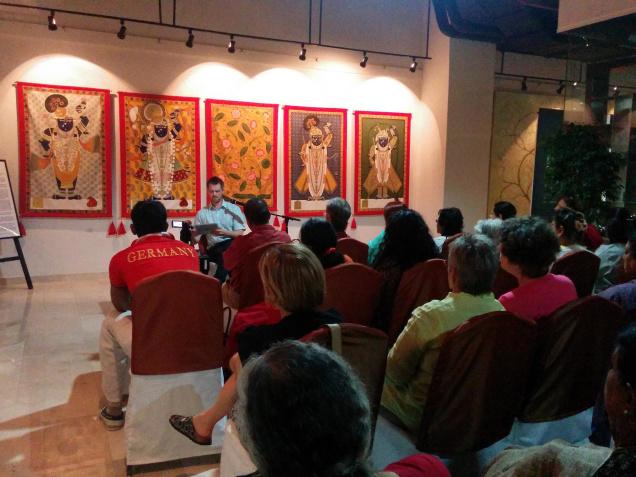
A gathering of around 50 people were present to listen to an engaging talk aptly titled ‘A Colour of Tragedy and Opportunity’ by Mark Balmforth  / by Special Arrangement / Th e Hindu
A gathering of around 50 people were present to listen to an engaging talk aptly titled ‘A Colour of Tragedy and Opportunity’ by Mark Balmforth / by Special Arrangement / Th e Hindu

Mark Balmforth’s engaging talk on the root diggers and dyers of Jaffna time-travelled through history

Inside the towering and majestic Leela Palace hotel emerges the forgotten tale of a lost people; the ‘chay’ root diggers and dyers of Jaffna. A gathering of around 50 people were present to listen to an engaging talk aptly titled ‘A Colour of Tragedy and Opportunity’ by Mark Balmforth, a doctoral student from Columbia University. As a part of his thesis on the social changes of Tamils in Jaffna, Balmforth has embarked on a journey to unearth the ‘chay’ root or chayaver(Srilankan Tamil), and the hands that dug them. He has spent eight months in Madurai learning Tamil, and travelled to Jaffna in search of their story.

This root (Oldenlandia umbellata) still grows commonly across the coastal areas of Andhra, Tamil Nadu, and Kerala, however the prime variant is found in the northern Tamil regions of Sri Lanka. The root itself is a long, wiry branch that stretches deep beneath the earth, and to procure a mere handful takes a laborious few hours. Once sun-dried, powdered, and chemically consolidated through a series of boiling, it yields a scarlet dye that can be toned to red, orange, and purple. It was once used for fabric, clothing design, baskets, and other daily products. It was also used medicinally as a haemostatic. Unlike indigo and its historical trajectory which is widely known and documented, thechayaver has been neglected to a point of oblivion.

Balmforth delves into the social history of the community who worked with this root as bonded labourers during the colonial era first during Dutch rule, and later British. They belonged to the lowest strata of the caste system and were collectively referred to as ‘Verkuthi’ — literally root diggers. However other than existing as a low-caste community, it is unclear as to what their rightful origins were as far as Balmforth has hitherto discovered. “I need to get arm-deep into evidence before I can grasp the subject fully, just like with the actual root,” he remarks.

For colonial trade and revenue purposes these people through generations were forced into the occupation but with the commencement of synthetic dye production from 1850 onwards, both the indentured labour and the art of dyeing with the chayaver came to an end. A community once depended upon to provide the colour of passion, power, and blood seems to simply vanish in terms of occupational and artistic existence. Scarce documentation available locally pertaining to their occupational history and conversion of many root diggers to Christianity makes it an arduous task to trace their genealogy.

On a trip to Jaffna, Balmforth encountered an 81-year-old siddharvaidyar whose ancestor had been a root digger, and narrates his memories and the knowledge that was orally passed down to him. He emphasises in particular that root dyeing was not simply an occupation, but craftsmanship — a forgotten one. “This man has a mental map of plants and their uses all across the Tamil landscape of Ceylon, which is a beautiful thing,” Balmforth says in awe.

The academic explains his fascination for the layers in symbolism of the red yielded by the root, connoting not only to slavery, but also the art that came from it.

This event was hosted at the Leela Galleria in association with Apparao Galleries.

source: http://www.thehindu.com / The Hindu / Home> Features> MetroPlus> Events / by Radhika Dontala / Chennai – May 11th, 2014

Unlimited ‘Downloads’ at First Namma Toilet in Chennai Suburb

Namma-ToiletCF19may2014

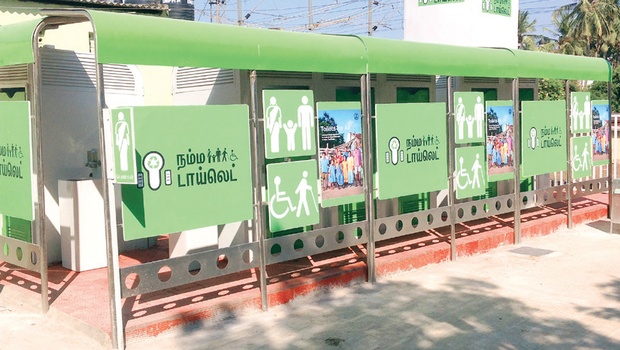
Nestled along the Beach-Tambaram Railway line, Kamarajar Nagar, one of Tirusulam’s biggest slum pocket has over 500 households, but sadly not even a single toilet until a few months ago. Thanks to the efforts of the Pallavaram Municipality, the slum now has one that rivals public toilets in foreign countries in terms of technology — the suburb’s first operational ‘Namma Toilet’.

In the few months that the toilet is operative, it has found patronage among residents to the level that today an average of 300 to 400 people use the six cabin toilets in Kamarajar Nagar’s Nehru Street on a daily basis.

While the pan Tamil Nadu Namma Toilet Scheme has been gaining pace across various municipalities, which are completely devoid of public toilets, the one in Kamarajar Nagar, according to Pallavaram municipal officials, is one of the first in the city’s suburbs to be established in a slum area instead of public places such as bus stops and railway stations.

“We had conducted a community survey before installing the toilets and deduced that such slum pockets along the railway lines are at a place where open defecation is most prevalent. We have given the toilet established at a cost of `15 lakh to a firm on an O and M (operate and maintain) basis. The firm maintains it on a free use basis and users are required to register their usage. As of now, the toilets see at least 350 users a day,” informed an engineer with the Pallavaram Municipality, who is in-charge of the project.

According to the officials, a total of five such modern toilets have been planned in bus stops at Chrompet, Pallavaram, Keelkattalai and Anakaputhur, which will soon be set up.

Although the toilets have been witnessing heavy usage, the cost of maintaining them is very low, courtesy the technology, said officials.

“One of its main USP is it that it is completely solar powered. Apart from the latrines and urinals, the toilets have separate wash basins, borewell connection and lighting. In the evening hours, the lights automatically switch on when the door is opened, which helps conserve electricity,” the engineer said. Of the six cabins, three have been allotted for women, two for men and one separate cabin for persons with disabilities.

Although the number of toilets is not enough to cater to Kamarajar Nagar’s entire population, the residents seem happy with whatever is available.

“When these were first constructed, we didn’t know what they were and not many were using them. I actually thought it was some type of a machine,” said Mathivanan, who works at a tannery nearby. “But slowly almost everybody has started using them and in the evenings most of the time all cabins are occupied,” he added.

“It is very useful, but we also have acute shortage of water for regular use in this area. If they put up a tap near it with a connection to a borewell, it will be more useful,” said Moginiammal, a local resident.

With over five more such toilets planned in Pallavaram alone and many more coming up in areas such as Perungalathur and Peerkankaranai, the patronage this toilet has gained has given the project a good hope for success.

source: http://www.newindianexpress.com / The New Indian Express / Home> Cities> Chennai / by Arun Venkat – Chennai / May 07th, 2014

IG inspects RPF training centre

The RPF Zonal Training Centre in Tiruchi is all set to train 400 constable recruits. / File Photo: M. Moorthy / The Hindu

Ahead of the impending training programme for constable recruits of the Railway Protection Force (RPF) at the RPF Zonal Training Centre here, the IG-cum-Chief Security Commissioner, RPF, Southern Railway, V.K.Dhaka, inspected the sprawling centre on Sunday. Mr.Dhaka held a discussion with senior RPF officers and enquired on the requirements for the proper conduct of the programme .

The Tiruchi centre is the lone training establishment of the force in Southern Railway zone, encompassing Chennai, Tiruchi, Madurai, Salem, Palakkad, and Thiruvananthapuram railway divisions, imparting theoretical and practical training for the newly appointed constable recruits.

The centre also organises refresher courses for RPF personnel at periodic intervals. Mr.Dhaka went around the centre inspecting the barracks where the trainees would be accommodated during the course of their seven month training .

He was accompanied by the RPF Tiruchi Divisional Security Commissioner K.Senthil holding additional charge as principal of the training centre and senior officers. The training centre was the venue for the physical efficiency and physical measurement tests conducted recently for over 10,000 candidates as part of recruitment of constables for the RPF and Railway Protection Special Force (RPSF).

Shortlisted candidates would take a vica-voce test prior to their selection. Around 18,000 candidates would be recruited across the country for the post of constable in the RPF and the RPSF. The Tiruchi centre would train 400 recruits under the programme expected to commence in August.

source: http://www.thehindu.com / The Hindu / Home> News> Cities> Tiruchirapalli / by Staff Reporter / Tiruchi – March 17th, 2014

The first walk after 17 years

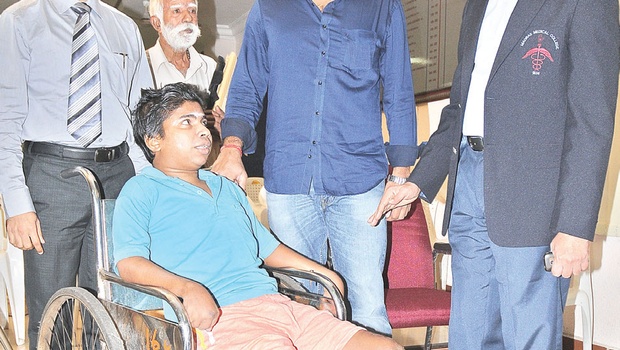
Karthikeyan along with RGGGH doctors after his ortho surgery

Thirty-year-old Karthikeyan from Udayarpalayam, Ariyalur district, had been bedridden for the past 17 years. But now, he has began taking baby steps, thanks to the efforts of doctors at the Rajiv Gandhi Government General Hospital. They say that he will start walking without any help in another one month.

When Karthikeyan was 13, he had developed a fever and joint pain that restricted his movements. He could not afford any treatment and was wheelchair bound for 17 years when a doctor in Ariyalur suggested that he approach RGGGH. Doctors here diagnosed that the man was suffering the end-stage of arthritis where his joints fused. Doctors decided to replace all major joints in his lower limbs and make him walk independently.

Under the Chief Minister’s Comprehensive Health Insurance Scheme, the right side of his hip and knee were replaced with stents. This surgery would have otherwise cost him `2.30 lakh. To straighten his knee that was bent at 90 degrees, a pin was inserted in the lower part of the leg and a weight was suspended from it for about two weeks.

“To perform the surgery on a side of the body, Karthikeyan’s father said he would sell his plot in his village. But we found help through our dean,” said Dr Singara Vadivelu, senior orthopaedic surgeon, RGGGH. Sunil from Ungalukkaga Trust came forward to provide `1.5 lakh following a meeting with Dr V Kanagasabai, dean, MMC and RGGGH. A surgery was performed on the left side hip and knee on January 9 and the patient was made to stand with a support on January 27. “This surgery would otherwise cost a total of Rs seven or eight lakh in a private hospital. Also, the patient bore all the pain as he had the confidence and was happy that he would soon walk again,” said Dr V Kanagasabai.

Doctors said that such form of arthritis usually affected men aged between 20 and 30 years, where the joints get fused restricting movement, but Karthikeyan suffered from it at an early age. “My father has become very old. I want to lead an independent life. Doctors have told me they would also perform surgeries on my wrist elbow. Even physiotherapy treatment is painful but I am confident I’ll become normal soon,” said Karthikeyan.

source: http://www.newindianexpress.com / The New Indian Express / Home> Cities> Chennai / by Express News Service – Chennai / February 01st, 2014

Greater flamingos found in Tenkasi tank

Tirunelveli :

The third leg of bird monitoring undertaken by the Tirunelveli forest circle spotted a good number of greater flamingos in the water bodies. Interestingly, some of them were spotted for the first time at the Sundarapandiayapuram tank near Tenkasi.

Tirunelveli forest circle consisting Tirunelveli, Tuticorin and Kanyakumari districts has undertaken six months’ aquatic bird monitoring in the water bodies. The third leg of bird monitoring took place on Saturday. According to forest officials, the monitoring was conducted in about 20 tanks across the three districts. Different species of birds, ranging from 10 to 40, were noted in each tank with numbers ranging from few hundreds to as high as 15,000. Important water birds noted were spot-billed pelicans, bar-headed geese, little grebe, Indian spot-billed duck, comb duck, Asian open-bill stork, painted stork, pheasant-tailed jacana, terns apart from egrets, herons, variety of ibis, cormorants and moorhens, forest officials said.

District forest officer C H Padma said a group of greater flamingos was noticed first time in Sunderpandiyapuram tank near Tenkasi. In many of the irrigational tanks, an increased water level is observed due to release of water from dams. “It is happy to note that local people were aware of these monitoring works going on around their villages. Local people were also involved in some of the tanks on Saturday,” she said.

Conservator of forests Tirunelveli, Rakesh Kumar Dogra also participated in the monitoring exercise in Kadambankulam and Tuthukuzham of Tuticorin district and spotted around 100 greater flamingos. Commenting on the greater flamingos spotted in Tenkasi region, he opined that they could have migrated from nearby tanks. “We have learnt from the local people that flamingos do visit different tanks but not regularly,” he said. Though the flamingos normally prefer tanks nearby seashore areas, they could have visited this Sunderapandiapuram tank in the interior area for food, said M Mathivanan, coordinator of Agasthiamalai based Conservation Centre of ATREE.

The bird-monitoring exercise is yielding positive results and helping in the conservation of the tanks and the winged visitors, Dogra said. “The monthly presence of the department around the water bodies improves conservation. Officials were also instructed to specifically look for any mortality of birds or abnormal behaviour. This activity has definitely improved the protection status of winter visitors to these bird habitats,” he said.

The next monitoring is on February 23.

source: http://www.articles.timesofindia.indiatimes.com / The Times of India / Home> City> Madurai / TNN / January 28th, 2014