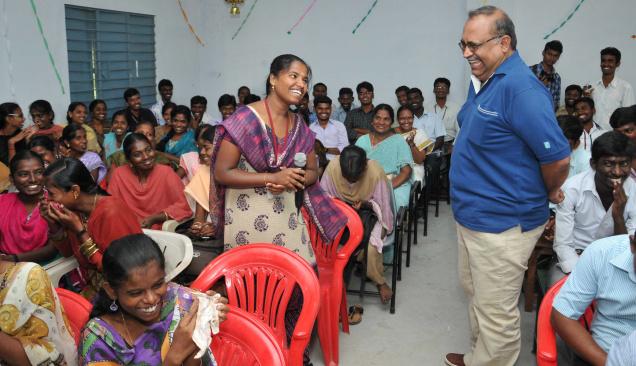
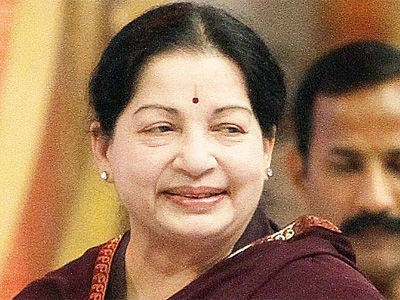
ALL SMILES: Film Director Balaji Sakthivel interacting with College students at the Workshop on Film Appreciation at Periyar EVR College in Tiruchi on Thursday./ Photo: M. Moorthy / The Hindu
I decide on climax and start working backwards, says ace director at film appreciation workshop
“Since my films are based on real-life incidents, I decide on the climax and start working backwards while writing the story,” said director Balaji Sakthivel who was in the city on Thursday.
The award-winning director was interacting with college students during a workshop on film appreciation organised by the Department of English, Periyar EVR College.
The man known for such hard-hitting realistic movies such as Kaadhal and Vazhakku Enn18/9 shared his passion for making realistic cinema with the participants. His frank talk and smiling disposition made the session lively. Shooting quick witted replies to the doubts raised by students, he explained concepts in an interesting manner.
The day-long workshop featured the screening of two films: the Italian film Bicycle Thieves and the Tamil film Kalloori, followed by students’ reviews and interactive sessions.
While Bicycle Thieves is based on the social condition of post-World War II Italy, Kalloori portrays the trials and tribulations of college students.
“Watching Kalloori brings back flood of memories. I feel I could have done a lot of things differently. For instance, I could have toned down certain scenes where there was too much drama ,” Mr.Sakthivel said.
“I have been stereotyped as a director who gives his films a tragic ending. But such an ending is essential to convey the intended message,” he said in reply to a question by a student.
B.Mathivanan, head, department of Tamil, Bharathidasan University, K.Sekar, principal, Periyar EVR College, and A.William, head, department of English, also addressed students during the workshop.
A total of 100 students from the department of English and department of Visual Communication of the college participated in the workshop.
source: http://www.thehindu.com / The Hindu / Home> News> Cities> Tiruchirapalli / by Deepika Muralidharan / Tiruchi – January 10th, 2014
Knowledge centres to create awareness of latest technology
The State agriculture department has identified 25 villages in Pudukottai district as model villages under the World Bank-aided Tamil Nadu Irrigated Agriculture Modernisation and Water bodies Restoration and Management (TN-IAMWARM) Project for implementing projects for the development of farming community.
Under the scheme, different departments such as public works department, agriculture, horticulture, Tamil Nadu Agricultural University, fisheries, animal husbandry, agricultural engineering and agricultural marketing, will work together to help farmers use latest technology in every agricultural activity – from seed to marketing.
The objective is to develop the identified villages as models for other villages. The project will facilitate the opening of a Single Window Information and Knowledge Centre (SWIKC) to create awareness on latest technology among the farmers, said K. M. Shajahan, Joint Director of Agriculture, here.
Redgram transplantation scheme is implemented in the district in 210 hectares, for which the department has already allocated financial assistance. CORG – 7 (C) is a variety suitable for the district and seedlings are prepared in polythene bags.
A subsidy of Rs. 7,500 per hectare under the National Agricultural Development Programme (NADP) and Rs. 5,000 per hectare under the National Food Security Mission (NFSM) is given to farmers.
Of the normal paddy area of 72,200 hectares in the district, 69,323 hectares has been brought under cultivation till last month. The farmers have also raised millets in 4,087 hectares, pulses in 1,087 hectares, sugarcane in 2,979 hectares, and oilseeds in 5,418 hectares.
The agricultural extension centres have stock of 169.11 metric tonnes of paddy seeds, 19.76 tonnes of pulses seeds, and 33.43 tonnes of oil seeds. Referring to the implementation of oil palm development scheme as a pilot project in the blocks of Gandarvakottai, Karambakudi, Aranthangi and Tiruvarangulam , the joint director advised farmers to contact the assistant director of agriculture of the respective blocks and enrol their names in the priority register for getting the benefits.
On the incidence of rice blast disease in samba , he said that the farmers can contact the agricultural extension centre for collecting pesticides at subsidised rates. Farmers could prepare cow dung solution and mix it with 200 litre of water and spray it on crops to control bacterial leaf blight disease, he said.
source: http://www.thehindu.com / The Hindu / Home> News> Cities> Tiruchirapalli / by Syed Muthahar Saqaf / Pudukottai – December 30th, 2013
The participants of the Special Olympics Asia Pacific Games being felicitated by Rotary Club of Tiruchirapalli Rock City on Thursday./ Photo: A. Muralitharan / The Hindu
Eight special children from Tiruchi, who had returned recently after taking part in the Special Olympics Asia Pacific Games held in Australia, were felicitated by Rotary Club of Tiruchirapalli Rock City, here on Thursday.
Seven out of the eight children were present, and they received citations from S. Gopal, governor, Rotary district 3000.
Mohanavel, Mani Balu, and Joel S. Varkey (Dolphin Special School); Divakar, Naveen Akash, and Arvind Subramani (Blossoms Opportunity School, Holy Cross College); Siril Robert (Vedivelli Special School); and Joseph Chkaravarthi (Asha Deepam Special School), participated in the Special Olympics held from December 1 to 7 in New Castle, Australia.
Three of the students won medals – Mohanavel had won silver medal in running and long jump, Joseph Chakravarthi bagged silver, and Mani Balu a bronze. The other five children secured fourth and fifth positions in different events.
Mr. Gopal thanked the teachers and the coach, and praised them for their unwavering support and dedication towards the children. “Special Olympians are in no way lesser than normal Olympians. In fact, Special Olympics help those with intellectual disability make friends and engage in sporting events. It brings out their hidden talents,” he said.
“Participation itself is a great achievement and the winners have gained immense self confidence. It is up to organisations such as Rotary Club to encourage, help, and support such special children in their endeavours,” he added.
Paul Devasagayam, area director-Tamil Nadu for the Special Olympics, commended the efforts of the special children. The coach, Sara Arockia Mary, was present.
source: http://www.thehindu.com / The Hindu / Home> News> Cities> Tiruchirapalli / by Staff Reporter / Tiruchi – December 13th, 2013
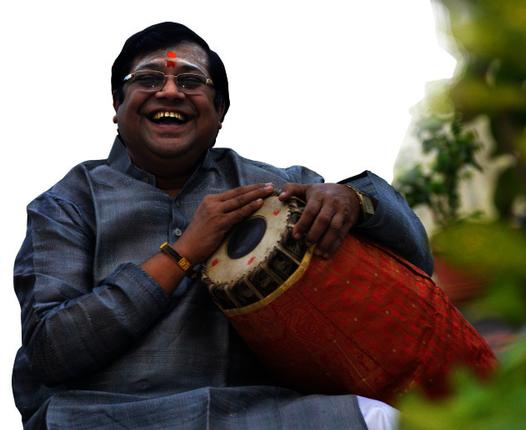
Mridangam maestro Thiruvaarur Bakthavathsalam. / Photo: S.S. Kumar / The Hindu
Natural talent and hard work has brought Tiruvaarur Bhakthavathsalam many laurels.
Somewhere in the mid 1970s, this writer used to observe at concerts a tall, handsome young man dressed in impeccable white talking to seniors with folded hands. Those were the days when Tyagaraja akhandam used to be held at different temples of the city, where he would be present and vie with other players for an opportunity to play.
Looking back, he had all the elements of a young hero. Had he joined the movies, the field of Carnatic music would have lost a wonderful artist. A self-made man, Tiruvarur Bhakthavathsalam was given the Life Time Achievement award by Bhartiya Vidya Bhavan, Chennai, this year, which is also the sabha’s 75th anniversary – an honour that he has earned after almost 50 years of playing the mridangam. Incidentally, there is laya even in his address – he lives in Gali ‘laya’ puram near the Music Academy.
“I never learnt mridangam formally,” he begins. Smiling at the stunning effect made on the listener, he continues: “My mother Tiruvaarur Anandavalli was trained well in classical music by Tiruvarur Sethuraman. Thus it was chaste music, from dawn to dusk and often well into midight.
“I think my gurukulavasam started when I was in my mother’s womb. She sang in concerts almost till the day before I was born. By the age of three, I started singing the songs that I had heard from my mother. My maternal uncles Rajarathinam Pillai (thavil), Tiruvarur Krishnamurthy (mridangam) and R.S. Krishnan (violin) lived with us. My sister and I were then trained by Chinna Thambia Pillai, an uncle of Tiruvaarur Namasivayam. My mind was always set on the mridangam and I started playing at home during my mother’s practice sessions when my uncle was not around. Playing for various forms of kritis, padams, javalis, Tiruppugazh was a good exercise.”
Self-appraisal
Bhakthavathsalam was named after the presiding deity of the Tirukkannamangai temple. Although he was praised by everyone for his singing, during his mother’s concert he would pose like an accomplished mridangam vidwan while seated near his uncle. His mother was not sure of Bhakthavathsalam’s success in music and hence wanted him to become a banker. So he went to college to get a B.Com degree. “But I never completed it,” he says laughing. Then on a serious note, he adds, “I am generally wary of Life Time Achievement Awards. I always go into a self-appraisal mode to find out if I am really worthy of these honours. And such recognition calls for sustained hard work.”
He came to Chennai as most of the stalwarts were here and started attending concerts in temples and sabhas. Returning home, he would hone his skills by trying out all the complicated korvais that were presented in the concerts. Whether at Tiruvarur or Chennai, he was present at all the Radha Kalyanams (bhajans) and Nama Sankirtana Utsavams and played for long hours.
He was the regular mridangam player for Vamana Bhagavatar’s harikatha even during his school days, which prepared him for the future and also the numerous Tyagaraja Swami akhandams.
“It was at the Mylapore Sri Thyagaraja Vidwath Samajam that I started getting noticed. I used to wait like the 12th man in cricket to play, just in case the mridangam vidwan for the day did not turn up. I was not disappointed. Those days, the stalwarts attended the concerts of others and that was how I got the recognition. Again at Tiruvaiyaaru, I played for many seniors and they started recommending me to others. I have played for all the doyens of Carnatic music and collaborated with many Hindustani musicians and am also happy to be associated with the present crop of youngsters. ”
Styles of the vidwans vary and so he prepared himself from the morning of the concert by trying to assimilate that technique and by playing it mentally. This is one factor he attributes to his success.
He has high regard for institutions that organise concerts and this has prompted him to institute an annual award to be presented to an organiser during the anniversary of his Laya Madhuraa School of Music (See Page 3).
“I want to educate rasikas on the concept of mridangam. My disciples are now busy in concert circuits and I treat them as my sons. After all Guru is the one who opens your eyes.”
His wife Rajam is the granddaughter of Vazhuvoor Ramaiah Pillai and daughter of Vazhuvoor Samraj Pillai, both renowned dance gurus. He has three daughters.
Bhakthavathsalam recalls the contribution of his mridangam repairer Navaneetham, who is the grandson of Valangaiman Shanmugasundaram Pillai, to his success. “It is a great art and I admire his ability to prepare mridangams for various srutis perfectly”.
“My mridangam has elevated me to this level and I dedicate every success to the instrument. If at all there is rebirth, I want to be born as a musician again with the blessings of Samayapuram Magamaayi.”
source: http://www.thehindu.com / The Hindu / Home> Features> Friday Review / by V. Balashuramanian / Chennai – December 12th, 2013
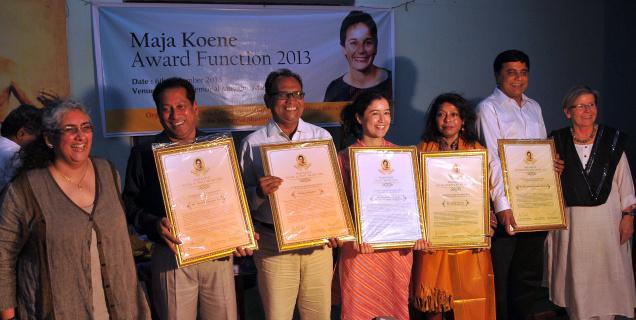
Reva Joshee, Mahatma Gandhi Canadian Foundation for World Peace, Canada, and Margrit Hugentobler, president, CESCI-Switzerland (right) with the winners of Maja Koene awards at a function held in Madurai on Wednesday./ Photo: S. James / The Hindu
The Gandhi Memorial Museum and Centre for Experiencing Socio-Cultural Interaction (CESCI) organised the Maja Koene Award Function 2013 here on Wednesday.
The Maja Koene Social Journalist Award was given to Himanshu Shekhar Mishra of NDTV-New Delhi and Ruby Sarkar, a freelance journalist from Bhopal. Mr. Mishra was felicitated for his coverage of the Jan Satyagraha non-violent march taken out by 50,000 people from Gwalior to New Delhi in October, 2012.
“While we highlight the problems and deprivation of the poor, their perseverance and determination to fight for their cause often doesn’t get the respect it deserves,” Mr. Mishra said.
Ms. Sarkar wrote about marginalised communities and highlighted the issues of the landless poor. “Their everyday struggle for basic necessities such as water and the way they are exploited and deprived need to be covered with sensitivity,” she said.
Naresh Chander Lal, a filmmaker from Andaman and Nicobar Islands, who was conferred the Maja Koene Social Activist Award, said that through his films he had sought to spread the message of ahimsa. “I believe Gandhiji is alive in all of us and by practising the concept of non-violence, we are keeping him and his ideals alive.”
Mr. Lal emphasised the potential and reach of the film medium.
The Kadam Cultural Centre in Jabalpur won the Social Activist Award for work on environmental issues and poverty.
Given to activists who practise non-violent methods of resistance while fighting for a cause, the Maja Koene Peace Award went to Orquidea Perez and Maria Liga, women who had shown exemplary leadership while working for the development of their communities in Columbia.
Accepting the award on their behalf, Natalia Rodriguez, a social worker from an organisation which worked with them, said the women had been fighting for rights over land in a place ravaged by violence, and in the absence of a government. “These women are fighting for their rights while battling political and economic instabilities, showing exemplary determination and courage to better their community,” she said.
Reva Joshee from the Mahatma Gandhi Canadian foundation for World Peace, Margrit Hugentobler, president of CESCI-Switzerland. and P.V. Rajagopal, secretary of CESCI, Madurai, were present.
source: http://www.thehindu.com / The Hindu / Home> News> Cities> Madurai / by Staff Reporter / Madurai – November 07th, 2013
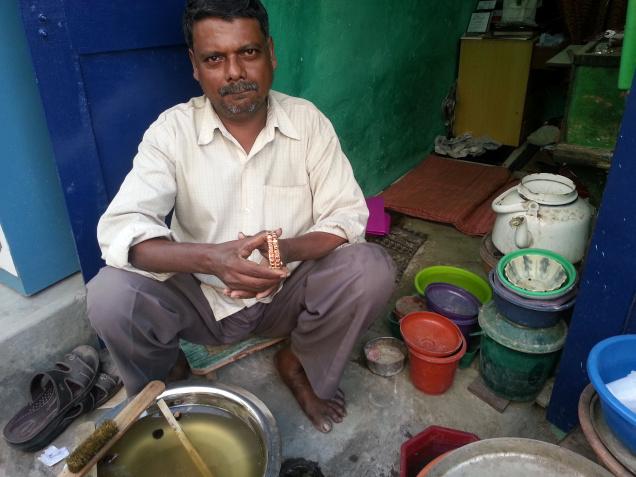
It’s only four in the evening, but Basheer has already decided to go home — he has no work that day. “The festive season just got over, hasn’t it? People will come to polish bangles and chains only after a few days,” he says, softly. Seated in front of a steel basin, with four boondhi kottais (soap berries) and four small brushes floating in the water, Basheer talks of the gold polishing business that he has been a part of for the last 30 years.
A Class 8 dropout, Basheer was initially a two-wheeler mechanic, before he trained for five years and became a skilled silver and gold polisher. After working out of several locations in Mylapore, Basheer now runs the ‘K. Noor Mohamed Gilt Shop’. “Earlier, I had my own shop. This one,” he says, pointing to the small, rectangular shop, with its blue shutters and green walls, “belongs to my cousin. He asked me to run it.” I strain to hear his voice, which gets drowned in the street noises of Mathala Narayanan Street; it’s only an old, narrow thoroughfare, but vehicle sounds and arguing neighbours make us raise our voices.
Our loud voices attract attention. One gentleman enquires why I’m asking Basheer “all these questions”; another offers to answer on his behalf and says, “He lives in Kunrathur.” Basheer explains that he moved to the ECR approximately 30 years ago. “Land was cheaper there, but now, it sells for crores!” Every morning, for the last three decades, Basheer has been taking two buses to reach Mylapore. “It’s faster to get here now, even though there’s heavy traffic after Tiruvanmiyur. In those days, there were hardly any buses, you see!” he smiles. The return journey is equally long, and he typically gets home for a late dinner around 10 p.m.
The day is spent in polishing silver and gold. Job orders range from small items — bangles and chains — to the temple kavacham or crown polishing. “Approximately 15 years ago, I polished silver items for the Kapaleeswara temple. Many of my customers are from Chennai, but some come from faraway places too.” Basheer, very modestly, says he’s an expert at polishing temple (dance) jewellery. “Dance jewellery is made in Nagercoil, and it’s difficult to clean and polish, as it has a lot of stones,” he says, showing me a pair of red-stone bangles that he has freshly gilded for a customer. It’s hard to tell it’s only ‘covering’.
To gold polish jewellery, Basheer first cleans it well. “I use soap berries bought from the naatu marundhu kadai; they foam naturally,” he says, pointing to the soapy water in the basin. Next, Basheer readies the ‘gold bath’, by dissolving a tiny amount of gold in acid, and boiling the resulting fine dust in water. This is then used to coat the article, by electrolysis. “After plating, the chain or bangle is dried on a bed of sawdust. It will then shine like gold.” (Silver plating is somewhat similar, except, it is buffed in the end).
Gold polishing costs around Rs. 250, a price that does not make it really profitable. “Gold prices have increased, but customers are not willing to pay more,” Basheer says. But he also rationalises their reluctance — gilt jewellery itself sometimes only costs Rs. 250, and the gold finish lasts for just a few months. And yet, Basheer seems happy with his lot; he talks of his three children — all graduates — and his visits to Nagore, with his family, once every two years. And when an old woman comes to his shop seeking alms, he springs up from his low stool, and fetches her a few coins…
(A weekly column on men and women who make Chennai what it is)
source: http://www.thehindu.com / The Hindu / Home> Features> MetroPlus > Society / November 11th, 2013
Collector R Nanthagopal while inaugurating a 25-day training programme for a group of entrepreneurs, who have been selected to receive financial assistance under the New Entrepreneur-Cum-Enterprise Development Scheme (NEEDS) launched by the State, on Wednesday at the VIT university campus urged the beneficiaries to emerge as job givers and not job seekers. The training programme was jointly organized by the Entrepreneurship Development Institute(EDI) Chennai and the Centre for Sustainable Rural Development and Research Studies attached to the VIT Business School and sponsored by the Department of Industries and Commerce.
The Collector said noted that Vellore being a backward district, the entrepreneurial activities would boost the rural economy. “There are many farm hands and you can employ them and contribute towards the welfare of society,” he said. He also urged the participants to make use of the resources provided by the State. “Translate your ideas into projects under this scheme which is also a dream project of the TN Chief Minister,” he said.
The EDI coordinator R V Subramanian spoke on the salient features of the NEEDS, the subsidy and components besides talking about bank loans and other incentives of the scheme.
source: http://www.newindianexpress.com / The New Indian Express / Home> States> Tamil Nadu / by Express News Service – Vellore / November 07th, 2013
Ooty-based dentist, 49-year-old Tarun Chhabra, is an expert on Toda culture and is possibly one of the few outsiders who can speak their language fluently / Photo: M. Sathyamoorthy / The Hindu
The year was 1990. A youth in his mid-20s was browsing through books at the Defence Services Staff College library in Wellington, when he chanced upon WHR Rivers’ The Todas. As the son of an Army officer who served in the Nilgiris for long and as a student of The Lawrence School, Lovedale, he was familiar with name Todas, but knew nothing more. The pictures and text in the book fascinated him. It spoke about the Toda rites of passage, their rituals and way of life. He got it reissued repeatedly till he was satisfied he had read it thoroughly.
Today, Ooty-based dentist, 49-year-old Tarun Chhabra, is an expert on Toda culture and is possibly one of the few outsiders who can speak their language fluently.
The transformation took time. Tarun read up some more and introduced himself to the Todas. To learn their language, he wrote down words in a notebook and memorised them. Many months later, his vocabulary stood at a mere 50 words. Then, he threw his notebook away. He learnt to speak. “There was a time when I spoke a language that was 95 per cent Tamil and five per cent Toda. Now, it’s nearly 100 per cent Toda,” he smiles.
Tarun says his life has been enriched by the Todas. “Their culture and traditions are unique, and I feel privileged to have experienced them first-hand,” he says.
THE WORLD HEREAFTER
One of the Todas’ main beliefs relates to the afterlife. When a clan member dies, a buffalo is sacrificed. It is believed the animal will accompany the soul to the after world, passing though 15 landmarks. “Once, Kwattawdr Kuttan, a clan leader, took me to Upper Bhavani to show me the landmarks. They actually existed. That brought alive the belief for me. It was an honour, considering he had not even taken his son to the place,” says Tarun. Incidentally, buffalo sacrifice is on the wane these days, with many settling for a symbolic sacrifice.
Tarun has also joined in the community task of thatching the revered conical temple. He accompanied the tribesmen to the western slopes of the Nilgiri rainforest to collect rattan cane for the job.
Today, the Toda way of life is at a crossroads with just about 1,400 traditional tribespeople left. The Toda Nalavaaazhvu Sangam, set up by Tarun in 1992, primarily works to preserve their culture and provide better healthcare. It has got munds electrified. It has rebuilt abandoned temples and migration hamlets where the pastoral tribesmen stay when they take their cattle grazing. When buffalos are killed by predators, the trust compensates the Todas with another buffalo so that livelihoods are not affected.
Tarun is so much in tune with the tribe, there’s little trace of his former avatar. He’s turned vegetarian and there are no religious symbols at home. Toda motifs reign — photographs of the temple, paintings of Todas or samples of Toda embroidery. Suzana, his assistant at the clinic, laughs: “He does not watch television or use a cell phone. He still depends on the radio.”
Tarun has also set up an NGO, Edhkwehlynawd Botanical Refuge Centre Trust (http://www.ebr.org.in/), to conserve the flora and fauna of the land and to re-establish native species and to study the fauna of the area. “The idea is to restore the local ecology to its original condition,” says Tarun, who is also a photographer.
He has rich knowledge of local flora and fauna, thanks to the Todas. “A bulk of my basic botanical knowledge is from them. I first say the Toda name, the botanical name and then the local name!”
READING NATURE
The Todas live a life attuned to Nature, a fact that Tarun deeply admires. For instance, they know the South West monsoon is on its way out when the Mawrsh (Michelia nilagirica or Nilgiri champak) flowers bloom. “They even have a flower that I call the worry flower,” smiles Tarun. “They believe that if you pluck the arkil poof (Gentiana pedicellata) by its stem and hold it, and it closes, you are worried. What a lovely way to gauge happiness!”
During one such botanical expedition with Kwattawdr Kuttan in Kudiakad Betta, Tarun sighted a white rhododendron. It has since been named after him: Rhododendron arboreum nilagiricum tarun.
Tarun, who’s as comfortable in a puthukuli, the traditional Toda shawl, as he is in a dapper suit, says he feels blessed. Despite being an outsider, he got to experience the life of the Todas at such close quarters, and even shared their home, an honour bestowed upon few. But, that’s probably because they consider him one of them. He reciprocates.
Treatment for Todas is always free at this dental clinic. One of his most memorable meetings was with Taihthilly Kuttan, who came to his clinic for a check-up. They spoke of the issues plaguing the tribe, when the elder said: “You will know our problem. After all, you are like a Toda. No, no, you ARE a Toda!”
Now, Tarun lives close by the Kizhker mund (Miniki Mund) near Fernill, on the foothills of Cairn Hill. His house is called Kewlngod, the Toda name for Cairn Hill. Tarun’s garden teems with native shola species, a spot of wilderness in new-age Ooty. He wakes up every morning to the sight of the mund in the near distance. He’s outside, yet a part of them.
source: http://www.thehindu.com / The Hindu / Home> Features> MetroPlus> Society / by Subha J Rao / Coimbatore – October 17th, 2013
Aimed at benefitting the farming community, Tamil Nadu Chief Minister Jayalalithaa has issued orders to set up a food processing research and training institute in Sivaganga district.
The Tamil Nadu Agricultural University would set up the institute in the Manavari Agriculture Centre , Chettinad, Sivaganga district, an official release here said.
(The Tamil Nadu Agricultural…)
For the construction of the buildings and purchase of equipment, Jayalalithaa has alloted Rs 49.32 lakh, it said.
The institute will train emerging enterpreneurs and self-help groups on various issues including enhancing the quality and life of vegetables and fruits, reducing the manual work in food processing through the use of machines and developing value added products from farm wastes,among others.
With the setting up of the institute, there would be an opportunity for the generation of self-employment in the villages located in the area, the release added.
source: http://www.articles.economictimes.indiatimes.com / The Economic Times / Home> News> Infrastructure / by PTI / October 08th, 2013
The custom in this village too is that the first delivery of a woman has to be at her parent’s place and the second delivery at her in-law’s place. But Meenakshipuram, a village in Sirumalai Hills, broke with custom a long time ago. For years, no babies have been delivered in this village. Pregnant women leave their hill home for the plains after the bangle ceremony in the seventh month of pregnancy and return only after the delivery.
This breakdown of custom is no act of rebellion. With no clinics around and, worse, no road to reach a hospital in the event of an emergency, villagers have been left with no choice but to leave their homes in the otherwise pretty and pleasant hill country for the heat and dust of the plains. Lakshmi, a 45-year-old resident, says she can’t remember when a baby was born in Meenakshipuram last. Women are taken to downhill for delivery. “It is normal tradition for the first delivery to be at the parent’s home and the second baby to be at the in-laws’ house, but Meenakshipuram women have to go down for all deliveries,” she says.
The primary health care centre at Katchaikatti near Vadipatti, a village at the foot of Sirumalai Hills, is where most villagers head in times of a health issue. Most of the villagers in Meenakshipuram migrated up the hill from villagers in the plains. So, most of them have relatives in the plains and the women go and reside in their houses. Or else, they rent a house in Vadipatti for a couple of months.
“We either stay in our relatives’ house or take up a house on rent. We return to Meenakshipuram a month after delivery,” says Murugeswari, another young mother in the village. While the daughter in-laws of the households naturally go to stay in their mother’s house for delivery, the daughters of the village don’t have the fortune of returning to their mother’s home. “Our daughters don’t come back here for the last month of pregnancy and we accommodate them downhill itself,” says Sundarambal, an elderly woman.
In case of emergencies, the women are taken in mini-trucks kept to ferry agricultural produces to a nearby village, Sirumalai Pudur, from where they are transported to the PHC in an ambulance, villagers say. The health staff at Katchaikatti PHC also confirms that all the deliveries in Meenakshipuram are done in the PHC itself. “We monitor their pregnancy during our field trips. They are brought down for the last month and the baby is delivered in the PHC,” a health staff adds.
A village health nurse from Vadipatti frequents the village every week to monitor the health of the villagers.
source: http://www.articles.timesofindia.indiatimes.com / The Times of India / Home> City> Madurai / by J. Arockiaraj, TNN / October 12th, 2013