Category Archives: Uncategorized

APJ Abdul Kalam uncovers 10-point agenda for India beyond 2020

New Delhi:

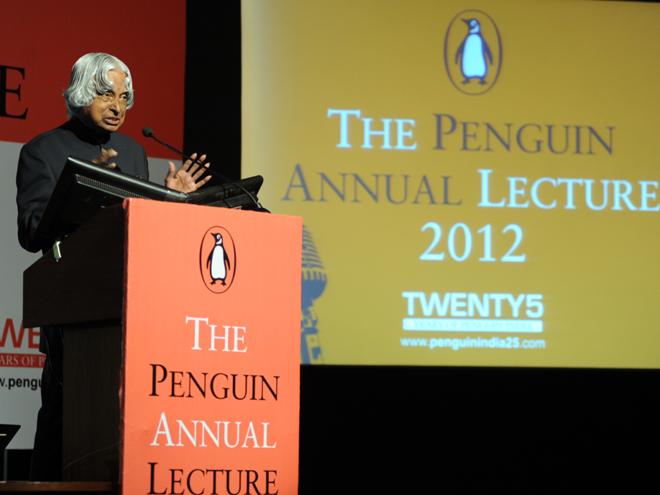
Former President-turned best-selling writer APJ Abdul Kalam uncovered a 10-point agenda for India beyond 2020 as a nation where the rural and urban divide will be reduced to a thin line, distribution of wealth will be equitable and education and value system will not be denied to people. The unveiling was performed on Tuesday.

The 10 commandments included “a responsive and transparent government”, “access to healthcare” and “sustainable growth”.

Outlining his vision of a shining India of the future at the Annual Penguin Lecture Series 2012, “Beyond 2020: Sustained Development Missions For the Nation”, Kalam said “sustainable development of the nation was the essence of India beyond 2012”.

Three aspects were the key to ensure sustainable development of the country, Kalam pointed out.

The nation needs “a steady economic growth of 9 per cent with minor variations of 1.5 per cent to 2 per cent”. The job profile of the future was “futhering of the technological nature of business and market aspirations” for sustainability that would provide continuous income and growth assurance in such a situation, the former president said.

“For millions of years, humanity has been taking more and more resources from the nature. Time has come to take less and less from nature to achieve sustainability, the formula for which is ‘a+b+c’. It will lead to well-being of the people and continuous growth,” he said.

The ex-missile man, who has been working on sustainable model for civic amenities in rural India under the project “Provision of Urban Amenities in Rural Areas (PURA)” since 2003, said it could improve the lot of 700 million people who live in 600,000 villages of India by developing systems that would “act as enablers” for inclusive growth.

He said “physical connectivity, knowledge connectivity and electronic connectivity” could bring “economic connectivity” to people in the rural areas by acting as broad enabling systems.

Kalam cited a new concept — user connectivity pyramid — to implement “integrated solutions needed for technologies and applications to be sustainable”. He said “Societal Development Radar” — another new apparatus that he was trying to give shape — could become a watchdog by “monitoring and reviewing the user connectivity pyramid”.

Explaining the nature of the user connectivity pyramid, the former president said it was built on “natural resources, info-communication, convergence of technology, societal business model, applications and at the bottom end, the users”.

He used Uttar Pradesh with its population of 100 million young people as a case study to explain his development model.

Lauding the role of publishing houses, the former President, who has authored books like the “India 2020: A Vision for the New Millennium”, “Ignited Minds” and “Turning Points: A Journey Through Challenges” said big publishers like Penguin could become partners in the country’s development success story by “presenting more researches and papers on the country’s success stories in the development in the form of books and e-books”.

source: http://www.pardaphash.com / Home> Education / by Vishal Srivastav / Tuesday, December 18th, 2012
Chennai’s Velammal to the fore

Chennai’s Velammal Matriculation Higher Secondary School bagged the lion’s share of medals in the 1st National School Chess Championship held at the Ludlow Castle Sports Complex in the capital.

Velammal made a clean sweep in the Under-17 and Under-15 team championships and topped the Under-13 and Under-9 categories.
In the individual championship also most of the medals were bagged by the Velammal students.

In all, over 600 school children participated in the 14 various individual categories ranging from U-5 to U-17.
Host city Delhi had something to cheer about in the Under-5 category where Garv Rai of Modern School, Vasant Vihar, won the gold medal.
Amongst other aspirants from the city, Nishant Malhotra of Bal Bharti School, Dwarka, took silver in the Under-17 open category, as did Manan Rai of Amity International School secured the same medal in the Under-13 section, Sarthak Mahajan (Under-15) and Aansh Gupta (Under-11).

Manpreet Singh, Harshal Shahi, Aarchi Agarwal and Abir Sinha won bronze medals in their respective categories.

source: http://www.DeccanChronicle.com / Home> Channels> Nation> North / by DC Correspondent / November 01st, 2012

Seeing through the world of sounds

Coimbatore:

S Sabari Venkat is just like any other smart 10 year-old-kid with a sweet smile and a sharp mind ready with an answer to almost every question thrown at him. But sit with him for two minutes and the truth will hit us like a sharp slap across our face. This fifth standard student who is also one of the class toppers is flashing the smile at us from his inner world which is constantly black, devoid of colours and any optical sense of recognition. Sabari was born blind in both eyes and though his retina’s react to light flashed at his left retina, it does not reach him since he is suffering from more than 90%  blindness in his left eye and total blindness in his right eye. Sabari had accompanied other differently-abled children to an event held at a private hotel here in the city.

“It was very good experience all of them said good things to me,” says Sabari at his residence near Perianacikenpalayam.

Later in the day as we entered his modest rented house comprising of two rooms and a kitchen adjacent to a private marriage hall in the locality, Sabari was tinkering with the volume switch of the television set. He constantly sits in front of the television and ‘listens’ to the programs aired on various channels, especially those which telecast cartoons. With great concentration and excitement he sits in front of it and draw faces and shapes to the conversations and sounds from the TV speakers in his mind

“He sits in front of the television and follows the conversations very keenly. He stays completely glued to it often,” says K Sreenivas, Sabari’s father.

Sabari is presently a student of Ramakrishna Mission Vidyalaya Swami Shivananda Higher Secondary School near Perianaickenpalayam along with normal children. He still manages to be one of the top scorers in the class often in the second or third position. The school authorities also support him in his academics and a teacher from the institution helps as his scribe during examination. Sabari is also a good orator and has won several competitions for chanting shlokas from Bhagavad Gita. He also regularly dresses up as Swami Vivekananda and is greatly inspired by his teachings narrated to him by his father K Sreenivas and his teachers.

“Swami Vivekananda lived for just 39 years but managed to achieve great things within that short span. Not everyone is able to do so in life,” says Sabari.

K Sreenivas, an agrarian and his wife S Neelaveni waited long for the birth of their first child and was initially shattered when they were told that Sabari will not be able to see them or anything else around him after his birth.

The couple was earlier residing near Kozhinjampara near Pollachi along the Kerala-Tamil Nadu border but they decided to sell of their agriculture land and relocate to Coimbatore city to ensure that Sabari is not left behind either in his education or medical treatment under any circumstances. The couple had tried to bring light to at least one of his eyes and tried to get his left eye treated. Though doctors diagnosed him with cataracts and an ensuing complication called Synechia which could not be completely cured so far.

“We used to live in a semi-rural area and in those places if there is a handicapped kid in the family people tend to talk about it constantly. Some do it out of sympathy, some because of superstition but we made a decision that our son need not grow up listening to it and so we came to Coimbatore,” Sreenivas adds.

source: http://www.TheHindu.com / Home> City> Coimbatore / TNN / September 16th, 2012

Farm tourism is in

Farm tourism seems to be the in thing for locals and tourists coming to the city. We explore.

Who would not want to wake up to the chirping of birds and soothing morning breeze? With farm tourism becoming the in thing in the city, farmhouses around Trichy are gearing up to provide that unique experience to the tourists.
These farmhouses seems to be popping up in every nook and corner of the outskirts of the city and those who have been yearning for that rural experience are all heading to spend their weekends there.
Sriram Krishnamoorthy, who owns a farm house in the city, says that he had always wanted a place to spend quality time with family away from the city. “Trichy is blessed with fertile soil, so when I invested in a house outside the city, I also made sure to cultivate the surrounding areas. I visit the farmhouse along with my friends and family. We just go there cook, eat, talk and relax, far away from the maddening city crowd.”
Such farm experience packages are gaining popularity in the city and travel agents are cashing in on the trend. Whether it is to explore the city’s temples, go trekking or relax under the monsoon weather, Trichy’s farmhouses have everything on board, “We have a group of Swedish students who visit us every year and stay with us to understand the Indian culture better. They return home inspired after looking at our lifestyle. So I provide them with the  essence of rural India by taking them to the nearby villages in Trichy,”says Santhanam Rajagopalan, an environmentalist.
Augustus Manimaran, a construction engineer who owns one such house, which is built with environment-friendly materials says that he is having the time of his life. “I have always wanted to retire peacefully and my farm house is my dream project. I have begun taking a walk around the place with my dog, visiting the place with friends and relaxing in nature’s lap.”
Constructed beautifully and nestled in acres of  paddy fields Augustus, has also allowed it for commercial renting. “Not everyone can afford to build such houses, so renting them out for commercial purposes, has now caught the city by storm,” he says.
Jerome Francis, an engineering student says that it’s great break and transports them in to a different world altogether. “Such retreats are great for friend’s reunion, we meet up in one of my uncle’s houses, which has a pool and is surrounded by lush greenery. We spend the day there just catching up on old stories.”

source: http://www.timesofindia.indiatimes.com / Home> Life & Style> Travel / by Nuvena Rajendran, TNN / September 15th, 2012

Desal plant gives life to Madurai village

Madurai:

With villages that used indigenous methods of water harvesting and storing being forced to look for alternative means, Kottanathampatti in Madurai is jubilant as it has been given a desalination plant to address its drinking water needs.

Kottanathampatti, identified a model village in the district, boasts of self-sustenance but for potable water. Relief came on Saturday when a desalination plant put up at a cost of Rs 6 lakh started functioning. The plant has an automatic dispenser that supplies 18 litres of water for Rs 2. The villagers need to drop in two one-rupee coins and collect the water from the plant, that has a capacity of 5,000 litres.

“The villagers can also have a pre-paid account, wherein they should pay Rs 100 and get their fingerprints registered. These people need not pay every time they want water. Instead, they should identify themselves in the fingerprint reader and collect water. The idea of the project is to ensure potable water for all villagers,” said collector Anshul Mishra who inaugurated the plant.

This is not the first time desalination plants have come to the rescue of drinking water-starved villages in Tamil Nadu. The villagers of K Ramanathapuram in Dindigul district have established a community-funded desalination plant to turn the highly saline ground water to consumable standards.

Mishra said the district administration was gearing up to implement similar projects in other villages too.

The district administration has selected one village in all unions and was addressing the needs of the people there, he added.

Kotanathampatti was chosen as a model village by former collector U Sagayam to show the way of self sustenance and development with assistance from the local body and the district administration. The village has also begun a green cover drive aimed at improving the groundwater table. To begin with, each of the 3,000 households have planned to raise one tree.

Another key aspect of “project self sustenance” is to make the village 100 per cent literate by ensuring that there are no dropouts. K Kandappan, panchayat president, notes that though the village was endowed with adequate resources, potable water was the only major problem.

With the desalination plant, that problem has been addressed and now the village is also planning to go in for solar power production.

source: http://www.articles.timesofindia.indiatimes.com / Home> City> Madurai / by M Mayilvaganan, TNN / September 09th, 2012

Devotees throng Shrine Basilica at Velankanni

Nagapattinam (TN), Sep 7 (PTI)

Thousands of devotees from various parts of the country today thronged Velankanni in this district to witness the illuminated Grand Car Procession at the Shrine Basilica.

Prior to the car festival, the holy flag was hoisted. After special prayers on the theme “Mary -refuge of Sinners” conducted by Archbishop Salvatore Pennacchio and Bishop of Thanjavur Devdoss Ambrose, seven illuminated cars in various sizes were taken in a procession.

source: http://www.ptinews.com  / Home> National / by Staff Reporter / September 08th, 2012

Meet the Halai Memons of Madurai

Madurai:

The Halai Memons migrated to Madurai from Ranavav, situated close to Gandhiji’s birth place Porbandar in Gujarat in the 1870s for trade and business purposes. Incidentally, it was a Memon who took Gandhiji to South Africa for the first time.

Established in 1878, the Hajeemoosa store is a famous landmark in Madurai, situated near the east gate of the Sri Meenakshi Amman temple and still continues to be patronized by people from Madurai and many southern districts. M Ismail Omar, the present owner of the store says that his forefathers realized the great potential that Madurai had in terms of trade and started establishing their businesses here. The present store has many floors, but originally it was established as a small 100 sq feet shop. Many of them established their shops around the temple and flourished as they were well versed in the textile trade. These merchants were the connection to the outer world, as their goods included fabrics exported from across the world, making them much sought after by the elite.

Though reluctant to come to Madurai at first and leave their relatives behind, the ladies soon followed their husbands and started adapting to Madurai, as the journey back and forth from their hometown took many days. Their counterparts, the Sourashtrians, came forward to rent their homes to them when they first started settling in Madurai. Even today both communities continue to maintain close ties.

As their trade flourished, the Halai Memons reduced the number of visits to Ranavav as they could not leave their work in Madurai unattended. Ismail says that he has never been to his native place. But many still continue to visit their hometown for family functions and weddings.

People of this community make sure that their children converse in their language called Memoni, a mixture of Gujarati and Sindhi, right from the beginning. Weddings are a time to showcase their cultural and traditional art forms like the dandiya dance. All the 350 families of this community who live in Madurai are members of the Halai Memon Association, which has one of the oldest marriage halls in the city constructed in 1965. They rented out the premises to the people of Madurai for a very nominal cost, even when marriage halls were not constructed here.

Being pious Muslims, they celebrate and observe the festivals of Ramzan Eid, Eid-ul-Azha and Milad-un-Nabi, with a lot of religious fevour. Ramzan feasts are grand affairs with traditional delicacies and include dates brought all the way from Saudi Arabia.

The founder president of the Tamil Nadu Textile Merchants Association A C Mohammed, belonged to this community. His contribution to the development of the textile trade in Tamil Nadu is still remembered by the textile industries. He was also the founder member of the Rotary Club of Madurai, which is celebrating its centenary year this year and is the second oldest club in Tamil Nadu.

This community is also known for its charitable nature, contributing in a big way to orphanages, hospitals and the members are active members of the Rotary, Lions and Jaycees clubs. Today, the Halai Memons constitute an important part of Madurai, helping the city make significant strides towards development.

source: http://www.timesofindia.indiatimes.com / Home> City> Madurai / by Padmini Sivarajah, TNN / July 31st, 2012

Endangered 750kg stingray snared

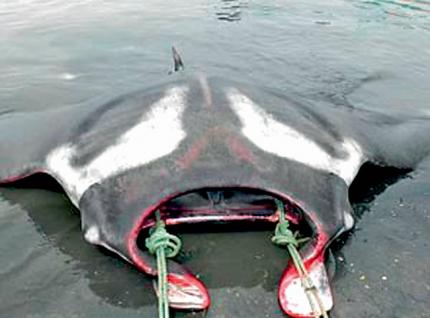
A massive stingray, weighing 750 kg, was caught by fishermen in the coastal waters of Pazhaverkadu near Ponneri and dragged for over 10 hours to the shore in the hope that the endangered fish would fetch them several thousands of rupees in the market.

Giant stingrays are often in demand for their medicinal value and their skin, which is exported by dealers in Royapuram.

“Stingrays often get caught in the fishing nets and the smaller ones are even eaten, but this is the first time that we have netted such a huge one, ” said Anthony Raj, a local fisherman. Increased trawling activity has endangered several types of sharks and stingrays, but protecting them continues to be a difficult task, as in most cases the fishermen are not aware of the fish trapped in their nets, say locals.

“Neither the Zoological Survey of India nor the state forest department has done anything to educate the fishermen on this endangered fish species,” rued a senior biologist of the forest department.

Pazhaverkadu, a backwater lagoon, is rich in biodiversity and famous for its large mud crabs. The fish catch in the area, which has fallen over the years , has been the subject of research papers of several marine biologists attached to the Zoological Survey of India at Santhome

source: http://www.asianage.com / Home> Metros> Chennai / by C. S. Kotteswaran / DC / Chennai, July 05th, 2012

Videocon to start operations in Manamadurai unit in 3-4 months

The company has invested around Rs 700-800 crore for the plant

The electronic consumer durables manufacturing facility of Videocon Group in Manamadurai, at Sivaganga is likely to start operations in next three to four months, said Rajkumar Dhoot, managing director of Videocon Industries. The project has been proposed to complete with an investment of around Rs 1,600 crore.

Speaking to reporters in the sidelines of Vision Tamil Nadu,a seminar organised by Assocham, he said, “The plant would be ready for operations in next three to four months. We have so far invested around Rs 700-800 crore for the plant.”

The new facility would be manufacturing various consumer electronic products including washing machine, refrigerator and colour television.

There was some delay in completion of the project, due to the economic slow down and related issues. However, the works are on full pace now, he said.

The company would also look at exporting the products from the facility to overseas. It has identified demand in exporting electronic consumer durables to countries like Indonesia and Malaysia.

According to reports in 2009, the State Industries Promotion Corporation of Tamil Nadu, the government agency which allots land for industrial projects, has allotted around 70 acres to Videocon to set up the plant in Manamadurai. The company currently has a manufacturing facility in Hosur.

The company is the largest manufacturer of colour television in India and though the market for cathode ray televisions are shrinking, it still has shortage in supply in states like Tamil Nadu and Karnataka, said Dhoot. The Manamadurai plant would initially create employment opportunity for around 500-700 people.

source: http://www.business-standard.com / Home>  Companies & Industry / by Gireesh Babu / Chennai, July 04th, 2012

‘Awareness about diabetes needed’

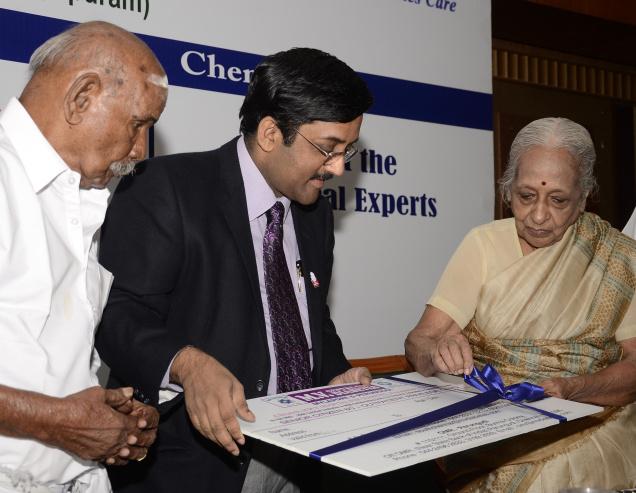
 A privilege: Dr. Shanta and Vijay Viswanathan, MD, M.V. Centre for Diabetes, handing over the Senior Citizen Outpatient Privilege Card to 99-year-old Ramasamy (left).  Photo: K.V. Srinivasan / The Hindu

Chennai:

“Lack of exercise, consumption of fast-food, obesity and sedentary lifestyle can lead to diabetes,” said V. Shantha, Chairperson, Cancer Institute.

Speaking at the launch of M.V. Centre for Diabetes, Senior Citizen Outpatient Privilege Card at M.V. Hospital for Diabetes, Royapuram, on June 16, she said that the number of people with diabetes in India was high when compared to other countries.

“The medical fraternity has moved from cure to control. Prevention should be given more importance in non-communicable diseases such as cancer, diabetes and cardio-vascular diseases.

“There is lack of medical care and medical insurance in non-communicable diseases. Care, cure and control should be the focus in non-communicable disease than treatment and management,” she said.

“Diabetes is more of a lifestyle disorder that can be attributed to modifiable risk factors such as lack of physical exercise, obesity and eating junk food.

Awareness and education on diabetes must be done on a large-scale, which should be a continuing programme,” Shanta pointed.

Adequate diabetic control and participation of family and physician is important in diabetic care and preventing health complications, she noted.

M.V. Hospital for Diabetes Managing Director, Dr. Vijay Vishwanathan, said that 4.6 million people died around the world in 2011 due to diabetes, of which 50 per cent of people were below the age of 60.

“India spends 31 billion on diabetic care. Around 60 million people in India are estimated to have diabetes. In India, diabetes patients have to spend money from their own pocket whereas in the United States of America, patients can avail themselves of health insurance policies,” he said.

The hospital launched the Privilege Card for senior citizens aged 80 and above in M.V. Centre for Diabetes, Mylapore and Perungudi, where it would provide a concession of 50 per cent.

The cynosure of all eyes was 99-year-old P.V. Ramasamy of Sivaganga district, who has been suffering from diabetes for the past 25 years. He said that diet control, daily exercise and regular intake of medicines have helped him to live a longer life. More than 20 people, who are 80 years and above and surviving with diabetes, were honoured on the occasion.

source: http://www.TheHindu.com / Home> Health / by T. S. Swaminathan / Chennai, June 24th, 2012