Three students to take part in Minifootball World Cup

Three students from the Government Arts College in Udhagamandalam have been selected to take part in the Under 21-Minifootball World Cup – 2018, to be held in Prague, the Czech Republic, between October 4 and October 7.
After an intensive selection process, Praveen Iveen, Ravi Chandran Rahul and Ajith Kumar, have been chosen to represent India.
Sponsors sought
The Government Arts College professors congratulated the students, and also called for sponsors to help them travel to the Czech Republic to take part in the tournament.
source: http://www.thehindu.com / The Hindu / Home> News> Cities> Coimbatore / by Staff Reporter / Udhagamandalam – September 26th, 2018
Flowers bloom in the Cauvery delta rice belt
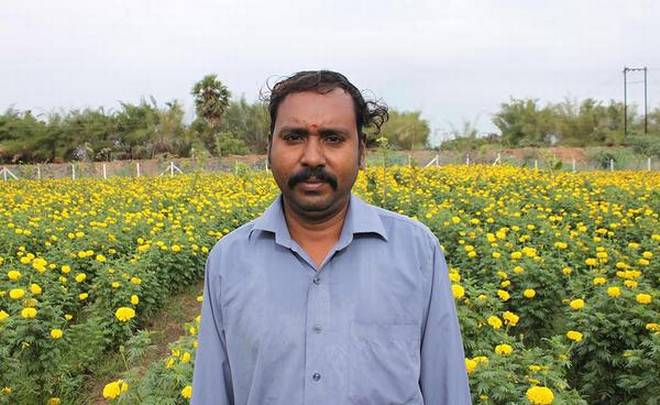
Mannargudi farmer shows an alternative to water-intensive crops
When K. Marimuthu decided to cultivate yellow marigold, a flower in demand for garland-making, instead of paddy in Mannargudi, situated in the Cauvery delta rice belt, other farmers warned that he was taking a risk.
“But I proved them wrong. I have harvested eight tonnes [of marigold] even though those who supplied the saplings predicted that the yield would be between three and five tonnes,” said Mr. Marimuthu, who has already started experimenting with cultivation of other flowers, including kozhikondai poo (hen’s horn flower), jasmine and sambanki (Magnolia champaca).
Garland-makers in Mannargudi regularly buy flowers from Thanjavur and Tiruchi. Mr. Marimuthu’s experiment fulfils local needs and the money needed for transportation is saved.
He also opted for drip irrigation and, in the process, saved about 80% of the water that would have been required for paddy cultivation. “The profit is also very high. I would have earned a maximum ₹20,000 per acre [cultivating paddy]. Marigold has so far earned me ₹1.5 lakh, after all the expenses, including labour, pesticides and fertilizers,” said Mr. Marimuthu, who buys saplings and manure from farmers in Hosur.
He planted 25-day-old plants and the yield began from the 60th day. Though marigold continues to yield for 120 days, he was able to extend flowering up to 145 days. “The only problem will be rain. We can save the saplings by giving them support, but flowers will not tolerate heavy rain. We will learn the art of floriculture through experiments,” he said, adding that a few farmers had already taken a cue from him and begun cultivating flowers.
Mannargudi MLA T.R.B. Raja, who has been advocating the idea of switching to alternative and less water-intensive crops, agreed.
Roping in experts
“Forget Cauvery water. Climate change is a major factor. Heavy dependency on water is not possible,” said Mr. Raja, who had already consulted experts from Israel and is planning to rope in their expertise in a big way.
He said there was a need to change the mindset of the people and farmers in the Needlamangalam area, who had successfully cultivated cotton crop, even though the workforce for plucking wasn’t adequate.
Reiterating that “precision farming” was the way forward, he said farmers who cultivated paddy in the Kovilveni area were waiting for the government to open procurement centres, and gradually fell prey to middlemen. “Heavy use of fertilizers for paddy has already killed the soil. Let us opt for alternative crops like millets, cotton and flowers. They will help replenish the soil,” he said.
source: http://www.thehindu.com / The Hindu / Home> News> States> Tamil Nadu/ by B. Kolappan / Chennai – September 05th, 2018
26
25
24
23
22
Evolving with time: down the memory lane with Evam’s founders
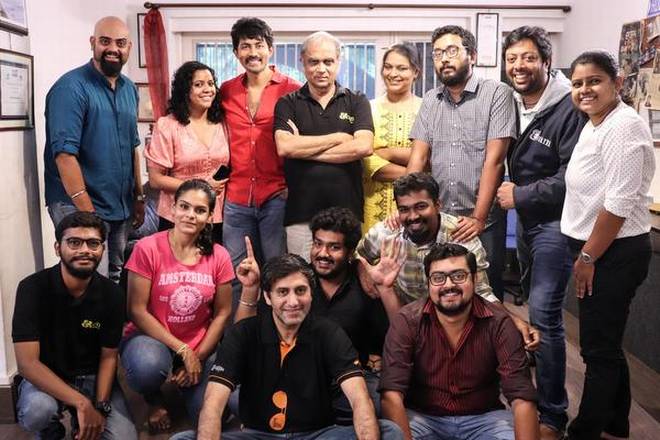
As city-based theatre group Evam turns 15, the founders look back in wonder
The quaint little studio space has a corner, which the team fondly refers to as ‘soapbox’. In the background is this intimate performance space adorned with fairy lights and illustrations — one of Evam’s newest initiatives conceived to make performance spaces more accessible. As I observe, the founders, Karthik Kumar and Sunil Vishnu, prepare to engage in a candid conversation. Through the course of the interview, we hear squeals of excitement from inside. Minutes later, one of the team members, walks out, rings a bell to grab our attention and declares, “The second ad for Evam is through!”
A couple of high-fives later, the conversation continues.
This is just a peep into what interests Evam at this very moment. Fifteen years since its inception, Evam strikes a perfect balance between the arts and business by drawing focus on to how the arts could cater to a growing business model, contrary to popular belief. As Sunil puts it, “We really don’t know what we are going to do in another 15 years. A lot of things that we do now, was not part of the plan at all. It’s really dynamic also because of the world we live in.”
The story dates back to when Karthik, a chemical engineer from Chennai and Sunil, a B.Com graduate from Bhopal met at Mudra Institute of Communications (MICA), Ahmedabad, where they were pursuing their MBA in Marketing Communications. “We used to pass notes in classes. Evam was one such note which was passed saying that we should do this for a living someday,” smiles Karthik. After reviving the college theatre group, Sankalp, the duo put up five plays in the course of two years in MICA. Soon enough, they realised putting a play together was easy; the real challenge was what went into the management of a production. In an effort to generate seed capital, they worked their respective corporate jobs for a couple of years. In 2003, Evam was born.
As they continue to narrate the story, Karthik points to the framed poster of their first-ever play as Evam, Art. ‘Sold Out’, the poster said. “We came together and started preparing for a three-play package. We tried selling it to sponsors and it took us almost six months before we actually could put it out,” recalls Sunil. Karthik chimes in, “The tough part was to market, sell tickets, arrange a team that could handle the logistics. Our first team consisted of six people”
Fifteen years down the line, Evam is now about 42 employees strong in addition to the 60 odd volunteers spread across different cities. “Two years of working, planning and saving up amounted to this,” says Sunil while Karthik reminisces about a book he had read. “Alyque Padamsee’s Double Life talked about how he juggled being an ad man and a theatre practitioner and became successful in both. We were not ready to believe it, we wanted to be full-time something and decided to give it our best shot possible,” says Karthik who also recently released a book titled Don’t Startup: What no one tells you about starting your own business. Don’t Startup…is written from the perspective of first generation entrepreneurs who knew nothing aboutentrepreneurship . “The book speaks about a lot of things that nobody tells you when you start-up. It is a little story about how we started out with what people believed we could not make a living out of, and yet we did,” he continues.
Few years into the business, Evam started discovering how theatre as an art form could weave itself into different scenarios. This thought is essentially what led them to branch out to initiatives that used theatre as a tool. “The truth is that we knew theatre and what it could do and started discovering it for ourselves,” says Karthik. Currently, under the canopy of Evam, multiple initiatives that embody this balance, have taken shape — Training Sideways, Standup Tamasha, Happy Cow, Digie, FirstRush, Brain Drama and Live — each headed by a team member. Now, Evam’s focus has shifted to what the market demands; putting up huge productions for public viewing has taken a backseat. Sunil says, “Ultimately, the constant thought is to do something exciting which is also relevant to the times. The question would be, if I have one day to spend, where am I going to spend that day to make it exciting, artistically great and is profitable at the same time.”
source: http://www.thehindu.com / The Hindu / Home> Entertainment> Theatre / by Gowri S / September 20th, 2018