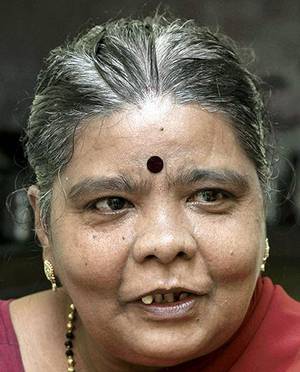
This volunteer helps the needy people in getting justice
When she is not attending to her duties as the leader of her Self-Help Group Federation at DHAN Foundation, S. Senthamaraican be seen reading legal procedures in India. This 54-year-old legal aid volunteer works twice a week at several clinics stipulated by the District Legal Services Authority. She provides counselling and direction to people belonging to low-income groups, who come to places such as offices of the Commissioner of Police, Superintendent of Police, district court, High Court, Madurai Collectorate and Social Welfare department in search of justice. She tells Sanjana Ganeshthat in the six years of volunteering service, she has seen a wide range of helpless people from the lowest rungs of society.
Having come from a humble background herself, she says connecting with their plight came easily. “I struggled to make my children study because my husband had a lot of debts. I joined the DHAN Madurai Federation with several other women from my community. Soon, I picked up and eventually became their leader. The senior people at the DHAN Foundation felt I had legal acumen and sent me for a two-day camp. After that, I began volunteering at Legal Aid Clinics,” she says.
For Ms. Senthamarai, the legal world has been her greatest learning curve yet. Her interest has grown with time, along with apathy for the voiceless. She provides counselling and shows people directions to legal courses. She helps in getting the right guidance for resolving disputes in courts, tribunals or other authorities. She also helps petitioners in finding lawyers who take up their cases pro-bono or for a meagre sum.
She focuses on civil cases such as property disputes, education loan issues and motor accident claims. Her area of interest, however, is women’s welfare. “I once helped a woman whose husband cheated her, sold her kidney, her jewellery and house because he had many loans. He went to Dubai and abandoned her.
When she realised her folly, she went to Dubai in search of him, but could not find him. After some clandestine work at some houses to feed herself and her two children, she was deported as she didn’t have valid documents. “At this stage, I helped her procure Aadhaar and family cards. This case changed my life,” Ms. Senthamarai says.
As a basic piece of legal advice, Senthamarai amma (as she is fondly called), says: “Read all your documents before you put your signature.”
source: http://www.thehindu.com / The Hindu / Home> News> Cities> Madurai / May 28th, 2018
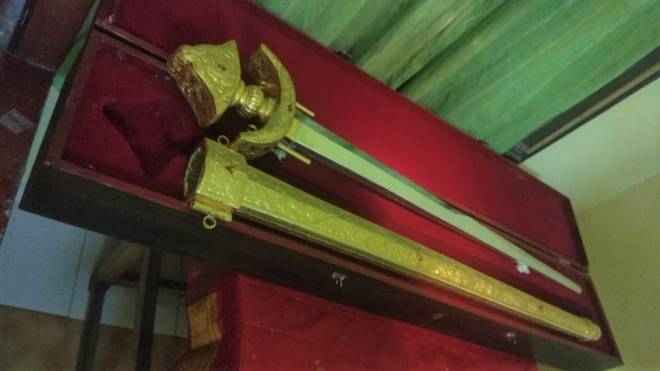
The swarna surya katari that was donated to the Tirumala temple on Tuesday. | Photo Credit: G.P. Shukla
Thanga Dorai, a noted textile merchant from Teni, Tamil Nadu, on Tuesday donated a golden sword worth ₹1.75 crore to the famous hill temple of Lord Venkateswara on Tirumala.
About six kilograms of gold is estimated to have gone into the making of the golden sword or ‘surya katari’.
Mr. Dorai handed over the precious offering to the temple authorities during the Suprabhata Seva early this morning.
source: http://www.thehindu.com / The Hindu / Home> News> States> Andhra Pradesh / by G.P. Shukla / Tirumala – May 29th, 2018
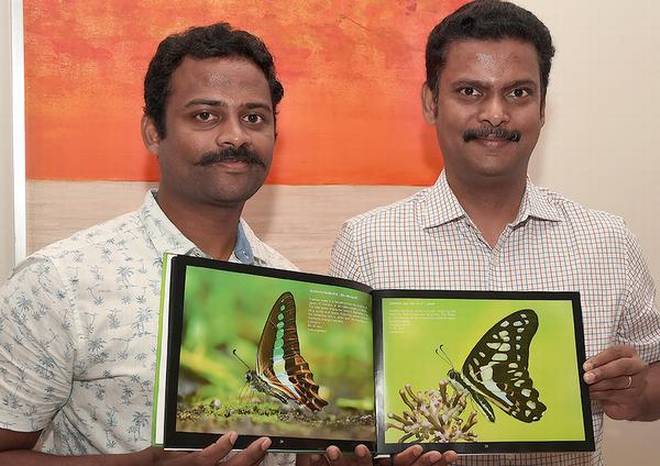
P. Mohanprasath and N. Satheesh with their book Butterflies of Tamil Nadu in Chennai. | Photo Credit: K.V. Srinivasan
It is the culmination of a two-year project
Did you know that Tamil Nadu has 326 species of butterflies identified so far? And did you know that the fragile vannathu poochi (or pattaam poochi) we chased as children are important ecological indicators?
“If you find butterflies in parks or in your gardens, it means these areas are fine for living. Butterflies are very sensitive to environmental changes and will migrate if they cannot survive,” explains N. Satheesh, Conservator of Forests, Tamil Nadu Forest Plantation Corporation Limited (TAFCORN), Tiruchi.
Mr. Satheesh, along with P. Mohanprasath, who works with the NGO, Act of Butterfly, has authored a book titled Butterflies of Tamil Nadu. Volunteers with the Act of Butterfly study the activities of the pretty insects, including their annual mass migration.
The book, with colourful photographs of 316 species found in the State, was recently released in the city.
The culmination of a two-year project, the book explains the ecological role of butterflies, their life cycle, and a list of 32 butterfly ‘hotspots’ in the State. It would make a good addition to any library.
Tamil Nadu has two butterfly parks — one in Srirangam in Tiruchi, and another in the Arignar Anna Zoological Park in Vandalur near Chennai. “If you want to watch butterflies, the best time is either between 6 a.m. and 9 a.m. or from 3 p.m. to 6 p.m. When it’s hot, they would rather hide in the shade than flit around in the sun,” Mr. Satheesh says. The book is priced at ₹ 900.
Copies can be purchased at the Forest Department office in Saidapet after a few days.
source: http://www.thehindu.com / The Hindu / Home> News> Cities> Chennai / by Deepa H. Ramakrishnan / Chennai – May 29th, 2018
The two new coir clusters recently set up at Uthiyur and Puliyampatti through government and beneficiary contributions is all set to provide employment to 320 artisans and increase the turnover from the said regions by ₹10 crore this financial year.
The targeted developments in terms of revenue and employment are planned to be achieved by undertaking cluster development activities to the tune of ₹8.55 crore, which would be a combination of grants from Union government and beneficiary contributions.
Of the outlay, the government grant portion was ₹5.78 crore.
“We are aiming to increase the turnover from the Uthiyur region from the present ₹27.6 crore to ₹31.74 crore before the end of the current fiscal year through an annual production of 8,760 tonnes of matting and biodegradable coir geo textiles like soil erosion control woven blankets”, Anitha Jacob, deputy director of Coir Board, which is the nodal agency of cluster activities, told The Hindu.
Similarly, the cluster activities at Puliyampatti region would be catapulting the turnover from the present ₹34.06 crore to a projected ₹39.16 crore in the current financial year through a combination of exports as well as domestic sale of products like coir pith and coir growbag.
Common facility centres
As part of the cluster activities, common facility centres were set up at both the clusters where the artisans could collectively use provisions such as fibre extraction equipment, growbag manufacturing gadgets and pith block making facility, among others.
The numbers of units involved in the manufacturing of various coir products too were expected to go up by another 10 to 20 units in each of the clusters because of the enhanced support.
Special purpose vehicles
To streamline activities, Special Purpose Vehicles have been constituted in two clusters with the representation of beneficiaries and officials from the Coir Board and ITCOT Consultancy Services.
source: http://www.thehindu.com / The Hindu / Home> News> Cities> Coimbatore / by R. Vimal Kumar / Tirupur – May 28th, 2018
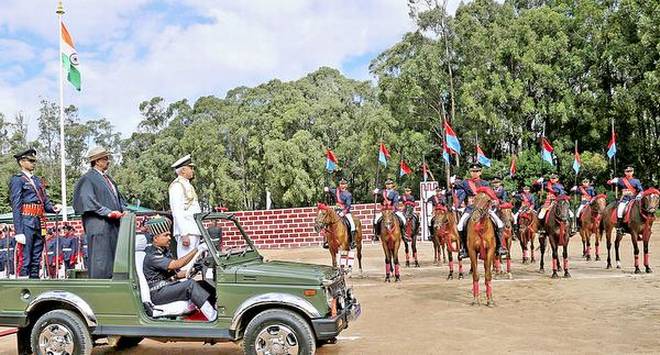
Chief of the Naval Staff Admiral Sunil Lanba reviewing the parade at Lawrence School, Lovedale, on Saturday.
The Lawrence School in Lovedale, under the aegis of the HRD Ministry, celebrated its 160th Founder’s Day on Saturday.
Following exhibitions in Science, Math, Art and Humanities, an Equestrian Display by the School’s Riding Club and an English play, “Peter Pan” was staged on Friday.
The second day of the celebrations commenced with the parade, keeping in line with the military antiquity and tradition of The Lawrence School, Lovedale.
Chief of the Naval Staff Admiral Sunil Lanba inspected the parade along with Headmaster Rajan Narayanan.
The Beating Retreat marked the end of the 2nd day celebration.
source: http://www.thehindu.com / The Hindu / Home> News> Cities> Coimbatore / by Staff Reporter / Udhagamandalam – May 27th, 2018
It’s a hot, uninviting terrain but it is here that the Madurai malli thrives and grows
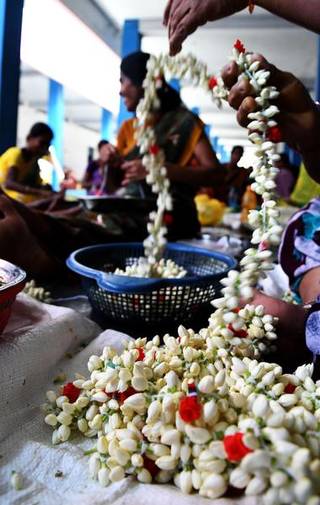
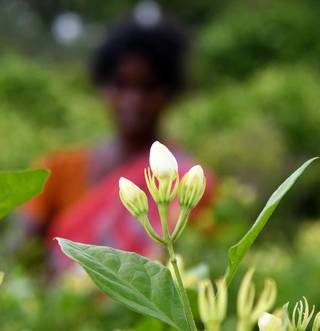
Off the Madurai-Aruppukottai highway, a little away from the airport, a road winds through solitary palm trees. On either side is burnished landscape in various shades of brown glistening in the summer sun. Shielded within this terrain are acres and acres of fields dotted with dark green plants — the Maduraimalli. Groups of women are at work, plucking flowers and weeding, and by 10 a.m., they are done for the day.
“A good worker can make about ₹7,000 a month,” says M. Ramar, 42, who owns about 12 acres of land in the tiny village of Melaupplikundu. His wife, Lakshmi, also works with the women in the fields, and their day begins as early as 3 a.m. Armed with headlamps, they make their way to the farm to pick the plump white buds and don’t stop until it’s time for the morning rice gruel.
By 10 a.m., Ramar completes five trips to the flower market in Villapuram, carrying 20 kilos of flowers on his motorcycle. It’s about 20 km from his village to the market, and Ramar zips on the highway. Even the smallest delay can cause the buds to unfurl in the heat.
Ramar is one of the hundreds of farmers in the district that’s famous for the Madurai malli, the jasmine with a GI tag. Madurai and Dindigul together have some 2,000 hectares under cultivation.
But Madurai is only the second home of the eponymous flower. Its birthplace is actually a tiny village called Thangachimadam on Rameswaram island, some 160 km or four hours away.
****
It all began in the summer of ’50. Betel leaf armer T. Subbiah Kumar stepped out of his home in the blinding light. The cool sea breeze had long dissipated and Thangachimadam, just 3 km inland, was simmering. Farmers in this little speck of a village lived off the cultivation of betel leaves. Lost in thought, Kumar made his way to the farm. Of late, men from the island had been steadily leaving for the mainland in search of work. Betel leaf cultivation being labour intensive, Kumar was finding the going hard. He planned to visit Coimbatore Agricultural College soon, hoping to get a new high-yielding variety.
___________________________
The paper trail
In 1962, The Hindu started using an Indian Airlines special flight to transport bundles of the newspaper to the temple town of Madurai. By September the next year it had bought its own aircraft, a Heron. The then small military airport in Madurai was used to land the plane and offload the bundles. As the aircraft had to return empty, it struck someone that jasmine flowers could be loaded in it for the export market. Nagarathnam of S.N. Exports chuckles. “It was The Hindu that opened up the world market for Madurai malli.”
_____________________________
The visit did take place and it changed not just Kumar’s life but also the landscape of Thangachimadam. In the agricultural college, he saw a jasmine plant being layered and, on a whim, brought back one sapling for the women at home. Once the plant grew, instead of propagating it using the layering method, he just cut a stem and plonked it a little distance away.
In a few weeks he was stunned to see the stem sprout a lush growth of tiny new limbs. In no time, his farm was teeming with rows and rows of jasmine saplings. At this time, jasmine farmers in Madurai and its peripheries were using only the layering method to propagate the flower. It took a long time for the plant to take root in the gravelly earth with its thick under-layer of clayey soil. Though the perfume was heady, the flowers were few and enough only to supply the local market.
One day, S. Nagarathnam, a flower-seller’s son who owned a few acres of farmland in Madurai, stumbled upon the Thangachimadam saplings. He planted a few on his plot and found that not only did they take root immediately, they also flowered profusely.
According to Kumar’s son Thavasi, who now runs a nursery in Thangachimadam, this realisation was the eureka moment for the Madurai malli. As we talk, he bends down to tug at a little sapling and uproots it for me to see. There is one primary root hidden in a maze of secondary roots. The sandy terrain and loose soil help the roots penetrate deep and proliferate. Till the saplings take root, coconut fronds are woven and layered like a shamiana to protect them from the harsh sun.
Once fresh leaves spring forth, the fronds are removed and the plants bask in the heat. In three months, the saplings are uprooted, tied in bundles, and sent for replanting, some as far away as Mumbai.
But without a doubt, the jasmine is at its seductive best only in the hinterlands of Madurai. Replanted here, the hundreds of secondary roots cling to the gravelly soil while the primary root goes deep into the clayey soil. In this uninviting terrain, the Madurai malli is reborn, hiding a heady perfume within its thick petals.
****
It is in summer that jasmine thrives. Of course, the plants need plenty of water. Like other farmers, Ramar too has deepened his borewell and invested in drip irrigation. The regulated supply helps the plants, he says.
A three-acre plot is divided into three sections, with plants in one acre watered for 10 days continuously. On Day 11, the buds are ready for harvest. The plants flower continuously for the next 20 days. On Day 20, the second acre is watered and by the time the first acre stops flowering, the second begins to bloom. As Ramar says, flowering is continuous in summer; daily average yields can be 9 kg per acre. The regimentation maintains a steady supply to the market.
Summer showers can be scary though, says Ramar. If it rains two days at a stretch, the flowering is prodigious, leading to a glut in the market. From mid-December to mid-February, when mist covers the region, the plants lie dormant. An occasional bud or two may be healthy enough to fetch the farmers a good price.
****
The Madurai malli hides a heady perfume within its soft petals. | Photo Credit: G. Moorthy
Madurai malli is a capricious child, says Nagarathnam, 70, proprietor of S.N. Exports, as he lovingly scoops out a handful of blooms from a sack. It is 6.30 a.m. and the flower market at Villapuram is bustling. Farmers carrying sacks of flowers enter the market, which is located in the middle of a housing board colony and roofed with corrugated sheets.
Nagarathnam’s grandson Mahesh, an engineer who left his job in Saudi Arabia to look after the family business, sits at a table on a raised platform. Weighing the flowers brought in from various parts of Madurai, he and a few others place half a kilo each of the tight buds into plastic baskets.
In an hour, P. Mukamma, 65, arrives, carrying a little tiffin-carrier, picks up a basket, and settles down against a pillar to start stringing the buds together. She is soon joined by about 50 other women, all stringing jasmine.
In another corner, some men are busy soaking gel sheets in water. Once the little chambers in the sheets puff up, they are placed in a refrigerator. By 11.30 a.m, P. Pothiraja, 28, is at his desk, readying thermocol cartons. Some men wrap the buds, now all in strands, in thick paper sheets, while others pack them in plastic bags.
These are all brought to Pothiraja who lines the thermocol cartons with butter paper and frozen gel sheets before putting in the precious cargo. Within the next hour, the cartons are on their way to Madurai airport from where the flowers will fly to Singapore, Malaysia, Dubai, Canada and the U.S. Two tonnes of jasmine are exported every day.
N. Karthikeyan, Nagarathnam’s son, says the packaging is good enough to survive the long journey, and the buds do not bloom until the carton is opened, and sometimes not till two whole days later. But exporting is risky business, and Karthikeyan recalls the time an entire consignment to Dubai went to waste after a worm was discovered nestling in the flowers. But business is otherwise good, he says, and as long as women love flowers and people need them for pujas and weddings and parties, there will always be a market for the Madurai malli.
beulah.r@thehindu.co.in
source:http://www.thehindu.com / The Hindu / Home> Field Notes> Society / by Beulah Rose / May 26th, 2018
The 1343 birth anniversary of the Perumbidugu Mutharaiyar went off peacefully with the local leaders cutting across party lines and garlanding the statue in the city on Wednesday.
The celebrations commenced with two state ministers Vellamandi M Natarajan and S Valarmathi and several other leaders from the AIADMK as well as the Mutharaiyar community associations garlanding the statue on Wednesday morning.
Since the district administration organised the celebration, district collector K Rajamani, AIADMK MPs P Kumar, T Rathinavel, and MLAs participated in the celebrations and garlanded the statue of the king.
AMMK deputy general secretary TTV Dhinakaran’s visit with his supporters created some ruckus at the venue as his men entered into arguments with the police. The arguments erupted after the police refused to allow his van to be parked near the police outpost. His supporters left after raising slogans against the police. Dhinakaran also garlanded the statue and left after addressing the press.
source: http://www.timesofindia.indiatimes.com / The Times of India / News> City News> Trichy News / TNN / May 24th, 2018
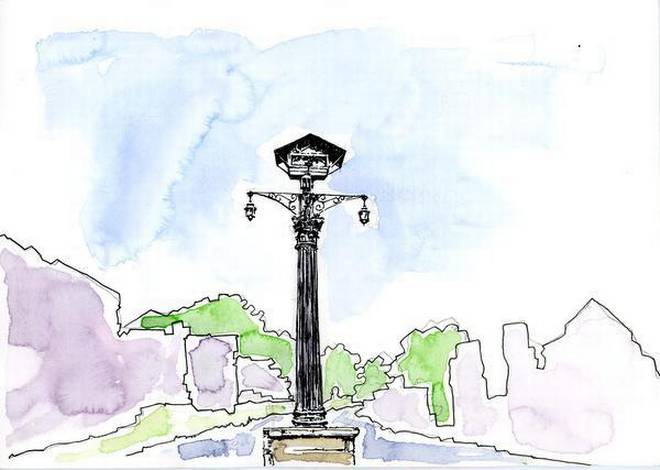
n illustration of Vilakkuthoon and rock art at Kidaripatti | Photo Credit: Special Arrangement
A self-help booklet brought out by INTACH Madurai helps to travel back 2,500 years in time.
As a local or a traveller, when you are ‘selfie-bored’ in a city like Madura, give yourself a couple of hours and a drive of 40-odd kms to understand the brilliance of the city through the ages. There are several gorgeous areas steeped in history but people either don’t know or care or are confused with the timeline and hence unable to appreciate.
Led by INTACH member P Rajesh Kanna, who conceived the idea for the small-sized 48 page guide book, P Pavalamani who wrote the bilingual script in Tamil and English and artist P Gunasekaran who did the illustration, the team undertook several trips, discussed and debated for a year and finally connected the dots to make travel, history, learning and tourism attractive and appealing.
The pamphlet titled “Back 2500 years in a few hours – Madurai through the ages” traces half-a-dozen best lesser known places of importance in the city. “One cannot simply live in or visit the city and not see these hidden spots of history that dominated particular eras,” says Rajesh, who also took lot of guidance from well known art-historian Prof.R.Venkatraman, who passed away in March this year. “This book is also a tribute to him,” he adds.
By starting from Vilakkuthoon and finishing at Kidaripatti with a small detour to Varrichiyur, the pamphlet helps to understand the city’s splendid past. If you follow the route map given with some basic details, brief descriptions, interesting facts, anecdotes and illustrations you step back from 20th century to the 16th, 8th and 1st century to 2nd BC. One of the best things about this travel is that it guides you to the most important monument of that period and helps to redefine the travel experience with a brush of history.
Madurai boasts of countless monuments, says Kanna, but we chose six heritage sites that combine the literary, cultural and spiritual evolution of the ancient city. The start point is Vilakkuthoon. The 150 years old structure is today lost in the buzz of heavy traffic, shops, hawkers and shoppers. But the INTACH booklet reminds you of the days when the imposing lamp post was erected in 1840 by the then Collector Blackburn who is remembered for his foresight in expanding the city and taking it to the next level of modernisation. Today the imposing monument stands at the cacophonous junction of East and South Masi streets where vehicles move bumber-to-bumper and it becomes impossible to walk in the area during festival seasons. Most times people walk or drive past the Vilakkuthoon now and even ignore many spots around and beyond. Instead they could pause.
The next rewind spot is the Vandiyoor Mariamman Theppakulam. It is four km eastward from Vilakkuthoon but two centuries back in time. Dug in 1646 and measuring 305 metres in length and 290 metres in width, the tank over 16 acres is the biggest in South India where the famous float festival is held on the full moon day of the Tamil month Thai. The booklet refers to interesting stories about the birth of the tank to entice travellers to visit the place. It also suggests what other things they can see or do at the destination.
Further eastwards from Teppakulam, the journey takes you to Varichiyoor where two rock cut cave temples – Udhayagiri and Asthagiri — were excavated in the 8th century . In between the two is a huge natural cave belonging to 3rd century BC. From this scenic and natural ambience where, it is believed the Pandya king viewed the sunset daily, the traveller is beckoned to move up north on the Trichy highway and leap back into the 1st century at Yanamalai. It is so called given its resemblance to the shape of a sitting elephant and also finds mention as a sacred site in age old literature of saivite poets and Jain monks. The booklet gives more insight into historical importance of Yanaimalai and its cave temples.
The next suggested halt is at Arittapatti which have Jain caves dating to 2nd Century BC. It is also believed that Pandavas stayed on one side of the Arittapatti hill which also has a beautiful 8th century siva cave temple. The last destination is Kidaripatti on way to Melur and close to Azhagar Malai. Here the eye-shaped natural cave belonging to 9BC are believed to be home to the aborigines of prehistoric time as red ochre rock paintings on the walls suggest. From neo-paleolithic style of 13 thematic rock paintings, a perennial spring and Brahmi inscriptions on stone beds to ponder at, you are almost in a time capsule.
“Our aim was to salvage the many authentic parts of the city,” says Kanna, “and we have tried to present an overview of the important structures against the background of history”. “The illustrations added more dimension to the presentation,” he adds.
When you flip through the pages of the booklet, you will see multiple things in it – from an educational journey to what tourism is trending on today – a delicate balance of local pride, iconic drawing power and a new experience of holidaying.
source: http://www.thehindu.com / The Hindu / Home> Life & Style> Travel / by Soma Basu / Madurai – May 24th, 2018
A child, along with farmers takes a look at the tradional paddy varieties on display
Trichy :
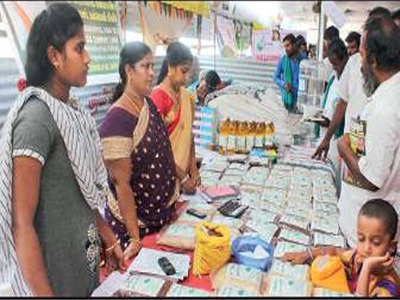
Farmers exchanged traditional paddy varieties, shared their experiences and discussed the necessity to conserve and cultivate traditional paddy varieties at the 12th National Paddy Festival which commenced in Tiruvarur district on Monday.
Addressing hundreds of farmers from across the country who are attending the two-day festival, Nabard chief general manager Padhma Raghunathan said that the bank has been encouraging not just organic cultivation but innovative ideas from farmers. The need of the hour was to take cultivation of traditional paddy varieties to neighbouring states also.
Leaders of various farmers’ bodies like Ambalavanan, R Sridhar and Ushakumari from Kerala, Durai Singam of the NGO ‘Create’, Tamil Nadu Vanigar Sangangalin Peravai president T Vellaiyan and progressive farmers from Tamil Nadu, Karnataka, Andhra Pradesh, Kerala and Puducherry participated. Experts delivered lectures on organic farming, traditional varieties and preservation of soil health among other things. The participants took a pledge to preserve organic and natural farming practices, besides conserving the environment.
The festival was organised by ‘Nel’ R Jayaraman, who has revived around 170 traditional paddy varieties as part of the Save our Rice (SoR) Campaign aimed at conserving traditional varieties of paddy. Traditional paddy varieties such as Karun kuruvai, Neeladi Samba and Maappillai Samba besides herbs, agriculture equipment and traditional food varieties, green manure, guides as well as manuals for organic farming have been exhibited too. Earlier, a rally led by organic farming expert Nammalvar and followed by farmers carrying traditional agriculture equipment such as plough, spade etc was taken out.
source: http://www.timesofindia.indiatimes.com / The Times of India / News> City News> Trichy News / TNN /May 22nd, 2018