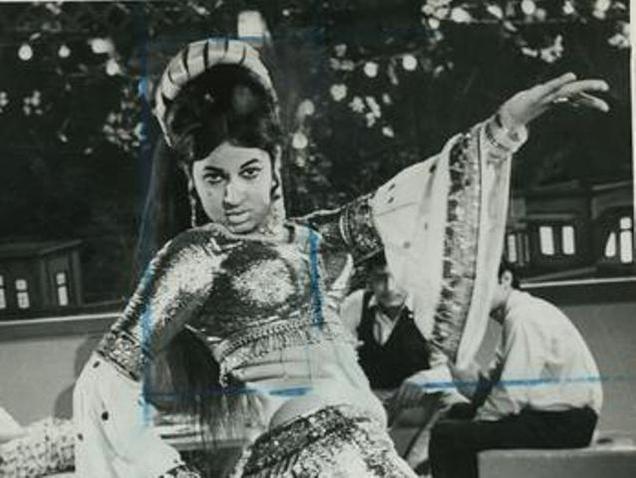
Jyothilakshmi in “Vichitra Dampathyam” (Telugu). PHOTO: THE HINDU ARCHIVES
Yesteryear actor Jyothilakshmi who was famous for playing the ‘bad girl’ in the ‘70s, passed away in Chennai on Monday midnight.
The 63-year-old actor breathed her last at a hospital in Chennai . She was said to be undergoing treatment for cancer. She made her film debut, starring in T.R. Ramanna’s Tamil film ‘Periya Idathu Penn’ that had actors Saroja Devi and M.G. Ramachandran in the lead.
She has over 300 movies to her credit, in all the four South Indian languages. A trained dancer, her skills on the dance floor were used to the best of her advantage by filmmakers and she soon became a constant fixture in most films.
She faded into oblivion around the late 80s but the fact that people still remember her speaks volumes about her popularity. Starting off as a child actor, she did her bit as a heroine in some films, but what established her in the industry were roles that were akin to that of a gangster’s moll and her ‘item’ numbers.
All through the 70s and a part of the 80s, Jyothilakshmi appeared to dominate in most South Indian films and her screen presence went on the vane when her sister Jayamalini made her entry on the celluloid screen. Telugu movies that became popular include ‘Gandharva Kanya (1979), ‘Sitaramulu’ (1980) and the hugely-successful film starring Akkineni Nageswara Rao, ‘Prem Nagar’.
source: http://www.thehindu.com / The Hindu / Home> Features> Cinema / by Suresh Krishnamoorthy / Hyderabad – August 09th, 2016
Chief Minister Jayalalithaa has given Rs. 1.45 crore to five sportspersons in the State, including a differently-abled woman who won honours in international contests.
Ms. Jayalalithaa presented a cheque for Rs. 25 lakh to Jenitha Anto of Tiruchirappalli for winning an international chess tournament held in Serbia last month. This is the fourth time she had won the tournament.
The Chief Minister gave Rs. 1.20 crore incentive to four other sportspersons, C. Ajith Kumar, R. Naveen, L. Samayasri, and S. Priyadarshini who had won medals in different events at the World School Athletics Championship in Turkey in July.
source: http://www.thehindu.com / The Hindu / Home> News> Cities> Chennai / by Special Correspondent / Chennai – August 08th, 2016
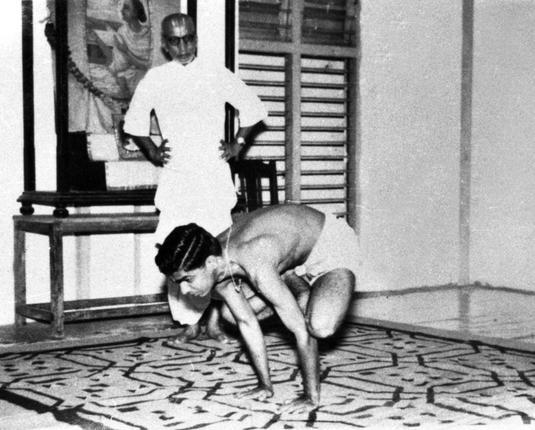
Desikachar practicing yoga, while his teacher and fatehr T. Krishnamacharya looks on.
T.K.V Desikachar, son of Indian yoga master T.Krishnamacharya , passed away in Chennai on Monday. He was 78. TKV Desikachar is the son and student of T. Krishnamacharya, popularly known as “the father of modern yoga.”
The Krishnamacharya Yoga Mandiram trust in Chennai was founded in 1976 by Desikachar as an ode to his father’s teachings.
source: http://www.thehindu.com / The Hindu / Home> News> Internet Desk / Chennai – August 08th, 2016
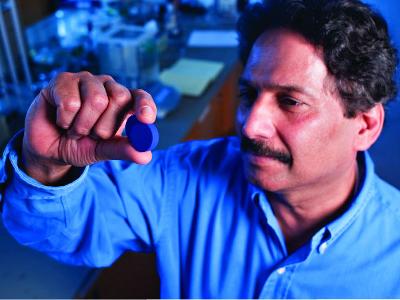
Global recognition isn’t new to Chennai, as namma people have made headlines time and again. The latest to join the list of achievers from Chennai is Dr Mas Subramanian , who has created the world’s newest shade of blue, called YInMn Blue. This vibrant shade is creating quite a buzz among artists ever since it has been licensed for commercial use. We caught up with Subramanian who is currently a chemist at the Oregon State University. He spoke to us about the YInMn Blue, his Tamil roots and more. Excerpts…
Tell us about the discovery of YInMn blue…
It was a serendipitous discovery because we were clearly not looking to create a new pigment. All this happened in 2009 when my team and I were researching on finding new materials for electronic applications. As part of the research, one of my students was doing studies on the magnetic properties of some compounds. And that’s when I noticed the formation of stunningly blue powder while doing experiments. During further tests, we realised that its compounds have properties to keep the colour from fading at all, even when exposed to high temperatures and other conditions. We named it YInMn blue as it is a combination of the names of the elements that make it up — Yttrium, Indium, and Manganese. It needs to be noted that the last commercially viable blue pigment Cobalt Blue was developed in France in 1802, more than two centuries ago.
Why did it take this long for the pigment to be commercialised?
The firm which has obtained the license to commercialise YInMn blue is called Shepherd Color Company. It took couple of years for them to do further tests to confirm that it is durable before commercialising it.
During a time when new colours are created using computer and technology, how do you known that YInMn blue is not a colour which has already been there without anyone actually identifying it?
Colours can be generated by computers, but not colour pigments. Colour pigments are made in laboratories and factories. You can’t make it on a computer and use it to paint buildings.
What are your other areas of interest?
Although I did not learn music formally, I do like Carnatic music. Otherwise, my areas of interests are mostly scientific stuff — designing new materials for electronics, environment and energy conversion.
Have you heard about MS Blue?
I know that MS Blue is named after late Carnatic vocalist MS Subbulakshmi, for, she used to wear saris in that particular colour. I am quite familiar with her music also. My grandmother, too, was a Carnatic vocalist and I remember attending one of the concerts of MS Subbulakshmi in Chennai, while I was young. I still listen to her Sri Venkateswara Suprabhatam recording regularly.
Tell us more about your Tamil roots…
I do visit south India often. I was born at Vallioor in Tirunelveli district, but grew up in Chennai. I went to Ramakrishna Boys High School. I did B.Sc at AM Jain College and MS at the University of Madras. Later, I completed my Ph.D. from Indian Institute of Technology-Madras, before I moved to Texas for post-doctoral research in 1984. I am a vegetarian and still follow Tamil customs at home.
source: http://www.timesofindia.indiatimes.com / The Times of India / News Home> City> Chennai / Ashish Ittyerah Joseph / TNN & Agencies / August 06th, 2016
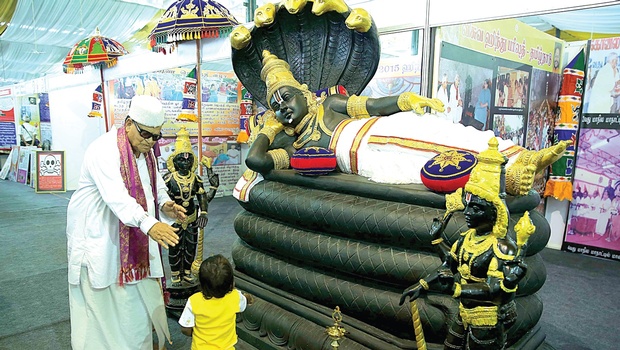
A man dressed as MGR standing near an exhibit at the Hindu Spiritual and Service Fair | Sunish P Surendran
Chennai :
THOUGH the Tamil Isai College was established 60 years ago, only about 150 students have enrolled. The college offers courses in ancient Tamil musical instruments. College authorities decided to spread awareness about the school at the Hindu Spiritual and Service Fair on Wednesday. N Padmini, a Bharatanatyam lecturer at the college, said, “This is the first time we are setting up a stall here. We feel that nobody knows that such a college exists.”
The college was started in 1932 by Rajah Sir Annamalai Chettiyar in Chidambaram and eventually found its place at the Raja Annamalai Mandram. Besides music and dance, the college has classes in Tamil history and literature. The college is on the top floor of the hall, but the teacher claimed that not many know of its existence. “People attend shows there, but don’t know what happens at the hall. We don’t have a proper board too because the Metro barricades and settlements outside hide the signs,” said Padmini.
Tamil musical instruments like veena, mirudhangam, nagaswaram and thavul are taught at the college. Moreover, the college has rare instruments from the 18th and 17th centuries like the kinnari yazh, mayura veena and pancha muga vadhyam. “We have instruments that only some museums might have; we restore them, but don’t have students willing to learn or even try their hand at them,” said another teacher at the stall.
The institution also has an evening college for students, who are interested, but cannot afford to attend the day college. The college offers three-year diploma courses and invites students of all ages. Padmini said that since the youth are hesitant to pursue music as an immediate career choice, many do other courses and then come back to music, while others wait their whole lives and choose to learn music or dance much later in life. “We have no age bar; anyone can choose to learn. No restrictions,” she added.
Apart from the music college stall,another stall at the fair displayed over 25 Tamil musical instruments collected from around the State, from a cow-horn to several types of mirudhangam. S Sivakumar, who runs the stall, said the display was an effort to get visitors to learn about the instruments and get a idea of how vibrant Tamil music was. “It is believed that there was less illness and there were fewer health issues in the past because there was music to listen to and music healed diseases. Nowadays no one listens to anything classical,” he said.
source: http://www.newindianexpress.com / The New Indian Express / Home> Cities> Chennai / by Express News Service / August 04th, 2016
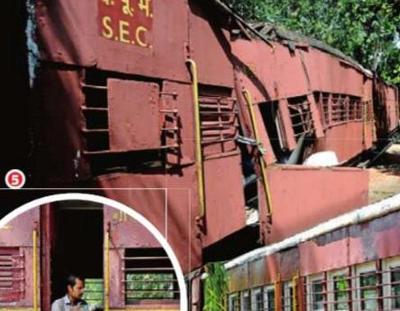
For the `gora sahib’ travelling to inspect the pride of the British Raj – the railway, the glass windows once framed the undulating arid landscape of the Marathwada region. Close to 100 years after it first trundled down the line connecting Nagpur to Jabalpur, the same coach has now been restored to its former glory and rests in the regional railway museum in the city .
For more than 50 years, the coach lay in a railway yard in Moti Bagh, Nagpur, before two officials from Chennai chanced upon it in the midst of mangled metal and splinters of glass and wood in 2010. “We went there to inspect another coach that the Railway Board sanctioned for the museum in Chennai, only to find that it was sent to a museum in Pune,” said Jagadeesan N, senior engineer, planning and furnishing at the Integral Coach Factory (ICF), Chennai.Jagadeesan and his colleague then came across a century-old coach, which served as a saloon for railway officers. “It was part of a narrow gauge train. The wood had rotted, leaving gaping holes, we could vaguely make out that the coach once had a bedroom, a kitchen and a bathroom,” said Jagadeesan.They identified three other coaches, which was part of the rich history of the narrow gauge lines: A postal coach, a first-class compartment and a guard-cum-luggage van. These coaches were part of the trains that ran between Nagpur, Chhindwara and Jabalpur.
While narrow-gauge lines are now restricted only to a few hilly routes, there were once more than 100 narrow-gauge lines in the country . Until 2015, narrow gauge lines covered 2,000km of the total 1.15 lakh km of the railway network.With a 622-km network, the Nagpur division of South-East Central Railway is one of the biggest narrow gauge routes in Indian Railways at present.
The coaches were brought by road on three trailer trucks.But it wasn’t until six years later that the railway museum officials here got funds to refurbish the coaches. “We first renovated the 1906 coach as it required extensive work,” said Arun Devraj, curator of the museum. The wooden walls were painted, the metal floor welded and colonial furniture introduced to recreate the era when narrow-gauge trains were a lifeline. The postal coach is now being renovated with the help of private players, following which work will begin on the other coaches, which were manufactured in 1968.
Arun said the 100-year-old renovated coach has been thrown open to visitors. “Visitors can sit inside a coupe and relive a bygone era,” he said.
source: http://www.timesofindia.indiatimes.com / The Times of India / News Home> City> Chennai / TNN / August 04th, 2016
A bicycle café, active clubs and more than 100 super randonneurs. The author explores Chennai’s vibrant cycling culture
As a culture that now celebrates all things quantifiable — a fitbit to track your steps, an app to count how far you’ve run — fitness is at the epicentre of our tech-focussed lives. From the calories you’ve consumed to the weights you’re lifting, there’s a number that makes it all worthwhile. If you didn’t Instagram a screenshot of your Runtastic app, have you even really worked out?
You’d assume then that this cycling fad that seems to be sweeping the city is just that — a fitness phase. Is cycling the new running? The new boot camp? Surprisingly enough, for all the avid bikers we spoke to, fitness came at the very end of their list of priorities. Whether it’s waking up at 5 a.m. to cycle, or spending the weekend on long rides, many of them may have started cycling to get fit, but they all agree it is way more than exercise that they are out to get now.
Creating culture
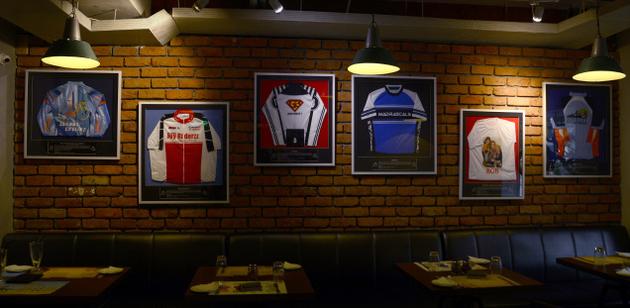
“Please don’t call it a themed restaurant,” Ashish Thadani clarifies at the very beginning of our conversation. Too many people have misunderstood what Ciclo (pronounced chee-klo), India’s first bicycle cafe, is attempting to do, and Ashish is eager to explain. As someone who cycles every day, Ashish admits that Ciclo was not conceived as a revenue spinner, but is more passion than business, as he’s excited to promote a lifestyle that he has grown to love. The cafe is a place where Ashish is hoping to build a common platform for the various cycling clubs in Chennai — there’s an entire wall where the jerseys of six reputed clubs are framed and proudly displayed.
The team jerseys displayed at Ciclo Cafe. / Photo: M. Vedhan / The Hindu
The cafe’s other speciality is the cleaning and repair services it offers bikers, who can have a snack while getting their rides fixed. And it’s not just pro-bikers — the cafe offers all customers a chance to rent cycles at the nominal rate of Rs. 200 a day to try their hand at cycling. With other Ciclos set to open in Gurgaon and Hyderabad, this time with shower and locker facilities, Ashish is hoping the bicycle cafe culture catches on all over.
Suresh Kumar likes to believe he called the cycling craze way back in 2006. Having grown up watching his father run Balaji Cycles, a 100-sq-foot shop, which launched in 1975, Suresh and his brother expanded the business. In 2012, they opened Pro-Bikers, one of the first high-end stores to sell professional bikes in Chennai. From five bikes a month to about a 100 now, Suresh says sales have peaked in the last four years, which is also why he set up a tech workshop with mechanics trained in Taiwan to service these high-end bikes. Suresh is also one of the founders of the Tamil Nadu Cycling Club (TCC), which began in 2010. They organise about 40 events a year, like endurance races, timed trials and workshops, where all the cycling clubs in the city participate. According to Suresh’s estimate, the cycling community in Chennai is about 10,000 people strong, and growing.
“When I started Chennai’s first biking club in 2009,” says Suhail Ahmed, “there were just 10 of us riding on the ECR.” Called ReaXion Cycling back then, their most popular event used to be a ride from Chennai to Mahabalipuram and back. This casual club soon grew to become an information portal called choosemybike.com that helped people find information about bikes in the market. Suhail now works for TI Cycles, where, he admits, he doesn’t get enough time to ride.
Another big draw for cycling is that, like running, this too is a social experience. It is easier to stay motivated when you’re in a group, and while you may start off concerned about fitness, what you’ll get hooked to is the company. Just ask Divagaran Thiagarajan, who started WCCG (We are Chennai Cycling Group) in 2012, as a neighbourhood cycling group. Today, WCCG has different chapters in different areas in the city, where people in the same neighbourhood ride together. Unlike a racing group or randonneurs, WCCG focusses on getting people together and creating themed rides to keep the regulars excited.
For the love of the race
For Aarthi Srinath, the party starts at 5 a.m. All days, except Mondays, you’ll find her at Madhya Kailash at the crack of dawn, geared up and waiting for her team — the MadRascals — Tamil Nadu’s first amateur cycle racing team. They ride for an hour and a half every day and three hours on weekends. Being the only woman on the team doesn’t deter her. “When people ask me why I do it, I tell them cycling is more than an activity — it’s a lifestyle choice,” says Aarthi. It’s a tough choice, considering the commitment one needs to keep up with the team. While there is only one winner at the end of the race, cycle racing is a team effort. There are positions like sprinter (who keeps up the speed), the climber (who takes care of the elevated bits) and even domestic (teammates who get in formation to protect the finishers from wind resistance). “When you’re in a team, you need to trust each other because often, when you’re riding at high speeds, all you can see of each other are the wheels,” she adds. The rest is intuition.
There’s also a need to be entirely self-sufficient when riding long distances. “You need to learn to fix a flat tyre, a fallen chain — when you’re riding alone, you’ve got to help yourself,” explains Aarthi.
On the fitness front, cycling is a great idea, since you tend to burn close to 850-900 calories on a 50-60 km ride. Also, it’s low-impact with no stress on the knees. For Aarthi though, it’s much more than fitness. It’s the love of the race and the adrenalin rush that keeps her — and many like her — going.
It’s the journey that matters
To win the title of Super Randonneur, as defined by the Audax Club Parisien, Partha Datta had to complete a series of brevets (rides that were 200, 300, 400, and 600 km long, in a fixed time limit) in one single year. He has won that title a number of times — and so have more than 100 others from Chennai as of last year, according to Partha. If cycle racing is a test of speed, then randonneuring is the ultimate test of endurance.
A fixed route, control points at regular intervals and a time limit is all you get when you attempt this sport; you need to have the discipline, stamina and time management to make it to the end point in time. With a minimum of 200 km, and a maximum of 1,000 km (in Chennai) brevets, this is no joyride, and yet more than 153 people completed the ECR Classic brevet held by the Madras Randonneurs on June 28.
What kept Partha going when he started off in 2011, is the fact that every ride he organised and took part in, was making history for randonneuring in India. Then, of course, there was that amazing feeling of completing each brevet. He recalls one brevet where it rained for eight hours straight and he even had to deal with a puncture, but managed to make it in time. Of course, there’s also the fact that he enjoys riding. “I enjoy explaining the concept of randonneuring to the strangers I meet on the road, and they never fail to ask me why I don’t just buy a motorbike,” he laughs.
At 65, Sundar Rajan holds the title of Grand Super Randonneur with great pride — but congratulate him on it, and he’s quick to tell you that it isn’t amazing, and anyone can do it. After a childhood of cycling every day to school and college, Sundar says he got back to it only in 2008, when he moved back to Chennai and decided to adopt a healthier lifestyle. Regular cycling soon became a habit, and he was looking for a challenge when randonneuring came into the picture in 2011. “I am not a speed guy. I can’t race, but I can manage long distances thanks to my stamina.”
“The best part is that randonneuring demands nothing extraordinary of you — if you put your mind to it, and focus, it’s easily done,” explains Sundar, whose daily routine is now cycling to Mahabalipuram and back in five hours every evening.
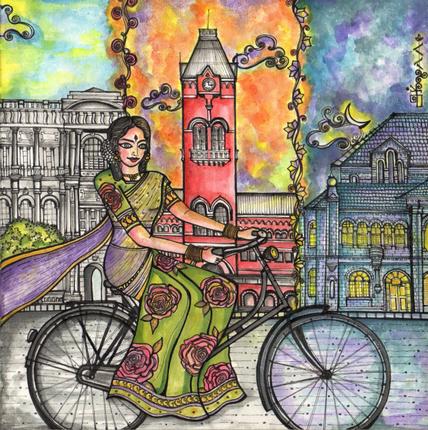
The book cover of Cycling in Madras. / Illustration By Akshayaa Selvaraj
A century of cycling
Probably the only city to have documented its connection with cycling over a period of 100 years, Chennai seems to have started its affair with the two-wheel ride right after it was invented.
The effort of a cycling club that calls themselves Cycling Yogis, led by Ramanujar Moulana, Cycling in Madras — from 1877 to 1977 documents every possible connection between cycles and the city. “I was always inquisitive about how the cycle, invented in far off Western countries, came to Chennai, and how it ended up in this form,” says Ramanujar. For him, the booklet symbolises the culmination of his two loves — history and cycling. In fact, the Cycling Yogis came together mainly out of Ramanujar’s love for sharing Chennai’s history as he rode along with friends.
Filled with little gems like the fact that the first bicycle in India was assembled in Madras, the booklet is the Yogis’ way of documenting how the city embraced the humble bicycle.
From indispensible when invented, to relegated to secondary status around the time motorbikes were invented, and now, back in vogue again, the bicycle seems to have come a full circle (pun intended) in Chennai.
Popular cycling clubs in Chennai
ReaXion Cycling – Chennai’s first cycle club, started in 2009
Madras Randonneurs – Pioneers of randonneuring in Chennai
MadRascals – Chennai’s only amateur cycle racing team
WCCG – Chennai’s neighbourhood-based cycling group with five chapters
Cycling Yogis – They enjoy cycling to heritage sites and historic locations
G3 – Chennai’s first all-woman cycling club
source: http://www.thehindu.com / The Hindu / Home> Features> Metroplus / by Elizabeth Mathew / Chennai – August 05th, 2016
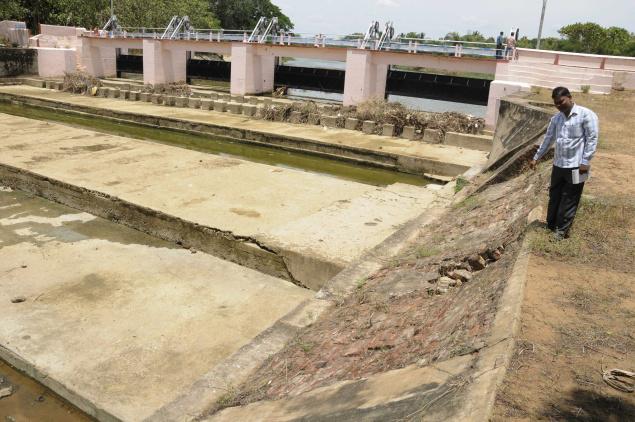
One of the British-built revetment which had got weakened at the Sozhagan head sluice near Kuthalam in Nagapattinam district. / Photo: A. Muralidharan
Under IAMWARM scheme on an outlay of Rs. 90 crore
A British-built irrigation infrastructure on three major rivers passing through Nagapattinam and Thanjavur districts will be renovated at an estimate of Rs. 90 crore.
The Public Works Department will execute the work under the Irrigated Agriculture Modernisation and Water bodies Restoration and Management (IAMWARM) scheme. The British-built revetments, damaged sluices, regulators and weak banks will be renovated and strengthened so ensure effective management of irrigation supply.
The infrastructure on rivers such as Manjalaru, Veerasozhanaru and Manniyaru will be given a facelift with total strengthening of the revetment. The brick work will all be replaced by concrete structures and the damaged head sluices, regulators and bed dams would be renovated, an official source told The Hindu here on Thursday.
The Manjalaru flowing from Sathanur near Kuttalam accounted for a course of 40 km, with 25 sluices, eight regulators and one bed dam. It had an ayacut of about 50,000 acres. The Manniyaru, with a total course of 60 km from Thanjavur to Nagapattinam, had about 60,000 acres irrigating the fields through 30 sluices, two regulators and one bed dam. The Veerasozhanaru had 50 head sluices, six regulators and eight bed dams. It ran its course for about 50 km.
The source said that the work would facilitate efficient management of water for irrigation. The work would be taken up after the forthcoming monsoon. “As it involves a good part of masonry and civil works, it can be executed only during the non-monsoon season,” the source said.
source: http://www.thehindu.com / The Hindu / Home> News> Cities> Tiruchirapalli / M. Balaganesin / Nagapattinam – August 02nd, 2016
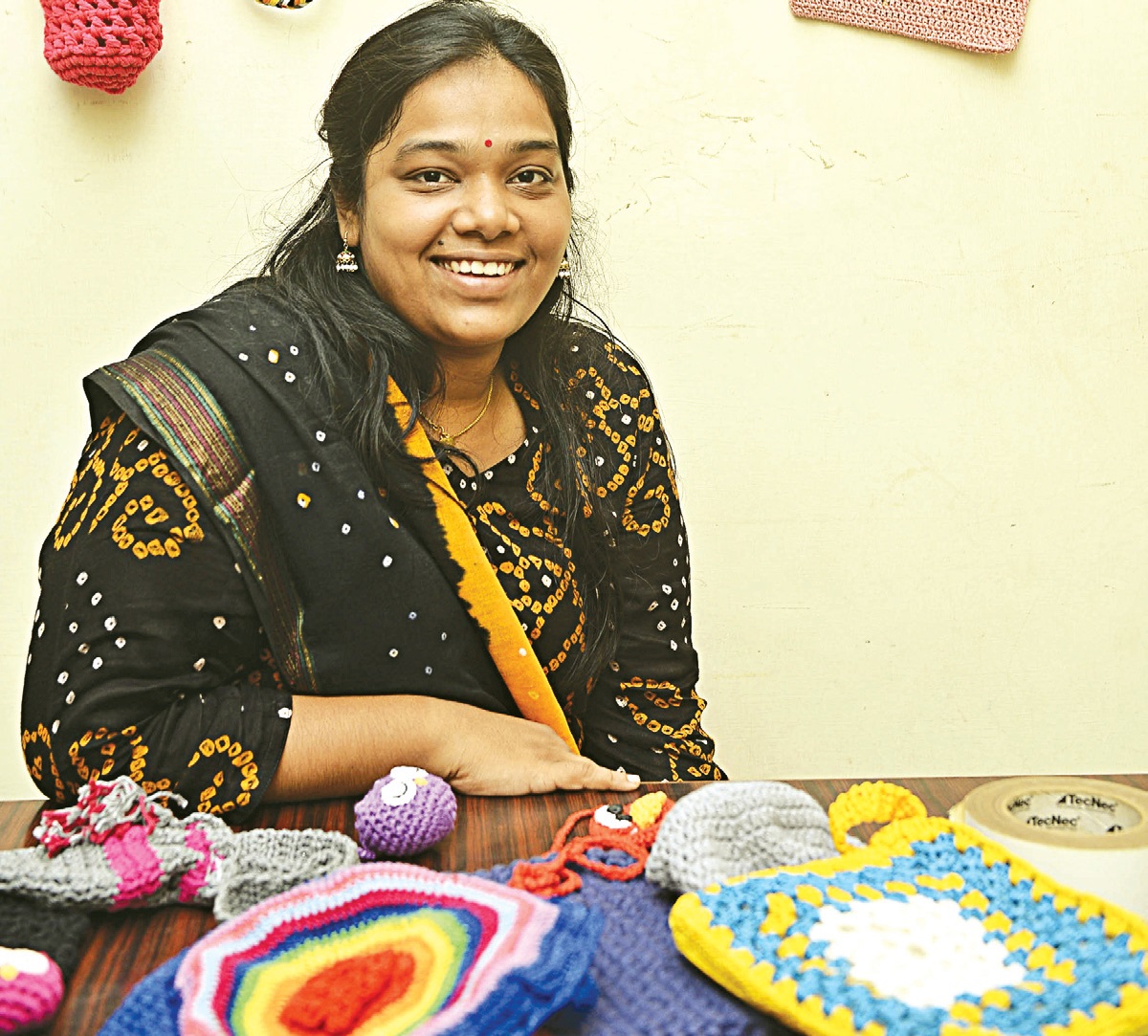
Bright colours and creative designs mark Bhuvana’s crochets Satish Babu
Chennai :
Colourful threads, interlocked in loops to create interesting patterns and accessories- this defines the art of crochet making, in a nutshell. While there are only a handful of crochet makers/artists in the city, CE caught up with Bhuvana, a city-based art teacher and crochet maker.
As we enter her ‘art den’, colourful crochet handbags, keychains, bottle holders, neck pieces, hair clips and other accessories stand out. Made from acrylic (artificial threads) to cotton yarns, from t-shirt yarn to jute, Bhuvana shares that procuring good quality yarns is a tough task. “We get synthetic threads and wool here. But if you are looking for the soft, thick, cotton yarns, you have to procure it from Delhi or foreign countries.”
When asked how she was drawn to crochet making, Bhuvana replies “It all began after I saw the movie Barfi (2012)! Priyanka Chopra carries a crochet handbag in the movie. Until then I had only seen old-fashioned scarfs, baby clothes and accessories.After that, for four years, I did intensive research on materials, tools and accessories involved in crochet making. Until then, I didn’t know the difference between knitting and crochet making!”
A year ago,she started her own label, EM’s Crochet art and artifacts on Facebook and has been showcasing her work on the page. “Since I also teach and paint, I make crochets whenever I get time. In fact, my goal is to incorporate crochet in art,” she says.“Abroad, crochet art installations are very common. Even in India, some artists have done such installations and I intend to do something like that.” With a plethora of styles and stiches in crochet, she explains a few such as single, double, triple crochet, granny squares and bobble stitch. “One interesting thing about crochet is that each stitch in crochet is completed before proceeding to the next. This makes it easy for us to remove a particular loop in case of changes,” she explains. Tapestry crochet, which is predominantly seen in carpets and mats, is another interesting style, adds Bhuvana. “This type of crochet making is not as easy, but its output is very beautiful. It involves working parallely with multiple threads of different colours. I am currently working on stocking material for that,” smiles the artist.
A Masters graduate in painting, she shares that any form can be achieved in crochet. Even stuffed toys! “I made a rat out of crochet. The loops are interlocked in the required shape and then the opening is stuffed with cotton before the final stitch. I am currently concentrating on making more toys,” she says. Shedding light on why crocheting is considered a women’ job in India, she avers, “Firstly, it’s not just a women’s job. I have seen a lot of men doing crochet in foreign countries. But, I don’t understand why it doesn’t happen in India. I know very few men who do it here,”adding that when it comes to accessories, men don’t prefer crochet. “They think it’s feminine. But key chains and crochet bracelets can be used by them. Some of my male friends have bought them from me,” she beams.
Bhuvana has exhibited her paintings and crochet art works at Bangalore and will also be a part of City Souk, Chennai. For details, visit: https://www.facebook.com/emsartandartifacts
source: http://www.newindianexpress.com / The New Indian Express / Home> Cities> Chennai / by Roshne B / August 04th, 2016
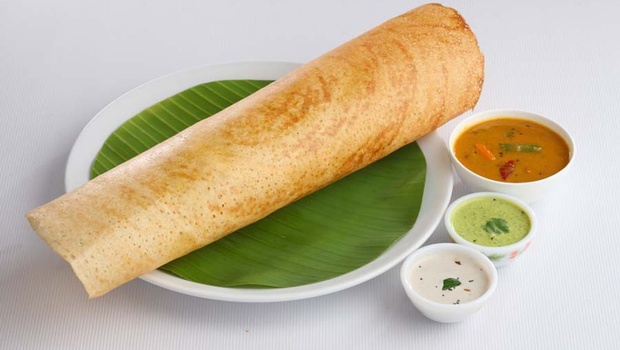
If you are pining for some hot ghee drenched dosa while trudging through a cold North American autumn, you have just been offered yet another choice to indulge in the taste of home. It seems one of South India’s most beloved restaurant chains is set to take its first steps into the United States of America.
The US Consulate in Chennai tweeted out late on Saturday night that Adyar Ananda Bhavan, popularly known as A2B, is planning to open its first branch there next month.
“A2B in the US? Yes! Chennai’s @A2BRestaurant plans 2 open its 1st outlet in US in Aug 2016!,” went the US Consultate’s tweet. It’s facebook post had a bit more information.
According to the Consulate, the decision to open shop in the North American nation was a “direct outcome” of the chain’s participation in the U S Commercial Service’s SelectUSA Investment Summit held in Washington D. C recently.
A2B will be following in the footsteps of the now iconic Hotel Saravana Bhavan, which already has three hotels in the United States and 56 outlets across the globe not including those in India, according to its website.
A2B meanwhile has no branches overseas and 95 branches in India. The chain began three decades ago as a small sweet shop started by founder K S Thirupathi Raja in Chennai. Now at the helm are his two sons – Managing Director K T Srinivasa Raja and K T Venkatesan.
The management of the chain could not be reached for comment.
source: http://www.newindianexpress.com / The New Indian Express / Home> States> Tamil Nadu / by Jonathan Ananda / July 30th, 2016