It was a dream came true for V Keerthana, a Class 9 student of Maniyakarampalyam corporation higher secondary school, when she was selected to deliver a speech at the 15th anniversary celebrations of the NGO American India Foundation at Richmond in Virginia.
The NGO was instrumental to introducing technology-enabled learning in corporation and government schools across 10 states in the country. Keerthana was accompanied by A Anju, science teacher at P N Pudur corporation higher secondary school, who delivered a speech at a function organised in New York.
Keerthana said she was filled with excitement and was awed at the sight of an aeroplane. She held onto her teacher’s hand as she entered the Chennai airport. She was the first in her family to have boarded a flight and to cross borders. After the successful US trip, the duo returned to the city a few days back.
Keerthana not only represented the country, but also made the city proud as she received a standing ovation at Richmond in Virginia after she delivered the speech. “I spoke about my family and my experiences. Also, I explained as to how technology-enabled learning transformed my life and personality. After my speech, the entire audience stood and clapped. That moment will remain in my memory forever,” she said.
Having studied in a Tamil medium corporation school till Class 6, Keerthana was introduced to English language only when she joined Maniyakarampalyam corporation higher secondary school. “But I had keen interest in the language and would watch English channels and shows to improve my spoken English,” Keerthana said. Another moment that she holds dear is the first sight of Massachusetts Institute of Technology’s gates. “It is my dream to pursue my higher studies at Massachusetts Institute of Technology and I was overwhelmed at the sight of university gates. Everyone I met encouraged me to work hard and reach greater heights, she further said.
Keerthana’s mother Dhanalakshmi said they were a bit apprehensive at first about sending her daugther to the US. “We were a little worried initially, but we knew that she would be safe. It is a dream came true for all of us. Since she turned 11, she has been telling us that she would visit the US and would pursue her studies there. We knew we could never afford it, but always encouraged her to study well,” Dhanalakshmi said.
Keerthana’s father is a mill worker, while her mother is a home maker. “Many people, including my school head master, helped me for the 10-day trip. Volunteers of American India Foundation arranged everything for us,” said Keerthana.
With just $29 in hand, Keerthana managed to purchase something for her entire family. A statue of liberty stands tall at her home that not only reminds her of the trip, but inspires her to pursue her dream.
Anju is equally happy with the US trip. “I feel very proud and still wonder if it was a dream. We learned a lot from the trip and met many people, including the governor of Viriginia,” she said.
Corporation commissioner K Vijayakarthikeyan said he was proud of their achievements. “I feel very happy when these children get this kind of exposure. We will continue to promote many activities and encourage students to pursue all their dreams,” he said.
source: http://www.timesofindia.indiatimes.com / The Times of India / News Home> City> Coimbatore / by Komal Gauthami, TNN / June 26th, 2016
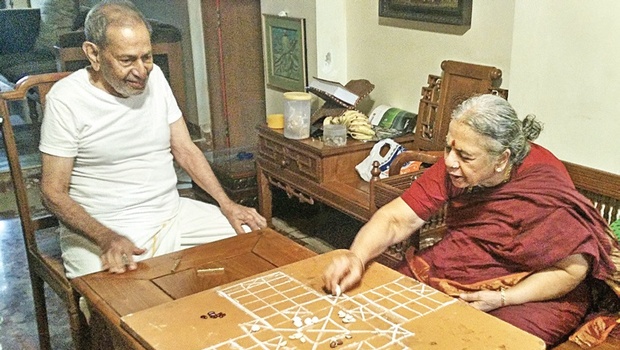
A game of Dayakattai in progress Archita Suryanarayanan
Chennai :
The sound of the long, rectangular brass dice reverberates on the wooden table. “Six and two. You can cut him…and play vettaatam,” instructs 83-year-old Namagiri Lakshmi to her grandson Vijay. Welcome to Dayakattai, a traditional Tamil dice game.
In a race-to-the-finish game (a predecessor to Ludo) you have four rectangles filled with squares that your pieces need to traverse. You start with six pieces in your ‘home’ territory, and you have to pass all the coins through the opponents’ territories and come back home. You can bring the pieces onto the board only if you roll a dayam and you need to ‘cut’ any opponent at least once. The bonus — you get an extra roll of the dice if you get a one, five, six or 12.
In Pagade, which is similar to Dayakattai, you can ‘cut’ the opponent’s pieces and send them back to the start box. However, there are eight safe zones where other players cannot cut you.
Experts like Lakshmi remember playing since they were little. “It used to be a little different back then — if you rolled a 7 or 9, it was a no-play. And we used to sing folk songs as we played,” she recalls. And she can do the mental math and tell you, based on what you’ve rolled, which square your piece will end up in. “Five, two, six, three — this piece will land there,” she says.
In fact, the association with the game runs so deep in the family that just the night before her grandson Vijay was born, his mother Usha played Dayakattai! “We played late into the night and the next morning Vijay was born in the hospital,” she remembers.
Explaining the concept of dokka vettu, she says, “It’s a more recent and violent addition to the game. It’s when your piece gets cut just one square before reaching home. It triggered so many fights between the kids!” Vijay and Usha recall a famous punch-line from the game when one player cut another player in revenge: “Vettuku vettu. Rathathuku ratham (cut for a cut, blood for blood).
The squares used to be drawn using maakkal (chalk-like substance) or even sandal. The coins can be anything from peanuts to cashew nuts. “Kids liked taking edible coins, because when you came back home, you could eat them! Sometimes, they would simply eat one in the middle of the game and say they had already crossed the finish line! It’s tough to keep track because there are six coins a player!” laughs Lakshmi.
With the spirit of game coursing through this family’s veins, looks like it will be quite some time before one can forget the coins and the cuts!
source: http://www.newindianexpress.com / The New Indian Express / Home> Cities> Chennai / by Varun B. Krishnan / June 25th, 2016
A book follows the lives and achievements of two engineering geniuses who changed the face of irrigation in India in the 19th century.
There is a thin but bright skein that runs through, and indeed often gets obscured by, the darker history of colonial rule in India. This thread represents the work of the small but extraordinary group of colonial innovators who pushed the boundaries in a diverse range of fields — from engineering to archaeology, from botany to triangulation and mapping.
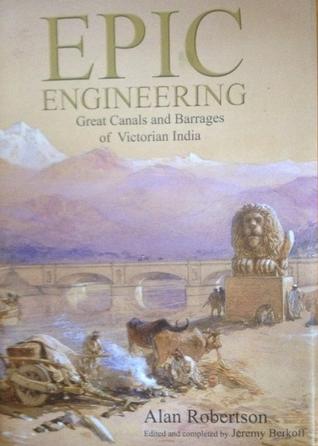
A recent book by Alan Robertson, Epic Engineering: Great Canals and Barrages of Victorian India follows the lives and achievements of Arthur Cotton (1803-1899) and Proby Cautley (1802-1871), two engineering geniuses who changed the face of irrigation in India in the 19th century. Cautley designed and built the 700-mile Ganges Canal, and Cotton harnessed for irrigation the flow of two of the great river deltas of South India – the Cauvery and Godavari.
Though contemporaries in India, and equally qualified, the two men could not have been more different in their approach to engineering problems. The book deals in some depth with the bitter public battle in England when they returned after their India postings, over the efficacy of their respective engineering designs in India.
According to Robertson, Cautley was recognised and honoured by his Victorian contemporaries, although it is Cotton who is remembered over a century and a half later in the Indian mind — celebrated as he is in writing, popular lore and public statuary in Tamil Nadu and Andhra Pradesh. In the 1930’s Cotton built the Upper and Lower Anicut to regulate and divert for irrigation the flow of water in the Cauvery and Coleroon (Kollidam) rivers. He then turned his attention to the Godavari delta, where in the 1930s the destruction of the weaving industry was exacerbated by a famine that together resulted in the death of one in four persons. The Godavari’s flow in monsoon was three times greater than the Nile in flood, Robertson writes, therefore greater the challenge. The many ingenious solutions Cotton devised to practical problems as they cropped up during the construction of the four-mile long Godavari anicut provides a flavour of the unconventional genius and the times.
In the same decades Cautely was making progress, though with some embarrassing reversals, on the Ganges canal. Later, in the adjudication of the dispute between Cautely and Cotton — who argued that the location of the headworks of the canal was wrong — a government committee sided with Cautely. However, “within a few years Cotton’s main criticism was quietly acted upon…” Robertson writes.
Historical archives and private collections in Britain still hold many stories on India including those that are already known but are waiting to be enriched with new information. Interestingly, the author of this enriched biography, Alan Robertson, was a nuclear physicist with an abiding interest in history. This led him to a post-retirement MA degree at King’s College on the mid-19th century indigo industry in India and on to the fascinating lives of the two Victorian water engineers.
Unfortunately, Robertson died before his book was published. Finding no publishers ready to accept the manuscript, it was eventually published privately by Catherine Hamilton, Robertson’s sister. Jeremy Berkoff, an irrigation expert who worked for many years with the World Bank edited and completed the manuscript.
Epic Engineering: Great Canals and Barrages of Victorian India
Alan Robertson / Beechwood Melrose Publishing, 2013, 254 pages
source: http://www.thehindu.com / The Hindu / Home> Books / by Parvathi Menon / London – June 14th, 2016
The move of the govt to create a Greater Chennai Corpn has virtually revived the ancient province of Tondaimandalam.
A study of the region by Colonel Colin Mackenzie says Tondaimandalam was 1st inhabited by Kurumbas, a fierce tribe .
Epigraphs of the region also reveal the existence of a sound administrative system
_______________________________
The move of the state government to create a Greater Chennai Corporation, bringing into its fold several areas of Kancheepuram and Tiruvallur, has virtually revived the ancient province of Tondaimandalam that is believed to have existed in the last Sangam period. The Chennai region was a part of Tondaimandalam.
With the first references to the region going back to tribal Kurumbars and the reign of King Karikala Chola in the 1st century AD, Tondaimandalam had been under the rule of the Kurumbars, Cholas, Kalabhars, Pallavas, Pandyas and the Vijayanagara dynasties for over 2,000 years. The region during the said period came under two divisions — Aruvanadu and Aruvavadatalainadu.
Greco-Egyptian writer Ptolemy observed that the region was named Aruvarnoi and that the territory roughly extended between South Pennar and North Pennar, which together came to be called as Tondaimandalam or Tondainadu, after the conquest by Tondaiman Ilam Tiraiyan, who took over the Chola empire from Karikala Chola and Nedumudikilli.
The Mackenzie Manuscript, a study of the region by Colonel Colin Mackenzie, the first surveyor general of India, says Tondaimandalam was first inhabited by Kurumbas, a fierce tribe — early references to whom are found in the Ashokan edicts — until their defeat by Ilan Tiraiyan.
The tribe divided the region into 24 districts and built several forts. Historian Prof K V Raman says, “Places like Mylapore, Triplicane, Egmore, Pallavaram, Velacheri, Thiruvanmiyur and Nungambakkam among many others formed a vital part of the ancient Tondaimandalam.”
“Even though names of places like Nungambakkam, Ayanavaram, Vyasarpadi, Villivakkam, Ambattur etc appear to be modern names of recent origin, they find mention in inscriptions dating back to the 12th and 13th centuries AD, which in turn stresses their antiquity,” he adds. Inscriptions belonging to the Pallavas, Cholas, Rashtrakutas, Pandyas, Cheras and the Vijayanagara kings that have been found in places like Pallavaram, Triplicane, Thiruvanmiyur, Thirunirmalai, Padi etc. bear witness to the political changes through which the region passed.
Those from the 10th, 11th and 12th centuries AD make it evident that the area on which Chennai city and its surroundings are situated were included partly in Puzhal Kottam and partly in Puliyur Kottam.
“The region has been rightly called ‘the classic ground of early Paleolithic culture in south India as the first Paleolithic relic was discovered at Pallavaram, leading to the discovery of many more Paleoliths in other places. Megalithic sites and tools, dating back to the Iron Age were also discovered here,” says Raman.
Epigraphs of the region also reveal the existence of a sound administrative system — both central and local — including active functioning of village assemblies (sabhas) in Manali, Adambakkam and Tiruvottriyur. The system was functional during the Pallava rule in the 9th century AD.
Later under the rule of Chola and Vijayanagar kings, the function of village assemblies was extended to many other places of the region. The region had an equally significant contribution towards the fields of literature and learning. Thiruvalluvar, the author of Thirukkural, is associated with Mylapore while Sekkizhar, author of ‘Periya Puranam’ is said to have hailed from Kunrattur.
Some of the heralders of the Vaishnava wing of the Bhakti movement were either born in this region or were closely associated with it. Pey Alvar, one of the earliest Alvars, came from Mylapore while Thirumazhisai Alvar was born in Thirumazhisai near Poonamallee. Thirukacchhi Nambi, a close associate of Sri Ramanuja, the famous philosopher of the Vishishtadvaita school, came from Poonamalli.
Epigraphical, archaeological and literary sources reveal that Buddhism and Jainism once had a hold in this region. Monuments of the Chennai region reveal the contributions of the Pallava, Chola and Vijayanagar dynasties. The Pallavas built the famous cave temples in Mamallapuram, Mamandur and Narasapalayam villages near Kancheepuram and at Singaperumal Koil.
Dr S Krishnaswami Aiyangar in ‘Madras Tercentenary Commemmoration Volume 1939’ also talks about Mylapore dating back to the beginning of the Christian era, making it over 2,000 years old.
Historian R Sathianathaier says, “Tondaimandalam was the heart of the Pallava empire, the helmet of the Chola empire, the scene of a triangular contest among the Pandyas, the nucleus of Saluva Narasimha’s power and the grave of the Vijayanagar empire.”
(The author is the director of Chennai 2000 Plus Trust)
source: http://www.timesofindia.indiatimes.com / The Times of India / News Home> City> Chennai / TNN / June 24th, 2016
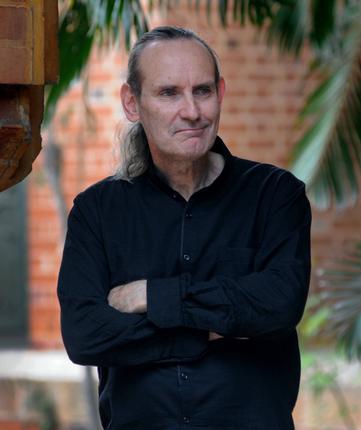
Mikael Stamm, scholar from Denmark, in Chennai. Photo: B. Jothi Ramalingam / The Hindu
Denmark’s Mikael Stamm in his search for philosophical answers ended up doing his Ph.D in Saiva Siddhanta at the University of Madras.
Philosopher Hume wrote that books on metaphysics contained nothing but “sophistry and illusion.” Most analytic philosophers were inspired by Hume’s condemnation of metaphysics. The logical positivists even tried to develop artificial languages, which, by their very nature, would make it impossible for metaphysical questions to be asked in those languages. The Vienna circle, which not only included philosophers such as Neurath, Schlick and Carnap, but also mathematicians such as Godel, also wanted to steer clear of metaphysics.
Coming to the Indian scene, it is hard to conceive of Hindu philosophy completely shorn of metaphysics. Hindu philosophers also had linguistic concerns, but their thoughts ran on different lines.
Grammarians such as Katyayana and Patanjali believed that language was eternal, very much like the Vedas. Speech after all, was the mode through which gods were invoked when Vedic sacrifices were performed.
Patanjali introduced the concept of ‘sphota.’ “Sphota is that which is manifested in the mind through the agency of hearing, and that which manifests meaning in the mind,” writes Dr. Pierre Filliozat.
Grammarian Bhartrhari (5th century C.E.) elaborated on sphota. When we say something, we enunciate all the letters in the sentence, sequentially. As each letter is uttered, the previous one fades away. How then do we get an idea of what is being said? This is where sphota comes in. Canadian scholar Harold Coward wrote: “Sphota is an object of each person’s cognitive perception.” Patanjali gave the example of the word cow — ‘go’ in Sanskrit. The moment the word ‘go’ is uttered, we get a mental image of a cow with all its features. Bhartrhari called the essence of speech ‘sabda.’ To him, ‘sabda’ is Brahman. Grammar helps us to see what errors have crept into language, and helps us to get rid of them. If speech is Brahman, then grammar is the path that leads us to this Brahman.
So while Western philosophy was occupied with language in a negative way, in India, language was looked at through a metaphysical prism.
My curiosity is aroused when I hear that a student of Western philosophy from Denmark, is doing his Ph.D in Saiva Siddhanta in the Sanskrit Department, University of Madras. I meet Mikael Stamm one afternoon, and he explains why he was disenchanted with Western philosophy. “I didn’t like its rejection of metaphysical questions. You don’t skirt round questions, simply because they are uncomfortable. I couldn’t accept the notion that it was the business of philosophy to clear up linguistic misconceptions for the sake of science. So I moved away from Western philosophy, and studied Computer Science, and for many years I worked in UNI- C, a government organisation, which develops service networks for Universities in Denmark.”
But the philosophical questions kept nagging him, and he thought perhaps India might have the answers. His first trip to India took him to Goa, and there he picked up a translation of the Bhagavad Gita. Reading it, he realised that the Gita had answers to many questions that had been troubling him. In subsequent trips, he visited many other towns, but when he went to Varanasi that things fell into place.
A visit to the Viswanatha temple and conversations with pandits there, helped him to make up his mind. He decided he would study Saiva Siddhanta, and applied to three Universities. Madras University was the first to respond, and Mikael did his Masters in Tamil Saiva Siddhanta.
He had read books on Hindu temples in Denmark, but had seen the temples merely as architectural marvels, without connecting them to the religion. It was his many visits to temples that made him realise that here was a living culture.
“In Denmark, our original culture was the Viking one, but within 200 years of the advent of Christianity into our country, the Viking culture was wiped out. So we don’t have an ancient, indigenous living religion and culture as in the case of Hinduism here,” Mikael says.
Tracing the history of Saiva Siddhanta, Mikael says, “The surfacing of distinct Saiva Siddhanta doctrines started at about 800 C.E. and lasted till 1300 C.E. After this, significant expressions of Saiva Siddhanta were confined to Tamil Nadu. The most important dualistically inclined Saiva Siddhantists were Sadyojyoti, Bhojadeva, Ramakantha and Aghorasivacharya, who based their views on the Agamas, especially the earlier ones such as Parakhya, Karana, Paushkara, Mrgendra, Matanga and Raurava. Aghorasivacharya was criticised by later Tamil philosophers such as Sivagnanamunivar and Śivaagrayogin, who were non-dualistic in their philosophy. But Tamil Saiva Siddhanta was not non-dualistic in a sense like Advaita, and the Tamil Saiva Siddhantists did not subscribe to the theory that the world was illusory.”
Mikael began studying Sanskrit from his very first day at the Madras University. Early lessons were self taught. Later, Dr. Balasubramaniam of the Sanskrit College, Mylapore, taught him Patanjali’s Yoga Sutra.
“I didn’t waste a minute. I would study Sanskrit from memory cards, while waiting for buses and in between lectures.”
Back home in Denmark, he studied under an Indian professor who also took spoken Sanskrit classes. From him, Mikael picked up an interest in Nada Karika, which is a text of 25 verses, written by Ramakantha II (11th century C.E.). It has a commentary by Aghorasivacharya. Nada Karika asks questions about the origin of sound, and how words relate to objects.
Does Saiva Siddhanta believe in Nada Brahman or Sabda Brahman? “No. In Saiva Siddhanta, Siva and Sakti are the ultimate sources. Word and sound are not present in the highest level, which is pure, without any trace of sabda or subtle matter. The ultimate experience is without words. This is opposed to the view point of grammarians and the view of later non dual Kashmiri Saivisim, where reality and language are one.”
Will he include a study of concepts like sphota in his work? “Yes, especially because I think concepts such as these deserve more attention from Western philosophers.” He plans to make a comparative study of Saiva Siddhanta with Nyaya, Mimamsa, and Bhartrhari’s work. He also wants to zero in on a temple and see how words are used in rituals. He wants to show how the history of the ritual and philosophy are connected.
Mikael says he left Christianity at the age of 25. “I lost faith in Christianity. I could not believe that you lived once and then went to heaven or hell. I also could not believe in Absolute Evil and Absolute Good, conquering the evil. I have seen how this is politically used, by labelling people evil. When I was a student, there were many Communists in my class. The government was quick to label them ‘evil.’ When the Communist movement lost its steam, a similar pattern was formulated. But the new evil became the immigrants. The only concern of the Danish People’s Party, for example, is to keep out foreigners. In India, I am amazed at how a religion, which predates Christ by a few thousand years, still survives although it is not patronised by the government. I see how many temples thrive, not because of government help, but because of the bhakti of devotees. In Denmark, the Church is run by the government and all priests are civil servants.”
Mikael says that a majority of youngsters in Denmark don’t go to Church, although Christianity is taught as a subject in schools.
Is his interest in Saiva Siddhanta more than just an intellectual one? “Of course. I am a practising Saivite. I have also become a vegetarian.”
Is it easy being a vegetarian in Denmark? “No, it isn’t easy. When I go to restaurants with my friends, the people in the restaurant have to scramble to toss a few vegetables together to make a salad for me. But luckily, there is an Indian restaurant in Copenhagen, where vegetarian food is served.”
After he finishes his doctoral studies, Mikael Stamm wants to teach Saiva Siddhanta in India, preferably in Tamil Nadu.
source: http://www.thehindu.com / The Hindu / Home> Features> Friday Review / by Suganthy Krishnamachari / June 16th, 2016
From hand-crafting musical instruments to providing a platform for people to learn music… here’s the story of Musée Musical
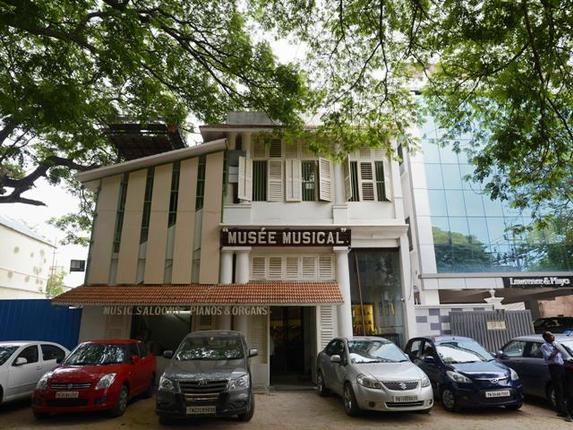
There’s a reason why the doors to the entrance of Musée Musical are tall enough for elephants to walk through. In fact, they served the very purpose: the building was used to shelter the elephants of Parthasarathy Temple. Today, it brims with guitars, violins and veenas that gleam from glass cabinets that line the walls. Situated in a cosy corner off Anna Salai, the music ‘salon’ was started by a Portuguese music-lover called Misquith in 1842. “He repaired and serviced pianos and organs back then,” recalls Kishore Das, the CEO of the company.
“Called Misquith & Co., it had 16 branches, including in places such as Lahore and the Nilgiris. But he sold them all, owing to ill health,” he adds. “Prudhomme, a Frenchman bought the Madras branch — he was the one who gave it the current name. His friend Amy Rozario, a pianist and music teacher, was the director; my grandfather Giridhar Das worked as the financial director.”
Towards the early 1940s, when the Independence Movement was at its peak, Amy decided to leave the country. That’s when Giridhar Das bought over the company. For the first time since its founding, Musée Musical had an Indian at the helm.
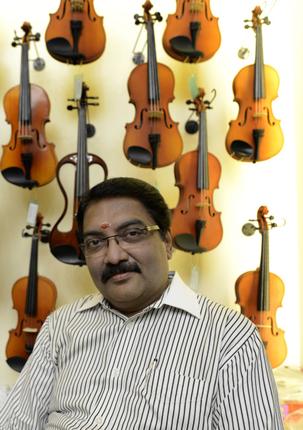
Kishore Das, CEO, Musee Musical / Photo: V. Ganesan. / The Hindu
Today, seated in an office surrounded by hundreds of musical instruments, Kishore narrates the story of this “institution” that not only sold and taught music, but also made its own instruments. Musée Musical started to hand-craft its own instruments out of necessity. This was because the Government imposed a 330 per cent duty on importing musical instruments after Independence. The trend continued until 1996. During the intermittent years, the company was a haven for those who wanted to practise Western music. They rented out instruments at a nominal rate and provided a platform for those who wanted to learn music.
“Music is common to everyone. It cannot be divided by borders,” feels Kishore. “We’ve seen musicians suffer without access to instruments and wanted to make them available.” Today, they continue to make their own instruments, although on a small scale. “We’ve been an examination centre for the Trinity College, London, since 1901,” he adds.
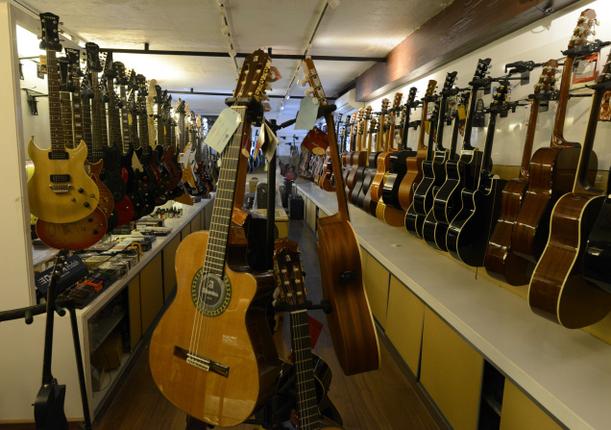
At Musee Musical. / Photo: V. Ganesan. / The Hindu
The aisles of the store have seen ordinary men and women walk in as starry-eyed lovers of music and walk out as geniuses after years of training: think Ilaiyaraaja and A.R. Rahman. Kishore remembers seeing a young Ilaiyaraaja come to their store on foot all the way from Mylapore. “He went through a lot of hardship to learn music,” he says. “For me, the best thing about being in this field is that over the years, we’ve shown people that music can also be a career,” says Kishore. “We’ve been working with the Government and educational institutions towards that.”
Years of hosting musicians and musical instruments has changed something in the quaint building. It clings to us as we walk out through the elephant doors. You can’t exactly name the feeling — it’s a mix of an inexplicable calm and awe.
source: http://www.thehindu.com / The Hindu / Home> Features> Metroplus> Society / by Akila Kannadasan / Chennai – June 21st, 2016
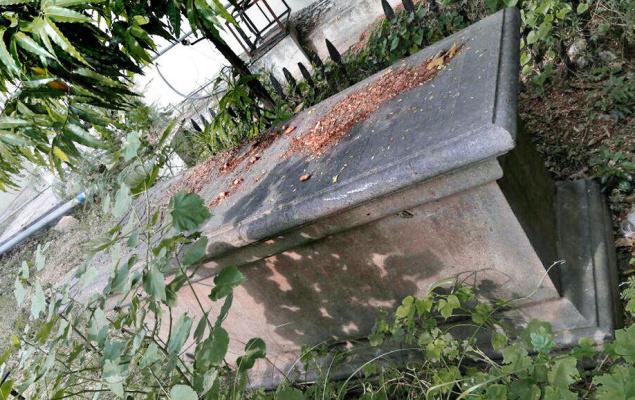
Edward Bulkley’s tomb in Ordnance Line may be moved to make way for a transformer. —Photo: Special Arrangement
Edward Bulkley was one of the first registered medical practioners in India
Students and faculty of the Madras Medical College (MMC) have of late been worried over the condition of the tomb of Edward Bulkley, one of the first registered doctors in the country, in Ordnance Line near the institution. They had recently visited the place to create an archive of the institution but returned disappointed after seeing the gross neglect the tomb has been subjected to.
“They were digging at the site to construct a transformer,” said Isaac Christian Moses, dean, MMC, who with some students and faculty visited the monument two days ago. “We went again on Monday and found crowbar marks on it. The engineer told us that they are planning to set up the transformer. The workers might have attempted to move the tomb,” he said.
On August 28, 1693, Dr. Edward Bulkley performed the first medico-legal autopsy in modern India, said V. Sriram, historian and heritage activist.
“James Wheeler, a member-in-council, died after being treated by another doctor Browne. The latter later discovered, much to his shock, that his servant had made the medicine in a vessel used for arsenic. Dr. Bulkley conducted the post-mortem and the two were tried,” he said. He also issued the first injury and medical certificate which cited illness as a cause of inability to work, he added.
In 1714, Dr. Bulkley died and was buried in the garden of his house that was later converted into a quarters for defence personnel. The tomb stands isolated inside Ordnance Line, opposite MMC, at the intersection of Poonamallee High Road and Evening Bazaar Road.
“His contribution is of immense importance to the medical world. We want his memory to be preserved,” said N.G. Suganth a final-year postgraduate student.
While officials from the Department of Archaeology were unavailable for comment, officials from the Ministry of Defence said that they will ensure that the tomb is not damaged.
source: http://www.thehindu.com / The Hindu / Home> News> Cities> Chennai / by Aditi R / Chennai – June 21st, 2016
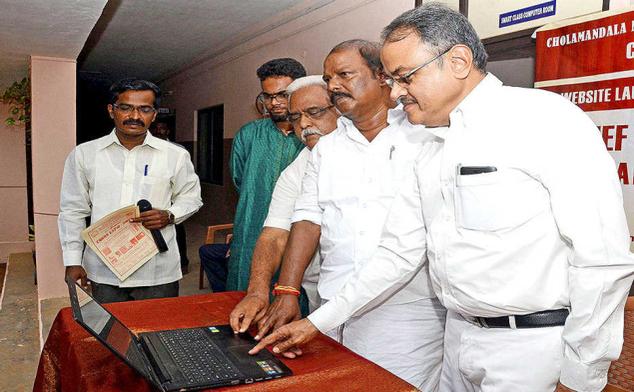
LEGACY WEBSITE:M. Rengasamy (second from right), former MLA, inaugurating the Serfojimemorial.com, a website on royal family, in Thanjavur on Sunday.— PHOTO: R.M. RAJARATHINAM
A website on the Thanjavur Maratha Royals was launched here on Sunday by Prince Pratap Sinha Raje Bhosle, the 14th descendent of Maharajah Venkoji and the Sixth descendent of Maharajah Serfoji II.
The website Serfojimemorialhall.com is in the name of Serfoji Memorial hall at the Sadar Mahal Palace, a museum founded in 1997 on the Palace premises by Prince Tulajendra Rajah Bhosle, the grandfather of Pratap Sinha.
The website contains information and details on the museum, Maratha Kings of Thanjavur and old rare photographs of the royal family. Prince Pratap Sinha Raje Bhosle started with a Facebook page in 2013 in the name of the private museum where he got a good response while in the next year he started a blogger.
In 2015, Prince Pratap published a book Contributions of Thanjavur Maratha Kings .
Maharajah Serfoji II, a descendent of the great Maratha ruler and founder of the Maratha Kingdom, Chatrapathi Shivaji the Great, ruled Thanjavur from 1798 to 1832 A.D. Prince Tulajendra Rajah Bhosle, the fourth descendant of Maharajah Serfoji II, has been living in Thanjavur Sadar Mahal Palace with his family, to preserve the heritage of the illustrious Maratha royals of Thanjavur.
To preserve the remaining antiques of Rajah Serfoji II, he formed a trust and opened a museum at Sadar Mahal in the name of “Maharajah Serfoji II Memorial Hall” that was declared opened on October 11, 1997.
The website was launched at the monthly meet of the Cholamandala Numismatic Society in the presence of Board Member, Saraswati Mahal Library, and Managing Trustee, Serfoji II Memorial Hall Museum, Prince Shivaji Rajah Bhosle, former MLA M. Rengasamy, Chairman, Parisutham Institue of Technology, S.P. Anthonisamy, historian Gopalan Venkatraman, Society president Shaktivel, founder M. Durairasu, and secretary I. Kulandaisamy.
Director of Sri Sakthi Natya Kalalayam Aruna Subrahmanyam spoke and presented a bharatanatyam performance by her disciples. Bharatanatyam master Herambanathan was present.
source: http://www.thehindu.com / The Hindu / Home> National> Tamil Nadu / by Special Correspondent / Thanjavur – June 20th, 2016
Karthik Arasuwill be contesting in the Australian senate election
His pursuit for education and small businesses took him to Australia nearly two decades ago.
His dream to be the voice of Indian-origin people has now made Chennai-born Karthik Arasu to run for Australian Senate election.
A former resident of Choolaimedu in the city, Mr. Arasu has become the first Indian-born independent senate candidate from Victoria in Australian Federal Elections 2016.
Techies in campaign
What’s more interesting is that a team of techies from Chennai are involved in his digital campaign.
Speaking to The Hindu over phone after a long campaign day in Victoria, Mr. Arasu said: “I started networking with Indian-origin people for my business in Australia and learnt about the issues of migrant population, especially of Indian origin. There was hardly any representation of Indian origin people in Australian politics and I decided to contest as friends encouraged me.”
Mr. Arasu, a manufacturing engineer, pursued his masters in Swinburne University and opened service station on contract with United Petroleum and also trained people in the small businesses. “Contesting in the election will be an opportunity to put forth issues of migrant population. My goal is to gain respect for the Indian-Australian community and other ethnic communities through better representation and encourage inclusive politics,” says Mr. Arasu.
The Senate is the upper house of Australian parliament and its representatives are chosen through direct voting. With most of his family members in Chennai, Mr. Arasu visits India every year.
Dedicated website
S. Suman Kumar, who is heading the digital campaign, said: “Six of us are managing the campaign online through a dedicated website and reach out to Victorians through social media. We got connected to Arasu through a friend. The only issue is the difference in time at both countries.”
source: http://www.thehindu.com / The Hindu / Home> News> Cities> Chennai / by K. Lakshmi / Chennai – June 20th, 2016
Alagu Servai, in his sixties, is small-made, has a bald head and wears a perpetual smile. This farmer is known for his wit; on one occasion he even made chief minister J Jayalalithaa laugh when he messed up his speech papers at a felicitation ceremony organised by Madurai farmers in August, 2014. Alagu is back after a government sponsored trip to Thailand from May 22 to 29 to learn agricultural practices in that country. Excerpts from an interview.
Q: How was your trip to Thailand?
A: I was among 100 farmers sent to various countries to learn the agricultural practices followed there. I went to Thailand and visited various places of agricultural interest. The experience was an eye-opener and a learning experience.
Q: What differences did you find in the cultivation methods?
A: They cultivate everything we do, like paddy, sugarcane, banana and millets, but all of them through organic farming. Farmers get their subsidies as freebies directly from government.
Q: Anything overwhelming you have observed during the trip?
A: They have a paddy variety called ‘Madurai paddy’; it was named so in memory of Chola King Rajarajan who visited the country. Many paddy varieties were introduced from India when the Cholas maintained contact with the country, I was told.
Q: What technologies do you think could be adopted locally?
A: We can’t switch over to organic farming all on a sudden like they do. Thailand farmers cultivate coconuts in a different manner. They plant them in heaps instead of in pits like we do and use channels to keep water around the plants. Also farmers don’t hand over work to farm hands. They stay on in their farms for 8 hours. It is one of the good practices I found there. I will be sharing my experiences and lessons with our farmers soon.
source: http://www.timesofindia.indiatimes.com / The Times of India / News Home> City> Madurai / TNN / June 18th, 2016