Sahitya Akademi awards: Double joy for Tamil Nadu, though a tad late

Chennai  :

Tamil Nadu has hit the literary jackpot this year with two authors from the state winning the Sahitya Akademi awards. The winners, Kuzha Kathiresan and Lakshmi Saravana Kumar, are a contrasting duo with just one commonality. Both of them, though happy, feel the recoginition has been delayed.
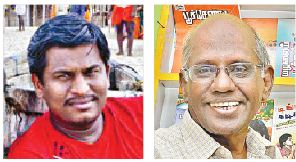
(L) Lakshmi Saravana Kumaf (R) Kuzha Kathiresan

Kathiresan, a 67-year-old publisher, famous for his children’s books and poetry, began his writing career at the age of 30. He was awarded the Bala Puraskar award for total contribution to children literature.

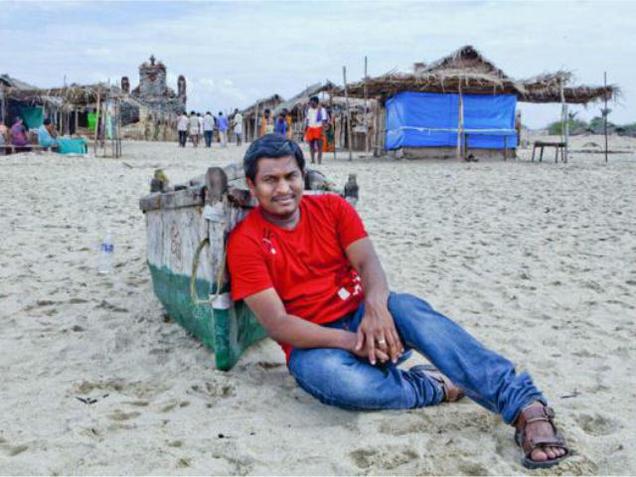
On the other hand, Yuva Puraskar awardee Lakshmi Saravana Kumar is just 31-years-old.  His novel Kaanakan, which won him the award, is set in the ganja fields of the Western Ghats in Theni district and deals with the lives of the underprivileged and the oppressed. The author, who carries his mother’s name as his first name, is also a filmmaker. He had assisted director Vasanthabalan in his period film Aravaan and the historical fiction, Kaaviya Thalaivan. Saravana Kumar is now working on the script for his first film.

Kathiresan who runs Ainthinai Pathippagam, was at his house in Anna Nagar when a well-wisher called him to inform about him being included in the list of awardees. “It is indeed a surprise. I hadn’t sent any sample work to the Akademi last year. Five years ago, I was expecting one. Then, over time, it never crossed my mind,” Kathiresan told  at his Anna Nagar residence.

Saravana Kumar was busy with production meetings for his movie when he was informed of the news. “This  award doesn’t call for a huge celebration, I feel. But I am happy nevertheless,” he told Express over phone.  He feels that his Yuva Puraskar award was due at least three years ago for his novel, Uppu Naigal, which he considers his as his best work. Though Akademi award was delayed, both the writers were bestowed with several other awards over the years.

source: http://www.newindianexpress.com / The New Indian Express / Home> Cities> Chennai / by Srikanth Dhasarathy / June 17th, 2016
At 100, this Victorian beauty retains her old world charm

Madurai:

Built in 1916, the Madurai District Collectorate – the palatial stone building near Anna Bus stand – is a fine example of Victorian-era architectural style. The 100-year-old building was constructed in random rubble masonry style and flaunts stone work with huge corridors and arches. The colonial-era stone structure as seat of the Madurai district administration is a feast to the eyes.

Situated on a 30-acre plot, the building houses the Madurai North and South tahsildar offices, supply office, Tamil Nadu Medical Services warehouse, government workshop, fire station and the Madurai RDO office.

Madurai fell into the hands of the British around 1750. Nayak rule ended in Madurai in 1736 as the last Nayak Queen Regent, Meenakshi sought help of Chanda Sahib who was eyeing for throne of Carnatic. She was deceived by him. After shuffling hands between Chanda Sahib, Arcot Nawab and Muhammed Yusuf Khan alias Marudha Nayagam for a while, Madurai Kingdom smoothly ended in East India Company’s rule. British formally established Madurai district and A Mc Leod was the first collector of Madurai, assuming charges on September 6, 1790.

During that period, Madurai was within the four walls of Nayak fort. In 1837, Madurai collector John Blackburn decided to bring down the walls and expand the city. Most of the British or European settlements were outside the city towards Teppakulam, including missions established by the American missionaries.

Sadly there is not much detail available about the building. Apart form a stone tablet on the portico, there is not even a single stone inscription narrating its inaugural or people behind it like the ones found in other colonial buildings.

Madurai district collector K Veera Raghava Rao said that the district administration is planning a centenary celebration of the building.

source: http://www.timesofindia.indiatimes.com / The Times of India / News Home> City> Madurai / by Arockiaraj Johnbosco / TNN / June 12th, 2016

VIT sponsors athlete’s travel expenses to Turkey

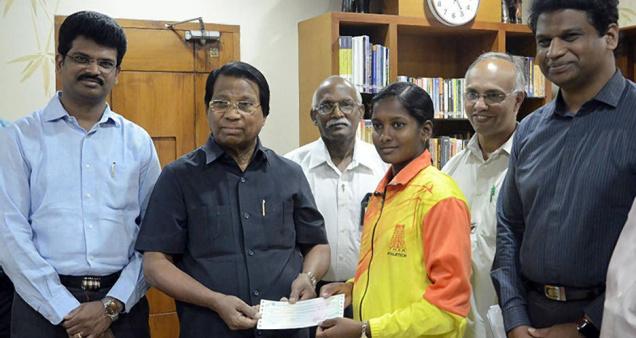
Timely help:VIT University chancellor G. Viswanathan hands over a demand draft for Rs. 50,000 to N. Hemamalini on Thursday.— Photo: C. Venkatachalapathy

N. Hemamalini will represent the country in javelin throw

VIT University Chancellor G. Viswanathan on Thursday handed over a demand draft for Rs. 50,000 to N. Hemamalini, a student of Government Girls Higher Secondary School, Odugathur, to meet the travel expenses to participate in the World School Athletic Championship to be held next month in Turkey.

Daughter of a farmer, the student will be representing the country in javelin throw at the championship.

Ms. Hemamalini, who is in class XII, has been training in javelin throw for the last three years and has bagged 13 medals in State and National-level championships so far. She has created three records at the State, South India and National level, with her best throw being for 40.98 metres. She has been selected for the World School Athletic Championship to be held from July 11 to 18 in Turkey. As she required sponsorships, VIT University chipped in with financial assistance of Rs. 50,000.

Ms. Hemamalini said she was happy to receive the assistance as it would help her meet the travel expenses to fly to Turkey. VIT vice-presidents Sekar Viswanathan and G.V. Selvam, vice-chancellor Anand A. Samuel and S. Pandiyan, headmaster of Government Girls HSS, Odugathur, were present.

source: http://www.thehindu.com / The Hindu / Home> National> Tamil Nadu / by Staff Reporter / Vellore – June 17th, 2016

New tech to produce palm sugar in 6 hours

Madurai:

Before the advent of cane sugar and mass production in factories, palm jaggery or palm candy used to be the local sweetener. But then, it lost sheen as it was unable to match the production of cane sugar.

One of the major impediments was that there was no mechanised method to produce like cane sugar. But, that tide is fast changing again as with its lower glycemic index is in demand over cane sugar.

Considering its huge potential, Thassim Beevi Abdul Kader College for Women has come out with a technology to produce with machines. This new technology was discussed during the international conference on food, nutrition and health organised by the college in Madurai from June 6 to 8.

Few pockets like Udangudi, Vembar in Tuticorin district, Sayalkudi in Ramanathapuram district and Srivilliputhur in Virudhunagar district are still famous for making palm jaggery from the sap of palm trees. They also make in conventional method by boiling palm sap for many hours to remove its impurities and store it in anaerobic containers where crystals are formed on threads tied inside the container. It takes 45 to 60 days to get in this manner.

The technology invented by the college provides in powder form within six hours.

Explaining the technology, S Muthumariswari, assistant professor, department of home science and research centre, said there is enormous demand for not just in India but from abroad as well. She has created the technology as part of her PhD research.

“In many places of Ramanathapuram district, people still make or powdered palm jaggery whenever there is a need. Considering the huge potential, we are making using machines,” she said.

The college has tied up with Coimbatore-based Dinu Technology to create the machine. J Dinesh from Dinu Technology said that similar to conventional method, in this technology too, palm sap is boiled and crystallised.

“Unlike 45 to 60 days, machine processing takes only six hours and sugar content may vary depending on the region. For instance, palm sap in Ramanathapuram district will have more sugar content than other places,” he explained.

It is said that there used to be five to eight crore palm trees in Tamil Nadu. After toddy tapping was banned, palm trees have seen a steady decline and there are only three crore now.

When demand for is said to revive palm cultivation, modern technology to manufacture it will be a great boon. But the machine cost is quite higher for poor palm farmers to afford, says Dr S Sumayaa, principal of the college urging government’s support in this regard.

source: http://www.timesofindia.indiatimes.com / The Times of India /News Home> City> Madurai / by Arockiaraj Johnbosco / TNN / June 08th, 2016

Novel on tiger hunting wins Yuva Puraskar award

PROUD MOMENT: Kaanakan is the second novel of Thirumangalam-based Lakshmi Saravana Kumar

Saravana Kumar’s novel ‘Kaanakan’ deals with Paliar tribes’ struggle against bid to appropriate their land for ganja cultivation.

Tamil writer and filmmaker Lakshmi Saravana Kumar’s novel Kaanakan, which depicts the life of Paliar tribe in the Western Ghats and hunting practices, has won the Sahitya Akademi’s Yuva Puraskar award for 2016.

“It deals with the Paliar tribes’ struggle against ganja plantations and the attempt to appropriate their land for the purpose in the 1980s,” said Mr. Saravana Kumar, who has penned three novels and six short stories and a poetry collection.

An associate of director, Vasanthabalan, Saravana Kumar, who had worked with him Kaaviya Thalaivan and Aravaan, is now working on his own film.

Kaanakan is Thirumangalam-based Saravanakumar’s the second novel. His first novel is Uppu Naaigaland his latest is Neelappadam .

“Kaankan deals with hunting and the ethics of hunting. It starts with hunting of a tiger and ends with tiger hunting men. The richness of a forest is always judged by the presence of tiger. There are some ethics when it comes to hunting. Females are spared by hunters,” said 31-year-old Saravana Kumar.

Tamil writer and publisher Kuzha. Kathiresan has won the Sahitya Akademi’s Bal Sahitya Puraskar for his contribution to children’s literature. Born in Royavaram in Pudukottai district, Mr. Kathiresan was trained in by Azha. Valliappa, a writer known for his contribution to children literature.

Simple lines with good messages are the hallmark of Mr Kathiresan’s works. He is running Inthinai Pathipagam, which published most of the works of T. Janakiraman and other great writers.

“I have written 4,000 poems and some of them were prescribed for schoolchildren in the State and Singapore,” said Mr. Kathiresan.

It deals with Paliar tribes’ struggle against bid to appropriate their land for ganja cultivation

source: http://www.thehindu.com / The Hindu / Home> News> Cities> Chennai / by B. Kolappan / Chennai – June 17th, 2016

From IIT-M: Capsule in body to count calories, diagnose cancer

CapsulesCF17jun2016

Chennai  :

Sensors in capsules that can wirelessly communicate data from within the body are getting smarter.

Researchers from IIT-Madras and the University of Nebraska, Lincoln (UNL) are working on an ingestible capsule that will stay put in the body – potentially for close to a week – with sensors that will take readings of an individual’s calorie intake, eventually help in diagnosis of diseases such as cancer and allow for sustained delivery of drugs.

_______________________________________

HIGHLIGHTS

  • IIT-Madras and the University of Nebraska, Lincoln (UNL) are working on an ingestible capsule that will stay put in the body with sensors that will take readings of calorie intake, will help in diagnosis of diseases like cancer

.  The microcapsule has a vacuum-powered ‘sucker’ surrounded by             tiny needles, similar to the hooks a tapeworm uses to embed                   itself in the gastrointestinal tract.

________________________________________

As part of the trial, researchers are studying the effect of the capsule on pigs, that have remarkably human-like digestive systems.

The pill, in its current form, carries a sensor to read core body temperature. The microcapsule has a vacuum-powered ‘sucker’ surrounded by tiny needles, similar to the hooks a tapeworm uses to embed itself in the gastrointestinal tract.

“The capsule, made of biocompatible materials, works like a parasite by latching on to the intestinal wall,” said Benjamin Terry, assistant professor, department of mechanical and materials engineering, UNL. The attachment mechanism, he said, caused no damage to the intestine of the pig, which carried it for six days.

Terry said the big breakthrough for the research team was to ensure the body did not immediately reject the capsule, which is 25mm in length and 12mm in diameter.

“Tissues are slippery and resistant to solid mechanical structures attempting to anchor to them,” Terry said. “They also constantly contract and elongate. On an average, the device initially stayed inside only for two hours.”

The team overcame this by testing numerous types and sizes of suckers, along with the number and angle of needles surrounding them. They settled on a configuration that yielded the strongest adhesion – one that was 5mm in diameter with six needles set at 45 degrees within it. The team’s study recently appeared in the journal Biomedical Microdevices.

The sensors communicate their readings to an external device through low-intensity radio waves.

“The device is kept a metre away from the body. We use only low intensity waves that don’t harm the body,” said P V Manivannan, assistant professor in mechanical engineering, IIT-Madras.

Terry’s team is collaborating with IIT-Madras to take the device to the next step – to measure calorie intake. Manivannan’s team create the system and controls for this.

Experts say biosensors could help monitor factors that influence digestive health. Such prolonged data sources could help in diagnosis of diseases such as cancer and eventually permit the sustained delivery of pharmaceutical drugs.

Terry said the mechanism could also serve as a long-term vessel for capsule endoscopes, the ingestible pill-shaped cameras that permit physicians to record images of the gastrointestinal tract.

“One of the shortcomings of current capsule endoscopy technology is its relatively quick migration through the gastrointestinal tract,” said Terry. “Pausing at a location of interest, such as a polyp or ulcer, is desirable. Our technology will make this possible.”

source: http://www.timesofindia.indiatimes.com / The Times of India / News Home> City> Chennai / by Ekatha Ann John / TNN / June 16th, 2016

Earthen pans that warm hearts in the Gulf

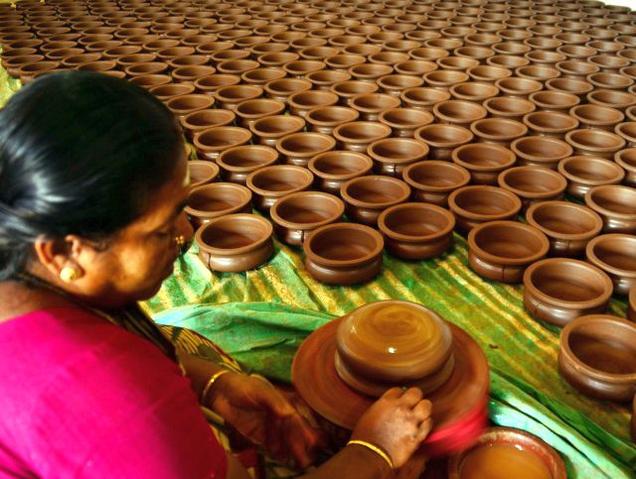
A worker giving final touches to the microwaveable earthern pans in a manufacturing unit in Palayamkottai, Tamil Nadu.— Photo: A. Shaikmohideen

The microwaveable pots, manufactured in T.N., have been popularised by a Dubai chef

The famous earthenware industry of Tamil Nadu’s Tirunelveli district, which is known for its quality pots and pans, has now started manufacturing microwave oven-friendly earthen pans that have won thousands of hearts in the Gulf.

Demand for samples

Five years ago, the executive chef of a star hotel in Dubai contacted S. Murugan of Kurichi in Palayamkottai after trawling through the Internet, and asked him for samples of the eco-friendly pans. Mr. Murugan followed the chef’s specifications and prepared the product that reportedly impressed him. The chef even recommended Mr. Murugan’s product to his other friends in the Gulf.

“We have our clientele in Dubai, Kuwait, Jordan and Qatar. The star hotels of the oil-rich nations use our pans for packing biryani meant for home delivery, instead of packing the mouth-watering dish in plastic or cardboard materials.”

Heat and eat

After stuffing the yummy biriyani in a use-and-throw earthenware pan, it is covered with a roti and kept in a hotbox. The customer, on receiving the delivery, needs to just put the pan in the microwave oven and heat it.

“Since we bake the pans in the kiln up to 950 degree Celsius, the earthenware pan can withstand the oven heat and this process will not affect the quality of biryani in anyway,” says Mr. Murugan.

source: http://www.thehindu.com / The Hindu / Home> National> Tamil Nadu / by P. Sudhakaran / Tirunelveli – June 16th, 2016

Veteran Tamil film director AC Tirulokachandar passes away

Chennai :

Veteran Tamil film director  AC Tiurlokachandar , who had directed over 60 movies including Tamil, Telugu and some Hindi films, passed away here today.

“He was 85 and he passed away at a hospital here due to age related health issues and he is survived by a son and a daughter,” N Shan, son-in-law of Raj Chandar, son of  Tirlokachandar told .

Remembered for films in which he had directed iconic yesteryear actors like MG Ramachandran and  Sivaji Ganesan , he debuted in Tamil film industry in the 1962 movie “Veera Thirumagan,” a AVM production.

Before that he had worked in film studios and had written numerous short stories in Tamil magazines. Films like Anbey Vaa (1966), (Ramu (1966), Athey Kangal (1967), Naanum Oru Pen (1963), Baratha Vilas (1973), Enga Mama (1970), were among his Tamil hits.

“The last movie that he directed was Sivaji starrer Anbulla Appa (1986),” Shan said.

Totally, he had directed 65 films, most of them in Tamil followed by Telugu and Hindi, he said.

He also directed  Rajinikanth starrer movies, including “Badrakali”.

Meanwhile, a press release from his publicist said he won a host of awards, which include Kalaimamani Award from the  Tamil Nadu  government, and Filmfare Awards . He also headed a State government panel to select best movies, it added.

The cremation would be held here tomorrow, Shan said.

VGN BN JCH

source: http://www.timesofindia.indiatimes.com / The Times of India / News Home> City> Chennai / PTI / June 15th, 2016

Plan to set up a museum in Tirupur

A group of young entrepreneurs and professionals are embarking on a mission to set up a museum here for a holistic depiction of the history and natural treasures of Tirupur, and showcase the image of the region beyond that of a garment export hub.

“We toyed with the idea as no museums are here now to pass on the history to the future generations,” said one of the group members Kathiresh Swaminathan (34), who is a prominent textile entrepreneur and chairman of Young Indians (Tirupur chapter), the youth wing of the Confederation of Indian Industry. The entrepreneurs and the professionals, who are part of the project, were mostly members of Young Indians, and the remaining being different stakeholders involved in development activities.

According to Mr. Kathiresh Swaminathan, the museum is being planned to be set up on around 20,000 sq ft in one of the unused garment factory/godowns available in Tirupur knitwear cluster.

According to the plans, the museum will have paintings and sculptures to give a narrative of the growth story of the city and about the activities in clusters other than the garments like sculpture cluster at Thirumuruganpoondi and steel/copper utensils manufacturing cluster at Anupparpalayam, among others.

Knowing that any narration of Tirupur cannot be completed without the mention of Tirupur Kumaran, who laid down his life fighting British, the museum will portray some rare pictures of him and tell about his role in the freedom struggle.

Similarly, the details about the natural treasures of the district like Kangayam cattle breed, which is facing extinction, and traditions followed in the rural areas, will be on display.

“We want children, many of whom in the present generation did not know much about the history, to visit the museum apart from the tourists as youngsters play a pivotal role in carrying forward any legacy,” said Mr. Kathiresh. The capital expenditure for the project is expected to be met by the contributions from the young members who were part of the project implementation along with the investments from philanthropists and voluntary donors.

source: http://www.thehindu.com / The Hindu / Home> National> Tamil Nadu / R. Vimal Kumar / Tirupur – June 16th, 2016

A city cab driver who is also a coach for civil service aspirants

Vijey Srinivas
Vijey Srinivas

Chennai  :

Next time you get into a cab, and find your driver speaking impeccable English and talking about general affairs, politics and education …don’t be surprised! Meet Vijey Srinivas, a 47-year old logistician-cum-cab driver. Hailing from Krishnapuram, Tiruchy this logistician turned-part time cab driver is what one would call Jack of all trades.

Apart from what he already does, he is also an academician and specialises in soft skill training, is a coach for competitive exams like civil service, TNPSC and MBA, and is also a motivational speaker. Vijey says that he really didn’t think he would be where he is right now.

“I grew up in a small village. I wanted to learn and gain knowledge about everything. That’s when I started reading newspapers,” he says crediting his progress to the various newspapers and tabloids. He started taking baby steps into the world of newspapers in 1987 and today, he reads almost six dailies.

“I can’t sleep without reading newspapers. It’s very hard for me to miss the day’s happenings,” shares Vijey, who settled in Chennai in 1992. His love for tabloids made him collaborate with his friends and start a tabloid Port Links (It deals with issues faced in the Chennai port). The tabloid was started to take issues like congestion to the ministry level. But he is no longer a part of it.

“I had other commitments,” explains the Economics graduate from the University of Madras. He aims to become a lecturer in business communication and is also doing a master’s degree in MA Journalism from Madurai Kamaraj University. “I want to keep learning and contribute to society,” he adds.

After serving over two decades in the shipping industry, he started pursuing a career in soft skills.

A qualified trainer, Vijey currently trains students across various institutions in public administration, Indian history, Tamil, Indian Constitution and other subjects.

“I haven’t done MBA. But, I even teach MBA students. I strongly believe having an aptitude for different subjects is more important than holding a degree in that specialisation,” he says.

So, let’s move to the cab part about which most of you are curious about by now. Vijey began to ponder over passenger logistics and cab aggregators and started driving for Uber on January 1 this year.

Travelling around the city, meeting people from different walks of life, networking and earning at the same time, Vijey hit a jackpot and started living the life he loved.

“I’ve met so many people in my journey. Everyone is surprised when I speak in English and talk about politics and current affairs. IT professionals to high command officers, I’ve met them all,” he shares, mentioning a passenger from the US who gave him a $10 tip, impressed by Vijey’s knowledge and skills.

Vijey’s day begins at 4 am and he works for up to 20 hours a day. “I do yoga, meditate and prepare if I have a class to teach. In my spare time I do what I love — drive!” he exclaims.

source: http://www.newindianexpress.com / The New Indian Express / Home> Cities> Chennai / by Roshne B / Express News Service  / June 09th, 2016