The house of groaning shelves

They were once hallowed spaces of knowledge. Today derelict and with aging collections of books, libraries in the city still hold secrets within their cavernous halls.


There’s pin-drop silence. The gentle whirr of a fan, the rustle of paper, and the thud of a dropped book often cracks it. Unlike in school libraries, there are no ‘shushers’. There isn’t need for one; there aren’t many visitors to shush. A few of the city’s grand old libraries, for most part of the day, are left with just the aging books. Pick one from the shelf, amidst a cloud of dust, and you’ll see tiny silver fish play hide and seek. Many of them, difficult to maintain, have been brutally shredded in the past, says Uma Maheshwari, librarian at Madras Literary Society (MLS) — the oldest in the city. But not anymore. People are now adopting books — paying all it takes to get them back in form. These sit on a separate shelf, newly-bound and way past their lifespan. “We have given them a grace life of 200 years for now,” says Uma, drumming her fingers on the remaining 45, which await adoption.


Braving vertigo

Madras Literary Society

“Books can be taken from there, but then most do not, because of the dust,” shouts Uma Maheshwari from below, as I carefully climb the metal ladder leading up to a set of shelves. “We should probably install a chair lift…” she says, before turning away to attend to an elderly visitor, who wants a certain book about writings by (Jawaharlal) Nehru. The search begins. The books are not classified; catalogues not set in order. After the renovation of the 203-year-old red-brick structure a few years ago, the wiring has been detached, and the books moved from their places. Founded in 1812, the Society was part of the College of Fort St. George, started by the then collector of Madras Francis Whyte Ellis. In 1830, the Society became an auxiliary of the Royal Asiatic Society of Great Britain, and functioned out of Connemara Public Library, before moving to its current location on College Road, inside the Directorate of Public Instruction complex, in 1905. “We need volunteers to dust, classify and set them all (around 80,000) up again,” says Uma, leaning on an antique rosewood chair. Clutching the shaky railing, I take another flight of steps. From here, the thick layer of dust on the fan and on the cupboards is visible.

So are the brick-and-lime mortar walls and tall windows with Rajasthani accents. Looking down through the grill gets me a little dizzy. “So when is the lift due?” I ask.

Home to: Arretolis Opera Omania QVAE Extant Graece and Latine (1619), Travels in India by John Baptista (1680) and Philosophiae Naturalis Principia Mathematica by Isaac Newton (1740)

Coffee with Captain G.A. Mustafa

Mohammeddan library

From inside a glass cubicle, an elderly man asks for my business card and tells me to write my address and contact number in a visitor’s register. Retired Air India commander Captain G.A. Mustafa’s family, starting with his great grandfather, has been taking care of the library ever since it was established in 1850. According to the book Madras Rediscovered by chronicler S. Muthiah, ‘the library was started as Madras Muslim Public Library by Surgeon Edward Green Balfour, head of the Museum, and his sponsor, Nawab Ghulam Mohammad Ghouse Khan of Arcot.’ Mustafa was there during the critical period between 1939 and 1945, when the library lost much of its collection; and when the building, which boasted Islamic architecture, was pulled down in 1996, and reconstructed in 2005. “There are over 15,000 books and manuscripts, many gifted by the kings of Egypt, Turkey and Jeddah in the 1850s. They cannot be found anywhere else in the world,” chips in librarian Tameemur Rahman.

It’s around 5.30 p.m., almost closing time. Hot cups of coffee are brought in. An 1852 edition of a yellowing astronomy Persian book in one hand and a freshly-bound book in another, Tameemur gets technical about photo encapsulation — a technique to document manuscripts using specially processed polyester film coated with glue — which he claims was kickstarted in the library.

On my way out, Mustafa stops me and says, “Saba Mustafa is my wife.” There is a long pause. “She was the one instrumental in getting the library back in shape. Will you please mention that?”

Home to: H.D. Love’s Vestiges of Old Madras (100 years old), The Lancet magazine (July 1883),Ramayana written in Persian, and the Bible of Barnabas

Walking in the dark

Connemara Library

On the first floor of Egmore Museum Library, at the far end of the room, a faded poster reads: ‘Way to the old building’. The narrow path leads into a bright circular room with desks and tables, and a staff member who takes your reference requests — just like in a departmental store. That is the closest you can get to the Connemara Library (established in 1890 by Bobby Robert Bourke Connemara) — unless you have special permission to visit.

It’s 15 minutes to 5 p.m. — closing time. I walk down the red-carpeted floor to a mammoth structure with an array of teak wood shelves. To my right is a glass case with important books like Thambiran Vanakkam by Henriques (the original copy of which rests in London); bang in the middle is a Gandhi statue by Roy Chowdhury; and on the floor are old maps of the Tamil Nadu villages, laid out like tiny step mats. I open one to see a dark sketch of Kulavoipatti village in Pudukottai district. To my left is a counter with a small window, from where the librarian used to issue books back in the day. A narrow wooden staircase leads to a long wide hall spread with books that have been left to dry on the floor. The other end includes large circular reading desks. Connecting both is a small space with shelves that house records of Lok Sabha debates. As I pick up a book, the lights snap. It’s spooky, but only for a while. The colourful Burmese windows let in soft shades of light, just enough for me to see the truncated semi-circle roof and the ornamental acanthus leaves and flowers adorning the pillars, marble-floors, and the exit.

Home to: Omnes Quae Extant by D. Hieronymi Strido (1553) and Opera Quae Exlast Ominia (Greek Latin) by Plato (1578) are part of the nearly eight lakh books.

Smelling lemongrass

Oriental Manuscripts Library

Librarian R. Chandramohan carefully unlocks a glass panel inside a room with double doors to take out a lingam-shaped structure. “This is the original text of the Thiruvasagam written by Manikavasagar,” he says. The over-350-year-old palm manuscript was showcased at the World Manuscripts exhibition in Frankfurt, Germany, a few years ago, he says. Next, he takes a set of palm leaves which have the famousThirumurugatrupadai by Nakkeeran inscribed on them. Right next to it is The New Testament in Hebrew, Soolini Manthiram, Mahabharata drawings on handmade paper, and an ivory manuscript case. “There is more,” he says, opening the door to rows of wooden shelves with compartments filled with over 70,000 manuscripts in Tamil, Sanskrit, Telugu, Kannada, Marathi, Urdu, Arabic and Persian; and air thick with the smell of lemongrass. A few palm leaves, freshly anointed with the oil, are spread on the floor. Most of these are personal collections of Colonel Colin Mackenzie (who came to India in 1783 as a Cadet of Engineers on the Madras Establishment of the East India Company), linguist and traveller Dr. Leyden, who was in India between 1803 and 1811, and C.P. Brown who was part of the Indian Civil Service in the 1830s, Chandramohan reads out from a presentation. The library, which is controlled by the Department of Archaeology, Government of Tamil Nadu, was established in 1869 with the collection which was first housed in Presidency College, before moving to Madras University. Locking the door behind him, he says, “Even if you go out of this room, the memory of the smell will linger.” Ten minutes later, I realise he was right.

Home to: Tolkappiyam, Manimegalai, Silapathikaram

Meeting the grandfather of Tamil

U Ve Swaminatha Iyer Library

The security at the Kalakshetra Colony gate says “Go right ahead”, and sure enough, hidden behind the trees, is a white building. A statue of U Ve Swaminatha Iyer, the grandfather of Tamil, welcomes visitors. Only, there are none inside. Just staff members, who are on their lunch break. The library, which was established in 1943, includes Tamil literature collected by UVS, who is known to have spent his life searching for palm leaf manuscripts and transcribing them into books. This content has now been converted into microfilms (462 in total) by Indira Gandhi National Arts Centre; and these have in turn been converted into DVDs. The library in itself is being computerised with research facilities; it clearly seems to know the road ahead.

Home to: 69 of the 96 palm-leaf manuscripts of Sangam literature; 32 of the surviving 120Tolkappiyam palm-leaf manuscripts.

In pursuit of art

DakshinaChitra Library

After catching a show at the Kadambari art gallery, I head to what is probably DakshinaChitra’s best-kept secret. Serpentine queues of children walk in and out of the heritage houses, and a significant crowd waits to get their hands messy at the ceramic art centre. But the library seems withdrawn from the buzz. The library started at Madras Craft Foundation office in 1984 with around 200 books, now has over 9,000, apart from the 5,000 volumes that are National Folklore Support Centre’s collections. With out-of-print art books and journals like Indian Magazine, Lalit Kala, Indian textile history and Marg, and around 1,50,000 photographs, the place seems like an extension of the gallery.

Home to: Traditional Indian theatre, UMI’s dissertation on Therukoothu, Theyyam and Tolubommalata, Sargam; Thurston’s volumes on Castes and Tribes of Southern India

source: http://www.thehindu.com / The Hindu / Home> Features> MetroPlus / by Naveena Vijayan / Chennai – March 11th, 2016
Ouch! Padma’s spicy Salmanic curses – What We Ate reveals Rushdie’s appetite


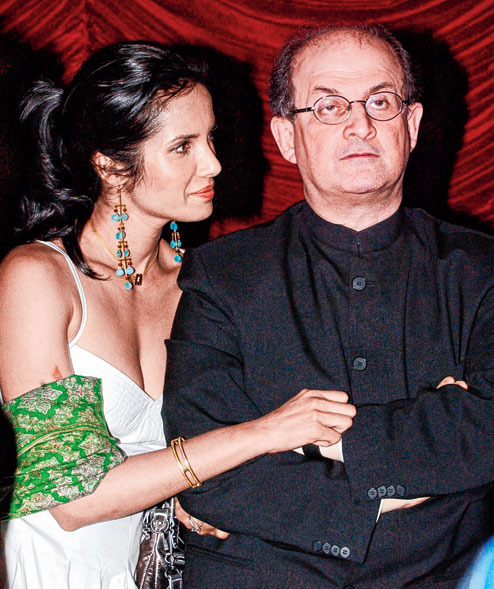
Padma Lakshmi with Salman Rushdie in Calcutta in 2004, the year they got married

London :

Padma Lakshmi has written an “autobiography” in which she has revealed she slept with Salman Rushdie on their first date but eventually could not satisfy his insatiable sexual appetite after they were married.

When she could not have intercourse with him because of an operation for a painful medical condition, called endometriosis, the author apparently turned surly and commented sarcastically: “How convenient!”

Each year when the Nobel Prize went to another writer, Rushdie took it hard. Padma would console him, she claims.

Padma’s book is in the shops in the US tomorrow but ahead of its release, the most salacious aspects of Love, Loss, and What We Ate (HarperCollins; $26.99) have already been picked out from early review copies sent to the American newspapers – and also given general coverage in British newspapers as well.

Padma, a TV cook and one-time model and actress (she starred in the Bollywood movieBoom), married Rushdie in 2004. The marriage ended in acrimony after three years.

He was unkind to Padma in his autobiography, published in 2012, and now she has got her revenge.

In his memoir, Joseph Anton – the pseudonym Rushdie assumed in hiding by mixing “Joseph” Conrad and “Anton” Chekov – the author wrote about himself, somewhat curiously, in the third person.

“Then he went to Paris for the publication of La terre sous ses pieds (The Ground Beneath Her Feet) and she (Padma) joined him for a week of intoxicating pleasure punctuated by hammer blows of guilt,” he said.

“‘You saw an illusion and you destroyed your family for it,’ (his third wife) Elizabeth would tell him, and she was right,” Rushdie acknowledged

“She (Padma) was capable of saying things of such majestic narcissism that he didn’t know whether to bury his head in his hands or applaud,” he continued. “When the Indian film star Aishwarya Rai was named the most beautiful Indian woman in the world in some glossy magazine or the other, for example, Padma announced in a room full of people, that she had ‘serious issues with that’.”

“She was ambitious in a way that often obliterated feeling,” he said of Padma. “They would have a sort of life together – eight years from first meeting to final divorce, not a negligible length of time – and in the end, inevitably, she broke his heart as he had broken Elizabeth’s. In the end she would be Elizabeth’s best revenge.”

Padma is now 45 and Rushdie 68. It wasn’t like this when it began.

This is the New York Daily News on Padma’s revelations: “Lakshmi was 28 and single, Rushdie was 51 and married to his third wife. A bit part in Mariah Carey’s disastrous 2001 movie Glitter was the apex of Padma’s big screen acting career. The pair first met in 1999 at a party. On their first real date – Rushdie initially wooed her by phone since she lived in Los Angeles – the pair fell into bed.”

“At 3am, I woke with a start. I’m naked in a married man’s bed,” the good south Indian girl thought before sneaking out of the hotel room.

Today’s Daily Mail is a little more direct: “Rushdie initially pursued her by phone since she lived in Los Angeles, and on their first date they ended up in bed together.”

The Daily News is rather taken with Padma: “The stunningly beautiful Padma Lakshmi, in her new memoir, Love, Loss, and What We Ate, serves up the hot, steaming dish about the egotistical writer.” The strap reads: ” Top Chef host Padma Lakshmi recalls her years with author Salman Rushdie as a once beautiful meal that ultimately left her with mood poisoning.”

And: “The ever-demanding Rushdie needed constant care and feeding – not to mention frequent sex, according to the book.”

Padma “wrote that Rushdie was callously insensitive to a medical condition that made intercourse painful for her”.

Rushdie once became so enraged by her rejection of his overtures that he denounced Padma as a “bad investment”, she alleged. “When her undiagnosed endometriosis diminished Padma’s sex drive, the unsympathetic Rushdie became furious that she was unavailable for the fevered, urgent intimacy they’d once enjoyed, according to the book.”

The marriage was initially blissful. And then it wasn’t.

At one point, Newsweek put her on the cover illustrating a story about the “New India”.

“The only time Newsweek put me on their cover was when someone was trying to put a bullet in my head,” came Rushdie’s less-than-enthusiastic reaction.

“Rushdie was often away. After one five-hour surgery, Lakshmi came home with stitches in four major organs and stents in both kidneys. Rushdie left the next day for a trip.” “The show must go on, after all,” he said on his way out of the door, according to Padma.

Her first post-op trip out of the house was to a divorce lawyer.

It’s unlikely that Rushdie will take his ex-wife’s revelations lying down.

The New York Post has offered some insight. Apparently, Pia Glenn, a new girlfriend of Rushdie, gave an interview after they split up to the Post, saying he was “cowardly, dysfunctional and immature”, and that he kept talking about Padma.

It was claimed that Rushdie then rang the newspaper to label Glenn “an unstable person who carries around a large, radioactive bucket of stress wherever she goes”.

There was a period when Padma was having sex with two men.

The Daily News reports: “The troubles in her next serious relationship were all of her own making. Ted Forstmann, the billionaire CEO of the global sports and media empire IMG, had previously dated Princess Diana.

Life with Forstmann was definitely an upgrade for Lakshmi. In 2009, for example, he asked where she would most want to travel on a fantasy food tour. Lakshmi named the two most exclusive restaurants in the world. Soon after, the couple was dining at the legendary elBulli in Rosa, Spain, followed by Noma in Copenhagen, Denmark.”

Padma says she had some lesbian experiences in Europe. She “didn’t want to settle down so soon after her marriage ended. Back in the day, when modelling in Milan and Paris, she indulged in some bacchanalian evenings where she ‘acted out my curiosities and fantasies’.”

She adds: “Some I regret, but not all, like knowing what it’s like to touch and be touched by a woman.”

The Daily News adds: “While those days were in the past, Lakshmi didn’t see her future in an exclusive relationship with another much older man. Forstmann was 30 years her senior.

“While still seeing Forstmann, Lakshmi took up with Adam Dell – a venture capitalist and brother of Michael, the founder of the eponymous computer company. It was only after Dell returned to Texas that Lakshmi learned she was pregnant with his child. She had wanted a baby for so long, but this wasn’t entirely happy news.

“Forstmann, who had waited out her affair with Dell, became enraged when Lakshmi told him he might not be the father. She was terrified that she might have squandered his love. When a paternity test proved the baby wasn’t his, Forstmann pleaded with Padma not to involve Dell, she wrote. The lifelong bachelor, who had adopted two boys he met in a South African orphanage in the ’90s, promised to support the child as his own. But Padma felt Dell had a right to know. She writes that she was fully willing to involve him, but Dell kept his distance through much of her high-risk pregnancy.”

More drama followed. “Forstmann was in the room for the C-section, and handed Padma her baby daughter, Krishna, on Feb. 20, 2010. Dell appeared to stage a scene in Padma’s room. She remembers crying and asking him not to yell. He was furious that his name wasn’t on the birth certificate, pacing ‘ominously’ at her bedside for hours. Hospital security subsequently escorted the infant to another room to visit with her father.”

The story goes on: “Later, when Dell came to New York, Lakshmi sent Krishna to visit her father in the arms of her own mother – accompanied by a security guard. A custody battle ensued. Forstmann warned Padma that things would get ugly, but offered his unending support. Not long after, he started exhibiting symptoms that would lead to an eventual diagnosis of glioblastoma, an aggressive brain cancer. Forstmann suddenly had only months to live.

“On her last visit before his November 20, 2011, death, the toddler crawled on his bed while dressed as a lion for Halloween. Forstmann could barely open his eyes, but their last words to each other were, ‘I love you’. She soon settled the custody issue by agreeing to amend Krishna’s last name to ‘Lakshmi-Dell’. The three have since shared some lovely times together. According to news reports, Forstmann’s will established a trust for Krishna – and so he, too, remains a part of their lives. It’s not a perfect ending by any measure, but certainly a new beginning for Lakshmi and her little girl.”

Padma has told People magazine: “Nobody is responsible for my actions except me. There were a lot of difficult things I went through in a very short intense period under very public circumstances. It was something that affected my family who are very private and it affected people I love, who probably didn’t deserve it. And so I needed to be honest and forthright about that.”

She has also been “honest” about her romance with Rushdie. While their early years were full of passion (and a lot of great meals) he bristled as her career blossomed. “I just wanted my own identity. I was making the transition out of one stage of my life and into another. But in order to do that, it required that I wasn’t everywhere that he needed me to be.”

Rushdie will probably point out that the world had not heard of Padma Lakshmi until she had met, married and divorcced him. For her, he was a good career move.

source: http://www.telegraphindia.com / The Telegraph,Calcutta,India / Front Page> Story / by Amit Roy / Tuesday – March 08th, 2016

Oxford Professor’s Tryst with Arni That Sparked a Lifelong Romance

In 1960s, Barbara Harriss-White along with her husband John Harriss began an extraordinary journey driving down from Europe to India in an old Ford van to take part in a mountaineering expedition to Kishtwar Himalayas.

The journey changed her life forever and for the next 44 years, Barbara spent visiting Indian small towns to understand the informal capitalist economy and its regulative politics. She chose Arni, a municipality in Tiruvannamalai district, for her life time study.

In an exclusive e-mail interview with S V Krishna Chaitanya from Oxford ahead of the International Women’s Day on March 8, Barbara, who is an Emeritus Fellow, Professor of Development Studies and Senior Research Fellow in Area Studies at Oxford University, took him through her astonishing journey, her love for India, especially Tamil Nadu, which sowed the seeds for her lifelong study that inspired her to pen 35 books, over 225 book chapters and journal papers, almost all on India. Her work in India is now setting a trend for other sociologists across the world to take up similar studies of small towns.

BarbaraCF07mar2016

Excerpts from the interview:

Tell us about the experience of driving all the way from Europe to India.

In the 1960s many young people from Europe took the Overland Route in search of exotic India. We had been invited to a mountaineering expedition to Kishtwar Himalayas. Mountaineering had suited my need to escape and learn about extreme environments. We were poor students at Cambridge. My husband John bought an old Ford van, and we set out. The experience was life-changing. Our van passed through Pakistan descending down the Khyber Pass. The Green Revolution was in its infancy in both Punjabs.

Why did you choose the town Arni for your lifelong study?

People ask me why bother to sweat it out in episodes of field research over four decades in a rapidly growing and changing town, Arni, that is obscure to all but those who live there? With a touch of incredulity local businessmen enjoyed the sight of a European woman, tailed in those days by a line of small ragged children, drawing maps of the businesses in town.

It became known locally as ‘professor’s work’. Because of Arni’s multiple societal dynamics and it being at the centre of the Green Revolution on TN’s Coromandel plain, I chose this town. Besides, it was also the closest market town to the village in which my husband John was researching capitalism and peasant farming.

What purpose did such exhaustive study of a small town serve? Whom does it benefit?

Over four decades, this research has explored a rolling agenda of questions about ‘Middle India’, non-metropolitan India’s economic and social development, which cannot be answered in any other way than through sustained or long-term rural and urban field research.

Over the years it has been possible to build an archive of comparative field material on rural markets and the policy processes through which the State intends to control them on the ground: rice in southern India, Sri Lanka, Bangladesh and West Bengal; coarse grains in central India and Francophone West Africa; and lately jhum products in Arunachal. A Chinese sociologist is taking the questions we asked in Arni to market towns in China. If only a young generation of Indian scholars would carry it on into the future!

What are the challenges you faced…did the people accept you to begin with?

To start with, I found Tamil very hard to learn because in the field, talking to businessmen I had no opportunity to practice, make mistakes and learn this beautiful but difficult language. Gradually I came to terms with the fact that I would never be a fluent speaker but I understand the language – territory of my research and work through assistants.

This means I can check and write down the interviews while the conversation is being choreographed. In fact, in juggling all these roles at once, an English interview is quite difficult!

The first wholesaler I ever interviewed, one very long evening in Vellore in 1973, took me through the entire process of paddy and rice marketing and milling and taught me about equipment, technical terms and the tricks of the trade. That was a revelation and a huge gift. Some of the most fascinating details come as digressions in talks about politics, or how local business builds the local economy or visits to meet their families at home.

Is the rural India keeping up with the pace of urban India which is seeing rapid growth?

That’s a question not answerable through field economics. It needs all India statistics, which many feel are not reliable. But we know from India’s fine school of long term village studies started exactly a century ago by Gilbert Slater in what is now Tamil Nadu that the urban industrial economy feeds upon the rural one.

In some regions returns to agriculture are good, even to rice but especially to vegetables, sugar cane and high value crops. But the reasons people are migrating in droves off the land are environmental degradation, the water crisis, the encroachment of common land, the squeeze of costs and prices, the pull of higher wages in the non-farm economy and the constant need to supplement the returns from tiny smallholdings by work other than in agriculture.

Even now, a majority of villagers have agriculture as their primary source of income. So the relative neglect of agriculture by the State is something this cannot support.

source: http://www.newindianexpress.com / The New Indian Express / Home> Cities> Chennai / by Express News Service / March 07th, 2016

MADRAS MISCELLANY – A 200-year-old connection

It was at a dinner the other night, when someone wondered why an eminent industrialist from Madurai had gone to Madras Christian College instead of American College in Madurai, that it suddenly struck me that the American missionary presence in this part of the world is 200 years old this year, causing me to interject with a non sequitur. The American Ceylon Mission sank roots in Jaffna not long after the Rev. Daniel Poor and his wife arrived in Colombo on March 22, 1816 together with two other missionary couples and a bachelor clergyman.

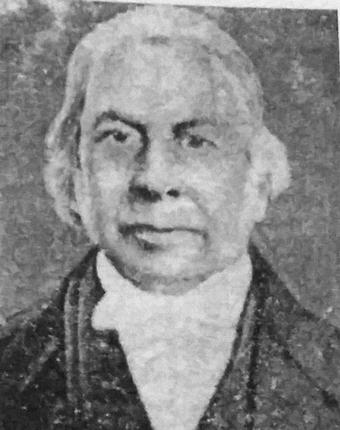
Rev. Daniel Poor
Rev. Daniel Poor

Poor opened the first American-run school in this part of the world when on December 9, 1816 he opened the Common Free School, now Union College, in Tellippalai, Jaffna. Seven years later, in Vaddukkoddai, Jaffna, he established another school that was to become the renowned Jaffna College from where came the first two graduates of the University of Madras (Miscellany, August 9, 2004 and October 29, 2012).

It was amongst the second batch of American missionaries to Jaffna that there arrived Dr. John Scudder, said to be the first medical missionary in the world. After working in Jaffna from 1820 to 1836, Scudder, the grandfather of the legendary Ida Scudder of Vellore, was moved to Madras where he established the American Madras Mission that year. He was to move to Vellore in 1841 and found the American Arcot Mission there.

But before the move to Madras, the Revs. Levi Spaulding, Henry Hoisington and William Todd and three Jaffna Tamil students (as translators) visited Madura in January 1834 to establish the American Madura Mission. They soon established two schools there but it was left to Poor, who moved to Madura in 1835, to found 37 schools in the district, including the one that became American College, Madura. He was its first Principal. He returned to Jaffna in 1850 and died there in the cholera epidemic of 1855. On June 28, 1915, one of the finest libraries in South India, the Daniel Poor Memorial Library, was opened in his memory. Its splendid new building, opened in 1926, was funded by a grand-daughter of Poor.

The close connections between the American Missions in Jaffna, Madura and Vellore (the Madras Mission gave way to the numerous British missions then moving in) led to the development of Kodaikanal as an important hill station (Miscellany, September 4, 2000). A connection with Madras, however, remains. The American Ceylon Mission, being a constituent of a union of congregational churches in South India, is part of the Church of South India, headquartered in Madras from 1947.

*****

Jesse Mitchell’s charger

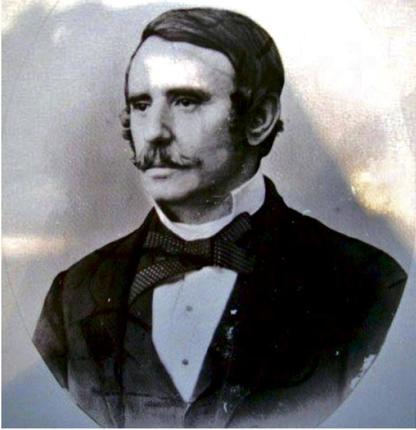
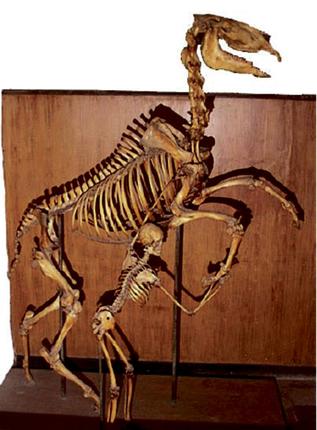
My ever-regular correspondent in Australia, Dr. A. Raman, having seen that unique picture of the Museum Tower (Miscellany, February 29) sends me another picture — but this, though many may have seen its focus in situ in the Madras Museum, I feature because it has a story to tell. It may be considered a memorial to the man who could well be considered the founder of the Connemara Public Library, one of India’s four national libraries, Capt. Jesse Mitchell. Raman had received this picture and the one believed to be that of Jesse Mitchell as well as other information about him from Chrissy Hart whose brother had been researching their descent from Mitchell.

Jesse Mitchell
Jesse Mitchell

Another of those Irishmen to join the East India Company’s Army, Mitchell arrived in Madras in 1829 and was immediately sent to the Pallavaram cantonment. He records an abiding memory of his first days there spent in regaining his land-legs. During those days meant for rest and recuperation, he and fellow newcomers went through “the terrible ordeal of drinking a strong dose of salts and senna every alternate day for six days, (while) formed up in line in the presence of the doctor”. On the last day “we were informed that the salt junk eaten on board for 3 months was washed clean out of us, and we were now fit for our exile in India for 21 years, when we would be entitled to a pension and allowed to go back to our mother”. They were then posted to various regiments, Mitchell being sent to join the Madras Horse Artillery in Bangalore.

While Mitchell was seeing action in China and different parts of India, the Madras Museum was inaugurated in January 1851 with Dr. Edward Balfour in charge. It was born through the efforts of the Madras Literary Society which petitioned the East India Company in November 1843, approval being given in 1846. After being located in the upper floors of the College of Fort St. George (Egmore) it moved into the nucleus of its present premises, The Pantheon, in 1853.

Why, when Balfour retired, Mitchell was chosen to take charge of the Museum cannot be explained, unless you take into account a couple of papers he wrote, ‘On the Influence of Local Altitude on the Burning of the Fuses of Shells’ and ‘Description of a Plain or Waxed paper Process in Photography’. Whether those papers justify the explanation that he was appointed part-time supervisor of the Museum because of his interests in microscopy and Natural Science is debatable. But once he was there he did a remarkable job. He acquired a variety of small fauna, shells and fossils from foreign museums in exchange for specimens from the Madras Presidency, started a collection of old coins and medals, and added to Balfour’s Amaravati collection of sculptures. In all he added over 72,000 specimens to the Museum’s collection before he passed away in 1872. One of those specimens that he added to the Zoology Gallery was the skeleton of the horse seen in my picture today, his regimental charger.

The skeleton of the horse in the Madras Museum

But perhaps the most significant thing he did was write to the Government in 1860 urging it to fund a library: “A few hundred rupees, judiciously expended every year, would place before the public a library of reference that would in the course of time be an honour to the Government.” His wish was fulfilled in 1862, when Government funding enabled the opening of a small library in June that year. This library evolved into the Connemara Library. Initially the library was supervised by the Museum, but in 1939, Dr. F.H. Gravely, the last British Superintendent of the Museum, had the Library separated from the Museum, each with its own head.

Of Mitchell, still very much a part of Madras in St. George’s Cemetery, it was said, “He had very clear ideas of the functions of Museums; first to contain as complete a collection as possible of the natural production of the country and other parts of the world, duly named and systematically arranged as a means of encouraging the study of Natural History, and secondly, to do its share in the advance of Science.” Advancement of knowledge he saw through libraries — and made it happen. That was perhaps a more memorable an achievement of his than all his splendid work for the Museum.

*****

Setting things straight

My Irish visitor Aine Edwards writes to tell me that some of my detailing in the item on Sr. Loreto (Miscellany, February 22) needs correction and she clarifies that the Little Lambs School in Perambur “is a multi-denominational school with Christian moral teaching” and that it was founded by Maria Gislen, not Sr. Loreto. Aine Edwards had volunteered at the school and was introduced by a mutual friend to Sr. Loreto of the Presentation Order who has been “based mainly in Madras”.

My correspondent, quoting Sr. Loreto, says that the names of the first Presentation nuns to arrive in Madras were not those listed by the publication with which the Irish Embassy was associated. Then citing a website of the Presentation Order they gave me two names on my list as well as Mother Frances Xavier Curran, instead of Xavier Kearney, and a Miss Josephine Fitzsimon instead of a Johanna Fitzgerald. The website does not list Ignatius Healy. I also learnt that the Kellys we both listed died of cholera, Regis in 1844 and Martha 18 months later.

But as usual I wonder about the accuracy of some of the material on the worldwide web. This time, the site Aine Edwards refers me to, says those first nuns moved to “what was once Robert Clive’s office, now to be the first Presentation Convent in India”. I can hardly imagine either of the Clives, Robert or son Edward, having an office in Black Town or the Catholics being given space in the Fort after 1749!

The information sent to me also indicates that the Presentation Order went beyond education in India. They helped with healthcare. In 1928, they staffed the railway hospital in Golden Rock (Trichy), in 1933 they established a hospital in Theni, and they opened a hospital at Manapad on the Fisheries Coast.

source: http://www.thehindu.com / The Hindu / Home> Features> MetroPlus> Society / by S. Muthiah / March 05th, 2016

Engineers to pedal, push for traditional farming methods

Chennai :

Two city engineers who gave up the cushy confines of their IT offices to take up farming have planned to cycle across villages of India next month, with the goal of accumulating knowledge about traditional farming methods that have lost significance since the rise of chemical farming. The second phase of the cycle expedition will see the two farmers travel through eleven countries in southeast Asia.

Vinodh Kumar, 31, and Raja S Pandian, 27, left their jobs two years ago and have since been ploughing the fields in their hometown with a focus of bringing back traditional farming.

Vinoth says, “Chemical fertilisers and pesticides have brought down the quality of farming output. We want to revive the traditional crops.” Vinoth grows millets and local vegetables like ladies’ fing er, brinjal and broad beans in his one and a half acre organic farm in Cheyyur, 90 km from Chennai.

“We were exposed to farming during our school summer holidays. After school closed, we were sent to the fields in our village where we herded cattle and spent the day under the sun in the banana plantations,” says Raja.Raja hails from Valliyur, a village near Tirunelveli, while Vinoth is from Cheyyur.

Vinodh who had worked at companies like Zoho, Standard Chartered Bank and Groupon gave up engineering when he realized his true calling.Vinoth, along with Raja, took two years off and backpacked across the villages in the country covering almost every single state. “I made more money than I had time to spend it,” says Vinoth who chose health over wealth.

“Our food habits have gotten worse. Once health deteriorates you cannot buy it back with money,” adds Vinoth who passed out of SRM Engineering College.

It then directed the owners to pay `10 lakh as compensation for causing men al agony , `3 lakh as losses suffered by Natesan, ` 35,000 as refund and `Rs 20,000 as case costs.

source: http://www.timesofindia.indiatimes.com / The Times of India / News Home> City> Chennai / by Abdullah Nurullah / March 03rd, 2016

Migrate with ease

Flytta, a startup by students of Hindustan University, is an online relocation portal. The idea of the company was suggested by two school students who faced a lot of problems when their parents relocated from one place to another. Started with the tagline “Migrate with Ease,” Gokulavasan Murali, chief technology officer of Flytta, and his team of developers have developed a cognitive algorithm which assists the users to be mapped to respective services of their preference. The portal currently features assistance for finding accommodation, schools, colleges, packers and movers, hospitals, food, groceries and daily needs. A relocation forum is also being developed which helps organisations, service providers and users to interact and share their relocation stories.

“Post the Chennai floods, many are slowly relocating to safer and eco-friendly zones in Chennai. This is where Flytta makes a difference and helps people,” says Rahul Kanuganti, chief operations officer.

The team includes Abhijith Ajay, business analyst; Anu.S.Menon, migration analyst; Rishab Gill, marketing analyst; Thomas Cherian, the little dev ; Sabri, business management intern; Ajjeet Verghese, smart data process intern and Dr. M. K. Badri Narayanan, associate prof., School of Management Sciences, coordinator HTBI&HEIC, Hindustan University.

source: http://www.thehindu.com / The Hindu / Home> Education Plus / February 29th, 2016

First Rail Auto Hub Opened in Walajabad

 Walajabad :

The country’s first rail auto hub being developed in Walajabad would flag off its first rake, which has the capacity to carry 125 cars, by the middle of this month, according to Southern Railway general manager Vashista Johri.

The hub was inaugurated by Union Railways Minister Suresh Prabhu from New Delhi through video conferencing. Top railway officials were present at the Walajabad railway station, which is located near Kancheepuram district.

Interestingly, the launch of the auto hub may sound the death knell of the facility in Thiruvallur, which is being used by Hyundai to transport its cars to Changasari in Assam. But car majors are cautious in welcoming the move by Indian Railways.  V Anand, senior general manager sales logistics, Hyundai, told Express that they need to evaluate the hub from the commercial point of view. While the hub would be useful in transporting cars to Ennore Port, which usually takes nearly 36 hours by road from the manufacturing facility, Anand feels that the cost factor still favours the road sector.

According to the railways, to move one load of six cars from the factory to the port by road, it takes 36 hours. But 300 cars can be moved to Chennai Port and Ennore Port in 2-3 hours from this facility.

However, Anand points out that the rail freight is too costly than road freight. Only if the distance is above 2,000km, rail freight service is affordable, he says. Interestingly, Hyundai, which produces 18,000 cars per annum, is using the rail to transport only four per cent of its cars and most of it is from the Melapakkam facility sector.

Aware of its limitations in NMG rakes, Indian Railways is planning to partner with APL VASCOR – a logistics specialist – which uses double decker wagons to transport the cars. One rake transports a total of 318 cars.

While the hub is being planned to cater to one million units of four-wheelers being produced per annum, the land looks inadequate and has to be developed to cater to huge containers carrying cars from the manufacturing plant. Johri is optimistic. “It is just a pilot-project. We will evaluate the first phase,” he says.

Interestingly, the initial holding capacity is for 300 cars and it is likely to be expanded to 800-1,000 cars during the second phase. Johri says that of the one million units being produced in Kancheepuram district, 3.6 lakh is being exported while the rest 6.4 lakh is transported to domestic market.

source: http://www.newindianexpresss.com / The New Indian Express / Home> States> Tamil Nadu / by C. Shivakumar / March 02nd, 2016

Swimmer arrives to a rousing reception

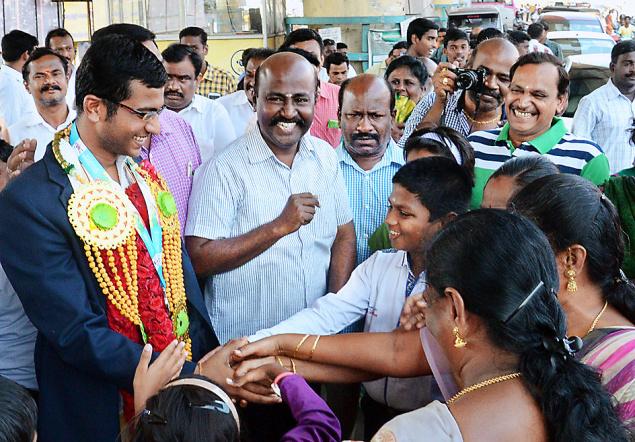
T.Sethumanikavel, who won silver medal in swimming competition in the South Asian Games, being given a rousing reception at Vannarpettai in Tirunelveli on Saturday.— Photo: N. Rajesh

Swimmers, sports lovers and students accorded a rousing reception to 16-year-old swimmer T. Sethumanickavel as he reached Palayamkottai, his native place, on Saturday afternoon after winning the silver medal in the 100-metre backstroke event in the South Asian Games at Guwahati.

Accompanied by ‘chenda melam’ and a caparisoned elephant, the floral reception accorded to the young swimmer on a sultry afternoon by Rajya Sabha MP Vijila Sathyananth even as the public crossing the Chellapandian Traffic Island were looking at the teen in awe, will certainly motivate him to achieve more in the aquatic meets in the future.

Having made his presence felt in school, divisional and State-level swimming competitions in the past, lanky Sethu has won several medals in the national events since 2012 and got fourth place in the international meets for school students.

While bagging 6th place in the international students’ meet held at Israel in 2014, Sethu managed to secure fourth place in a similar meet in Poland in the next year.

During an informal chat with reporters on reaching Palayamkottai, Mr. Sethu made it clear that his next target was winning gold medal in the 2018 Asian Games and then medals in the 2020 Olympics. “If the Central and the State Governments, which are executing various schemes for encouraging young sportsmen, can help me, I’ll certainly win medals for my country,” Sethu said.

source: http://www.thehindu.com / The Hindu / Home> National> Tamil Nadu / by Special Correspondent / Tirunelveli – February 1th, 2016

Kshema to honour two clinician scientists

Mangaluru:

To mark National Science Day, the Centre for Science Education and Research and KS Hegde Medical Academy (Kshema) will honour two clinician scientists, Dr VI Mathan and Dr Minnie Mathan, for their contribution to medical research on Monday.

Prof Mathan, who superannuated from Christian Medical College, Vellore, as professor of medicine and gastroenterology and director, has a number of awards to his credit. This includes the Ambedkar Award of the Indian Council of Medical Research for his lifetime contributions to health research. Prof Minnie was the head of the department of gastrointestinal sciences at the college till her superannuation in 1997.

At the event Prof Mathan will speak on the challenges of clinical research and Prof Minnie on integrated research.

source: http://www.timesofindia.indiatimes.com / The Times of India / News Home> City> Mangalore / TNN / February 29th, 2016

SASTRA professor’s win science awards

Chennai:

Sastra University on Sunday presented National Science Day awards.

Delivering the lecture, D P Singh director of National Assessment & Accreditation Council expressed the need for senior scientists to mentor youth to take up a career in science. This he said was essential for innovation with three prerequisites – novelty, relevance & implementation.

He also awarded the ‘Sastra – Obaid Siddiqi Award’ to professor K Vijay Raghavan, secretary, department of biotechnology, ‘Sastra-G N Ramachandran Award’ to professor T V Ramakrishnan, distinguished associate, IISc Bangalore and the ‘Sastra-CNR Rao Award’ to professor T K Chandraeskhar, former secretary, Science and Engineering Research Board (SERB) and professor N Sathyamurthy director of Indian Institute of Science Education and Research Mohali.

source: http://www.timesofindia.indiatimes.com / The Times of India / News Home> City> Chennai / TNN / February 29th, 2016