What do you do when when you’re a Vice President of a company, but you don’t have an office? Blessing A Manikandan found himself a desk with a beach front view – all rent free.
Six years ago, the business veteran had moved to Chennai from Coimbatore as the sole employee for the South division of Franchise India. Living too far from his clients to work out of home, he recalls, “I would drive over to Marina Beach every morning from my house in Madhavaram, set up appointments with clients and then head over to their offices to meet them.” This was certainly cheaper than sitting at a coffee shop all day, he admits with a laugh. Of course, it was only natural that over time he began to take note of the poor maintenance of the massive square footage he had begun to his workspace – being dumped on all the way from reception to the low tide restroom.
However, it wasn’t until over a year later that Blessing, snacking on sundal out of a newspaper found his inspiration to clean up. “I saw a quote from Gandhiji that said ‘Be the change you want to see.’ And that was a turning point for me,” he recalls. Shortly after, he set up an initiative for cleaner beach called ‘Angels of Marina.’
Clean-ups that started with a few volunteers every Sunday at 6 am back in 2012, have now grown into a few hundred – including the likes of celebrities like Sakshi Agarwal who was spotted helping out at his most recent activity last week. “We put the word out on Facebook and all kinds of people volunteer to help, or rather angels as I like to call them, the 41-year-old is all smiles when he tells us.
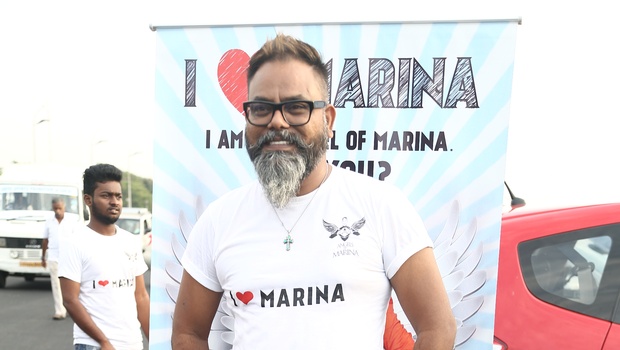
If you’re wondering where Blessing works from these days, he tells us that he’s swapped sandy shores for a corporate set up as CEO of the Paulsons group in Kilpauk. But clearly his love for Marina Beach continues to grow. Just check out his T-shirt!
To join this force of angels that opt for garbage gloves over wings, call 9176840500.
source: http://www.newindianexpress.com / The New Indian Express / Home> Cities> Chennai / by Sonali Shenoy / March 16th, 2016
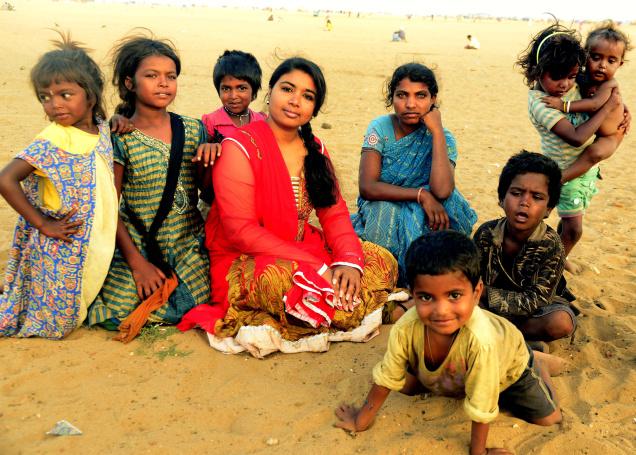
Swetha (in red) with people from the Narikuravar community at the Marina beach Photo: R. Ravindran / The Hindu
Meet M. Swetha, Tamil Nadu’s first Engineering graduate from the Narikuravar community.
“Did you hear what he said?” asks M. Swetha, widening her eyes. We’re at the Marina beach for a photo shoot, and a small crowd has gathered. An onlooker makes a rude comment directed at one of the gypsy girls standing next to her. Swetha is disgusted. This is perhaps what sets her apart from her tribe. Narikuravar herself, she refuses to ignore the way society crinkles up its nose at the sight of people from her community. Swetha is the first Narikuravar girl in Tamil Nadu to get an Engineering degree — a feat that took her years of struggle to achieve.
The 22-year-old is caught between the excitement of the new possibilities that life brings her, and the responsibilities that rest on her shoulders. “Right now, all I want to focus on is my parents’ NGO, Narikuravar Education and Welfare Society in Tiruchi,” she says. Swetha is now the voice of her people. They have so many things to prove to the world — demands such as a Bill that provides them ST status. And it’s people like her who give the community hope.
But behind her every move is her mother M. Seetha, who hides a fiery nature beneath her smiling demeanour. Seetha had studied till Class X herself, and was bent upon educating her children. It began as a protest against the cloistered nature of her people. “We are from Devarayaneri on the outskirts of Tiruchi,” says Seetha. “When Swetha started school, there were no buses between our village and the outside world.”
And so, a whole community lived as though on an island. Parents sold beads and trinkets for a living, and their children stayed at home to cook and care for their younger siblings or followed them on their work trips. Girls as young as 13 were married off, and those who dared to marry outside their community were ousted from the village. “We are extremely traditional and have been following certain customs for years,” says Seetha.
But she wanted a change. How long could they go on this way? Young, and a little fearful back then, Seetha took a revolutionary step: she sent her daughter to school. She went with Swetha to school and back; for there were deserted stretches along the way to be covered on foot. “I would wait till school got over and bring her back,” remembers Seetha.
Swetha studied under the tutelage of her hawk-eyed mother, who faced opposition from her community every day. “Someone or the other would block our path as we walked to school, asking me why I was earning everybody’s hatred,” says Seetha. Swetha faced discrimination at her end too; sometimes veiled, and sometimes downright. “She would hush me if I spoke our language when I accompanied her to school,” laughs Seetha. “She didn’t want anyone to know who we were.”
Hostel wardens who used crude casteist language, incidences that made her almost quit college, constant threats from her community… Swetha grit her teeth through it all to get an engineering degree. Some others from her community followed suit — today, there are several youngsters who are educated and working in mainstream society.
But not all of them make it past Class X. Seetha states instances where Narikuravar children are asked to bring beads from home for their classmates. “Won’t this embarrass them?” she asks. As a result, they drop out of school and take to what their parents and grandparents did.
Swetha now attends fundraiser meetings with her mother and goes door-to-door to request Narikuravar people to send their children to school. Her parents run a school for children from their community that’s fallen on hard times, and she’s helping them get back on their feet. Ask her if she wants to work in the field of her education — she’s trained in Computer Science Engineering — and she hesitates. “I’ve not thought about that for now,” she smiles. One step at a time.
source: http://www.thehindu.com / The Hindu / Home> Features> MetroPlus> Society / byAkila Kannadasan / March 18th, 2016
Asked to name warrior queens from the country, few would go beyond the Rani Laxmibai of Jhansi, and probably none would be able to name women from south India. Though history may make it seem that the first revolution of Independence in 1857 was an orchestration of north Indian rulers, Lucknow-based researcher Kirti Narain is bringing to the fore contribution of the forgotten heroes.
Narain says the popularly held belief that the revolution of 1857 was concentrated to north and central India was not true. “Southern India also responded to the first movement for Independence.Some of these southern rulers were women,” says Narain who was in the city recently with her assistant Amina Hasan to delve into the Tamil Nadu government archives. Narain is engaged in a study , on participation of women in the 1857 uprising under the aegis of the Indian Council of Social Science Research and the Giri Institute of Development Studies, Aliganj in Lucknow.
Instead of going by British records, Narain’s study has unearthed forgotten Indian writings. Backing her findings, Narain cites examples of powerful women like the 18th century Sivaganga queen Rani Velu Nachiyar, besides Belawadi Mallamma and Kittur Rani Chennamma of Karnataka.
“Rani Velu Nachiyar was the first queen of Tamil origin to fight against the British in India. She formed an army and fought and won against the British in 1780, with military assistance from Hyder Ali,” says Narain, head of Giri Institute of Development Studies. Nachiyar, the princess of Ramanathapuram, was married to the king of Sivaganga, Muthuvaduganatha Periyaudaiyathevar. She was drawn into battle after her husband was killed by the British. Living under the protection of Hyder Ali of Mysore near Dindigul, Nachiyar was said to have come up with idea of a human bomb. She also formed a women’s army and was one of the few rulers who regained her kingdom and ruled for 10 more years.
Inspiring women in the south was another queen from Karnataka Kittur Rani Chennamma. Born in 1791, she was best known for leading an armed rebellion against the East India Company in 1824. The resistance ended with her arrest and she was imprisoned for life.Adept at horse riding, sword fighting and archery from her youth, Channamma called for a war when the British refused to accept her adopted son as ruler. “Kittur Rani Chennamma was the first woman activist who fought a lonely , but courageous battle against the British. She did not succeed in driving them away , but she inspired many women,” says Narain.
Prior to these women, Belawadi Mallamma was a popular warrior queen from Bailhongal, in Belgaum district of Karnataka. She was the first woman to form a women’s army to fight against the British and the Marathas in the 17th century. “Belawadi Mallamma fought with the Maratha king, Shivaji, while defending her husband’s kingdom. She was defeated and taken to Shivaji, who was quite impressed by her valour and decided to return the kingdom.”
During the turbulence of revolt, there were many women who participated in their own way. While many gave away their jewellery to finance the revolution, some requested their masters to train them in warfare. “Our study also looks at unknown women and tribal women who have no identity. These women played a significant role in the revolt,” says Narain.
source: http://www.timesofindia.indiatimes.com / The Times of India / News Home> City> Chennai / TNN / by CDS Mani / TNN / March 17th, 2016
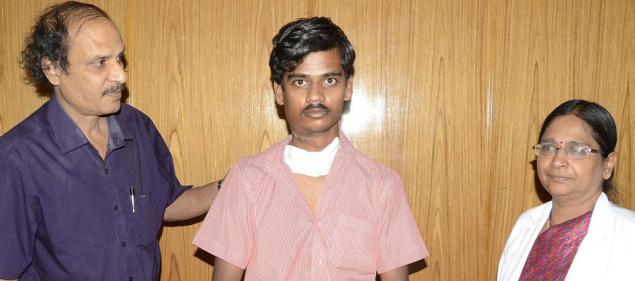
R. Madanagopal, professor and head, ENT, Government Vellore Medical College Hospital along with V. Anandan who underwent the surgery. Hospital dean, Usha Sadasivam, is also in the picture.- Photo: C. Venkatachalapathy
After experiencing difficulty in swallowing food and losing close to 15 kilos in two months, 21-year-old V. Anandan is returning to normal life. Little was he aware that a cricket ball-sized tumour was growing in his oral cavity, giving him a tough time even for breathing.
It was only 15 days ago that Anandan, a carpenter from Ambur, knew he had a tumour in the oral cavity after being examined by ENT doctors at Government Vellore Medical College Hospital (GVMCH), Adukkamparai.
“We did a MRI scan and found that he had a parapharyngeal mass present in the oral cavity. This has been causing difficulty in swallowing, breathlessness, change of voice and loss of weight,” R. Madanagopal, professor and head, ENT, GVMCH told reporters on Tuesday.
Following this, the doctors planned a surgery to excise the tumour.
“However, we did not want to perform the procedure by cutting open the neck as the nerves and blood vessels will be compromised. Instead, we did a tracheostomy to enable him to breathe. We secured his airway, and performed the procedure through the oral route and excised the mass,” he said.
A team of five doctors performed a two-hour surgery on March 11 and removed the tumour. Also a Fine-Needle Aspiration Cytology found that the tumour was benign.
However, the cause of the tumour is not known, Dr. Madanagopal observed. “The tumour could have started to grow slowly at least in the last six months,” he said.
The surgery was covered under the Chief Minister’s Comprehensive Health Insurance Scheme. Usha Sadasivam, GVMCH dean, was present. Doctors -Bharathi Mohan, ENT professor, R. M. Elango, Kalidas and Thilagavathy – assistant professors – were part of the surgical team.
source: http://www.thehindu.com / The Hindu / Home> National> Tamil Nadu / by Staff Reporter / Vellore – March 16th, 2016
It began in a small household in Triplicane… Here’s the story of Ambika Appalam, established long before the Second World War
Ambika Appalam owes its legacy to a man called Ayappan
They say the trick to achieving the perfect appalam lies in the hands of the maker. The process is referred to as appalam ‘iduradhu’ — a Tamil word that doesn’t have an exact English equivalent. Shaping, perhaps? It is a task that requires far more than a machine’s precision. Which is why at Ambika Appalam, every appalam is still hand-made. “I spent lots of money in R&D on making them with machines,” says K.V. Vijayaraghavan, who owns the company. “But I was not successful. Something or the other would go wrong if a machine was employed. The dough wouldn’t be right or the appalam would turn brown when fried.”
Ambika Appalam owes its legacy to a man called Ayappan, about whom the present generation that runs the company knows little. “All I’ve heard about him is from my father K.A. Velayudham. Poverty forced Ayappan, my grandfather, to come from Kerala to Madras to make a living,” remembers Vijayaraghavan.
This was in the 1920s. Far from home, Ayappan started with what most of his neighbours in Triplicane did — making papadums. A little moist before being fried, a papadum puffed up like a poori when it came into contact with hot oil.
And so the young Ayappan, barely into his twenties, made dough using urad dal and shaped it into little circles. Although they cost just a few annas, each one was handled with care. He sun-dried them, packed them into bundles of 100, and arranged the lot in a bag. This marked step-1. Step-2, the more difficult one, consisted of Ayappan journeying with his precious cargo to various houses in the area to sell them.
The business gradually developed, and Ayappan married and started a family. His wife and children then joined him in making papadums at home.
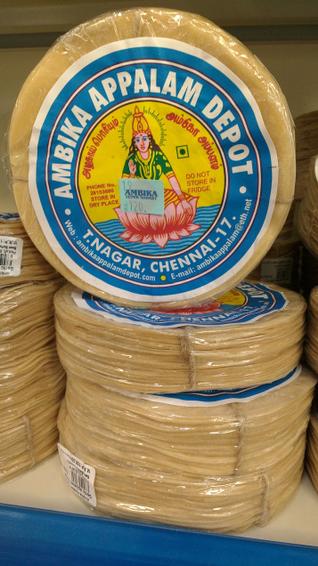
Soon, Velayudham took over. He made appalams instead, for the lifespan of an appalam was up to a year, but that of a papadum was just seven days. It was Velayudham who gave his family business a brand and an identity — he named it Ambika, after his favourite goddess back home in Kerala. An artist in the neighbourhood sketched their logo — a line drawing of a goddess seated on a lotus. Even today, the same logo with the tagline ‘Azhagaai porium’, meaning ‘Fries beautifully’, adorns their wrappers, except that it has been embellished with technology.
Velayudham ferried appalams in a cycle to not just households in Triplicane, but to those as far as Tambaram. “My father then opened a small shop in Mathala Narayanan Street in Mylapore,” says Vijayaraghavan. It was “just enough for one person to stand amidst the appalam bundles.” From then on, Ambika grew much like a dream business, with Velayudham opening one shop after the other across the city.
They did have a hitch. In 1966, the business was shut down due to labour issues. “We had about 600 people working for us then. They would work from 3 a.m. to 7 p.m. in three houses in Triplicane that doubled as their workplace,” recalls Vijayaraghavan. Suddenly, it was all over. But they bounced back, with well-wishers who worked for them, offering to make appalams for them in their respective households.
It’s this model that the company follows till date — apart from their factory in Choolaimedu, their appalams are made in households across Chennai and Kanchipuram as per Vijayaraghavan’s specifications.
The crispy appalam that reaches our plate is extremely delicate in its initial stage. “If the maker grips a just-shaped appalam hard, it might break. But if not held properly, it might slip and lose shape,” says Vijayaraghavan. “This is why they stack the circles and pat it together. This is tricky too, for the circles might stick.”
Vijayaraghavan has various memorable customers – Kavignar Kannadasan among them. “He would buy an entire tin,” recalls Vijayaraghavan. The poet was a huge fan of Ambika’s potato chips.
source: http://www.thehindu.com / The Hindu / Home> Features> MetroPlus / by Akila Kannadasan / Chennai – March 15th, 2016
Walking into their alma mater after 50 years on Sunday was a joyful experience for the 1960-1965 batch of students of the Thiagarajar College of Engineering.
The batch comprised the creamy layer of students who entered the premium institution that was founded in 1957. Correspondent of TCE Karumuttu T Kannan presided over the function and listened to the elderly alumni narrating their experiences as carefree students in this institution. He said the alumni would be an inspiration to the present day students.
They had gone on to become chief engineers of PWD, defence, electricity board, steel plants, harbours, while some of them contributed to the various space projects in their capacity as research scientists at ISRO. Forty of them attended the event along with their families.
The old students re-lived their days in the institution and visited various departments. “This is a place that brings us immense joy that cannot be replaced by any other,” they said sharing their experiences with the students of today who were eager to listen to them.
V Sathappan, president, 1965 batch alumni reunion committee, welcomed the gathering, N Shanmugam, secretary explained the objectives of the reunion.
Karumuttu T. Kannan presided over the function. Former principal M Maria Louis and C. Kothandaraman addressed the gathering and greeted the alumni. V Abhaikumar, principal, made a presentation about the progress of the college over the years.
M Vettrivelswamy proposed a vote of thanks.
source: http://www.timesofindia.indiatimes.com / The Times of India / News Home> City> Madurai / TNN / March 14th, 2016
An Indo-Canadian trio has put together a video timeline featuring 20 of Tamil cinema’s eternal favourite songs
Nothing is better than listening to the classics; some hits are immortal, even as pop, rock and hip hop continue to top the charts. It’s the same when it comes to Tamil film songs. No matter what the latest composers dish out, it’s the oldies that bring us together.
In an effort to pay homage to their roots, Thakshikah Sritharan, Kavistuthy Thavanesan and Saikavin Sritharan, an Indo-Canadian trio, has put together a nostalgic six-minute video called Tamil Mime Express, tracing the history of film music.
Thakshikah, a classical dancer, talks of the inspiration behind the video, saying, “We were fascinated by a video called Mime Through Time by SketchShe; so we decided to do the same with Kollywood, trying to make it as appealing and innovative as possible. We thought that a timeline of Tamil songs shown through dance would be a fun way for everyone to remember and enjoy some of the songs they grew up listening to.”
Throughout the video, which is shot entirely in a car, the three of them sport various outfits with élan — shirts with rolled-up sleeves, popped collars, saris, lehengas — which is what has caught the fancy of many viewers. “We invested a lot to acquire the perfect costumes to match each song,” they say.
Starting from ‘Naan Aanaiyitaal’ from Enga Veettu Pillai, all the way through ‘Chikku Bukku Rayile’ from Gentleman to ‘My name is Billa’ from Billa, the video concludes with the latest ‘Thara Local’ fromMaari.
“We initially listed about 150 songs, but narrowed down to just 20 spanning all genres,” says Thakshikah. The trio credits their parents, as well as G Design Labs and Yashtra for their support in the video’s production.
Thakshikah and Kavin have only been to India four times, but concur that, “The food is absolutely amazing. The best trip was our visit to Agra and the Taj Mahal.”
They’re currently working on a couple of projects but are keeping them under wraps. A timeline of Bollywood music, perhaps?
source: http://www.thehindu.com / The Hindu / Home> Features> MetroPlus / by Justin Dominic / Chennai – March 12th, 2016
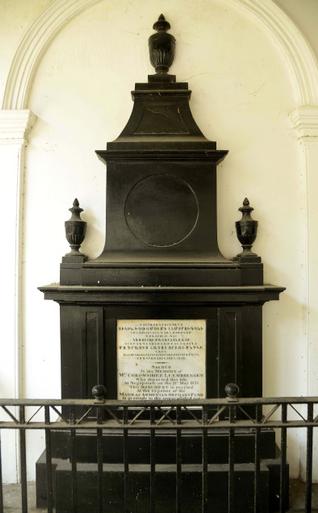
Coramseemee Leembruggen’s memorial at Armenian church Photo: R. Ravindran / The Hindu
International Women’s Day was celebrated this week and so it’s perhaps appropriate that this week’s story is about a remarkable woman, who may not have lived in Madras, but has a memorial in the city’s Armenian Church.
Located on the western wall of the verandah that leads to the church is a handsome memorial dedicated to Coramseemee Leembruggen. As to what such a Dutch name was doing in the Armenian church was a puzzle to me till I readArmenians In India, from the Earliest Times to the Present Day by Mesrovb Jacob Seth, written in 1937. I learnt that the lady was an Armenian whose real name was Hripsimah. Coramseemee or Khoromeseemee is apparently the corrupt form of the Armenian name.
She was born in 1778 as the only daughter of Eleazar Woskan, a wealthy Armenian based in Surat. While still in her teens, she was given in marriage to Stephen Agabob, an elderly widower whose sole aim in life appears to have been to marry young girls and treat them harshly. Not one to stand such brutality, Coramseemee left him and took refuge in the house of an English doctor, who was a family friend. In 1795, she fell in love with Robert Henry Leembruggen, a Hollander who was in the employment of the Dutch East India Company in Surat. However, knowing fully well that he was not to be trusted financially, she had the prudence to enter into what would today be known as a pre-nuptial agreement. As per this, her Rs. 40,000 in cash and valuable jewels were to be hers alone, and she was in no way to be held responsible for any debts her husband may incur.
They lived happily for a while, during which time Leembruggen was transferred to Colombo and Nagapattinam. By then, they had begun a business, of which she was sole proprietor. Differences arose over Leembruggen’s profligate nature and the couple separated in 1817, with Coramseemee paying her husband a monthly maintenance allowance of 25 pagodas thereafter. He died in 1819, leaving behind nothing but some old furniture that she never bothered to claim. She ran her business successfully on her own, till her death in 1833.
Between 1819 and 1833, she had the habit of making a new will each year, copies of which were sent to the Armenian Church, Madras. When she died, the last will and testament, after several charities to Armenian causes, left the bulk of her estate to the Armenian Church, Madras, for the Armenian Orphans Fund. The memorial here was put up for her in gratitude. Two other legatees, the Armenian College and the Armenian Church of Nazareth in Calcutta put up a memorial for her in the church in that city.
Taking into account her tombstone in Nagapattinam, there are therefore three memorials to her in India. That must be a record of sorts.
source: http://www.thehindu.com / The Hindu / Home> Features> MetroPlus / by Shriram V / Chennai – March 14th, 2016
V Vedavalli, who was leading the life of an orthodox housewife from a middle class family that was reluctant even to let her work, responded to a bigger calling at the age of 60 and started writing books. Her first book was released at the age of 64. Now at 70, she has completed the draft of three books – one on Indira Gandhi, one on Buddha and the other on Velunaichiyar, the valiant queen who fought the British.
She says at the age of 59 when she looked back at her life, she realized that she hadn’t achieved anything. All she could see was that she had been a daughter, a wife, a mother and a home maker. “I wanted to leave my mark and do something that would remain long after I am gone,” she says. Interested in history, social science, politics and spiritual studies, she wrote her first book on Mahabharatam at the age of 60.
Vedhavalli belonged to a very orthodox family and was not even allowed to work after marriage. “Only when we faced a financial crisis, was I allowed to work as an accountant in a company. After the company shut down, I indulged in some handicraft. But I always loved reading and writing,” she said.
But when she decided to write a book, everyone including her family mocked at her. “Everyone laughed and asked me if this was necessary at this age. As I came from humble backgrounds, nobody took me seriously as well,” she said. Not one to be discouraged she started reading voraciously and after reading over 100 books and travelling to various universities to get help from professors, she completed her first book ‘Vedhavalliyin Mahabharatham’. With little knowledge of computers and internet, she said her main aim was to ensure that her book was error free. She was even felicitated for her book by the Tamil Sangam. “When my first book was published, I was on top of the world. I felt I had achieved something and that is when my family also started taking my work seriously,” she said.
She has also written three other books and has travelled extensively for those. She is working towards getting these books published. “I got very little support from my family and so I struggled a lot in my research work. I would get up at 4 and write till 6.30 am. Then after completing my household chores, I would visit libraries at 4 pm and return by 6 pm. Again I would start writing at 11 pm and work till 12.30 am on my book,” she said. When she had to stay for 14 days in Madurai alone to research for her book on Velunaichiyar, she said she was very scared. “I had never lived alone before. That was a challenge and I am glad I have overcome it successfully,” she said. Her book is available at the government libraries. “The other three books will also be published by April and will be available at government libraries,” she said.
source: http://www.timesofindia.indiatimes.com / The Times of India / News Home> City> Coimbatore / by Komal Gautham / TNN / March 08th, 2016
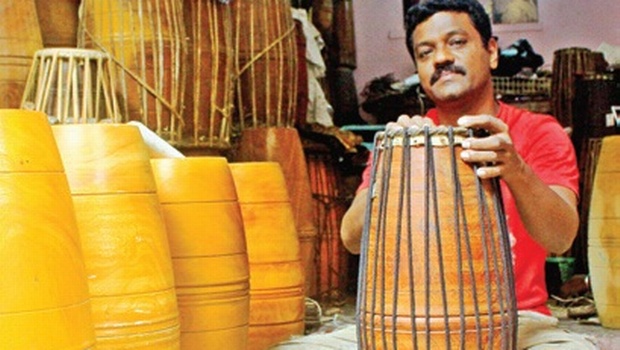
A small shop is tucked away at the shaded turning across the Vivekandanda College road in Mylapore. In this space that doubles as a warehouse, at least a hundred different mridangams sit set for the fingers — 22-inch ones for women and 24-inch ones for the male singers, as the artisan and the owner points out.
“The smaller ones come in the sruthi ranges of 4, 5 and 6 which suit the women voices better, and their slightly larger cousins produce sound that match the lower sruthis of 1 and 2 to suit a male vocalist’s voice,” says Arogyam A, sitting down for a chat. A fifth-generation mridangam maker, he says there is a certain dignity the instrument commands from anyone who lays a finger on it.
Hailing from Thanjavur, where his forefathers also hand-crafted the instrument for ages, he keeps alive the art today, with his helpers working on different parts of the instrument — polishing the body of the hollow mridangam, stitching the three layers of skin on either side — which Arogyam informs, is made of cow hide. “We can modify the sruthi based on the thickness of these layers of skin,” he says. And finally, looping the holder-strings tightly, criss-crossing the body of the instrument. The process takes over seven days if done leisurely.
“But during months like December, or when a stream of orders comes in, we have to sit the extra hours and finish each piece in 4 to 5 days,” he says as he points to a newly crafted piece. There are also several antique mridangams, that carry yesteryear shades of wood — all made of jackfruit tree wood from Panruti — they all sit gathering dust, many here for repair.
When asked if today’s young musicians are dwindling, the answer jumps from his lips. “Not at all!” He explains that not only are younger players aplenty, there are also 4-5 women who come by regularly.
“There are also customers from London, Geneva and Canada who place orders, though we don’t advertise. The tradition still gets around, and people are genuinely interested. It is a satisfying trade and art,” smiles Arogyam
source: http://www.newindianexpress.com / The New Indian Express / Home> Cities> Chennai / by Amrutha Varshinii / March 10th, 2016