Joe D’Cruz to Bid World of Novels Adieu With His Third Book Asthinapuram

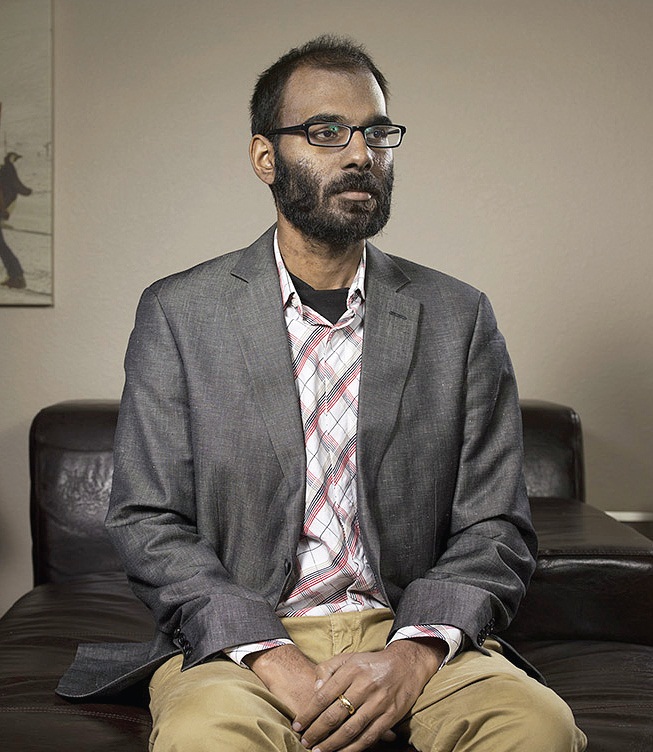
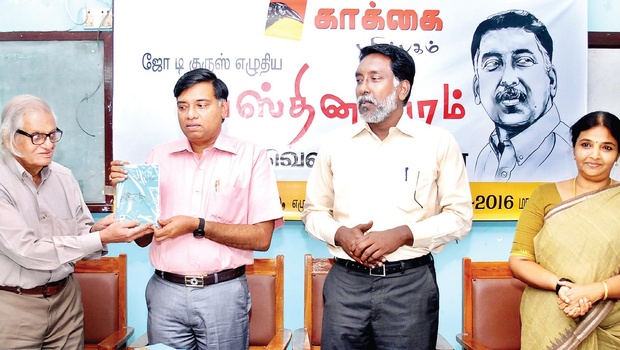
Historian K R A Narasiah giving the first copy of Joe D’Cruz’s (third from left) novel to Agriculture Department Commissioner M Rajendran, as critic Chitra Balasubramanian looks on | d sampathkumar

Chennai :

Sahitya Akademi-winning Tamil writer, R N Joe D’Cruz on Saturday said his third and latest novel, Asthinapuram based on the shipping and logistics industry would be his last.

The announcement has come nine months after the writer was taken to court over his alleged negative portrayal of fishermen and Christianity in his second novel, Korkai, which won him the Sahitya Akademi award in 2013.

The writer will, however, continue writing essays and articles in magazines, he said at the launch of Asthinapuram. “I do not see myself as a writer to feel the necessity not to cease writing. I am a common man who shared my experiences in life in the form of novels. I don’t have much to share anymore,” D’Cruz told Express on his decision.

Asthinapuram attempts to throw light on the functioning of the shipping and logistics sector, in which he has first-hand experience, he said. “The public have been oblivious to the life inside harbours and ports. I have tried to explore it. My novel is a small drop in the mighty ocean that the field is,” he added.

Dismissing the controversies surrounding his two earlier works, the writer said that they have not affected him much. “There is a personal agenda behind all my novels, I agree,” he said even while denying that his latest work is a political novel, as pointed out by more than one speakers in the event.

“I leave that to the readers’ perception, but I would say it is a work of literature,” he said. A Facebook post on April 2014 in support of the then PM candidate Narendra Modi stalled the English translation of his first novel, Aazhi Soozh Ulahu as the Delhi-based publishing house, Navayana, cancelled the agreement.

D’Cruz, who also faced backlash from a section of writers and critics over his pro-Modi stance before the 2014 Lok Sabha elections, started his speech at Asthinapuram’s launch by saying he likened his position to that of a student awaiting exam results, similar to what Modi had said ahead of this year’s fiscal budget.

Senior historian K R A Narasiah released the first copy of the novel as senior IAS officer M Natarajan received it.

source: http://www.newindianexpress.com / The New Indian Express / Home> Cities> Chennai / by Srikkanth Dhasarathy  / March 27th, 2016

Awards given to women achievers

Chennai:

Celebrating women icons, Raindropss conducted its 4th annual women achiever awards on Saturday at a ceremony presided over by its brand ambassador and music composer AR Raihanah.

Raindropss is a youth-based social organization.

It gave away awards to project director of Agni and ‘Missile Woman of India’ Dr Tessy Thomas, first Indian woman fire officer Meenakshi Vijayakumar, musician Sudha Ranganathan, acid attack fighter and model Laxmi Agarwal and film director Sudha Kongara. tnn

source: http://www.timesofindia.indiatimes.com / The Times of India / News Home> City> Chennai / TNN / March 28th, 2016

Noyyal restoration begins

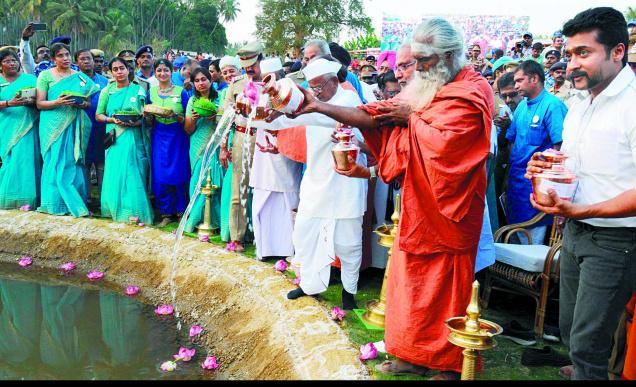
Social activist Anna Hazare and actor Suriya at the launch of Noyyalai Nokki , an initiative to restore the Noyyal, in Coimbatore on Saturday.— Photo: S. Siva Saravanan

It was a festive occasion at Kooduthurai (Alandurai) near the foothills of the Western Ghats, here on Saturday evening.

Hundreds gathered for the launch of Noyyalai Nokki , a people’s initiative to restore the 160-km long river.

The river originates in the Western Ghats and passes through Coimbatore, Tirupur, Erode, and Karur districts to join the Cauvery at Noyyal village.

“I want to come after two years to see the Noyyal restored,” said social activist Anna Hazare at the launch function. It is important to focus on conservation of land and water resources for development, he said.

Earlier, he told reporters that linking of rivers was good if it was done scientifically. It was important to plan water management, conserve natural resources, take up rainwater harvesting and restore rivers.

Actor Suriya, who participated at the inaugural of Noyyalai Nokki , said the confidence of the people gathered in restoring the river gave hope for restoration of more rivers across the State. It was necessary to take up such projects and conserve water bodies for the benefit of the future generations.

According to Vanitha Mohan, Managing Trustee of Siruthuli, it was a joint project by the public to restore the river.

C.R. Swaminathan, chairman of Noyyal River Restoration Federation, said the project would be implemented on divide-distribute-develop model by forming committees for every 500 metres of the river. Volunteers, educational institutions, non-governmental organisations and the government will be involved. To begin with, a survey of the river would be taken up and an estimate of the project would be prepared. Steps would be taken to install sewage treatment plants to prevent waste water from entering the river, said S.V. Balasubramaniam, chairman of Siruthuli.

source: http://www.thehindu.com / The Hindu / Home> News> Cities> Coimbatore / by Special Correspondent / Coimbatore f- March 27th, 2016

MADRAS MISCELLANY – A 175-year-old landmark…

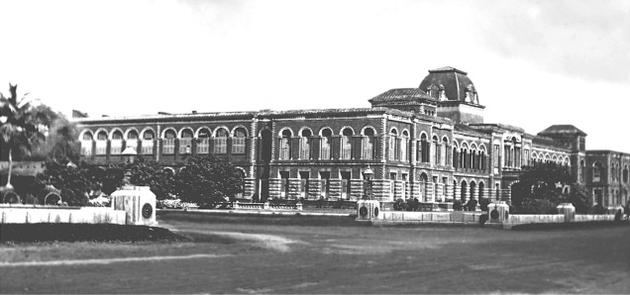
Presidency College c.1900 / Photo: Special Arrangement / The Hindu

Marking its 175th year in muted fashion this year is Presidency College, the oldest college in South India and the seed from which Madras University grew. But its early history has always left me with a question or two and I wonder whether some academic will shed some brighter light on those rather murky beginnings.

It was in March 1835 that the Government of India stated that “the object of Government ought to be the promotion of European literature and sciences among the natives of India.” It was an affirmation of Macaulay’s Minute on Education. But none of the Presidency governments knew quite what to do with this statement of policy. Of suggestions there was no shortage, but while Calcutta and Bombay did get around to action on some of these suggestions, Madras kept a debate going till there arrived a new Governor, Lord John Elphinstone, in 1838. To him George Norton, then the Advocate-General, and a few other eminent personalities presented a petition in November 1939 signed by 70,000 ‘native inhabitants’ seeking institutions of higher education.

Their petition read in part, “We see in the intellectual advancement of the people the true foundation of the nation’s prosperity… We descend from the oldest native subjects of the British Power in India, but we are the last who have been considered in the political endowments devoted to this liberal object…Where amongst us are the collegiate institutions which, founded for these generous objects, adorn the two sister presidencies?” The petition also promised that the citizenry would also gladly, “according to our means”, play a role in establishing such institutions if Government gave the lead.

A month later, Elphinstone responded positively with a proposal which is still what confuses me, even if it finally resulted in the birth of Presidency College. He proposed establishing a “collegiate institution, or a ‘University’” with two departments: A high school offering English Literature, a Regional language, Philosophy, and Science, to prepare students for the second department, the College, which would provide instruction in the higher branches of these subjects. A University Board, headed by Norton, was appointed in January 1840 to implement this proposal.

My confusion arises when I wonder whether there were no high schools before this — Madras history is full of schools of different types from at least 1715 and couldn’t they have years before 1840 been developed into high schools? Even as we wonder over this, there comes another poser. The University Board gets down to work and, believe it or not, starts a preparatory school! This school, started in Edinburgh House, Egmore, and later moved to Popham’s Broadway, was meant to prepare students for the High School! What were the other schools in Old Madras doing?

The High School opened its doors on April 14, 1841, in D’Monte House, Egmore, where the Chief Magistrate’s Court now is. Elphinstone, inaugurating the School, told the gathering, which included the School’s first 67 students that they were “witnessing the dawn of a new era, rather than the opening of a new school.” After studying English Prose and Grammar, Arithmetic and Algebra, Moral Science, History, Mechanics, Natural Philosophy, a vernacular and, in due course, Political Economy, the students graduated as ‘Proficients’. But what did they do for a degree?

Eyre Burton Powell, a Cambridge Wrangler, was appointed Headmaster and in 1853 saw the High School elevated to collegiate status. Two years later, in 1855, he became the first principal of the school that had attained collegiate status and which had been named Presidency College. But with no University in sight — The University of Madras was still two years away — where were the students getting their degrees — if any — from? Another mystery. The College moved to its new buildings on the Marina in 1870-71 by when its students were getting University of Madras degrees.

I don’t know whether a centenary or an earlier jubilee history of the College was written providing answers to all these strange goings-on in the early years of the institution. If not, one should be written now to explain why a major policy decision had to be taken to establish a prep school and a high school and how a college was founded with no University affiliation. Or perhaps someone will provide answers before a book is even thought of.

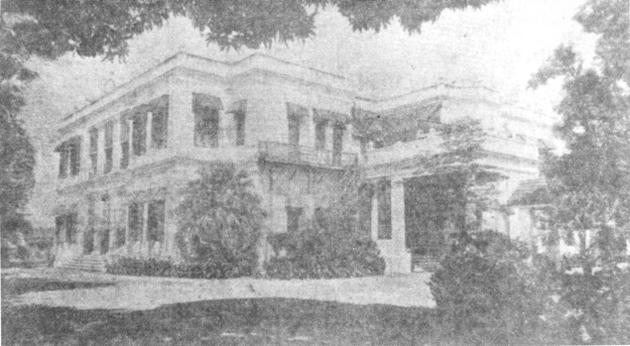
The Connemara Hotel main block before remodelling began in 1934 / Photo: Special Arrangement / The Hindu
The Connemara Hotel main block before remodelling began in 1934 / Photo: Special Arrangement
/ The Hindu

… And a 125-year-old one

To mark its 125th year as the Connemara Hotel — without seeking to celebrate the years before that when it had been a hotel under different names — this landmark institution in the city is soon to start a year-long refurbishment and when that’s over I hope it will just be the Connemara again. I also hope it will then commemorate someone who has long been forgotten by it — Eugene Oakshott.

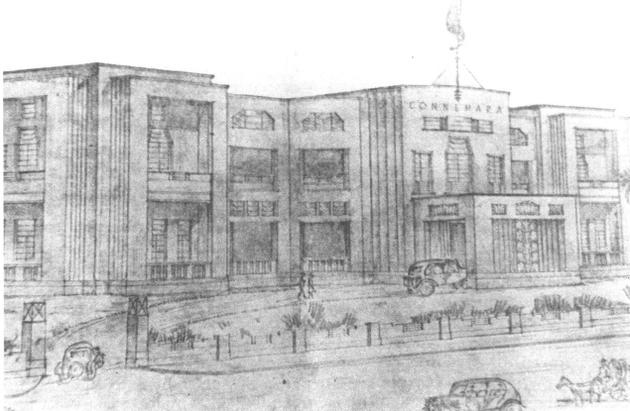
An architect's sketch of what the remodelled Connemara (1930s) was expected to look like when complete -- and as it remains today
An architect’s sketch of what the remodelled Connemara (1930s) was expected to look like when complete — and as it remains today

The hotel has a Wallajah Room and an Arcot Room recalling the name of the Nawab, as well as that of his fiefdom, on whose once-upon-a-time land-holding the hotel came up. It also has a Binny Room, recalling the owner of a property successive hoteliers took over before it became the Connemara’s, but nowhere in the hotel is there anything named after the man who took over in 1891 the hotel that had been renamed the Connemara in 1890.

Eugene Oakshott was the boxwallah who took over in 1882 a small store called Spencer’s on Mount Road and by 1895 moved it into a palatial home further up the road and got it on its way to becoming the biggest retailing empire in Asia. He then bought for himself the neighbouring Connemara on the advice of a colleague James Stiven, who became a partner in, and General Manager of, the Connemara. It was Stiven who took the first steps towards making the Connemara what it became from the 1930s, the leading hotel in Madras till the 1970s.

How about an Oakshott Hall and a Stiven’s Bar to remember them both when the hotel opens in its new avatar next year?

When the postman knocked…

* Recalling the founding of Vidya Mandir, (Miscellany, March 14) C.L.R. Narasimhan, an old boy of Rosary Matric, remembers what a shock it was to parents like his who found their wards being suddenly asked to leave Rosary in the middle of its year when they were in the 4th Class. “It created a lot of consternation among parents, many of whom were active members of the Mylapore Ladies Club.” The concerted reaction of many such parents, he adds, led to the founding of Vidya Mandir 60 years ago. Nearby St. Bede’s and St. Patrick’s did not offer State Board finals and getting into Madras Christian College High School or Hindu High School was not only not easy but they were quite a distance away. So there was born of the determination of the MLC members Vidya Mandir with just one class, Class Four, and two “outstanding” teachers, Ammini, the daughter of noted scholar P.N. Appuswamy, and Stella, who later migrated to Australia.

Narasimhan also points out that there was a time when the Mylapore Ladies Club had an emphasis on sport, Ball Badminton being the most popular game. The five-a-side game played with a fluffy yellow ball is little heard of today, but till the 1960s it was one of the most participated in sports activities in South India. Shantha Narasimhan, my correspondent’s mother, was a regular member of the MLC team, which was one of the strongest teams in the city. Noteworthily, all its members played in nine-yard sarees! “It was comfort personified, my mother used to insist, whether playing badminton or tennis or rowing in the Kodaikanal regattas,” concludes Narasimhan.

* Going past the San Thomé cathedral, on the same side, you cross a narrow lane and then a pair of very impressive gates. To whom do these gates belong, asks G. Shantha. Judging from her description, I think the Church Shantha refers to is the St. Thomas Basilica. In which case, the handsome gates are those of the Archbishop of Mylapore’s Palace. The Palace is on the site of the large garden house John de Monte, a knight of the church, built in 1804. It passed through many hands, including Thomas Parry’s, before it was bought by the Church in 1838. Just before the consecration of the Basilica in 1896, Bishop Dom Henriques da Silva made it his Episcopal Palace. After the Archdiocese of Madras-Mylapore was created on December 12, 1952, its first Archbishop, Rev. Dr. Louis Mathias, had the Palace renovated and considerably expanded over the next year. The handsome gates were made by the Salesian Technical Institute, in Basin Bridge. He even created a museum of Catholic antiquities in the Palace grounds. But this has now been moved to buildings in the rear of the Basilica.

source: http://www.thehindu.com / The Hindu / Home> Features> MetroPlus> Madras Miscellany / by S. Muthiah / Chennai – March 26th, 2016

Couple Shells Out Rs 39K for ‘Divine’ Lemon

Villipuram :

What is the maximum you would shell out for a lemon? On the local market, it is available for `5, but come the last day of Panguni fest at the famed  Rettai Kunru Bala Dhandayuthapani Temple at Ottanandhal near here, it becomes the most sought-after possession. So much that one single piece can go for a mouth watering Rs 39,000.

This is no ordinary lemon, but one with divine powers, capable of turning barren couples fertile. Or so the devotees believe. Thursday’s auction at the temple fetched Rs 57,722 for just nine lemons.

According to the sources, 700-odd devotees gathered at the over a century-old temple. After nine days of poojas, devotees gathered on the premises on the 11th day to bid for the ‘divine fruit’. According to Bala Krishnan (70), the temple’s chief priest, “A lemon is pierced on the temple’s holy Murugar Vel (spear) on each day of the fest. After the day’s pooja, the lemon is kept near the idol, where it remains till the last day.”

On the eleventh night, a special pooja is performed in front of the idol of Idumban. Sources said Jeyaraman and Amaravathy, a childless couple from Ottanandhal, raised the bid for lemon from the first day till it settled at Rs 39,000.

source: http://www.newindianexpress.com / The New Indian Express / Home> States> TamilNadu / by Express News Service / March 26th, 2016

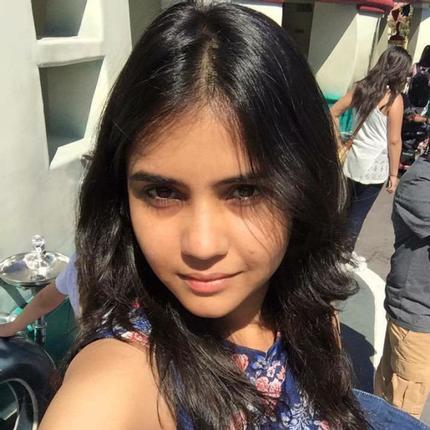
Meet Rahman’s rockstar sound engineer

27-year-old Srinidhi Venkatesh has her hands full with multiple projects

SrinidhiCF26mar2016

Srinidhi Venkatesh vividly remembers her first job interview. She had interned as a sound engineer at A.R. Rahman’s studio for eight weeks, and when it was time to leave, she felt like she wanted to stay on for a while.

So, she wrote to the Oscar winner and sought a job opportunity. In a couple of days, she was called in for an “interview” — the first one she’d ever faced. She was prepared, having brushed up on the concepts and latest trends in sound engineering that she might possibly be questioned on.

There was none of that. “It lasted for less than thirty seconds,” she laughs, “Rahman sir was like, ‘Hey, so you want to work here?’ I meekly nodded, and he said, ‘Ok, go ahead and take up that session.’”

There was none of that. “It lasted for less than thirty seconds,” she laughs, “Rahman sir was like, ‘Hey, so you want to work here?’ I meekly nodded,

And that was it. She was immediately handed over a session for Raavan that required her to tap into her experience as an intern and childhood passion for sound.

SrinidhiCF0226mar2016

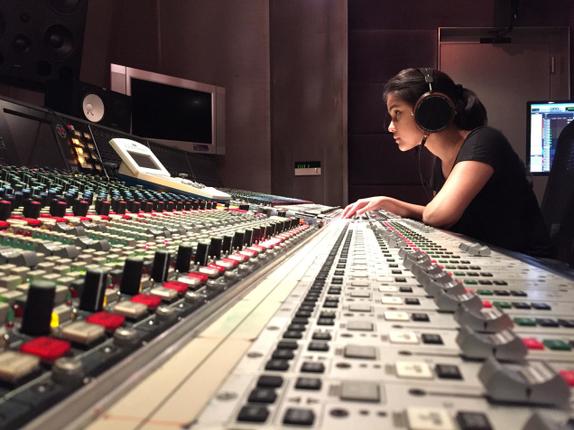
As a sound engineer, Srinidhi’s job profile includes organising a session, getting the right microphones in place and getting singers and directors to liaison to make the song sound better. And when she’s a music supervisor, she primarily acts as a middleman between the composer and the director.

It’s a job in which she gets to witness the birth of a song, which might be a super hit a year or so later, from scratch to finish.

“I like the old-school method of recording, where a singer does an entire take,” she says. Once that happens, she has to edit the takes and prepare two mixes — a shoot mix and a final mix — and then proceed to mastering.

Srinidhi describes ‘Chali Kahaani’ from Tamasha as one of her toughest songs so far. “There are so many layers in it and an interesting mix of singers — there’s Sukhwinder Singh, Haripriya and Haricharan… all in one song,” she says.

Born in Indonesia, where she lived for eight years, Srinidhi’s early association with music involved listening to a generous dose of Michael Jackson songs. When the tunes of Thalapathi and Roja came out and life brought her to Chennai, music got into her life in a bigger way.

Being close friends with popular late sound engineer H. Sridhar’s children, Varun and Vinay, raised her curiosity about the profession. “Whenever I went to their house, I used to peer at the equipment and wanted to know more,” she recalls.

Her quest to know more about the trade, slowly overtook many other career desires — veterinarian and chef — to become a passion. Once she actually enrolled into a course, it was obvious to her family members and friends that she had made, well, a sound choice.

One of the primary challenges as a female sound engineer was the timing — most music composers preferred working at night. “My working day usually begins in the afternoon when I get to the studios to work on songs. We pack up at sunrise, get home to sleep and have brunch… and then it goes on,” she narrates.

Apart from working with composers, Srinidhi has also dabbled in singing — she made a music video called ‘Lonely Sound’ that she sang and wrote. She’s also the female singer in Anirudh’s latest single ‘Avalukkenna’. Is she fancying a future as a singer? “Not at all,” she quickly responds, “While I plan to sing for my independent stuff, I’d rather listen to the far more qualified film singers out there.”

One of them — Arijit Singh — is her favourite, due to her interactions with him as a sound engineer. “He doesn’t give us what we want… he already knows what we want! Due to his varied experiences in the industry, he understands every angle that there is to a song. He gives his truest, and prefers doing five full takes, without any cuts, and giving us options to choose from.”

Being a sound engineer is far from a glamorous job, she says. “That’s why it appealed to me,” chuckles Srinidhi, who is currently readying the tunes and mix of 24, Mohenjo Daro and Achcham Yenbadhu Madamaiyada.

What does a sound engineer do?

* Coordinate with the lyricist to check if the words fit the meter of the finalised tune.

* Organise a session with the singers.

* Arrange the right microphone; different voices need different ones.

* Act as a bridge between the singer and the film’s director and ensure that the recording takes place smoothly.

* Once recorded, go through all the takes and select the best ones to fit in the song.

source: http://www.thehindu.com / The Hindu / Home> Features> MetroPlus / by Srinivasa Ramanujam / Chennai – March 25th, 2016

Asteroid named after endangered bird, thanks to Chennai teacher

Mention of an outer main-belt asteroid now brings to mind an endangered bird. It has been named after Akikiki, a critically endangered Hawaiian honeycreeper bird.

Prakash Vaithyanathan

The credit for this goes to Prakash Vaithyanathan, a science teacher from the city. Mr. Vaithyanathan said he had written to the International Astronomical Union (IAU) suggesting that new planetary bodies and other objects in space could be named after endangered or extinct animals, birds and plants. “In class, I keep speaking to my students about endangered and extinct flora and fauna and also encourage them to give each other nicknames based on such species. Most new planetary bodies and other objects discovered in space are given complicated names through a scientific protocol of the IAU and I wrote to ask them if they could name objects in space in the manner,” he said.

Mr. Vaithyanathan wrote to them on May 29, 2015, and received a reply the same day from a database manager with the IAU stating that they would be interested in implementing his idea.

“They contacted me again and asked me to suggest a name and I went with ‘Akikiki.’ The reason for choosing the name of the Hawaiian honeycreeper was because the IAU annual conference was happening in Hawaii in May,” Mr. Vaithyanathan said. Nearly ten months after his suggestion, the IAU implemented this and named an asteroid ‘Akikiki.’

In the small body database on the Jet Propulsion Laboratory website of the California Institute of Technology, credit for the name ‘7613 akikiki,’ assigned to an outer main-belt asteroid, is given to Mr. Vaithyanathan. It says: ‘name suggested by Indian high-school teacher P. Vaithyanathan, on the occasion of the 2015 IAU General Assembly.’

source: http://www.thehindu.com / The Hindu / Home> News> Cities> Chennai / by S. Poorvaja / Chennai – March 23rd, 2016

A glass act

Anjali01CF22mar2016

Anjali Srinivasan was recently selected as one of the ‘Swarovski Designers of the Future’. The glass-smith from Chennai talks about art as an invitation to dialogue, sustainable design and her vision for future living

To Anjali Srinivasan, the kiln is where the art is. It is where the familiar meets the imagined, where strength courts fragility and where physical forms signal ephemeral experiences. The idea of working with red-hot molten material, and learning to control it as it transformed from solid to liquid and back to solid, unfolded when she visited Firozabad, India’s glass hub, during her student days at the National Institute of Fashion Technology.

Anjali’s sense of inquiry about the medium took her to Alfred University in New York and the Rhode Island School of Design, where she invoked new ways of working with glass. ‘Puffy Glass’, one of her many inventive departures, was the outcome of “intensive research in particle activism”.

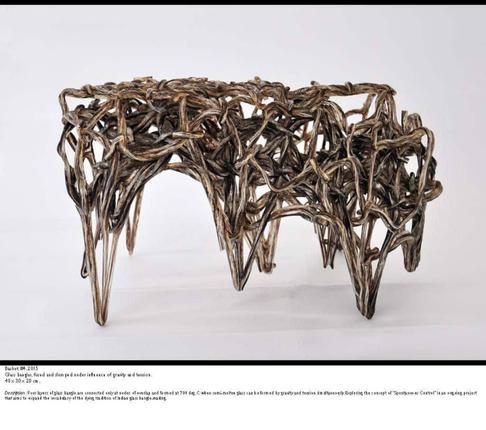
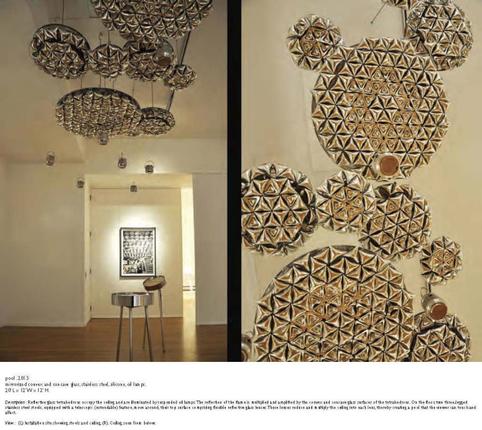
Back in India in 2010, she worked with traditional glass artisans in Firozabad, Purdilnagar and Papanaidupet, before setting up a studio in SIDCO Women’s Industrial Park near Pallavaram in 2011. With ‘Depths of Field’, where she showcased a wearable glass sculpture and an installation that sprayed turmeric and coffee into the gallery when a participant pulled at its strings, and ‘Of Shifting Natures’, the highlight of which were digital prints on flat glass and a mirror-painting diptych encrusted with tiny convex mirrors that turned the viewer’s movement in front of it into its subject matter, Anjali subverted preconceptions of her medium. After many solo shows and honours, she moved to Dubai last year “as a random life experiment”, and set up ChoChoMa Studios, where she provides customised solutions in hand-crafted glass and conceptualises themes for art shows. It was during a showing at the Dubai Design Week last year that ‘Untitled’, an 11-ft high archway with web-like glass filaments co-constructed with visitors, caught the attention of the Swarovski-Design Miami/Basel team scouting for convention-challenging talents.
Anjali02CF22mar2016

In an e-mail interaction, the artist talks about the honour and the less-trodden paths her work is leading her to. What you cannot ignore is the fact that to this artist, the glass is only half full — always!

What did the Swarovski selection panel find unique about your work?

They informed me that I had been selected through a nomination process. The curator felt that my approach was worthy of recognition, as it showed a new way forward for creative process and its engagement with people.

Since it’s a Swarovski honour, would the assignment involve working with crystals?

The award comes with a commission, and so yes, I will be working with Swarovski to create something new for Design Basel in June 2016. Who knows what the future holds past that, but since I am interested in optical phenomena, and crystals epitomise optics, I hope to continue using crystals.

The optical behaviour of crystal is quite different from glass…

For me, the task of working across media lies in being able to speak in the voice of each material, and bring out a conversation or collaboration between them. I see harmony as just one theme in design. Sometimes, the communication of diversity, tension or even conflict between media helps in the effectiveness of a work.

Going by your repertoire, it’s apparent that art is part of the dialogue in any interior space you create…

I am foremost an artist; it is about how I see the world and relate to my existence. My design practice feeds into building that overall philosophy, and I am fortunate to be able to interpret interior spaces in that sense.
Anjali03CF22mar2016

You’ve used spices, dough, coffee powder at shows… What are your latest experiments?

I’m working on transitioning from a crusty, rock-like glass entity to a sublimated, light-infused crystal body, all in the same object. I hope this investigation can be used in the Swarovski project. Simultaneously, I am looking at expanding the material language of glass bangle-making. I want to build a new vocabulary that sustains the craft tradition across its current boundaries.

What drew you to Dubai?

I realised that living and working in my home country was not conducive to my practice. Also, I had outgrown the job market in the U.S., from where I had relocated to India. I looked for some place in-between India and the U.S. My gallerist was showing works at Art Dubai with significant success. It was a random life experiment to see what it is like to set up a creative enterprise in Dubai.

What led you to launch ChoChoMa? In what way has the studio pushed the frontiers of glass and nurtured craftsmanship?

ChoChoMa Studios is named after my grandmother. It was started originally as a fair-trade umbrella for glass artisans I was working with in Delhi in 2005. The goal was to upgrade technology, offer design inputs and guide artisans to sell directly to consumers. I wanted the handicraft glass sector in India to have a voice in creative activity. But, since then, its role has changed, according to what I responded to most. We showcased contemporary art collaboration with traditional artisans during Art Chennai in 2014. Today, we are a start-up in West Asia, working on design projects, teaching students about glassmaking and making impossible ideas happen through art.

Yes, it has been an important concern of the Studio. We just created tableware for a restaurant, by splicing old water bottles. We are working on large wall panels that use bottle glass, for a city-wide recycle centre initiative of the Dubai Municipality. Each panel saves 50 kg of consumer glass from landfills — a heartening application of sustainable design.

What is your vision of future living? Where do you see your medium going?

My vision is less dissonance between humans, and humans and their objects. Creative glass exploration, with recent developments of 3D printing and lathe-working, is heading towards breaking traditional boundaries with technology, as well as being a medium of performance, time and phenomenon-based interfaces.

Three names were announced by Swarovski (including a two-member design team). In what way do you think your work will be different?

I’d like to believe that each of our works will be special, based on our vastly different backgrounds. I am the only artist in the lot. So, my approach will be more conceptual and I will explore the philosophies I am invested in. I was told that I am the first Indian designer, and also the first glass-maker chosen for the honour. I have been encouraged to use my own glass in collaboration with crystal, so I imagine that will define the project as being unique. My sensibilities are Indian, my skill-base is American, and I am working out of West Asia and imagining with Swarovski crystals! Surely that adds up to something significant, right?

source: http://www.thehindu.com / The Hindu / Home> Features> MetroPlus> Society / by  T. Krithika Reddy / March 22nd, 2016
TN man gets IIT alumnus award

Chennai:

Indian Institute of Technology, (IIT) Mumbai conferred the distinguished alumnus award on Dr Shantikumar V Nair, the dean of research and director of Amrita Centre for Nanosciences and Molecular Medicine at Amrita University in Coimbatore.

The Award was given in recognition of Dr Nair’s contribution as an outstanding academic and researcher in the field of nanosciences and molecular medicine.

He is known for his innovations in tissue-engineered products, nano-medicines, energy conversion and storage devices.

source: http://www.timesofindia.indiatimes.com / The Times of India / News Home> City> Chennai / TNN / March 20th, 2016

Writing a Life Beyond Death

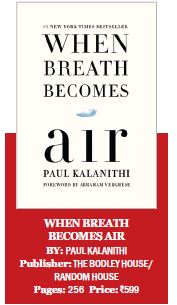
BookCF20mar2016This disturbing book, which almost wrings the life breath out of you, is this year’s best non-fiction so far. Searing, unapologetically noire, inhabiting the cusp of life and death, second generation American doctor Paul Kalanithi’s account of his young life and his progress towards death takes us to the brink of our own lives. Writing till a few weeks before he died of lung cancer, with the concluding description of the days leading to this death written by his wife Lucy, it is a story of life, death, science, the meaning of life, and the various existential queries it throws up as we traipse through life as if we are born not to die.

Paul Kalanithi
Paul Kalanithi

Kalanithi was the brightest young neurosurgeon that the US medical system produced in recent years. Wooed by all universities, offered jobs that anyone would, well, die for, Kalanithi was consumed by lung cancer despite the best medical treatment available and despite the fact that the victim himself knew how to keep away death.

Kalanithi was the third son of a Tamil Christian father and his Hindu wife who eloped to get married. In the US, his father became a well-known surgeon. After New York, his father moved the family to the far outreaches of Arizona where “spaces stretched on, then fell away into the distance”.

Out of there emerged this brilliant writer-doctor on who the US medical system too had pinned great hopes. But science hadn’t accounted for nature’s dark humour.

In When Breath Becomes Air, the young surgeon deals deeply with issues which confront all of us. First was his passion for literature and philosophy, and he imbibed the larger glories of Eliot, Whitman etc. He found Eliot’s metaphors “leaking into his own language”. And then “throughout college, my monastic, scholarly study of human meaning would conflict with my urge to forge and strengthen the human relationships that formed that meaning”. Kalanithi resolved his inner conflict by finally choosing medical science where the “moral mission of medicine” lent his med school days a “severe gravity”. Here he explored the relationship between the meaning of life and death.

In his short life Kalanithi achieved greatness in both showing an academic life few can surpass—MA in English literature and BA in human biology from Stanford, MPhil in history and philosophy of science and medicine from Cambridge, graduated cum laude from Yale School of Medicine, inducted into the Alpha Omega Alpha National Medical Honour Society, postdoctoral fellowship in neuroscience and the American Academy of Neurological surgery’s highest award for research. He was just 36.

In his death, two of his greatest passions converge—medicine and literature. Even as he groped, incised, cauterised, sutured and brought people back from the jaws of death, he himself was being eaten away by cancer. Often there was hope that the first defence against his lung cancer, Tarceva, “that little white pill” would do the trick. For six months, it seemed the cancer was in retreat. Kalanithi started work, fighting against tiredness and nausea. Then in one of the routing scans appeared a moon-shaped tumour. He couldn’t avoid chemo any longer. He fell back on literature during this difficult phase looking for meanings of death and life. “Everywhere I turned, the shadows of death obscured the meaning of any action.”

This young doctor on the threshold of death fought bravely. But there is little science can do about determined nature. Detaching himself brilliantly from impending death, Kalanithi takes us through his final weeks of turmoil. Most tearful is the last operation he would ever do as he decides to give up surgery, and go home and wait for death. He watches the soap suds drip off his hands after his last surgery. He saved one more life but his was nearing the end.

Here there is no redemption. Death is the winner from page one. It is only literature, this book, that outlived him. He has left back a poignant memoir of life and death that many will  find succour in life as well as when they near death.

source: http://www.newindianexpress.com / The New Indian Express / Home> LifeStyle> Books / by Binoo K. John / March 19th, 2016