Chief minister J Jayalalithaa on Thursday announced 3 lakh financial aid to a fencing professional to help her participate in competitions scheduled in Venezuela and France this month.
“I have directed for 3 lakh to be provided to C A Bhavani Devi through the Sports Development Authority of Tamil Nadu,” she said in a statement. Devi, who won a silver medal in last year’s Asian Fencing Championship besides winning many other laurels, had appealed to her for financial assistance to participate in these tournaments, Jayalalithaa said.
Devi, a resident of Old Washermenpet in Chennai, won a bronze medal in a fencing competition in Mongolia. The chief minister recalled that Devi won number of medals in various contests and that she was presently training in the US to make it to the 2016 Rio Olympics. Jayalalithaa extended her best wishes to Devi, wishing her success at Venezuela and France
source: http://www.timesofindia.indiatimes.com / The Times of India / News Home> City> Chennai / TNN / October 09th, 2015
Skilled dancers pirouette at a surf and salsa festival while footballers score goals to resounding cheers — all at this beach on East Coast Road. PRIYADARSHINI PAITANDY on the rapidly changing fishing village
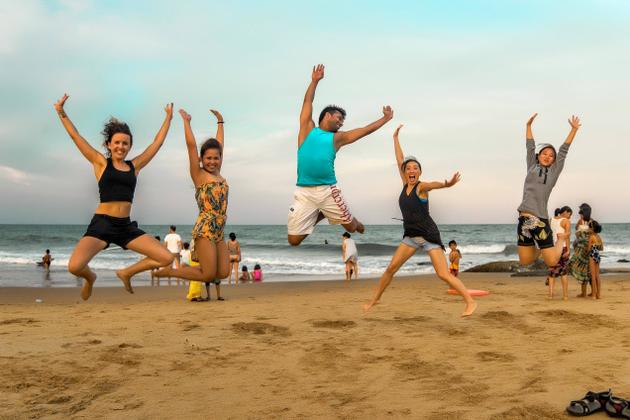
Covelong is full of surprises. From being a sleepy fishing village, it’s now one of the celebrities on East Coast Road. Amble over to the beach, and you’re sure to find something entertaining. Over the last weekend, two strikingly diverse events had our attention.
Latin Festival Madras
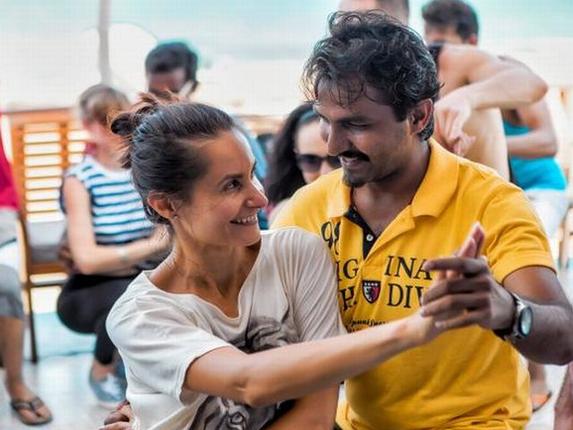
The music leads you to the party. Distinct Bachata beats blare from the speakers. Stylish women dancers and bare-chested men in board shorts walk back from the beach, doing a few moves. Surf Turf, the charming café at the surf school, is brimming with glamorous dancers in berets, waistcoats, crop tops and shredded tees. The second edition of the Latin Festival Madras feels like a scene out of Dirty Dancing 2: Havana Nights. The couples spin, twirl, turn and dip their flexible bodies in sync with the beats. Along with all the dancing, there’s also a fair bit of surfing involved.
Arun Srinivasan, organiser of the festival, and founder and director of Salsa Madras, says, “The idea is to expose Chennai to international dancers and techniques. It brings together dancers and instructors of Latin dance forms such as Salsa, Bachata, Cha-cha…” This year there’s Kizomba too — a slower and more sensual dance style that originated in Angola. “In Europe, it’s bigger than salsa. I started teaching this style a couple of years ago, and now there are 200 people in Chennai who do the Kizomba.”
There are around 100 participants from Delhi, Bangalore, Puducherry, Kolkata, Pune, Hyderabad and Kochi, and 10 international instructors from Romania, Australia, Canada, Japan, Singapore and Guinea Bissau. It’s Bachata specialist Alex Teodorescu’s second time in the city for the festival. He’s been dancing for eight years and is an instructor. “I’ve come with my team of dancers from Bangkok. I love it here because it’s so cosy and we are like a close-knit family who eat, surf and dance together for three days.” Workshops, boot camps, pool parties and championships at The Gateway hotel are all part of this event.
Watching some of the skilled dancers in action is truly fascinating. There are the novices who manage to manoeuvre the tricky turns with the help of their advanced partners. Nobody loses their smile or their attitude. A few of them continue, despite the wet outfits and beads of sweat trickling down their cheeks. Everybody is out to have a good time, and brush up on their skills. “As dancers, it’s important to travel and understand different cultures and their styles. Sometimes they can’t travel, so we bring in people from all over and this facilitates an exchange of ideas,” says Arun.
Barcy Beach Football 2015
You’ve heard of Barca, but have you heard of the Barcy Football Club? That’s what Covelong village’s home team is called. Formed by the fishermen of the village, this team organised the first edition of Barcy Beach Football, along with the Covelong Fisherman’s Panchayat.
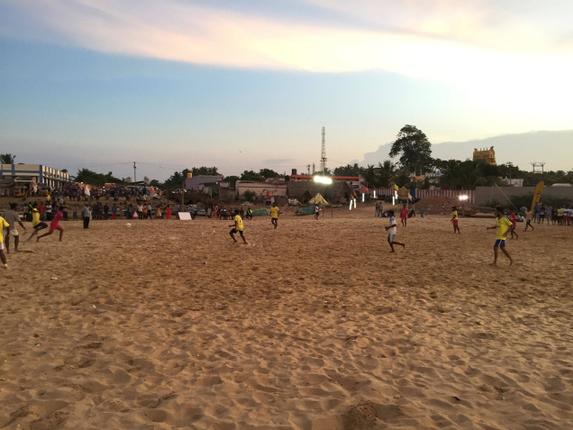
Bright flags fluttering in the wind, a couple of floodlights, a quickly fading evening sun, the roaring sea and the aroma of roasted corn… set against this backdrop, 24 football teams from across the city battle it out for the trophy. Since it’s an open category, the age groups vary from 18 to 40. These include players from city colleges, football clubs and teams from the fishing villages of Pattinapakkam, Kottivakkam, Kalpakkam… Nearly 5,000 curious passers-by stop and cheer as the goals are scored in quick succession. The format is different, with each team comprising eight players, with the field size being 60 x 40 m. Play time is 30 minutes, with a short half-time after the first 15 minutes. That’s when enthusiastic spectators make a dash for a fish-fry and sundal. “It’s a day/night match. The idea is to motivate youngsters to focus on a sport and keep away from drugs and other harmful habits. Given the success, we plan to make it an annual event,” says Sundar, official commentator for the evening. Unfortunately, a heavy downpour has rescheduled the semi-finals and finals. “As soon as the water drains out of the beach,” adds Sundar. For now, the semi-finalists are Barcy Football Club, Asan Memorial College, Kottivakkam Football Club and Pattinapakkam Football Club. Here’s wishing them all the best.
source: http://www.thehindu.com / The Hindu / Home> Features> Metroplus / by Priyadarshini Paitandy / October 03rd, 2015
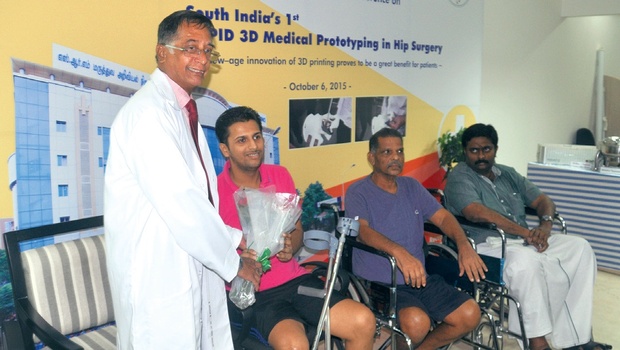
Dr K Sridhar, pro vice-chancellor (medical), SRM University, with three patients who underwent the treatment. | EPS
Chennai :
Less than two decades ago, it was impossible to feed a schematic into a computer and getting a completely built, accurate, full size model out from a machine in a matter of hours. But 3D printing technology has come so far, so fast that not only is that possible, but also doctors have begun using it to simplify what used to be very complicated surgeries.
Doctors at the SRM Institute of Medical Sciences(SIMS) have used the very same technology to successfully operate on three patients at a fraction of the time it normally takes. Called Rapid 3D prototyping, the technique utilises a high definition medical 3D printing machine to churn out scale models of any bone structure that doctors want in a matter of hours. The implications of having such scale models, flawless in their reproduction has been priceless, especially in time consuming surgeries with low first attempt success rates like hip replacement.
“We have utilised this technique to operate on three patients successfully for the first time in South India. We have seen a rapid reduction in the time taken to complete the surgery and a higher chance of success,” said Dr K Sridhar, pro vice-chancellor (medical) of SRM University and part of the group’s effort in putting together an advanced medical research team. The doctors first began with taking extensive CT scans of the affected areas of the hip — from shattered bone fragments and broken pelvises. With the CT scans developed into a 3D schematic using software designed for the same, doctors had printed out exact and high resolution models of the fractured hips.
“What these models helped us do was plan exactly how to approach each surgery and the materials and implants required to correct them. Earlier, the scans only allowed us to imagine where and what was in there. One of our patients actually had to have two failed attempts before he came here to us,” said Dr Vijay C Bose, joint director, consultant orthopaedic surgeon.
Being able to plan the exact route and knowing what to find has reduced surgery time by 2.5 hours, and increased chances of success. “We do not have to rely on trial-and-error methods of surgery anymore. We have the exact model to rehearse on now,” he said.
source: http://www.newindianexpress.com / The New Indian Express / Home> Cities> Chennai / Express News Service / October 07th, 2015
The Coimbatore Medical College and Hospital has performed 100 cochlear transplant surgeries in the last two years, becoming the first government hospital to reach this number.
Coimbatore :
The Coimbatore Medical College and Hospital (CMCH) has performed 100 cochlear transplant surgeries in the last two years, becoming the first government hospital to reach this number.
All the surgeries had been performed under the chief minister’s comprehensive health insurance scheme, said doctors.
The CMCH is the only other government hospital, besides Madras Medical College, approved to perform cochlear transplants under the Tamil Nadu Health Systems Project.
Doctors said they performed their first cochlear transplant surgery on August 10, 2013 and performed the 100th surgery on October 1 this year.
“All the surgeries were successful and all the children operated have recovered and are doing extremely well,” said professor and head of the ENT department Dr V Aravindhan.
The insurance scheme makes cochlear transplant surgeries free for children between 0 to 6 years of age.
“Cochlear transplants are usually done on stone deaf children or those who are severely hard of hearing,” said ENT professor Dr Ali Sultana.
“But since the implant is something that stimulates an auditory nerve in the brain, and later fills the auditory cortex with sounds and information, children learn to use it and benefit better,” he said. “Thus they can speak on the phone and have face to face like conversations like normal people.”
Earlier cochlear transplants were being done only at private hospitals because of the implant was expensive—Rs 5.1 lakh even for the basic low-end one. Now since the scheme allots Rs 7 lakh for the surgery, government hospitals have now begun performing the surgery.
“This includes pre-surgery screenings tests, the surgery, implants, post-surgery complications and a one-year rehabilitation program for the children,” said Dr Aravindhan.
The CMCH has tied up a private institute called “Hearing Aid Centre” to provide the one-year rehabilitation post-surgery.
“They with a team of audiologists and speech therapists provide audio verbal therapy to children, who will start filling their memory cortex with sounds and noises, and slowly start repeating them as part of speech processing. Within the first three months, they start speaking simple words,” said Dr Sultana. `
While cochlear implant surgeries are being done under the state comprehensive health insurance scheme in private hospitals too, other screening and post-surgery costs start piling up, say patients.
source: http://www.timesofindia.indiatimes.com / The Times of India / News Home> City> Chennai / by Pratiksha Ramkumar, TNN / October 05th, 2015
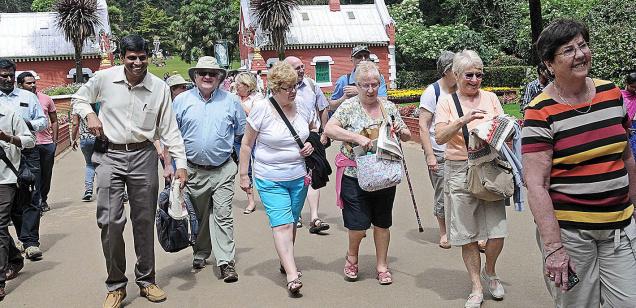
Tourists from England at the Government Botanical Garden in Udhagamandalam.— Photo: M.Sathyamoorthy
Twenty two visitors from England have come all the way to Udhagamandalam not for a holiday but to trace the roots of their grand parents who lived and worked here.
But they were nevertheless delighted to see places such as Botanical garden and Charing Cross which reminded them of places back home. Such as the Adam foundation at Charing Cross which is there in London as well.
Many Britishers continued to live in Udhagamandalam after India’s Independence. A lot of them have been laid to rest at the cemeteries at Stephens and Thomas Church.
Locals say that not a year passes by without a tourist from England coming to the hill station looking for memories. Many of them recognise the places as they have heard about them from their grandparents who lived and worked here. The 22-member group included Freddy Shaw who came to see the places where his father worked and lived. The 22-member team is on a 16-day tour of South India and they reached the hill station on Saturday.
Freddy said that his father worked with the Army from 1944-46 at Duley camp of 22 Madras Unit.
V. Stalin who is a tour manager and guide took the visitors to the Botanical garden, Dodabetta and Stone house (the present Govt Arts College) which was the first building in Udhagamandalam built by the Britishers. They also visited Toda tribal hamlets and St Stevens church. A train ride on the NMR and a trip to the tea estates are also on the cards.
source: http://www.thehindu.com / The Hindu / Home> National> Tamil Nadu / by V. S. Palaniappan / Udhagamandalam – October 04th, 2015
Tracking a genetically pure Kangayam bull/cow for mating and identifying a genuine buyer for Kangayam cattle are now just an app away.
V. Sivakumar, an Indian-American engineer from Tirupur and his team regularly rescue Kangayam bulls from slaughter.
He has introduced the mobile app as an extension of rescue/rehabilitation/conservation activities to improve breeding of genetically pure Kangayam cattle and ensure sales to only needy farmers.
He had recently launched ‘Konga Goshala’ to rehabilitate the Kangayam cattle, “Both these steps are aimed at saving the Kangayam cattle from extinction. When it comes to sales, the app will help prevent the cattle from falling into the hands of middlemen who could resell the animal to slaughterers as the buyers too have to register first”, he told The Hindu . The registration of names into the database is being done free.
Explaining its salient features, Mr. Sivakumar said that the app would function on Android based mobile phones and iPhones with Tamil as the language to enable farmers use it comfortably.
“Only those farmers having their addresses within the Kangayam tract that spreads over Tirupur and some adjoining districts, are allowed to join the group”.
The application enables a farmer to locate a bull which is near to their location for mating with the cow.
“For sales too, features are embedded to help buyers easily identify the cattle of their choice,” said Mr. Sivakumar. The marketing of the app will be confined to within the farming community.
source: http://www.thehindu.com / The Hindu / Home> National> TamilNadu / by R. Vimal Kumar / Tirupur – October 02nd, 2015
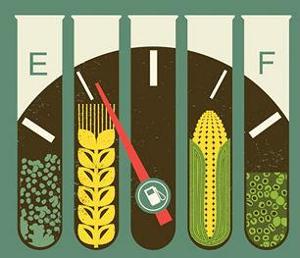
Popularly known in our old Tamil folklore as the ‘Tree that cures’ or as the ‘Tree that protects’, the Punnai tree’s population along our coastal and river belts has been dwindling in the last three decades owing to its rich timber value. But scientists have now begun repopulating this tree for its biofuel and healing properties.
Scientists have cloned certain varieties of the Punnai tree suitable for use as biofuel. (Getty Images photo)
The bio-fuel produced from Punnai tree can run a machine like a pumpset or even a generator, say researchers. Scientists with the Institute of Forest Genetics and Tree Breeding (IFGTB) have managed to clone a few varieties of this tree, scientifically called as Calophyllum Inophyllum, rich in oilseeds, rather than timber.
“Not many people know that the oil extracted from the tree’s seeds can be used as a biofuel,” says the scientist who has been researching tree-borne oils for the past decade, Anandalakshmi Ravichandran. “It can be used to run pumpsets, generators and a lot of machinery that otherwise require petrol or diesel,” she says. A five-year-old well-looked Punnai tree can give a minimum of 4.2 litres of biofuel a year, or 2.1 litres per harvest.
“A tree older than five-years, which is watered well and fed bio-fertilizers, will produce at least 4-10 kg of oilseeds per harvest, which in turn produces 1kg to 2.5kg of kernel, from which oil can be extracted,” she added. Oilseeds from the tree can be harvested at least twice a year.
The tree, which is found in many parts of South India like the Andaman Islands, Kasargod, Sengottai, Cuddalore, Kutralam, Puducherry and Karaikal, unlike most can even survive on loose soil or sandy soil. “These trees are like mangroves and grow in the wild in the same conditions,” says Ravichandran, also the HOD of the seed technology department at IFGTB.
Scientists recommend that farmers choose the number of trees they want to cultivate based on their oil requirement. Around 35 trees can be planted in a one-acre land either on the perimeter or as intercrop. “These trees are natural wind shields, because they initially used to stop the salt carrying sea breeze from blowing into the agricultural lands,” says Ravichandran. The institute has sold 600 units of Punnai seedlings so far.
The drawbacks of growing or cultivating the tree is that it takes at least five to six years to mature, and start yielding fruits or oilseeds. “It will grow upto 15m in height and start producing even more than 10kg of fruits after its 10{+t}{+h} year,” she says. “Nobody realises this because they cut it down after it reaches its fifth year for timber, which is used to make catamarans and furniture,” she adds.
After a lot of research into Punnai trees in its natural habitats, scientists short-listed 156 genetically superior trees across Kerala, Karnataka, Tamil Nadu and Andamans.
Seedlings of these varieties are on sale at the IFGTB nursery for Rs20
source: http://www.timesofindia.indiatimes.com / The Times of India / News Home> City> Coimbatore / TNN / October 01st, 2015
Chennai may have proliferating waste, sewer rats, mosquitoes and bad traffic but it is an intellectual city, which does not fake. Its people are real
I would like to invite the new graduates and post-graduates [of Madras University], to journey with me, briefly, on a survey of life around us, of the scene here, in our very own city of Chennai and in our beloved state of Tamil Nadu. You belong, as I do, to Chennai, most of you, and to Tamil Nadu. So what I describe is what you and I are witness to, complicit in, and part of.
Let me start with three things that are good and great about Chennai, famous for having the largest number of temples, medical shops and posters to a street.
First, it is a real city. Its people are real. Their problems are real, their poverty, their misery is real. As are their joys and their sense of fun. Their creativity, their improvisations are real too. Chennai does not fake, does not pretend. And above all, Chennai handles real life, in a real way, making of that reality what it can. You could say India is like that and so it is but, in being true to itself, Chennai can be said to be India’s teacher.
Second, Chennai is a metropolis with a mind of its own. It can, alongside Kolkata, be described as an intellectual metro. ‘Metro,’ incidentally, comes from ‘mother’. A metropolis is ‘Mother City’. This intellectual mother city has corner shops and stalls that sell every variety of newspaper, superb journals, well-brought out magazines — including, I must say a lot of rubbish — with unflagging speed. If you see in a Chennai newspaper the list of that day’s happenings, you will see meetings being organised by study circles ranging from Gandhi to Ambedkar, Periyar to J. Krishnamurti, Marx to Einstein. No wonder a person like Sarvepalli Radhakrishnan, born to a Telugu-speaking mother, chose this mother city as his home.
Third, Chennai is a city with the most extraordinary cultural resources. No other place in the world has as many music halls that double up as meeting halls, small or big, five star or zero star, as Chennai does. ‘All Are Welcome’ is surely a Chennai phrase, signifying the bandwidth of the city’s cultural life. No wonder Tanjore Balasaraswati and Madurai Subbulakshmi became so comfortable in Madras, as the city was then called.
We can be proud to be Chennaivasi.
But pride becomes conceit if it is unaccompanied by honesty. So, let me now turn to three things that are not so good or great and are, in fact, positively wrong about our city and therefore about us.
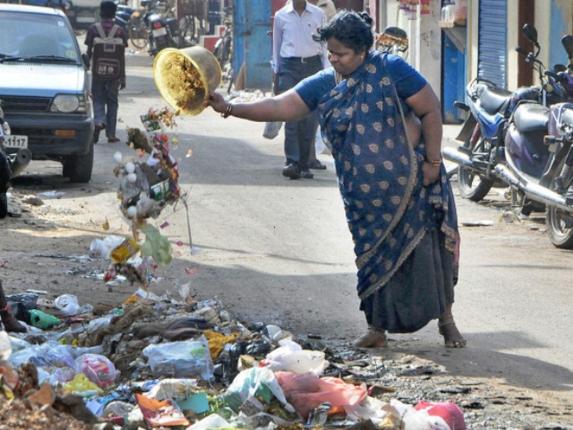
Ours is a city where unknown and unnamed diseases incubate in uncountable measure because we are callous, short-sighted and downright irresponsible—Photo: M. Karunakaran
First, our civic sense. Chennai’s civic sense is an affront to the senses. Of what self-purifying or uplifting use, what earthly or heavenly use, can the temple-at-every possible step be if the Chennai male spits and urinates at every possible corner, crevice and culvert? It is utterly hypocritical on our part to blame the civic authorities, our Corporation, of not keeping the city streets clean, if we maltreat our surroundings 24×7 as we do. The conservancy staff that clears the mounds upon mounds of garbage we generate deserves not just our gratitude but our apology for doing its work without our help. Believe me, they are more important and more deserving of respect than the temple chariots that block our paths every so often in futile repetitiveness.
Ours may be the city where Tiruvalluvar is believed many centuries ago to have lived, where Mudarignar Rajaji, Thanthai Periyar, Perunthalaivar Kamaraj, Arignar Anna and Sangita Kalanidhi M.S. Subbulakshmi lived, but the fact is that ours is also the city where sewage rats proliferate in their millions, mosquitoes breed in their billions and unknown and unnamed diseases incubate in uncountable measure not because the so-called ‘authorities’ are neglectful but because we are callous, short-sighted and downright irresponsible. Make no mistake, dengue and chikunguniya today and — who knows — plague and rabies tomorrow will not be caused by an inefficient administration but by our own cynical lifestyles.
Second, our road sense, by which I mean the way we negotiate our movement on roads, is scandalous. And the biggest offender, I might even say ‘culprit,’ is the motorcyclist. No one is above the law except the motorcyclist. I take it that many if not most of you graduating students of MU are motorcyclists. So please take this as addressed to you. The poor pedestrian is the biggest victim of the motorcyclist’s dizzying hurry.
There is another hurry around us. The hurry to build, which is accompanied by the hurry to destroy. The sharp-toothed bulldozers of destruction which can reduce a building to pulp in a matter of hours and the large cones of cement which can build on the destroyed site within days, are about hurry as well, a hurry to reap in profits as quickly as possible. And the result? Roadsides that are permanently dug-up, footpaths with heaps of sand and cement bags on them.
This brings me to the third wrong, our sense of right and wrong. Chennai is overlooking some human tragedies being enacted right under its gaze. Simply put, this is the huge and widening divide between the very rich and the destitute in our city. If the number of cars and motorcycles has risen dizzyingly, the number of vagrants is also rising at an alarming rate. And they symbolise the great divide.
It is utterly wrong that sky-scraping buildings should rise in our city, both for residential and professional purposes that will pull out ground water in profligate quantities, when thousands of people in the city have to pump up water physically from derelict, broken down hand-pumps at street corners.
Let us not again blame the authorities for giving permissions, clearances. Who asks for them? Who facilitates them? Is there any clearance without an applicant?You, products of Madras University, can choose to be part of the greatness of Chennai or part of its problems. I hope you will choose right.
Tamil Nadu’s tradition
We are rightly proud to belong to this State. Speaking for myself, being a resident of Tamil Nadu, and descended from Tamil ancestors is an identity I cherish. Let me quickly enumerate three things that make our State great.
The first is its breaking the back of caste discrimination. The battle is not over yet but it has achieved phenomenal success. For this we have no one more to thank than Thanthai Periyar and the self-respect movement that he started. We cannot also forget the pioneering role played by the Congress prior to independence against untouchability.
The second is its tradition of religious accord. There is a dangerous wave of religious intolerance that is being set afloat. Tamil Nadu can be sure to rebuff, stoutly and spontaneously, any attempts to introduce religious and communal majoritarianism on the wings of electoral majorities.
The third is the remarkable improvement in the status of its women, be it in the matter of the age of marriage, health or education. The curse of dowry is still with us and in pockets, child marriages still take place, but the woman in Tamil Nadu is no longer the undernourished, under-educated and abused woman of some decades ago.
But let me now list three factors or three characteristics of ours as a people that should cause us to worry.
The first is our proneness to glorify success, success in politics, in commerce, in any field. It is not unconnected to our devotionalism. The glorification of success leads to worship of the successful and the powerful who are, by definition, successful. It is one thing to admire, to support and even to adore. It is quite another to make of anyone we admire, a cult.
The second is our preoccupation with our regional, linguistic and cultural identity. This is self-depriving. We are looked upon — let us be aware of it — as a people who are wrapped up in our own self-importance. This is a very unfortunate image to have for our tradition is far from being that. Take the number of Tamils or residents of Tamil Nadu who have become Bharat Ratnas — Rajaji, Sir C.V. Raman, Radhakrishnan, V.V. Giri, Perunthalaivar Kamaraj, MGR, the author of the green revolution C. Subramaniam, A.P.J. Abdul Kalam, Sangita Kalanidhi M.S. Subbulakshmi. They were national personalities and I take this opportunity to say that it is a thousand pities that Periyar and Arignar Anna were not awarded the Bharat Ratna in their lifetimes.
The third is our relationship with money. It is the most passionate. But in the case of the vast majority of us, the passion is also honest. But it is a fact that we are too easily dazzled by wealth, be it the wealth of persons, corporates, or of temples. Money is blinding us. We may want to earn big, we should not let that desire blind us.
Remember what has made us great and that which keeps our great heritage from rising higher.
Remember too that Tamil Nadu has as much to offer to India today and tomorrow as it did in the decades gone by. You have as yet reputations to make, none to lose. Make them with not just your minds but your consciences wide awake.
(Excerpts from Gopalkrishna Gandhi’s address delivered at Madras University’s 158th annual convocation on Monday. Former Governor of West Bengal, Mr. Gandhi is Distinguished Professor of History and Politics, Ashoka University.)
Click here to read the full text of Mr. Gandhi’s speech
source: http://www.thehindu.com / The Hindu / Home> National> TamilNadu / by Gopalkrishna Gandhi / September 29th, 2015