Rice farmer grows crop with 60% less water, awarded

Coimbatore  :

The Indian Rice Research Institute, Hyderabad, has awarded a farmer from Dharapuram for adopting drip irrigation system in rice cultivation, thereby reducing water consumption by 60%.

Parthasarathy M, 69, received the Innovative Rice Farmer Award on August 29. In all, 30 farmers from sixteen states were nominated for this award.

Parthasarathy bagged the award for largescale adoption of drip irrigation for rice cultivation in Amaravathy sub-basin in Tamil Nadu. The award was presented to his son during the Innovative Rice Farmers meet 2015 on August 29 at Indian Institute of Rice Research, Hyderabad, by the Union minister for labour and employment, Bandara Dattatreya.

Parthsarathy has been cultivating rice for 50 years. “In 2013, I was in Coimbatore for an agri fair in Codissia Complex. There I was introduced to the drip irrigation technology. I immediately went to Tamil Nadu Agricultural University and was given a demo. I first adopted it for vegetables and then for growing maize. And, in 2014, I used the technology for rice,” he said.

The farmer, who draws water from the Amaravathi Dam, had installed drip irrigation to water trees in his farm in the 1980s. “But, I came to know about the use of this technology in rice only in 2014,” he said.
Parthasarathy said that he not only saved 60% water, but he also saw an increase in yield. “On an average, the yield was five tonnes per acre after I adopted drip irrigation, which was a 20% increase from the yield in 2013,” said Parthasarathy.

What’s unique about Parthasarathy’s achievement is that he used drip irrigation and crop rotation together. He cultivated onion, maize and rice in rotation. “This has helped improve his yield and save water consumption,” said director of water technology department, B J Pandian.

Tamil Nadu Agricultural University started research on the possibility of using drip irrigation for the cultivation of rice in 2010. “In 2012, we succeeded in cultivating rice through this technology. The state government also provides subsidy to farmers using drip irrigation,” he added.

Parthsarathy said that he spent 40,000/acre after receiving subsidy from the government. He received 73,000 per hectare as subsidy for installing drip irrigation.

source: http://www.timesofindia.indiatimes.com / The Times of India / News Home> City> Coimbatore / by Adarsh Jain, TNN / September 02nd, 2015
When Netaji took Madras by storm

September 3 is regarded as an important day in the history of the city. It was on this day in the year 1939 that legendary freedom fighter Netaji Subhas Chandra Bose visited the Madras Presidency for the first time.

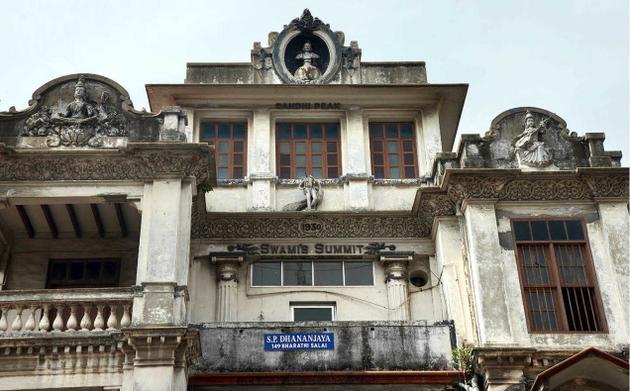
On invitation from Pasumpon Muthuramalinga Thevar, the then leader of the All India Forward Bloc, to amass support for the party, Bose went to Madurai. He came to Madras en route. He reportedly stayed for three days at ‘Gandhi Peak’ on Bharathi Salai, Triplicane.

A view of ‘Gandhi Peak’ on Bharathi Salai at Triplicane in Chennai.—Photo: K.V. Srinivasan

“Bose arrived by train at Madras Central. He was received by his supporters, and lawyer and freedom fighter S. Srinivasa Iyengar and Pasumpon Muthuramalinga Thevar. He was taken in an open jeep to the ‘Peak,’ the palatial house of civil engineer S.P. Aiyaswami Mudaliar, followed by a mammoth crowd of supporters,” S.P. Dhananjaya, the grandson of Mudaliar, said.

Earlier, S. Satyamurti, eminent freedom fighter, had issued a directive to Congressmen to boycott Bose, as he had a difference of opinion with Mahatma Gandhi. Mudaliar agreed to accommodate Bose at his home at the request of zamindar of Puliyur, Janakiram Pillai. He stayed in a room on the third floor.

In those days, the house was called as ‘Maniadikura Veedu’ (the house where the bell rings). The front portion of the house had a gong, which used to strike hourly for the benefit of residents around the ‘Peak.’ Once the hourly striking of the gong disturbed Bose’s meditation. He objected to this practice. Mudaliar refused to oblige Bose, saying the routine practices of the house could not be changed.

On the evening of September 3, Bose addressed a public meeting on the Marina. The meeting drew a crowd of more than a thousand people. The news of the Second World War had reached Madras. Bose announced the invasion of Poland by Germany and subsequent declarations of war on Germany by U.K..

On September 5, 1939, he left for Madurai. During his three-day stay, people thronged in large numbers to get a glimpse of the charismatic leader, and were jostling for space in front of the ‘Peak.’ Banners welcoming the ‘Lion of Bengal’ were put up on each floor of the home.

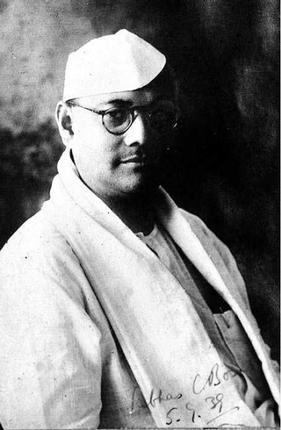
The spacious home was illuminated like a palace, he noted. An autographed photograph of Bose dated September 5, 1939, a prized possession, remains with the family.

BoseAutographCF05sept2015

The ‘Gandhi Peak’ saw yet another visit by Bose on January 10 and 11, 1940.

The proof for this is recorded in an account notebook maintained by his grandmother Dhanammal, wife of Mudaliar.

source: http://www.thehindu.com / The Hindu / Home> News> Cities> Chennai / by Atul Swaminathan / Chennai – September 05th, 2015

S Sarada centenary celebrated in city

Chennai :

Alumni, teachers and students of Kalakshetra Foundation marked the 100th birth anniversary of renowned scholar S Sarada at a programme on Tuesday. In a musical evening, artists recreated dance moves associated with S Sarada’s body of work. Friends too also shared their memories on stage.

Recalling Sarada as an ‘erudite scholar of Sanskrit’, Kalakshetra chairman N Gopalaswami, in his welcome address, said the scholar “was a true guru and force behind the choreography of Rukmini Devi Arundale’s dance productions.”

Calling her the ‘teacher of teachers’, G Sundari, who was Sarada’s friend, said: “She had no reservations while sharing her knowledge.” The audience was treated to the performances of veteran dancers Dr C V Chandrasekhar, V P Dhananjayan, C J Janardhanan and Balagopalan.

A song written by Sarada, expressing her admiration for Rukmini Devi, was also performed. Snippets of a documentary, once aired by Doordarshan showing Sarada explain aspects of dance theory, was also screened.

source: http://www.timesofindia.indiatimes.com / The Times of India / News Home> City> Chennai / TNN / September 02nd, 2015

Innovation, collaboration take centrestage

A new Japanese import is on the cards. The Chennai Corporation is planning to bring in advanced technology from Japan to improve the stormwater drain (SWD) network in the city. So far, management of stormwater drain network has only been partly effective.

Corporation engineers will be sent to Japan for a training programme, which would cover techniques to construct and manage SWDs effectively. The Chennai Corporation Council passed a resolution on Monday permitting engineers K. Chinnasamy and G. Tamilselvan to attend this programme.

Expenses for the training — which is from September 23 to December 5 — will be met by Japan International Co-operation Agency. The knowledge the engineers will acquire from this exercise is expected to be useful in the implementation of new projects in watersheds of waterways such Adyar and Cooum.

With the help of World Bank funding, work on SWDs will begin next month in zones such as Ambattur and Valasaravakkam. Designed with advanced technology, new SWDs are likely to reduce the displacement of people living along the banks of waterways and canals.

The work on construction of drains will prevent flooding of neighbourhoods in many of the added zones.

source: http://www.thehindu.com / The Hindu /Home> News> Cities> Chennai / by Aloysius Xavier Lopez / Chennai – September 06th, 2015

Ooty Varkey, snack from the hills, all set to get GI tag

Chennai  :

Ooty Varkey, the baked delicacy synonymous with the Nilgiris, is all set to get the prestigious Geographical Indications (GI) tag. A society of its manufacturers has recently submitted an application in the city GI registry seeking the tag.

India, as member of the WTO, enacted the GI Act in 1999 which came into effect in September 2003. The GI tag is given to a product to indicate its specific geographical location or point of origin. The tag ensures none other than those authorised are allowed to use the product name.

The popular snack, which traces its history to the Raj, is distinct to the Nilgiri district. It is made from a mixture of flour, sugar, salt and mava (a mix of home-made yeast comprising banana, rava or semolina, maida or flour, and sugar). It gets its distinct taste from the water used to prepare the mix and the climatic conditions of the Nilgiris. The varkey mix is baked in a firewood oven on moderate heat. The entire process, from preparing the dough mix to baking, takes around 12 hours. The product, which has a sweet and spicy variant, has to be consumed within 20 days.

According to the application submitted by the Ooty Varkey Producers Welfare Association, the British, who had been residing in the Nilgiris, made their own snacks which included mostly biscuits, cakes and cookies. A new snack, similar to a cookie, was made in Ooty. The British ate this new cookie with their tea.

After Independence, the product became an important item in the bakeries of Ooty, Coonoor, Kothagiri, Manjoor and Gudalur. The production and sales also increased substantially.

“In spite of attempts made by the bakeries down in plains, the varkey made in those places does not have the same taste,” the application said adding, “over the years its popularity has been growing from domestic and foreign tourists.”

The popular snack, which originated during the Raj, is made from a mixture of flour, sugar, salt and mava. The Ooty Varkey gets its taste from the water used to prepare the mix and the climate in the Nilgiris.

source: http://www.timesofindia.indiatimes.com / The Times of India / News Home> City> Chennai / by Manish Raj, TNN / August 31st, 2015

A Concoction of Contradictions

Yuvan Bothysathuvar | R SATISH BABU

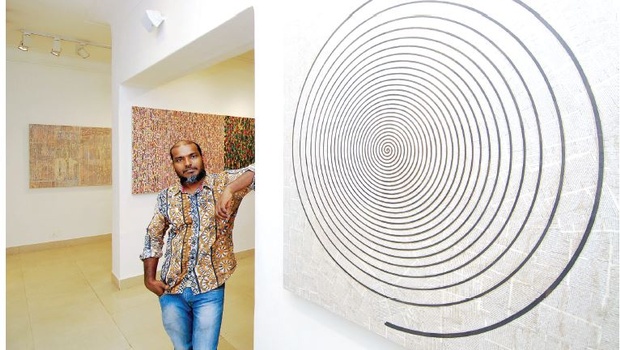
Life is full of illusions, which in turn keep its stark realities cloaked under their convincing garb,” muses Chennai-based mixed media artist Yuvan Bothysathuvar as he shows us around at his ongoing solo show ‘Shifting Paradigms: Learning From Life’ at Gallery Veda in Chennai.

The 40-year-old, who gave up pigments and the canvas for mixed media eight years ago, believes only an artist could break these illusions and remind humanity of life’s true nature through novel mediums of expression.

In his recent body of art, Yuvan marries Papier Colle with geometric abstraction and creates a unique visual rhetoric to depict the different faces of life.

“There is something magical about paper and the printed word. Rough or glossy, blazingly white or dirty, paper comes with a range of colours, tones and crisp. A blend of these elements gives my works an intriguing look,” he says.

Little black letters indeed speak out in ‘Ripple’, a 96”X96” work done on eight panels of plywood. Coiled over a backdrop of soiled printed paper is a huge ripple made of thinly cut magazine strips. It is not just the contrasting tones of both the papers that make the work eye-catchy but also appearances of smaller ripples that fuse with the troughs and crests of the bigger one.

“The ripple symbolises the disturbances that plague our life. One moment there is calm and then something, whether in the form of social, political or economical tumult pierces through our composure, just the way a pebble disturbs water,” summarises Yuvan.

Although pregnant with meaning, Yuvan’s works are evenly catchy and loaded with colours as the artist believes his priority is to make his work visually pleasant rather than preachy. “Even if your art depicts the true horrors of a war, what is the use when its goriness repels people,” he says.

A native of Tiruvannamalai, Yuvan begun his stint in art by painting portraits for a banner company in 1992.  Although he later moved to Chennai to pursue his graduation and post-graduation in Visual Communication from the Government College of Fine Arts, Chennai, it wasn’t until 2007 that he discovered a wider vista in mixed media.

A former researcher at Chennai’s Lalit Kala Akademi, Yuvan uses optical illusion as a symbol in his work ‘Grass Is Greener on the Other Side’, to show the difference between deception and reality. The work, comprising a twin set of square boards plastered with colourful strips of paper, looks like a spray of confetti from a distance, but appears to be alternate pairs of green and red squares when seen from the corners.

“The squares show how coloured our judgment would be if we do not see a thing from both the sides. The same faulty perception makes us envious towards others, even though nature has invested the same qualities in us,” Yuvan says.

The artist addresses the transiency of life in his work ‘Wall’ (90”X41”) which he has made by leaving hazy imprints of freshly painted posters on plywood board. “Even though the images are residue of the original painting, the reality is they have replaced the latter, just like one generation is subbed by another,” he explains.

Besides, paper which he procures from second hand book shops, the artist uses materials like threads, mirrors, jute, turmeric, beads, stainless steel and different types of stones to articulate his concepts.

Honoured with the ‘Emerging Artist of the Year’ award as Part of ‘Glenfiddich’ Artist in residence programme in Scotland, 2013, Yuvan recently won the CIMA Merit Award 2015 in Kolkata.

Currently improvising on his concepts for the Papier Colle Collection, Yuvan says giving them form is a daunting task. From sorting out the papers to manually cutting (or tearing) them into several dimensions to gluing them to shape takes him from three weeks to one-and-a-half months to achieve.

But the labour pays off eventually. “It does, not when people buy my works, but when they fall in love with them. To them I don’t have to explain my concepts because deep within I know they have found their own meanings and that’s what makes me happy,” he adds.

source: http://www.newindianexpress.com / The New Indian Express / Home> Magazine / by Samhat Mohapatra / August 29th, 2015

GKD School wins CIT Young Mind Quiz held in Coimbatore

Coimbatore :

They have won several quiz contests, but it hurt them when they lost at the Young Mind IT Quiz in 2014. The team from G K D Matriculation School in Periyanaickenpalayam here returned with the intention to win the contest this year. And, they did it.

M Sharat Chandar and A S Hari Krishna became the champions of the Young Mind IT Quiz 2015 that was organized by Coimbatore Institute of Technology on Monday.

After competing with more than 400 teams across the state, the GKD Matriculation Higher Secondary School made it to the finals only to clash against the former champions from Vivekananda Vidyalaya in Chennai.

“I think the G K D team was well prepared. It reflected in the way they were shooting their answers for every question,” said the quiz master Giri Balasubramaniam.

“There was no specific strategy as such. We wanted play the game as usual,” said M Sharat Chandar. The team said that this quiz was easier for them because they prepared for another IT Quiz a few days ago.

The team won the quiz scoring 70 points in the five rounds of the finals. While the GKD team had strategically claimed their win before the final round ended, the fight for the runners up became closer between St Jude’s, Kotagiri and Vivekananda Vidyalaya. However, by the end of the final round, both teams managed to score 40 points each, and the quiz master called for a tie breaker.

Unfortunately, the St Jude’s team pressed the buzzer with excitement, but got the answer wrong, making Vivekananda Vidyalaya the runners up of the quiz.

The winners of the contest were awarded a trophy and an iPad each. All other participants were given a trophy and a tablet.

source: http://www.timesofindia.indiatimes.com / The Times of India / News Home> City> Coimbatore / by Adarsh Jain, TNN / August 31st, 2015

Longest Running Movie in South Wins Hearts Across the Globe

Sivaji in a still from Veerapandiya Kattabomman

Chennai  :

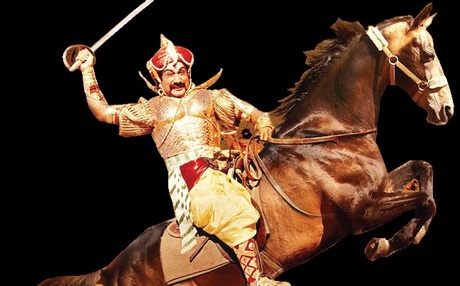
In popular film lore, it is said that the legend of Veerapandiya Kattabomman, the Palayakarrar chieftain who was hanged by the British in 1799, has lived on due to late Tamil thespian Sivaji Ganesan’s powerful portrayal of the warrior in the 1959 biopic.

Such has been Sivaji’s screen magic that the film Veerapandiya Kattabomman continues to draw fans in droves 56 years after it first hit the screens. On Friday, when the movie was re-released, his fans distributed sweets, burst crackers and performed aarthi to a cut out of the actor at a theatre here.

At Shanthi Theatre, owned by the actor’s family, people from all walks of life turned up to watch their beloved hero in one of his eternal roles one more time. Every time Sivaji appeared on screen, loud cheers rent the air with most fans giving him a standing ovation and screaming, ‘Tamil Naatin Singame, Thalaivaa…’ Among them was Pappaiyaa, who had lost vision 12 years ago after acid spilled on his eyes. “I’ve been a fan of Sivaji since 1975. I have watched this film scores of times but I love it so much that I will keep coming to the theatres. All I have to do is listen to the dialogues as I remember the scenes vividly,” he said. In 1959, when the film was first released, it was on 35mm and had mono-sound. It has been converted to cinemascope with 5.1 surround system.

However, the film is not only restricted to the love and respect of the viewers in India. It was won hearts across the globe.

“Vijayalakshmi Pandit, the sister of then Prime Minister Jawaharlal Nehru, inaugurated its screening at the Tamil Sangam in London. This is the only Indian film to have won Afro-Asian awards in three categories—best acting, best music and best film in 1960,” said V Srinivasan, the vice president of Nadigar Thilagam Sivaji Samooga Nala Peravai. The film was a silver jubilee hit in 1959 when it first released, running for over 175 days. “Interestingly, this film impressed audiences in Egypt too which had been a British colony and needless to say, it was a hit there too,” said Srinivasan.

Legendary Leader of Tamil Nadu

Veerapandiya Kattabomman, the 18th century Palayakarrar chieftain of Tamil Nadu, was one of the earliest warriors to oppose the British rule in south India. Even before the historic War of Independence could pick up its pace in the northern part of the country, Kattabomman had already sounded his war bugle against the Britishers. Although he fought valiantly, he was betrayed by a supporter and was eventually captured by the enemy. Kayatharu, the place where he was executed in 1799, has become a place of political pilgrimage. Centuries after his death, many folklores and folk songs that praise the valour of the brave man continue to be a part of Tamil Nadu’s culture.

source: http://www.newindianexpress.com / The New Indian Express / Home> The Sunday Standard / by Manigandan K R / August 23rd, 2015

Don’t know how to wear a sari? Expert help is at hand in Coimbatore

Coimbatore :

Renuka Mohanraj, an independent upcoming beautician, is fully booked for all the ‘muhurtham’ dates up to November. Not all of them are by brides, but include friends, relatives and cousins of the new to-be-wedded couples. Here’s the catch — the main service in demand is for draping saris.

“People prefer us independent beauticians for draping saris as against the new parlours that have been popping up all around,” she says. “Most youngsters otherwise prefer the more fancy salons for hair blow-drying, straightening, styling and make-up.”

With a growing population of women in their twenties and thirties not knowing how to wear sari by themselves, this is fast turning into a specialized service, even in the non-bridal beauty service segment. Once considered a basic skill of most Indian women above the age of 21, a neat sari drape is now considered a “work of art”.

“Now women are particular about how thin or endowed the sari makes them look and they do not want to experiment by trying it themselves,” says another independent beautician, Omana Thomas. “Especially, with heavy saris like kanchivaram, benarasi, organzas or even heavily-embroidered Georgettes. They don’t mind spending a few thousands on it,” she says.

As a result, sari draping has become a lucrative service on offer by beauty parlours and beauticians. A sari draped according to the classic Indian style, which is a 20-minute job, costs anywhere between Rs200 to Rs600.

“A decade ago, women close to the couple used to call us mainly for hair and make-up. Only clients studying in colleges or still unmarried used to request help with their saris or request a drape as an additional service,” says Thomas. “However, now this is the main service requested by even married women in their late twenties. Hair and make-up have become side services,” she says.

Sari draping experts and old-timers say this change in trend can be attributed to changing lifestyles and fashion patterns. “Two decades ago, women used to wear saris everyday to college. It slowly changed to salwar suits, kurtas and kurtis,” says designer Aparna Venkatesh. “Besides farewell, graduation day, ethnic day and friends’ weddings, the sari is hardly worn,” she adds.

This has also led to sari draping classes cropping up across not just across the city, but the country too. “While some offer it as a separate one-day course, some offer it as part of personal grooming classes,” said Kavita Ramesh, who used to organize personal grooming workshops for young women twice a year.

Meena Krishnakumar, one of the most popular sari draping teachers in Coimbatore, says she gets at least 15 to 18 students a month. “A majority of students are girls who come to me just after their wedding date is fixed and their mother-in-laws have asked them about their sari tying abilities. There are also the newly appointed college lecturers and students of colleges who insist on wearing sari once a week,” she said.

However, Meena doubts that her classes will ever create a dent in the demand for professional sari drapers. “Sari draping requires regular practice because you need to learn to drape different types of fabrics to your shape and size. Just attending a two-hour session and then trying it for a function three months later will not work,” she says. “Regularly wearing a sari is almost impossible now,” she adds

Once considered a basic skill of most Indian women above the age of 21, a neat sari drape is now considered a “work of art”.

source: http://www.timesofindia.indiatimes.com / The Times of India / News Home> City> Coimbatore / by Pratiksha Ramkumar, TNN / August 30th, 2015

Clinic launches initiative to help women diabetics

Chennai :

Women are prone to diabetes at every stage of their life, so a community-based approach is needed to help woman patients understand the disease, said endocrinologist Dr Usha Sriram of ACEER clinic.

The clinic on Saturday launched ‘Women2Women’, an initiative by women for women to address the rising epidemic of diabetes in India. “Diabetes in women is different, difficult, neglected and on the rise. Women are particularly more vulnerable to more complications and a shorter lifespan,” said the doctor. The premise of the initiative is that women are great change agents as they are able to share, communicate, support and nurture, she added.

About 100 women diabetologists and physicians from across the country will be trained in capacity building and will come together for physician training, review of educational material and launch of tools and portals for community empowerment. The first phase of the programme is designed to reach 2,500 women physicians across the country and 50 lakh women in the community.

The highlight of this programme is the community education approach to prevent and manage diabetes.

The doctor pointed out that this is the first time that a coalition of women endocrinologists and diabetologists are coming together to focus on how to reach women for better health outcomes. Actor Radhika Sarathkumar and Dr Sr Jasintha Quadras, principal Stella Maris College were present at the launch.

source: http://www.timesofindia.indiatimes.com / The Times of India / News Home> City> Chennai / TNN / August 30th, 2015