The corridors of a 200-year-old house, the grounds of an equestrian centre, and on Friday, a stretch of the Adyar River… designers in Chennai want to make sure it’s not just their clothes that are couture, but their catwalks as well.
Under floodlights, the Adyar River beneath their feet, models and mannequins were poised on boats in resplendent Moroccan-inspired outfits designed by Fibin-Imaad as they were ferried across a 250-metre stretch of water, for a first of its kind fashion show in the city.
“The trend in fashion these days is sports and we thought we would incorporate that idea into our show,” says Fibin, who showcased his clothes against the river, with help from Madras Boat Club which provided the boats and rowers. “Our clothes are avant-garde and so we figured that doing a show at a venue that was just as original was the perfect way to showcase our line,” adds Fibin.
Around the globe, unusual venues are quite in vogue among designers — cobble-stoned streets turned to catwalks recently at fashion capital Milan, for instance. Now some Chennai designers too seem to have taken a fancy to the idea.
A few weeks ago, it was well-known designer Vivek Karunakaran, who gave the term dressage a whole new meaning when he used an equestrian centre as a backdrop to photograph his formal men’s wear line ‘Seabiscuit’ themed after the 2003 English movie of the same name.
“The shoot for the collection was done at the Chennai Equitation Centre at Old Mahabalipuram Road and now I am planning to sequel it with a fashion show for the same line at the centre. Just having the models walk with horses, with a stable in the background, I feel it is the perfect venue for a show on the line,” says Karunakaran. Earlier in April this year, he had curated a show at a hotel in the city where the entire space from the lobby to the bar, coffee shop and terrace were used to create a seamless catwalk. “We had models start at the coffee shop and walk through all the spots showcasing the outfits with guests on either side of the catwalk. It was a continuous catwalk with TV screens relaying what was happening at each of the sub-venues,” says Karunakaran.
Designer Sandeep Ravi of Studio 9696 similarly debuted his collection this March at the 200-year-old Luz House with actors Taapsee, Sanchita Shetty and Bharath walking through the corridors, rooms and stairways of the heritage building. “We placed a long red carpet along the centre of the rooms and corridors of Luz House for the models to walk on, as guests stood on either side,” says Ravi. “Luz House was perfect – the entire structure is stunning and we didn’t even need artificial lighting, the natural light that flowed in was unbeatable,” he adds.
“We wanted our show to be more of an experience. Most fashion shows are held at hotels or halls and the whole thing feels run of the mill and boring. For our debut, we wanted to make an impression. While we knew our collection would wow, we wanted a venue that would keep up, one that people would remember and talk about for days after. And Luz House delivered,” adds Ravi, who has other out of the box venues lined up for future shows.
source: http://www.timesofindia.indiatimes.com / The Times of India / News Home> City> Chennai / by Kamini Mathai, TNN / August 29th, 2015
A city has several awe-inspiring sights, but a village too is not far behind, as a group of more than 200 college students learnt on Sunday. The students, who had gone on a ‘heritage walk’ to a small village in Madurai, were amazed by the richness of tradition and the diversity of cultural practices in the hamlet.
Thenoor, about 12km from Madurai, is around 200 years old and believes itself to be under the control of Lord Sundarajaperumal, the deity of Alagarkoil.
Children beat drums in the background as the group, which included historians and scholars, walked around the villages, admiring its ancient structures. They visited the Sundaram temple, Perumal temple and Sivan temple.
The village is known for its ‘vetrilai’ or betel leaves, which the people grow in large numbers to offer to Lord Sundarajaperumal.
Special performances were arranged for the visitors, including folk dances like ‘kollattam’ and ‘kummi’ performed by village girls dressed in traditional attire.
In an interesting competition, the men in the village are required to prove their eligibility for marriage by lifting a heavy stone. The competition, called the Ilavattakal, drew many spectators on Sunday.
Some of the students became so enthusiastic that they soon began to cheer for the participants.
The villagers played traditional games like uriadithal, pambaram, gilli, pacha kudirai and kabbadi. Some of the older members took part in games like vidukathaigal (riddle-telling) and proverb-telling.
The trip was organised by the Dhan Foundation. The group was also treated to glasses of ‘kool’, a preparation made out of millets that some of them had not even heard of.
source: http://www.timesofindia.indiatimes.com / The Times of India / News Home> City> Madurai / by Karishma Ravindran, TNN / August 10th, 2015
Four inscriptions belonging to different historical periods have been found at an ancient temple in a dilapidated condition at Alamelumangalam, a remote village off the Tiruchi-Musiri Road, by research scholars of Dr. M. Rajamanikkanar Centre for Historical Research, Tiruchi.
The inscriptions split into fragments apparently during renovations taken up in the past were found during an explorative study undertaken by R. Akila, assistant professor, Arignar Anna Government Arts College, Musiri, along with two K. Kasturi and S. Sridevi, postgraduate history students of the college.
Ms. Kasturi’s brother, K. Sarankumar, a schoolboy, had sounded out her sister on the existence of a dilapidated temple in the village. Ancient sculptures were found at the temple, referred to as Varadaraja Perumal Temple by local people, according to R. Kalaikkovan, Director, Dr. M. Rajamanikkanar Centre for Historical Research.
In a press release, Dr. Kalaikovan said large size icons of Vishnu and his consort Sridevi, which were once inside the temple, have now been kept under a thatched shed, a makeshift arrangement made by a local resident A. Ramasamy.
The dilapidated temple at present has a vimana without upper structures and two mandapas in front. The larger pillared mandapa in the front has a raised platform on its northwest housing two sculptures of Vishnu of medium size and an icon of Naga. The mukha mandapa was empty, he said.
M. Nalini, Head, Department of History, Seethalakshimi Ramasamy College, who verified the inscriptions found at the temple, said that two records of 14th century split into several fragments were identified at the bases of two mandapas and the vimana and one of them reveals the gift of a fertile land to the temple towards its worship and offerings by the sabha of a certain Brahmin settlement. The inscription provides a list of signatories who were members of the sabha.
The other inscription throws light on a processional deity and the endowment of dry land towards its worship made by a group of people. Another inscription of 18th century copied from the door jamb of the larger mandapa registers the gift of a land by Vedanayaka Nambi. The purpose of the gift was not known.
A later Pandya inscription copied from a pillar of the same mandapa introduces Kailayamudaian Anjataperumal who probably was behind the construction of the mandapa.
The inscriptions split into fragments were found during an explorative study
source: http://www.thehindu.com / The Hindu / Home> News> Cities> Tiruchirapalli / by Special Correspondent / Tiruchi – August 28th, 2015
The fibre paintings depicting the history of freedom fighter Veerapandiya Kattabomman at his memorial in Kayathar has become a crowd-puller.
After the Kattabomman memorial was opened by Chief Minister Jayalalithaa on June 18 last, over 200 tourists visit this place every day and the number goes up during holidays.
To add more colour to the memorial, two mega fibre paintings depicting the coronation of Kattabomman and a hare chasing the hound near Kattabomman’s fort at Paanchaalankurichi have been kept.
source: http://www.thehindu.com / The Hindu / Home> National> TamilNadu / by Special Correspondent / Tuticorin – August 28th, 2015
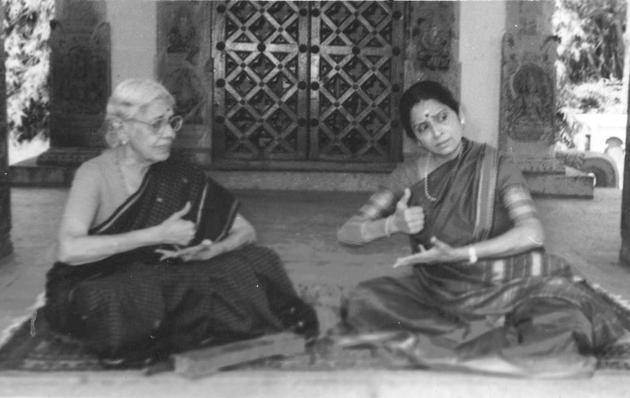
S. Sarada of Kalakshetra.(1915-2009) with student Kala Ramesh Rao. Photos: Special Arrangement. / The Hindu
A photographic memory and compassion were the hallmarks of Periya Sarada teacher’s personality.
The image slowly pixelates on the mind screen. Like a million small pieces of information gleaned from memory, reflection, direct experience and nostalgia, each molecule falls into place on the large canvas of history. What we see is a giant portrait – of a savant, scholar, musician, student, life-long seeker, psychological salve, cultural archaeologist and a life-long loyalist to the cause of Theosophy and the vision of Kalakshetra.
S. Sarada, (Periya Sarada teacher -(1915-2015) was a shadow. Not invisible, but more like a clear silhouette, a visible presence whose mind proved a perfect catalyst to Rukmini Devi’s dazzling imagination. The founding of Kalakshetra in 1936 attracted many great minds – Tiger Varadachariar, Budalur Krishnamurthy Sastrigal, Mylapore Gowri Ammal, Mysore Vasudevachariar and Karaikudi Sambasiva Iyer. But one young woman became the pillar of the institution. She was 24 years old when she joined and became such an integral part of Kalakshetra that Rukmini Devi herself acknowledged that “Srimati S. Sarada is my right hand and a rare embodiment of knowledge, devotion and artistic ability.”
Born on September 1, 1915, in Thanjavur, Periya Sarada teacher was initiated into learning Sanskrit, Carnatic music – vocal and instrumental – and Advaita philosophy by her grandfather and parents. The density of the Yoga Vasishta, the sweep of Kalidasa’s writings and the commentaries of great teachers such as Sankara, Ramanuja and Madhava comprised her daily reading. Lightning struck when she watched Rukmini Devi at the Madras Music Academy’s general session in 1934. “I was stunned by her striking personality,” she confesses in her book, ‘Kalakshetra-Rumini Devi.’ She continues, “Rukmini Devi had come to witness a dance performance and I was watching Rukmini Devi.” The very next year, Rukmini Devi performed for the Diamond Jubilee of the Theosophical Society and S. Sarada’s initial fascination deepened.
Rukmini Devi’s charisma and demeanour created an aura that the young Sarada wanted to be close to. The opportunity came when her grandfather Pandit Subramania Sastri came to work at the Adyar Library in 1939. His grand daughter accompanied him and was suddenly thrust into the cosmopolitan society of Madras – the vibrant Theosophical movement.
When Rukmini Devi invited S. Sarada to attend one of her dance rehearsals in 1939, she was so inspired that she began writing down the notations for the choreography of the dance, ‘Ananda Natana Prakasam.’ Her knowledge of music and Sanskrit came to her aid while she wrote down each line of the choreography with meanings and the sketches of line drawings to reflect the choreography. Rukmini Devi was initially skeptical but looking at the exact notation of each swara and tala pattern that Sarada had painstakingly written down impressed her. The notation system is still followed in Kalakshetra.
With Rukmini Devi becoming increasingly busy with education, craft revival and attending the Rajya Sabha sessions in New Delhi, it was Periya Sarada teacher who conducted the long rehearsals in Kalakshetra, Chennai. The students and dancers looked forward to her keen eye and unflagging patience. A photographic memory and all encompassing compassion were the hallmarks of S. Sarada’s personality. She was the link between the text and the dancer. Every word, every line and every mood was explained in several ways to the eager students. Even the musicians were in awe of her knowledge. Her tiny room in Kalakshetra, next to Rukmini Devi’s, was always filled with her tiny frame and numerous books and papers. Students lined up to talk to her, ask questions and interpretations for some words in a particular dance. S. Sarada was also a fascinating story teller, who kept children glued under the Adyar banyan tree for hours while grateful parents completed their chores.
Looking back, one can confidently state that without the patient and dedicated erudition of S. Sarada, Rukmini Devi would have never been able to complete her iconic Ramayana Natya series. One image remains in my memory since 1973. A Post Graduate student at Kalakshetra, I was being taught by Neila Sathyalingam, Sarada Hoffman and N.S. Jayalakshmi. After class, we would all stagger out of the thatched huts and slowly make our way to the exit. Passing by the main theatre, some of us would stop silently and peer through the cane and bamboo divider. It was there that I saw Periya Sarada teacher seated, surrounded by books and papers, in Sanskrit and Tamil, strewn on her lap and her slender body leaning towards Rukmini Devi.
Through the trellis, I saw dancers Krishnaveni, Janardhanan, Kunhiraman and Balagopal standing quietly on stage, waiting for instructions. Atthai would tilt her head towards Periya Sarada teacher who would be pouring multiple interpretations of the Sanskrit text into Atthai’s fertile mind. At times, Atthai’s voice was sharp, almost a reprimand, but never did Periya Sarada teacher raise hers. When dancers were reduced to tears by some remark from Atthai, it was Sarada who applied the emotional salve to their young wounds. She was a life coach, helping students, guiding the teachers, creating the teaching syllabus, drafting the classes for dance theory and history and being the ‘asthana vidwan’ under the banyan tree.
How could such a slender frame accommodate so much brilliance? How could her patience and energy never flag for decades?
Periya Sarada teacher could explain each word or line of a poetic text from the Gita Govindam or a rare Tamil kriti for hours. She could provide endless explanations for each word, thus opening up the possibilities of young minds that flocked to her after class hours. Her hour-long explanation in one of my classes (a surprise rare visit) on the first line of the iconic varnam ‘Roopamu Joochi’ is indelibly etched in my mind. Even today I remember her slender fingers opening out into an ‘alapadma’ to depict the idea of beauty and grace!
Erudition, patience, dedication, compassion, humility, fierce focus and endless thirst for knowledge – these were the words that appeared and re-appeared in the various articles that I edited for the volume ‘Nirmalam’ on her 90th birthday in 2005. Every writer, Yamini Krishnamurthy, C.V. Chandrasekhar, Dhananjayans, Janardhanan, Katherine Kunhiraman, Leela Samson, C.K. Balagopal and others stressed that Kalakshetra’s choreographic treasures would never have been created and preserved without Periya Sarada’s meticulous notations and enormous generosity towards Rukmini Devi’s vision for the arts.
My time in Kalakshetra was brief and although I was interested in dance theory and international dance history (I was already an English Literature Graduate from Madras University), I never got a chance to study under Periya Sarada teacher. She was already steeped in the research and creation of the Dasavatara Natya series for Kalakshetra. She did, however, find the time to read my papers which were forwarded to her by Neila Sathyalingam. She added her appreciation on the pages in her neat flawless writing. She also attended two of my performances – in 1978 and 1996. On both occasions, she came back stage, embraced me and stroked my face saying, “Your abhinaya is very good.”
In 1985, Sarada teacher was cruelly dismissed from service during the Government of India take over of Kalakshetra. Devoid of pension, retirement income or any means of existence, she was nurtured until her last days by her faithful companion and friend since 1939 – G. Sundari.
The technology of the present day – You Tube, Instagram, live streaming, Facebook – while distracting – may have kept her legacy and thoughts alive in multiple ways.
Today, her contribution remains a gentle memory for those who were fortunate to study and catch a sliver of her fecund mind.
In her final days, she sat silent and listless on her wheel chair, gazing into the green vistas of the Theosophical Society which was her home. Dimmed eyesight, a saddened spirit and almost forgotten by the new generation of students and teachers in Kalakshetra, Periya Sarada teacher held her disappointment and ache within her frail body. As much as she adored and admired Rukmini Devi’s pioneering vision for the arts, Sarada was estranged from her idol when she was one of the signatories who aligned against Atthai in a legal issue. S. Sarada maintained that the institution was always larger than the individual. Towards the end of her days, Rukmini Devi and S. Sarada settled their differences but this chasm was heard like a thunderbolt throughout the dance world and stunned all of us.
Her passing on November 4, 2009, was akin to the felling of an ageless tree. In knowledge Periya Sarada teacher gave shade like a Banyan, in scholarship she towered above all like a Redwood and in grace she healed like a Neem.
Her final breath came amidst the verdant Theosophical Society, whose most devout student has left generations of dance and music students enriched and blessed with her singular personality.
September 1 marks the birth centenary of Periya Saradha teacher. The students of Kalakshetra will present a special musical homage at Rukmini Arangham, 6.30 p.m.
CHENNAI: Danseuse and cultural activist Anita Ratnam at the Crossword bookstore, T.Nagar, in Chennai on October 25, 2006. Photo: R. Shivaji Rao
(The writer, performer-arts entrepreneur, The writer was a Kalakshetra student. She has published a book on S. Sarada’s life. She may be contacted at anitaratnam@yahoo.com; @aratnam)
source: http://www.thehindu.com / The Hindu / Home> Features> Friday Review> Dance / by Anita Ratnam / August 27th, 2015
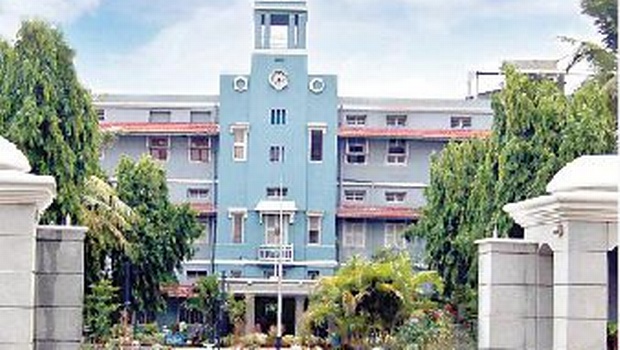
In a bid to increase public awareness of cervical cancer, considered to be the most common cancer among women in India, the Christian Medical College is hosting the Sixth Asia Oceania Conference on Genital Infections and Neoplasia (AOGIN) from August 27 to 29 at its campus.
The theme this year is “HPV infection and HPV related cancers”. There will be five concurrent workshops on the first day on Colposcopy, Community Screening, HPV detection, Cytopathology and Research Methods. In the evening, there will be a public meeting on measures adopted to increase awareness of cervical cancer, its prevention and treatment. This will be followed by the AOGIN-India Presidential Oration by Professor Shalini Rajaram from New Delhi.
Over 15 international universities’ faculty members and over 50 national universities’ faculty members will be taking part. There will be lectures, debates, panel discussions and video presentations. The topics covered will be basic science of HPV, vaccination, screening for pre-cancer and treatment of cancer of the cervix, vulva, vagina, anus and oropharynx. The conference will end with a round table discussion on “Collaborations and linkages to tackle cervical cancer”.
It is hoped that the conference will increase public awareness, stimulate young doctors, galvanise NGOs and increase leverage with the government to take preventive steps to fight cervical cancer in India.
source: http://www.newindianexpress.com / The New Indian Express / Home> States> TamilNadu / by Express News Service / August 27th, 2015
The Department of Library Services, Christian Medical College conducted a regional workshop on ‘Scientific Writing’ in collaboration with the University of Madras to enhance communication skills.
Dr. Amudavalli, Head of Library and Information Science Department, University of Madras, in her opening address titled “Introduction to Scientific Writing” emphasized the importance of communication and presentation skills. She said reading books enhanced writing skills and said despite advancements in technology, there is no replacement for books and newspapers.
This reinforces the larger role that librarians have to play in information transfer. The librarian provides personalised service to users, she said.
Professor Dr. Nagaraj Sitaram, from Dayanand Sagar College of Engineering, Bengaluru, presented an informative session titled “Preparation and Presentations of Research Proposals” and dealt with the dos and don’ts in research preparation and proposals. He addressed the elementary principles beginning with identification of the problem, composition, organisation, precision and fluidity in writing to support scientific findings in order to be published.
Dr. K.P. Vijayakumar, a professor from the University of Kerala in his topic on “Research Report Writing” emphasized efficient writing skills through experts sharing their views and experiences on the essentials of scientific writing. Dr. V Chandrakumar, University of Madras spoke on Reference Management.
There were about 90 delegates from Tamil Nadu, Kerala, Andhra Pradesh, Karnataka and Puducherry
source: http://www.newindianexpress.com / The New Indian Express / Home> States> TamilNadu / by Express News Service / August 27th, 2015
The Centre has given the go-ahead for the state to convert Adyar Cancer In stitute into a centre of excellence and a State Cancer Centre.
Announcing this in the assembly, chief minister J Jayalalithaa took credit for the upgrading of the institute and praised it for the good work it has been doing to treat cancer patients for many years. She said the institute would be upgraded at a cost of `120 crore.
The chief minister had in a 2013 letter to then Prime Minister Manmohan Singh sought that the institute be upgraded.
“A proposal for upgrading the centre as a national centre is pending with the Union ministry of health and family welfare and it may be approved to enable it to expand and strengthen its capacity to treat cancer patients in larger numbers,” Jayalalithaa had stated. In a statement in the assembly on Tuesday, Jayalalithaa said, “The Centre has accepted the request to make the cancer institute a centre for excellence. It will be [done] at a cost of Rs 120 crore.”
The state will also provide mammography equipment to 15 district government hospitals at a cost of Rs 2.25 crore, she said.
Thanking the chief minister, Adyar Cancer Institute chairperson Dr V Shanta said the institute will spend the funds allocated to it over a period of 10 years. “It can be used only for purchase of equipment and construction of buildings,” she said. “We cannot use the funds for maintenance or to increase salaries of our employees. It is great honour that our work has been recognised.”
Stating that the cancer institute is a leader in its field, Dr Shanta said it could play a leadership role for all cancer treatment centres in the state.
“It is my dream to assume a leadership role and coordinate the screening and prevention measures being done by various centres in districts. As a nodal agency we will be able to collate data collected from these centres and analyse it,” Dr Shanta said.
source: http://www.timesofindia.indiatimes.com / The Times of India / News Home> City> Chennai / by B. Sivakumar, TNN / August 26th, 2015
It is rather typical of several Mylaporeans to pride themselves on the fact that their area has two streets named after John F. Kennedy. Sadly for them, Kennedy Streets 1 and 2 have nothing to do with the President of the U.S. who was assassinated on November 22, 1963 at Dallas, Texas. For that matter, these narrow thoroughfares that connect Luz Church and Musiri Subramania Iyer (Oliver) Roads do not even commemorate any other Kennedy. The two lanes are actually a throwback to the not-so-distant pastoral past of our city. Names recalling that verdant history abound — Ayanpuram (now Ayyanavaram) — the hamlet of cowherds, and Mandaiveli — pastureland, are two such examples. The Kennedy Streets are part of the same heritage.
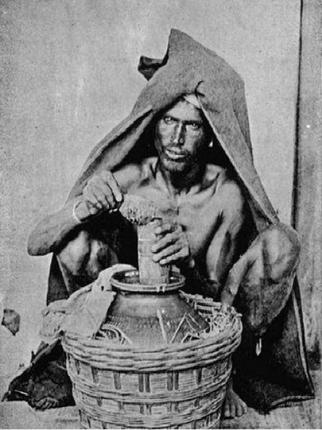
They are both Kannadian Streets and commemorate a community of curd-sellers who, as the name suggests, were Kannada speaking. This sub-grouping among Lingayats had some distinctive trade practices — they carried on their heads a woven basket in which was a mud pot that contained the curds. The whole ensemble was covered with a thick black woollen blanket, no matter what the season of the year was. Setting out early in the morning, they would cover all the streets, shouting alternately ‘thayiroooo’ (thayir is Tamil for curds) and its Telugu equivalent — ‘perugu’. Given the blanket and the weird cries, mothers conveniently used them to scare their kids into submission.
Edgar Thurston (1855-1935), the anthropologist, studied the community very closely and devoted several pages to them in his Castes and Tribes of Southern India, a book he wrote with K. Rangachari and published in 1909. As per this work, which also has a photograph of a Kannadian, the tribe was to be found in plenty, numbering 4,000-strong around the Chembarambakkam Tank and in Kanchipuram District. It does not mention the Mylapore settlement. The authors trace the community’s arrival in the Madras area to the 17th Century.
That was when the Lingayats had revolted against the Mysore king, Chikka Deva Raya and were ruthlessly suppressed. Those that survived took to a nomadic existence. In the 18th Century, which according to Thurston, was the most troublesome that India had seen, with armies “passing and re-passing the Ghats”, the Lingayats attached themselves to the troops, as purveyors of milk and butter. With peace, a large group settled outside Madras and came to be known as the Chingleput Lingayats.
Given the Tamil Brahmin’s affinity for curds, a group of Kannadians settled in the two lanes of Mylapore and catered to the local market there. Carrying the curds balanced on two pots suspended across the shoulders or head led to the community being referred to as Kavadigas also. Their settlement in Mylapore too morphed with time — becoming Kunvadi and later Kannadi Street. From there to Kennedy was but a step. What happened to the Kannadians? Bottled (later sachet) milk must have driven them out of business. There is no trace of them and both streets are quiet residential localities today.
source: http://www.thehindu.com / The Hindu / Home> Featurer> MetroPlus / by Sriram V. / Chennai – August 14th, 2015
You might have spotted differently-abled people seeking alms. But have you ever come across any such person using the money so generated for charity? Meet 73-year-old R Selvaraj, who begs for a living but gainfully utilises the money by buying stationery for disadvantaged school students in the neighbourhood.
Selvaraj, a resident of Karunanidhi Nagar in Tamil Nadu, is polio-afflicted and has been a mendicant in the Karaikudi new bus stand since 2006 after he gave up his job as a cycle mechanic. “I’ve been helping disadvantaged students since 1968 after I witnessed children from poor families struggling to get educated due to financial problems. But only after 2006, when I could not get any job, I started imploring people for alms for the welfare of the students,” he said.
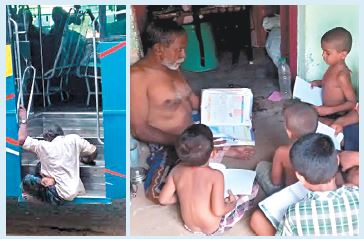
R Selvaraj boards a bus at the Karaikudi bus stand (left); he distributes notebooks to disadvantaged children
Selvaraj, however, added that he never appealed to anyone after telling them that he has been helping students. “I frequent buses on the Madurai, Tirupattur and other selected routes as I am unable to handle all the routes. I seek alms from each passenger. Sometimes they ignore me. Some donate as much as they can. Even if people ignore me, I never take it to heart,” he said, adding, “Though I board buses with difficultly, I do it for the children. If a student wants a bag, I try to get it and surprise him or her with it. When I do such an act, it gives me immense satisfaction.”
Through social media and by talking to people, he has got some benefactors. One such person from Chennai has been sending Rs 500 every month without fail for the last two years after learning about his service.
Selvaraj said he couldn’t recollect the number of students he had helped so far. But this year he has helped around 26 students who stayed near his home to buy notebooks, pens, pencils and other stationery.
“On an average, I get Rs 400 a day by seeking alms. Through this I get Rs 10,000 to Rs 12,000 per month and from regular benefactors I get at least Rs 2,000 per month. Overall I get Rs 12,000 to Rs 14,000 per month, of which I spend Rs 7,000 to Rs 8,000 on children every month,” Selvaraj said. In the evenings, he offers tuitions to those he have been helping. He teaches students from classes I to X. “Though I hold a Bachelor of Arts degree in Economics, I teach all subjects. Sometimes I find it difficult to answer questions. At such times, I reread the text,” he added.
One of his students, R Anand, said, “I never knew that he sought alms to help us. When I came to know about it, I was surprised.”
source: http://www.newindianexpress.com / The New Indian Express / Home> The Sunday Standard / by Vignesh V. / August 23rd, 2015