Indian medicine, at 1/100th cost, saves Aussie’s life

The story is also a vindication of sorts for India's patent regime that is often criticized in the West for not honouring intellectual property rights in medicine.
The story is also a vindication of sorts for India’s patent regime that is often criticized in the West for not honouring intellectual property rights in medicine.

Less than four months ago, Greg Jeffery was on the verge of getting liver cirrhosis. The 61-year-old Australian, suffering from hepatitis C, desperately needed a drug called Sivoldi to reverse the life-threatening condition.

The problem was, each Sivoldi pill cost over 1,000 Australian dollars and the total treatment regime of 84 tablets would have set him back by around 100,000 dollars.

Jeffery, a historian and author, didn’t have that kind of money. Desperate to source the drug at a cheaper rate, he landed in Chennai three months ago. There, he not only got the drug but bought it for less than one-tenth the price in Australia.

“The same treatment with the same drug in India is $900,” Jeffery told Australian TV channel, ABC.
” Basically as soon as I got home I started taking it. Within 11 days all my liver functions had returned to normal and within four weeks there was no virus detectable in my blood — I was essentially cured,” he told the channel.

Jeffery’s story, now all over Australian media, has renewed the debate on whether life-saving drugs should be priced so high.

” If you haven’t got the money, for a lot of people it’s a death sentence — you die,” Jeffery told ABC. ” I was right on the edge of cirrhosis of the liver, once you get cirrhosis you then open up to tumours and cancer.”

And just like the protagonist of Hollywood movie Dallas Buyers Club, Jeffery is now helping other Australians in a similar situation to source the drug from India.

” I get about 40 to 50 emails every day, seven days a week and they are from people who have hep C, whose mother or father has hep C, wife or husband has hep C,” he told the channel.

The story is also a vindication of sorts for India’s patent regime that is often criticized in the West for not honouring intellectual property rights in medicine.

In January this year, India’s patent office rejected the patent application for Sovaldi (chemical name sofosbuvir) from US pharma giant Gilead Sciences on the ground that there was little evidence to show that ” minor changes in the molecule” had substantially improved the drug.

What made the ruling possible was a controversial provision in India’s law that says patent applications can be turned down if they fail to show sufficient novelty and inventive steps.

The decision opened the doors for Indian manufacturers to copy the drug and sell it cheaply. According to one report, 10 Indian companies were now making sofosbuvir. Two Hyderabad-based companies have reportedly priced their copied version at a retail price of Rs 19,900 per bottle of 28 tablets of 400 mg dosage, which is one-90th of Gilead’s price.

Earlier, a study from Liverpool University had claimed that sofosbuvir could be produced for as little as $101 for a three-month treatment course.

source: http://www.timesofindia.indiatimes.com / The Times of India / News Home> Science / TNN / August 21st, 2015
THUS SPAKE COOUM – Stirring expressions of patriotism

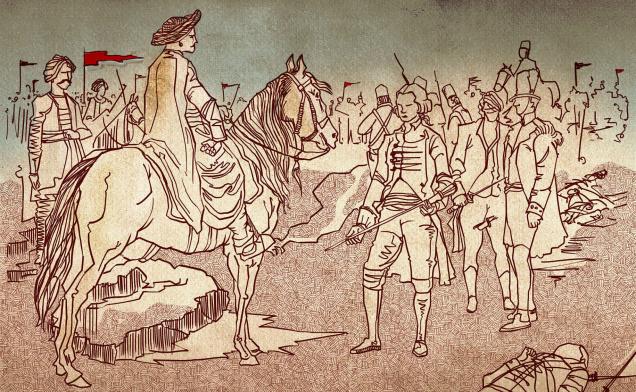
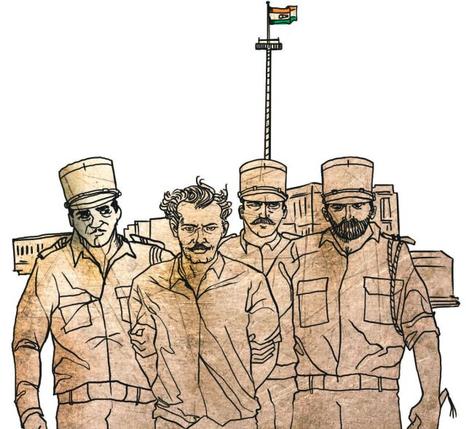
Arya Bashyam being taken away by the police after he hoisted the tricolour at Fort St.George in 1932. Ilustration: Satwik Gade

From the tricolour being hoisted at Fort St.George to filmgoers at Gaiety defying imperialist high-handedness, Cooum has witnessed some defining moments of the Indian freedom struggle

All of us are in some form of shackles, self-imposed or otherwise. I was made to flow freely, but the dead weight of man-induced sewage has reduced me to a piteous crawl. If I could, I would break free of this shackle. But I am just a river, and I can’t. My own helplessness has made me an admirer of those who have shaken off their yokes. For one, I have been a witness to stirring expressions of love for the country, when it was under British yoke.

MadrasWeekCF19aug2015

Everyone loves a hero. Everyone is enthralled by people who put their lives on the line for the common good. On the 26 of January in 1932, in the whole of India, there was none more heroic than Arya Bhashyam. Even today, I develop goosebumps as I recall how Arya Bhashyam, his face afire with a deep-burning love for his country, clambered up the incredibly tall flagstaff at Fort St. George, and replaced the Union Jack with the Tricolour. When he climbed down, his eyes were aglitter with pride and a sense of accomplishment. There was no trace of fear in those eyes, when the guards pounced on Bhashyam.

It surprises me no end how we forget our heroes – most of them, I mean. I got to see T. P. Kumaran Nair, when he was lodged in the Madras Central Jail in the early 1940s. A handsome and guileless man, he was on death row. Arrested when he was returning from Singapore and tried for treason, he did not seek mercy and faced death fearlessly. He courted martyrdom and found it on July 7, 1944, and had the honour of Subhash Chandra Bose calling him Shahid-e-Hind (martyr of Hindustan). Nair worshipped Bose and he trained cadets in the Indian National Army. It’s a pity that except for a road in Nellicode, Kerala, that bears his name, T.P. Kumaran Nair remains largely forgotten.

There were many common people who made a contribution to the freedom struggle who will forever remain in the shadows. During stilly nights, the cries of people being beaten inside the Gaiety cinema come back to me.

It was 1939 and Thyaga Bhoomi, a Tamil film based on a work by writer Kalki, was being screened in defiance of ban orders from the British Indian government in Madras. The government saw in the film a subtle call to support the freedom movement. It acted on the assumption that the Congress party had a hand in it. The ban order was served when the film was in its 22 week at Gaiety. The people behind the film, which included S.S. Vasan and K. Subramanyam (who made the film) chose not be cowed down: they ran free shows of the film at the cinema. It was during one such show the police barged into the cinema and beat up the audience. Despite the pummelling, they stayed inside.

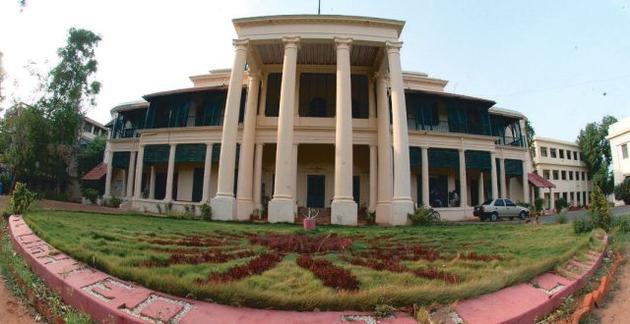
Doveton House in Women's Christian College where Tipu Sultan' sons are believed to have been held captive.
Doveton House in Women’s Christian College where Tipu Sultan’ sons are believed to have been held captive.

Then there are certain structures proximate to where I flow, which are not readily associated with the freedom struggle. But they have had a part in it. Tipu Sultan’s sons were held captive at the timeworn Doveton House in Women’s Christian College.

Then the Tipu’s weapons of war on display at the Madras Museum bring back the past powerfully for me. For visitors to the Museum, they are relic of the past. Flowing – actually, crawling by the Museum – and looking at these instruments, I could hear the distant sounds of a spirited struggle.

Sources: Venkatesh Ramakrishnan of the Chennai Cooum Group, The Hindu Archives and the Madras Musings

source: http://www.thehindu.com / The Hindu / Home> News> Cities> Chennai / by Prince Frederick / August 20th, 2015

Shots from the past – memories in black and white

A less ornamented Kapaleeswarar Temple, a Hema Malini when she wasn’t a star or when wedding photography meant a visit to the studio after the ceremony . The people be hind the images of Madras are still holding fort but are changing with the times to capture pictures of a new era. On August 19, World Photography Day , we go back to an era when photography was manual, dark rooms secret repositories of knowledge and printed photographs only preserves of memories.

Photo Emporium, which still stands tall in Chennai, was established in 1927 by A Thirunavukarasu. “Those were the days of expertise and innovation. In 1959, my father was making a video on Satya Sai Baba in Putaparthi. As there were frequent power cuts, he shot the video using the light of four to five cars,” says A K Rajkumar.

A lot of what the present Photo Emporium is now is due to the business acumen of A T Kathiresan, Rajkumar’s father. It was under him that the studio set up offices in Mumbai and Kolkata and it became one of the first importers of cameras from Japan, Ger many and Italy, cut films, single-use flashbulbs and photo mounts. The studio has been associated with illustrious families like those of the Murugappa Group, Apollo Hospitals and the Chettiars for three generations, documenting the developing city through its connections with industries like Binny , Weston Crompton and Parry & Co.

Long-standing relationships have also helped Sathyam Studios in Mylapore survive 83 years. V V Giri, musicians G N B, singer T V Rathinam and Cho Ramaswamy were regulars. Despite the small space, which houses the photo studio, it has a roomful of old cameras, glass negatives and numerous black and white pictures from a time when getting a photograph taken was a big occasion. “Even for weddings, people used to take only a couple of pictures. The newlyweds and the family would all come to the studio for a photograph,” says C S Balachandra Raju, the octogenarian owner.

His father C Satyanarayana Raju, the founder of the studio, was a self-taught man like most early photographers in the city . This passion runs through generations, as Balachandra’s three sons have also taken after their father.Hence though the daguerreotype camera was much before his time, B Anand, the youngest son, knows how to use it. “We have kept all the old cameras for their heritage value. But in this age of quick and easy photography , few people appreciate this art form,” says Anand.

source: http://www.timesofindia.indiatimes.com / The Times of India / News Home> City> Chennai / by Arpita Bose, TNN / August 19th, 2015

THUS SPAKE COOUM – The scene of great battles

Illustration: Satwik Gade

‘Valourous Chola Prince Rajaditya was killed right in front of my eyes by a poisioned arrow’

A great city grew on my banks, but did you know that they have been sites of the clash of civilisations?

The location was close to what you now know as the spot where the dam was constructed across me at Keshavaram, where Kosasthalayar splits to do her own thing. It was near the location of this modern dam that I witnessed a bloody war of much importance, many moons ago.

MadrasWeekCF19aug2015

In 949 AD, the combined armies of the Cholas and Cheras were led by the Chola crown prince Rajaditya, son of King Parantaka-I. The army met a fierce enemy in King Krishna III of the Rashtrakuta kingdom at Thakkolam (now technically placed in Vellore, but quite close to Kancheepuram), to whose aid came the forces of Ganga dynasty.

On a fateful afternoon, Rajaditya, the valorous Chola prince, was killed right in front of my eyes by a poisoned arrow, altering forever the history of the Tamil kingdom. Owing to the death of the prince, the crown later moved to his younger brother Arinjaya Chola and thus paved the way for the ascension of his descendants Raja Raja-I and Rajendra-I, two of the greatest Chola emperors, at a later point.

Imagine this: If not for the Thakkolam battle on my banks, you may not see the iconic Brihadeeshwarar temple today in Thanjavur since Raja Raja Chola would not have become a king.

A few kilometres down Thakkolam, the Polilore battlefield (Pullalur), again near my waters, was where the British forces faced tremendous losses in the Carnatic wars.

In 1780, Tipu Sultan faced off with British East India Company commander Colonel William Baille, inflicting deeps wounds to the British ego. As I watched the guns and canons blaze on either side, Baille was captured along with many of his troops and taken to Srirengapattna in Mysore.

But a year later in 1781, they returned to the same spot for another encounter.

The British side, now reinforced with better fire power, defeated Hyder Ali under the leadership of Eyre Coote. I remember that the Polilore field had witnessed another ancient but less decisive war as well, when Chalukyas led by Pulakesin II and Pallava King Mahendraverma-I took on each other. The former won.

Source: Venkatesh Ramakrishnan, Chennai Cooum group

source: http://www.thehindu.com / The Hindu / Home> News> Cities> Chennai / by SruthiSagar Yamunan / August 17th, 2015

Unsung heroes of India freedom struggle find place at Race Course

Coimbatore :

The regular walkers at the Race Course were in for a small surprise on Friday morning as portraits of several unsung heroes of the freedom movement were displayed on the path. Everyone knows about Mahatma Gandhi, Jawaharlal Nehru, Bhagat Singh and other freedom fighters as our history lessons in school were complete without them. But names like Akkamma Cherian, Usha Mehta, Hemu Kalani, Durga Bhabi, Leela Roy and Bhima Bai Holkar hardly appear in any text book nor are many children taught about their sacrifice for the motherland.

“With each portrait that I pass, the only feeling I have is that I have done nothing for my country so far. These people gave up everything to ensure that we live in a free country but we should ask ourselves what have we done to better our country,” said Saroja, a home-maker from Salem. D Yuvarajan, 12, pointed out to a portrait depicting the Jallianwala Bagh massacre and told his mother all that he learnt in school. “I am not familiar with many of these leaders and so I am asking my mother to explain their contributions to me while I am sharing what I know with her,” he said.

A government arts college student was moved by the story of Hemu Kalani, who was hanged at the young age of 19, and said that he would definitely go back and read more about these unsung heroes. “I am very interested to read more about their life and their struggle. I am interested in learning more about each of them,” said S M Arun Boopathy studying BSc Maths.

For some it was a day to play quiz and find out who knew better history. “We both have seen nearly 30 portraits so far and we are testing each other as to who knows more about them. But the sad part is we did not even recognise half of them,” said R Ashish, who was with his friend Samuel.

The portraits are on display outside All Soul’s church at Race Course till 6pm on August 15.

source: http://www.timesofindia.indiatimes.com / The Times of India / News Home> City> Coimbatore / by Komal Gautham, TNN / August 15th, 2015

Tailors who don’t ‘stitch’ clothes

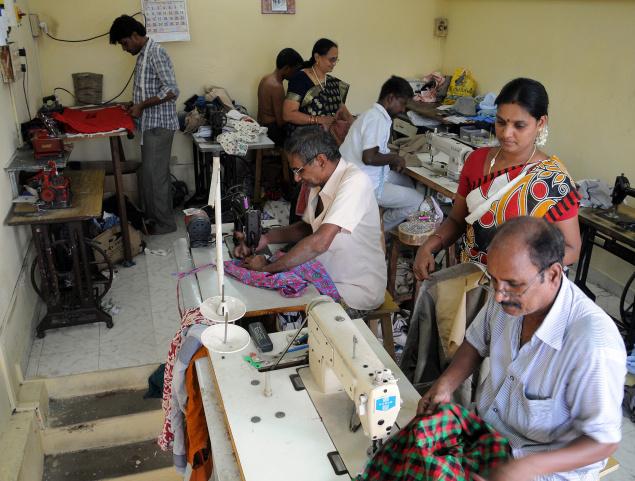
Giving clothes a second innings: Employees of Re-Stitch Point. Photo: K. Pichumani

For 25 years, this small establishment in Mylapore has made a business out of a need to alter clothes, reports Liffy Thomas

Finding a tailor who specialises in altering stitched clothes is a challenge. More likely than not, your regular tailor is not keen on alteration work. If he accepts such work, he is likely to sit on it for a few weeks. And then, you don’t always trust the road-side tailor with an expensive dress.

For 25 years now, this shop specialises only in alteration of clothes for men and women. Re-Stitch Point at Mylapore does not take up stitching jobs. It does not have to. It has a huge number of customers giving it re-stitching jobs.

Not many tailors are keen on taking up such work, so that makes us different from most tailors, says M. Sashikala, who owns the shop.

Five tailors and two front-office staff take care of the day-to-day activities: taking measurement of customers and altering clothes.

From patchwork on an old and torn jeans to re-sizing a salwar kameez , the shop does it all, except for altering blouses.

A good number of customers want clothes altered for sentimental reasons.

For instance, a lady customer wanted a pair of trousers worn by her brother, who passed away, altered to fit her so that she could continue to wear it.

“It was a low-waist trouser and we had to add extra material to make it her fit,” said a staff that altering was more challenging that stitching.

Amjad Khan, who has been working in the shop for the last two decades, says the most difficult task is increasing the waist. “Unlike other parts that have extra stitches, here we have to get almost matching material to increase the waist,” he says.

Re-Stitch is keen on expanding, provided it gets more employees.

The shop is open from 10 a.m. to 1 p.m. and 4 p.m. to 8.30 p.m.

Address: Shop No 15, Luz Ginza, Shanthi Vihar Complex, Luz Corner, Mylapore. / Phone: 4210 6971.

source: http://www.thehindu.com / The Hindu / Home> Features> DownTown / by Liffy Thomas / June 28th, 2014

PSG Group to set up bioethics centre

The PSG Group of Institutions will be the third in the country to start an independent bioethics centre. The official announcement regarding the centre was made on Wednesday morning at the PSG Institute of Medical Sciences & Research.

This will be third centre exclusively set up for bioethics and related research. The other two centres are in Chennai and Mangalore.

The PSG Centre for Research and Bioethics will be setup within the PSG Institute of Medical Sciences Research. The institute will offer a postgraduate diploma programme on bioethics. “A lot of clinical trials are conducted in India, and the growing pharmaceuticals market has evoked several research projects on new drugs. Consequently, there have been several debates on bioethics that govern such research,” said registrar-research, PSG Institute of Medical Sciences & Research, Dr Sudha Ramalingam.

The postgraduate diploma course is a one-year course, and would be taught through distance education. The programme would started from the current academic year, and admissions for the 2015-16 batch began in July. “It is a batch of 20 students, and we have only a few seats left,” said Ramalingam. The tuition fees for the course has been set at Rs40,000. The institute would also offer scholarship to four students with merit. “It will be a partial tuition fees waiver,” Ramalingam said.

The course, taught through the distance education mode, is recognized by Bharathiar University. “There would be five contact sessions every three months. Students would be continuously monitored through online assignments. There would be a final exam at the end of the course,” said Ramalingam.

Any graduate is eligible to apply for the course. “People in the pharmaceutical industry and those in biology, biotechnology and allied fields would find better job opportunities after they complete the course. For people in academia, it will be a value addition,” said Sudha Ramalingam. The course is likely to be upgraded to a two-year Masters programme in the future. This course could also help people become part of ethics committee in colleges and educational institutions. “Every institution has an ethics committee that monitors the activities of the staff and students. Not just research, but routine activities like classroom sessions, tours, laboratory activities, events and hostels too,” said Ramalingam. “This course would not only teach ethics in biology and related fields, but it encompasses philosophy, law and public health.

source: http://www.timesofindia.indiatimes.com / The Times of India / News Home> City> Coimbatore / TNN / August 06th, 2015

National Radio Controlled Car Racing: All 30 participants qualify for main events

Coimbatore :

All 30 participants who enrolled for the National Radio Controlled Car Racing championship were qualified on Friday for the main events to be held on Saturday and Sunday.

All 30 of them maneuvered their cars through the laps within the minimum time during the qualifying rounds held on day one of the championship.

The championship, being held at GEEDEE driving institute in Eachanari, will see engineering students actually build or buy a car which can be radio controlled and guiding it through the many laps. The driving institute has a special track where you can take a radio controlled car and race them.

The cars are usually an eighth of the size of a normal car, and except a gearbox, will contain all the features of a real car. The cars, which run on methanol, can touch a speed of up to 120 kmph and can rise from 0 to 100 kmph in just three seconds.

The competition was created by the Coimbatore Radio Control Racers Association along with the Kovai Modelers Club to get more youngsters interested in automobile engineering, car building and also have a lot of fun. It will also expose mechanical, electrical and electronic engineering students to the fundamentals of automobile engineering.

The actual races will be held on Saturday and Sunday from 10am to 5pm.

source: http://www.timesofindia.indiatimes.com / The Times of India / News Home> City> Coimbatore / by Pratiksha Ramkumar, TNN / August 14th, 2015

Chennai’s first TV channel, and much revered too

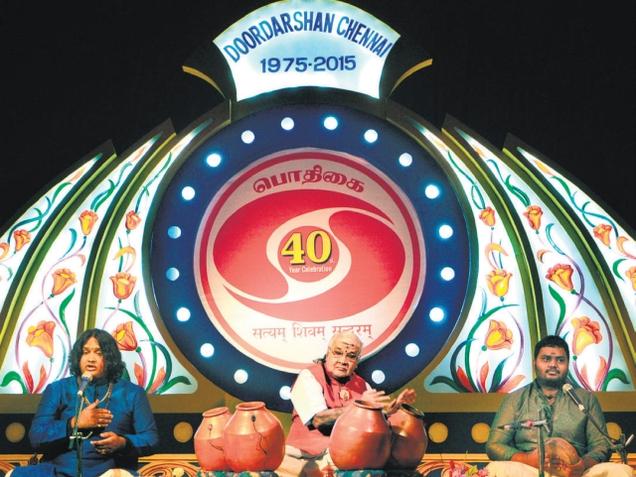
Musician Vikku Vinayakaram performs at the 40th year celebration of Doordarshan. Photo: B. JothiRamalingam / The Hindu

As it completes 40 eventful years in chennai, Doordarshan vows to continue as family-oriented infotainment channel.

On the occasion of Doordarshan Chennai’s 40th anniversary, several celebrities and dignitaries flocked to the Narada Gana Sabha on Wednesday to celebrate the channel that defined television for them.

They also offered suggestions on the route it should take in the future.

Actor and director Bhagyaraj recalled how Doordarshan launched many a film career. “It is from DD that the world of cinema got several musicians and actors. Music director Deva and actor Vadivukarasi were involved in DD programmes before entering films,” said Mr. Bhagyaraj, who has directed Kadhaiyin Kadhai for DD-Podhigai.

“Programmes on my grandfather and violinist Kumbakonam Rajamanickam Pillai have been telecast,” actor Thyagu said.

“We are enjoying the limelight because of DD. My drama, Ayya Amma Ammama, has been telecast eight times since 1982,” said Mr. Ramamurthy, who has done nearly 48 plays for Doordarshan.

Danseuse Padma Subrahmanyam, who performed at the launch of DD in 1975, was back on Wednesday to give a Bharatanatyam performance. “I am glad to be associated with DD for many decades. I remember giving a solo performance on Krishnayya Tubhyam Namaha and Silapadigaram then,” said Ms. Subrahmanyam, who has been performing for DD every year.

“I have performed in many Bharatanatyam shows and even produced programmes like Konjum Salangai,” said veteran actor Vennira Aadai Nirmala.

“I watch DD-Podhigai regularly because of the importance it gives to classical music and Bharatanatyam,” she added.

Governor K. Rosaiah said that with programmes on health, education, career counselling, film and agriculture, Doordarshan catered to diverse viewers.

He lauded DD-Podhigai for creating awareness of government schemes and staying a family channel despite stiff competition from private satellite channels.

Adopting the latest technology in production and ensuring more advertisements would take DD-Podhigai ahead of other channels, he said.

Earlier, A. Suryaprakash, chairman of Prasar Bharati, elaborated on the need for a public service broadcaster in these days of mushrooming private satellite channels.

Recalling the popular programmes, including sports quiz, he said, “We will continue to offer quality infotainment and unbiased news and raise awareness on government schemes.”

Nadoja Mahesh Joshi, additional director general (south zone), Doordarshan, and N. Thyagarajan, additional director general (engineering, south zone), also spoke on technological changes that DD has undergone.

source: http://www.thehindu.com / The Hindu / Home> News> Cities> Chennai / by K. Lakshmi / Chennai – August 13th, 2015

Impressive performance by Mylapore student

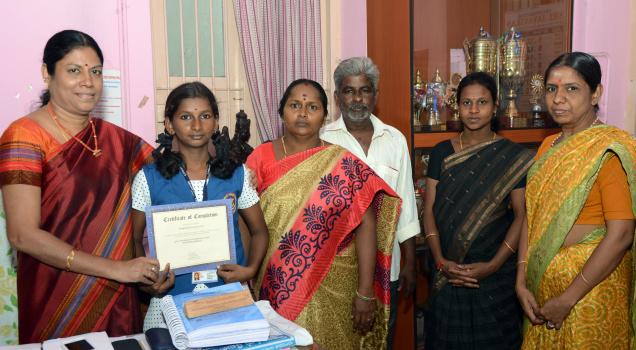
Sangeetha with headmistress Ruby Puthotta (left), her parents and teachers. Photo: K.V. Srinivasan / The Hindu

Designing a robotic racing car, she stood out in the ‘Building Bridges’ programme at the University of Rhodes Island

Sangeetha does not drive a racing car, but she just might help you drive one. This class IX student of Siva Swami Ayyar Girls Higher Secondary School recently designed a robotic racing car at the University of Rhodes Island, Kingston, United States. She is one of 20 students who took part in ‘Building Bridges’, a four-week cross-cultural and academic programme that introduces students to engineering and robotics.

Of the eight students selected from India, Sangeetha is the only one from the state representing a government-aided school. Robotics classes were the best part of the programme, she says, which allowed every team to design a car. Each of the participants was teamed with participants from the United States and Pakistan.

“For two days, our car did not move. Once we learnt coding and the technicalities involved in sensor technology, we stayed late into the night to finish designing the car,” she says.

Sangeetha plans to pursue a career in mechanical engineering and also design an autorickshaw for her father, an autorickshaw driver.

Although much of the expense for the trip was borne by the organisers, her parents spent around Rs. 7,000 towards the preparations she had to make for joining the programme. “She had to do a lot of reading, so we got her an Internet connection and some clothes for the journey. We borrowed money but that’s fine as she has made us proud,” say her parents S. Rajakumari and L. Subramani.

Sangeetha, a national level Silambam player, also stunned everyone with her Silambam performance at the meet.

The Mylapore school got an opportunity to send a student to the programme after it partnered for the ‘STEM Education’ programme, for which five schools from the city were selected.

“The entire class VIII was made to take a test to check one’s interest in science and technology. Twenty were short-listed and trained for almost a year in spoken English, leadership skills and science and maths,” says V. Prema, teacher in-charge of the project. Verizon Technologies and Institute of International Education sponsored the student.

Sangeetha is grateful to the secretary of the school Leela Narendran, headmistress Ruby Puthotta and other teachers who encouraged her.

source: http://www.thehindu.com / The Hindu / Home> Features> DownTown / by Liffy Thomas / Chennai – August 08th, 2015