Golden jubilee reunion

Those who completed SSLC (Secondary School Leaving Certificated) at the Hindu High School, Triplicane, fifty years ago are planning a reunion this year. The golden jubilee reunion hopes to bring together people the SSLC batch of 1965 in one of the oldest schools.

Honouring teachers, assisting in infrastructural development, and creating a scholarship fund for meritorious students from economically backward families have also been planned.

Former students who want to be part of the event may get in touch with Janardhanan at Ph: 9841210884. e-mail: janakrishjai@gmail.com. — Special Correspondent

source: http://www.thehindu.com / The Hindu / Home> News> Cities> Chennai / by Special Correspondent / Chennai – July 04th, 2015

A golden saga of grit and enterprise

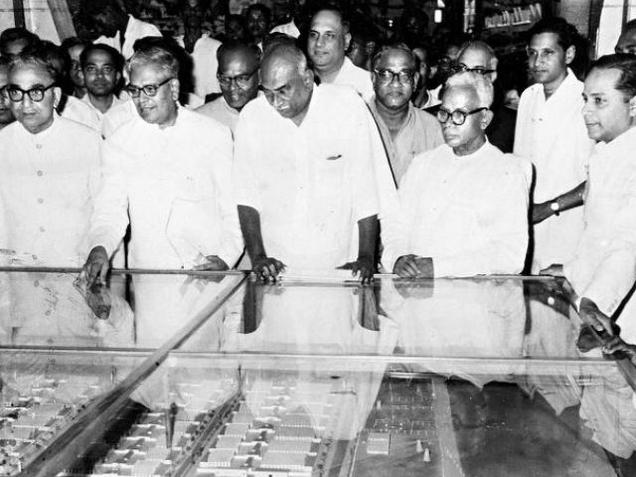
K. Kamaraj, the then president of the Congress, takes a look at a model of the Ambattur Industrial Estate that was inaugurated on July 3, 1965.

Ambattur Industrial Estate that turns 50 today has great milestones to cherish and new goals to reach for.

From a sleepy village of paddy fields with mud paths for roads, the Ambattur Industrial Estate has come a long way. The estate, which turns 50 on July 3, is now a thriving hub of small- and medium-scale industries.

Established in 1965 with the efforts of the then Industries and Power Minister, Madras State R. Venkataraman, the estate was inaugurated by the then Congress president K. Kamaraj and was home to 400 units, manufacturing locomotive and automobile accessories. Now, spread over 1,200 acres, the estate has grown to accommodate over 2,000 industrial units in the manufacturing and service sectors, including consumer durables and garments.

Senior industrial unit holders and members of the Ambattur Industrial Estate recall those days when the estate was dotted with units manufacturing engineering components. It was reported to be Madras State’s largest industrial estate that accommodated small-, medium-, and large-scale industries by The Hindu . Mr. Venkataraman had also contributed to the four-page inauguration supplement brought out by The Hindu .

A former president of the Ambattur Industrial Estate Manufaturers’ Association (AIEMA) recalled Mr. Venkataraman’s foresight and how he pitched for an elevated corridor to divert heavy vehicular traffic from the estate right then. Chennai Bypass now takes the traffic from Tambaram to Red Hills without any hindrance to the estate.

In the late 1960s, many engineering graduates launched units at Ambattur. “I shifted from Pune to Chennai to open my unit here. It was convenient for many like me to stay in Anna Nagar and run the unit at Ambattur that also has a railway station,” said a past president of AIEMA.

With rapid development in the past decade, several software companies have also set their eyes on the estate. Infrastructural issues such as poor roads and waterlogging have been eliminated.

“We have many welfare measures for employees, including a hospital. Our crèche, which accommodates 100 children, is one of the few such facilities available in industrial estates. We are focussing on making it a green estate with effluent and sewage treatment facilities,” AIEMA president K. Sai Sathya Kumar said.

Having exhausted space for expansion, the units are now scouting for land to set up an ancillary estate.

source: http://www.thehindu.com / The Hindu / Home> News> Cities> Chennai / by K. Lakshmi / Chennai – July 03rd, 2015

Coimbatore-Mettupalayam Electric Train Service Commences

Coimbatore :

The long awaited electric train service between Coimbatore and Mettupalayam commenced operations today.

The 32 KM stretch from Coimbatore North to Mettupalayam, electrified at a cost of Rs 28 crore, was a long pending demand of passengers of the district, including a large number of tourists visiting nearby Nilgiris district.

Eleven bogies of Blue Mountain Nilgiris Express were attached to the train, which made its maiden trip to Mettupalayam.

The electrified service had been delayed due to technical snags and two trial runs were carried out last month before before the service commenced today, railway sources said.

Six trains operate between the two destinations daily, covering the distance in 45 minutes.

However passengers wanted the speed to be increased from 90 km to at least 140 KM to reduce running time for the benefit of office goers and tourists.

Railways attributed the lower speed to the inability of the track to withstand higher speeds and load, which can be augmented in a phased manner.

Since Mettupalayam railway station does not have a lengthy platform to accommodate 26 bogies of Nilgiris Express, only 10 were coming there, after detaching 15 bogies at Coimbatore junction.

Passengers said Railways should take efforts to extend the present platform.

source: http://www.newindianexpress.com / The New Indian Express / Home> States> Tamil Nadu / by PTI / July 03rd, 2015

Unique pest-trapping device draws keen attention at agriculture exhibition

Madurai :

A unique pest-trapping equipment was the main attraction at the ongoing United Agri Tech, 2015 held at Tamukkam grounds in Madurai. The stall displaying the equipment stands out among hundreds of stalls that showcased various types of fertilisers, pesticides, seeds and technology for the benefit of the farming community.

At the stall of Barrix Agro Sciences, a specially designed pest trap that uses pheromones, a chemical substance produced by insects, became the focal point at the agriculture exhibition. It can be used to kill fruit flies (Tephrididae) in orchards and gardens. In this method, the smell of female flies is kept inside the trap to attract male flies. Once the flies are inside, they are killed with pheromones. The trap boxes are sold with various pheromones meant for different fly species. The pheromones should be changed every 15 days. These traps will not kill agriculture friendly insects, like honey bees or spiders, since the pheromones used in the traps will not attract them.

For other fly species that could not be trapped with the boxes, sticky sheets are used. When suspended in gardens, flies get attracted and stuck on the paste. The adhesive sheets last for 15 days.

Field officer of the company, D Jayakumar, said they have received an overwhelming response from the visitors. “We have sold out lot of trap boxes and adhesive sheets on the first day. We have been receiving many enquiries from farmers”, he said.

Tirunelveli deputy director of horticulture, B David Raja Beulah, who designed solar traps for pests, said the pheromones traps are effective. “These traps will come in handy for certain pests that can not be handled with pesticides. Specific pheromones should be used to trap male flies. If the male flies are killed, female flies can not reproduce, and pest attack on crops is prevented,” said he David. The exhibition that commenced on June 25 will be held till 28.

source: http://www.timesofindia.indiatimes.com / The Times of India / Home> City> Madurai / TNN / June 28th, 2015

Doctors receive awards

Actor Sarathkumar inaugurates National Doctors Day celebrations

Women and Children Foundation Ltd., a corporate health care company, gave away awards to doctors on National Doctors Day on Wednesday.

Actor Sarathkumar, who conferred the awards on the doctors in recognition of their achievements, said he had recovered from a major accident only because of the doctors who treated him.

“It is like a rebirth for me. I owe my doctors so much. So, in a way, it feels special to be part of the National Doctors Day celebrations,” the actor said.

Dr. Rajasekar, founder and chairman of Women and Children Foundation Ltd., said the government should recognise doctors who did yeomen service to society.

Muthulatha, Kurian Joseph, Palaniswamy, Chandramohan, Mayil Vahanan Natarajan, S.S. Manikandan, and Shivaraj received the awards. V. Shanta, Kamala Selvaraj, and V. Seshiah were conferred the awards in absentia.

source : http://www.thehindu.com / The Hindu / Home> News> Cities> Chennai / by Staff Reporter / Chennai – July 02nd, 2015

Selfless work by Dalits recalled

Selfless work done by a group Dalits six decades ago has not only brought them laurels now but also made them proud land owners.

From now on, they need not depend on landlords for their survival.

Ten Dalit field workers, including three women who are 85 years and above, have become landowners, thanks to support offered to these workers who stood along with T.S. Soundaram, founder, Gandhigram Trust, when she floated the trust at Gandhigram village to extend health care to the poor and the downtrodden.

Breaking all barriers and hurdles, Gandhigram Trust had fulfilled the dream of the founder and offered 65 cents of agriculture land each to 10 Dalits living at Thoppampatti village since the 1950s as per the direction of the founder.

“Our founder had promised to offer land for the uplift of Dalits. Now, we have fulfilled her wish by offering land owned by the trust to them,” said K. Shiva Kumar, secretary of the trust.

Ms. Soundaram had identified people from villages around Chinnalapatti to develop an area for their activities. The selected beneficiaries were settled in Thoppampatti with a promise of land for their survival.

“We joined work for wages of 50 paise a day for women and 75 paise for men to cut firewood and level the field,” said beneficiary Y. Chinnappan (85), who was picked from Panjampatti in the 1950s.

“My husband Raju joined the work force. He died and my only son too died in an accident. Now, my grandson is taking care of me,” said another beneficiary R. Azhagammal (89).

Octogenarian P. Mariappan said he was picked from Kalikkampatti. “We are honoured now,” he said.

The land was registered in the name of the beneficiaries and also their legal heirs to enable even the next generation to enjoy it.

No sale

“Even though it is patta land, the beneficiaries cannot sell it,” said Mr. Shiva Kumar. Managing Trustee M.R. Rajagopal handed over the pattas to the beneficiaries.

source: http://www.thehindu.com / The Hindu / Home> News> National> Tamil Nadu / by Staff Reporter / Dindigul – July 01st, 2015

How early Portuguese book spread religion

by K R A Narasiah

Jesuit missionary Fr Henrique Henriques (1520-1600) worked among the pearl fisheries people of South Indian coast between 1546 and 1600 -a little over half a century. He learned the local Tamil language as spoken by the Parathava community to make his conversion work easier. He had little knowledge of classical Tamil and its grammar. His goal was to instruct his missionary colleagues about the language spoken in the coastal area by the community and help in his mission. He wrote a book of grammar in Portuguese around 1549 CE and thus ” Arte da Lingua Malabar” stands as the first linguistic connection between India and the West.

Jeanne Hein, an American scholar, had been studying the life of Henriques and the period of the Portuguese in India, with a view to understand the work of missionaries from 1964. She was stuck as she could not get much help in decoding Tamil. V S Rajam Ramamurthi had come to the US in 1975 to do her PhD in Pennsylvania and met Jeanne Hein in ’78-’79. It was then that they collaborated on the project of translating the Tamil grammar book written in Portuguese into English. The translation was published in 2013. Jeanne, who died in 2013, did not know Tamil and Rajam, Portuguese. That the two managed to get the book to this shape is remarkable.

Arte da Lingua Malabar was first discovered by Fr Thaninayagam in his search for Tamil works of Europeans in South India. Jeanne acquired a microfiche of the same from Lisbon.

In Tuticorin, Henrique Henriques mastered the local language and worked hard to bring out a book of grammar for the language, as he believed that books of religious doctrines should be in local language. Henriques, apart from being the first to produce a dictionary (Tamil Portuguese), set up a Tamil press and printed books in Tamil script. The first book printed in Tamil script was “Thambiran Vanakkam” (1578), a 16-page translation of the Portuguese “Doctrina Christam”. It was followed by “Kirisithiyaani Vanakkam” (1579).

Rendering the Arte da meaningfully in English was not easy . For, Henrique took Tamil as he heard it spoken in the Parava villages and stretched it over the grammatical structure of Latin. In addition, when he Romanised Tamil, he did it in his language phonetics of 16th century .The document, at once, therefore becomes a product of Portuguese discovery relating to South India. As Caldwell records in his book ” A History of Tinnevelly”, the South Indian chieftains were interested in getting Arab steeds due to which Muslim traders were ruling the day in the coast.In fact the pearl fishermen were under their mercy as Muslims controlled the trade. The fishermen looked up to the newly arrived Portuguese who were stronger especially after they won the 14-years war at Vedalai in Kerala coast.

Joao de Cruz, a convert, persuaded the Paravas to become Christians so that the Portuguese would assist them. Eighty-five leading Paravas went to Cochin to seek Portuguese assistance and all of them were baptized and on return they were instrumental in converting a vast number into Christian fold. It was in this background that Henriques arrived in the coast to find that though converted the Paravas were following the traditions of their earlier faith.

To impart the knowledge of Christianity, language had to be learned and books written in local language.

Henriques worked for eight een years on writing the gram mar of Tamil as spoken in the coast so that Tamil material could be supplied in spreading the faith. He had no idea about Tamil grammar nor did he attempt to learn it.On the other hand, for the first time he devised a grammar for a language as spoken by the people he was dealing with and shaped a linguistic structure in India for Christianity .

Rajam has taken pains to show how he wrote the letters of the alphabet and their pronunciation. Since he himself spoke 16th century Portuguese, to understand his phonetics today , a specialist of the language of that day was necessary .To add to the confusion the Tamil dealt with was that of a community of 16th century of which even Tamils have very little knowledge. “We are examining a document which describes Tamil the way a foreigner heard it. I have not corrected errors except for minor changes,” says Rajam.

(A former marine chief engineer , the author is a historian, writer and heritage enthusiast)

source: http://www.timesofindia.indiatimes.com  / The Times of India / Home> City> Chennai / by K R A Narasiah / July 01st, 2015
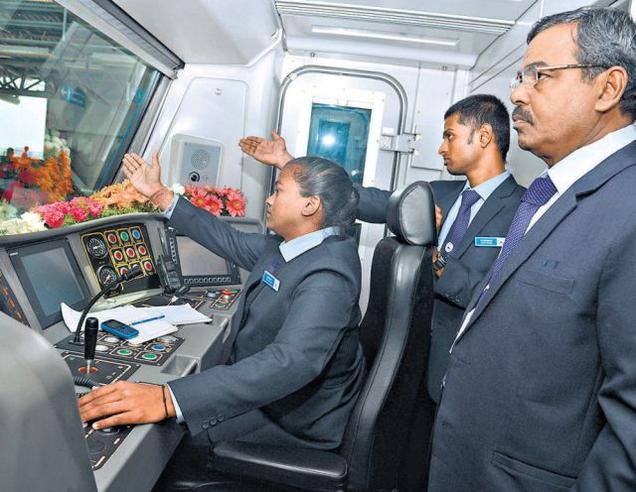
Woman power to the fore at inaugural

A.Preethi created a record of sorts when the drove the first Metro service. Photo: K.V.Srinivasan

For Preethi, from the time she aspired to serve as a loco pilot in the Railways to driving the first train in Chennai Metro, it has been one exciting ride.

As A. Preethi was about to ease the train out of the station during the maiden run of Chennai Metro Rail from Alandur to Koyambedu, she saw her mother and niece standing on the platform, eagerly watching the proceedings.

A surprised Preethi immediately beckoned the two to get inside the train. But, her mother asked her to stay put and gestured that she would take the next train.

“I am so proud of her,” Preethi’s mother said, even as her voice choked and her eyes welled up. “Initially, I did not want her to take this job. But now, I m so happy that she’s driving this train,” she said.

For Preethi, from the time she aspired to serve as a loco pilot in the Railways to driving the first train in Chennai Metro, it has been one exciting ride. “I was absolutely thrilled. Beginning now, my concern is to drive carefully and keep passengers safe,” she added.

While she is more than happy driving along this elevated stretch, Preethi is eager to drive through the tunnels of the Metro when the underground stretches become operational.

After Preethi, it was Jayashree’s turn on the second train. Both of them bagged diplomas in electronics and communication before taking up jobs as train operators. Soon, five more women operators will join the team.

source: http://www.thehindu.com / The Hindu / Home> News> Cities> Chennai / by Sunitha Sekar  & T.K. Rohit / June 30th, 2015

Consumer activist R. Desikan passes away

Activist R. Desikan, who spearheaded the consumer movement in the State, passed away on Saturday evening at his home at Vettuvankeni. He was 83.

Born in Srirangam in 1933 to Raghavachari, who ran an automobile business and Ranganayaki, Desikan, Chairman Emeritus of Consumers Association of India, studied in Madras Christian College and later moved to Mumbai where he worked in Reader’s Digest as an advertisement manager.

“It was in Bombay at the Reader’s Digest that we met and got married. We moved to Chennai in 1972 and printed our own magazines. He then ran the South Madras News, a tabloid from 1974 to 1983 after which he got full-time into the consumer movement,” recalls Nirmala Desikan, his wife, who is Chairman and Managing Trustee of CAI. “He lived his life for the consumer, thinking about how he could improve their life. Though he came across a lot of hurdles, he still ensured that the consumer’s view point was taken to the policy makers,” she adds. The couple has two daughters. His last rites were held on Sunday evening.

S. Saroja of the Citizen consumer and civic Action Group, who has been associated with Desikan for several years now, recalls he would remember small things about people. “He would make you feel special. He was quite active till the end and even on Saturday, he was conducting discussions on how the movement should be taken forward. We were to participate in a programme next week.”

The veteran activist began working full-time with the consumer movement in the State in 1983

source: http://www.thehindu.com / The Hindu / Home> News> Cities> Chennai / by Special Correspondent / Chennai – June 29th, 2015

Selected for BRICS Youth Summit

 Bridge and foundation course in English being inaugurated at Seethalakshmi Ramaswami College in Tiruchi; C.K. Vishnu Narayanan of National College in Tiruchi.
Bridge and foundation course in English being inaugurated at Seethalakshmi Ramaswami College in Tiruchi; C.K. Vishnu Narayanan of National College in Tiruchi.

C.K. Vishnu Narayanan, a second year B.Sc. (Physical Education and Sports Sciences) student of National College has been selected to participate in the BRICS Youth Summit to be held in Russia from July 1 to 7. He is a part of the 60-member Indian delegation of Department Youth Affairs (International Cooperation Cell) of the Union Ministry of Youth Affairs and Sports. He has bagged a national award in yoga in 2013. He has participated in the 2014 Republic Day parade in New Delhi as a National Service Scheme volunteer. He learnt the basics of yoga practices during his childhood under his guru Kalari S.D. Benny in Thrissur. Since then, he had been performing on regional and national platforms. Earlier, he had secured Best Volunteer Award from the National Service Scheme in Kerala for 2013 and 2014.

BRIDGE, FOUNDATION COURSE IN ENGLISH

Bridge course will help students turn their aspirations into realities, said G. Balakrishnan, former vice-principal, St. Joseph’s College, while inaugurating the bridge and foundation course in English at Seethalakshmi Ramaswami College. He observed that the course bridges the gap between the school and college education, sharpens the intellect and helps orient the skills of the students. Good knowledge of English language could take students to greater heights. Students hailing from rural and Tamil medium could excel through rigorous practice and thirst for learning. During the interaction session, he helped students practice speaking simple and error free sentences. M. Jayanthi, Principal, and K. Renukadevi, Associate Professor and Head, Department of English, spoke.

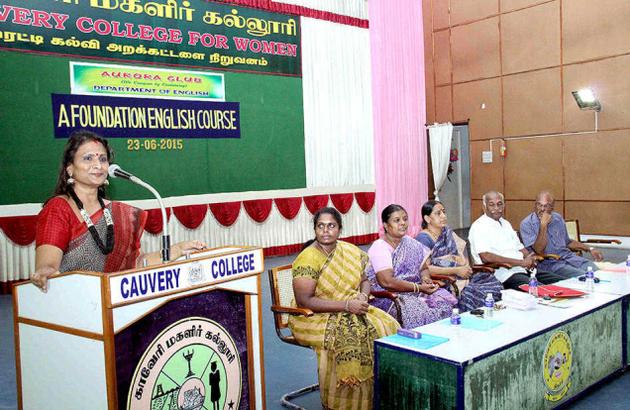
CauveryCollegeCF29jun2015

LEARN ENGLISH WITH PROPER PRONUNCIATION

Importance of learning English with proper pronunciation was emphasised by V. Sujatha, Principal, Cauvery College for Women, in her inaugural address at the Foundation English Course for the first year students organised by the Aurora Club of the Department of English Cauvery College for Women. R. Murugan, president, college executive committee, motivated the students to shed their inhibition and gain confidence by mastering the language. K.S. Dhanam, Associate Professor, Department of English, Periyar E.V.R. College, who was the resource person, explained how to overcome the hesitation to speak in English. R. Gobinathan, treasurer, college governing council, and Hilda M. Thenmoli, Head, Department of English, were present.

AWARENESS PROGRAMME ON USE OF HELMETS

Leo Club and National Service Scheme of Tiruchi Engineering College conducted an awareness programme on use of helmets.

P. Gopalachandran, Inspector of Police, Siruganur, spoke on the importance of wearing helmets. S. Subramaniam, secretary, Sujatha Subramaniam, chairperson, and R.M. Ramachandran, Principal, were present.

Compiled by G. Prasad

source: http://www.thehindu.com / The Hindu / Home> News> National> Tamil Nadu / June 29th, 2015