A visitor checking out the exhibits displayed at the Korean Exhibition at Fort St George | D Sampath Kumar
Chennai :
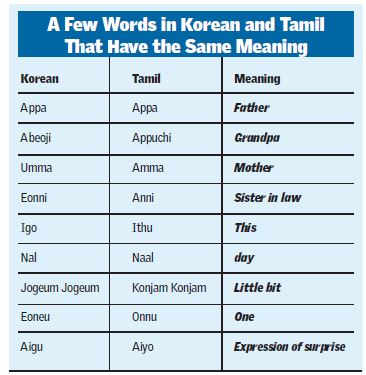
Just as Prime Minister Narendra Modi was recalling the age-old cultural and business relations between South Korea and India in Seoul on Monday, Kyungsoo Kim, Consul General of South Korea in Chennai, revealed that his country indeed had a link with Tamil Nadu from the first Century AD., at a function held at Fort St George. Speaking at the inauguration of exhibition titled Museums of India and Korea, Kim said strong evidence to this connection lay in the common words used in Korean and Tamil languages even today. He narrated an interesting incident that took place just a day before, on Sunday, when he was visiting Mahabalipuram. As he was walking along the sea-shore, Kim heard his son calling him. When he turned back, he realised that it was not his son, but another child who was calling him Appaa. He learned, to his surprise, that the two languages shared some common words.
In all, he claimed, there were around 4,000 words in Korean and Tamil that had similar meaning, indicating the age-old connection between the two countries. It was the French missionaries in Korea who first noted the similarities between the two languages. Many of the names of ancient colonies of Southern Korea were the exact counterparts of Tamil words. Exhaustive as it is, linguistic similarities were not all. The Consul General pointed out that the way both people built their hutments were the same, so were some of the household utensils like ural (a heavy stone or wooden mortar) and ulakkai (long heavy wooden pestle). Experts say that agriculture, pottery, beads, textile, turtle boats, and many ancient industries and cultures in the two countries have stunning similarities.
These similarities, they add, are not coincidences. Early Tamil people migrated to the Korean peninsula around the first century AD, noted N Kannan, Orissa Balu and Dr Nagarajan, all experts on the topic.
The connect between the two cultures is believed to have started way back in CE 45, from the period of King Suro and Hok and Ayi of Pandian Kingdom. Incidentally, King Suro’s kingdom was named Karak, which has a Tamil (proto-Dravidian) meaning fish. “This view was confirmed by the Centre for Korean Studies at the University of Hawaii. Both languages are agglutinative, follow the subject-object-verb order, nominal and adjectives follow the same syntax, particles are post positional, modifiers always precede modified words are some of the common features,” they say.
Inaugurating the photo exhibition, R Kannan, secretary, Culture, Museums, Tourism and Religious Endowments Departments, recalled the strong cultural connection between the two countries.
Earlier, Consul General Kim released a CD on the museums in Tamil Nadu for the student community. K Moortheeswari, Deputy Superintending Archaeologist, Archaeological Survey of India, said the CD would be distributed to all schools in Tamil Nadu free of cost if they approached the Fort St George museum.
The theme of this year’s International Museum Day is ‘Museums for a sustainable society’. It highlights the role of museums in raising public awareness about the need for a society that is less wasteful, more cooperative and that uses resources in a way that respects living systems, she added.
The exhibition will be on till the end of May.
source: http://www.newindianexpress.com / The New Indian Express / Home> Cities>Chennai / by T. Muruganadham / May 20th, 2015
As she expected, S Padmasandhya, a student of Kendriya Vidyalaya I in Narimedu, secured good marks in the CBSE Plus Two results that were released on Monday. She scored 486 marks and emerged as the topper among the students in Madurai district. Padmasandhya, who aims to become a chartered accountant, is already busy preparing for the entrance exams.
She scored 95 in English, 96 in Economics, 98 in Mathematics, 99 in Business Studies and 98 in Accountancy.
She thanked her parents and school for their role in her success. Revising her lessons from the school and the help from her teachers during her preparation helped her secure good marks, she said. “Plus Two exam is not the end. You should keep away from stress. Studying too much without any diversion would not work,” she said.
It was a pleasant surprise for M S Revanth, a student of Mahatma Montessori School in Madurai when the results came out, as he had scored 484 marks and emerged as the second topper in the district. “I expected only around 475. However, I gave my best shot and put in a lot of hard work to achieve this. My parents and teachers in the school helped me a lot. I want to study either Computer Science of Civil Engineering,” he said.
source: http://www.timesofindia.indiatimes.com / The Times of India / Home> City> Madurai / TNN / May 26th, 2015
A well-known city-based film production company, Wide Angle Creations, which has produced Papanaasam with Kamal Haasan in the lead, played an important part in the making of Dheepan , which won the Palm D’ Or at the Cannes film festival.
This would mean that Kalieaswari Srinivasan, who plays the lead, is not the only connection the film has with the city. The film, which was shot for not more than 7-8 days in parts of Mandappam (near Rameswaram), and Ooty among other places in Tamil Nadu, in the month of December and January, has actually made use of a number of local technicians and several hundred junior artistes.
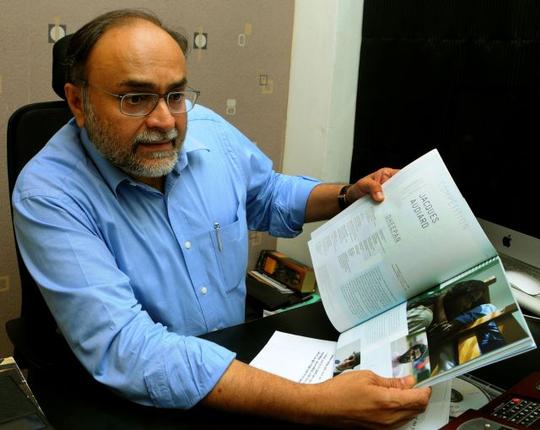
Suresh Balaje, one of the partners of Wide Angle Creations, said the Palm D’ Or came as a pleasant surprise./ Photo: R. Ragu / The Hindu
Suresh Balaje, one of the partners in the company that specialises in ‘line production’ in India, said that he did not really expect to win the big prize. “There was a lot of interest in the film because of Jacques Audiard, whose earlier films have been received well by the press. But, honestly, nobody was expecting to win, although everybody was proud that the film was selected in the competition section,” he said.
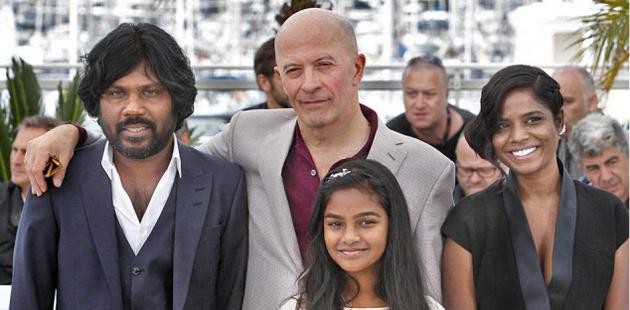
While the crew only shot for a few days, it wasn’t a small-sized production, says George Pius, Mr. Balaje’s partner. He says that except for the camerawoman, Jacques Audiard, costumer and the art director, the support crew were all locals.
Many of the actors and technical support staff of the film directed by Jacques Audiard were from India —Photo: Special Arrangement
“We erected a big set in Mandapam of a refugee-camp. We worked with hundreds of junior actors on the sets. Even the technical crew had very few people from France. They came with a small crew and the rest of the technicians were locals,” he explained.
George Pius, who worked on the film, said that this recognition for Dheepan would likely open many doors, which were earlier not available for production companies from the South. “Previously, only companies from Mumbai were working with foreign productions. After this award, I hope companies like ours also get a look-in,” he said.
Though Dheepan is a French production, it is said that at least 75 per cent of the film is in Tamil. Asked if he thought if the film would clear the censors, Mr. Balaje said, “ I do not think there is anything wrong with the film. It should release without a hassle,” he said.
The awards for Dheepan are likely to flow as the film will also be in pole position to win the Best Foreign film at the Oscars next year.
City-based Wide Angle Creations played a key role in the making of Dheepan
source: http://www.thehindu.com / The Hindu / Home> News> Cities> Chennai / by Udhav Naig / Chennai – May 27th, 2015
The intention was to get chatty about cheese. But the conversation veered off to reveal how Kodaikanal’s best known family for producing cheese is famous for a lot more
You will never get it wrong while visiting the Manis in Kodaikanal. A visit to their home is invariably greeted with the ‘eat cheese’ welcome! The plate loaded with rusk and toasts topped with the ‘Kodai Cheese’, the brand they are reputed for, lay in front of me temptingly through the interview. And honestly, the ‘cheese content’ of the assignment remained restricted only to eating. For, when you are sitting with the two ladies of the family – Lalitha Mani and Janani Harisanker, the mother-in-law and daughter-in-law duo – you can only hear and see how they share their homes, lives and hearts with animals, patients and people in general.
The business of cheese is of course managed by Lalitha’s husband G.S.Mani and her son Harisanker. And both are mostly away at their newly established factory in Batlagundu (see box). But it is this dynamic pair of saas-bahu making news more often in Kodaikanal. They are either chasing tourists who make the Kodi roads dirty or rescuing stray animals from the streets or ensuring good medical care of patients in the hospital started by them.
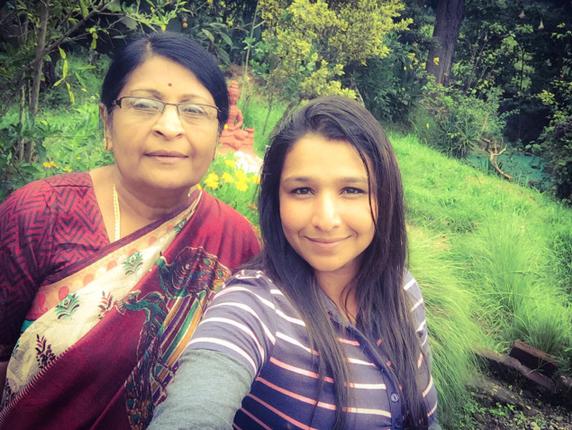
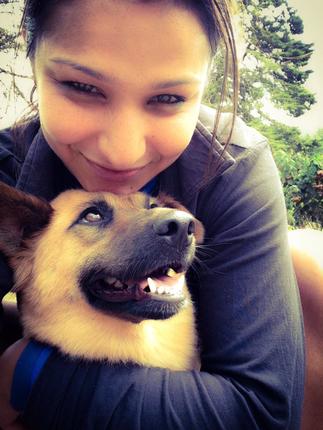
Lalitha Mani and Janai Harisanker. / Special Arrangement
And when they are not doing social service, they are either landscaping their gardens or playing golf. Lailtha and Janani connect so well that you fall in love with them when they say, you can drop the ‘in-law’ bit from our relationship. “We are like mother and daughter,” they echo, asserting on the beautiful relationship.
Janai Harisanker with Pebbles. Photo: Special Arrangement
When Chennai-bred Janani wedded into the Mani family seven years ago, she was not sure whether her in-laws would be happy with her role as a silent volunteer for the Blue Cross, the 55-year-old animal welfare organisation based out of Chennai. She was even more upset when her mother told her that her adopted stray dog Pebbles, was missing her and refusing to eat. With much trepidation she checked with her mom-in-law if she could bring Pebbles over to Kodaikanal for a few days.
“Pebbles is your dowry we will happily accept,” Lalitha told her newly-wedded daughter-in-law. That one line not only changed the relationship between the two women forever but it also made Pebbles a permanent resident of Kodaikanal.
“Amma has an amazing way of dealing with people and is extremely supportive where she sees something good,” says Janani fondly about her mother-in-law. Lalitha returns it with, “And Janani is very friendly and caring”. But these are not just complimentary words for each other. They go much beyond in action.
Just a few days ago, says Lalitha, while returning from work we saw people in the car ahead of us throwing chips wrappers out of the window. “We stopped and picked up the empty packets, overtook the car, handed over the packets back to them with the request that they should properly dispose them off,” narrates Lalitha. “And we both are pretty well known in the town for doing this,” laughs Janani.
Though they are often referred to as the “dynamites of Kodi”, Lalitha worries about when people will ever learn to be responsible by themselves. The duo distributes garbage bins and bags to various agencies in the hill town and also places them at strategic locations in the heavily crowded tourist hotspot. But look at Kodi, rues Lalitha, how dirty it has become. She came post-marriage in the Seventies and finds it difficult to digest how the idyllic town with flowing streams has been reduced to such a trash spot.
For her own peace, she along with her husband does the landscaping of her properties and much to her delight has found her daughter-in-law sharing the same interest. Janani being the quintessential nature lover and environmentalist is a student of urban architecture and of late has been doing projects in Coimbatore and Kodaikanal, particularly the villa properties. “I never encourage any exotic species of flora or fauna but only promote and integrate the locally known birds, animals and trees for perfect harmony with the territory and environment,” she says.
Both of them are now trying to work out a waste management proposal for Kodi in collaboration with Wasteless from Auroville. While Lalitha feels there is not much hope, Janani says, there is still a chance to save the township.
But it is her animal rescuing mission that sets Janani on a hyperactive schedule. In the last five years she has rescued 45 stray dogs and cats, all of whom have found a place either in her or Lalitha’s home, or in friend’s homes. She has attended 20-odd emergency calls and treated injured dogs, horses and cows. She practices reverse psychology with pony owners and makes them take care of their animals better.
Animal welfare works with care and compassion, not threat,” she underlines.
Both the women have also been instrumental in reviving one of the oldest units of SPCA (Society for Prevention of Cruelty Against Animals) in Kodaikanal. It was established in 1929 by the Americans and continued to work with the help of senior citizens of Kodi. But the association went defunct in 2002 following diversion of Government funds to the Dindigul unit of SPCA. So now it has been renamed Kodaikanal Protection and Care for Animals and Janani is in the forefront rescuing stray pups and kittens.
In the middle of all this when does she find time for golf? With my father-in-law laying the first organic golf course in Kodi, I could not stay away from it for long being a sportsperson, smiles Janani, already on a winning spree in various city tournaments.
Both her’s and Lalitha’s minds are cluttered with ideas to better the environment of their much loved town. “Recycling is the buzzword for everything now,” they say.
The Kodai Cheese
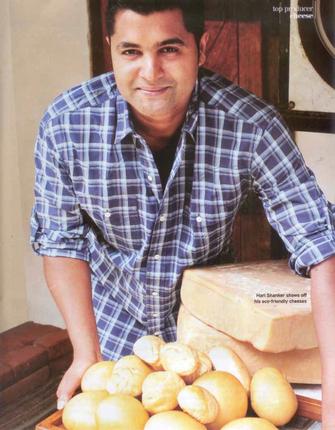
For four decades the “Kodai Cheese” brand has been popular for its special range and nutritious value. “We believe in creating our own brand and identity with value-added quality,” says Harisanker who now controls the business with his father G.S.Mani, who took over Kodi’s famous Cheese Factory from his father in 1977.
Harisanker./ Photo: Special Arrangement
The family has a word of mouth reputation to uphold and prides in producing boutique innovative cheese with techniques adopted from around the world.
What started from a rural village as a family-owned dairy with six suppliers in 1972 has grown in magnitude manufacturing 150 metric tonnes of cheese every year. In the beginning horse-drawn wagon collected 50 litres of milk per day, today 4,000 litres of milk goes into the making of Cheddar, Mozarella, Ricotta, the Blue cheese and the latest handmade Cambrie. The entire line is made with fresh antibiotic-free milk, experience and from authentic recipes in eco-friendly way, according to Harisanker. The whey created in the cheese making process is used for making organic compost for the entire vegetation, fodder, flowers, fruit and other trees grown on their property.
The KHMS Hospital
The Kodaikanal Health and Medical Services is a Trust formed by G.S.Mani with six other trustees to cater to the health and medical needs of the residents and visitors to Kodaikanal. The trust runs the 16-bed hospital established in 2009 and is equipped with a pathology lab for basic investigation facilities and essential facilities like the ICU, Operation Theatre, Ultrasound, X-ray machine, pharmacy and an ambulance. “The idea is to stabilise the patient here in case of an emergency before they can travel to a big hospital in Madurai or Dindigul,” says Lalitha Mani, who holds charge of administrative responsibilities. The hospital caters to 25,000 patients in a year and the treatment is highly subsidised.
source: http://www.thehindu.com / The Hindu / Home> Features> MetroPlus / by Soma Basu / Madurai – May 07th, 2015
Noted social worker Savithri Devanesen, who ran the organisation Roofs for the Roofless after the death of her legendary husband, Chandran Devanesen passed away at her residence in Chennai on Wednesday. She was 99 and is survived by two sons.
Her late husband Chandran was the first Indian to become principal of Madras Christian College, Tambaram. He founded Roofs for the Roofless in 1980 to ‘improve the quality of life for a better India’. After he passed away in 1982, Savithri took over the reins of the organisation.
Over the years, the organisation took up several programmes in villages on health, primary education, sanitation and environment protection. It now supports work in 18 villages. Persons close to the family said, Savithri till recently used to work in her office and inspected the villages where the projects and programmes were underway.
She is survived by her sons Dr Sudarshan Devanesen, a professor of family medicine who was honoured as the Member of the Order of Canada and Dr Dayalan Devanesen, director of Aboriginal Health, who too was honoured with the Member of Order of Australia. Savithri’s funeral service will be held on Thursday at 2 pm at the St. Andrews Church, the Kirk, and 4 pm at the Kilpauk Cemetery.
source: http://www.newindianexpress.com / The New Indian Express / Home> Cities> Chennai / by Express News Service / May 07th, 2015
Some of the country’s distinct arts and crafts awarded the prestigious Geographical Indications (GI) tag have, for the first time, been compiled in a book.
The GI tag, a form of intellectual property right, is distinct from other forms of intellectual property rights (IPR) as it ascribes exclusivity to the community in a defined geography rather than to an individual as in case of trademarks and patents.
Madras high court additional government pleader P Sanjai Gandhi in his ‘Arts and Crafts of India’ has collated and described 64 arts and crafts that have been accorded the prestigious tag.
Thanjavur doll, Madurai Sungudi Saree, Swamimalai Bronze Work, Arani Silk, Salem Silk and Fabrics, Kancheepuram Silk, Kovai Kora Cotton and Bhavani Jamkkalam Carpet are some of the products from Tamil Nadu detailed in the book.
It also describes the origins of Budithi Bell and Brass Metal Craft, Kondaoalli Bommalu (wooden toy), Nirmal paintings, toys and crafts, Pembarthi Metal Craft, Silver Filigree of Karimnagar, Siddipet Gollabama Sarees, Pochampally Ikat Fabrics and Machilipatnam Embroidery from Andrhra Pradesh as well as Karnataka’s Bidriware, Kinhal Toys, Mysore Rosewood Inlay, Ilkal Sarees, Molakalmuru Sarees, Mysore Silk, Kasuti Embroidery and Sandur Lambani Embroidery. Alleppey Coir, Aranmula Kannadi (metal mirror) and Screw pine craft from Kerala are also mentioned .
Highlighting the rich legacy of the products, the book, for instance, explains how the Swamimalai Bronze Icons of Tamil Nadu can be traced to the Chola period (850-1279 AD) and how Kancheepuram’s weavers manufactured silk sarees for the royal families of Chola and Pallava empires. Similarly, Kovai Kora Cotton of Coimbatore dates to the Vijaynagara Empire and the Madurai Sungudi Saree is traced to the 16th century Nayak dynasty. According to folklore, Aranmula Kannadi, a mirror made of metal alloys, was first made by bronze casters of Tirunelveli. Around 400 years ago, a priest from the Aranmula temple in Kerala brought them from Tamil Nadu.
We also learn, through the book, that Puneri Pagdi of Pune was first worn by Justice M G Ranade in the 18th century. Since then, it has been worn by leaders such as Lokmanya Tilak and D D Sathye.
The manufacturing of some products takes into account scientific principles. Thanajvur dolls are made on the concept of gravitational force. Perhaps, the process of making these dolls began long before Sir Issac Newton propounded the theory of gravitation.
source: http://www.timesofindia.indiatimes.com / The Times of India / Home> City> Chennai / by Manish Raj, TNN / May 04th, 2015
The Danish Fort, also called ‘Dansborg Fort’ at Tranquebar, built in 1620 AD. / Photo: T. Singaravelou / The Hindu
The National Archives of Denmark records that a fisherman from Karaikal was responsible for the modern history of Tranquebar.
On a glorious day in April 1620 AD., a Danish jaght (a three-masted, lightly armed merchant vessel of the 17 century), Øresund, was freebooting around Karaikal on the south-east coast of India, when a fleet of six galleys sent by Andre Botelho da Costa, the Portuguese governor of Jaffna, attacked it. Its captain, Roeland Crappe, and twelve of his crew escaped thanks to the aid of a fisherman.
A list of salaries found in the Danish National Archives reveals a stunning secret: “Cuti’s mother, a woman whose husband (was he also Cuti’s father?), saved the life of General Crappe when he lost his ship, Øresund, outside Carical” was paid one pardou every month for 25 years in gratitude for saving Crappe’s life. The jaght was totally wrecked, and the rest of the crew captured and murdered by the Portuguese. Two of the heads were displayed on stakes to warn the enemies. Earlier the jaght had captured several small Portuguese junks laden with rice and areca nuts on the east coast and auctioning goods with the permission of the king of Kandy.
Roeland Crappe managed to reach the court of Raghunatha Nayak at Tanjore, whom he had known earlier. Crappe must have expressed the wishes of his employer, Christian IV of Denmark, to set up trade relations in south-east Asia to Raghunatha Nayak. A letter by Raghunatha Nayak on a gold-foil asserts: “We order the creation of a port named Tharangampadi here and allow the export of pepper to that country (Denmark) as it is rare there.” A fisherman from Karaikal was thus responsible for the modern history of Tranquebar! Raghunatha Nayak signed the official treaty in Portuguese on November 19, 1620. Ove Gedde, a barely 23-year-old Admiral appointed by Christian IV, as the leader of a Danish fleet concluded the formal treaty on behalf of the Danes.
The National Archives in Copenhagen, Denmark, is a treasure house of records, dealing with the history of Tanjore and Tranquebar of 17 to 19 centuries. The Royal Library and the National Museum in Copenhagen house more than 350 palm-leaf collections from India from old almanacs to the diaries of local catechists to Arunachala Kavirayar’s Rama Natakam. As is often said, history is usually written by the conquerors and thus becomes one-sided. When available, history needs to be studied from both sides — and here the records in Denmark come as a great help.
Most historians assume that Raghunatha Nayak ruled between 1600 and 1634. Vriddhagirisan, an authority on the Nayaks of Tanjore, writes: “Considering the duration of all the individual reigns of the Tanjore Nayaks, it becomes evident that Raghunatha, the most illustrious ruler of this family had but a relatively short reign and his death will have to be placed about AD 1634.” On the question of who succeeded Raghunatha Nayak, Indian historians disagree. On the successor to the throne, Vriddhagirisan assumes that it was Vijayaraghava Nayak. He writes: “Vijayaraghava’s accession must have taken place in the year 1633 and that it was celebrated sometime before the death of Raghunatha.” There are many claims and counter-claims. Vriddhagirisan mentions two sons of Raghunatha, namely Achyuta and Ramabhadra, and Vijayaraghava would appear to the eldest son according to the genealogy given in the Raghunathabhudayam of Vijayaraghava Nayak. At the same time, Vriddhagirisan also cites a Jesuit letter: “Two brothers of the (Vijayaraghava) Nayaka, whom he had shut up in prison, after pulling out their eyes to remove all possibility of succeeding him… Ramabhadra could not have been on the direct line of succession… it is not quite known for certain, that Achyuta Vijayaraghava was also called Achyuta Ramabhadra.”
Tranquebar (Tharangampadi) celebrated its 395th year of its Danish connections in April this year.
The Danish records are certain. Ove Gedde left three diaries after his strenuous voyage. He noted down everything. These diaries were then transcribed by Johann Heinrich Schlegel and are available as Google books. On November 4, 1620, Gedde notes, “I paid a visit to the eldest son of the Nayak and the throne follower, who requested me to visit him often.” On November 7: “the same day, the Nayak requested me to visit his middle son, who had complained that I had not paid him a visit.” It is obvious that Raghunatha Nayak had at least three sons. Citing a letter from Roeland Crappe written on September 17, 1628 from Masulipatnam (the original letter is in the Archives), Schlegel writes: “Ragnato Naiche died early on 25 November 1626 and cremated the same day with 119 of his wives. His eldest son Rambadra succeeded him to the throne, and came with 100 men to the fortification of Dansburg (in Tranquebar) (Johann Heinrich Schlegel, Samlung zur Dänischen Geschichte, Münzkenntniss, Oekonomie und Sprache, Erster band, Viertes Stück, pp. 162-163).”
Hidden in the National Archives in Copenhagen for almost 400 years, there is an innocuous letter from Christian IV written from his castle at Frederiksborg on April 11, 1631. The letter affirms the affection of the King to the Nayak of Tanjore, and expresses his wish for a continuation of the relationship between the two countries. The letter itself is not significant — the Addressee is: “The mighty, royal Prince Ramabadro Naico, King of Tanjore, our specially good friend!” Evidently, after the death of Raghunatha Nayak in 1626, Ramabhadra Nayak succeeded his father until he was gruesomely relieved of his post by his younger brother, Achutha Vijaya Raghava Nayak in 1634 AD.
P.S. Ramanujam is Professor Emeritus in the Technical University of Denmark, Roskilde, Denmark. psramanujam@gmail.com
source: http://www.thehindu.com / The Hindu / Home> Features> Magazine / by P.S. Ramanujam / May 02nd, 2015
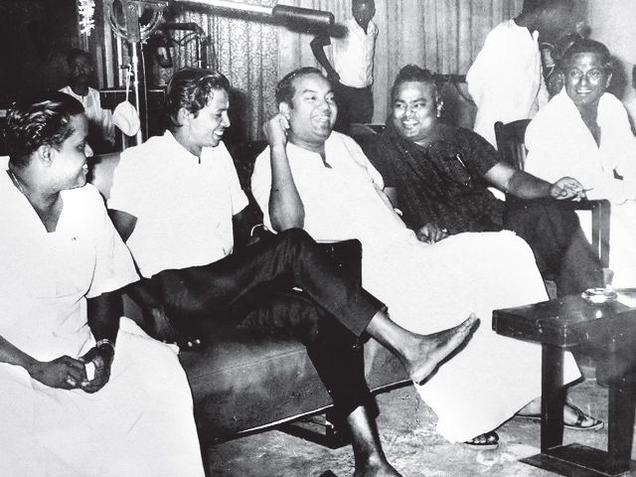
An old photograph of singer Sirkazhi Govindarajan, film director C.V. Rajendran, poet Kannadasan, writer Jayakanthan and music composer M.S. Viswanathan exhibited at the Russian Cultural Centre. Photo: M. Vedhan / The Hindu
Photographs of Jayakanthan preserved by the last librarian of Russian Cultural Centre on display.
A writer who transcended all literary genres; a fiery orator who spoke his mind; a film-maker who experimented with cinema, and a politician — a photo exhibition at the Russian Cultural Centre here offers glimpses into the life of Jayakanthan.
Seated with him in a photograph are poet and lyricist Kannadasan, music director M.S. Viswanathan, playback singer Sirkazhi Govindarajan and film director C.V. Rajendran. But, even those who moved closely with Jayakanthan for decades were not able to identify the occasion on which it was taken.
“Kannadasan wrote the title song for the film Yarukkaka Azhuthan and M.S. Viswanathan scored the music for Sila Nerangalil Sila Manitharkal and Oru Nadigai Nadagam Paarkiral. Kannadasan and Jayakanthan, who worked together in the Congress, planned to make a movie, Nyayam Ketkirom. However, it did not materialise,” said P.S. Kuppusamy, a friend of Jayakanthan since 1965 and who travelled with him the length and breadth of Tamil Nadu.
The exhibition got its collection from the library run by the Russian Cultural Centre.
When it was closed down in 1991 after the disintegration of Soviet Union, P. Thangappan, the last librarian, preserved the photographs.
“Though many pictures can be dated back to the 1960s, one of the important events was the release of his political memoirs, Oru Ilakkiyavathiyin Arasiyal Anubhavangal. It was attended by Kamaraj. We have used 54 pictures among the many in our possession for the exhibition,” said Mr. Thangappan, general secretary of the Indo-Russian Cultural and Friendship Society.
Even though he became a vociferous Congress supporter, Jayakanthan shared a dais with Communist leader and his mentor K. Baladhandayutham and a young D. Pandian, indicating his political roots.
He never missed an opportunity to take a snipe at the Dravidian movement and even bluntly told Chief Minister M.G. Ramachandran that if he was keen on meeting him he could do so at his residence.
However, he changed with times —from Jayakanthan with an “I-don’t-care attitude and look to a soft spoken man —and became very close to DMK leader M. Karunanidhi.
It was Jayakanthan who first brought Mr. Karunanidhi to the Russian Cultural Centre to inaugurate the office of Indo-Russian Cultural and Friendship Society.
source: http://www.thehindu.com / The Hindu / Home> National> TamilNadu / by B. Kolappan / Chennai – May 02nd, 2015
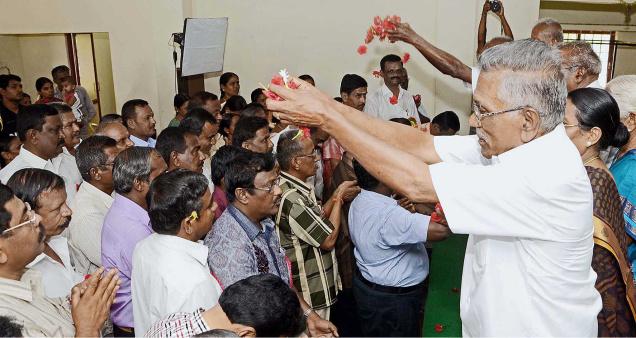
Alumni of Government High School, Chithode, receive blessings from teachers of their days on Sunday.— PHOTO: M. GOVARTHAN
Incidences of teachers appreciating kind gestures of students may not be unusual. But, the situation was refreshingly different on Sunday when 80-year-old retired teachers were overwhelmed by the affection showered on them by their students of the Government High School, Chithode, who had organised a get-together after 36 years.
For, the ‘students’ had driven home the point that respect for teachers would remain all through life. According to the octogenarian speakers, the get-together would well serve as a pointer to the current generation of students on holding teachers in high esteem forever.
It was a family get-together most of the students of the 1977-78 batch kept date with high anticipation. Seventy seven of the 88 students of the SSLC batch turned up. Of them, Nalini, who is settled in the USA, flew down with her husband Shanmugam, a textile consultant. The meeting also had the presence of Deputy Mayor K.C. Palanichamy whose wife Nirmala was a batch mate.
There are certain niceties in life that would linger in the mind forever, and the get-together is one such, according to A. Velliangiri, a LAWYER in Erode district, who, along with his Karur-based batch mate Maheshwaran was instrumental in the success of the get-together.
They gathered the phone numbers of all their batch mates and even undertook personal visits to make the get-together happen. About half of the batch mates had grandchildren, but had no qualms reliving their student days in jovial mood for the few hours they were together. Five of their teachers had died due to old age. Nine of the eleven teachers turned up to bless their students collectively by showering flower petals.
To set an example worthy of emulation, the old batch of students has decided to make the get-together an annual affair.
source: http://www.thehindu.com / The Hindu / Home> News> National> Tamil Nadu / by R. KrishnaMoorthy / Erode – May 04th, 2015
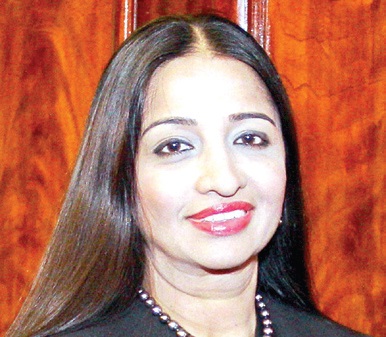
She has lived the immigrant dream — a journey from a one-room house in Alwarpet and a childhood learning classical dance to becoming a criminal court judge in New York City. The first Indian-origin woman at that.
Chennai-born Raja Rajeswari now hopes to ensure that the multi-ethnic population, the foundation of New York City, is treated fairly, while she also balances her other passion in life — dance.
Having migrated to the US aged 16, Rajeswari, now 43, worked at the Richmond County DA’s Office her entire career before being sworn in as a judge by NYC mayor Bill de Blasio on April 27. Her childhood experiences growing up in Chennai, her career as a prosecutor, her early observations of gender inequality, influences from her mother who was a dancer — Rajeswari believes all these paved the way for her successful career.
“I had a wonderful childhood. We were a low income household, and I was an only child. We did not have a lot of money but our lives were filled with dance and music,” she says, speaking to Express in an e-mail interview. Reminiscing about her mother who was a dance instructor, and her father who was an office clerk, she calls him a ‘gentle soul who resembled Mahatma Gandhi in looks and philosophy’.
Having lost her mother in an accident when she was 18, and her father to cancer in 2013, it was Rajeswari’s promise to her dad during their last conversation that prompted her to become a judge. “My mother bequeathed me her love of dance and the belief that the world can become a better place if there is even one person who cared enough,” she says.
And dance it was, that first brought her to New York.
Rajeswari had started dancing at fundraising events as a toddler, teaching dance at the age of 10, and receiving a government research scholarship at the age of 14. After doing her advanced studies in Kalakshetra for Bharatanatyam and also learning Kuchipudi, she travelled with her mother Padma Ramanathan dance troupe to several countries. In 1988, it was on the last leg of a dance tour she came to the city where she would live her life.
“At 16, I had traversed the planet and realised how the treatment of women made an impact on me. I decided to stay in New York and pursue my education in a country where women got equal opportunities,” she says.
Living The American Dream & How
Her cultural background and multilingualism, is what she believes, greatly helped her career as she dealt with various ethnic backgrounds in domestic violence and sexual abuse cases.
“My personal experience of growing up in a third world country provided me with insight into understanding the social stigma of accusing one’s husband or boyfriend in certain cultures,” she says.
Through her appointment, she hopes to follow in the footsteps of those who brought ethnic diversity to the bench, besides standing by her firm belief that the rights of the defendant are sacrosanct and can never be trespassed.
“I cringe every time I read about another defendant who has been exonerated after spending decades in prison for a crime he did not commit,” she says.
The speed and equal access to justice administered in the US, she says, is something to take note of; though not perfect, it is still much more efficient than the legal system in India.
Speaking about cases like the Delhi gang-rape, she says that unless we deal with ingrained social prejudices and discrimination against women, we will never be able to achieve our potential.
“Unless there is a gruesome death, no one pays attention to the victimisation of women. The woman or children rarely report these crimes because they know they are never going to be taken seriously and would be blamed and shunned by the society.”
Being an immigrant in a bustling city like New York, Rajeswari has worked her way up through several trials and is a firm believer in the American criminal justice system, which she considers the best in the world since it affords every person, regardless of sex, race, colour, sexual orientation and social standing, an opportunity to seek justice.
“As an immigrant you have incredible opportunities in this country but you have to be able and willing to work really hard and constantly prove yourself,” she says.
If a female immigrant from a city in South India can make history by becoming the first South Asian female judge in New York City, Rajeswari believes, there is hope for every female who aspires to higher office in India and abroad.
source: http://www.newindianexpress.com / The New Indian Express / Home> Cities> Chennai / by Archita Suranarayanan / ENS / May 02nd, 2015