Nobel laureate Sir Venkatraman Ramakrishnan to head Royal Society in UK

Nobel laureate Sir Venkatraman Ramakrishnan has been confirmed as president elect of Britain’s prestigious Royal Society. Ramakrishnan, who will be the first Indian-origin scientist to hold the post, was born in Chidambaram, Tamil Nadu, and studied biology in the US.

The result of a ballot held by the fellowship was confirmed at a meeting of the Society’s Council this week and Ramakrishnan, or Venki as he is popularly known, will take up the post on December 1, 2015, PTI reported.

“I feel very touched that the Royal Society has chosen me for this job, especially because I only came to Britain 16 years ago from the US,” said the 63-year-old structural biologist who shared the 2009 chemistry Nobel Prize for discovering the precise structure of ribosomes ? the molecular machines that manufacture proteins inside all living cells.

“I think in some ways the Royal Society, ever since its inception, has reflected the best traditions of openness in Britain. I think of Britain as a particularly open and tolerant society,” he told BBC.

He is currently deputy director of the British Medical Research Council’s Laboratory of Molecular Biology at Cambridge University.

He was elected a Fellow of the Royal Society in 2003 and was knighted by Britain’s Queen in 2012.

The Royal Society dates back to 1660 and its president is a key advocate for science in the UK and the world.

Previous presidents of the Royal Society have included Isaac Newton, Christopher Wren, Samuel Pepys, Joseph Banks, Humphry Davy, and Ernest Rutherford.

Ramakrishnan?will succeed geneticist Sir Paul Nurse, also a Nobel laureate.

“Appointing the first Indian-born president of the Royal Society sends a strong message about the importance of the contribution of immigrants to British science,” said Blakemore, a Royal Society Fellow from the School of Advanced Study, University of London.

The research for which Ramakrishnan shared the Nobel was commenced in the US, where he has spent much of his working life before moving to Cambridge in 1999. He shared the prize with Thomas Steitz, of Yale University, and Ada Yonath, of the Weizmann Institute of Science, Jerusalem.

The award recognised the team working out, between 2000 and 2002, the exact structure of a key part of the ribosome, the tiny molecular machine ? found in the cells of our body ? that turns the genetic code of living beings into the proteins from which they are made.

“I knew the ribosome was going to be the focus of Nobel prizes. It stands at the crossroads of biology, between the gene and what comes out of the gene. But I had convinced myself I was not going to be a winner,” he said of his award.

In winning the prize, Venki became the 13th member of staff of Cambridge’s Laboratory of Molecular Biology to win a Nobel; previous winners include Crick and Watson, discoverers of the structure of DNA.
source: http://www.indiatoday.intoday.in / Indiatoday.in / Home> World / New Delhi – March 20th, 2015

An intimate portrait of the city’s many facets


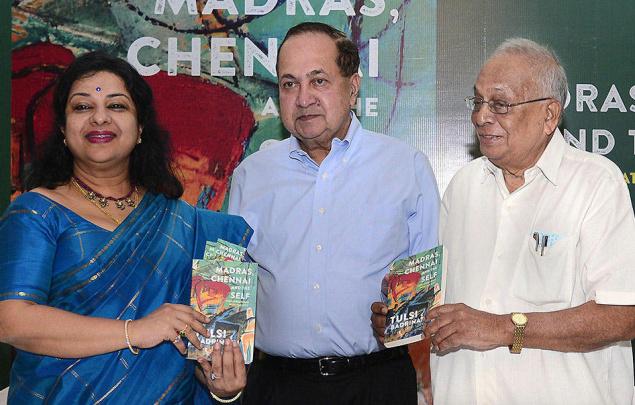
(From left) author Tulsi Badrinath, N. Ram and S. Muthiah at the book release function. Photo: R. Ravindran

‘Madras, Chennai and the Self: Conversations with the City’, a book that explores the metropolis through the personal stories of an eclectic cluster of 12 individuals, was launched on Wednesday.

The author Tulsi Badrinath paints a portrait of a city that is both rooted in tradition and dynamically modern. Launching the book, N. Ram, chairman, Kasturi and Sons Ltd., said, “There is a certain familiarity when one reads the book, but there are also many surprises that the author brings out through her writing.”

Historian S. Muthiah, who received the first copy of the book, said, “This book is by far the best among all the writing on Madras. It is a literary work on how the author sees the city of Chennai through the conversations she has with many people who call this place home.”

Some of the personalities featured are Dalit writer and activist P. Sivakami, the Prince of Arcot Nawab Mohammed Abdul Ali, actor Vikram and priest and karate enthusiast K. Seshadri to name a few. By bringing together disparate narratives of people and the spaces they inhabit, Ms. Badrinath attempts to capture the flavour of a city that is both intimate and contemporary.

The book launch concluded with a panel discussion with chronicler Sriram V. and scholar A.R. Venkatachalapathy interacting with the author.

source: http://www.thehindu.com / The Hindu / Home> News> Cities> Chennai / by Staff Reporter / Chennai – March 19th, 2015

Museum to Come up on MMC Campus

Chennai :

After a brief lull, efforts to convert the Institute of Anatomy building at Madras Medical College into a full-pledged museum have gained pace. A seven-member “core committee” headed by college Dr R Vimala, has been formed recently to work out the design and suggest the kind of exhibits.

The decision to have a fullfledged museum was taken after the anatomy department was shifted to the new campus on the erstwhile Central prison premises in 2013.

Dr R Vimala  said the museum would have exhibits of evolution of medicine at MMC, rare photographs, British-era certificates and documents, history of doyens of the alumni and historical events of the college. Also old equipment, medical devices would occupy a place. “We are looking forward to contribution of rare pictures of relevance to this Institution. Soon we will create a new email id, enabling people to share,” she added.

Speaking to reporters on Monday, Dr Sudha Seshayyan, Director, MMC Institute of Anatomy, said the heritage structure, popularly known as ‘Red Fort’, would not be disturbed.  Only renovation to rectify the damages would be done. “We also seek help from government curator for maintaining the museum. Now, there are more than 1,000 specimens of which a few are century-old precious possessions. So funds for renovation works are invited. Once ready, it will be open for doctors, medical students and the public,” she added.

Meanwhile, MMC alumni, starting from 1961 batch, have donated Rs 2 lakh till Saturday, giving hope that funds will pour in.

Dr Sudha further said names of people donating above Rs 5 lakh would be inscribed on a plaque. It is estimated that the work for the conversion into museum would take another two years.

source: http://www.newindianexpress.com / The New Indian Express / Home> States> Tamil Nadu / by Express News Service / March 17th, 2015

Vidya Sagar celebrates 30th anniversary

Chennai :

After schools repeatedly denied admissions to her son because he had cerebral palsy, Poonam Natarajan decided to work with what she had. She got trained as a special educator to teach her son and from the garage of her house on Arcot Road in T Nagar, in 1985 Natarajan began with three students and two staff. That was the beginning of Vidya Sagar that completed 30 years on Sunday.

The city’s pioneering organization that works with children and young adults with disabilities later moved to Kotturpuram in 1996 and now have close to 4,000 students across the country. As the school grew, Natarajan lost her son when he was 22. Did she foresee that Vidya Sagar would nurture people with disabilities for three decades? “Yes, it was a step by step process and I did know it would be an organization that continues to do great work,” says Natarajan who left the oganisation in early 2000s to become the chair of a statutory body constituted by the Ministry of Social Justice and Empowerment. “I am the founder but I came like a parent visiting to celebrate.”

An alumni association and a website that exclusively tells stories of their alumni was launched on the 30th anniversary Sunday to celebrate their past students. “The website isn’t a profile but it documents every student’s challenges, how they met the challenges, their milestones and memories with Vidya Sagar,” says deputy director, Dipti Bhatia.

“Many parents also are empowered over the course of time and start their own initiatives or community activities”

The website features 69 alumni students and will feature more over the year. “We are celebrating our students who come in with various disabilities from mild to profound,” Bhatia says. The organisation’s alumni had together launched the association saying it was for them to network and help each other. This was followed by a carnival for their students. Vidya Sagar provides education for children with neurological disabilities, and work in rehabilitation, advocacy and training.

source: http://www.timesofindia.indiatimes.com / The Times of India / Home> City> Chennai / TNN / March 16th, 2015

Accounting company releases documentary

Venture is part of Corporate Social Responsibility initiatives of the service provider

Vitae International, an accounting service provider that has its Corporate office here, has released a documentary titled “The Power of Love and Commitment-The Jethro Daniel Story”, as part of their Corporate Social Responsibility initiatives.

The documentary is an effort to create awareness on cerebral palsy.

Daniel Victor, Managing Director of Vitae, told presspersons here on Wednesday the company has started and supports about 10 organisations that work in the areas of environment, care for senior citizens and infrastructure development in and around Coimbatore. The documentary will be available on social media and television channels shortly. It is a story of Jethro Daniel, son of Mr. Victor, who is affected with cerebral palsy and microcephaly.

Mr. Victor said that the company spent about Rs. 40 lakh towards CSR projects in 2013-2014.

It services 17 accounting firms in several countries, including Australia, the U.K. and the U.S. and its annual turnover is Rs. 15 crore. It has plans to expand to more countries taking its client base to 25 or 30 soon.

Documentary creates awareness on cerebral palsy

source: http://www.thehindu.com / The Hindu / Home> News> Cities> Coimbatore / by Staff Reporter / Coimbatore – March 19th, 2015

Narada Gana Sabha founder Krishnaswamy dead at 79

Chennai :

R Krishnaswamy, secretary of the famous Narada Gana Sabha, passed away in the city on Wednesday. He was 79 and is survived by his wife and two sons.

“The end came at 3am at a Mylapore hospital. His body will be cremated on Thursday,” said sabha treasurer M Ravichandran.

A lawyer, Krishnaswamy was one of those responsible for establishing the sabha in 1958 and since then has been the secretary.

A classmate of veteran actor Cho S Ramaswamy, Krishnaswamy was responsible for introducing plays at the sabha and also helped popularize namasankeerthans during the music seasons.

“Krishnaswamy was among the trinity of sabha secretaries along with R Yegnaraman of Krishna Gana Sabha and Rajagopal of Karthik Fine Arts who contributed towards the growth of the December music season over the years,” said Krishna Gana Sabha secretary Y Prabhu.

He strived to get land for the sabha in the initial days and partnered Indian Overseas Bank in constructing the building. It was due to his personal interest that the sabha hosted several programmes throughout the year, said Prabhu.

“It is great loss to the Carnatic music world. Krishnaswamy had good words for youngsters which was a great encouragement,” said vocalist Sudha Ragunathan.

source: http://www.timesofindia.indiatimes.com / The Times of India / Home> City> Chennai / TNN / March 19th, 2015

Spirit of entrepreneurship has no age

The 78-year-old’s unit employs many women, including his daughters

T.P. Rajendran working in his 'vaththal' factory in Aruldosspuram in Madurai.Photo: R. Ashok
T.P. Rajendran working in his ‘vaththal’ factory in Aruldosspuram in Madurai.Photo: R. Ashok

Ask for ‘Vaththal Thatha,’ even a child in Sellur will take you to where he is. A road in Aruldosspuram is named after his business, ‘Tirupati Vilas.’ Tonnes of papad, vaththal and vadagam leave his factory to several States and outside India every month. At 78, T.P. Rajendran of Ahimsapuram in Sellur is an example of how spirit of entrepreneurship can win over age.

A drop-out in fifth standard, Mr. Rajendran wanted to do something on his own while working in a dhal mill in Virudhunagar for a salary of 10 annas. He came to Sellur in the 1960s with his wife and started a grocery shop by pledging her jewels for Rs. 300. He added vegetables to the shop but the leftovers posed a problem. The ‘vaththal’ made of unsold vegetables was a hit and soon the family of five, including three daughters, started to produce several ‘vaththal’ varieties.

The actual break came in 2005 when he procured a machine from Gujarat to produce papads. Since then, Tirupati Vaththal Company has been producing the accompaniments to daily food in different forms. The range includes 30 varieties made from rice, wheat, corn, ragi, potato, brinjal, onion, chilli and cashew. Most of them are made by hand under his supervision.

Mr. Rajendran starts his day at 4 a.m. by monitoring the wholesale vegetable market at Paravai through his mobile phone. If need be, he goes to the market to select the vegetables and other ingredients.

He reaches his factory by 8 a.m. to experiment new combinations. Every batch of ‘vaththal’ is first tested by him during lunch and production goes in full stream after his nod. His unit provides employment to many women, including his daughters. But the salary for them is on a par with that of others. He takes his employees on a free tour twice a year.

Mr. Rajendran, who provides free training to college students in papad making, firmly believes that hard work, honesty and quality make a successful entrepreneur.

source: http://www.thehindu.com / The Hindu / Home> News> Cities> Madurai / by S. Annamalai / Madurai – March 18th, 2015

2,200-yr-old Stone Mace Head Found

Cuddalore :

In a rare discovery, researchers from the Annamalai University history department have found a 2,200-year-old stone mace head at Marungur village near Neyveli.

It is believed that ancient people used the mace as a tool for both hunting and agricultural purposes. The wooden staff attached to the mace head allowed the tool to be used as a weapon.

Sivaramakrishnan, an assistant professor hoped that further research would lead to more findings.

source: http://www.newindianexpress.com / The New Indian Express / Home> States> Tamil Nadu / by Express News Service / March 18th, 2015

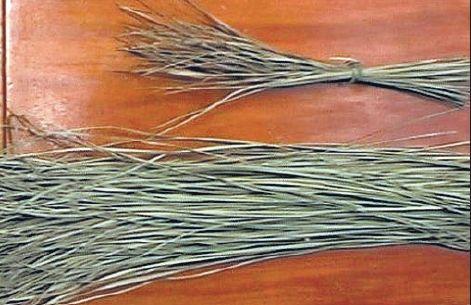
‘Darbha’ grass, a natural preservative

Darbha (Desmotachya bipinnata) is a tropical grass considered a sacred material in Vedic scriptures and is said to purify the offerings during such rituals.


Darbha (Desmotachya bipinnata) is a tropical grass considered a sacred material in Vedic scriptures and is said to purify the offerings during such rituals.

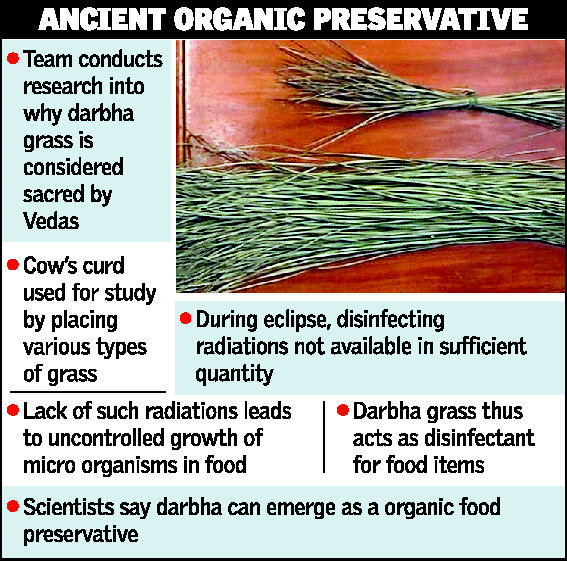
Traditional tropical grass, Darbha, has been identified as an eco-friendly food preservative.

This finding was evolved in a research study undertaken jointly by the Centre for Nanotechnology and Advanced Biomaterials (CeNTAB) and the Centre for Advanced Research in Indian System of Medicine (CARISM) of the SASTRA University, Thanjavur, under the supervision of Dr. P. Meera and Dr. P. Brindha respectively.

AncientDarbhaC F19mar2015

Darbha (Desmotachya bipinnata) is a tropical grass considered a sacred material in Vedic scriptures and is said to purify the offerings during such rituals.

At the time of eclipse, people place that grass in food items that could ferment and once the eclipse ends the grass is removed.

A systematic research was conducted by the SASTRA University researchers, in which cow’s curd was chosen as a food item that could ferment easily.

Five other tropical grass species, including lemon grass, Bermuda grass, and bamboo were chosen for comparison based on different levels of antibiotic properties and hydro phobicity.

Electron microscopy of different grasses revealed stunning nano-patterns and hierarchical nano or micro structures in darbha grass while they were absent in other grasses.

On studying the effect of various grasses on the microbial community of the curd, darbha grass alone was found to attract enormous number of bacteria into the hierarchical surface features.

These are the bacteria responsible for fermentation of cow’s curd.

During eclipse, the wavelength and intensity of light radiations available on the earth’s surface is altered. Especially, the blue and ultraviolet radiations, which are known for their natural disinfecting property, are not available in sufficient quantities during eclipse.

This leads to uncontrolled growth of micro-organisms in food products during eclipse and the food products are not suitable for consumption. Darbha was thus used as a natural disinfectant on specific occasions, say researchers at SASTRA University.

Further, the scientists say that darbha could be used as a natural food preservative in place of harmful chemical preservatives and the artificial surfaces mimicking the hierarchical nano patterns on the surface of darbha grass could find applications in health care where sterile conditions were required.

This entire research was funded by the SASTRA University’s Research Fund.

source: http://www.thehindu.com / The Hindu / Home> News> Cities> Tiruchirapalli / by L. Renganathan / Thanjavur – March 16th, 2015

Buckles All Around, Thanks to British Collector

Madurai : 

What can be in a name, particulary when it sounds unfamiliar, lacking in local cultural resonance? Well, some local history behind it. Buckle was one such name that is completely alien to Tamil Nadu but has come to stay for various reasons said historian Venkatraman, a native of Thoothukudi district, at an INTACH (Indian Natural Trust for Art and Cultural Heritage) meeting here recently.

Quite common in the southern district, particularly in the coastal areas, Buckle cuts through caste divides though not many know how the name came into currency. “Before I joined the teaching profession I was managing a salt pan along in Thoothukudi town when I came across this name,” he recalled. “Some Dalits working in our salt pan answered the name Buckle – either Buckle or Buckle Durai. Out of curiosity, I asked them the meaning behind the name and they drew a blank. Then my father explained the history behind it,” said Venkatraman, who retired as history professor from Madurai Kamaraj University.

He had also come across the name among students when he taught at Aditanar College of Arts and Science in Tiruchendur.

Folklorist V  Sivasubramanian came across Buckles when he worked as a tutor in the Tamil department of VOC Arts and Science College. “While correcting an examination paper, I saw the name Buckle Durai. But the student belonged to the Nadar community,” he said.

“Many Nadar families in Srivaikundam, Tiruchendur and Sathankulam named their children  Buckle along with the caste title Nadar. It is very common among the agricultural families among our community,” said Murali, a businessman from Thoothukudi town.

Well, Buckle has its origin from R K Puckle, a popular, visionary and benevolent British Collector of the old Tirunelveli district. He served the region 160 years ago, when he built the Srivaikundam dam. Since all communities benefited from the Srivaikundam dam, Puckle caught the fancy of all communities.

Dalit writer, P Sridhar Ganesan, has named the protagonist of his Tamil novel, ‘Vangal’, as Puckle. He said that when he went to his wife’s village Muthuammallpuram Cheri, a coastal hamlet, he met two elders with the name Buckle. ‘During my interaction with the villagers, I learnt that the people were proud to name their children after Puckle, who enaged Dalits to work in his horse wagon,’ Ganesan said.

Collector Puckle was the collector and settlement officer. For building the Srivaikundam dam, he collected Rs 20,000 from the farmers. He also liberated Dalits from forced labour in the region, Sivasumramaniam said. He also constructed a canal to drain rainwater and saved the placed from flooding, said Venkatraman.

All these legendary work done by the collector had endeared him to the local people, whose descendents still pay their tributes by naming children Buckle. It does not matter that many of the Buckles do not know the origin of their name

source: http://www.newindianexpress.com / The New Indian Express / Home> States> Tamil Nadu / by Gokul Vannan / March 18th, 2015