IndiaFilings.com a leading online portal launched India’s first mobile application for company registration, trademark registration and tax registration. The mobile app was released by K Rosaiah, Governor of Tamil Nadu.
IndiaFilings mobile app is designed to help Entrepreneurs with their business registration, provide alerts on regulatory dues and connect an Entrepreneur with financial & legal experts, when required.
Speaking about the application, Lionel Charles, CEO and Founder said “Businesses are becoming increasingly mobile with the penetration of smart phones in India. Entrepreneurs now wish to keep track of their business using their mobile phones and our app will help full-fill their wishes.”
source: http://www.newindianeexpress.com / The New Indian Express / Home> Cities> Chennai / by Express News Service / March 05th, 2015
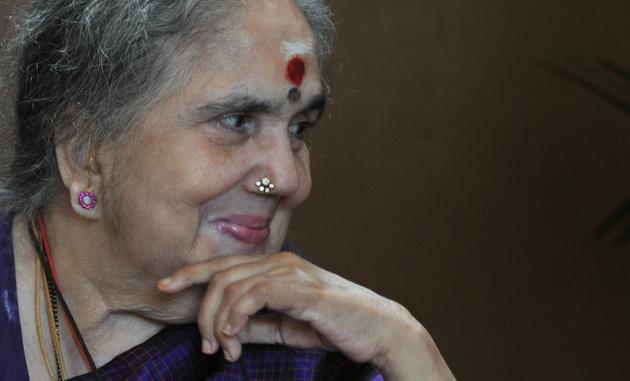
Radha Viswanathan re-lives moments of living and performing with an icon, to Ranjani Govind.
“It’s comforting to see my grand-daughter Aishwarya become a serious performer. I remember the days when I would wonder whether there would be anyone in the family to carry the legacy forward. My prayers seem to be answered,” says the 80-year-old Radha Viswanathan, daughter of M.S. Subbulakshmi, during a recent interview in Bengaluru.
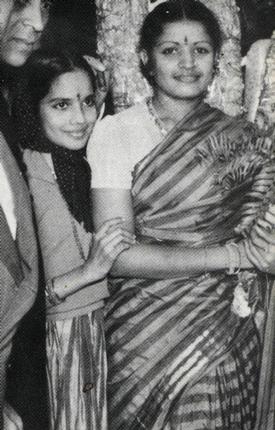
A young Radha with MS.
Radha was recently honoured during the release of an album of a nearly 40-year-old soundtrack of MS and hers, in Bengaluru, with veteran mridangam vidwan T.K. Murthy and former ISRO chairman K. Radhakrishnan participating. The album was recorded in Mumbai by the National Centre of Performing Arts (NCPA) and is now being brought out in association with Sony Music.
Radha is happy that the rare gems from the 1970s, was now being shared with rasikas. “It is a historic occasion for our family.”
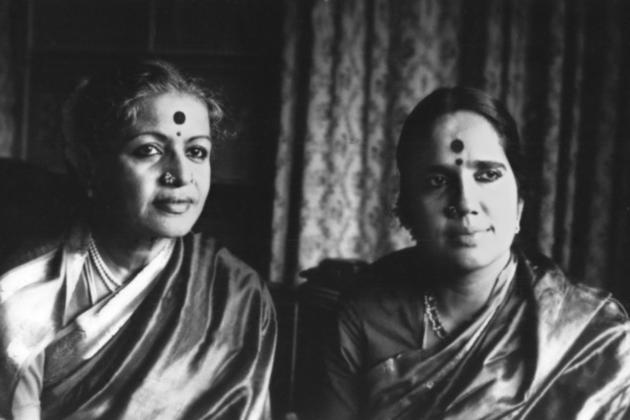
Radha, who accompanied her mother for over 60 years, be it at live concerts or recordings, cherishes every memory of the time she spent with her iconic mother. “I was blessed to have a mother who was an embodiment of compassion,” she says, as she gets nostalgic. Radha’s mobility might have been restricted to a wheelchair owing to several health issues, but her zest for life, passion for music and elephantine memory keep her as youthful as ever. She can leave you stumped with her recollection of events, rolling back to instances when as a four-year-old she remembered the time when MS entered her family.
MS and Radha. The Hindu Archives
Talking about her computer-like memory, Radha says, “Storing information is inherent to my persona. Every time I sang a kriti leant instantly at class, Semmangudi mama would say, ‘You have a camphor-like brain, catching everything instantly!’” recalls Radha, who always made notations of the trickiest of sangatis.
Looking settled in her son V. Shrinivasan’s home, the contentment is apparent on her still radiant face. “It’s rewarding to have taught Aishwarya nearly 500 kritis. Do you realise that it is authentic Semmangudi, Musiri and T. Brinda schooling that I have passed on? My younger grand-daughter Saundarya too is catching up,” she says.
But why didn’t MS train other students? “My mother was too busy an artist to teach. She was incredibly humble and used to continuously learn from others and considered herself a student all her life,” says Radha. There were instances when Radha learnt from Semmangudi Srinivasa Iyer as MS was too busy. Radha would later sing what she had learnt to her mother. “In fact, we practised together to get the nuances right,” she remembers.
Radha stepped on to the music platform as a four-year-old, singing tail-enders or the so-called ‘tukkadas.’ “That was the beginning of my musical journey. But later I learnt from Mayavaram Krishna Iyer and GNB’s sishya, T.R Balu,” she says. Once when MS was unwell, Musiri came visiting. Radha had then sung ‘Saraseeruha’ in Nattai and ‘Sudhamayi’ in Amruthavarshini. Fourteen years later, when the same kritis were presented at the Central College of Music where Musiri was the principal, he remembered, “I recall Radha singing these kritis as a six-year-old. Even then, I knew she would go a long way.”
It was Musiri who had advised them about the importance of ‘voice synchrony;’ he had told Radha, “Your voice should blend with MS’s and sound like a single, integrated tenor.” No wonder their Vishnu Sahasranamam recording is known for this quality! “In the line, “Amaaani Maanado Maanyo,” when MS briefly stopped to take a breath, it had to be re-recorded, but Amma insisted it be left alone. ‘Let people know that Radha sang along,’ Amma said.”
What was special as far as their voice experimentation was concerned were the lessons that MS and Radha got from T. Brinda and T. Muktha, who had by then set a trend in high-and low-octave singing. Kritis such as ‘Janani Ninnuvina’ in Ritigowla, ‘Raave Himagiri’ in Thodi and ‘Teera teeyaga raada’ in Gowlipantu that saw MS taking to the base and Radha singing in the higher octaves, became a rage with audiences.
Father Sadasivam’s love for dance saw Radha and Anandi (daughter of Kalki Krishnamurthy) team up and learn Bharatanatyam from Vazhuvoor Ramaiah Pillai. Her ability to learn and absorb was so amazing that Radha had her arangetram, along with Anandi, as an 11-year-old! They performed to packed audiences, effortlessly. “Even here, Amma would sing padams for us. Who can forget the rave reviews that the two got for their superb pairing in ‘Maalai Pozhudinilae’ and ‘Thayae Yashoda’?
Says Radha’s son, Shrinivasan, “In 2010, when my mother was asked to do abhinaya at the Cleveland Tyagaraja Aradhana, she obliged and left the the audiences in tears. And mind you, she was sitting all the while!”
It was her love for song and dance that Radha saw act as the young Bharatan in ‘Shakuntalai’ in 1940 and as Bala Meera in ‘Meera’ in 1946. “By the time, the Hindi version came, I had grown taller and so I did not act in it,” she says. When Radha was13, she had led the chorus in ‘Meera’ and had the music director Bhattacharya refer to her as ‘my boss.’
Born in 1934, December 11, in Gobichettipalayam, Radha was married to Viswanathan and went to Ahmedabad. But Radha’s passion for music and MS’s need for a vocal support soon brought them together and they travelled the world and became ambassadors of Carnatic music.
From Radha’s memory bank
* MS always advised me and my sister Vijaya to have a smile on our faces while singing.
* We took classes from Semmangudi, Musiri, Brinda-Muktha, K.V. Narayanaswamy, Siddeshwari Devi in Hindustani, Sandhyavandanam Srinivasa Rao and Meera bhajans from Dilip Kumar Roy.
* Radha still remembers the first concert at The Music Academy. Prime Minister Nehru was to inaugurate. The Udaipur Maharaja, mesmerised by our Kalyani rendering, had offered MS his kingdom!
* She recalls MS’s ‘never-question’ attitude towards her father Sadasivam’s ‘concert listing’ as a mark of respect for his knowledge and intuitive knack of planning.
* Once, Radha danced in front of Mahatma Gandhi with MS singing ‘Ghana Shyam Aaaye Re’ at the Birla House in Delhi. “And Gandhiji really enjoyed my performance!”
From the NCPA archives
The CD with 16 songs of M.S. Subbulakshmi and Radha Vishwanathan that Sony Music has released in association with the National Centre of Performing Arts (NCPA), is part of “Masters Works” series,” which was recorded in the 1970s.
Shridhar Subramaniam, president, Sony Music said, “Two more live concerts of MS and Radha, with Karaikkudi Mani on the mridangam will be released in two months. Also in the pipeline is one with Alla Rakha and Zakir Hussain on the tabla.”
NCPA had 5000 hours of live and studio-recordings in several genres mainly done in Mumbai from 1971 for their archival and academic purposes and directed towards student-researchers. Soon, recordings of Pandit Jasraj, Ustad Bismillah Khan, Ustad Rashid Khan, Gangubai Hangal, Dr. M. Balamuralikrishna and M. L. Vasanthakumari, were released by Sony Music.
source: http://www.thehindu.com / The Hindu / Home> Features> Friday Review / by Ranjan Govind / February 26th, 2015
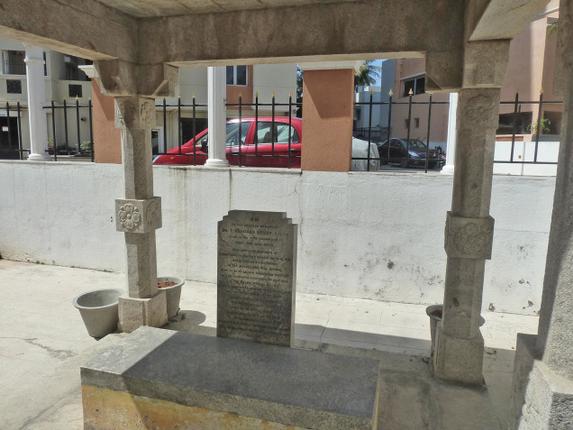
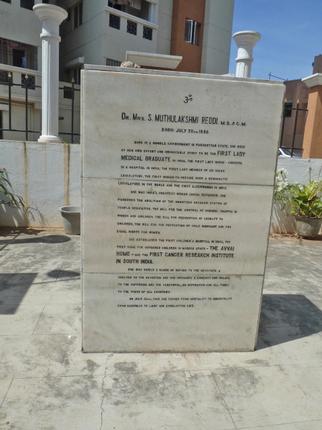
The mandapam housing the memorial to Dr. Sundara Reddy. / The Hindu
“You need permission,” says the watchman at Ramaniyam Sanjivini, a residential complex in Thiruvanmiyur, and despatches his assistant to call the secretary of the building association. I blink at the CCTV camera, hoping the secretary will take kindly to what he sees. Soon, a couple of dhoti-clad seniors walk toward me. “I need to photograph the memorials of Dr. Sundara Reddy and Dr. Muthulakshmi Reddy,” I tell them. “Historian Narasiah told me I’d find the shrine and the memorials here.” They point to the round-about ahead; a few steps down and I’m face-to-face with the stone memorials — Dr. Sundara Reddy’s under a traditional mandapam and Dr. Muthulakshmi Reddy’s out in the open air.
The memorial to Dr. Muthulakshmi Reddy / The Hindu
Dr. Muthulakshmi Reddy deserves more than just an open stone plaque in a private property. Born in the princely state of Pudukkottai on July 30, 1886 to Narayanaswami Iyer and Chandramma (16), a devadasi, Muthulakshmi was one of eight siblings. An exceptionally bright child, she completed schooling from home, fought for higher education, and was admitted to college as the first girl student when the Maharaja passed an order for her to be enrolled. (She sat behind a screen visible to the teachers alone, and left the class while the boys remained seated.) She topped the Intermediate exams, refused to get married and insisted on doing medicine, a decision brought on by her mother’s cancer attack and death of a cousin during childbirth.
In Madras, she met Sarojini Naidu at Dr. Nanjunda Rao’s Mylapore bungalow, and with her attended Annie Besant’s speeches at Adyar, and was drawn to the Home Rule Movement. Having stood first in her Medical degree (MB & ChM) exam, she worked at the Women and Children’s Hospital in Egmore, the first lady house surgeon in Madras’ medical history. She married Dr. Sundara Reddy in 1913.
Meeting the kids in Dr. Vardappa Naidu’s Destitute Home for Boys and Girls on her child’s Vidyabhyasam Day, she vowed to help them. When her youngest sister died of cancer, Muthulakshmi decided to do all she could to tackle the disease. Foregoing her handsome practice, she went to London with her husband and two boys for PG studies. In June 1926, she attended the International Congress of Women in Paris as India’s representative. When she returned, the Women’s Indian Association proposed her name for the Legislative Council and she became the first woman legislator in the Council. She was also the first alderwoman between 1937 and 1939. During her time, the Council passed a resolution giving the right of franchise to women. Her association with a home run by Sister Subbulakshmi brought her close to the plight of women and children, and she piloted the legislation preventing child marriage. Her bill for abolition of the devadasi system was passed after much debate in February, 1929. In 1937, she moved a bill for Inam lands to be given to devadasis. In 1930, when a batch of seven freed devadasi girls were refused accommodation in Madras hostels, she started the Avvai Home to house and train children and young girls, selling her jewellery for its basic facilities. She organised the first Vigilance Association, Rescue Home for Women and supported the Children’s Aid Society.
She resigned from the Council when Gandhiji was arrested in 1929-30. She was then editing Stri Dharma, a journal promoting the national movement. She went as a delegate to London to depose before the Lothian Committee on Franchise and to Chicago to attend the International Congress of Women. In 1935, MMC moved a resolution for a specialised hospital for cancer, but she had to wait to see it happen. After constant campaigning, she collected Rs. 2 lakh and established the Cancer Institute in 1955. She was awarded the Padma Bhushan in 1956. In 1967, she spoke for half-an-hour at the Golden Jubilee celebrations of Women’s Indian Association, her last public speech. She passed away on July 22, 1968.
How did the plaque get there? The land belonged to Dr. Reddy and her son lived there, said Narasiah. After he passed away, the builder purchased it. While researching on Dr. Reddy, Narasiah came to know of the memorial at the residential complex. “I showed Sridhar of Ramaniyam the memorials at the site, and requested him to preserve them along with a shrine where the Reddys used to pray.” It turned out he had already promised Dr. Shantha of the Cancer Institute the memorials would be left untouched. “Dr. Shantha visits it often to see that it is well-maintained,” said the seniors.
source: http://www.thehindu.com / The Hindu / Home> Features> MetroPlus / by Geeta Padmanabhan / March 03rd, 2015
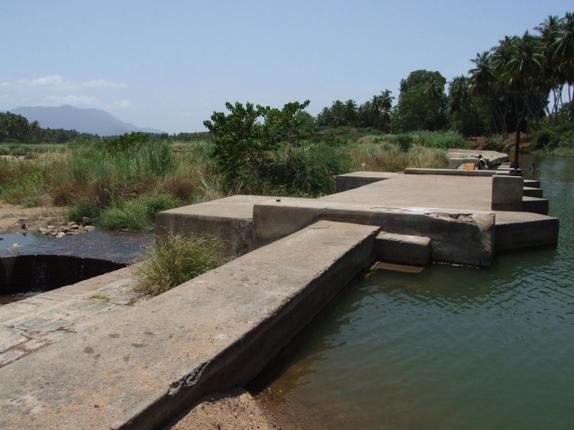
The dam constructed by Parakrama Pandian in Kuruvithurai. Photo: Special Arrangement
Inscriptions dating back to 12th Century, found along river Vaigai, talk about the efficient water management system devised by the Pandiya Kings
With summer round the corner, most of us are already worried about water scarcity this season. Experts have done their bit by sounding the alarm on the depleting water table. But have you ever wondered how are ancestors used, managed and conserved this elixir of life?
When it comes to effective conservation, distribution and management of water, one cannot dispense the role of King Karikal Chola, who built the Grand Anaicut across River Cauvery. There are several historical evidences to prove that ancient Tamil rulers had effective water management systems in place in their respective kingdoms.
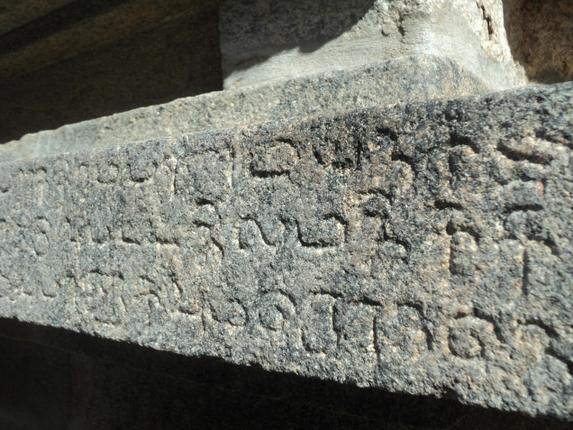
The Pandiya kings constructed check dams across River Vaigai. King Maravarman Arikesari, also known as Koon Pandiyan, who ruled Madurai during Seventh century built a check dam across Vaigai and named it after himself. It is near the Kuruvikaran Salai road and archaeologists have found a stone inscription there. Likewise, King Parakrama Pandiyan constructed a check dam Sitranai in Kuruvithurai near Madurai. He also extracted granite from the nearby hill Kuruvikal and built a stone quarry. Stone inscriptions in Kuruvithurai Perumal Temple record this.
The stone inscription in the Kuruvithurai Perumal Temple. Photo: Special Arrangement
In the olden days, exclusive groups were constituted for the upkeep of the water bodies. These were theyeri variyam (lake board) and kalingu variyam (sluice board). According to B. Thirumalai and R. Sivakumar, authors of ‘Vaiyai Thadam Thedi’, the landmark ruling of Sri Vallabha Pandiyan, who established the riparian rights of the lower ayacut farmers, is remembered even today. “The case of a landlord cutting off the main channel by digging a channel upstream and depriving farmers of the lower areas was brought to the King,” says Sivakumar.
“The practice of creating a water body to help people has been there for ages,” says C. Santhalingam. Secretary, Pandya Nadu Centre for Historical Research. Tamil Brahmi inscriptions recovered from Nadumuthalaikulam near Vikkramangalam give evidence of existence of a 2000-year-old man-made lake. “Kings created water bodies and collected land tax from people. Pallavas constructed lakes across their kingdom and named the lakes after them. Some of the man-made lakes are Chithiramega Thadagam and Vairamega Thadagam,” he says.
There were also several lakes like the Thoosi Mamandoor Yeri near Kanchipuram, the biggest of the lot. “The rulers did not end with that. They appointed guards to stop people from polluting and created a corpus fund for the maintenance of the water body. The board used the money to desilt the lake and to distribute food and clothes for victims of floods. They also let the lake on contract for fishing and for ferrying people on coracles to generate funds. Many rich people also donated liberally,” he says.
“For effective distribution there are different types of sluice gates like Pulikan madai (which has three outlets). Depending upon the storage the water is released through these outlets. The one with seven outlets is located near Srivilliputhur. It is constructed by the Koon Pandiyan and to control the flow a pillar is erected at the centre of the main sluice gate,” he says.
Lakes were given much importance in those days. They were quoted in Sangam literature to identify the geographical division of that place, like the Madakulakeezh which refers to the land irrigated by the Madakulam Lake.
“Predominantly an agrarian community dependent on water source, our ancestors knew the importance of conserving water. They were farsighted, sensitive to environmental issues and better equipped than the current times,” concludes Santhalingam.
source: http://www.thehindu.com / The Hindu / Home> Features> MetroPlus / by T. Saravanan / Madurai – March 04th, 2015
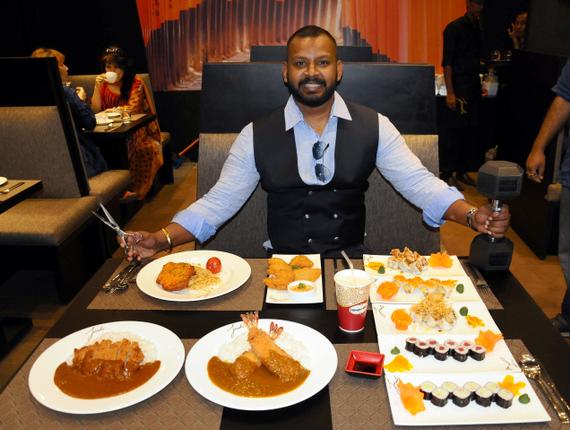
Sam Paul at Jonah’s goes to Japan. Photo: M. Karunakaran / The Hindu
From educational institutions and restaurants to gyms and styling salons, Sam Paul has ventured into a slew of businesses. The city businessman tells why he’s always looking for new frontiers to conquer.
There are two men, employed by Sam Paul, who look after newspaper clippings.
Every morning, Sam wakes up at 7, fits in an hour of exercise and then, sits down to scan the local papers. Since 2004, from the first mention of the launch of Casa Piccola in Chennai, he’s collected about 500 news clippings of himself. He often makes it to the papers for something or the other; news about the latest Toni & Guy store launch, party pictures, involvement in charity activities and social, news about his acting venture in the upcoming movie Patra… even the smallest mention, he clips, files, indexes and laminates. “We need some cheap thrills, no?” laughs Sam.
The reason he values these clippings and takes such care in making sure they are preserved is because, he says, he treasures the recognition and appreciation that comes his way. “This is achievement! I am well-heeled — I own a house, I drive a Porsche. I have good people working for me. What else do I need?”
Sam, who has been the reason for the arrival of many big brands in the city, schooled here. He holds a Bachelors and Masters degree in Engineering and followed it up with a doctorate from College of Engineering, Guindy. He started working with his father, helping manage educational institutions owned by the family, had many grand business ideas which his father disagreed to and eventually, was asked to leave home for being too rebellious.
Relentless, Sam worked to prove himself, sleeping on the floor of his friend’s place in the meantime. Using the money he earned, and then some, he opened Casa Piccola in 2004, which was all the rage those days. “I just wanted to show my father that I was capable of earning my own money. But from there to where I am right now, it’s all God’s grace. Nothing else.”
Over a decade later, he has chiselled an identity for himself as a restaurateur in Chennai. He manages Crimson Chakra, Haagen-Dazs and Jonah’s Bistro. His latest, Jonah’s goes to Japan, in collaboration with Momoyama, introduces an Asian twist to the existing European menu designed by ‘MADChef’ Kaushik. “Right now, I’m tripping on Japanese,” grins Sam.
At the launch of the restaurant, Sam bustles about, greeting old friends and making new ones. He’s a people’s person; no doubt about it. He says he has the knack to identify the right ones too. “My greatest asset is that my staff have remained with me… it’s important to have the right people,” says Sam, adding that the same men who worked at Casa Piccola are cooking up a storm in Jonah’s kitchen too.
As the dishes stream out, Sam talks about the peasant origins of the beef goulash, fusses over the amount of fish in the seafood broth and insists that the chicken parmigiana would pair better with mashed potato, as opposed to spaghetti. “I’ve been doing this since 2004, you start to know a little by now,” chuckles the foodie.
This, however, is not all that he knows. In 2010, sometime in between opening new restaurants, managing educational institutions and being responsible for the mushrooming of Toni & Guy outlets in the city, he got bored of all that he was doing and bounded off to study law at the Government Law College. “I was 32 years old at that time, and I sat with these boys who were 18-19 years old and studied for three years. In fact, I got debarred for six months for not having enough attendance,” laughs Sam. He now practises law at the High Court and works with N. Chandrasekaran, Special Public Prosecutor for CBI cases.
That hardly confines him from juggling other things though: Sam just acted in a film and is producing another. He’s looking to do some celebrity DJing born out of a love for music and the request of a few friends. Keeping in line with body building titles that Sam won when he was in University, he launched a new project last month — Slam, the fitness studio. He is further looking to expand the Jonah’s brand and working to bring Doner Kebab to India, because, he says, “I am very particular about my kebabs.”
“That’s the greatest thing in life: to be able to do what you want. If I want to do something, I just have to think of the way to do it professionally… it’s all about God’s grace and having the right people by your side.” smiles the 37-year-old.
source: http://www.thehindu.com / The Hindu / Home> Features> MetroPlus / by Raveena Joseph / March 03rd, 2015
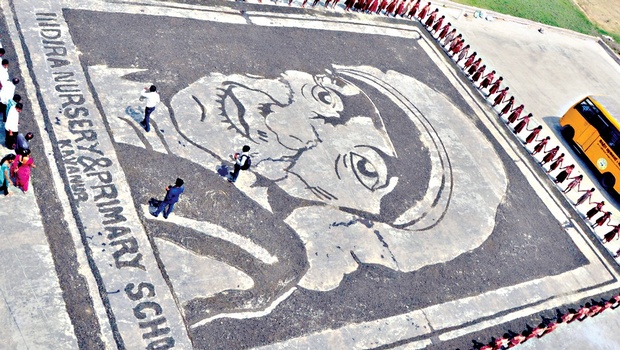
An aerial view of the portrait of Mother Teresa created by students of a private school at Kavanur, in Vellore on Saturday | express
Vellore :
The chances of your hearing about Kavanur near Timiri is as remote as the village is. Located in the eastern part of the district, the village is likely to enter Limca Book of World Records, courtesy the artistic skill of 70-odd students of a private school.
On Saturday, the children made a 72 feet by 60 feet portrait of Mother Teresa, using small black pebbles. The weight of the pebbles was around three tonnes, a record of its own kind, worthy of finding place in the Limca Book of Records.
The initiative was taken by the drawing teacher Navakumar (29), who is a self-styled record breaker himself. In 2006, he entered the record book by drawing a picture of Tamil saint Thiruvalluvar using enamel paint on 133 feet by 60 feet canvas.
In 2008, he attempted another portrait on a 280 feet by two feet canvas to draw the world flags. The attempt gave him another entry in the record books in 2009. In 2010, he drew a picture of Gandhi on water on a three feet container using kolam, which gave him another entry into Limca records.
Navakumar, a part time arts teacher at a government school in Seemapudur village, also goes to the Indira Nursery and Primary School in Kavanur every week to teach drawing to kids free of cost. He also runs an art studio in Vellore, where he teaches children and elders various forms of drawing. According to Navakumar the previous record was held by students in the age group of eight to 10 for drawing a portrait with the dimension of 30 feet by 40 feet using colour powders. This attempt by the Kavanur school students in the same age group would break this record comfortably, he said.
“When I told the school correspondent R Settu about the possibility of training the school children for a Limca record, he put me on the job,” recalled Navakumar. He began training the kids on the pebble portrait three months ago. Last week, he organized practical sessions on the school grounds.
“We decided to go for the portrait of aged persons, as the facial wrinkles could be better captured. Though difficult, it makes a lot of difference in artistry,” said Navakumar when asked why he chose Mother Teresa.
“By drawing her portrait, children would learn about her and imbibe her qualities,” he added.
On Saturday, the district educational officer D Manoharan was the chief guest when the children toiled for nearly an hour before putting on display the portrait under the guidance of Navakumar. The whole event was documented, videographed in the presence of government officials and would be sent to Limca Books.
source: http://www.newindianexpress.com / The New Indian Express / Home> States> Tamil Nadu / by V. Narayana Murthi / March 03rd, 2015
The civic body began its Coimbatore Guinness Championship Campaign on Sunday to clean up the city. Despite facing a shortage of sanitary workers and push carts, the civic body officials roped in hundreds of volunteers and college students to go around the city collecting litter and promote source segregating.
The championship will begin on Wednesday after officials purchase push carts and begin to evaluate workers, said K Vijayakarthikeyan, corporation commissioner. The challenge will end on March 11, he added.
On Monday, officials inspected six wards and instructed sanitary workers to begin the championship. “Around 20 volunteers from NGOs have been allotted to each ward. Each zone will have a non-governmental organisation leading the effort. A team of sanitary inspectors and corporation officials will monitor them and evaluate their work.
“A jury will judge the best zone, best ward and best team,” said Suresh Bhandari, co-ordinator of Clean Cities Foundation.
Each ward would require at least 15 push carts but have been provided only seven push carts, said an official.
The civic body aims to create awareness about source segregation through this championship, as volunteers will go door to door to educate residents on segregating waste at source into three parts-wet, dry and hazardous. “The dry waste which is plastic waste will be weighed at collection centres such as ward offices and sold to companies. Workers will earn 4 per kg. The wet waste will be transported to Vellalore dump yard,” said Sri Rangaraj, sanitary inspector, central zone. Officials will evaluate every sanitary worker based on five criteria such as appearance, work skills, segregation, weighing and cleaning.
The volunteers have informed hotels, residents of apartments and other commercial complexes to segregate waste and hand it over to workers. “We have distributed around two lakh contest cards to school students who will get it signed by their parents. They will receive certificates from the corporation at the end of the championship,” said a higher official.
Registrations are taking place through a website and a missed call service-814436000-has been activated. As on Sunday evening, 2,500 residents had registered on the website and 300 had registered through the missed calls service. “We have already reached the two lakh mark so far. If the numbers increase, it will help us win with a bigger margin,” said Suresh.
On March 5, Dr Sanjay Gupta, coordinator of the Guinness Book of World records will visit the city to instruct them on the methodology. “Since the verification of two lakh contest cards will take a few weeks, we are hopeful that by the end of March, we will get the results and will enter the Guinness Book of world records,” added an official. While activists said that the championship was a gimmick to divert attention from the Vellalore dump yard issues, corporation officials maintained that they were planning to set up at least 15 segregation sheds after the championship ends.
“We will make sure that the drive continues even after the championship ends,” said a higher official.
source: http://www.timesofindia.indiatimes.com / The Times of India / Home> City> Coimbatore / TNN / March 03rd, 2015
V Rama Rao is a familiar face in Alandur and Nanganallur not only among residents but also government officials. The 72-year-old retired government employee spends hours in government departments submitting petitions and filing RTIs to demand better transportation facilities, civic infrastructure and more.
Known as `Demand Rama Rao’, the former trade union leader and retired chief telegraph master, has won many battles against civic authorities. “I became an activist after seeing people suffering. Having been a trade union lead er, I found it easier to confront authorities and officials,” says Rao, who runs Traffic and Transportation Forum, a non-governmental organisation that has lobbied for extra ticket counters at suburban stations, more bus services, road widening and other facilities.
“People pay taxes and they have every right to demand that civic amenities are good and well maintained.Why should people suffer bad roads and poor drainage?” says Rao.
One of Rao’s first successful battles involved rallying residents to get underground drains. “We were the first to set up underground drainage in Nanganallur in 2003. Each resident contributed `5,000 to get the work done. Neighbouring Tambaram still does not have an underground drainage system,” he says.
Right now, the forum is demanding a bus stand near St Thomas railway station. “Once metro rail starts functioning, a bus stand will be needed urgently,” he says. “Why wait till then to ask for it?” The forum is also suggesting that metro rail use the underpass of Kathipara junction to connect to the neighbourhood for the proposed AlandurAsargana Hub, where more than 100 buses could be operated.
Rao and his team have now turned their attention to water bodies. “We are still fighting against encroachments on Adambakkam lake by both the ruling and opposition parties. We will make sure we will restore the lake to its its original condition,” he says.
source: http://www.timesofindia.indiatimes.com / The Times of India / Home> City> Chennai / TNN / March 04th, 2015
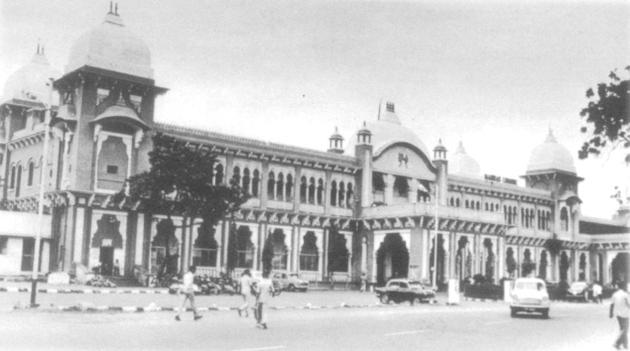
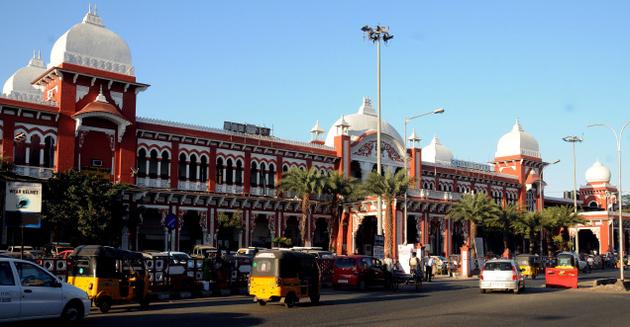
At a quiz I conducted recently, one of my questions was: What were the railway companies that were combined to create the Southern Railway in April 1951? The majority of answers recorded South Indian Railway (SIR) and did not proceed further. A few put down Madras Railway Co and SIR. Still fewer said Madras & South Mahratta Railway and South Indian Railway. And only one person got it right saying Madras & South Mahratta Railway, South Indian Railway and Mysore State Railway. I recalled these answers a few days later when, thanks to new traffic regulations, I saw the Egmore Station after a few years and found it looking as handsome as one of a city’s prime heritage buildings should look.
Egmore Railway Station today.
Purist conservationists will undoubtedly sniff at what red and white colour washes have done to the building’s red brick, Tada sandstone and Pallavaram granite. But I have always held that they should be thankful for little mercies; after the latest ‘restoration’, many a layperson or a visitor is sure to stand and stare for a while at a building which stands out midst all the tawdry construction surrounding it. Certainly I did — and as I did so I wondered what the answers would be to another quiz question: The South Indian Railway had five stations in Madras; what were the three main ones? I wonder how many would have got Tambaram, Egmore and Beach. Egmore may have been the main Madras SIR station, but Beach was the end of the line and Tambaram and Beach were the two termini of the SIR’s electrified suburban railway system established in 1931 and which in its very first year handled nearly three million passengers.
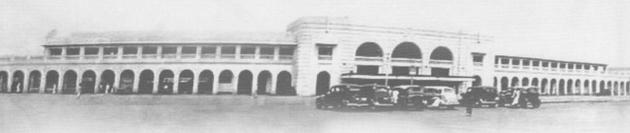
Trichy Junction in 1935
The SIR’s main railway station, however, was in Trichinopoly, where its headquarters was. The first SIR headquarters was in Negapatam (Nagapattinam) from where its first train ran to Tiruvallur on July 15, 1861, then in December that year to Tanjore and on March 11, 1862 to Trichinopoly to which the headquarters began moving from 1865 and went on till 1880. Remodelling of the old station began in 1900 and went on till 1935, T. Samyanada Pillai of Bangalore responsible for the work. Pillai, based on his splendid work in Trichinopoly, was given the contract for building the Egmore Station we see today. Work began on it in 1905 and it opened for use on June 11, 1908. The station was designed by Henry Irwin, with specialised engineering work being carried out by Arbuthnot’s Industrials and the entire supervision being done by SIR’s company architect E.C.H. Bird.
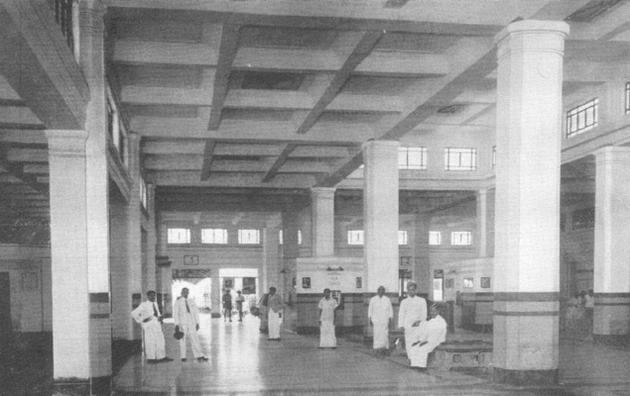
Beach Station interior (1929)
Handsome stations were also built at Beach (which also received M&SM traffic) and Tambaram befitting their status. That handsomeness can nowhere be seen in these two stations today, given surrounding construction, lack of upkeep and all the grime. They too could use the attention and facelift given to Egmore.
******
The houses by the Adyar
The other day I was reminded of a story I had told in these columns some years ago (Miscellany, July 13, 2009) when reading something about the Andhra Mahila Sabha. The Sabha’s nurse-midwife training scheme had to find accommodation for increasing numbers of trainees (120) in the 1950s. The Sabha had put down roots just north of the Adyar River and on the western edge of what is now Durgabai Deshmukh Road — named after the Sabha’s founder — and was then Adyar Bridge Road. Fortunately for the Sabha there was a garden house abutting it to its north, reaching out to the southern edge of Greenway’s Road. The owner was offering the large house and its 171/2 acres for Rs.1.75 lakh. Which the Sabha did not have. But he agreed to rent it at Rs. 500 a month.
When Union Health Minister Rajkumari Amrit Kaur came to inaugurate the children’s ward of the Sabha in 1950, Durgabai Deshmukh told her the problems she was facing with accommodation for the trainees. At the time the trainees were in the rented house, but the Sabha needed to own it to expand further and the owner was not willing to bring down his price. Let’s go and see him, the Minister promptly said. They found him sick and in bed, but overawed when his visitor introduced herself. She told him that she was willing to grant Rs. 1 lakh to the Sabha if they could acquire his premises for that amount. He agreed and Yerolyte came into the Sabha’s hands. The building still stands and is the administrative centre of the Sabha. Next to it has come up a modern hotel run by the Sabha.
Discovering what Yerolyte is the other day is what led to this item. Having discovered what Yerolyte is now being used for, I began to search for information about other garden houses that had come up on the north bank of the Adyar. To the east of Elphinstone Bridge, now supplemented by Thiru-Vi-Ka Bridge, are Brodie Castle dating to 1798, at present home to the Tamil Nadu Government College of Music, Underwood Gardens, now the residence of the Regional Manager of the State Bank of India, andSomerford that’s been incorporated into Chettinad Palace.
To the west of the Bridge, going west from the Adyar, the first block of buildings comprises, from river inland, Bridge House, Government property which I think has now been replaced with a newer building,Cranleigh, named after an English village in Surrey which has been replaced by the Andhra Mahila Sabha Hospital, and Yerolyte. The next block west once comprised Riverside, Hovingham, Greenway, Cherwell and Ardmayle, the three aside from Riverside and Greenway probably taking their names from villages in Yorkshire, Oxfordshire and Tipperary (Ireland) respectively, all no longer in existence and replaced by Government bungalows for Ministers. The next block includes Adyar House, used as a Police commando training centre (a glimpse into which shows an old building, possibly the original house), Beachborough, named after a hamlet in Kent, a house now built over it, and Ben’s Gardens, once leased to Parry’s by the Diocese of Madras-Mylapore and where Parry’s built a few more houses for its Directors. Then come, Serle’s Garden, no longer in existence, like neighbouring Pugh’s Garden. Still surviving, however, is what was Norton’s Garden (1853), built by the lawyer John Bruce Norton, and which c.1907 was re-named The Grange. With a Government management training institution in it,The Grange is fairly well maintained, but could take lessons from the last building on this stretch,Moubray’s Garden/Cupola (c.1790), and the first modern house to be built on the banks of the Adyar. Today it is beautifully maintained by its owner, the Madras Club.
*****
The tank that vanished
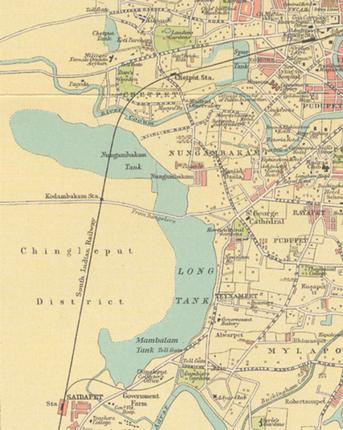
Was there a huge tank in the middle of Madras that has vanished, asks schoolgirl S Prema who tells me that she is interested in the environment. Yes, indeed, there was a tank called the Long Tank which once stretched about 6 km from the Adyar River to Loyola College, following the western side of Mount Road and Nungambakkam High Road. Reminders of it are found in such names as Lake Area and Tank Bund Road. It was in reality two tanks, the Mambalam/ Mylapore Tank in the north and the Nungambakkam Tank in the south, and spread through parts of Saidapet, Mambalam, Nandanam, T. Nagar and Nungambakkam.
To meet the demands of a growing population, plans were drawn up from 1923 to reclaim land from the Long Tank and this was done from 1930 to create the 1,600 acres for the Mambalam Housing Scheme that gave us Theagaroya Nagar or T. Nagar. From 1941, further reclamation gave us the Lake Area in Nungambakkam. At the westernmost end of the Tank, 54 acres were reclaimed earlier for the Loyola College campus and in 1974 what was left of the Tank was reclaimed to give the city the Valluvar Kottam campus alongside Tank Bund Road.
Map showing the Long Tank
Once, when the Long Tank had water for most of the year, it was home to the Madras Boat Club’s activities. In fact, there was a Long Tank Regatta. It’s first recorded in 1893 that this was held “on the fine expanse of water that starts from the Cathedral Corner (once where Gemini Studio’s property was) to Sydapet”. Till any kind of boathouse was built by the Long Tank, the Club used the spacious premises of Blacker’s Gardens — kindly lent for the occasions by whoever the occupant was at the time. The Club’s first Boathouse, a temporary one, was inaugurated on December 5, 1896 and a permanent one in 1899. The Tank also hosted sailing events, the Boat Club at that time also nurturing yachting.
The earliest record of competitive rowing dates to November 21, 1875, ‘Scratch Fours’ races being held in the Long Tank. The first regatta held there was on February 4, 1884 on a course that was about half a mile. These continued till 1904, by when the Club had firmly put down roots in its present home in Adyar. The Long Tank, however, continued to be used by some oarsmen till work on reclaiming land began in the late 1920s.
There would be 200-300 “ladies and gentlemen (present, representing) the fashion and beauty of Madras,” as well as the Governor and his Lady and their retinue, the Band that would play through the evening and night, refreshments aplenty, and dinner and dancing. Now where their ghosts waltzed, there is no tank, only a congested clutter of buildings just as what you’ll see where the other important tanks of the city were. Once, the ten most important tanks of Madras were Vyasarpadi, Perambur, Peravallur, Madavakkam, Chetput, Spur, Nungambakkam, Mylapore/Mambalam, Kottur and Kalikundram. None of them exist in today’s concrete jungle.
source: http://www.thehindu.com / The Hindu / Home> Features> MetroPlus / by S. Muthiah / March 01st, 2015
At 84, when most people would decide to make peace with a bad knee, J D Ramanathan decided he would not let the pain be an inconvenience.
Doctors at Apollo Hospitals performed an intricate knee replacement surgery on the elderly man who is up and about now. The patient had chronic rheumatoid arthritis for several years. “His family members were skeptical but he opted for knee replacement surgery.
“We performed a minimally invasive knee surgery and he could walk the very next day,” said senior orthopaedic surgeon Dr Madan Mohan Reddy.
Orthopaedic surgeons said recent advances in minimally invasive surgery offer older patients more options for spine, hip, knee and neck care. “Studies have shown that elderly patients who undergo invasive procedures experience higher complication rates and longer recovery periods. But minimally invasive procedures have been game changers,” said Dr Reddy. He added that the oldest patient to undergo hip replacement at the hospital was a 94-year-old man.
Many surgeons are hesitant to perform open procedures on elderly patients because of the increased risk of complications, said Dr Jonathan Saluta, an orthopaedic surgeon from California. “Older patients who undergo an invasive surgical procedure are more likely to suffer from an infection, life-threatening complication, or a return visit to the hospital within a month of surgery. The minimally invasive approach provides the benefits of undergoing an outpatient procedure with minimal blood loss, less scarring, faster recovery time, and fewer postoperative risks,” said Dr Saluta.
The only drawback of minimally invasive procedures is that the cost is 30% higher than open surgeries, said Dr Reddy. “But it is compensated by the faster recovery and shorter hospital stay,” he said.
source: http://www.timesofindia.indiatimes.com / The Times of India / Home> City> Chennai / TNN / February 28th, 2015