Due to changes in lifestyle, the country chicken ‘naatu kozhi’, once a common sight, has largely vanished from the homes in the state.
It has been replaced by the juicier, cheaper and more easily available broiler chicken. However, country chicken varieties are slowly making a comeback in the district, thanks to the efforts of the department of animal husbandry.
Under a scheme to boost country chicken breeding, the department is providing individuals and women self-help groups (SHGs) money and other incentives.
It enables eligible applicants to get Rs 1,29,500 for every unit of native chicken breeding. One unit consists of 750 chickens, which will be given in three dues of 250 each.
Half the money would be provided by banks, which has to be repaid later. The state government and the national bank for agriculture and rural development (NABARD) will provide 25% each of the total cost.
The beneficiaries have to set up a shed and lights to create an atmosphere conducive for chicken breeding. For 2014-15, 160 people are receiving the units, worth Rs 2,07,20,000.
The number of beneficiaries in 2013-14 and 2012-13 were 240 and 35 respectively, with a total cost of Rs 2,80,80,00 in 2013-14 and Rs 40,95,000 in 2012-13.
Unlike broiler chicken, which has been said to create health problems in the long run, country chicken is bred in natural circumstances. Under the scheme, the chickens are fed with greens for healthy rearing. It takes around 75 days for a chicken to attain its full growth of 1.5 kg. Each kilogram of country chicken costs around Rs 300.
District collector Jayashree Muralidharan said that the scheme had benefitted a lot of women and it gave an impetus to rear country chicken.
Dr R Mohanarangam, joint director, department of animal husbandry, said that immunization drops were provided to the country chickens to protect them from diseases.
source: http://www.timesofindia.indiatimes.com / The Times of India / Home> City> Trichy / December 09th, 2014
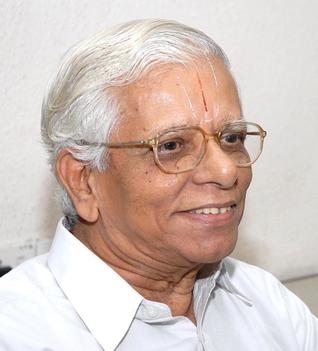
Mr. Sampath, retired Senior Associate Editor of The Hindu, suffered a massive cardiac arrest. He was 78.
M.C. Sampath, retired Senior Associate Editor ofThe Hindu, passed away here on Saturday evening after suffering a massive cardiac arrest. He was 78.
He retired from The Hindu in 2012 after serving the newspaper for 50 years, not counting the five years during which he was the part-time correspondent in Chengalpattu. Joining the organisation in June 1961 as a Staff Reporter, he rose to become an Editorial writer and a Senior Associate Editor. He was also in charge of the Book Reviews for some years. For long years, he was writing the Religion column in the newspaper.
In his later years with the newspaper, as the seniormost member of the editorial team, Mr. Sampath assisted the Editor in managing the editorials for the day, finally seeing them off on the page after scrutiny.
MCS was an old school journalist who was meticulous in his commitment to accuracy, contextualising and fairness. As an editorial writer, he was clear-headed, sceptical about big claims, nuanced, and able to deal with complexity skilfully and to present a persuasive argument with ease. But he never shied away from expressing a forthright opinion on issues that mattered. And as a coordinator of editorials, willing to put in long hours, he was considered the safest pair of hands any Editor could wish for.
His father, the late K.M. Narasimhachariar, was the Agent for The Hindu in Chengalpattu. An M.A. in Economics from Madras University, Mr. Sampath was a genial friend, philosopher and guide to his colleagues. Though he was due for retirement in 1996, he was given extension of service till 2012 by successive Editors.
He is survived by his wife and two sons.
source: http://www.thehindu.com / The Hindu / Home> News / Chennai – December 21st, 2014
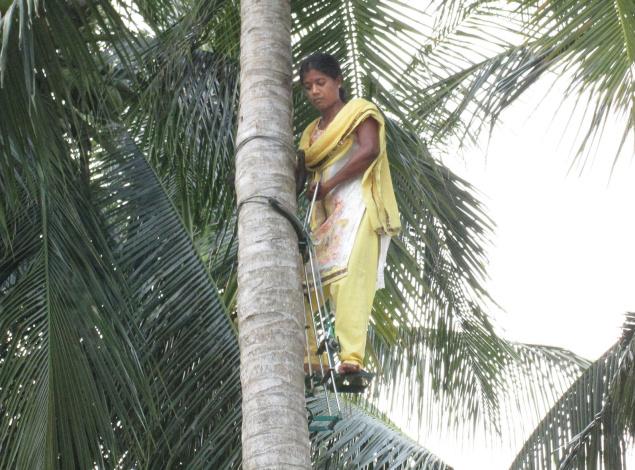
A woman undergoing training in coconut plucking at Parangipettai in Cuddalore district.
Even though Cuddalore district abounds in coconut trees, the price of coconuts is high. The reason trotted out for such market behaviour is the lack of manpower to pluck coconuts or the high wages the workers demand.
It has created a situation in which even the ripe coconuts are left either to rot on the trees or fall. It has become consternation for the coconut growers to find the workforce on time to harvest, not to speak of the plight of the households having a few coconut trees in their garden.
To overcome the problem, the M.S. Swaminatan Research Foundation (MSSRF) has launched the “Friends of Coconut Tree” programme for farmers and the unemployed youth.
R. Elangovan, Project Officer of the MSSRF, told The Hindu that the six-day training programme organised under the aegis of the MSSRF Village Resource Centre at Parangipettai was intended to help the farmers and unemployed youth learn to climb trees to pluck the coconut.
To start with, 20 persons, including four women hailing from Killai, Nochikadu, Manikkollai and Parangipettai, joined the programme conducted recently. It was conducted in coordination with the Coconut Development Board that provided the device for climbing the trees free of cost.
In-house training
It was a sort of an in-house training as the trainees would stay at the Parangipettai centre throughout the training programme. Besides mastering the tree climbing techniques, they were also taught yoga and pranayam.
Mr Elangovan said the Coconut Development Board had made it mandatory that 30 per cent of the trainees ought to be women.
It was a surprise that four women had come forward to enroll their names in the programme.
One of the trainees, Kausalya, 24, told this correspondent that initially she had hesitation in joining the programme as she lacked courage in climbing tall trees.
But, the device provided by the centre made the job simple and easy. She gained confidence gradually.
However, the centre has prescribed a dress code for women — they should either wear salwar kameez or a pair of trousers to avoid risks.
Mr Elangovan said that after completion of the training programme, Parangipettai Town Panchayat Chairman Mohammad Yunus gave away certificates and the climbing device (free of cost) to the participants.
source: http://www.thehindu.com / The Hindu / Home> News> National> Tamil Nadu / by A.V. Raghunathan / Cuddalore – December 18th, 2014
Surgeons at a government hospital in the city set right a neural disorder that causes an uncontrollable shivering of limbs by inserting an endoscope through the patient’s nose.
Manaangatti, 60, a labourer from Red Hills, could not find proper work for the past five months because of shivering in his hands and legs. He was admitted to the neurosurgery department of Stanley Medical College Hospital in October. Doctors diagnosed the condition as atlanto-axial dislocation.
“An MRI scan showed that his atlas bone in the spine was dislocated and causing severe compression of nerves. This caused shivering and loss of sensation in the lower part of his body,” said Dr Jacob Grand, head of the neurosurgery department.
In a procedure performed last month, surgeons inserted an endoscope (a device with a light used to look inside a body cavity or an organ) through his nose and corrected the dislocation by removing the C1 and part of the C2 vertebrae.
“Conventionally, this is done as a standard surgery through the mouth. We cut open the soft palette and perform the procedure. But in an attempt to avoid tissue loss, we decided to do a nasal endoscopy, which is minimally invasive and relatively painless,” said the doctor.
Since some bones in the spine had been removed, the doctors used a collar to maintain the position of the neck. Stanley dean Dr A L Meenakshi Sundaram said such minimally invasive procedures reduce blood loss, pain and the length of hospital stay. “Considering the age of the patient, doctors skipped the conventional open surgery and managed to achieve much better results.”
Three days after the procedure, doctors performed spinal surgery and attached titanium rods to stabilize the neck bone.
Within a few days, the patient regained sensation in his limbs and could move around normally.
source: http://www.timesofindia.indiatimes.com / The Times of India / Home> City> Chennai / TNN / December 17th, 2014
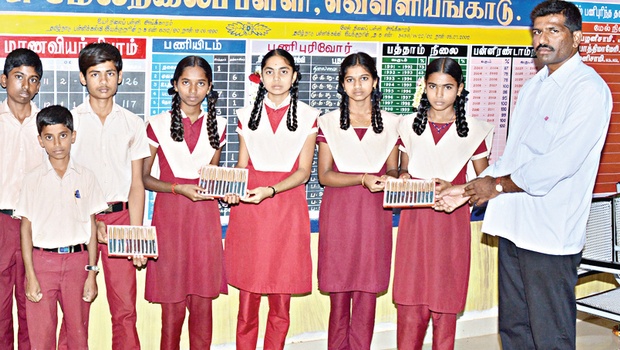
C Kannan handing pens to the students in Coimbatore | EXPRESS
Coimbatore :
A science teacher has sought to reach out to his students by going back to the once popular Hero pens.
The teacher at Velliangadu government school near Karamadai chose to pay his respects to the his hero, revolutionary poet Subramania Bharathi, on his birth anniversary by gifting the fountain pens to all the 750 students from classes VI to XII.
For C Kannan, who spent `20,000 for the gifts, such acts of benevolence are not new, as he has already provided students from economically weaker sections with two sets of uniforms.
The science teacher, who has completed two years at the Velliangadu Government Higher Secondary School, says the gesture would also serve as an encouragement for the students who are in the middle of their half-yearly exams.
Speaking to Express, Kannan said, “Sincerity and dedication from teachers motivate students to perform better. Inspiring children and moulding them into responsible citizens are part of the duty of every teacher.”
R Palanisamy, headmaster of the school, said that though Kannan was appointed as a BT Assistant to handle science classes for students of classes VI to IX, out of interest, he used to take English and Mathematics classes.
Whenever teachers handling Class X were not present, he used to chip in and help the students, he added. Another interesting aspect with Kannan, as pointed out by his colleagues, was that he would make the learning process interesting for students by discussing general issues with them before getting into the text books.
According to the staffers, “Kannan also has good knowledge about computers and helps us a lot in our work. He is always optimistic and ready to help.”
source: http://www.newindianexpress.com / The New Indian Express / Home> States> TamilNadu / by Ram M Sundaram / December 16th, 2014
It came into existence to support the flourishing textile industry in Coimbatore a few years after the IIMs were set up in Kolkata and Ahmedabad. Today, PSG Institute of Management (PSGIM), the first private management education institution in the country, is turning 50.
The institute was started in 1964, just three years after the IIMs were established in 1961, and offered diplomas in management to feed to growing textile industry which had plenty of skilled engineers but not enough marketing, sales and managerial executives. PSGIM’s history is closely linked to the textile trade of Coimbatore. Around 20 years before Independence the cotton industry began flourishing in the Kongu belt. “Engineer and educationist G R Damodaran started PSG Polytechnic College in 1939 to train and provide diplomas to those wanting to work in spinning factories in the area,” said R Nandagopal, director, PSGIM.
Later, G R Damodaran, better known as GRD, set up PSG College of Technology in 1951. “Many graduates from PSG Polytechnic and College of Technology became businessmen and industrialists. This helped the textile industry flourish,” said Nanadagopal. But soon the engineers realized that they lacked management skills.
“In the early 1960s, a group of graduates came to GRD with a problem. They said they were unable to market their products and faced problems when it came to management of resources and putting processes in place,” said Nanadagopal.
In 1964, GRD approached the department of personnel and training and started a two-year diploma course in industrial management.
As the institute grew, a department of management science was established in 1971 in PSG College of Technology. “At that time, there was a rule that an institute could start a particular course only if the university to which it was affiliated has the said course,” he said.
PSG College of Technology was affiliated to the University of Madras then. “GRD pushed for the university to start an MBA course so that PSG Tech could begin one,” said L Gopalakrishnan, managing trustee of PSG Institutions. PSG Tech started a full-fledged MBA programme in 1971, a full year before University of Madras started its MBA course.
In 1994, the department of management science became PSG Institute of Management. E Balaguruswamy, who later became vice-chancellor of Anna University, was the first director of the institute. The institute has produced around 7,200 management postgraduates. Alumni have fanned out across the world and include Thamarai Kannan, ACP, Chennai, Jagadeesa Pandian, chief secretary, Gujarat and MPs Jose K Mani and R Radhakrishnan.
Chairman of the alumni association D Madan Mohan said: “When I was studying in the institute between 1985 and 1987, we were one of the few institutions in the country with a computer lab. Now the institute has established a trading centre for students.” In the trading centre, students monitor share market feeds live from New York Stock Exchange and Bombay Stock Exchange and trade them, he said.
PSGIM has completed 50 years but Nandagopal and Gopalakrishnan feel the institute has a long way to go. “Twenty years ago, we were one of the few management institutes in the country. Today, we have stiff competition from within the nation and also the world. Our challenge is to maintain world class standards,” said Gopalakrishan.
The institute recently introduced a specialization in family business and entrepreneurship. “This will help firms and companies that do not have heirs to plan succession in a family business. There are some family-run empires that are facing problems and do not know how to resolve them,” said Nandagopal.
source: http://www.timesofindia.indiatimes.com / The Times of India / Home> City> Coimbatore / TNN / December 15th, 2014
Have you ever had the misfortune of visiting the Chennai Corporation-administered crematoriums in the city?
Even if you had, you or grieving people neck-deep in their own worries and tragedy, may not have had time to notice the ‘funeral assistants’ soaked in all-pervasive soot and smell at the place you want to exit in a hurry.
Ganesan* and at least 37 others like him have made cremation their profession, for a paltry remuneration. “Our post has no specific name, and our salary ranges from 1,500 to 2,500 a month,” he says, rushing to add that for the past nine months even that salary has not been paid.
“It’s all the Madurai-based contractor’s attitude. While Chennai corporation pays 600 per body cremated here, the contractor pockets it leaving nothing for us. At best of times we used to receive salary once in only two-three months, now we have gone without salary for nine months,” Ganesan says. His colleagues nod in agreement.
When contacted, senior officials of the corporation said this issue was brought to their notice recently and they will enquire. “These employees are appointed by the contractors and we pay the contractor directly for every cremation. Since we have no arrangements directly with the employees we will look into this and ask the contractors to pay necessary amounts if it has not been paid,” an official said.
“Worse, we have not been given any basic safety gadgets such as mask, gloves, soap or any cleaning agent. Many of us acquire respiratory problems over a period of time. A doctor living nearby gives us masks free of cost, and treats us if we have any complaints,” another attendant said.
“If we make any demand and insist on enhanced or regular payment, we are immediately sent out of job,” he said.
Having heard of Chennai corporation’s Swarna Jayanthi scheme, which had been benefiting scores of sanitary and other workers engaged for daily jobs, they say they too could be roped in, so that they would be paid about 300 to 400 daily. “We have no complaints about the corporation, it is contractor who is standing between us and welfare,” said Ganesan. “Kin of the dead pay sums ranging from 2,000 to even 5,000 on their own volition. From out of the sum, the corporation staff posted here give us 1,500 to be shared by four of us,” an attendant working in Besant Nagar crematorium said.
“It is a difficult life. We need a decent salary and facilities such as masks, gloves, insurance and treatment.They are entitled to minimum wages, better service conditions, gadgets and healthcare. If they come together and fight for their rights, we are ready to initiate legal proceedings against the contractor, said Madras high court lawyer R Y George Williams.
*(Name changed)
source: http://www.timesofindia.indiatimes.com / The Times of India / Home> City> Chennai / TNN / December 16th, 2014
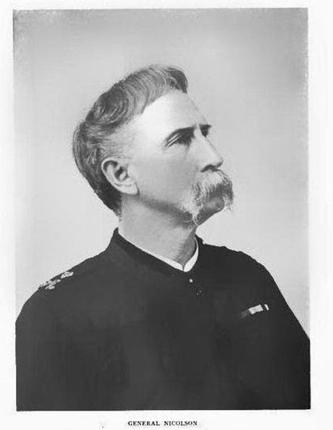
Lt. Gen. Malcolm Nicolson / by Special Arrangement / The Hindu
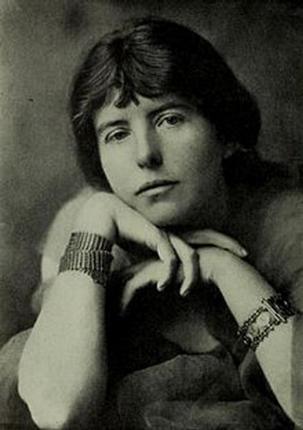
When Virginia Jealous speaks to members of the Madras Book Club this evening she might report that midst all the tall grass in the unkempt St. Mary’s Cemetery on The Island she found the tombstones of Adele Florence Nicolson and Lieutenant General Malcolm Nicolson.
John Jealous, her father, had found them side by side during his first visit to Madras in 1989, soon after he had started on the trail of a woman who was to become the obsession of his life as he pieced together her life during several subsequent visits to Madras and other parts of India for a book that didn’t get written; he passed away before he got to it. Now his daughter Virginia, a poet and a travel writer, who has been following his trail, hopes to write a book on that journey as well as on the woman who was the second great love of his life, Laurence Hope.
Adela Florence Nicolson / by Special Arrangement
What he — and Virginia — didn’t get to see was the mansion where she committed suicide a few months after her husband died. Dunmore House, in Alwarpet, was where Florence Nicolson, whom few knew as the famed poet of the 19th Century, Laurence Hope, and her husband, who called her Violet, lived for some months after they returned to India in 1904.
Murray’s Gate Road, named after the Hon. Leveson Granville Keith Murray, Collector of Madras between 1822 and 1831, led to Dunmore House, so named by him because he was the son of the fourth Earl of Dunmore. Whether he built the great garden house he lived in during those years is not known, but the house no longer exists.
What happened to the house in the 50 years immediately after Murray retired in 1831 after 38 years in the Madras Civil Service is not known but in 1888 it was bought by Eardley Norton, the well-known lawyer, for Rs. 47,800 in a Court sale.
The house was next bought from Norton’s estate in 1910 by the Maharaja of Pithapuram. A tragedy in the Pithapuram family led to them moving out to Cenotaph Road and, no doubt, Dunmore House remained rented out till businessman K. Gopalakrishnan bought it in 1941. Over the years that followed, the acreage of Dunmore House was sold off in substantial plots and its northern half became Venus Studios, home to Venus Pictures. After the studio closed down, the property was developed as today’s Venus Colony. In the southern half, a couple of roads close to Dunmore House take their names from members of the Pithapuram family, and some members of Gopalakrishnan’s family have homes on these roads. But none in the area seems to know of Laurence Hope.
Laurence Hope wrote impassioned poetry that as the ‘Indian Love Lyrics’ scandalised Victorian England. Her ‘Pale Hands I loved By The Shalimar’, her best remembered poem, had many tattlers nattering about a love affair with a young Kashmiri after her identity got known.
But her only known love affair was with the then Col. Nicolson, 46 at the time, whom she married in 1889 when she was 23. She was the daughter of Arthur Cory, who was the Editor of North India’s leading newspaper, the Civil and Military Gazette, published from Lahore. The Corys had arrived in India in 1881. The General, an Indophile like her, was ADC to Queen Victoria for a few years before his retirement in 1893. On his retiring, the Nicolsons returned to India and settled in Calicut for a few months before illness brought them to Madras for their last year. They died in 1904.
Laurence Hope’s poetry was read in closed rooms in the late 19th-early 20th Century but by the 1920s it had been set to music and was sung at tea soirees in the world’s leading hotels. She was certainly a woman ahead of her times, most people of the time resenting her intellectuality and her passion.
******
Back almost to roots
The House of Binny, in its 225th year, appears to be going back to one of its first, and most successful, businesses, liquor. For years now there has been little talk of Binny’s in business circles, if you except all the speculation about what it plans to do with its considerable holding of land in Perambur. The latest news, however, is that Binny’s is back in business again, with Mohan Breweries and Distilleries being merged with it. With Binny’s at present having no business operations, the merger will make liquor its business again.
From its earliest days as Binny & Dennison in the first years of the 19th Century, wines, spirits and beer was one of its largest imports, either for sale or ordered by individuals and institutions. Madeira was one of its major wines, but it provided it an export opportunity too. It was found that Madeira was a wine that matured particularly well in Madras and casks of it were imported, matured locally and re-exported to Britain.
A wine story retailed over generations in Binny’s Liquor Department concerned a veteran employee in the Department, Alex Rodrigues, who in 1873 blotted his copybook. When seven casks of Madeira, each of different quality, were found to be short through leakage or evaporation, he topped them up with loose Madeira they had around, quality be damned. He followed this up by washing empty claret bottles with the best brandy in stock. He got away with it all with a 15 per cent (Rs.15) pay cut.
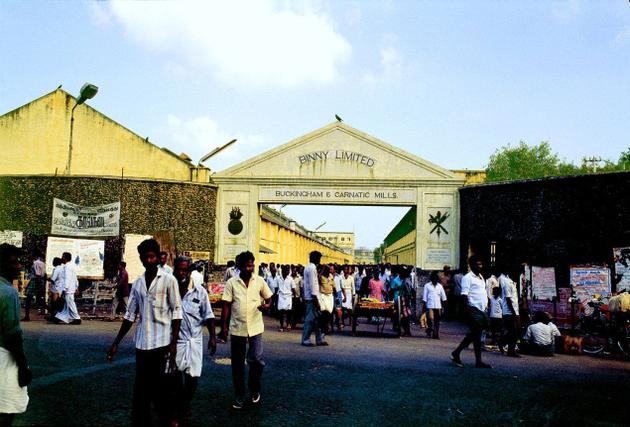
Binny Mills gate just before the mills were closed / by Special Arrangement
But for all the liquor business Binny’s did up to the 1940s, it publicly expressed concern over the ‘Drink Evil’, particularly as it affected production in its mills. In 1924, it persuaded Government to allow the six toddy shops and two arrack shops in the vicinity of the mills to be open only during mill working hours; frustrated workers, thus, found it difficult to get a drink after work, their usual drinking hours. And as for Sundays, it got Government to allow the liquor shops to be open only from 12 to 3 in the afternoon, siesta time. All this, however, did not completely solve the problem the mills — and the families of workers — faced. Binny’s as late as 1935 had temperance workers doing the round of workers’ colonies lecturing on the ills of drink, and its dramatic society often staged plays on the same theme in those areas.
All this is unlikely to be seen when the new township in 70 acres of Binny Mills property is developed over the next few years in partnership with the SPR Group. This is promised to be an integrated, self-contained residential township with every facility, from healthcare to education, from hotels to entertainment, provided for. But will it be named Binnyville or Binnypuram in memory of a once grand old institution that helped considerably in the growth of Madras?
******
Does a rose need a name?
Dharmalingam Venugopal, that dedicated documenter of the Nilgiris, tells me that he recently received a letter from a Colin Sullivan, a descendant of John Sullivan, who opened up the Nilgiris and is considered the progenitor of Ooty, wondering whether the Government of Tamil Nadu would name a rose in the Ooty Rose Garden after John Sullivan.
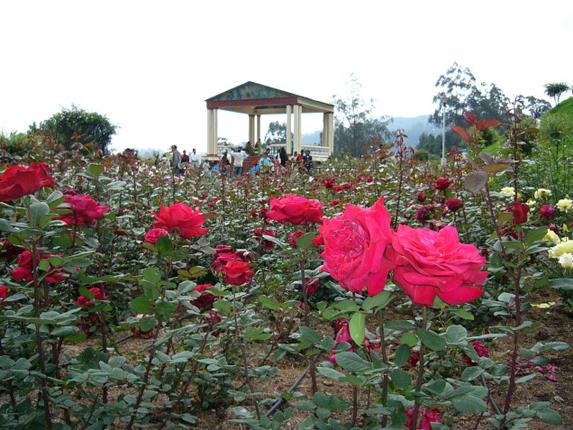
Ooty’s Rose Garden / by Special Arrangement
Rose plants, it is stated, first came into the Presidency in 1831 from England when Governor Stephen Lushington of Madras placed an order for them. A reference to the Ooty Botanical Gardens in 1832 speaks of the “fragrance of roses” filling the air. Did these roses come to the Gardens from John Sullivan?
Sir Frederick Price, who wrote one of the most definitive records of Ooty and its history (1908), said, “I consider that the introduction of European vegetables and of the apple, peach and strawberry may safely be attributed to Mr. Sullivan.” So why not roses? After all, John Sullivan was associated with the Nilgiris and Ooty from 1817 till the 1840s.
John Sullivan, the Madras Civilian, would certainly warrant a bit of Nature’s bounty being named after him.
source: http://www.thehindu.com / The Hindu / Home> Features> MetroPlus> Society / by S. Muthiah / December 14th, 2014
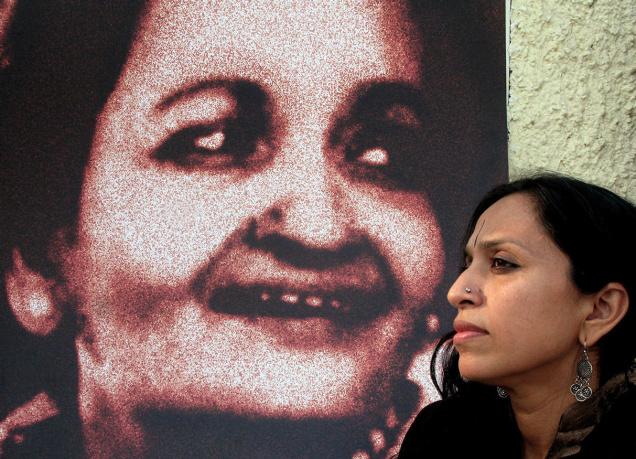
The Hindu Lit for Life 2015 – Poetry with Prakriti festival closes tonight with Delhi-based Hindustani classical musician Vidya Shah’s tribute to the music and poetry of the legendary singer Begum Akhtar in her centenary year. Excerpts from an interview with Vidya:
What drew you to Begum Akhtar and her work?
I learnt in the lineage of Begum Akhtar, taught by Shanti Hiranand, one of her senior-most disciples. So I grew up listening to vignettes about her life. Begum’s most important contribution to music was her singing of the ghazal, which is what drew me to her. Through this project, I’d hoped to highlight aspects of her life that reveal her greatness as a person, and the way in which she gave the ghazal a mainstream space in an otherwise hierarchical musical world. And since I’m presenting this at a poetry festival, I will look at the wonderful way in which she understood poetry, and the poets of her time, many of whom she had special relationships with. Her music was very much a part of that poetry, and it shaped her spirit and her singing.
Tell us about the process of creating this concert and its structure.
This concert is my understanding of Begum Akhtar, my perspective on her as a contemporary musician living in these times. I examine who Begum Akhtar was, her journey from being a bai to a begum, and in these journeys how she empowered herself with music and poetry. The performance is woven with a narrative that highlights interesting aspects of her life with anecdotes, some rare and others better known, which reveal how she could make such a fantastic impact on audiences even today. Choosing pieces from her vast repertoire was quite a difficult process. I was often overcome and overwhelmed with greed because I’d want to sing this song and that one too, because there are so many charming pieces she’s done. But ultimately, what I did choose are those that reasonably showcase the versatility of her singing, the richness in her choice of poetry and the journeys she made within her world of music.
What about Begum still resonates with audiences today?
It is musicians like Begum who paved the way for us. We don’t have the social baggage that they carried but we have the opportunities to present similar work. Begum was an assertive, independent feminist, who, despite the struggles in her life, was able to empower herself and others. For instance, in Hindustani classical music, the ritual of the ganda bandhan initiates one into a formal guru-shishya relationship. In her time, it was an entirely male practice. She was one of the first women to do it for her female students. So there was a lot of élan and strength to her as a person, and she found an amazing balance between her joie de vivre, and life’s struggles and sorrows. And that passion shows through in her music. Which is why she will remain relevant forever.
How has creating this project changed you?
Right at the start, I knew I could never reproduce or replicate Begum’s music. That would be impossible. The biggest advantage of her music, though, was the inherent quality that lets you imbibe it, absorb it, understand it, internalise it and make it your own. The project is now a year old and I’m still growing with it, still learning from it. It has given me a lot of humility and it’s been a humbling experience. It has also given me a lot of strength. I can now sense what must have been her greatness. And I’m excited to bring this now to Chennai, being a Tamilian myself, singing Urdu poetry here and sharing the life of a diva who wasn’t from here, but whose story still resonates here. I’m excited to be making that journey for myself.
source: http://www.thehindu.com / The Hindu / Home> Features> Lit for Life / by Esther Elias / December 09th, 2014
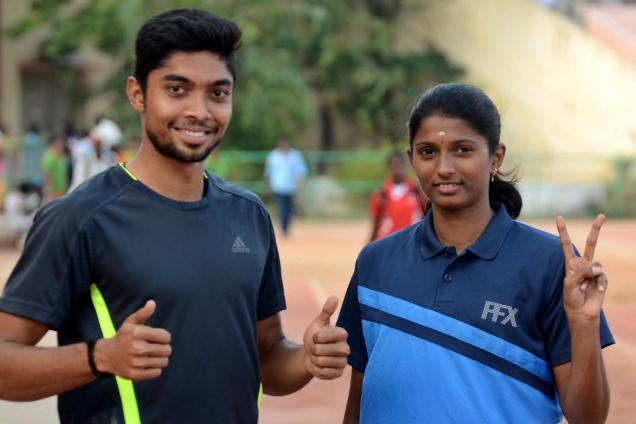
CHAMPIONS: S.N. Mohammed Salahuddin and M.A. Sivanbarasi were declared the best athletes in the Bharathiar University inter-collegiate athletic meet in Coimbatore on Friday. Photo: M. Periasamy
Dr. NGP College of Arts and Science and Nirmala College, with 63 points apiece, emerged the overall champions in the men and women’s sections respectively in the Bharathiar University inter-collegiate athletic meet at the Nehru Stadium here on Friday.
Three records fell on the final day and all came in the men’s section. A. Deepan Chakravarthi of STC (Pollachi), who shattered the 400m mark on Thursday, doubled his effort winning the 200m gold with a record timing of 21.7s.
A. Dharun of Dr. NGP College followed it up with a new record time of 53.5s in the men’s 400m hurdles. Later in the day, the STC men ran a brilliant last two legs to set a new 4x400m record.
Triple jumpers S.N. Mohammed Salahuddin (PSGCAS) and M.A. Sivanbarasi (PSGR Krishnammal) were declared the best athletes.
The results: Men: 200m: 1. A. Deepan Chakravarthi (STC, Pollachi) 21.7s (NMR); 2. K. Kevin Rinalldo (Dr. GRD); 3. P. Arul Prakash (Dr. NGP). 400m hurdles: 1. A. Dharun (Dr. NGP) 53.5s (NMR); 2. M. Parthiban (STC); 3. J. Balaji (Sri Krishna). Long jump: 1. S.N. Mohammed Salahuddin (PSGCAS) 7.27m; 2. S.P. Laxman (Dr. NGP); 3. S. Bharathiraj (STC). 10,000m: 1. T.M. Shaheer Ali (Dr. NGP) 34:48.6s; 2. K. Thangavel Murugan (Dr. NGP); 3. G. Gopa Kumar (PSGCAS). Discus: 1. R. Ashwin (Sri Krishna) 38.04m; 2. S. Bharathi Raj (STC); 3. S. Durai Murugan (Dr. NGP). Pole vault: 1. G. Krishna Vishnu (PSGCAS) 3.60m; 2. A. Khassan Khan (Dr. NGP); 3. R. Saravana Kumar (STC).4x400m: 1. STC Pollachi 3:22.0s (NMR); 2. PSGCAS; 3. Sri Krishna. Best athlete: S.N. Mohammed Salahuddin (PSGCAS) 1003 pts. Overall champion: 1. Dr. NGP CAS 63 pts; 2. PSGCAS 55.
Women: 200m: 1. D. Anitha (Dr. NGP) 26.1s; 2. R. Mohana (Nirmala); 3. A. Manjusri (Nirmala).400m hurdles: 1. P. Iniya (PSGR Krishnammal) 1:07.3s; 2. G. Sathya (Nirmala); 3. P. Vinosha (Nirmala). Long jump: 1. M.A. Sivanbarasi (PSGR Krishnammal) 5.50m; 2. P. Monisha (Nirmala); 3. U. Sukithra (PSGR Krishnammal). 10,000m: 1. R. Poongodi (Gobi Arts) 37:34.8s; 2. E. Vasanthamani (Gobi Arts); 3. S. Vidya (Dr. NGP). Pole vault: 1. M. Deebika (Nirmala) 2.00m; 2. R. Geetha (Nirmala).Heptathlon: 1. P. Jayanthi (Dr. NGP) 3487pts; 2. G. Sathya (Nirmala); 3. M. Vetrivel Vigneshwari (Sri Krishna). Best athlete: M.A. Sivanbarasi (PSGR Krishnammal) 928 pts. Overall champion: 1. Nirmala 63 pts; 2. PSGR Krishnammal 56.
source: http://www.thehindu.com / The Hindu / Home> Sport> Other Sports / by Special Correspondent / Coimbatore – December 13th, 2014