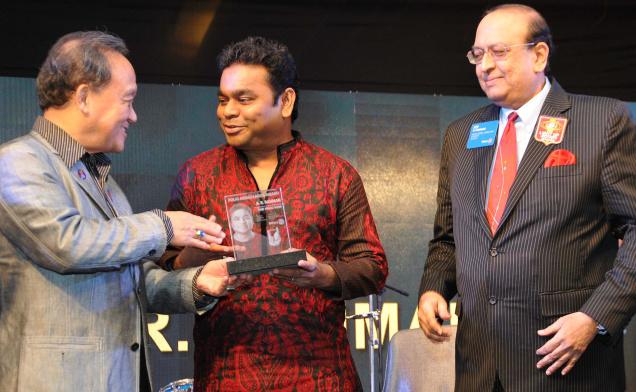
A.R. Rahman won the award for his fight against polio — Photo. M. Moorthy / The Hindu
Rotary International presented the polio ambassador award to music director A.R. Rahman at a meeting held in Guindy on Saturday.
Accepting the award, Mr. Rahman spoke of helping fight polio through social media.
“I used to think Facebook was a waste of time. But when it was suggested that I open a Facebook page and upload videos of my rehearsals, it helped me reach out to a huge user base of 22 million. It was through this page I began sharing awareness messages on polio,” he said.
Pianist Anil Srinivasan played some of Mr. Rahman’s hits songs from Hindi and Tamil cinema and asked him questions based on them.
Speaking about the influences behind Jai Ho, Mr. Rahman said, “I just wanted to approach the song like an anthem, uniting the musical influences of various cultures: Chinese, Japanese, Spanish. The song has all these influences.”
On working with Mani Ratnam, he said he was given the space to experiment beyond what the script required. “There have been occasions when I have tried something out for myself, even if it seemed outside the scope of the film in the beginning. Sometimes, Mani included them in his film. Deivam thanda poove was one such song,” he said.
Having just landed in Chennai from Berlin, Mr. Rahman was in no mood to sing. But the audience was in no mood to let him go without a song. The maestro left with a promise to sing the next time.
Singer Naresh Iyer entertained the audience afterwards.
source: http://www.thehindu.com / The Hindu / Home> News> Cities> Chennai / by Staff Reporter / Chennai – December 14th, 2014
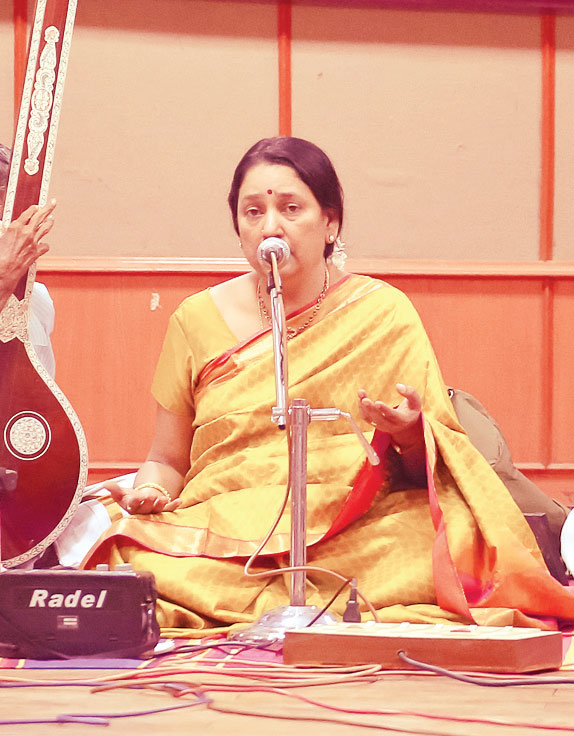
Senior vocalist Subhashini Parthasarathy is gifted with an in-depth intuition of musical phrases. Her performances only reflect the excellence of carnatic music, which is delivered by her in her own chaste style.
Bringing out aesthetic qualities and integrating them into the texture of the compositions has always been the hallmark of the artiste.
Her concert for the Sri Meenakshi Sundararajan fine arts that was performed recently, brought out the lustre of carnatic music of an earlier era. Beginning with the Neranammi varnam, a composition by the late singer-cum-composer Ramnad Srinivasa Iyengar, she moved on to sing Siva Siva (panthuvarali), a composition by saint Thyagaraja. And when she rendered Rama Badra Ra Ra (ananda bhairavi), composed by saint Bhadrachala Ramadoss, we realised that she is one original artistes who stands for the traditional values of Carnatic Panthathi.
Subhashmi’s competence in handling kriti passages, in both the octaves, made the listening experience a great pleasure indeed. Cowming back to the performance, Thyagaraja’s composition Kalikiyunde (Keeravani), rendered by Subhashmi with scintillating swara passages, revealed her capacity to deliver it with a natural flair and unhurried expression. When she brought out the salient characteristics of the raga, it was evident that the vocalist relied on fast tempo and the principles of vishranthi.
Pakala Ramdas (violin) made good effort to complement the singer, with Arun Prakash (mridangam) and Chandrasekara Sarma (ghatam) unfolding the laya exposition.
source: http://www.newindianexpress.com / The New Indian Express / Home> Cities> Chennai / by Narayana Vishwanath / December 13th, 2014
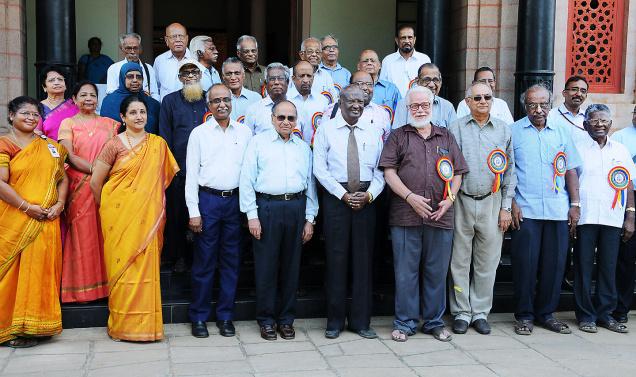
Former students of Thiagarajar College of Engineering of the 1960-1965 batch, along with Uma Kannan, secretary, at the golden jubilee reunion in Madurai on Monday. Photo: G. Moorthy
Former students of Thiagarajar College of Engineering, belonging to the 1960-1965 batch, came together to celebrate their golden jubilee reunion at the college premises here on Monday.
“I am meeting some of my friends after fifty years. It feels great to recollect our college memories,” said S. Nambi Narayanan, retired director of Indian Space Research Organisation and an alumnus.
Around 20 former students from different cities in India and abroad had converged at the college for the reunion. They toured the campus and honoured retired faculty members.
“It is very exciting to visit the college again and meet our friends after five decades,” said Ravi Ravindran, a retired scientist from Bell laboratory, USA.
The former students also expressed jubilance over the developments that had taken place at the college over the years since they had graduated.
“We feel happy to take note of the developments in the college. They are beyond our imagination,” Dr. Nambi Narayanan said. Mr. Ravi Ravindran urged the students to improve their skills to shine in any field.
V. Abhaikumar, Principal of the college, welcomed the alumni to visit the college and share their experiences with the students. “Alumni visiting the college at least once in a semester and sharing their stories on success and struggle will motivate not just students, but young faculty members as well,” he noted.
He also stated that the college is focusing on becoming a research-based institution. “We are looking for more involvement from industries in curriculum development and syllabus formation,” he added.
Former principal Maria Louis spoke on the importance of value based education. “College managements should inculcate the sense of responsibility in students. Most educational institutions, barring a few like TCE, have become commercialised,” he noted. Secretary of the college Uma Kannan interacted with the alumni.
source: http://www.thehindu.com / The Hindu / Home> News> Cities> Madurai / by M. Vandhana / Madurai – December 09th, 2014
Time was when tea was the drink of the working class in the state and coffee was considered a sophisticated brew for the uppermiddle class and the elite. The introduction of coffee into Tamil Nadu caused a certain cultural anxiety initially but the beverage was ultimately appropriated by Tamil society.
These and other fascinating insights about the history of plantations, coffee and tea were revealed at a seminar titled ‘Tea For David’, a felicitation of historian and professor David Washbrook, who retired from Trinity College, Cambridge University after teaching at the famous institution for 40 years. This wasn’t surprising, because Washbrook is an academic who specialises in the history of south India.
“The appropriation of coffee was mediated both by caste and class and coffee became the marker of the brahmin middle-class,” said A R Venkatachalapathy, professor, Madras Institute of Development Studies, Chennai, speaking at the seminar organised by the department of humanities and social sciences of IIT-Madras
Quoting a court case from Kolar Gold Fields in which a Buddhist dalit was refused coffee, Venkatachalapathy explored the question of coffee and caste in colonial TN. “On July 13, 1927, Ramaswamy and two friends, one a brahmin, walked into a restaurant. He ordered three coffees. When the proprietor saw Ramaswamy, he told the waiter not to give coffee to a lower caste. Upset over the incident, he walked out. His brahmin friend, however, didn’t accept the coffee served to him as a mark of protest,” said Venkatachalapathy, the author of ‘In Those Days There Was No Coffee: Writings in Cultural History’.
“Ramaswamy filed a case and hired barrister E L Iyer, a renowned labour activist in Madras,” he said. “But today, there is no record of the proceedings, barring three reports in a Tamil newspaper. It shows that drinking coffee was no ordinary matter those days. With a separate place for Brahmins, caste was very much part of the ‘coffee hotels’ of those days, and leaders like Periyar E V Ramasamy had to fight against this.”
Speaking on ‘Planters, Power and the Colonial Law’, Ravi Raman, of Council for Social Development, New Delhi, said the British subjected dalits in plantations to various forms of institutional and coercive repression.
“The contrasting dimensions of colonial law have been explored by historians, but it appears that plantation owners too developed their own laws. They ultimately minimised abuse of workers but, by and large, they wielded coercive power,” he said.
source: http://www.timesofindia.indiatimes.com / The Times of India / Home> City> Chennai / TNN / December 09th, 2014
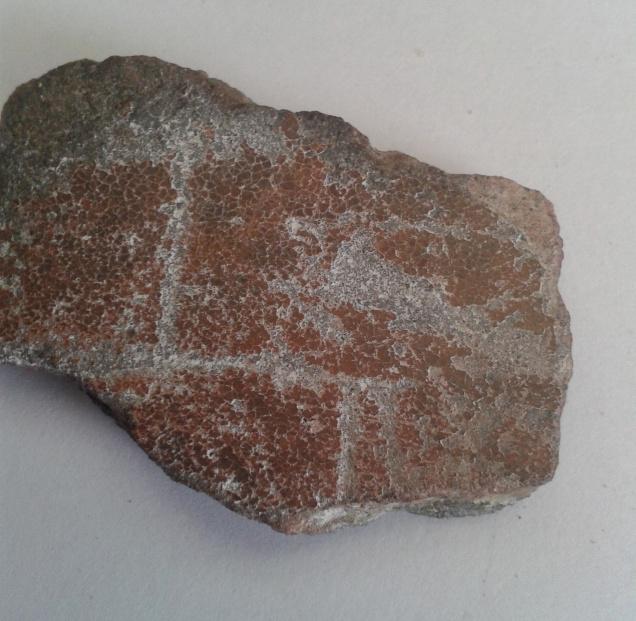
A total of ancient 30 pottery pieces dating back to 3 century BC have been unearthed at Madhagam village on the Pudukottai-Avudaiyarkovil road near Embal, a coastal village, recently.
A salient feature of these pieces is that eight of them contained strokes testifying to the ancient practice of denoting figures.
While one of the pottery pieces had the strokes of wings of a bird, another contained Swasthik symbol.
Interestingly, one piece contained a couple of alphabet-like markings, said S.Neelavathy, Assistant Professor in History, Government Arts College for Women, here on Thursday.
Chance discovery
She said the digging of an irrigation tank in the village for maintenance led to the chance discovery of these pieces.
She, along with Karu.Rajendran, an epigraphist, went to the spot to study the pieces following a tip-off from the students hailing from the nearby villages about the finding.
The pieces testify to the fact that the coastal district accounted for human habitation in the hoary past.
She has planned to take up further research in the area with the cooperation of the local villagers.
She has appealed to the villagers to immediately contact her if they come across any piece of pot with strokes, by dialling 9788205562.
source: http://www.thehindu.com / The Hindu / Home> News> Cities> Tiruchirapalli / by Special Correspondent / Pudukottai – December 12th, 2014
They look nothing like Harrison Ford. One is a professional archaeologist who is more than 70 years old and the other a shippie-cum-blogger who is more comfortable doing painstaking background work than with the limelight.But, in terms of real life impact their work is as thrilling as and probably more productive than Indiana Jones ever was in the movies. Through their websites, plunderedpast.in and poetryinstone.in, they have tried to create a record of artefact thefts and done their bit in tracking them down in museums and private collections across the world. Kirit Mankodi and Vijaykumar Sundaresan have also come up with crucia information that has helped to beef up the case against art thief Subhash Kapoor lodged in jail and undergoing trial.
Mankodi’s passion for retrieving stolen treasures started in the late 1990s when he accompanied a team of archaeologists who went on an excavation in Rajasthan. The team found three ancient sculptures dating back to 9th century .
The site was cleared and the sculptures were displayed with a signboard. But a couple of years later they disappeared from the site. “The big sculpture among the three was the first to be stolen. A year later another one went missing and soon after the last one too vanished. I wrote to the concerned authorities but that was of no use. Then I decided to do some thing of my own to prevent illicit smug gling of antiques from our country and that’s why it all began,” said Mankodi, who is a senior archaeologist. Vijay who grew up in awe of the thousands of grand temples across Tamil Nadu was also concerned about antique idols being stolen from unguarded tem ples. By reading books, visiting temples and connecting with a larger group of heritage enthusiasts over the internet, he started to piece together information.He started feeding this information from the background to investigative agencies for two years but he found that did not help. “It was then I decided to come out and go to the press. I had to open up because there was no point being a silent informer,” he says.
By working through a network of heritage enthusiasts including among the global Indian diaspora, Vijay has been able to unearth crucial information in the Subhash Kapoor case. One such was a print catalogue belonging to Subhash Kapoor’s Art of the Past gallery in New York that helped him to connect the statue of Uma in Singapore’s Asian Civilizations Museum he had seen many years back with the one in grainy photographs published by the Tamil Nadu police’s Idol Wing as having been stolen from Ariyalur.
Poetryinstone.in documents missing artefacts and explains to the otherwise flitting online reader the value of Indian heritage. Reach Foundation’s citation lauds Vijay for his efforts not just in educating people about missing temple icons but also for explaining to the layman in simple terms the complex craft of iconography and temple art.
The recent return of a Nataraja idol from Australia is only the beginning and many , many more stolen statues are in museums across the world including in Australia, say Kirit and Vijay . Among the work of Mankodi is the sourcing of the sandstone Bharhut Yakshi – at $15 million the most expensive item in Kapoor’s loot catalogue – still with US authorities. Mankodi was able to trace it to a shrine in Madhya Pradesh (South Pole, April 29) following which Indian officials in the US got in touch with him asking for supporting evidence. Mankodi says indications from US and Indian officials are that the Yakshi would return, sooner or later.
Email us your with full name and address to southpole.toi@timesgroup.com
source: http://www.timesofindia.indiatimes.com / The Times of India / Home> City> Chennai / by Debayan Tewari & M T Saju, TNN / December 08th, 2014
Senior journalist and former assistant news editor of The Hindu R.P. Sarathy died here on Wednesday. He was 87. He is survived by wife Saroja Parthasarathy, son Venkatesh Parthasarathy and daughter Nalini Ramanujam.
The last rites would be performed at Besant Nagar crematorium at noon on Thursday.
A history graduate from St. Joseph’s College, Tiruchi, Sarathy was in charge of editorial administration in The Hindu .
source: http://www.thehindu.com / The Hindu / Home> News> National> Tamil Nadu / Chennai – December 11th, 2014
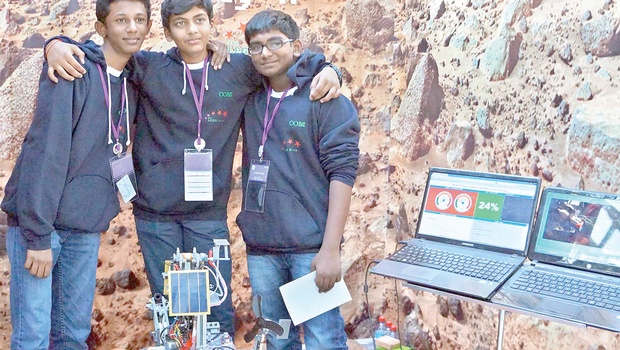
Arock Joe, Motheswar and Shiva Manickam, who won second prize in the International Robot Olympiad held in Russia
Chennai :
With wind turbines based on the air velocity in Mars, track wheels based on the planet’s ground texture, sensors and spectrometers, the children who built the robot ambitiously hope to find solutions to the challenges in the Mars rovers. Now armed with second prize in the International Robot Olympiad held in Russia, the team of three from Chennai hope to go a long way.
Arock Joe (Class 9) of St Michael’s Academy, Adyar, Motheswar (Class 10) of Akshayah School, Velachery and Shiva Manickam (Class 9) of DAV Public School are the first Indian team to bag the prestigious prize in the event. The team received its training in Robotics under the Chennai-based trainer TechKnowledge Education Solutions Pvt Ltd.
Over 367 teams from 62 countries participated in the event held in association with the Ministry of Education & Science and Ministry of IT of the Russian Federation.
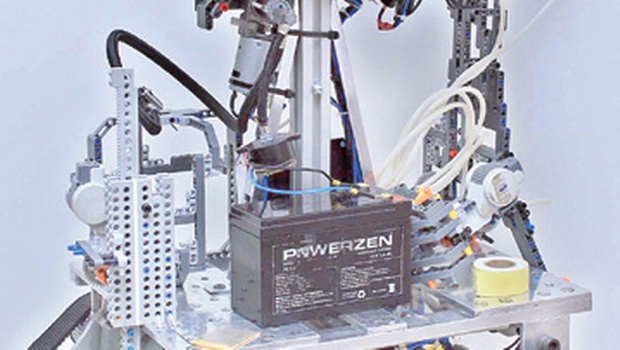
The theme for the year was ‘Robots and Space’, and the challenge these children took up was the issue of power failures in the Mars rovers in their prototype Infinity-M. “With our research we found that all of them had solar panels as the power source. We found that the wind velocity in Mars was enough to propel a small turbine so we installed a windmill, would supplement solar energy,” said Joe.
The robot built by the children
He said that they found that the wheels were getting stuck in some portions in the Curiosity rover, which they changed by using track wheels with larger surface area to reduce the pressure. The team began their work in May. “We did our research on the Internet and spoke to a scientist from ISRO,” says Joe. The judging was gruelling, with nine judges evaluating the students of whom three were ‘plainclothes’ judges who came to the stalls like visitors.
“There were some last minute challenges like Internet issues. And it was freezing in Russia!” said Siva. But the group made it to second place — a huge achievement. Indian teams have been participating for many years, but nobody has made it to the top three until now.
“Robots find their role in anything from making cars to packing pickles. There is a new wave in the school education system that is recently coming up — robotics for school children,” says Godwin Varghese, director, Development and Operations, Techknowledge Education.
The competition, however, had to be funded by the students themselves, and building a robot over months and a trip to Russia did not come cheap. Scholarships and sponsorships could go a long way in encouraging robotics.
source: http://www.newindianexpress.com / The New Indian Express / Home> Education> Student / by Express News Service / December 10th, 2014
Children need to be allowed to play on the beach—barefoot,” says 61-year-old K Shanmugam, founder of Eldam’s Orthotic Centre. “A majority of children these days have flat foot, and there are multiple reasons— hereditary, incorrect footwear and much more. But we need to detect it early and correct it; otherwise it will pave the way for secondary ailments when they grow up.” Shanmugam who opened Chennai’s second orthotic clinic for civilians explains that children in rural areas are less affected by flatfoot, because they walk barefoot on different surfaces and hence their feet get exercised.
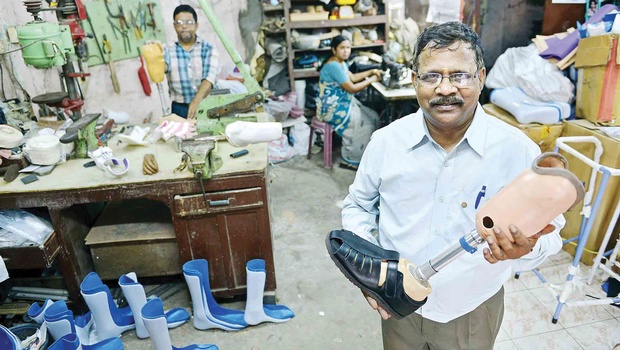
Seated in his small shed-workshop-consultation room just off Eldams Road, Shanmugam explains that when he started this unit in 1985, he was the second person in the city offering orthotic care for civilians. “There was only one centre in Pune that offered artificial limbs to those whose hands and legs were affected during service. My professor M Natarajan decided that civilians also required this service and created a course to train students,” he says. Shanmugam explains that initially artificial limbs were created by carpenters, blacksmiths and tailors; however his professor believed that to understand the dynamics of the human body, you need to be certified and trained. So, Shanmugam signed up for the course in 1975, which had only six students.
Post graduation, he took voluntary retirement from Stanley Government Hospital and with the assistance of his wife Geetha Rani, started this small unit. “Initially I would create artificial limbs and aesthetic hands by myself. Soon I hired physically challenged people in my workshop to create these products,” he explains. There were two reasons why he hired physically challenged people to do the job—it empowered them and they understood clearly the requirements and factors that needed to be addressed when creating limbs. “I train these people in my workshop for a year and help them find opportunities elsewhere. Since my wife and I do this as a service, our income generation is limited. So, after training we send these people to bigger enterprises where they can earn sufficient income,” he says. This year, Shanmugham has two deaf and mute men working in his workshop and assisting him create mechanical hands.
“Over the last few years, I have seen a lot of children and diabetic patients coming in. The feet are the most neglected part of the human body. Since childhood, children need to be taught to care for their feet. It goes beyond wearing slippers; they need to wash it twice everyday, apply an oil or lotion to control dry skin, massage the feet, clean the web-spaces and trim the nails—it is a routine that needs to be followed,” he emphasises. “Ask your children to wash their feet and make an impression just like how you do it on Gokulashtami. Check if there is an arch, and if you don’t see one, visit your doctor and get corrective footwear. Ignoring it will lead to secondary issues like swollen ankles, bunions, bone issues etc,” he warns.
Shanmugham adds that modifications in the footwear can be done—from creating a new footwear to adding insoles, everything can be done to curb the problem. Besides this, Shanmugam and team are constantly designing new tools and apparatus for patients with unique requirements. “A five-year-old girl fell and fractured her jaw line. Everything healed, however the child was not able to open her mouth and was on liquid diet. After discussion with her doctor, we created a mouth exercise tool putting together steel rods and springs. After the first session she was able to open her mouth wide enough to allow two fingers. Everything in this workshop is customised,” he says.
At the moment, Shanmugham has roughly 100 people who come in every month with feet and hand issues. “We have been focussing on creating mechanical hands of late. Earlier there were aesthetic hands that were famous. These look like real hands, yet have no other use. With mechanical hands, the user can actually write and do normal things like all of us,” he elaborates. Recently a person he had created and fitted a mechanical hand has found himself a job as a writer. “He writes and documents things for his company,” Shanmugham says, adding that these differences he makes to peoples’ lives is what motivates him to go on.
He has not been inspired to shift location, nor create a glossy office like his counterparts. “I got several offers to go abroad and work. My uncle came and asked me whether there were no physically challenged people in India who needed help. I thought over it and decided to stay her and help those who need prosthetics and orthotics care,” he smiles. He adds that there are so many vacancies in this field, yet very few takers.
“Usually during a medical check at school, the vision, heart and hearing is checked, but never the feet. I insist that feet should also be checked thoroughly,” he says and adds earlier when they said get yourself checked head to toe, they meant it literally.
source: http://www.newindianexpress.com / The New Indian Express / Home> Lifestyle> Health / by Jayanthi Somasundaram / December 06th, 2014
Finding the exact day of any given date in 110 years is not an easy task for most people, but N Priyanka, a 14-year-old girl affected with cerebral palsy, can accomplish that within a five seconds. This extraordinary talent has brought national recognition to the Trichy girl, who has just got back from meeting the Indian President.
Priyanka, daughter of N Kannan and B Banu, won the ‘national award for the empowerment of persons with disabilities’ last week, presented by President Pranab Mukherjee at New Delhi. She met the collector and received accolades from the district administration and a cross-section of people on Monday.
She showed off some of her talent at the grievance day hall here in the presence of district collector Jayashree Muralidharan, instantly calculating the day for the dates mentioned between 1941 and 2050. Her questioners needed to check the calendars to ascertain the answer, but Priyanka never required any outside help
Though she is affected with cerebral palsy and mental retardation, this Class 8 student of Ramakrishna middle school in Puthur has an extraordinary memory power. The discovery of her talent was purely accidental. Her mother, K Banu, tells the story, which took place sometime in June this year.
“I was trying to figure out the day of August 17, 2014 to apply for a leave to attend a function. To my surprise, my daughter said that it was Sunday within a few seconds. When I cross checked with the calendar, her answer was perfectly correct,” she said, who is a caretaker in a private school in the city.
Unlike some normal people who have such talent, but who may have to depend on some formula to find out the day, Priyanka relies solely on her memory power.
When her teacher asked her how she could find out the answer within a fraction of second, she simply said with a smile, “I don’t know, madam.”
She is also capable of listing out the dates of a day in all weeks in a month. For instance, if we want to know the dates of ‘Wednesday’ in a month, she will list out the dates within few seconds.
Her father Kannan, who is an auto rickshaw driver, proudly says that this is only the first step for his daughter, ahead of a brilliant future.
“It takes only two to three seconds for my daughter to find out the days. I feel her talent can help children like her. My aim is to make her a doctor to serve the poor people,” said Kannan.
source: http://www.timesofindia.indiatimes.com / The Times of India / Home> City> Trichy / TNN / December 09th, 2014