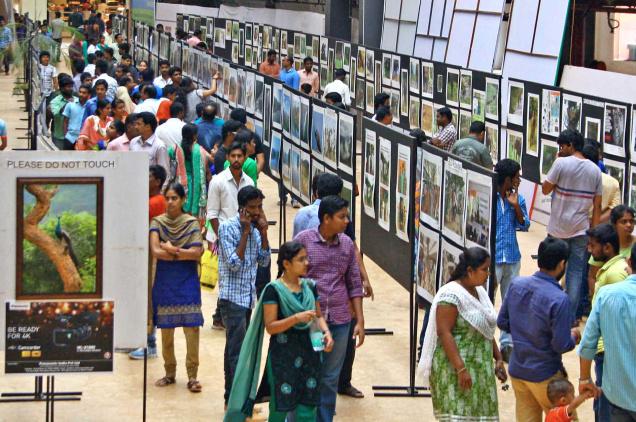
Thousands visit wildlife photo expo

Visitors having a look at the exhibits displayed in ‘Click Your Pic 2014’ wildlife photography contest and expo at Brookefields Mall in Coimbatore. / by Special Arrangement / The Hindu

Importance of wildlife photography stressed

Thousands of visitors flocked Brookefields Mall in the weekend to see the wildlife photographs displayed by 165 photographers across the country in the ‘Click Your Pic 2014’ wildlife photography contest and expo. It was organised by the Environment Conservation Group.

The photographers displayed India’s rich biodiversity. Eminent wildlife photographer T.N.A. Perumal, who distributed prizes to the winners of the competition, on Sunday, spoke on the importance of wildlife photography and change in technology that had made wildlife photography much easier.

I. Anwardeen, Conservator of Forests, Sathyamangalam, asked the public to work towards conserving wildlife and India’s rich natural heritage.

R. Mohammed Saleem, president of ECG, elaborated on the importance of the pictures displayed in the expo and efforts taken by photographers in taking them.

Winners were given prizes in three different categories. In the mammals category, Sudharshan Murthy came first, followed by Bharathi and Dhanuparan. In the birds category, Ganesan Ram won the first prize. Anvitha Jaganath and Sivakumar came second and third. In the insects category, Sibi Ussan bagged the first and the second prizes. R. Prakash Kumar of Nallampalayam bagged the third prize.

Prizes for the drawing competition held on Friday were also given away to school students on Sunday.

The exhibition is open to visitors at Brookefields till November 19. Schools can bring their students in batches to visit the exhibition and learn our rich natural heritage.

source: http://www.thehindu.com / The Hindu / Home> News> Cities> Coimbatore / by Staff Reporter / Coimbatore – November 18th, 2014

Philately, not just a hobby but also an investment

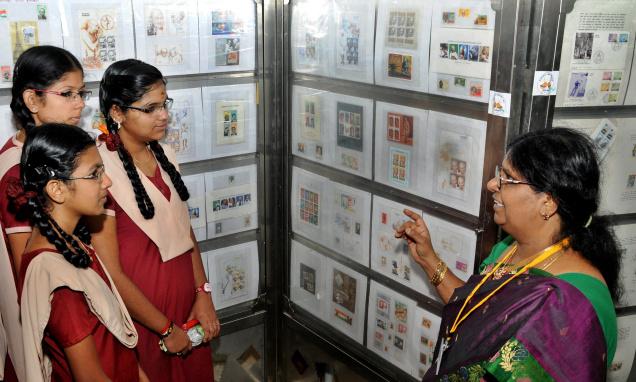
Students at ‘Kovaipex 2014’, a district-level philatelic exhibition at Techno Park, TNAU, in Coimbatore on Thursday. Photo: S. Siva Saravanan / The Hindu

P.R. Krishnan, who is into export business, considers some of his most profitable investments to be those made outside that business. For, his best returns have come from philately.

Mr. Krishnan, a senior philatelist in the city, says, gold purchased for Rs. 100 in 1949 will be worth around Rs. 79,000 now. However, stamps bought for the same amount in the same period will now be valued in excess of Rs. 3.25 lakh, more than four times that of the gold’s value. “Today, stamp collection is the best investment avenue for youngsters,” he adds.

Mr. Krishnan is the secretary of Philatelist Club of Coimbatore, playing its role with India Posts in organising a three-day philatelic expo “Kovaipex” that began here on Thursday.

Manju P. Pillai, Post Master General of Western region, says the expo is a quadrennial event that is being given a fresh impetus this time around. All the schools in the district have been invited to send their students for the expo. It features 144 frames holding thousands of stamps collected by many young and senior philatelists in the city.

Rare stamps such as the ‘Scinde Dawk’, the first Indian stamp released in 1852, ‘Sandalwood Scented Stamp of India’ released in 2006 and ‘Kurinji stamp’ released later in the same year to celebrate the legendary blossoms of Western Ghats also find a place of prominence.

U. Srinithish, Class VIII student of PSG Public School, says, “I have a personal collection of around 500 stamps that is something of a generational inheritance. They were passed down from my grandmother to my father and now, to me. Its value struck me only after visiting this expo.”

Competitions are also being held for the best collection. Students from various schools in the city visited the exhibition, which is being held at the Techno Park II and III on TNAU premises on Marudamalai Road. Entry is free for the expo, which will be open from 10 a.m. to 7 p.m. It concludes this Saturday.

source: http://www.thehindu.com / The Hindu / Home> News> Cities> Coimbatore / by Srinithi Mahendran / Coimbatore – November 28th, 2014

IIT-Madras shows the way in low-cost housing

Chennai :

With real estate prices and cost of construction on the rise, owning a house in cities remains a dream for the middle class. But it might soon be a thing of the past, courtesy IIT Madras and its efforts to popularize the cost-effective, rapid and eco-friendly method of construction using Glass Fiber Reinforced Gypsum (GFRG) panels.

After the successful construction of a two-storey building at the IIT campus in June this year using GFRG panels, experts from the civil engineering department of the institute are close to an agreement with Tata Housing Development Corporation Ltd to build a housing project at Boisar, a suburb in Mumbai, for low-income groups.

The GFRG building method essentially uses glass fibres and specially calcined gypsum plaster to make the regular panel stronger and water resistant.

According to Shinto Paul, structural design engineer for the GFRG building at IIT-M and PhD scholar at the civil engineering department, the foundation for the building is laid in the regular manner and GFRG panels are used for erecting the remaining superstructure with minimum concrete usage except at the joints and cavities of the panel. Once the foundation is constructed and the panels are erected, the main structure can be built in a few days.

However, while using GFRG panels, all floors should ideally have the same floor plan. Curved structures and domes are best avoided or concrete can be used for such areas.

“The rapid low-cost housing project is headed in the right direction and we are in talks with Tata Housing to use the technology for mass housing projects. We are also collaborating with various state governments and housing structures are already being built in Kerala using this technique.” said Bhaskar Ramamurthi, director, IIT Madras.

A senior official with Tata Housing confirmed the development and said the pilot project discussions were under way. The pilot module of the Boisar project consists of nine buildings, each with five floors and eight apartments on each floor. After the construction of the pilot module, the project may be scaled up with more buildings. It is estimated that the total cost of construction will be limited to less than 1,200 per sqft.

“We have been getting numerous enquiries about the project after the completion of the demo building at our campus,” said A Meher Prasad, head of the department of civil engineering, IIT Madras. The 1,981sqft two-storeyed building at the IIT campus, with two one-bedroom and two two-bedroom apartments, was completed in just a month at a cost of 24 lakh.

“We are constructing a 54-unit housing building for Kerala government at Chottanikara at a cost of 1,000 per sqft. The idea is to bring down the cost of constructing the structure and the customer can choose the remaining accessories and fittings,” said Shinto Paul.

As of now, the GFRG panels are being manufactured at FACT-RCF Building Products Ltd (FRBL) in Kochi, a joint venture between The Fertilisers and Chemicals Travancore Ltd (FACT) and Rashtriya Chemicals and Fertilisers, Mumbai. Proposals have been mooted to the Union government and more manufacturing units for GFRG panels are expected to be set up across the country to further scale down the transportation cost of the panels.

source: http://www.timesofindia.indiatimes.com / The Times of India / Home> City> Chennai / by Binoy Valsan, TNN / November 24th, 2014
IIT-M Joins Hands With CERN To Explore Secrets of Universe

Chennai :

Led by an expert who was part of the ATLAS experiment that helped find the God Particle, Higgs Boson, by the Large Hadron Collider at CERN, the Indian Institute of Technology – Madras has become a full member of a collaboration with the Geneva-based organisation in search of the structure of the universe.

While reputed institutions including TIFR, BARC and a few others have been partnering with CERN, IIT-M is the first IIT to come on board of the prestigious LHC experiment.

According to Prafulla Kumar Behera, associate professor with the department of physics, this initiative will help the institute strengthen its capabilities in fundamental research. “CERN is home to a lot of innovations, including the world wide web. This collaboration is like a bridge that would connect us to the highest level of scientific research while offering them our talent and expertise,” Behera told The New Indian Express.

Besides him, another faculty, James Libby, and two PhD scholars have come on board on the CMS collaboration.

Behera was part of the ATLAS (A Toroidal LHC Apparatus), one of the many particle detector experiments at the LHC particle accelarator, for half a decade till 2011 before returning to India to take up the job at IIT-M.

The collaboration will be on CMS or Compact Muon Solenoid, a particle detector that is designed to see a wide range of particles and phenomena produced during high-energy collisions in the LHC. This information is believed to hold answers to questions like what the universe is really made of, what forces act within in and what gives everything substance.

Behera has previously worked on silicon pixel detector, a sophisticated technology used primarily in fundamental scientific research, which is not available in India. “We would like to collaborate and develop Indian expertise so that by the time the plant is upgraded by 2020 as has been planned, there will be substantial contribution from our country,” said Behera, who returned from CERN a week ago.

The silicon pixel detector has uses outside the limits of fundamental scientific research, including medical purposes like advanced imaging, he said, pointing out that Indian industries could manufacture the detector in the coming years.

While the team from Chennai will be placed at CERN during the summer, the idea is to collaborate from here by using grid computing to access data generated at the labs in Geneva. Grid computing facility has already been networked till TIFR, Mumbai, which will be expanded to south India, he added.

source: http://www.newindianexpress.com / The New Indian Express / Home> States> Tamil Nadu / by Express News Service / November 23rd, 2014

Chennai sees first dusk-to-dawn marathon

Photos: B. Jothi Ramalingam

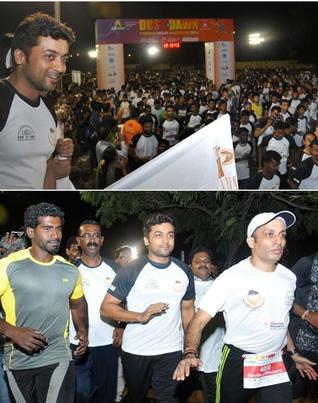
Island grounds on Saturday night found a crowd of thousands gathered to run for a cause as part of the city’s very first dusk-to-dawn marathon.

The initiative, conceived to increase awareness about liver diseases, liver wellness and the need to donate organs, was flagged off at 10 p.m. by actor Suriya, who has pledged to donate his organs.

The event saw a massive turn-out, with as many as 6,000 individuals participating.  While some ran a daunting 21 km, others did a course of 3 km. Transplant patients too took part in the event and were to cover a distance of 1.5 km.

Presented by Apollo Hospitals Chennai – Centre for Liver Disease and Transplantation, along with Love your Liver Foundation, and supported by Chennai Runners, Dream Runners, Cool Runners, Tamil Nadu Cycling Club and Neville Endeavours, the marathon was expected to extend to the early hours of Sunday.

source: http://www.thehindu.com / The Hindu / Home> News> Cities> Chennai / by Staff Reporter / Chennai – November 23rd, 2014

Award of merit for educationalist

This is a significant year for India and Australia to build bilateral relations and strengthen economic ties between the countries, Patrick Suckling, Australian High Commissioner to India, said here on Saturday.

He was in Chennai to present the Indo-Australian Award for Meritorious Service to Elizabeth Varghese, chairperson, Hindustan Group of Institutions.

Highlighting the significant aspects of recent meetings between Prime Ministers of India and Australia, Mr. Suckling said their mutual visits helped to intensify the relations between the countries.

Drawing comparison between Prime Minister Narendra Modi and Australian Prime Minister Tony Abbott, he said both were deeply committed to values and development. Pointing out that several agreements were signed for sustainable development, Mr. Suckling said mutual contributions by the communities in both the countries were also significant. He lauded Ms. Varghese for her achievements in male-dominated fields and also for her pioneering work in the engineering and education fields.

Accepting the award and citation given by the Indo-Australian Association and Australian Consulate General, Chennai, Ms. Varghese said, “This award is recognition for my work in the fields.”

Deputy Consul General to South India Stuart Campbell and Indo-Australian Association’s vice-president Eugenie Pinto also spoke.

The Indo-Australian Award for Meritorious Service was presented to Elizabeth Varghese of the Hindustan Group of Institutions

source: http://www.thehindu.com / The Hindu / Home> National> Tamil Nadu / by Special Correspondent / Chennai – November 23rd, 2014

Korean music group celebrates opening of its Consulate General

Madurai :

In a bid to strengthen bilateral ties with India and expand its programme in the south, the consulate general of republic of Korea held a traditional Korean performance here on Friday. The performance, which was carried out by a Korean music group called “Noreum Machi”, was held to commemorate the opening of consulate general of republic of Korea in Chennai. The office began functioning on February 7.

In Kook Kim, a member of the consulate general, commented that their agenda was to deepen bilateral ties with India and expand their ties with different places in India. These ties would be cultural as well as academic, he said. The group of four artists, wearing the traditional Korean dress consisting of a hat and a long ribbon, gave a dance performance called the “sangmo”, accompanied by Korean folk music. The group sang as they danced, and traditional instruments like the ‘janggu’, which looked like a drum, ‘jing’, a large metal gong and ‘teapyungso’, which is a double-reed wing instrument, were used to create the music, besides a double-barrel drum called the ‘buk’. tnn

source: http://www.timesofindia.indiatimes.com / Times of India / Home> City> Madurai / TNN / November 22nd, 2014

History stands tall on Madurai’s Palace Road

Madurai :

Although the beautiful Thirumalai Nayak mahal, a palace built by the Nayak king Thirumalai Nayak (1623-1659) more than 400 years ago, is only one-fourth of its original structure now, it still attracts thousands of tourists every year. The road that hosts it does credit to the handsome structure, as British-era buildings, including a church, line the stretch.

The name Palace Road too is a British contribution, said V Vedachalam, an archeologist, explaining that the street came under the foreigners after they conquered Madurai by 1790. Many Nayak structures were converted to offices, and the district court was housed in Nayak mahal till the 1980s, assigning much prominence to the road, he said.

The east gate CSI church is another important structure here, established by American missionaries in 1845. T Chinnaraj, former principal of American college, said that it had been the first church of the American missionaries.

“It is believed that it was the most beautiful church at the time and British collectors had written back to England about this church coming up. The missionaries bought this piece of land outside palace entry and constructed a place of worship for themselves. Most of their constructions, like the mission hospital, came beyond this church,” he pointed out.

The palace, built in 1636, was dismantled by Thirumalai Nayak’s grandson, who shifted most of the materials to Thiruchirapalli to construct his own palace.

However, the hybrid Dravidian- Islamic style palace remains one of the prime attractions of city, drawing even foreign crowds.

Sixty-nine-year-old A K Venkatachalapathy, a resident of Palace Road, recalls it as one of the most beautiful streets he had ever seen. The road used to act a min-bus stand, and buses would start from here and go to the tail ends of the city.

The park in front of the palace used to be a hive of activity, he says, as people gathered there after their day’s work to listen to the radio. Televisions had not started to make an appearance, he recalls, and loud speakers used to blare out the radio for the residents. Over hot cups of coffee from the Saraswathy cafe opposite the palace, the residents used to meet and talk, and the memory of the good old days remains with Venkatachalapathy even as he admits that the face of the street has changed forever.

source: http://www.timesofindia.indiatimes.com / The Times of India / Home> City> Madurai / by J . Arockiaraj,  TNN / November 23rd, 2014

MIOT Hospitals to launch hyperthermic chemotherapy to treat patients with abdominal cancers

Hyperthermic chemotherapy is done immediately after a surgeon performs a cytoreductive surgery.

Chennai :

In an attempt to reduce the risk of death and increase the life expectancy of a patient with abdominal cancer, MIOT Hospitals in Chennai has collaborated with its UK counterparts to launch a new treatment technique called the hyperthermic intraoperative peritoneal chemotherapy (HIPEC) as part of its Indo-British Health Initiative.

HIPEC is done immediately after a surgeon performs a cytoreductive surgery in which, using standard surgical methods, he will dissect all visible tumors that can be removed throughout the peritoneal cavity.

Then the abdominal lining is removed, and the surgeon will continuously circulate a heated sterile solution containing a chemotherapeutic agent directly into the abdominal cavity for an hour to 90 minutes.

Dr C R Selvasekar, consultant colorectal surgeon at the Christie NHS Foundation Trust Hospital in Manchester, where more than 400 patients have benefited from HIPEC, said, “The term ‘hyperthermic chemotherapy’ means that the solution containing chemotherapy is heated to a temperature greater than normal body temperature. The idea is to destroy any microscopic cancer cells that may remain post surgery. Heating the drug improves the effectiveness several folds.”

Despite numerous recent advances in chemotherapy, the overall chance of chemotherapy being curative is still low, and the side effects are difficult for the patient to endure.

“However, when the cancers are confined to the peritoneal cavity, HIPEC boosts their life expectancy from three weeks to a year or more,” said Dr Prithvi Mohandoss, joint managing director of MIOT Hospitals.

The procedure also improves drug absorption and effect with minimal exposure to the rest of the body. In this way, the normal side effects of chemotherapy can be avoided.

source: http://www.timesofindia.indiatimes.com / The Times of India / Home> City> Chennai / by Janani Sampath, TNN / November 21st, 2014

100 Years of German in India

Chennai :

To commemorate the 100 years of German language teaching in India, the Indo-German Teachers’ Association (InDaF) and the Goethe-Institut Chennai are organising a conference for German teachers. The two-day conference, which is to be held on November 24 and 25, will be inaugurated on November 23 at Hotel Ramada, Egmore.

More than 100 German teachers from South India are expected to participate in the conference. The conference will have lectures, workshops, presentations by publishers and a discussion. Experts from India, Germany and Austria will offer presentations that will touch a variety of topics relevant to German teachers engaged in schools, language institutes and universities.For details, e-mail Susanna.Magesh@chennai.goethe.org

source: http://www.newindianexpress.com / The New Indian Express / Home> Cities> Chennai / by Express News Service / November 22nd, 2014