Four students will travel 5,907 km in 78 hours and 4 minutes, in a four-wheeler, driving non-stop
Four students from ITM Business School, Siruseri, are attempting to enter the Limca Book of Records by travelling 5,907 km in 78 hours and four minutes, in a four-wheeler.
The team will travel across the four metropolitan cities in the country.
V. Sathvik, Mohana Murali Krishna, Krishnaswamy and Adarsh Bhooshan, who make up ‘Team SAAMI’, set out on Wednesday morning from the ITM campus.
The record is dedicated to ‘all the men who respect women’, a release said.
“Women play an important role in our lives and we would like to honour them by doing something we absolutely love — driving,” said Mohan.
The journey began in Koyambedu and will end there in four days.
The car will be driven continuously and the engine will be switched off only when the team is filling fuel.
If the team is successful, they will reach Chennai by Saturday morning, the release said.’
source: http://www.thehindu.com / The Hindu / Home> News> Cities> Chennai / by Staff Reporter / Chennai – October 16th, 2014
A region-based angel network has been formally launched in Madurai city on Wednesday. Native Angel Network (NAN) is launched to exclusively focus on Madurai and southern districts. The network would not only help students but also people who are aspiring to become an entrepreneur. While many people come up with innovative business ideas they could persist with the plan due to lack of guidance and monetary support.
The network is very much similar to Indian Angel Network, which has got its presence throughout the country. The differences are the tune of money invested and focus area. NAN would be more region specific and would soon be in a position to invest up to Rs 25 lakh to potential business ideas.
The network has already attracted around 30 investors from Madurai and its surrounding regions. Native Lead Foundation which focuses on nurturing and developing entrepreneurs from this part of the state has started the network. According to founder R Sivarajah and co-founder R Ashwin Desai of Native Lead around 30 ideas which can be potentially turned into business model have been shortlisted from this region.
Of the total proposals, 12 ideas have already taken shape and two have already attracted funds. A group of angel investors who have signed up with the network have proposed to fund the projects. While one of the projects was recycling waste water and conservation of rain water the second one was online fresh non vegetarian sales.
Eminent people including Karumuttu T Kannan, an industrialist and educationist, K Pandiarajan, founder, Ma Foi group and Nagaraja Prakasam, angel investor and fund advisor are patronizing the initiative.
Addressing the investors, Kannan said it as a thing of the past where money is considered as everything. But, nowadays ideas and committed persons are considered as precious. While Chennai has already been over developed it is the time that other regions should be considered. Initiatives like this will help for the region distributed development, he said.
Pandiarajan said that people from Madurai and southern districts are known for business. Business and people here are inseparable. There are villages in southern districts where people respect those who do their own business instead of employed somewhere, even if one gets handsome salary, he said.
source: http://www.timesofindia.indiatimes.com / The Times of India / Home> City> Madurai / TNN / October 16th, 2014
S.S. Rajendran known as SSR — a contemporary of Sivaji Ganesan and M.G. Ramachandran in cinema and politics — breathed his last on Friday. He was 86.
Tamil cinema’s yesteryear actor S.S. Rajendran known as SSR — a contemporary of Sivaji Ganesan and M.G. Ramachandran in cinema and politics — who was battling for life at a private hospital in Chennai, breathed his last on Friday. He was 86.
Born in Sedapatti, Madurai district, SSR, like all his contemporaries cut his teeth in the Boys Company and later in the theatre troupe run by T.K.S Brothers. He was also a good singer and a few could match his Tamil pronunciation.
In his autobiography Naan Vantha Paathi, he had said he could get a job in the TKS troupe after singing a song set to raga Karaharapriya. “It impressed T.K. Bhagavathi, the younger brother of T.K. Shanmugam,” he had said.
He had penned his autobiography, but kept the manuscripts with him. “IAS officer Rajendran and artist Trotsky Marudhu are responsible for getting the book published,” said poet Vennila, whose publishing house Agani has brought out the book.
SSR was closely associated with the Dravidian movement, and he was the first actor to be elected to the Assembly in the country in 1962 from Theni constituency on a DMK ticket. He also represented the DMK in the Rajya Sabha in 1970.
When he was a Rajya Sabha MP, his absence in the House at the time of the adoption of the Constitution Amendment Bill to abolish privy purses in September 1970 made a big difference as the Bill collapsed by one vote. This triggered a major political controversy and eventually, the nation had to face snap polls to the Parliament.
Though he was a close friend of DMK leader M. Karunanidhi, he fell out with him after the expulsion of former chief minister MGR, and became a member of the AIADMK. Later he was elected from Andipatti Assembly constituency on a AIADMK ticket with a highest victory margin.
In his autobiography, SSR had recalled his close association with the family of DMK founder C.N. Annadurai and his decision to send Rs 5,000 per month to the widow of the late leader after knowing about the family’s financial troubles.
“After Anna’s adopted son Parimalam started earning, he asked me not to send the money,” SSR had said.
Parasakti, starring Sivaji Ganesan, gave him the much needed introduction in the film world, though he had acted a few films earlier.
Some of his outstanding films include Poompuhar, for which the dialogues were penned by DMK leader M. Karunanidhi, Sivagangai Cheemai, a film by the late lyricist Kannadasan and Manimagudam, a film he played opposite former chief minister Jayalalithaa.
He is survived by two wives, including actress C.R. Vijayakumari (his wife Thamaraiselvi had passed away earlier) and eight children.
IANS adds:
A family source said, “He was admitted to Meenakshi Hospital yesterday (Thursday) in critical condition. He passed away this morning (Friday) due to issues related to lung infection.”
source: http://www.thehindu.com / The Hindu / Home> Features> Cinema Plus / by B. Kolappan / Chennai – October 24th, 2014
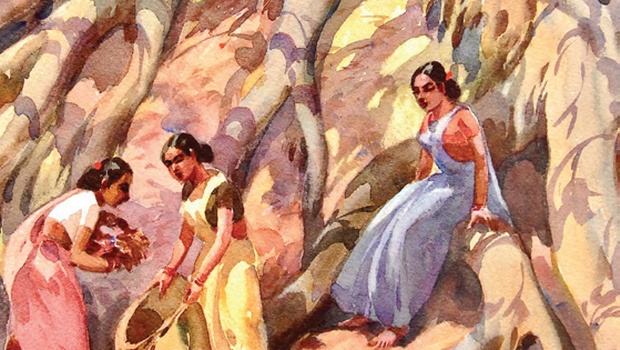
They say a fine piece of art has the power to silence the chatter in the mind and lift us to another place. “Well, art is art, isn’t it? If the versatile artist GD Paul Raj had been alive today, he would have turned 100. More than 80 works of his were on display at Anna University Alumni Club, Adyar, for two days, to commemorate the birth centenary of the acclaimed artist. The event was inaugurated by actor-artist Sivakumar.
When you see Paul Raj’s works, you can’t help but instantly fall in love with them. His paintings might seem simple and straightforward. Linger a little longer and one is aware of something deeper, the story that the artist was trying to tell.
Every line and colour expresses a statement. Art works are arranged in such as way that they unfold the artist’s journey.
A visual treat not only for nature lovers but also for those who enjoy realistic paintings, they provoke, inspire and narrate in every literal sense. It also retells or recreates a sense of child-like enthusiasm of stories heard or seen long ago.
Most of his paintings are influenced by day-to-day life and feature men, women and animals. Different shades of the same colour are used to give the paintings a distinct impact. The use of minimum colours to give the feeling of so many colours and the sharpness of the outlines show a clear influence of the mural style. The subjects are all painted in great detail, and tell tales of rural life.
Those curves of certain lines… the subtleties of colours… Each canvas is uncomplicated, with the subject matter drawn from the seemingly mundane, but for Paul Raj, each brush stroke rendered them unique. He used artistic liberty to enlarge their eyes or juxtapose them with nature.
His paintings (pencil shading, acrylic works, water colour, pastels) explore men and woman in bright colours with the folk element through the path of gradual artistic transformation.
When you see a painting of trees, it looks as though we are seeing it for the first time – that is the quality of freshness that the artist infuses into each painting, enabling the viewer to embark on a journey of wonderment.
The paintings, mostly, are given a light wash, and have a misty look which gives them an ethereal feel.The recurring images of dramatic monsoon skies at sunset, thick mist, mountains, rivers and cattle depict his extraordinary relationship with nature.
source: http://www.newindianexpress.com / The New Indian Express / Home> Cities> Chennai / by S. Subhakeerthana / October 22nd, 2014
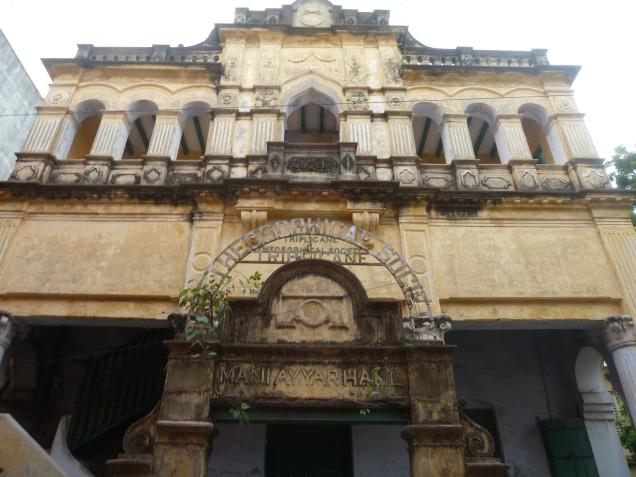
How did the once-famous Aiyer Hall in Triplicane get its name? Why is it now locked and left to crumble?
The new board outside the run-down double-storeyed building flashes the standard warning: Trespassers will be prosecuted. “You can’t go in!” shouts Thenmozhi, the flower woman nearby. “There used to be a watchman; even he is gone.” But I need answers to the multiple questions this building sparks: What is a Theosophical Society building doing in Hanumantala Street in Triplicane, far away from its headquarters in Adyar? Who built it? Why was it named Mani Ayyar/Aiyer Hall (the name is spelt in two ways on the building-front)? What went on inside? Why is it locked and left to crumble?
The long-time resident in the house opposite claims he’s been inside. “Beautifully done up in wood,” he offers. “The main hall has a lot of wood carving around. The floor is wood, as is the upper balcony. The wooden furniture inside is priceless.” Co-freemasons met here till about four years ago, he says, but “I’m afraid undesirable people may use it.”
At the Adyar library on the Theosophical Society campus, curator Jayashree finds an old booklet on the subject. The Triplicane Theosophical Lodge was founded on February 11, 1898, it says. After two decades of meeting in different places, members registered it in 1920 and decided to build a hall for its activities. The place would have a library, guest rooms, an outhouse and an “industrial school” for the poor. People like C.S. Swaminatha Mudaliar, T.B. Ramachandra Mudaliar, M.S. Venkatramana Iyer, Seshadri Iyer, Kanakasabai Pillai and P.S. Ramaswami Iyer pooled cash and with Rs. 33000, the structure was completed in 1928. The school closed down but, in 1934, additions were made on the first and second floors for meetings. “Mani Ayyar Hall is the only lodge in the Madras Theosophical Federation to own a building,” says the book and ends the chapter with, “we have 25 members, at present. Regular activities are attended by both members and non-members.”
Fine, but why Mani Aiyer? The hall was named after Dr. Sir S. Subramania Aiyer, popularly known as Mani Aiyer, venerated as the “grand old man of India,” says the book. Born on October 1, 1842, he took his law degree in 1868, enrolled as a high court vakil in 1869, made a name for himself in the Ramnad Zamindari case, improved facilities in Madura as its municipal commissioner, and became an MLC in 1884. His wife Lakshmi passed away that year and that was the beginning of a new phase in his life.
Mani Aiyer met Colonel H.S. Olcott and became an ardent theosophist, serving as vice-president of the Theosophical Society under Dr. Annie Besant.
In 1885, he was nominated to the Madras University Senate, and was its member for 22 years. In 1888, became government pleader/public prosecutor, the first Indian appointed to that post. The British government showered him with titles of CIE (1889), Diwan Bahadur (1891), and Knight Commander (1900). When Annie Besant was interned, he surrendered his knighthood in protest. His work in the fields of social reform, local self-government, political awakening of Indians, revival of Sanskrit studies and support for Indian culture made him one of the most famous men of Madras. Newspapers covered his exemplary work in and outside the court and the Gazette Extraordinary issued a statement praising him. In 1914, Annie Besant wrote: “He joined the Society in its early days and has kept unbroken his loyalty and devotion to it… [He] is a remarkable example of the ideals of youth still cherished in old age.”
The hall is one of the stops on historian V. Sriram’s walking tours of Triplicane. “The second Conference of The Music Academy was held here in April, 1930,” he said. The hall honours theosophist Sir S. Subramania Aiyer, the first Indian to become acting Chief Justice of the Madras High Court, he says. A member of the University of Madras Senate, he is commemorated with a statue — unveiled in 1935. “Mani Aiyer is remembered for his daring act of writing in 1914 to the U.S. President Woodrow Wilson that America must not assist the British in WW1, unless they commit to freeing India.
He was one of the founding members of the Indian National Congress.”
Surely, this historical building, named after an illustrious man, deserves to be restored!
source: http://www.thehindu.com / The Hindu / Home> Features> MetroPlus / by Geeta Padmanabhan / October 21st, 2014
Ace southern cinematographer Ashok Kumar Agarwal, who was battling for life here for over the last six months with “health-related issues”, passed away Wednesday.
“Cinematographer-director Ashok Kumar Agarwal passed away due to health problems this morning. He was undergoing treatment in hospitals in Chennai and Hyderabad over the last six months,” a family source told IANS.
“His family recently brought him back home after his condition had deteriorated,” the source added.
Ashok Kumar worked as a lensman in over 100 films across several languages. Some of his best works include films such as “Jeans, “Nadigan” and “Johnny”.
He received a National Award for his work in 1980 Tamil film “Nenjathai Killathe”. He also worked as a cinematographer in Hindi and English films such as “Sacha Pyaar” and “Backwaters”, respectively.
He also directed award winning films like “Andru Peitha Mazhayil” (Tamil), “Abhi Nandana” (Telugu), and “Kaamagini” (Hindi) as well and has worked with several stalwarts of the Indian film industry.
source: http://www.indianexpress.com / The Indian Express / Home> Entertainment> Entertainment-Others / Indo-Asian News Service / Chennai – October 22nd, 2014
Silverscreen goes to the launch of the Alisha Abdullah Racing Academy for Women
We walked into the venue of Alisha Abdullah’s racing academy launch on a wet, wet day. An older gentleman in a bright blue shirt was on the piano, playing a song that obviously held deep meaning for him. Before we could get closer to investigate, a bold dash of colour grabbed our attention.
There was no evidence of the biker chick in the Alisha Abdullah we saw yesterday. In a neat pink blazer and with her hair in an intricate braid, she looked like your average fashion conscious Chennai-ite. Albeit one with a higher purpose. After ushering us inside, she went away to pose for the photographers. Hashtag pretty in pink .
When Alisha’s father arrived with one of the guests of the evening – Akbar Ebrahim, the father of Indian Moto Sports – the event began. Akbar has literally seen Alisha grow – from that of a child obsessed with racing to a woman who has raced with the best of them. The fact that she has never considered her gender a ‘restriction’ and has excelled in what is essentially a man’s sport is an immense source of pride to both Akbar and Abdullah. “Motor sports is not the easiest place for anybody, much less a young girl. She could have thrown a fit about many things, but she bore it all stoically and it is this strength that will help her with this new initiative of hers,” said a beaming Akbar on stage.
********
When it was Alisha’s time to speak, she used it wisely. She spoke of the time when she felt intimidated at the races in Thailand; a ‘smaller’ country than India. “I thought I would easily finish in the top three, but I was beaten by eight very powerful women racers. I couldn’t compete on the same level and it got me thinking. What do they have that we Indian girls don’t?”
It was with this aim – to provide talented racers in India the guidance needed to survive in races abroad – that the academy was started. “I have been thinking about this for over three years. After a lot of brainstorming sessions with dad and mom, it was only this year that I could finally set up something concrete.” Alisha plans to recruit a hundred students for the academy and provide free training for them. And she will be doing this while juggling her successful and ‘satisfying’ racing career and the cinema opportunities too. “I want to use my stardom for the betterment and empowerment of women. When my film released, many women got in touch with me and asked me to help them drive super-bikes. It’s this need that I want to satisfy.”
********
The academy was then duly launched by Renuka David, Bruce Schwack and Ashok Verghese.
Alisha hopes to begin the school soon and if all goes well, she will also embark on an extensive promotional tour to publicise it.
Indian-origin Singaporean poet and writer K.T.M. Iqbal will be awarded Cultural Medallion, the country’s highest cultural award by President Tony Tan Keng Yam on Thursday night in Singapore.
It is the highest recognition for the 74-year-old Tamil poet whose achievements include more than 200 children’s songs written for Radio Singapore in the 1970s and 1980s, as well as seven collections of poetry.
Mr. Iqbal said he was “delighted” to receive the award which was “an incredible honour”.
“My first love is poetry. We have been together for 60 years. I never imagined this would bring me the Cultural Medallion award,” The Straits Times quoted Mr. Iqbal as saying.
Mr. Iqbal learned the basics of Venpa, a form of classical Tamil poetry from a poetry-writing workshop. “I would sit on the street in the evening to write or an idea might come when I was on the bus,” said Mr. Iqbal.
The poet, also a retired bank executive, has received recognition in the education system of Singapore also.
Mr. Iqbal’s compositions are studied in schools and some of them have appeared in the subway stations as part of efforts to bring the arts close to the community.
Mr. Iqbal migrated to Singapore at the age of 11 with his father from Kadayanallur in South India in 1951.
A Tamil newspaper Malaya Nanban, which is now defunct, introduced him to the simple but evocative compositions of Tamil poet Mathithasan. The poet’s vivid depiction of people and values in society inspired the young Iqbal to start penning poems.
The retired bank executive continues to pen poems and hopes to produce an edited collection of his best Tamil poems and an English translation of it.
Along with the award, Mr. Iqbal will get 80,000 Singapore Dollar grant, which can be used to fund artistic endeavours over their lifetime, according to The Straits Times.
“The money once spent is gone. But to have the nation recognise your contribution is great and it will encourage people to keep writing poetry,” said Mr. Iqbal.
The award will also be given to sculptor Chong Fah Cheong, 68, and 51-year old Alvin Tan, the artistic director of a theatre company, The Necessary Stage. Recipients are each eligible for a 80,000 Singapore Dollar grant.
The award, instituted 35 years ago, has been presented to 115 artists to date, including Mr. Iqbal, Mr. Chong and Mr. Tan.
source: http://www.thehindu.com / The Hindu / Home> News> National / by PTI / Singapore , October 16th, 2014
Poet-activist Salma on her experiences at the Writers of India Festival, Paris
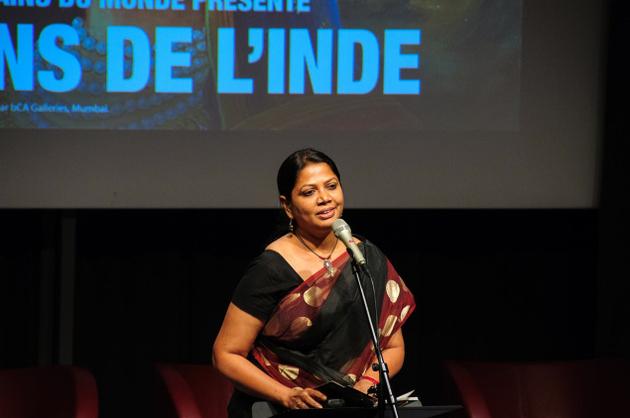
On May 26, this year, poet Salma received a letter inviting her to be a guest of honour at the Writers of India Festival, Paris, in September. The festival, a new collaboration between Columbia University, New York, and the Bibliothèque nationale de France, featured a series of lectures and discussions with more than 12 Indian writers at Reid Hall, Columbia and BnF in Paris. Salma talks about her journey as a poet, her experiences in Paris and how poetry can make an impact.
You used to write secretly when you were young as you were confined to the house from the age of 13. Did you ever think at that time that you would be an established writer?
(Laughs) I was very confident my words would reach the world. I still remember this scene vividly. I was 16. I was standing with my sister in the kitchen and she was rolling out chapatis. ‘You had better learn to cook,’ my sister said. Otherwise, people will say we did not bring you up properly. I told my sister — I’m going to be a famous writer. I’ll go to many countries and attend many conferences. I don’t need to learn to cook!
And now, you have just attended the Writers of India festival. How was the experience?
There were several readings and discussions every day and at least five events were happening at the same time. Everything was well organised. They had French translators. I was the only one to have a screening of my film Salma! It was followed by an interview with senior journalist, Judith Oriol — she came prepared with an in-depth questionnaire.
What was the audience reaction to your film, which documents the story of your life?
Many of them got very emotional. It was hard for people to believe that so many women do not have even the basic rights and that it is a struggle.
Is poetry part of our everyday culture?
Thirukkural
What made you write poems, not stories?
Like many girls in a Muslim community, I was not allowed to leave the house in my small town Thuvarankurichi. I had many conflicting feelings and I wanted the freedom to live life, do many things. A poem can be a powerful expression and all my pent-up emotions came through in verse.
Can you read from one of your poems presented at the festival?
A few lines from Naan Illadha Avan Ulagam (His world beyond me). It is about a mother and son.
He, who had asked me
on a night of the moon’s full retreat
if the sun too would be gone someday,
has no more answers to seek from me.
How have your experiences impacted your writing?
It is an unbelievable life, to be a writer. My poems are for everyone, but I especially wanted to reach out to women, and make a difference for them. They must realise their lives. They must understand their identity.
Your family’s resistance to your writing – did that change?
There were many changes that happened over time, but the big shift happened when I entered politics. At that point, my family had no choice but to accept it.
(Salma won a seat reserved for women in Thuvarankurichi in the 2001 panchayat elections and was elected MLA in 2006).
Your writing got acceptance when it was connected with a larger purpose — political and social. Can writing by itself bring about social change?
Writing alone cannot bring change. We need political will to usher in change.
The theme of the festival in Paris was on the impact of globalisation on cultural creation and consumption. Did the festival address these ideas?
I got the chance to be on the same platform as award-winning writers Jeet Thayil, Vikram Chandra and Kiran Desai and there were stimulating exchanges. All participants had to contribute essays on globalisation, which will be published in the form of a booklet.
In India, many do not consider storytelling and poetry real professions. How did you find it in other countries?
People respect writers. A writer receives more adulation than a politician, in some ways. From the time I landed at the airport, people used to ask me to recite a poem in Tamil, just because they wanted to hear how it sounded!
source: http://www.thehindu.com / The Hindu / Home> Books> Author / by Sujatha Shankar Kumar / October 17th, 2014
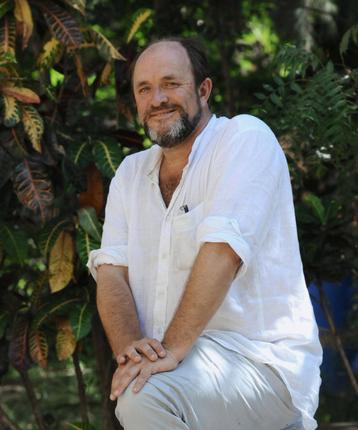
Historian William Dalrymple was in the city to speak at the launch of ‘Return Of A King’ at Starmark bookstore and to deliver a lecture on the same at Stella Maris College. Photo: R. Ragu
William Dalrymple talks about his next book The Anarchy that traces the rise of the East India Company and why he still treasures the curiosity and surprise of the outsider perspective
It takes a William Dalrymple to fill malls and college halls with crowds that will wait hours for him to arrive, and hang on his every word while he launches a book that’s over a year old. “Imagine yourself far away from Chennai,” he whispers, “seated on a bleak, empty step in the borderlands between Iran and Afghanistan. It’s a cold, harsh winter in November, 1837. A war is about to break out, and what you are to witness will change the course of history, forever.” Through a rapid tale of pride and ambition, folly and misfortune, Dalrymple spins us through the narrow passes and cruel terrain of Afghanistan, alongside an 18,500-strong British army with Indian soldiers that forces new governance upon a conquered nation, only to be catastrophically overthrown and reduced to one surviving man. It’s the story of Dalrymple’s most recent work Return Of A King, and this is a lecture he’s delivered before numerous heads of State, the Indian Army, at the White House and to former Afghan President Hamid Karzai, himself.
Dalrymple is in Chennai though, for different reasons. The city stars in his next book, The Anarchy, which traces the rise of the East India Company from a private company “five-windows wide and run by 35 people” to a coloniser of nations.
The book opens amidst the drama of 1739, when the ‘Second Alexander’ Nadir Shah of Persia invades the Mughal empire, captures its ruler Mohammad Shah, plunders Delhi and loots the land of wagons of jewels and gold, all of which is shipped back to Persia. As the empire begins to crumble, the French and British East India companies creep into strength. Chapter two cuts to the Madras of the 1740s, to the rivalry between Robert Clive and Marquis Dupleix that unfolded here, and proceeds to trace the Company’s expansion henceforth.
Chronologically, The Anarchy prequels Dalrymple’s last three works White Mughals, The Last Mughaland Return Of A King, all of which unfold from 1790 and 1850, the relatively “unwritten time” between the fall of the Mughals and the rise of the British. As with Return Of A King, though, The Anarchy finds uncanny relevance in modern times. The Return release of Return Of A King coincided with the period of “regime change” the British foisted on Afghanistan, followed by the recent withdrawal of its forces, an event that Dalrymple notes almost exactly replicates the First Afghan War. “I’m most interested in how history echoes backwards and forwards into modern politics,” he says.
With The Anarchy, he examines the relationship between State powers and corporate power. “There’s much to be learned from how the Company infiltrated British Parliament and Parliament aided the Company. Moreover, when Clive and the Company were granted diwani powers , it was the most extreme example of privatisation in history, and when the Parliament finally gobbled up the Company, that was nationalisation right there. Because these events are locked in history, we cease to look at them in modern terms, which gives it a whole new perspective.”
The Anarchy also ties in with a project Dalrymple spent the last year on, writing a sweeping cultural history of the nation that he couldn’t ease a “coherent narrative” out of. The spoils of all that research will now seep into The Anarchy, in true Dalrymple style of soaking his stories in the music and art of their times. “All through the chaotic events of this book, where every small village has its own raja fighting insurgent wars against the raja next door, there was the decentralisation of art. When the Mughals ruled, great art flourished in Delhi, Agra, Jaipur and Lahore, but now, schools of painting grow out of the small towns of Rajasthan and the hill towns of the North.” This was the high point of the Jaipur and Jodhpur schools of miniature, and in architecture the mighty forts and palaces of Hyderabad and Lucknow grew in this age, he adds. It is the vastness of this book’s imagined canvas that, at this stage, enthuses and challenges, yet humbles Dalrymple. “Till you figure out the shape of the thing, it’s like a new relationship. You flirt with the subject initially, realise something interesting is going on, and then at some point, you’ve to make a commitment to it. I’m still haven’t gotten over this flame!”
Back in his Mehrauli farmhouse on the outskirts of Delhi lie the fruit of many past flames. Three travelogues, the first written when he was 22, followed by three historical works and books of essays in between have perfected for Dalrymple an “anal system” of research and organisation, of physical index cards for every piece of information he unearths. All that he discovers about Dupleix, for instance, goes under the ‘D’ category of people cards, and under another label organised topic wise. “It’s the only way I don’t write myself down a blind alley and have to find my way back,” he says. It’s also these early times of research and travel in the average four-year birthing period of a book, before he’s “shackled to a desk”, which Dalrymple finds most exciting. In Chennai, for The Anarchy, he hopes to stumble upon records of the Carnatic kingdoms from the attic records of old families, besides spending months here holed up in archives. “Once all the material is well organised, my writing year can move quickly. You reach a point, eventually, where things seem to just write themselves, where wonderful phrases turn up that you haven’t particularly planned, where it’s all sort of pouring out, and that’s very rare.”
As a writer, Dalrymple firmly places himself as a narrative historian, in the traditions of those like Antony Beevor and Simon Schama. From his days of travel writing for In Xanadu, City of Djinns andFrom the Holy Mountain, he takes the tendency to now write “history books with a strong sense of place”, travelling between the library and the places he’s reading about. And from 30 years of living in India, he still brings to the table the “curiosity and surprise” of the outsider. In writing history, though, he sees it as a “sliding scale between the academic world of the social sciences on one end, and literature at the other end”, with him tilting toward the latter. “History can be wonderful literature, and no less scholarly or valuable for it being written in fine prose. I’ve learnt that there’s no shame in telling a good story.”
source: http://www.thehindu.com / The Hindu / Home> Books> Authors / by Esther Elias / October 17th, 2014