Arushi Nayar, Akshay Venkataraghavan, Aditi Balaji, Abinaya Raman and K S Adhithya Kumar of Padma Seshadri Bala Bhavan, K K Nagar, won the Debating Matters International Final 2014 held in London on October 18.
The debating championship was organised by British Council in partnership with the Institute of Ideas in the UK.
Student participants said the competition was known for its rigorous and intellectually challenging format that valued substance over style. The final round pitted students of PSBB Senior Secondary School, KK Nagar, against their peers from Franklin College of Grimsby, UK.
This year’s debate motion was, “We should be willing to compromise our privacy in the interests of national and international security.”
The Indian students spoke for the motion, while those from Franklin College in the UK spoke against the motion.
The PSBB students had to compete with the best in the country at the national level of the competition, after facing an online elimination round and zonal finals, before heading for the international final round in the UK.
source: http://www.timesofindia.indiatimes.com / The Times of India / Home> City> Chennai / by M Ramya, TNN / October 20th, 2014
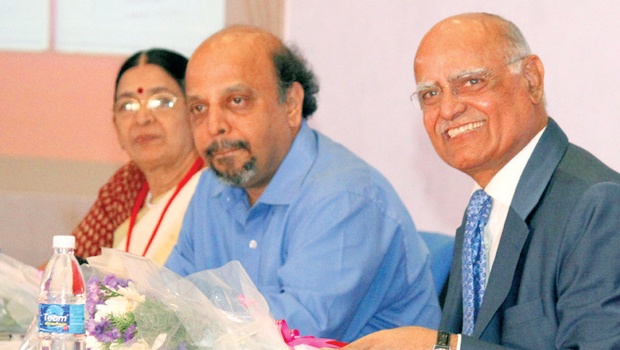
TNIE Editorial Director Prabhu Chawla was one among the dignitaries at IIA Southern Chapter’s golden jubilee event l ALBIN MATHEW
Chennai :
Eminent personalities from different fields gathered at the Indian Institute of Architects, Southern Chapter, to participate in the think-tank event organised by the Institute as part its golden jubilee celebrations recently. They discussed the link between society, environment and architecture.
Speaking of society’s perception on architecture, Prabhu Chawla, the Editorial Director of The New Indian Express Group, stressed the importance of architects in designing an aesthetic and calming environment. “Buildings are a mirror of society, and architecture needs to reflect an Indian identity. Everyone sells buildings by foreign names and prefer Italian marble, but we need to learn from our tradition,” he said.
“To me, a green building is one which has good ventilation, I should be able to see the sky from my building,” he said. Ashalatha Thampuran, an educationist and architect, Mili Majumdar, director of Sustainable Habitat, The Energy Research Institute, architects Sanjay Mohe and Dean D’Cruz spoke about striking a balance between nature and design. They also stressed the importance of going back to the traditions.
source: http://www.newindianexpress.com / The New Indian Express / Home> Cities> Chennai / by Express News Service / October 21st, 2014
As promised last week, here are a couple of tales about the building of bridges in 19th Century Madras as related to me by civil engineer D.H. Rao who has made delving into the histories of the city’s bridges his hobby. These are stories arising out of Government’s practice of getting estimates for civil work and then finding the costs have been exceeded. Inquiries follow, then as now, but what happens next? Nothing seems to change.
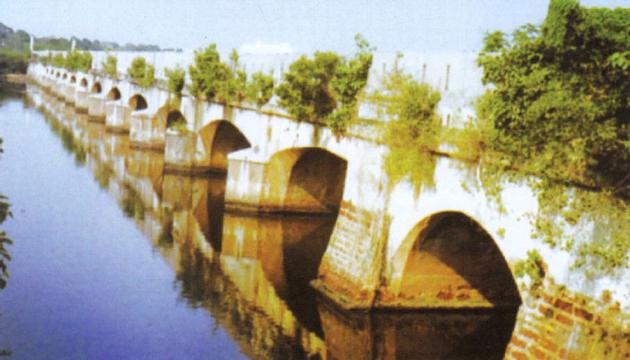
In the case of the 1840 18-arch Elphinstone Bridge over the Adyar (now lying derelict but looking solid, while constant maintenance work goes on on its neighbour, the new Thiru Vi Ka Bridge), on its completion, the Military Board declared it a magnificent piece of work. But Governor Lord Elphinstone did not think so; he wanted to know from the Board why the cost had exceeded the estimate, particularly when it had been approved by the Court of Directors in London with the proviso that the approved amount should on no account be exceeded.
In his reply, the Superintending Engineer cited the costs of two other bridges he had built to show that the costs incurred in building the Elphinstone Bridge were on the same lines. The extra cost incurred was only because the river was always full of water and several persons had to be employed in constantly bailing out the water to keep the coffer dams dry while raising the foundation. This was totally unexpected. The arguments went on for months, but in the end the matter was happily resolved to the engineer’s satisfaction.
It was in another instance too, but in this case it caused the builder of the 1805 St. George’s Bridge (now the Periyar Bridge) considerable more concern for months. Lt. Thomas Fraser was not only censured for the cost over-run but also had his commission and other benefits withheld. In this case, Fraser justified the excess expenditure by pointing out that after the foundation work was completed, he was asked by the Council to re-align the bridge. So, he once again had to sink wells for the foundation, piers and abutments. Further changes were ordered by the Council from time to time and he carried out the Council’s orders every time. He was therefore not responsible for the final cost — which was entirely due to his only having carried out the orders of the Council. In this case too, the arguments continued for long, but eventually Governor Lord William Bentinck accepted Fraser’s appeal and restored all his benefits.
On a third occasion, a bridge on South Beach Road needed substantial repairs. These were carried out, but a couple of years later the Military Board sought further funds to carry out additional repairs to the bridge. The Governor was not ready to sanction the amount until he was told why the bridge had not been regularly inspected for maintenance, who was responsible for such inspection, and “why he had not carried out his work sincerely.” What eventually happened in this instance is not known, but what is clear is that, at one time, heads of government kept a sharp eye on even comparatively minor expenditures. But then those were more leisurely times, weren’t they, and heads of government had time on their hands.
*****
A reluctant sale
Some time ago I had mentioned in this column that the land on which the handsome Egmore Railway Station (then of the South Indian Railway) was built had belonged to Dr. Pulney Andy (Miscellany, September 20, 2010) and that he had sold it for Rs.1,00,000 to the SIR in 1904. It wasn’t a particularly happy sale, I now learn from a copy of Dr. Pulney Andy’s letter to the Deputy Collector of Madras, J.R. Coombes, which was sent to me by a reader from ‘Trichinopoly’, N.C. Martens. The land in question was 1.83 acres in extent and had several buildings on it. It was his attachment to those buildings that were the cause for the reluctance of ‘S. Pulney Andy M.D., M.R.C.S. (Eng.), F.L.S.’ to sell the property, the letter of ‘15th February 1904’ makes clear.
Reacting to a letter from the Deputy Collector citing ‘Act I of 1894’ requesting his property for “the remodeling of the S.I.R. Egmore Station”, and asking whether he had any objections to handing it over to the S.I.R., Pulney Andy writes, “I have very strong reasons for not wishing to part with my property…” He goes to state those reasons.
He writes that he had bought the property “mostly for the benefit of my health which was broken down after long service in the Travancore state… (and the environment proved itself over) about 30 years… not a case of any illness or death occurred among the dwellers on this estate.”
Secondly, the house was designed and built by his wife before she passed away in Travancore, after which he returned to Madras to spend the rest of his life in the house “which perpetuated her memory” and which he had improved by developing an orchard around it.
Then comes his most significant argument. “After retiring from Government service, I have turned my mind to the remodeling of the Indian Christian Church and am the founder and the President of the National Church of India. My residence in Egmore is the Head Quarters of the movement and I have utilized a building here for the purpose of worship and there have been already two ordinations of Ministers during the past year. It was also my intention to erect a substantial building as a Temple for public worship by members of the Christian Community on the land… (which) is centrally located.” With such extent of land not available in a central area, a move to a distant location where space might be available would inconvenience his congregation considerably, Pulney Andy goes on to explain at some length. He, however, concludes:
“But should it be considered that my property is absolutely required for the purpose of Railway construction and should Government desire to compel me to part with it, under the provisions of the Act, I beg to state that I may be granted a compensation of not less than one hundred thousand rupees (Rs.100,000) for it and sufficient time should be given me for removal.” His request was met with alacrity but not generosity, the ‘not less’ ignored, it would appear, for the handover was quick and the station was ready to flag out its first train, the Boat Mail, on June 11, 1908.
*****
Search for the Old Jail
Where is or was the Old Jail, wonders Jayanthi Selvam, saying she uses Old Jail Road quite often. The road is the central portion of a three-part road, from east to west being Ebrahim Sahib Street, Old Jail Road and Basin Bridge Road in the southern shadow of what was the North, or Old Town, Wall, of which only the stretch preserved with the Maadi Poonga atop it is all that survives. It was south of a bastion of this wall that the Old Jail was established in 1804, though its roots go back to 1692.
The Old Jail’s premises, at the corner of Popham’s Broadway and Old Jail Road, was cleared of prisoners shortly after Independence and the campus was given to the Congress Prachar Sabha which ran a cottage industries training centre in the numerous buildings there. When Kamaraj stepped down as Chief Minister in 1963, the enthusiasm for the training centre waned and the premises were handed over to the Central Polytechnic Institute and a new Arts College for Women in 1964. Four years later the last of the CPI’s constituent units moved to Adyar and the college expanded into the Bharathi Women’s Arts College. It was many years before the College got new buildings for its students, its early batches having used many a prison block, some of which survive, derelict, till today.
source: http://www.thehindu.com / The Hindu / Home> Features> MetroPlus / by S. Muthiah / October 19th, 2014
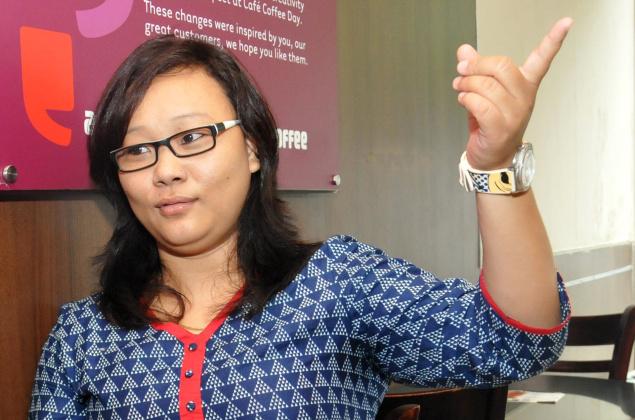
VJ Thapa arrived in Chennai only 10 years ago, but has become a household name — Photo: B. Jothi Ramalingam / The Hindu
Sharmila Thapa has been making waves with her work as a VJ and dance artiste
Her wacky dance moves and humour have won her quite a few fans among television audiences. But, what makes her stand out from your average video jockey is a surprising fluency in Tamil.
Meet Sharmila Thapa, or Thapa as she is known on screen, who has been making waves as a video jockey and dance artiste with Tamil comedy channel Adithya TV. A native of Nepal, the 26-year-old, who moved to the city just 10 years ago, has attained an almost celebrity-like status among Chennaiites, both young and old.
Born in Narayanghat, Nepal, Thapa was initially considered an unlikely candidate for compering in Tamil, mainly due to her accent.
“After my graduation, I auditioned to be an anchor for a show in a well-known news channel, but was rejected. Disappointed, I gave up and went on to work as a visa assistance executive,” says the jovial anchor, a graduate in Tourism and Travel Management from Anna Adarsh College for Women, Anna Nagar.
Interestingly, Thapa’s opportunity came during a brief visit to a therapy centre for weight loss in Vadapalani.
“I befriended Adithya TV VJ Archana at the centre who guided me towards an audition with the humour channel. Finally, I ended up at their studio for the audition by the end of 2012, extremely nervous. I performed a few funny skits and dance steps. Some months later, I got the call,” adds the VJ who went on air for the first time on April 14, 2013.
Thapa’s TV performances and celebrity status have had some unexpected consequences.
“People often stop me on the road and ask if my voice is dubbed or whether I can actually speak Tamil. I have been avoiding bus travel to escape such questions,” laughs Thapa, who dreams of shining on the big screen like her icon Kovai Sarala.
source: http://www.thehindu.com / The Hindu / Home> News> Cities> Chennai / by Petlee Peter / October 16th, 2014
When Anjum Khan received her PhD on Monday, it meant more than it does to most doctoral candidates-the 27-year-old lost her vision at the age of five after an attack of measles and has studied entirely in Braille.
Anjum is an assistant professor of English at Avinashilingam University. Her family moved from Gwalior in Madhya Pradesh to Coimbatore in 1993 for her treatment but doctors said she would never regain her vision.
“While my parents were thinking what next, the doctors told us about Avinashilingam school for girls,” says Anjum. She began learning Braille and use audio technology to help her read, write and study.
Her father, Mehmood Khan got a job at a private cement company in Madukkarai, 27km from Coimbatore. If Anjum had to continue her studies, Avinashilingam was among the few options as it had facilities and faculty to help her.
“I decided I would live in hostel and study. It is then that I realised that to gain something, one has to sacrifice something,” Anjum says. She lived in the hostel for 12 years from Class 6 till she finished her postgraduate degree.
After finishing school, Anjum joined the Avinashilingam University for Women to pursue a Bachelor of Arts in English Literature. “She finished her masters’ degree and applied for her doctoral studies in 2009,” says S Kalamani, Anjum’s guide and an associate professor in the department of English, Avinashilingam University. “Anjum had to leave thehostel after her MA, but, regularly visited me every Friday and told me how her research was progressing,” she says.
Anjum’s younger brother Abid Ali died in a road accident eight years ago while she was doing her masters’ degree. “My father had bought him a bike to make his commute between college and home easier,” says Anjum.
“It was a difficult time for the family. But, I have faced so much that I treat happiness and sorrow equally,” she says. Anjum has dedicated her PhD to her brother.
Anjum did her research on ‘Ethnic Silhouettes: An Interpretation Of The Community In Select Works Of M G Vassanji In The Light Of New Historicism’. She became an assistant professor in January 2013 in the university in which she studied.
Besides teaching at the university, Anjum also teaches blind children Braille and computer operations. “I consider teaching a means to reach people,” she says.’
source: http://www.timesofindia.indiatimes.com / The Times of India / Home> City> Coimbatore / by Adarsh Jain, TNN / October 14th, 2014
Legend has it that Pandya kings had major ‘Akkasalai’ (coin minting units) in Tirunelveli, where many artisans and goldsmiths worked. When the units were wound up, they migrated to Madurai. The king then provided them land at a place in the city which is now called as Akkasalai Pillayar Koil Theru.
Akkasalai Pillayar (Lord Ganesh) is worshipped by these artisans and goldsmiths. Akkasalai Pillayar temples also exist in Korkai and Sivaganga, where goldsmiths live.
Most of the residents in Akkasalai Pillyar Koil Theru and the adjacent Ezhuthanikara Theru are goldsmiths. Chinnakadai Theru, another street next to Akkasalai Pillyar Koil Theru, once had numerous shops selling tools for goldsmiths. Retired archaeologist C Santhalingam said Akkasalai means coin minting units and goldsmiths were involved in minting coins for Tamil kings ? Chola, Chera and Pandiya – in those days. Archaeologists have unearthed a bronze statue in Nagapattinam known as Akkasalai Nayagar, he said.
Nonagenarian M V Mani Chinnakadai Theru, adjacent to Akkasalai Pillayar Koil Theru, also confirms that Akkasalai means coin minting unit.
Akkasalai Pillyar Koil Theru is a narrow lane, predominantly a residential area, sandwiched between Vaikolkara Theru and Ezhuthanikara Theru in South Gate area. Along with houses, there are also a number of gold ornaments making workshops and a Lord Ganesh temple, situated at the entrance of the street.
The temple was renovated some two decades ago, says Venkata Subramanian, 49, who resides nearby the temple. Before the renovation of the temple, there was an ancient temple built of stones, he said.
“Renowned film personality M K Thiagaraja Bagavathar worshipped in this temple and also sang bhajans at times,” he recalled. Subramanian says the street has not seen much change for many decades and remained intact. “Most of residents are from goldsmiths of Viswakarma community and demographics of the street did not change much like other places in the city,” he said.
source: http://www.timesofindia.indiatimes.com / The Times of India / Home> City> Madurai / by J. Ariockiaraj, TNN / September 09th, 2014
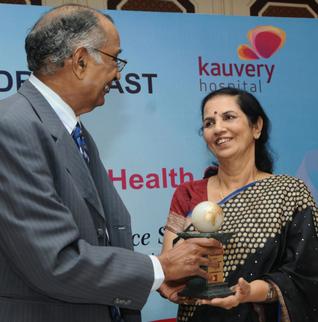
Dr. Suniti Solomon has made great strides in the fields of HIV epidemiology, preven-tion, care, support and research. Photo: R. Ragu / The Hindu
In 1986, when the world was just waking up to the HIV/AIDS pandemic, Suniti Solomon, then a professor of microbiology at Madras Medical College, identified, for the first time in the country, six HIV-positive cases from 100 samples.
Since then, there has been no looking back for the doctor who has made great strides in the fields of HIV epidemiology, prevention, care, support, community education and research.
As she put it herself, “I’m a fighter.” Dr. Solomon was the recipient of the Dr. K.V. Thiruvengadam Award for healthcare, presented by the Rotary Club of Madras East and Kauvery Hospital at a function on Wednesday.
Speaking about the intense stigma people with HIV/AIDS continue to face, she said, “Today, it is easier to handle people with HIV/AIDS than those with diabetes. But it is the stigma that is killing people.”
Justice S. Mohan, former Supreme Court judge, who presented the award, said for the country to reach new heights, it needed fighters like Dr. Solomon.
Dr. K.V. Thiruvengadam expressed his concern with the mushrooming of medical colleges in the State.
President of the club, V.G.P. Ravidas, and executive director of Kauvery Hospital, Aravindan Selvaraj, were also present.
source: http://www.thehindu.com / The Hindu / Home> News> Cities> Chennai / by Staff Reporter / Chennai – October 16th, 2014
Distinguished scientist Sivathanu Pillai, chief controller, Defence Research and Development Organisation, received the lifetime award from Rotary Club of Madras.
At a function held recently, S.N. Srikanth, president of the club, presented him with the award.
In his acceptance speech, Dr. Pillai said the indigenous missile development programme was among the great scientific accomplishments of the country.
source: http://www.thehindu.com / The Hindu / Home> News> Cities> Chennai / by Special Correspondent / Chennai – October 17th, 2014
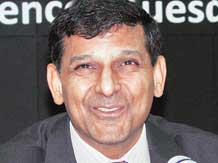
Successfully tackling the currency crisis has earned Reserve Bank of India Governor Raghuram Rajanthe Euromoney magazine’s Central Bank Governor of the Year Award for 2014.
“Reserve Bank of India Governor Raghuram Rajan’s tough monetary medicine combatted the storm ravaging the deficit-ridden economy in the recent emerging market crisis. Now, he is battling vested interests to arouse a sleepy financial system for over one billion people,” Euromoney said while announcing the award.
Rajan took charge of the country’s central bank in early September last year, just a few days after the rupee plunged to its historic low, hitting 68.83 against the dollar on August 28, 2013.
“As he confronted capital outflows, the rupee at record lows, and over-blown but palpable, fears India was marching towards an Asia-crisis style abyss, Rajan duly administered tough monetary medicine to ailing bond and currency markets,” said Euromoney.
Rajan took several steps to attract capital flows which helped the rupee strengthen. It is now trading in the narrow range of 60-62 per dollar.
“Remarkably, the internationally-renowned economist, who earned acclaim for his warnings in 2005 of an upcoming global crisis of sorts, has, for the past year, been true to his word.”
After tackling the currency crisis, Rajan’s next task was to tame inflation, which stayed close to the double-digit mark for more than three years. He resolved to bring down inflation – evident from three rate hikes between September 2013 and January 2014, accompanied with a hawkish stance that has helped CPI-based inflation register its slowest growth in September, since the series was launched in January 2012.
source: http://www.business-standard.com / Business Standard / Home> Finance> News / BS Reporter / Mumbai – October 16th, 2014
A team of scientists in the city, along with experts in Andhra Pradesh and Japan, has found that a citric acid-based disinfectant can destroy the chikungunya virus. The chemically synthesised citric acid developed in Japan, has earlier proved effective in killing the human influenza virus.
The team from the department of virology at Sri Venkateswara University, Tirupati; Nichi-In Centre for Regenerative Medicine, Chennai and scientists in Japan have tested the disinfectant in the form of granules on chikungunya virus. The team first collected more than 1,000 samples of chikungunya virus and developed and maintained in both human and mosquito cell line. The disinfectant was then tested on these viruses when it showed it can destroy the virus.
Scientists said the application could be on skin or fumigation to bring down the probability of infection even if bitten by a carrier mosquito. D V R Saigopal, professor of virology, SV University, said that the disinfectant, which is an ingredient in several food additives, was developed in Japan 10 years ago. “The disinfectants we get in India are detergent, phenol, foam or alcohol-based and have high toxicity and side effect. This disinfectant is solvent based and our tests showed it has low level of toxicity. It is not only safer but also cheaper,” the professor explained.
Scientists said that the disinfectant is at present approved as a mouth gargle and rinse in Japan and also used by the Japanese railways department as spray in their train coaches during flu seasons. It is also sold with a brand name ‘Clinister’ by a Japanese multinational company.
Encouraged by the positive result, the scientists have decided to approach the Union government with their research work looking for avenues to try it on other viruses. “It can kill the virus in the environment and in the mosquito as well as on the surface of the human skin where there is mosquito bite. It can be used in detergents, fumigant, mosquito repellent and hand wash,” the professor said.
Scientists have also decided to use the same methodology to test it on other viruses like foot and mouth disease virus and dengue virus.
source: http://www.timesofindia.indiatimes.com / The Times of India / Home> City> Chennai / by U. Tejonmayam, TNN / October 14th, 2014