Samba Ryots Stick to Tradition

RyotsCF29sept2014

Nagapattinam :

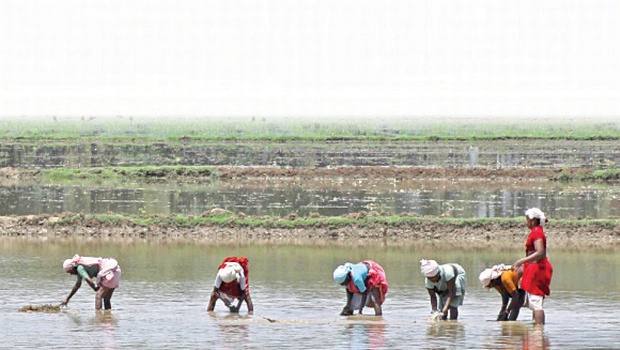
Ever tried traditional rice, the one that looks brownish-red? It may taste a bit different but it has immense health benefits. In fact, the biggest consumers of traditional rice breeds are private super specialty hospitals across major cities, which cater to dietary needs of patients, predominantly diabetics.

Besides health benefits, the breeds – Maapillai Samba, Kavuni, Garudan Samba, Thanga Samba and Samba Mosanam – are said to be drought-resistant and can also survive excessive rainfall. That works like an insurance cover, isn’t it?

To cater to the growing demand, farmers here this year have expanded the acreage under traditional rice by about 600 acres. While the last season witnessed about 1,200 acres of traditional rice cultivation in Nagapattinam district, the figure would go up to 1,800 acres this Samba season.

Farmers say traditional paddy breeds do not seek high amounts of water, as they utilise moisture content in the air for growth.

According to Jayaraman, State coordinator of Save Our Rice campaign, “Thalainayar, Valivalam and Thirukuvazhai localities of Nagapattinam district have witnessed farmers opting for traditional paddy varieties. Since there is good demand for traditional rice such as Maapilai Samba, farmers are comfortable cultivating them.” About 20 kg of seeds are required per acre for traditional paddy cultivation for harvesting as much as 1,500 kg. Traditional rice fetches a market price of over Rs 62 per kg, which is decidedly more that the conventional rice you normally consume at home. It is the higher value for effort that draws farmers towards its cultivation.

Just as Maapilai Samba faces a huge demand from diabetics, the ‘Kavuni’ breed is supposed to fortify the immune system. “Super specialty hospitals at Chennai and Tiruchy are procuring traditional rice varieties from us. It is the hefty procurement prices that encourages other farmers to take up traditional paddy cultivation,” Jayaraman adds.

While cultivation cost for traditional paddy per acre is around Rs 6,000, it is about Rs 15,000 per acre for conventional paddy such as CR-1009 and other ADT paddy varieties. Traditional crops also keep weeds in check, as they grow taller than weeds, thus depriving them of sunlight.

As many as 63 traditional varieties, including Poonkar, Maapillai Samba, Kavuni and Thengapoo Samba are cultivated in the delta districts. Farmers say they get seeds for traditional paddy through links with their counterparts across the delta districts.

source: http://www.newindianexpress.com / The New Indian Express / Home> States> Tamil Nadu / by S Deepak Karthik / September 29th, 2014
Sambar: The great Tamil dish of Maharashtrians

Chennai :

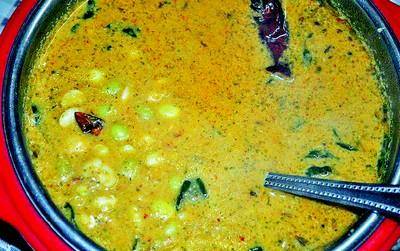
The story goes that the original recipe for sambar – a dish which is so intrinsic to Tamil Nadu cuisine – can actually be traced to Maratha ruler Shivaji’s son.

Legend has it that Shivaji’s son Sambhaji, who was one of the Maratha rulers, attempted to make dal for himself when his head chef was away.

Legend has it that Shivaji’s son Sambhaji, who was one of the Maratha rulers, attempted to make dal for himself when his head chef was away. “He added a little tamarind to the dal that he made and no one in the royal kitchen dared to correct him on the fact that tamarind was not used in dal,” says S Suresh, Tamil Nadu state convener of Intach, who gave a lecture on Tanjore Maratha history earlier this week. “He loved his own concoction, which was then referred to as sambar,” says Suresh, who adds that the other culinary contribution of the Marathas – now very popular in Tamil Nadu – is ‘poli’ (sweet roti).

Although Sambhaji’s sambhar is more lore than recipe, and there are more than 50 varieties of sambar today, chefs do admit that the Tanjore sambar is still something to be savoured. “While the Sambhaji influenced sambhar was more a tamarind soup, the Thanjavur brahmin sambar recipe is mostly followed today – where there is no onion and garlic, and the dish is not heavy on spice,” says K Natarajan, corporate chef at Gateway Hotels and Resorts.

“But even today, the sambar of Tamil Nadu is very different from what you find in the state’s neighbour Karnataka,” says Vasanthan Sigamany, associate professor of food sociology and anthropology at the Welcom Group Graduate School of Hotel Management, Manipal. “In TN, dry powders are used, while in Karnataka they use wet pastes. In Tamil Nadu, in a traditional vegetarian meal, sambar is served first and then rasam, but it is the opposite in Karnataka,” he says.

Sigamany adds that while in Tamil Nadu only local vegetables such as drumstick, radish or brinjal are used in the sambar, in other states like Kerala, ‘English’ vegetables – that became popular during the British rule in India – such as potato and carrot are used.

Over the years, sambar has seen numerous variations. Chef Damu, who specializes in Tamil Nadu cuisine, for instance, says that apart from the 30 varieties of vegetarian sambar that he prepares, he has also flirted with the idea of seafood sambar and chicken sambar, which weren’t big hits in south India. “People are still not open to the concept of chicken in their sambar. But to be honest, it is delicious,” he says.

But perhaps the most unusual of the sambars that evolved is the ‘milk sambar’, which food blogger and cooking instructor Roma Patil believes evolved in the 1930s, an unusual blend of Maratha and Jain traditions. “In Kolhapur, the Marathas ate a dish called Tambda Rassa, a kind of sambar made from lamb stock. The Rassa was so flavourful and aromatic that Jains there thought of adapting it for the Jain palate. They used milk instead of lamb stock and that was how milk sambar was made,” says Patil, who now lives in Belgaum.

source: http://www.timeofindia.indiatimes.com / The Times of India / Home> City> Chennai / by Kamini Mathai, TNN / September  26th, 2014

Tiruchi-born techie jumps to glory

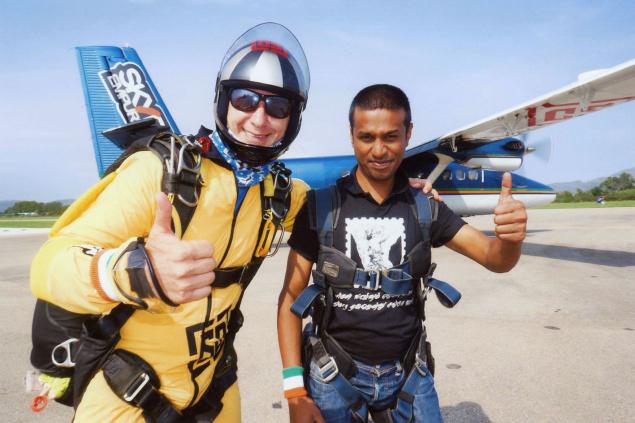
P.S.Karthikeyan seen with his tandem instructor at the record-setting event held in Spain. / The Hindu

A Tiruchi-born techie working in Finland has become one of 89 Indians and the only Tamilian to have participated in a new world record setting tandem skydiving event in Spain recently.

P. S. Karthikeyan, 36, who works for Microsoft Mobile in Helsinki, Finland, took part in the April 25 challenge to set a world record (confirmed by the Guinness and Limca Book of World Records) for the largest group of Indian civilians to perform a total of 35 tandem jumps in an hour. The earlier record was 28 jumps. The same team had to abandon a similar 10-hour tandem jump attempt due to adverse weather.

The event, organised by the Maharashtra-based Phoenix Skydiving Academy, and sponsored by Indian businessman Manish Gupta, had a further Indian connection of being held at the Skydrive Empuriabrava centre in Girona, Spain, which was featured in the 2011 Bollywood hit Zindagi Na Milegi Dobara.

In the adventure sport, a student skydiver is connected by a harness to a tandem instructor who guides him or her through the whole jump. “I came to know about this adventure, earlier this year through my friend Vaibhav Rane, who is the husband of Indian skydiving pioneer (and Phoenix Academy founder) Shital Mahajan,” Karthikeyan told The Hindu in an email.

Despite hurting his feet on a rocky beach shortly before the event, Karthikeyan decided to go ahead with the skydive as it was a “once-in-a-lifetime” opportunity.

“As this was a special day, I had decided to wear the T-shirt given by my brother, with the words ‘Engal vaazhvum engal valamum mangatha thamizh endru sange muzhangu,’ during this historic event,” he wrote.

Karthikeyan recalled his days as a student of Bishop Heber Higher Secondary School, Puthur, and the Jamal Mohammed College, and being allowed to “get away with adventures” as the youngest son in the family of four siblings.

source: http://www.thehindu.con / The Hindu / Home> News> Cities> Tiruchirapalli / by Nahla Nainar / Tiruchi – September 26th, 2014

Century-old Rly Workshop May Shut Soon

Vellore :

The century-old engineering workshop of Southern Railway at Arakkonam, which played a crucial role in building the country’s first sea bridge (Pamban Railway Bridge), is on the verge of closure due to shortage of manpower.

Established in 1905, the workshop played a vital role in the construction of major railway bridges, including the railway bridges in Kerala, Karnataka and Andhra Pradesh, which come under the Southern Railway.

Among the workshop’s main products are welded type girders, riveted type girders, steel channel sleepers, dip lorry, push trolley, points and crossings assemblies, passenger platform shelters and foot over-bridges. Ten years ago, around 4,000 employees worked at various units of the workshop. Today, the workforce has reduced to less than 800. About 80 per cent retired over the years.

Sources said officials surrendered the vacant posts without filling them. One year ago, 30 were recruited through Railway Recruitment Board. But every year, at least 100 persons were retiring from service. “If this situation continues, the workforce will be reduced tremendously to less than 300 in the next three to four years,” an employee, who is also nearing retirement, said. In the next six to seven years, only 50 employees will be left, he added.

Employees said vacant posts were not filled intentionally in a bid to shut down the workshop. The workshop has been manufacturing components to build bridges, tracks, signals, crossings, switches, trolley, inter-loading wagons, moulding and casting of wheels.

Employees said the foundry shop of the workshop had already been closed and many other units were likely to be closed in the near future. The source said there were many employees in group-C category that comprises supervisors, while group-D category had fewer employees. Some employees, who were part of the labour unions, were not working properly, said a Railway staff.

source: http://www.newindianexpress.com / The New Indian Express / Home> States> Tamil Nadu / by J. Shanmugha Sundaram / September 27th, 2014

The man with a rock-solid hobby

Coimbatore :

A man with a sharp eye for stones and a deep-rooted passion for his hobby has been collecting mineral stones, fossils and ambers for the past 20 years.

While most of his collection is from Nasik and Shirdi, T R V Sundar also has stones from Hawaii, Uruguay and US. He always travels with a cutter. “I just cannot stop now. Where ever I go I look for rare minerals,” he says.

He only looks for the rare minerals. “At Kangayam near Tirupur, I found an amethyst in the trash,” he said. He has collected more than 1,800 mineral stones and dreams of having a museum of his own one day.

Sundar, now 42, started collecting rare minerals when he was 21 years old. A native of Salem, he has been living in Coimbatore for the past six years.

“I completed my studies and got into the granite stone business. One day at a quarry, I saw a different stone and started reading about it,” he says.

After that day he collected several such stones for two months only to realize that they were all quartsite.

“I got hooked to the hobby of collecting rare stones and visited several geologists for more information,” he says. His collection has rocks dating back 1.2 billion years. “I travel at least 50 times a year to collect these minerals,” he said.

His collection includes stones such as apophylite, cave coral, green heulandite, geode agate on rainbow chalcedony and amethyst. He has six fossils called ammonites which are fossils of sea creatures from 415 million years ago. He has a few ambers which are fossilised tree resin with mosquito fossils in them that are over 20 million years old.

“It was only six months ago that I realised that these minerals and fossils can be sold. According to an article in an interior magazine, several interior designers incorporate these minerals as part of the design in the living room, bar counters and many other places. So I spoke to a few architects and have sold a mineral stone recently for Rs 7,000,” he said.

There are several groups online that help you with information on these mineral stones. “I recently swapped two of my rare stones with a collector in Uruguay,” he said. He warns young mineral collectors to beware of imposters online.

“I suggest one should go to the field and collect these stones as it is fun as well as informative.” There are several rules to be followed while collecting such rare mineral stones. “We should get prior permission from the geologist centre of a particular place before cutting from caves. Also several agents in such locations will guide us with the formalities,” he said.

With his favourite mineral stone apophyllite in his hand, he says, “I don’t believe in wearing rare stones as jewellery. Frankly, I have so many rare stones but none have brought me any extra positivity or prosperity. All these are superstitions. But this is my favourite stone and is my pet too. Sometimes it talks to me and tells me to be calm.”

source: http://www.timesofindia.indiatimes.com / The Times of India / Home> City> Coimbatore / by Komal Gautham, TNN / September 15th, 2014

Jaya Inaugurates Lab for Tamil Computing

Chennai :

Chief Minister J Jayalalithaa inaugurated the Lab for Tamil Computing and Software Incubation Centre at the Tamil Virtual Academy in Kotturpuram, in Chennai. The Lab is set up with 24 modular work stations with air-conditioning facility while the incubation centre has a library and 13 air-conditioned rooms.

A conference hall with a capacity to accommodate 150 people and a studio to record study-related programmes and for online classes were also opened on September 22 by the Chief Minister through the video conferencing facility at the Secretariat. The total cost involved for setting up of these facilities is `82 lakh.

The Chief Minister also commenced the distribution of appointment orders to 307 livestock inspectors (Grade II) to ensure extension of services like artificial insemination, first aid, deworming, castration, vaccination, etc., to livestock reared in villages. Of the 307 inspectors, seven received the appointment orders from the Chief Minister on September 22.

Already 289 livestock inspectors (Grade II) were appointed in 2013 after they were trained. The government has been taking many steps towards creating a second White Revolution in the State. Free milch cows, goats have been provided to lakhs of poor in the rural areas.

source: http://www.newindianexpress.com / The New Indian Express / Home> States> Tamil Nadu / by Express News Service / September 26th, 2014

Tiger census brings together an eclectic group of people

Udhagamandalam :

The All India Tiger Census 2013-2014 held in the three divisions of the Nilgiri forests and the Mudumalai Tiger Reserve (MTR), brought together a varied group of people, many of them participating for the first time in the tiger census.

A large section of the volunteers are members of different NGOs involved in wildlife activities and students of the forest college and wildlife zoology. A few of them had participated in the census previously and wanted to experience the thrill of it again. People from across the board participated including software engineers, fashion designers, business men and even journalists.

The seven-day tiger census started with a training programme on December 16 in Ooty. The volunteers were transported to their respective allotted beats in the forest areas on the same evening.

The breathtaking and exciting field survey started at 6.30 am on December 17 on the transect lines in all the beats in the three divisions of the Nilgiris forest as well in the MTR. The following five days included activities such as carnivore sign survey, ungulate encounter rate, vegetation and human interference and pellet counts of herbivores.

S Sathesh Premnath, a senior software engineer from Coimbatore, who is attending the census for the first time, said, “It was a fascinating experience. I was completely bowled over by the sense of adventure in spotting indirect signs and direct sightings of animals like elephants and gaurs. The census made me more aware of my social responsibility.”

For Karthick, a business man from Chennai, who is a wildlife enthusiast and has visited several forests and tiger reserves in India, the census was a great learning experience. “It is very exhilarating just wandering the forest searching for signs of carnivores and once in a while actually spotting a wild animal,” he said.

R Parameshwari, a first year student of Wildlife Zoology in the Ooty Government Arts College said, “On the first day of survey I was actually afraid to enter the reserve forest. But the forest staff encouraged me and were very supportive. I soon forget about my fear and thoroughly enjoyed the experience, despite the rough terrain we had to cover”.

Dr. K. Bharanidharan, assistant professor of the Wildlife Department in the Forestry College and Research Centre in Mettupalayam said, “Around 36 students from our college participated in the census in MTR. Though theoretically they are familiar with the wildlife subject, nothing can beat hands-on experience”.

source: http://www.timesofindia.indiatimes.com / The Times of India / Home> City> Coimbatore / by Shantha Thiagarajan, TNN / December 23rd, 2013

Sapna Bags Lions Club’s Best Teacher Award ’14

sapnaCF25sept2014

Chennai :

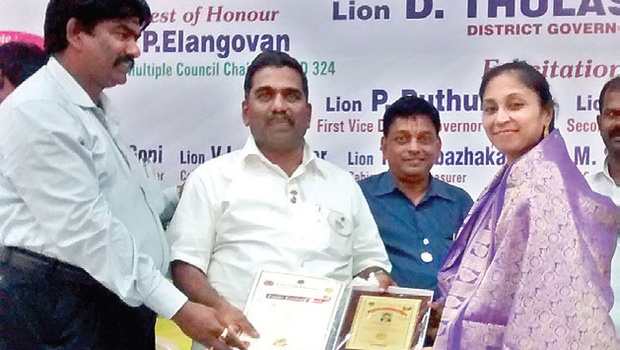
The initiative by Lions Club International, District 324 A6 to honour the true heroes of the classroom brought recognition for Sapna Sankhla, principal of Narayana E-Techno School Arumbakkam.

Her 18 years of exemplary contribution to the cause of education led to her selection for the Best Teacher Award 2014.

Sapna was invited to attend the award ceremony on September 21 and was felicitated with a certificate and a citation by the chief guest, district governor PMJF Lion D Thulasingam, and guest of honour district chairperson MJF Lion S Balasekaran.

The chief guest in his address emphasised the importance of teachers and said that the award was presented in appreciation and recognition of outstanding service to the student community with dedication and devotion as a teacher.

source: http://www.newindianexpress.com / The New Indian Express / Home> Education> Student / by Express News Service / September 25th, 2014

Self-styled Godman Takes Chilli Powder ‘Abishekam’

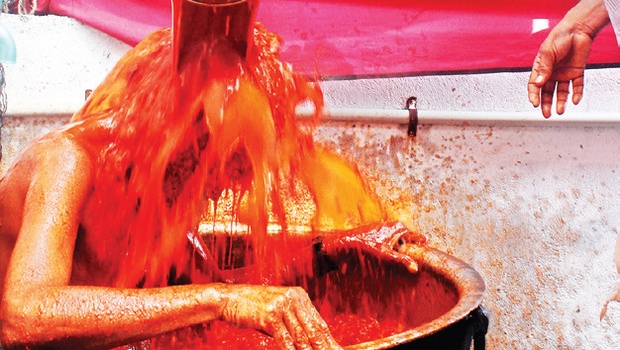
Chilli powder-mixed water being poured on Alukku Samiyar

Vellore :

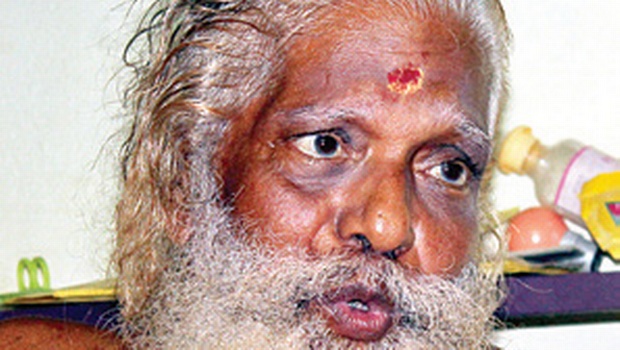
A 86 year-old self-styled godman took  bath in water mixed with over 30 kilos of chilli powder, in a bid to ward off the hardships and suffering of others. The news spread like wildfire and attracted a huge crowd to where the godman was performing his special ablution in a narrow street of Vavusi Nagar in Sathuvachari.

Around 100 people in and around Sathuvachari, Vellore and Gudiyattam poured the water mixed with chilli powder over the godman, who calls himself as “Alukku (Dirt) Samiyar.”

At 10.15 am, the godman sat inside a 25 litre cooking vessel, while his devotees poured the chilli-powder-water over him, one after another, for half-an-hour. “Around 10 persons purchased the chilli powder. We mixed it in water and we poured it over him using a small bucket . He did not show any sign of discomfort. We recorded the entire happening,” said Pandian, a realtor, who arranged  the special pooja.

“I observe the torment and miseries of the persons who pour the chilli-powder-water over me. With the holiness vested in me, I will relieve them from all their sufferings,” the godman claimed. He said, a couple of years ago, he performed a similar pooja in Kadapa in Andhra Pradesh.

“It (chilli powder water) will not harm me,” said the godman, who is a native of Kerala and was brought up in an ashram in Vadakara (Kerala).

During a special pooja in Sathuvachari on Tuesday | S Dinesh

Before coming to Vellore four months ago, he was in Red Hills and Tiruvallur. “We want to set up an ashram in Sathuvachari hills during his stay here. He does not ask for anything from persons seeking his blessing, but accepts whatever they offer,” said Pandian.

However, some residents stated that  few persons were trying to make money in the name of faith. The police warned the organisers of the pooja that action would be initiated if something happened to the godman.

source: http://www.newindianexpress.com / The New Indian Express / Home> States> Tamil Nadu / by Shanmuga Sundaram / September 24th, 2014

100 years on, remembering Emden’s generous captain


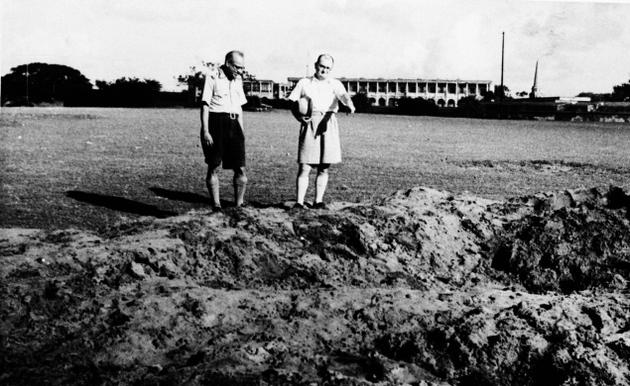
One of the bombed sites in Madras. Photo: The Hindu Archives

On September 22, 1914, the unsuspecting shores of Madras were bombed by German cruiser, Emden, during World War I.

A whole 100 years on, the terror the word Emden invokes has lived on, and the word has crept into local slang to denote a person who is fearsome.

Yet lost in the narrative of notoriety, is the surprising reputation of generosity and honour the otherwise despised adversary earned, thanks to Captain Karl Von Muller and his crew.

In a series of articles featured in The Hindu on the experiences of those captured by Emden, accounts suggest that the crew, before vanquishing enemy ships, gave time to seamen onboard to collect essentials before being transferred as prisoners into the accompanying German liners.

A survivor of the sunken ship Indus was quoted as saying: “As we went on board, each man was handed a towel and a soap. The German engineers and inmates vacated their cabins to make room for us.”

It wasn’t for nothing that Muller was titled the ‘gentleman of the seas.’ Not only did he reduce casualties to the bare minimum but is also said to have treated his defeated captives well.

Captain Karl Von Muller of the ‘Emden’, and his crew, were known for treating their captives with great respect. Photo: The Hindu Archives

B.B Furbester, chief engineer of Pontuporous which was sunk by Emden, recalls, “As I stepped on board, the German chief engineer came forward and shook hands, saying, ‘Mr. Chief, you will be treated like a gentlemen. We can never tell, but we may be prisoners next.’ All the crew raised their caps to me and the skipper came down… also assuring me I would be treated well.”

The hostages were ensured three full meals, including coffee, served diligently at 6 p.m., every day.

Breakfast, consisting of porridge, boiled rice, milk, hot roast beef, and cheese, was provided at 7.30 a.m., while potatoes and sausages were prepared for ‘tiffin’ at noon.

Supper was light with portions of bread and butter distributed at 3 p.m.

The fact that Muller and many of his crew members spoke English was a further source of comfort for the hostages.

A.G.G. writing for the Daily News and Leader found that Muller, in many ways, embodied the best of the spirit of war.

He wrote, “He has fought without hate and without bitterness, with chivalry and good temper and he has shown that it is possible to be a brave man and a gentleman.”

It was said that if ever he were to land in Liverpool, where many of his victims had landed, he would be hosted to a lavish celebratory dinner.

source: http://www.thehindu.com / The Hindu / Home> News> Cities> Chennai> Society / by Nitya Menon / Chennai – September 24th, 2014