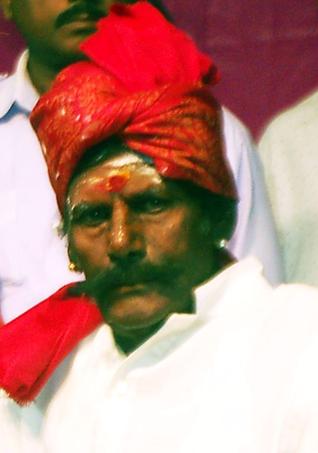
Jegaveera Pandiya Subramania Kattabomma Durai / by Special Arrangement / The Hindu
A 74-year-old descendant of Veerapandia Kattabomman is finding it hard to make ends meet.
He has appealed to the State government to increase the ‘tyagi’ pension as he was finding it difficult to run the family with a paltry amount of Rs. 2,000 a month. V. Veemaraja alias Jegaveera Pandiya Subramania Kattabomma Durai, who belongs to the fifth generation of the Kattabomman clan, is residing at Sathathiyar Kudiyiruppu at Panchalankurichi, the birth place of Kattabomman.
“I have been drawing pension since the age of 27. In 1872, the British government sanctioned a pension of Rs. 52 for Kattabomman’s descendants. For years, I was called ‘maharaja’ and ‘samy’ by residents of our area. Now, I seek government support to protect my family. Occasionally, programme organisers invite me to deliver talks on the deeds of Kattabomman. But the money I get from such programmes is not sufficient,” Mr. Durai told The Hindu .
A request for old age pension for his wife V. Petchiammal (58) was turned down citing Mr. Durai’s pension. Petchiammal used to earn a meagre sum for manual labour under the Mahatma Gandhi National Rural Employment Guarantee Scheme.
source: http://www.thehindu.com / The Hindu / Home> News> National> Tamil Nadu / by J. Praveen Paul Joseph / Tuticorin – July 10th, 2014
She may be best known for her Grammy-winning song from Slumdog Millionaire, but there are more sides to the Chennai-based singer, songwriter and designer
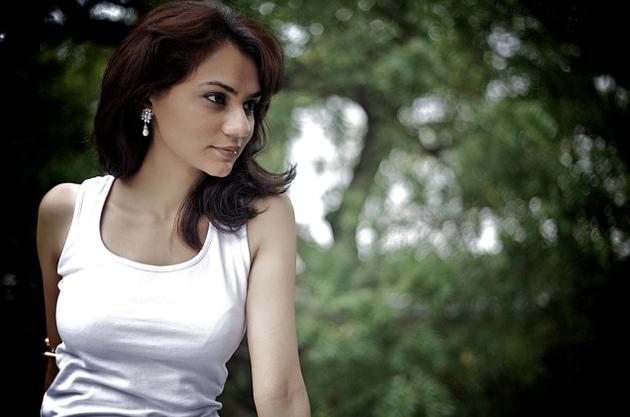
On early mornings, there’s only one place to find Tanvi Shah: out at sea. The calm descends within the moment she paddles out into the waters. With the sky above and little else around, Tanvi surfs the sea’s swells, thinking. From lyrics for her next song-writing project, to rehearsing rhythms and tunes, planning song videos, even deciding band placement spots and her performance moves, this is Tanvi’s “me, myself and I” time. The energy in the vast expanses fuels her inventive spirit and this Grammy-awarded singer, songwriter and designer is bubbling over with creative energy.
This past Monday though, she’s as jittery as a spring wound tight. She hasn’t hit the water for three weeks, her band is scattered across town and she has a rehearsal to run for in an hour, for her big gig at Hard Rock on Thursday last. Start talking about her music though and Tanvi unwinds, relaxing in the obvious pleasure it gives her. “It’s a Latin night!” she says, “I’m going to be singing in Spanish, Portuguese, Brazilian, French and I may even sneak in a Hebrew song if I can manage it.” Tanvi shot to fame in 2010 when her Spanish lyrics for ‘Jai-Ho’ won her the Grammy with A.R. Rahman and Gulzar, but her love for languages roots itself way back, in her college days, studying ceramics in the U.S.
Born into a family proficient in design, Tanvi never envisioned herself a singer — “always some environment-friendly activist kind” — but her mother says she recognised voices in music even as a child. She grew up on Asha Bhosle and Kishore Kumar, and discovered Osibisa at 11, but her musical world was thrown open in an American college dormitory. With an Egyptian roommate who jived to Daniela Mercury on one side and Spanish friends who danced merengue, samba, salsa and tango on the other, Tanvi delved into a truly international culture at the Havana village parties she frequented in Washington DC. She encountered the Latin American greats — Sergio Mendez, Juanas, Pablo Alboran, Celia Cruz, Gloria Estefan — and though it took a while to understand their complex rhythm patterns, she wasn’t one to cower at a challenge.
Back in India, a chance recording of her singing a karaoke cover, reached Rahman, and in 2004, he gave her her first break with ‘Fanaa’ in the film Yuva. From Delhi 6, to Slumdog Millionaire, Jaane Tu Ya Jaane Na, Enthiran, Biriyani and much more, Tanvi has worked the Hindi, Telugu and Tamil playback singing circuit for a decade now, most frequently with Rahman and Yuvan Shankar Raja. “Every time I’m at a Rahman recording, he throws me a challenge — let’s sing in Spanish today, let’s try a different style today — and I come away having learnt so much about music and language. I’ve been enormously blessed to work with directors who let me improvise, explore my own talent and draw out what they believe is my potential.”
Outside films, Tanvi has collaborated with international artistes across genres, from Snoop Dogg, on the track ‘Snoop Dogg Millionaire’, to Spaniard Gustavo Alarco on her song ‘Lluvia Lejana’ and producer JHawk on her singles ‘Llamalo Amor’ and ‘Meant To Be’. Three more singles, “on love, life and just taking off on a holiday’ are set for release later this year and Tanvi currently won’t divulge news on more collaborations in the pipeline. With all this genre-hopping, is there a ‘Tanvi Shah sound’ that has evolved over time? “I don’t want there to be!” she says. I have the whole gamut of music genres available to me right now; restricting myself to one would be like eating just the cherry on the cake. I want the whole cake, the cream and the cherry!”
At home in parallel worlds: Tanvi Shah / by Special Arrangement / The Hindu
This positive addiction to productivity is what also pushes Tanvi to lead a parallel career as designer for her label Tansha. Her little office on Chamiers Road is bursting with scrapbooks, lampshades she’s fashioned from discarded liquor bottles, phone covers sprinkled with her doodles, an up-cycled design table mounted on a bicycle and even a cherry blossom tree made of duct-tape climbing across her wall, all of it drilled, chain-sawed and hammered into place by hand. Shoulder pains, bruises and fractures aren’t really deterrents, says Tanvi. “I probably have too much energy bursting inside me. But it’s when my head finally hits the pillow at night and I know I’ve achieved something today, that I’m most satisfied.”
It’s Thursday evening and the heavens have opened slushy chaos over Chennai. In a quiet corner of Hard Rock Cafe, Phoenix Mall, though, Tanvi Shah is a picture of peace. The tables around her are slowly filling up and midway through pre-concert photographs she casts quick glances at the lengthening line outside the entrance. Her band sets up on stage; Hard Rock breaks into its trademark YMCA dance, and the evening is set to begin.
A clash of cymbals, drum rolls like thunder and Tanvi opens into the sharp, seductive notes of ‘Ojos Asi’, Shakira’s Arabic-Spanish number that translates to “Eyes like Yours”. Dressed in a flowing, floral bustier dress, Tanvi belly dances to the beats, hair bouncing, bangles jangling and everyone else’s feet tapping. It’s a mainstream welcome into her world of Latin American music. Her hope though, is to open her listeners to artistes less celebrated than Shakira and Enrique Iglesias. “Within Latin American music alone, there’s Merengue, Flamenco, Pambiche and much else, and under Merengue itself there are seven sub-sections. There’s a whole wide world out there,” she says.
It’s a Portuguese song from Salvador Bahia up next, and Tanvi’s voice soars, all warmed up now and building from soft whispers into full-throated belting. She comes into her own in the Afro-Brazilian maracatu-dance inspired number about liberation. It’s all spunk and power in a call-and-answer sequence with her backing vocalists Roshni Sharon and Priya Krishnan, enough to get the crowd on their feet and dancing. For an audience that understands little Portuguese or Spanish, her music reaches out beyond language, and that’s how she wants it, “Music is universal, and as musicians we have the privilege to step into different cultures. Ninety per cent of the songs in the world say the same things, more or less, but it’s the difference in expression that really speaks to us.” Despite experimenting so broadly, Tanvi says she’s a stickler for perfection. Diction is her pet peeve and she goes into spiels about how the ‘s’ in Spanish is pronounced with a lisp in northern Spain and without one in Mexico, the difference in dialects and how all of this pans out while singing.
By now, the room has transformed into something out of Tanvi’s college days and she takes the crowd with her to the Caribbean islands this time. Playing off the beautiful tones from Shyam Benjamin’s keyboard, she rouses the crowd into singing the chorus of a song that tells of an old woman who can solve any problem with three drops of her magic potion. For her musicians too, Tanvi’s choice of genre is something of a welcoming relief. In a culture popularising rock and fusion, jazz and blues, it’s been a while since any of them have done a Latin American music-only night. With Jeoraj Stanly on drums, Allwyn Paul on a whole host of percussion, Napier Peter Naveen Kumar on the bass and Donan Murray on guitars, the band is in full form all night. By the time the skies outside have let up, Tanvi is well into the closing crowd-pleasers Beyonce’s ‘Single Ladies’ and Shakira’s ‘It’s Time For Africa’. When she finally steps off the stage, she’s tired but smiles and says, “Now, I’m happy!”
source: http://www.thehindu.com / The Hindu / Home> Features> MetroPlus / by Esther Elias / Chennai – July 11th, 2014
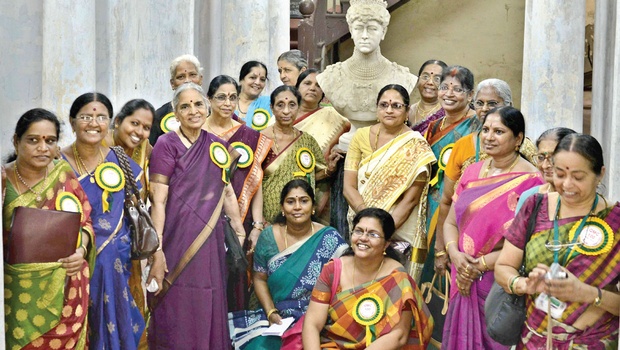
A visit to the alma mater is always special. And at the Queen Mary’s College, the Old Students Association (OSA) had more reasons to cheer as they gathered on Wednesday to discuss the various activities planned for the institution’s centenary year celebrations starting from July 14. Alumnae of the college, founded on July 14, 1914, were present as they fondly recalled their college days.
“I might have studied and worked across the world, but Queen Mary’s is always special to me. The one thing that immediately strikes me when I think of this place is the library and the tennis court where I spent most of time. It is sad that the buildings are now old and collapsing,” said Sarasa Bharathi, 80, who works as an academic advisor in a well-known private institution.
Leela Thiraviyum, 91, one of the oldest students in the group recalled her fellow students’ participation in the Quit India Movement.
“I was the president of the students’ union then. Two students from Intermediate and a research student were jailed at the time of the Quit India Movement. We also witnessed the World War II,” said the student of 1942-43 batch. “You know those days; we were not interested in fashion and style. In fact, we used to make fun of girls wearing lipstick. Admissions were strictly on merit. Today, it has changed so much that girls are so conscious about their looks,” she added with a smile.
Every student had a unique story to tell when it came to their alma mater. Mahalakshmi of the 1989 batch recalled her association with the college from the days of her great grandmother, who handed over 16 acres of land for free to set up the college in 1914. “My great grandfather Arcot Ratna Sabha Mudaliyar ran a hotel here. After he passed away, my great grandma took over but she could not take care of the hotel. She rented it out for 5 annas. Then, following request from the then governor, 16 acres of the land were handed over for free. I completed both my UG and PG courses here,” she said as she sat with other old students in a classroom singing songs.
With celebrations to kick start this month, various activities have been planned, including erecting a pillar with a contribution of `7 lakh from old students and release of a postal stamp.
The OSA had been meeting every Wednesday for the past one year to plan the activities for the centenary year. “The Education Minister will inaugurate the celebrations. We have sent a proposal to the government to construct 60 classrooms as a part of the centenary celebrations. The celebrations will culminate in December,” said R Akthar Begum, principal, Queen Mary’s College.
source: http://www.newindianexpress.com / The New Indian Express / Home> Cities> Chennai / by Express News Service / July 10th,2014
Little did Kamatchi, a resident of Vilankudi village here, know that the tin box his family took out in a procession every year during temple festivals was a treasure trove until he decided to clean it.
Kamatchi during the cleaning process found two copper plates inside the box with inscriptions in some old script. He took the plates to the Ramalinga Vilasam palace to show it to the curator Sakthivel, who deciphered the script and informed the Archaelogical Department. “The copper plates were gifted to the family of Vanni Muthuan, a resident of Vilankudi village and the temple priest, by Ramanathapuram king Regunatha Thevar alias Thirumalai Sethupathy in 1638 and 1645. Muthuan used to preside over the poojas at the Kamatchi Amman temple,” an archaeology department source said.
The plates came in an ornate box, which was passed on from generation to generation. Later, it assumed a divine value and they began taking it out in procession during temple fests.
Elaborating on the inscriptions on the plates, Sakthivel said, “The king in the inscriptions commands each farmer in 20 counties to donate one padi (one-and-a-half kg) paddy to the temple priest once a year.”
“Farmers donating paddy as per the royal command would incur benefits equalling that of establishing 1,000 lingams in a temple or sinking 1,000 water tanks. However, those shunning the command would incur sins equalling that of killing their own mothers or a Brahmin or cow,” the curator said, adding that the inscriptions were engraved on the plates by a carpenter of Yeluvarkottai village.
A source in the archeological department told Express that Kamatchi was allowed to retain the plates, as those were family heirlooms. “The plates are precious, but the family has been preserving it for centuries,” the source said.
www.newindianexpress.com / The New Indian Express / Home> States> Tamil Nadu / by Express News Service / July 10th, 2014
As the Fort City wakes up on Thursday morning to pay homage to the 350-plus soldiers who had sacrificed their lives to launch the ‘First War of Independence’ against the British imperialism in 1806 exactly on this day, the city would also remember the promise made by the State to establish a war memorial for the martyrs.
While the Tamil Nadu government had taken steps to release a commemorative postal stamp on the revolt, when it came to the recording of Indian history, the revolt had neither been recognised nor documented properly, they said.
According to Madras-based historian S Muthiah, most of the 1,500-strong Indian garrison at the Fort took part in the uprising. More than 100 of the 350 European soldiers on garrison duty were killed and by mid-morning the rebels had taken over the Fort.
A massacre ensued, with more than 350 of the rebels killed and as many injured before the British finally re-captured the Fort.
Social activist Chandrasekaran said, the Tipu and Hyder Mahals inside the fort and the tunnel in the Jalakanteswar temple must be renovated and thrown open to visitors. A sound and light show of the revolt could also be displayed for the visitors, to promote tourism.
source: http://www.newindianexpress.com / The New Indian Express / Home> States> Tamil Nadu / by V. Narayana Murthi / July 10th, 2014
Further east, at the famous Srirangam temple in Trichy, a separate `sannidhi’ has been dedicated to Thirupaanalvar, one of the 63 Tamil bhakti poets who lived in the Chola court.
Thirupaanalvar, also known as Paananar, was a poet and the fourth son of Vararuchi, the legendary patriarch of the Pan thirukulam.
Moving west, about 180km from Srirangam at Karaikal in Puducherry, a temple has been dedicated to Karaikal Ammaiyar. The deity dressed in traditional Kerala white sari is believed to be the only female child of the Vararuchi-Panchami couple. Such similarities are not surprising, say scholars. “Myths and legends are a part of every society across the world and there are often cross-overs. One of the major purposes of the myths was to forge a sense of belongingness among communities,” said professor A R Venkatachalapathy of the Madras Institute of Development Studies.
Such myths likely served to strengthen trade and political links. Karur, the confluence of Amaravathi originating in Kerala and Cauvery, was the capital of the first Chera empire. “If you draw a line connecting the `sathrams’ (resting place for traders) along the Bharathapuzha and Cauvery, we can see an unbroken ancient trade route connecting the two regions. Kolamukku, on the banks of Bharathapuzha, and Poompuhar, on the banks Cauvery, were two major urban trading centres in those days,” said Keshavan Veluthatt, a historian at Delhi University and an authority on south Indian history.
There are literary references to such connections as well. According to Pattinippalai, a Sangam text, it was through Amaravathi that Adimanthi, the daughter of Karikala Chozhan, reached Palakkad and became the wife of Mezhathur Agnihothri, the eldest child of Panthirukulam. “Further exploration of Panthirukulam in Tamil Nadu may throw up more interesting details,” said Rajan Chungath, who has written many books on the subject.
source: http://www.timesofindia.indiatimes.com / The Times of India / Home> City> Chennai / by Hussain Kodinhi, TNN / July 09th, 2014
On Tuesday afternoon A Saleem is getting ready to collect the body of a septuagenarian man he has never met before, from the GH mortuary. He is working on getting the vehicle ready to perform his last rites at a burial ground nearby.
The 29-year-old is no priest, under-taker or mortuary van driver. He just believes that every dead person has the right to rest in peace and While most people probably believe the same, Saleem goes the extra mile to get ensures that dead people get a decent funeral. Saleem, through his organisation Jeevan Shanthy Trust, performs last rites for many unclaimed and unidentified bodies in the city every year. They have buried 154 bodies in the last 10 months.
About five to 10 people from the trust, formed seven years ago but registered two years ago, are at GH every day to collect bodies that are released after postmortems. “We always carry incense stick, candles and camphor, so that we can perform rights according to Hindu, Muslim and Christian customs before burying them,” says Saleem.
The bodies are usually buried at the Aathupaalam burial ground on Podanur Road. Saleem and the other members from the trust pool in money. for a garland and a white cloth to wrap the body.
“It is difficult to identify the religion of an unclaimed body, so unless there is some identification, we go with our instincts,” says another trust member.
The trust started this service seven years ago, when Saleem and his friends realised that bodies of relatives often become a burden for people from the economically weaker sections.
“There were so many people who would have come
from Trichy, Tirupur, Pollachi, Erode and other places who could not afford to pay for final rites, A mortuary van would charge a daily wage labourer a rent of 10,000 which is not affordable, ” says Saleem. “Then at crematoriums and burial grounds too, people would demand money for every little thing,” he says. “It was painful to see poor people, who are also emotionally devastated, being fleeced,” he adds. “We also realised that a lot bodies rot in the mortuary for days with no one coming to claim them,” he said.
The trust now has 50 members which primarily s of Saleem’s college mates and friends. They do not raise funds from the public or any NGOs. “We pool in money for everything right from the vehicle, to the fuel for the vehicles, to cloth, garlands, candles and incense sticks,” says Saleem.
The trust has managed to buy two vehicles — a maruti van and an ambulance, to run their service.
The trust also transports a body from GH to their houses or villages km away, allowing the family to perform the last rites. “We initially pooled in money to buy a Maruti van to transport unidentified and unclaimed dead bodies to the burial ground,” says Saleem. “But we also use the vehicle to transport a poor man’s body to his village even if it is 500 km away, so his family can perform the last rites,” he adds. “Around six of us pool in 500 each, fill fuel for 3,000 and take the body,” he says.
They rescue destitute people from the streets and pavements and admit them to the hospital. “Many are abandoned by their families after they tested positive for HIV. So we admit them to the GH, get the necessary tests done, collect and administer their medication. We also provide them with clothesWe also give them a bath and a plate to collect their food,” says Saleem.
Their services are so well-known that 108 ambulance drivers and the police notify them in cases of unidentified bodies or destitute people they rescue.
“We help them by filing FIRs for unclaimed bodies so that it makes their job easier. We have also seen them adopt many abandoned and destitute people from the street and admit them to the hospital,” said a police constable posted at GH.
source: http://www.timesofindia.indiatimes.com / The Times of India / Home> City> Coimbatore / by Pratiksha Ramkumar, TNN / July 07th, 2014
Hindustan University conducted ATYANTA-2014, the Annual ZONASA Convention at its campus in Chennai. ZONASA is the zonal convention of National Association of Students of Architecture (NASA), a student body for association of the undergraduate students of Architecture in India.
ZONASA was inaugurated by Elizabeth Verghese, chancellor, Hindustan University and S Ramachandra, vice chancellor, Hindustan University. A R Jaisim Krishna Rao, founder, Jaisim Fountain, Bangalore was the chief guest of the event. Chandan Chowdry, MD, Dassault Systems, W Anand , Chairman IIA Chennai Chapter were also present during the inauguration. The convention, which was a three-day event, saw the participation of 54 colleges with over 1200 delegates from various architecture schools across Tamil Nadu and Kerala. Each year a college is chosen to host the prestigious event in its campus and this year it was hosted by Hindustan University.
According to the organisers, It is a grooming platform where an atmosphere of creativity, innovation and fun is created alongside learning. The learning experience includes students’ participation in events, competitions and guest lectures by prominent architects who share their experiences.
An installation by Saajan Varanasi, (Design Mafia) , a tall structure using waste and recyclable materials which made a new record of 3.6 m, attracted the crowd.
School of Architecture and Planning, Anna University bagged the over all trophy, Dr KCG Verghese Memorial Trophy. Faculty of Architecture Sathyabama University Chennai and School of Architecture MES, Kerala were the first and second runner up respectively.
source: http://www.newindianexpress.com / The New Indian Express / Home> Cities> Chennai / by Express News Service / July 09th, 2014
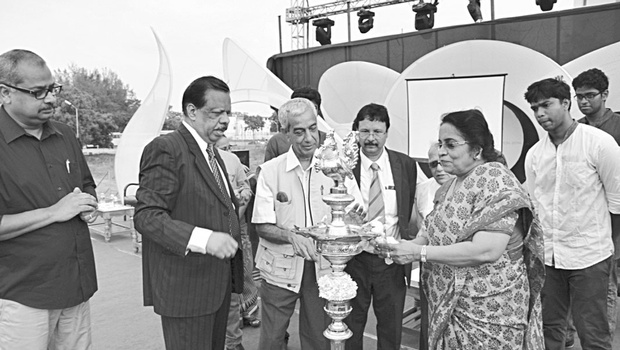
(From left) President of All India Pingalwara Charitable Society Dr Inderjit Kaur, Director of Tibet House, New Delhi, Geshe Dorji Damdul, Sankaracharya of Kanchi Kamakoti Peetam Sri Jayendra Saraswathi and Samani Shri Shruthnidhiji of Shri Jain Poushadshal, during the inauguration of the sixth Hindu Spiritual and Service Fair in Chennai. On the second row are columnist S Gurumurthy and danseuse Padma Subramaniam | Albin Mathew/Express Photo
Chennai :
The 6th Hindu Spiritual and Service Fair, showcasing the extensive philanthropic activities of diverse Hindu organisations, was inaugurated by the Sankaracharya of Kanchi Sri Jayendra Saraswathi here on Tuesday.
Describing the coming together of over 200 organisations at the week-long Fair as a Hindu renaissance and awakening, the Kanchi seer chanted Sri Kanakadhara Stotram composed by Adi Sankara and explained the importance of charity and service to the poor and downtrodden. “Manava seva is Madhava seva (service to man is service to God),” he pointed out. “Protect dharma and dharma in return will protect you,” he said.
Noted columnist S Gurumurthy said the Fair was a demonstration that Hindu spiritualism and lifestyle was based on the principles that conserved forest and wildlife, preserved ecology and environment, fostered women’s honour, promoted patriotism and inculcated family and human values.
Drawing a parallel to the situation in the West, where the elderly, infirm and disabled were the responsibility of the State, Gurumurthy, who is patron of the spiritual fair, said in India they were looked after by their families. Charity was never institutionalised because every individual and family was an institution. “However, we found that the whole country was qualitatively not seen as compassionate, that we were lacking in philanthropy,” he rued.
“Hence, we decided to organise the Fair to showcase the service activities of Hindu organisations.”
Quoting statistics showing the extensive contribution of the organisations in the education and health sector, Gurumurthy said the efforts were now directed towards integrating Hindu spirituality to contemporary challenges like pollution and ecological and environmental degradation.
Earlier, eminent danseuse Padma Subramaniam said the Fair, which began in a small way with 30 organisations putting up stalls, was seeing the participation of 260 organisations this year. Besides, thousands of school children were taking part in various competitions. Traditional games like Pallankuzhi were also being revived.
Religious leaders of different faiths also spoke at the gathering. The Fair, which is being held at Sri Ramachandra Medical University Grounds in Tiruvanmiyur, will be open to the public from 9.30 am to 8 pm till July 14.
source: http://www.newindianexpress.com / The New Indian Express / Home> Cities> Chennai / by Express News Service / July 09th, 2014
Four years ago Zareena Banu, primary teacher in Chennai Corporation’s Urdu Middle School in Old Washermanpet, found her class unruly and disinterested in studies. That was before she had a smartphone.
Technology has helped the teacher transform classes for her 74 Class 5 children. Banu, 34, was given charge of performing an experiment in mobile-aided learning, screening video clips of English grammar and science activities among the 10 and 11-year-olds. The success of the experiment has helped Banu win the Global Bridge IT India Award.
The experiment was conducted by education service providers EzVidya and Pearson Foundation, in association with Nokia. “It captured their attention.
Reticent children started speaking up. Even children with mental retardation answered questions and we were able to promote them to the next class,” Banu said.
Her biggest success, she said, is the transformation of Riyaz, a 10-year-old ‘bully’ and ‘trouble-maker’. “He would not sit still. He would beat the other children and not listen to me at all,” Banu said. His previous class-teachers had all give up on him. “But when I introduced the videos to the class he slowly started showing interest. Now he is not naughtyhas given up his naughtiness , answers questions brightly and interacts well with other children. It’s a big achievement for us,” said Banu. A baseline study at the beginning of the year showed that Riyaz could not spell properly. Now his grades have improved radically.
This is an unexpected area that technology has aided the teachers. The introduction of the continuous and comprehensive evaluation system left teachers in a dilemma over whether to spend time writing notes of lessons or preparing educational aids. Now, the video lessons delivered through phone projected on a television set has taken care of educational aids, leaving much more time for interaction and appropriate assessment. “They say technology will make teachers redundant. But, I find more time and ways to interact with the children now. I am much closer to them,” said Banu.
Chitra Ravi, founder of EzVidya, said that it sparks the interest and curiosity of children when they see something cool in the hands of their teacher. “It is very motivating for the children, and motivation is very important for learning,” said Ravi. She is quick to add, “But, it’s not just about doing something cool and innovative. It’s about meaningful use of technology.”
Technology has also added meaning to Banu’s life. It has empowerd her, she said. “I used to feel helpless when I used my old mobile phone. Now, I WhatsApp the EzVidya co-ordinators and get answers to my queries instantaneously. I don’t use the helpline. It’s too slow,” she said, with a laugh.
source: http://www.timesofindia.indiatimes.com / The Times of India / Home> City> Chennai / by M Ramya, TNN / July 08th, 2014